Fixing "Calendar Inflation": How to Turn High-Intent Local Search Traffic Into Committed Med Spa Bookings
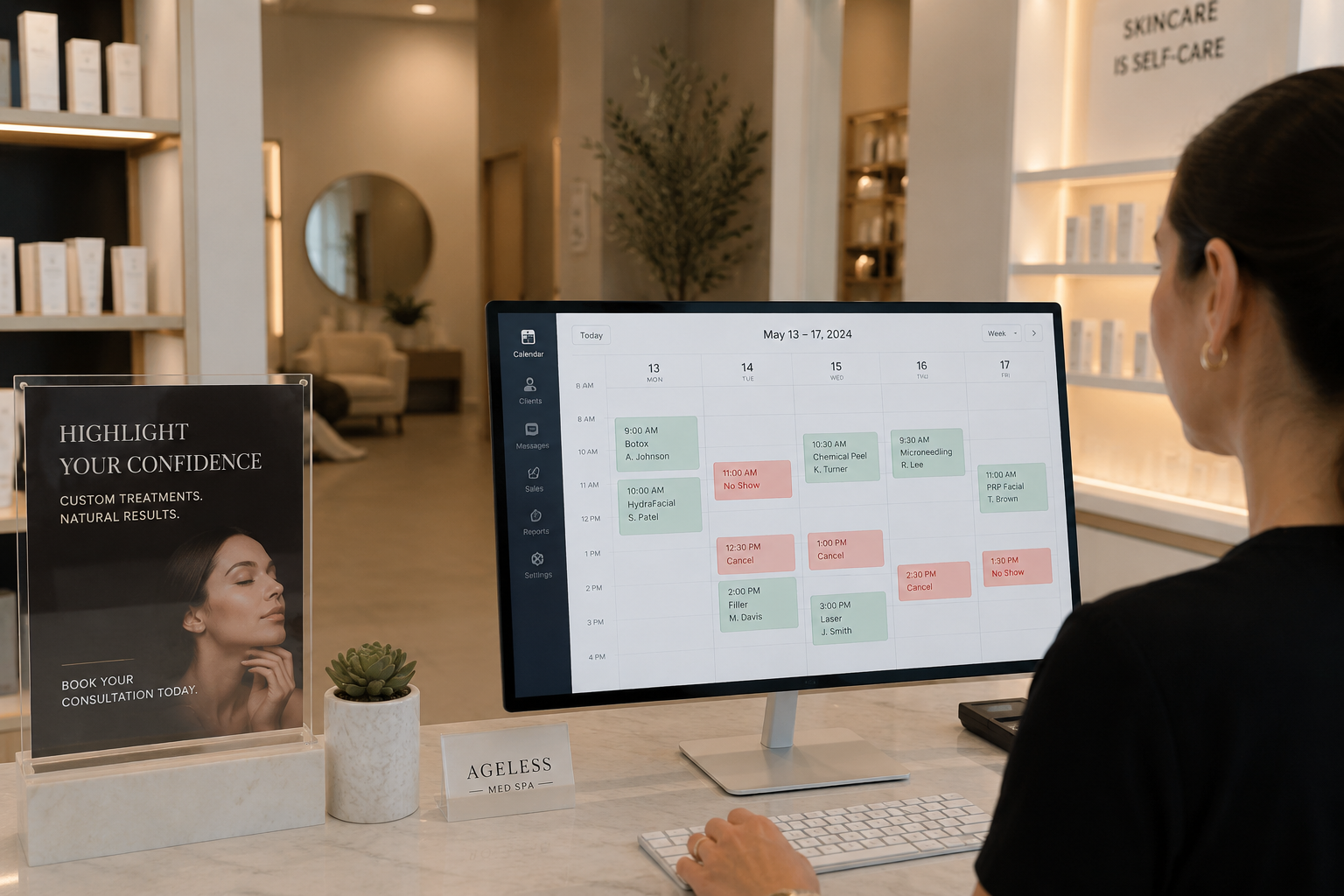
Walk into a med spa on a Tuesday and look at the appointment book. It's full. The schedule is packed, the staff is rostered, the rooms are prepped. By all appearances, business is thriving. Then the day actually unfolds: a no-show at 11, two last-minute cancellations after lunch, a rebooked client who simply never confirms. The "full" calendar quietly deflates into a half-empty day — and a half-empty day's revenue.
This is calendar inflation, and it's one of the most insidious problems in the aesthetics business precisely because it disguises itself as success. A booked appointment that doesn't show isn't just a gap; it's a gap you planned around. You turned away another client for it. You staffed for it. You forecasted revenue from it. The inflated calendar creates a false sense of security that makes the eventual shortfall hit twice as hard — once in lost revenue, once in the wasted capacity you could have filled.
The instinct is to treat this as a front-desk or reminder problem. But the deeper fix starts much earlier, at the very top of the funnel — in how you attract and qualify the booking in the first place. Because not all bookings are created equal, and the difference between a committed patient and a flaky one is often determined before they ever pick up the phone. Let's break down the real numbers, then build the system that fixes it.
The Data Behind the Inflation
Start with how leaky the med spa schedule actually is, because the benchmarks are sobering. Across the industry, roughly 22% of med spa appointment bookings end in cancellation — a higher rate than most other beauty and wellness business types. Layered on top of cancellations, no-show rates typically run 17–22%, especially for new clients, and missed appointments cost the average clinic somewhere in the range of $1,200–$2,000 every month. Some analyses peg the structural reality at roughly 16% cancellations and 5% no-shows for med spas specifically — a combined drag that, as one report put it, you simply cannot "market your way out of."
But the single most revealing statistic — the one that exposes calendar inflation directly — comes from the 2026 Beauty and Wellness Benchmark Report: among med spa locations where guests were rebooked once, 37% of those appointments were cancelled. Read that carefully. More than a third of standard single rebookings evaporate. That's the inflation in raw form: the calendar shows the booking, the staff plans for it, and over one in three times it disappears.
Here's the flip side, though, and it's the key to the entire solution: guests rebooked two or more times cancel at just 4%. The gap between 37% and 4% is enormous, and it tells you exactly what calendar inflation really is — a commitmentproblem, not a scheduling problem. The flaky booking and the committed booking look identical on the calendar, but they behave completely differently. The entire game is learning to attract more of the second kind and filter out the first.
Why the Problem Starts at the Search Result
To fix commitment, you have to look at where the booking originates — and increasingly, that's a high-intent local search. When someone searches "Botox near me" or "body contouring [your city]," they're at peak intent, often ready to book within days. The Google Map Pack — those top three local listings — is the single most valuable piece of real estate in the aesthetic industry, because most patients prioritize proximity and immediate social proof, and a top-three position captures them at the exact moment they're ready to act.
But here's the strategic insight most clinics miss: the quality of the lead is shaped by what they search for and what they find. A patient searching a generic "near me" term and booking on impulse behaves very differently from one who searches a specific, high-margin treatment, reads detailed information, sees the investment involved, and books with full understanding of what they're committing to. The former is a prime candidate for calendar inflation. The latter is far more likely to show up.
This is why the fix isn't just "get more bookings" — it's "attract better-qualified bookings for the treatments that matter most." And that starts with how your Google Business Profile is optimized.
Optimizing Your GBP for High-Margin Treatments
Most med spas treat their Google Business Profile as a digital business card. The clinics that beat calendar inflation treat it as a conversion engine deliberately tuned toward their highest-value, highest-commitment services. The financial logic is compelling: an optimized GBP can drive 20–30 additional consultation bookings monthly, and with treatment packages frequently ranging from $500 to $3,000+, the ROI on that optimization can exceed 500% in the first year. Here's how to point that power at the right treatments.
Build out a treatment-specific service menu. Rather than a generic listing, use the Service Editor to clearly list each treatment — and give particular prominence to your high-margin offerings like body contouring, long-term packages, and device-based treatments. Patients searching for these specific, considered procedures are inherently more qualified than impulse browsers, because the search itself signals research intent. A patient hunting for "body sculpting near me" is in a weeks-long research mode, exactly the deliberate mindset that produces committed bookings.
Choose the right categories and attributes. Set "Medical Spa" as your primary category, then add relevant secondary categories for specific high-value services. Use the Attributes section strategically — details like "women-led" can be the deciding factor for the right patient, helping you attract clients who self-select as a strong fit.
Lead with visual proof. Med spa patients rely heavily on visual evidence — before-and-after photos, real facility images, and the team behind the work. Roughly 78% of med spa clients research treatments online before booking, and the overwhelming majority read multiple reviews first. Original, high-quality photos of your space and results (never stock images) and an actively managed review ecosystem build the trust that converts a researcher into a committed booker rather than a tentative one.
Connect a direct booking link — to the right page. This is a small detail with outsized impact: use the dedicated Appointment URL field to link directly to your scheduling platform, never to your generic homepage. Linking to the homepage forces the high-intent patient to hunt for the booking path, introducing exactly the friction that loses them. A direct link removes it.
The throughline: a GBP tuned for high-value treatments doesn't just generate more bookings, it generates better bookings — from patients who arrive informed, qualified, and more committed to showing up.
The Booking Flow That Filters Flakes
Capturing the high-intent searcher is only half the battle. The booking experience itself is where committed patients get either confirmed or lost — and where you can structurally filter out flaky leads. The friction data here is brutal: 79% of med spa clients abandon a booking if the process is difficult or slow, and up to 40% of new client leads drop off during a high-friction booking flow. A clunky form doesn't just lose flakes; it loses your best prospects too.
The solution is a low-friction, multi-step booking structure — and the multi-step design does double duty. As we've seen in conversion research, breaking a booking into staged steps dramatically improves completion by reducing perceived effort and leveraging the sunk-cost effect: a patient who completes step one feels invested and is far more likely to finish. But for med spas specifically, the multi-step flow also acts as a commitment filter. Here's how to build it:
Make step one effortless — a single, easy choice (treatment type or preferred time) that gets the patient committed to the process before asking for anything demanding.
Sequence the ask — save contact details and specifics for later steps, once they're invested, rather than confronting them with a wall of fields upfront.
Build commitment into the flow — for high-value treatments, structuring the booking around a consultation step, a clear cancellation policy stated at booking, or a deposit requirement filters out the genuinely flaky while the committed patient proceeds without hesitation. Stating the policy clearly at the point of booking sets expectations and prevents the "I didn't think it was a big deal" no-show.
Be available when patients actually book — 81% of clients want to manage bookings outside regular hours, and peak booking windows fall in the evenings, so the flow must be mobile-first and available 24/7. A patient researching at 9 PM who hits a "call during business hours" wall is a lost committed booking.
The elegance of this approach is that the same multi-step design that raises completion for genuine prospects also screens out the lowest-commitment leads — the ones most likely to inflate your calendar and then vanish. You're not just converting more; you're converting better.
The Bottom Line
Calendar inflation is dangerous because it hides in plain sight. A full schedule looks like a healthy business right up until 37% of those single rebookings cancel and the day collapses into wasted capacity. The benchmark proves the real nature of the problem: flaky bookings cancel at 37%, committed ones at 4% — this was never a scheduling issue, it's a commitment issue, and commitment is shaped long before the appointment date.
The fix is a connected system: optimize your Google Business Profile to attract high-intent searchers for your high-margin treatments, where the search itself signals serious intent; build visual trust and direct booking paths that convert researchers into committed patients; and pair it all with a low-friction, multi-step booking flow that lifts completion for real prospects while filtering out the flakes. Do that, and the number on your calendar stops being a hopeful guess and starts being a reliable forecast. The traffic is high-intent and already searching. The opportunity is turning that intent into patients who actually show up.
Turn High-Intent Searches Into Bookings That Stick
A full calendar means nothing if a third of it cancels. The clinics that win in 2026 aren't just generating more bookings — they're generating committed ones, by connecting high-intent local search to a conversion experience engineered to filter out flakes.
Ritner Digital builds exactly that connected system. Our localized Conversion Rate Optimization (CRO) frameworks and custom landing page strategies tune your Google Business Profile and booking flow toward your highest-margin treatments — pairing high-intent local visibility with low-friction, multi-step booking structures designed to convert serious patients and screen out the no-shows inflating your calendar.
Stop forecasting revenue from appointments that vanish. Book your med spa conversion strategy session today →
Sources: Zenoti 2026 Beauty and Wellness Benchmark Report (Medspa edition); Mangomint Med Spa Booking Statistics; Workee Med Spa Booking Statistics; Zenoti Salon & Spa Booking Trends 2026; Flutch/Agentech 2026 Med Spa Trends; Prospelle Med Spa GBP Data; Digital MedSpa GBP Optimization 2026; Townsquare Interactive; and Prospyr Med GBP Guide.
Frequently Asked Questions
What is "calendar inflation" in a med spa?
Calendar inflation is when your appointment book looks full but quietly deflates through no-shows, last-minute cancellations, and rebooked clients who never confirm. It's dangerous because it disguises itself as success — you turn away other clients, staff up, and forecast revenue around bookings that don't materialize. The shortfall then hits twice: once in lost revenue, once in the wasted capacity you could have filled. The fix starts earlier than the front desk, in how you attract and qualify bookings.
How high are med spa cancellation and no-show rates?
Higher than most beauty and wellness businesses. Roughly 22% of med spa bookings end in cancellation, with no-show rates typically running 17–22% (especially for new clients). Missed appointments cost the average clinic about $1,200–$2,000 per month. The most revealing figure: among guests rebooked once, 37% of those appointments cancel — but guests rebooked two or more times cancel at just 4%. That gap shows calendar inflation is really a commitment problem, not a scheduling one.
Why do flaky bookings and committed bookings matter so much?
Because they look identical on the calendar but behave completely differently — 37% cancellation for single rebookings versus 4% for repeat rebookings. A patient who books on impulse from a generic search behaves very differently from one who researches a specific high-margin treatment, understands the investment, and books deliberately. The entire strategy is attracting more committed bookings and filtering out the flaky ones, which is shaped long before the appointment date.
How should I optimize my Google Business Profile for high-value treatments?
Treat it as a conversion engine, not a business card. Build out a treatment-specific service menu that gives prominence to high-margin offerings like body contouring and packages, set "Medical Spa" as your primary category with relevant secondaries, use attributes strategically, lead with original before-and-after photos and active reviews, and connect a direct booking link to your scheduling page — never your homepage. An optimized GBP can drive 20–30 additional consultations monthly, with ROI often exceeding 500% in year one.
Why shouldn't my GBP booking link point to my homepage?
Because it adds friction at the worst possible moment. A high-intent patient ready to book shouldn't have to hunt through your homepage to find the scheduling path. Use Google's dedicated Appointment URL field to link directly to your booking platform. This single change removes a key obstacle and can meaningfully increase the rate at which profile viewers become booked appointments.
How does a multi-step booking flow reduce no-shows?
It does double duty. Multi-step booking improves completion for genuine prospects by reducing perceived effort and leveraging the sunk-cost effect — a patient who finishes step one feels invested. For med spas specifically, it also acts as a commitment filter: structuring high-value bookings around a consultation step, a clearly stated cancellation policy, or a deposit screens out the genuinely flaky while committed patients proceed without hesitation. It lifts good bookings and screens out the low-commitment ones simultaneously.
Does booking friction really cost that many clients?
Yes — significantly. Research shows 79% of med spa clients abandon a booking if the process is difficult or slow, and up to 40% of new client leads drop off during a high-friction flow. Compounding this, 81% of clients want to book outside regular hours and peak booking windows fall in the evenings, so a flow that isn't mobile-first and available 24/7 loses committed patients who are ready to book at 9 PM.