The Patient Research Lifecycle: How AI Overviews and Perplexity Shape Treatment Choice Before the "Near Me" Search
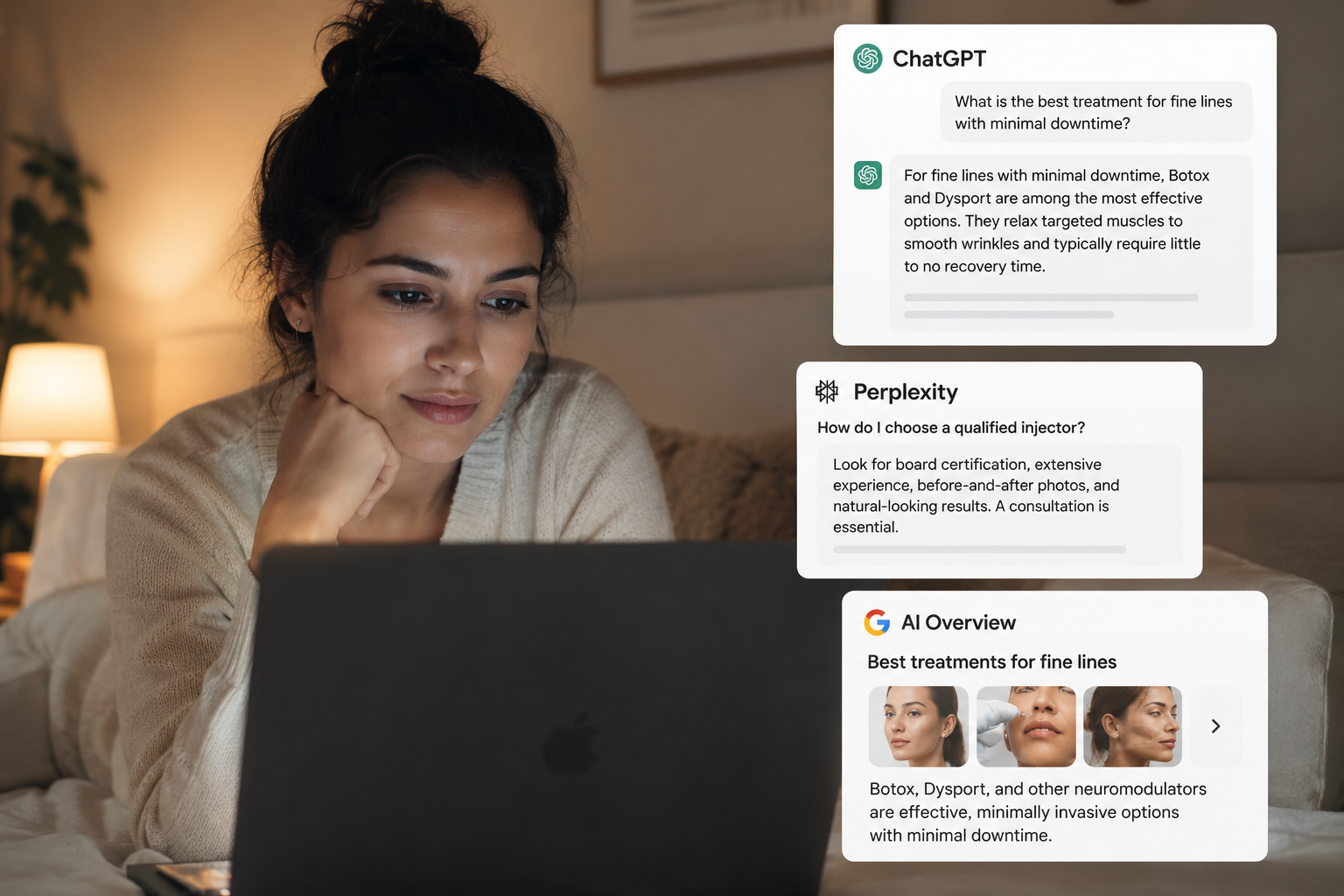
For years, med spa marketing operated on a comforting assumption: the patient journey begins when someone types "Botox near me" into Google Maps. Capture that local search, rank in the map pack, and you'd win your share of patients. It was clean, measurable, and — as of 2026 — dangerously outdated.
Because by the time a patient searches "near me," the most important decisions have already been made. Weeks earlier, often late at night, she opened ChatGPT or Perplexity and started asking questions. What's the downtime for a CO2 laser? Is barrier-first skincare better than retinol? What's the difference between exosomes and PRP? Which is more effective for skin tightening — Morpheus8 or Ultherapy? By the time she finally opens Google Maps, she's not discovering options. She's confirming a shortlist that was assembled, quietly, inside an AI engine that may have never mentioned your clinic.
This is the patient research lifecycle as it actually works now, and it has a brutal implication: if your med spa isn't programmatically linked as a trusted entity to those specific treatment answers, you lose the patient long before she ever sees your reviews or your map pin. Let's map the real journey — and where, exactly, you're being eliminated.
The Journey Starts Weeks Before the "Near Me" Search
The first thing to understand is just how much of healthcare decision-making has migrated into AI tools, and how early it happens. The data is striking. More than 40 million people in the U.S. now use ChatGPT daily for healthcare-related questions, with roughly one in four users submitting a health-related question each week — and notably, seven in ten of those healthcare conversations happen after hours, when clinics are closed and the patient is alone with her curiosity. Healthcare is one of the single largest categories of AI search precisely because patients turn to these tools for immediate information about treatments and provider recommendations before contacting a professional.
Aesthetic treatments sit at the exact intersection of health and personal care, which makes them especially AI-mediated. Industry analysis finds that health and symptom queries trigger an AI response around 92% of the time — the highest rate of any query category — and that AI Overviews now appear on the overwhelming majority of healthcare-related Google searches. So when a prospective patient asks "how many units of Botox do I need," "is lip filler safe," or "what should I look for in an injector," she almost always gets a synthesized AI answer rather than a traditional page of blue links.
This is the part that should reframe your entire strategy: the patient isn't thinking about platforms. As one analysis put it, she thinks of herself as asking a question and getting an answer — the platform is invisible to her, and the answer is everything. She reads the AI's first three sentences about a treatment, a device, or a provider, and those sentences increasingly aren't written by a beauty editor or a marketer. They're generated in real time by ChatGPT, Claude, Perplexity, and Google's AI Overviews. Whoever those engines cite becomes her reality. Everyone else is invisible.
The Modern Patient Asks About Treatments, Not Clinics
Here's the strategic subtlety most med spas miss. The patient doesn't begin by asking "who's the best med spa near me." She begins by educating herself on treatments — and the clinics that get woven into those treatment answers are the ones that earn a place in her consideration set before she's even consciously building one.
Consider the questions defining the modern aesthetic research journey: queries about downtime and recovery, about barrier-first skincare philosophies, about regenerative treatments like exosomes and PRP, about non-invasive tighteningoptions and how they compare. These are not "near me" searches. They're deep, conversational, weeks-long research threads — and each one is an opportunity for an AI engine to either associate your clinic with the answer or leave you out entirely.
The shift in luxury patient behavior here is now documented. The first published audit of AI citation share in medical aesthetics — the Medical Aesthetics AI Visibility Index 2026, released by Haute MD with the communications firm 5WPR — found that the luxury patient's research journey has moved from social platforms into generative search. As the report described it, she stopped scrolling and started asking, and the sources AI engines cite now shape her consideration set before she consciously evaluates it. Critically, that study found steep concentration: the top 15 brands captured roughly 62% of total AI citation share, leaving a dramatic visibility gap for everyone outside that tier. In AI search, there is no page two. You're cited, or you don't exist in the answer.
Why Traditional SEO Leaves You Invisible at This Moment
You might assume that a clinic ranking well on Google would naturally show up in these AI answers. Often, it doesn't — and understanding why is the whole point.
Generic websites built for traditional SEO are largely invisible to AI systems at the moment of the treatment decision, because answer engines don't simply pick the top-ranked page. They retrieve, extract, and synthesize from sources they can clearly understand as authoritative entities connected to the specific treatment being discussed. When a patient asks Perplexity "which med spa does Morpheus8 in my area" or asks ChatGPT to compare tightening treatments, the engine isn't scrolling Yelp or counting keywords — it's resolving entities and pulling from content structured for extraction. If your treatment information isn't programmatically linked, clearly structured, and machine-readable, you're simply not in the candidate pool.
There's also a freshness dynamic that catches practices off guard. Analysis of AI citations found that roughly half of all content cited by AI answers is less than 13 weeks old — meaning a blog post ranking #1 on Google can fall out of AI citations entirely within a quarter. SEO content tends to compound over time; AI citation visibility decays without maintenance. A "set it and forget it" content approach silently bleeds AI visibility even when your traditional rankings hold steady. And here's the measurement trap: standard analytics can't see inside ChatGPT, Perplexity, or AI Overviews, so most practices losing this battle have no idea it's even happening. The patient who chose a competitor from an AI answer never appears in your data as a loss. She appears as nothing.
How You Actually Get Cited: AEO and GEO
The disciplines built to win this moment are Answer Engine Optimization (AEO) and Generative Engine Optimization (GEO) — getting your clinic retrieved, trusted, and cited inside AI-generated answers. For med spas, this is a specific, technical undertaking, and the components are well established:
Structure treatment pages to answer real patient questions. Each major procedure needs content built to directly and cleanly answer the specific, conversational queries patients actually ask — downtime, candidacy, comparisons, safety. Answer engines extract clear, self-contained answers, so the content must lead with them. This is the difference between a vague "services" page and a page engineered to be the answer.
Implement medical and aesthetic schema. MedicalBusiness, MedicalSpa, MedicalProcedure, Physician, and FAQPage structured data explicitly tell AI engines what your treatments are, who provides them, and how everything connects — the entity layer that lets the AI link your clinic to a treatment query with confidence rather than overlooking you.
Build entity authority and consistency. Consistent NAP data, comprehensive schema, and credentialed provider information establish your clinic as a resolvable, trustworthy entity. The engines reward sources they can confidently identify and verify.
Earn third-party validation. AI systems weigh editorial mentions, reviews, and authoritative coverage heavily. Beauty and wellness media constantly need credentialed practitioner sources — and those earned mentions build exactly the authority AI engines look for when deciding whom to cite.
Maintain a refresh cycle. Because AI citations favor recency, the practices that stay visible run a regular cadence: test target queries across ChatGPT and Perplexity, identify where you've dropped out, refresh content with current protocols and updated dates, and resubmit. AI visibility is maintained, not banked.
Critically, none of this replaces SEO — it extends it. Google's own 2026 guidance confirms that optimizing for AI search is still fundamentally SEO, and a meaningful share of AI Overview citations still come from pages ranking in the top organic positions. Strong fundamentals feed AEO; AEO captures the moment those fundamentals alone would miss. The two work together, and the practices treating them as one integrated system are the ones being recommended.
The Bottom Line
The "near me" search isn't the start of the patient journey anymore — it's nearly the end of it. By the time a prospective patient opens Google Maps, she's spent weeks asking AI engines about downtime, skincare philosophy, and regenerative treatments, and those engines have already shaped her shortlist. If your med spa isn't programmatically linked as a trusted entity to those treatment answers, you've been eliminated from consideration before you ever had a chance to compete on price, reviews, or results.
The encouraging news is that this is still an open field. The visibility gap the AI Visibility Index revealed is also an opportunity: most of your competitors aren't even tracking their AI citation share yet, let alone building the entity and content infrastructure to earn it. The practices that do the AEO and GEO groundwork now — structuring treatments to be the answer, building verifiable entity authority, maintaining freshness — are the ones AI will keep recommending as this channel grows into the default layer of patient research. The patient is already asking. The only question is whether the answer includes you.
Find Out If AI Is Recommending You — or Your Competitor
Right now, prospective patients are asking ChatGPT and Perplexity about the exact treatments you offer, and AI engines are naming specific clinics in response. You have no way of knowing whether you're in those answers — unless you look.
Ritner Digital's Answer Engine Optimization (AEO) and Generative Engine Optimization (GEO) frameworks are built to secure your clinic's place inside the answers patients trust. We structure your treatment content to be the extracted answer, implement the medical and aesthetic schema that lets AI engines recognize you as a trusted entity, and build the citation authority that gets you named in ChatGPT, Perplexity, and Google AI Overviews — at the exact moment patients are deciding who to consider.
See where your clinic currently stands in AI search before your competitor locks up the citations. Book your AI visibility audit today →
Sources: GlowCite AI Search for Med Spas 2026; Haute MD / 5WPR Medical Aesthetics AI Visibility Index 2026 (via Haute Living); Becker's Hospital Review / OpenAI healthcare usage report; Marchex on AI and the patient journey; Direction.com AEO Guide 2026; Frase.io AEO Guide 2026; Mentera.ai AEO for Med Spas; ShowUpWithAI GEO for Med Spas; and KingFish Media Healthcare AEO 2026.
Frequently Asked Questions
When does the modern patient journey actually begin?
Weeks before the "near me" search. Prospective patients now start by asking AI tools like ChatGPT and Perplexity about treatments — downtime, safety, comparisons, regenerative options — often late at night when clinics are closed. By the time they open Google Maps, they're not discovering options; they're confirming a shortlist already assembled inside an AI engine. More than 40 million Americans use ChatGPT daily for healthcare questions, and seven in ten of those conversations happen after hours.
Why do aesthetic treatments trigger AI answers so often?
Because they sit at the intersection of health and personal care. Health and symptom queries trigger an AI response roughly 92% of the time — the highest rate of any category — and AI Overviews now appear on the large majority of healthcare searches. So questions like "how many units of Botox do I need" or "is lip filler safe" almost always return a synthesized AI answer naming specific providers, rather than a traditional page of links.
If my med spa ranks well on Google, won't I show up in AI answers too?
Not necessarily. Answer engines don't simply pick the top-ranked page — they retrieve and synthesize from sources they can clearly understand as authoritative entities linked to the specific treatment. Generic websites built for traditional SEO are often invisible to AI at the moment of the treatment decision. If your treatment content isn't structured for extraction, programmatically linked, and backed by proper schema, you're not even in the candidate pool, regardless of your Google ranking.
What's the difference between AEO and GEO?
They're closely related disciplines for earning AI citations. Answer Engine Optimization (AEO) focuses on structuring your content so AI systems can extract and cite it as the direct answer to a patient's question. Generative Engine Optimization (GEO) is the broader practice of getting your brand recognized, trusted, and cited across generative AI engines. In practice they overlap heavily — both aim to make your clinic the source AI names when patients ask about treatments. Neither replaces SEO; they extend it.
How concentrated is AI visibility in medical aesthetics?
Very. The first published audit — the Medical Aesthetics AI Visibility Index 2026 — found the top 15 brands captured roughly 62% of total AI citation share, leaving a steep visibility gap for everyone else. In AI search there's no page two: you're either cited in the answer or you don't exist in it. That concentration is a warning, but also an opportunity, since most clinics aren't yet competing for those citation slots.
How quickly can AEO produce results, and does it last?
AEO can show results relatively fast — often within weeks — because platforms like Perplexity and Google AI Overviews pull from live web content and re-crawl frequently. But visibility decays without maintenance: roughly half of all content cited by AI is less than 13 weeks old, so a page can fall out of citations within a quarter. Staying visible requires a refresh cycle — testing target queries, updating content and dates, and resubmitting — rather than a one-time effort.
Can I see whether AI tools are recommending my clinic?
Not through standard analytics — Google Analytics can't see inside ChatGPT, Perplexity, Claude, or AI Overviews, which is why most practices losing this battle don't know it's happening. Visibility has to be checked directly by running your target treatment queries through the AI platforms (or via a dedicated AI visibility audit) to see which clinics get cited, which competitors appear, and where you're missing.