Why Your Med Spa's Blog Is Invisible: How Google's YMYL Guidelines and Core Updates Are Killing Aesthetic Traffic
If you run a med spa or aesthetic clinic, you've probably experienced the quiet frustration of publishing blog content that simply… disappears. You hired a writer, posted a steady stream of articles about dermal fillers and laser resurfacing, ticked all the keyword boxes — and the traffic never came. Or worse, the traffic you did have evaporated after a Google update you barely noticed. You did everything the generic SEO advice told you to do, and your blog is functionally invisible.
Here's the hard truth that most aesthetic practices haven't internalized: Google does not treat your content like beauty content. It treats it like medical content. And that single classification changes everything about what it takes to rank. The rules that govern a recipe blog or a travel site do not apply to you. You're playing a fundamentally stricter game — and if your content was built for the easy game, it was invisible before it ever published. Let's unpack exactly why, and what actually moves the needle.
The Classification That Changes Everything: YMYL
Google has a category called YMYL — "Your Money or Your Life." It applies to content that could significantly impact a person's health, financial stability, or safety, and it triggers the strictest quality evaluation standards in all of search. Healthcare is the textbook example, because misinformation about symptoms, treatments, or medications could cause real harm.
And here's what aesthetic practices consistently underestimate: cosmetic procedures fall squarely inside YMYL. Google holds content about neuromodulators, dermal fillers, and laser resurfacing to the same E-E-A-T standards it applies to any healthcare topic. A page explaining how long Botox lasts or comparing CoolSculpting to liposuction isn't lifestyle content in Google's eyes — it's medical information that could influence someone's health decisions. The moment your content touches a treatment, you've entered the most heavily scrutinized territory on the internet.
This is why the generic content playbook fails so completely for med spas. The mass-produced, keyword-stuffed article that might rank for a low-stakes hobby topic is precisely the kind of content Google's systems are now built to identify and suppress on YMYL queries. You're not competing on content volume. You're competing on demonstrated medical credibility — and that's a completely different contest.
E-E-A-T: The Cost of Admission
The framework Google uses to evaluate this is E-E-A-T: Experience, Expertise, Authoritativeness, and Trustworthiness. For ordinary content, these signals matter somewhat. For YMYL content, they're decisive. One correlation study found that E-E-A-T signals account for roughly 8% of ranking weight across all queries — but for YMYL queries, that correlation roughly triples to around 24%. In other words, for your aesthetic content, the credibility signals Google evaluates are about three times as intense as they'd be for a non-medical site.
The newest and most important element is that first "E" — Experience — added in 2022. Google now wants evidence of first-hand involvement with the topic: a medical explanation from someone who has actually treated patients, not a generic article assembled by an anonymous content mill. As one SEO strategist put it, three years ago you could rank a well-optimized article without an author bio; try that now on a YMYL topic and you won't make page two.
The consequences of ignoring this are severe and well-documented. Health content sites have lost the majority of their traffic in a single core update specifically because they lacked author credentials, medical review processes, and source citations — while e-commerce sites selling low-risk products barely felt the same update. If your aesthetic blog has no named medical author, no verifiable credentials, and no editorial oversight, you aren't at a slight disadvantage. You're at a structural one.
The Core Updates Are Tightening the Screws
This isn't a static situation — it's getting stricter with every algorithm update, and aesthetic practices are directly in the blast radius. Google's December 2025 Core Update was the biggest algorithm shake-up of the year, and healthcare was in the crosshairs: roughly 67% of health-related websites experienced significant ranking changes. The March 2026 Core Update was, by some measures, the most volatile in Google's history, with reports of nearly 80% movement in top-three results.
Critically, the 2026 updates specifically changed how Google evaluates medical content. The systems now look much more closely at who wrote or reviewed the content and whether that person is genuinely qualified to speak on the specific topic. The updates also cracked down on clickbait headlines, began requiring direct answers earlier in the content, and put pages that merely aggregate or lightly repackage information from elsewhere under increasing pressure as Google works to surface primary, authoritative sources.
There's a holistic dimension that catches many practices off guard, too. Core updates frequently evaluate sites as a whole — meaning a pile of thin, low-quality blog posts elsewhere on your domain can drag down even your strong treatment pages. That mass-produced content you added "for SEO" may be actively harming the pages you care about. And recovery is slow: while some industries bounce back in three to six months, YMYL sites in health categories often take six to twelve months to recover, and only when the next core update rolls through. The cost of getting this wrong isn't a bad month; it's potentially a bad year.
What Actually Makes Aesthetic Content Rank
The good news is that the same strictness that buries generic competitors creates a durable moat for practices that build credibility properly. Here's what genuinely moves the needle for med spas and aesthetic clinics.
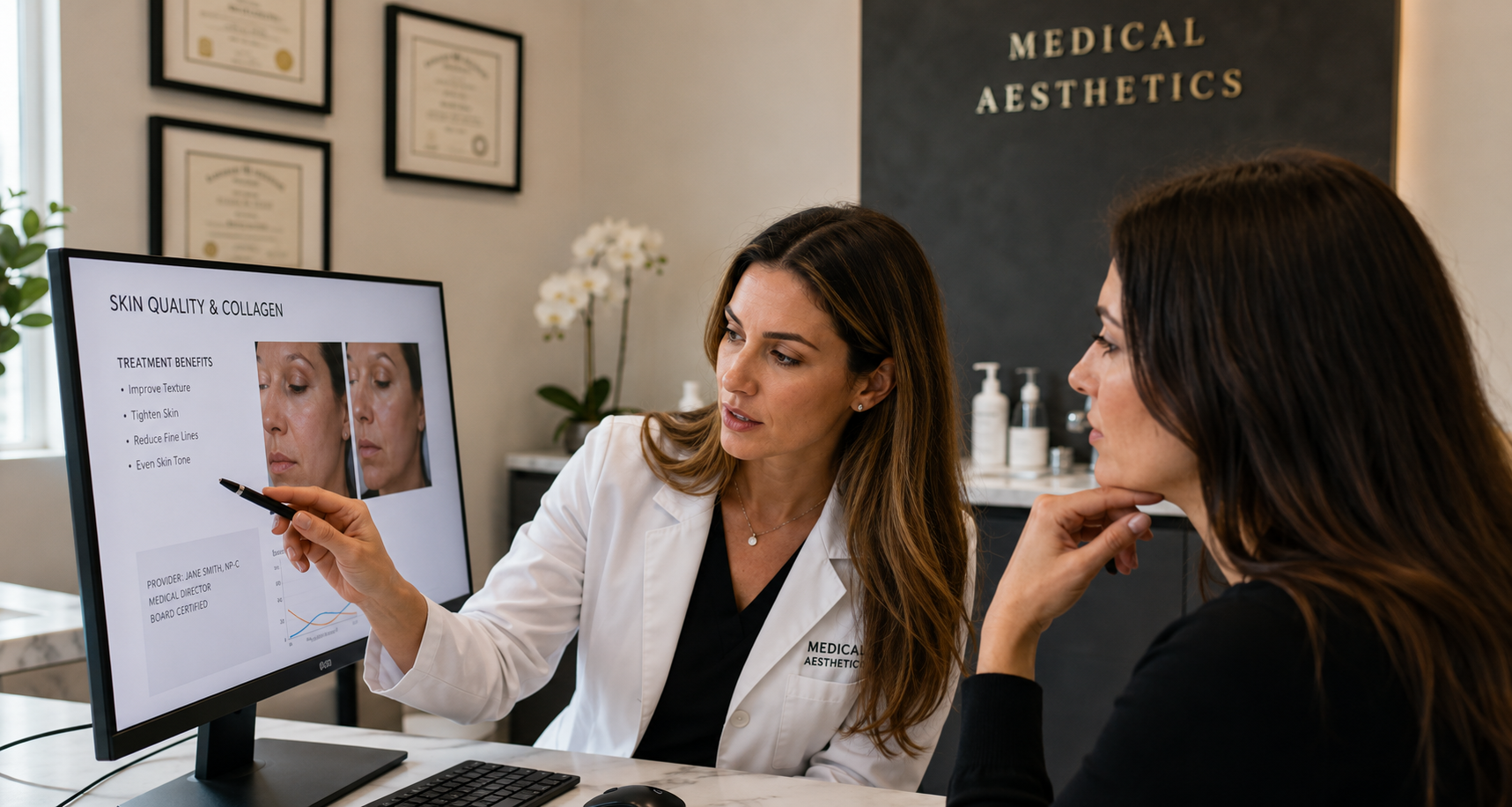
Credentialed, named authorship — prominently placed. Every piece of clinical content needs a named author or reviewer with a linked bio. "Staff writer" doesn't pass. Your medical director, lead nurse practitioner, or senior aestheticians should carry the bylines on educational content, because that attribution is how Google distinguishes authoritative medical content from marketing noise. The 2026 updates went further: medical content now needs an author-credentials block near the top of the page — including the reviewer's name, board certification, years of experience, and professional affiliations — not buried in the footer. Without it, your content can be effectively invisible, including in Google Discover.
Medical and aesthetic schema markup. This is where technical precision separates the serious practices from the rest. Specific structured-data types — MedicalSpa, MedicalProcedure, Physician, Service, and FAQPage schema — explicitly tell search engines and AI models what your content is, who's behind it, and how your providers, procedures, and credentials relate to one another. This is the machine-readable layer that lets Google verify your clinical authority rather than guess at it, and it's increasingly what determines whether you surface in rich results and AI answers.
Genuine expertise and accuracy. Content should align with medical consensus, cite reputable sources, and be kept current. Google's quality raters compare medical content against established authorities, and outdated treatment recommendations get downranked as a signal of neglect. Practitioner-authored opinion pieces — why your medical director prefers one injectable over another, what patient safety looks like at your practice — are where most clinics leave authority on the table, and they're exactly the kind of first-hand experience the updates reward.
A clean technical foundation. HTTPS, fast load times (Google's 2026 Core Web Vitals targets are demanding), mobile-first design, and a logical site architecture aren't optional extras — for a YMYL site, they're trust signals in their own right and table stakes for ranking.
Notice the through-line: every one of these is something a cheap, generic content vendor cannot replicate, because it requires understanding medical compliance, structured data, and how Google evaluates clinical authority. This isn't a writing problem. It's a search-architecture problem.
Why This Matters More Than Ever
The stakes are rising in two directions at once. The aesthetic market itself is booming — the med spa market is projected to grow at roughly 15.8% annually toward $78 billion by 2033 — and SEO is the primary patient-acquisition channel for capturing that growth. At the same time, the paid alternative is brutal: competitive terms like "Botox near me" can run $75–$150+ per click, which means every high-intent patient you capture organically is one you didn't have to pay a fortune for.
And the YMYL bar now extends beyond Google entirely. Every major AI platform applies its own version of medical-content scrutiny: Perplexity cites an average of 21+ sources per medical answer, heavily favoring clinically authoritative content, and Google's AI Overviews use E-E-A-T signals to decide which sources get featured. Your content now has to pass YMYL standards not just for Google's blue links, but for an entire ecosystem of AI-powered answer engines that an increasing share of patients consult first. Building real clinical authority isn't just defense against core updates anymore — it's the price of being visible anywhere your patients are searching.
The Bottom Line
If your med spa's blog is invisible, it's almost certainly not because your information is wrong or your writing is weak. It's because Google classifies your content as medical YMYL content and holds it to a credibility standard that generic, mass-produced articles can never meet — and the core updates keep raising that bar. Without clear provider credentials, prominent medical authorship, proper medical schema, and a deeply structured technical foundation, your content was filtered out before it had a chance.
That reality is daunting if you've been relying on cheap content, but it's genuinely good news if you're willing to do it right. The same standards that make this hard are what make it defensible — a moat that filters out the low-cost competitors who can't navigate medical compliance search architecture. The practices that build true clinical authority into their search presence don't just recover their traffic. They become the authoritative answer in their market, in both Google and AI search, in a way no content mill can dislodge.
Build Search Authority That Core Updates Can't Touch
Generic SEO agencies treat your aesthetic content like any other blog — which is exactly why it's invisible. Ranking in a YMYL category requires a firm that understands medical compliance search architecture, not just keywords.
Ritner Digital specializes in the technical search infrastructure that med spas and aesthetic clinics actually need: prominent credentialed authorship and E-E-A-T signals, medical and aesthetic schema markup (MedicalSpa, MedicalProcedure, Physician), and the deeply structured data foundation that lets Google and AI engines verify your clinical authority rather than overlook it. We build the kind of search presence that survives core updates and surfaces you as the trusted answer — filtering you above the cheap competitors who can't.
Find out why your aesthetic content isn't ranking — and what it takes to fix it. Book your YMYL search architecture audit today →
Sources: SEO-Kreativ E-E-A-T Guide 2026; Halcy.ai How Google Ranks Medical Content; DoctorRank 2026 Core Update & Medical Websites; RankVed YMYL Healthcare SEO; Somo Agency Core Update Guide; OrangeMonke March & May 2026 Core Update Analyses; Reporter Outreach Med Spa SEO 2026; AuthoritySpecialist Aesthetic Clinic SEO Checklist; AesthetixMedia Medical Aesthetic Schema; and Lily Ray commentary (January 2026).
Frequently Asked Questions
What is YMYL and does it apply to med spa content?
YMYL stands for "Your Money or Your Life" — Google's classification for content that could significantly impact a person's health, finances, or safety. It triggers the strictest quality evaluation in all of search. And yes, it applies directly to med spas: Google holds content about neuromodulators, dermal fillers, laser resurfacing, and other aesthetic procedures to the same E-E-A-T standards as any healthcare topic. The moment your content discusses a treatment, you're in the most heavily scrutinized territory on the internet.
Why is my med spa blog getting no traffic despite good content?
Almost always because it lacks the medical credibility signals Google requires for YMYL content — not because the information is wrong. Generic, mass-produced articles without named medical authors, verifiable credentials, editorial review, and proper schema are exactly what Google's systems are built to suppress on health topics. For YMYL queries, E-E-A-T signals carry roughly three times the ranking weight they do for ordinary content, so the absence of those signals is a structural disadvantage, not a minor one.
How have recent Google core updates affected aesthetic websites?
Significantly. Google's December 2025 Core Update saw roughly 67% of health-related websites experience meaningful ranking changes, and the March 2026 update was among the most volatile in Google's history. The 2026 updates specifically changed how Google evaluates medical content — looking much more closely at who wrote or reviewed it and whether they're genuinely qualified. Recovery for health sites typically takes six to twelve months, far longer than other industries.
What is E-E-A-T and why does it matter so much for med spas?
E-E-A-T stands for Experience, Expertise, Authoritativeness, and Trustworthiness — Google's framework for evaluating content quality. It matters enormously for med spas because E-E-A-T signals carry about three times the weight on YMYL topics (roughly 24% correlation versus 8% for general queries). The newest element, Experience, rewards first-hand involvement — a treatment explanation from someone who actually treats patients — which is exactly what generic content vendors can't provide.
Who should be the author of my med spa's blog content?
A credentialed medical professional from your practice — your medical director, lead nurse practitioner, or senior aestheticians — not a "staff writer" or anonymous byline. Every piece of clinical content needs a named author or reviewer with a linked bio, and as of the 2026 updates, an author-credentials block should appear near the top of the page, including the reviewer's name, board certification, years of experience, and affiliations. That attribution is how Google distinguishes authoritative medical content from marketing noise.
What schema markup does an aesthetic clinic need?
Specific medical and aesthetic structured-data types: MedicalSpa, MedicalProcedure, Physician, Service, and FAQPage schema, among others. This structured data explicitly tells search engines and AI models what your content is, who's behind it, and how your providers, procedures, and credentials connect. It's the machine-readable layer that lets Google verify your clinical authority rather than guess at it — and it increasingly determines whether you appear in rich results and AI-generated answers.
Does YMYL affect my visibility in AI search tools too?
Yes — and this is increasingly important. Every major AI platform applies its own version of medical-content scrutiny. Perplexity cites an average of 21+ sources per medical answer and heavily favors clinically authoritative content, and Google's AI Overviews use E-E-A-T signals to decide which sources get featured. Your content now has to meet YMYL standards not just for Google's traditional results, but across the AI answer engines that many patients consult first.