The Trust Signal Matrix: Why Where You Place Proof Matters as Much as Having It
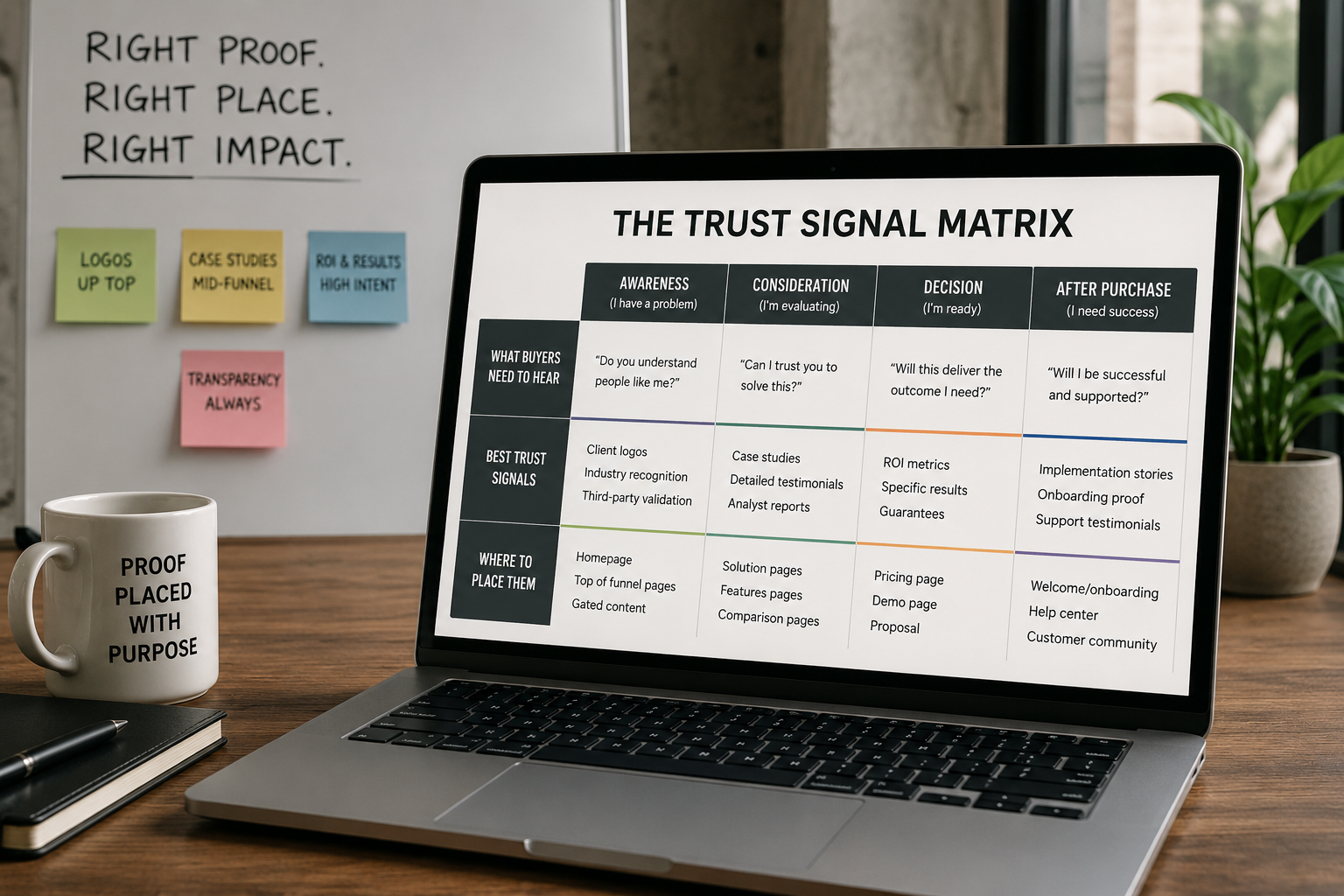
Most companies think about social proof as a checkbox. Get some client logos, collect a few testimonials, scatter them across the site, and call it credibility. The logo wall goes everywhere. The five-star quote gets pasted onto whatever page needs filling. The case study lives in a tab nobody clicks. The thinking is simple: proof is good, so more proof in more places must be better.
This is wrong, and it's quietly costing companies conversions. Because here's the uncomfortable truth the research keeps surfacing: the same trust signal can lift conversions on one page and depress them on another. A generic testimonial on a high-intent service page can actually erode trust rather than build it. A logo wall in the wrong context reads as filler. Proof placed without intention isn't neutral — it can be a liability.
The companies that win on trust don't have more social proof than their competitors. They have better-placed social proof — mapped deliberately to where the buyer is in their decision and what specific doubt they're feeling at that exact moment. This is the Trust Signal Matrix: a structural way of matching the right kind of proof to the right page and mindset. Let's build it.
Why Random Proof Backfires
Start with why scattering proof everywhere fails, because the mechanism is important. Every trust signal exists to answer a specific question in the buyer's mind. A security badge answers "is my data safe?" A client logo answers "do credible companies trust these people?" A detailed case study answers "will this actually work for someone like me?" Each signal is a key cut for a particular lock.
The mistake most teams make, as conversion researchers put it, is treating trust signals as decoration to add everywhere — when in reality the variable that matters is placement: which signal appears at which funnel stage, at the exact moment the corresponding doubt arises. Use the right key on the wrong lock and nothing opens. Worse, you can actively damage credibility: research is explicit that outdated, irrelevant, or generic social proof can erode trust, and that a stream of only vague, unspecific praise can be less effective than having no social proof at all.
There's also a stakes problem unique to B2B. When a VP commits to a new vendor, they're betting their professional reputation on that choice. The Edelman B2B Trust Barometer found that 89% of enterprise decision-makers say they need to trust a brand before they'll even consider buying — yet only 29% describe their trust in technology vendors as high. That gap is enormous, and it's precisely why sloppy, generic proof fails: a skeptical, risk-averse buyer scrutinizing your credibility will notice the anonymous "Fortune 500 company" testimonial that can't be verified, and it will register as a red flag, not a reassurance. In B2B, trust is built by removing doubt, not by adding generic confidence.
The Matrix: Mapping Signals to Mindset
The solution is to stop thinking "where can I fit some proof?" and start thinking "what doubt is the buyer feeling on this specific page, and which signal resolves it?" Trust signals fall into recognizable families — authority markers (client logos, awards, certifications), testimonials and case studies, reviews and ratings, security and compliance badges, and guarantees — and each does its heaviest lifting at a particular stage. Here's how the matrix maps out.
The homepage and top fold — establish instant credibility. This is the buyer's first-impression moment, where the question is simply "are these people legitimate?" Authority signals do their heaviest lifting here: recognizable client logos, certifications, and awards establish instant credibility at a glance. A logo wall that says "we work with these companies" belongs here, near the top fold, where it answers the threshold question fast and lets the visitor proceed with confidence. This is the one place generic brand logos genuinely shine — because at this stage, the buyer just needs to know you're real and trusted before investing more attention.
High-intent service and solution pages — prove it works. This is where the buyer has moved from "are they legit?" to the far more demanding "will this actually work for me?" Generic logos don't answer that question — outcomes do. This is the home of raw performance data and specific, outcome-driven case studies. The difference is everything: a logo wall is fine for credibility, but a case study that says "we helped Company X increase qualified pipeline by 127% in four months" is conversion gold, because the variable that converts is outcome specificity. On these pages, the proof must match the promise — industry-specific testimonials, quantified results, and detailed before-and-after data that lets the prospect see themselves in the story.
The point of conversion — reassure at the moment of commitment. Right at the form or call-to-action, a final, well-placed proof element removes last-second hesitation. The data here is compelling: when Hubstaff placed testimonials and customer logos directly underneath the CTA to build trust at the exact moment of conversion, they saw a 10.95% conversion rate versus 6.89% for the control — a 59% lift. The signal didn't change; the placement did. A relevant testimonial or trust badge at the decision point catches the buyer precisely when doubt is most likely to kill the deal.
Checkout, contact, and data-entry moments — answer the safety question. When you're asking for personal or payment information, the dominant doubt shifts to "is this safe?" This is where security badges, SSL seals, privacy assurances, and compliance markers (SOC 2, GDPR) belong — placed near the fields where the anxiety arises, not buried in the footer. Compliance badges near a CTA have been shown to lift conversions specifically because they answer the security objection before the prospect consciously raises it.
The through-line is this: proof is not a garnish you sprinkle evenly. It's a targeted intervention. Each page has a dominant question, and your job is to place the one signal that answers that question, there.
Format Matters as Much as Placement
Within the matrix, the format of your proof also moves the needle — and the gap between formats is large. Outcome-specific case studies outperform generic praise dramatically, as we've seen, but the format research goes further: video testimonials have been found to increase conversion rates by around 80% over text-only versions, because the visual and emotional connection creates a stronger trust signal — particularly valuable for high-stakes B2B decisions where trust requirements are elevated. And comprehensive, multi-format social proof strategies have been associated with conversion improvements ranging from modest single-digit lifts for basic implementations up to dramatic gains for fully optimized approaches.
One counterintuitive but important nuance: authenticity beats perfection. Ratings in the 4.2–4.5 range often signal moretrustworthiness than a flawless 5.0, because buyers have learned that perfect scores look manufactured. The same principle applies across your proof: real customers who'll take a reference call, specific named results, and honest specificity outperform polished-but-anonymous praise every time. The 2026 B2B buyer, as one analysis put it, has been burned enough times to know the difference between a brand that performs trust and one that has earned it.
The Most Powerful Signal: Publishing Your Own Numbers
Here's where the matrix points to something bigger than placement tactics — a philosophy. The most defensible trust position isn't a well-placed testimonial. It's radical transparency: publishing your own real numbers, openly, before anyone asks.
This is the frontier of B2B trust-building in 2026, and the research is unusually direct about what it requires. Trust-building has moved from branding into execution detail — it means publishing pricing transparently rather than hiding it behind a "contact us" wall, sharing benchmark data that includes real competitor performance rather than cherry-picking favorable comparisons, and producing case studies with specific, verifiable metrics rather than vague claims. The payoff is competitive: brands building this level of transparency are reported to be winning deals against better-funded rivals whose marketing relies on claims rather than evidence.
The reason it works ties directly back to that Edelman gap — 89% of buyers need trust, only 29% have it. That chasm is a massive commercial opportunity for the minority of brands willing to close it systematically. When you publish your actual results in public — wins and the honest context around them — you do something no competitor's testimonial wall can replicate: you remove the buyer's need to take your word for it. You've pre-answered the skepticism. And there's a compounding benefit: a brand that consistently publishes transparent, evidence-based content builds what crisis communicators call "reputational armor," and increasingly trains the AI models buyers now consult before they ever reach your site to cite you as a credible source.
This is the deepest expression of the Trust Signal Matrix. The matrix tells you to place specific proof where specific doubt lives. Radical transparency takes that to its logical conclusion: build your entire credibility posture around verifiable, public evidence, so that doubt has nowhere to take root in the first place.
The Bottom Line
Having social proof isn't enough — and scattered, generic proof can actively hurt you. The companies that win on trust treat it structurally: brand logos and authority markers at the top fold where credibility is established, raw performance data and specific case studies on high-intent service pages where buyers ask "will this work for me?", reassuring testimonials and security signals at the points of conversion and data entry where last-second doubt lives. Match the signal to the mindset, favor specific and verifiable over generic and polished, and the same assets you already have will convert dramatically harder.
And the ceiling of this approach is radical transparency — publishing your own numbers in public, removing the buyer's need to trust you on faith. In a market where nearly nine in ten buyers demand trust and barely a quarter feel it, the brands willing to put real evidence on the table aren't just building credibility. They're claiming the single largest competitive opening in B2B.
Build Trust That's Structural, Not Decorative
If your social proof is scattered across your site by instinct rather than strategy, you're leaving conversions on the table — and possibly undermining the very credibility you're trying to build.
At Ritner Digital, radical transparency isn't a tagline — it's how we operate. We publish our own numbers in public, and we build that same evidence-first philosophy into every client engagement: mapping the right trust signals to the right pages and buyer mindsets, favoring specific and verifiable proof over generic praise, and engineering credibility into your site structurally rather than sprinkling it on as decoration.
See what a strategically built trust architecture can do for your conversion rates. Start the conversation today →
Sources: DigitalApplied Trust Signals Placement Framework 2026; Discovered Labs Social Proof & Trust Signals 2026; Edelman B2B Trust Barometer (via AI Marketing Fundamentals); Genesys Growth Social Proof Statistics 2026; Shapo Social Proof Examples 2026; Kacerr Social Proof Guide 2026; Digital Therapy on Radical Transparency; Only-B2B 2026 Marketing Trends; and PRNews Brand Transparency.
Frequently Asked Questions
Can social proof actually hurt my conversions?
Yes. The same trust signal can lift conversions on one page and depress them on another — placement is the variable that matters. Outdated, irrelevant, or generic social proof can erode trust, and research shows a stream of only vague, unspecific praise can be less effective than having no social proof at all. In B2B especially, a skeptical buyer will read an anonymous "Fortune 500 company" testimonial as a red flag rather than reassurance. Proof placed without intention isn't neutral; it can be a liability.
What trust signals belong on which pages?
Match the signal to the dominant doubt on each page. Authority markers — client logos, awards, certifications — do their heaviest lifting on the homepage and top fold, where the question is "are these people legitimate?" Specific case studies and raw performance data belong on high-intent service pages, where buyers ask "will this work for me?" Reassuring testimonials work right at the point of conversion, and security or compliance badges belong near checkout and data-entry fields, where the question becomes "is this safe?"
Why are specific case studies better than client logos?
Because they answer a different, more demanding question. A logo wall establishes baseline credibility — "credible companies trust them." But on a high-intent page, the buyer wants to know whether it will work for them, and only outcomes answer that. A logo is fine for credibility; a case study that says "we helped Company X increase qualified pipeline by 127% in four months" is conversion gold. The converting variable is outcome specificity — named results beat generic praise every time.
Does the placement of testimonials near the CTA really matter?
Significantly. When Hubstaff placed testimonials and customer logos directly beneath the CTA — at the exact moment of conversion — they saw a 10.95% conversion rate versus 6.89% for the control, a 59% lift. The signal itself didn't change; only the placement did. A relevant proof element at the decision point catches the buyer precisely when last-second doubt is most likely to kill the deal.
Are video testimonials worth the investment?
For high-value B2B offerings, usually yes. Video testimonials have been found to increase conversion rates by around 80% over text-only versions, because the visual and emotional connection creates a stronger trust signal. That performance gap tends to justify the production cost, particularly for high-stakes purchases where trust requirements are elevated. That said, format works best when paired with placement — a great video on the wrong page still underperforms.
Should ratings be a perfect 5.0?
Not necessarily — authenticity beats perfection. Ratings in the 4.2–4.5 range often signal more trustworthiness than a flawless 5.0, because buyers have learned that perfect scores look manufactured. The same logic applies across all your proof: real customers who'll take a reference call, specific named results, and honest specificity outperform polished-but-anonymous praise. The modern B2B buyer can tell the difference between performed trust and earned trust.
What is radical transparency and why is it so effective?
Radical transparency means publishing your own real numbers openly — pricing without a "contact us" wall, benchmark data that includes honest competitor comparisons, and case studies with specific verifiable metrics — before anyone asks. It's effective because of a striking gap: the Edelman B2B Trust Barometer found 89% of enterprise decision-makers need to trust a brand before buying, yet only 29% have high trust in tech vendors. Closing that gap with public evidence removes the buyer's need to take your word on faith, and increasingly trains the AI models buyers consult to cite you as credible.