From Page 3 to Page 1: What 90 Days of SEO Data Reveals About a Maryland Law Firm's Investment
There is a particular kind of skepticism that lives inside the legal profession when it comes to digital marketing. Attorneys are trained to demand evidence. They want proof, not promises. They've heard the pitch before — "we'll get you to the top of Google" — and they've watched that promise evaporate into monthly reports full of metrics that never seemed to connect to actual cases walking through the door.
That skepticism is healthy. It's also exactly why data matters.
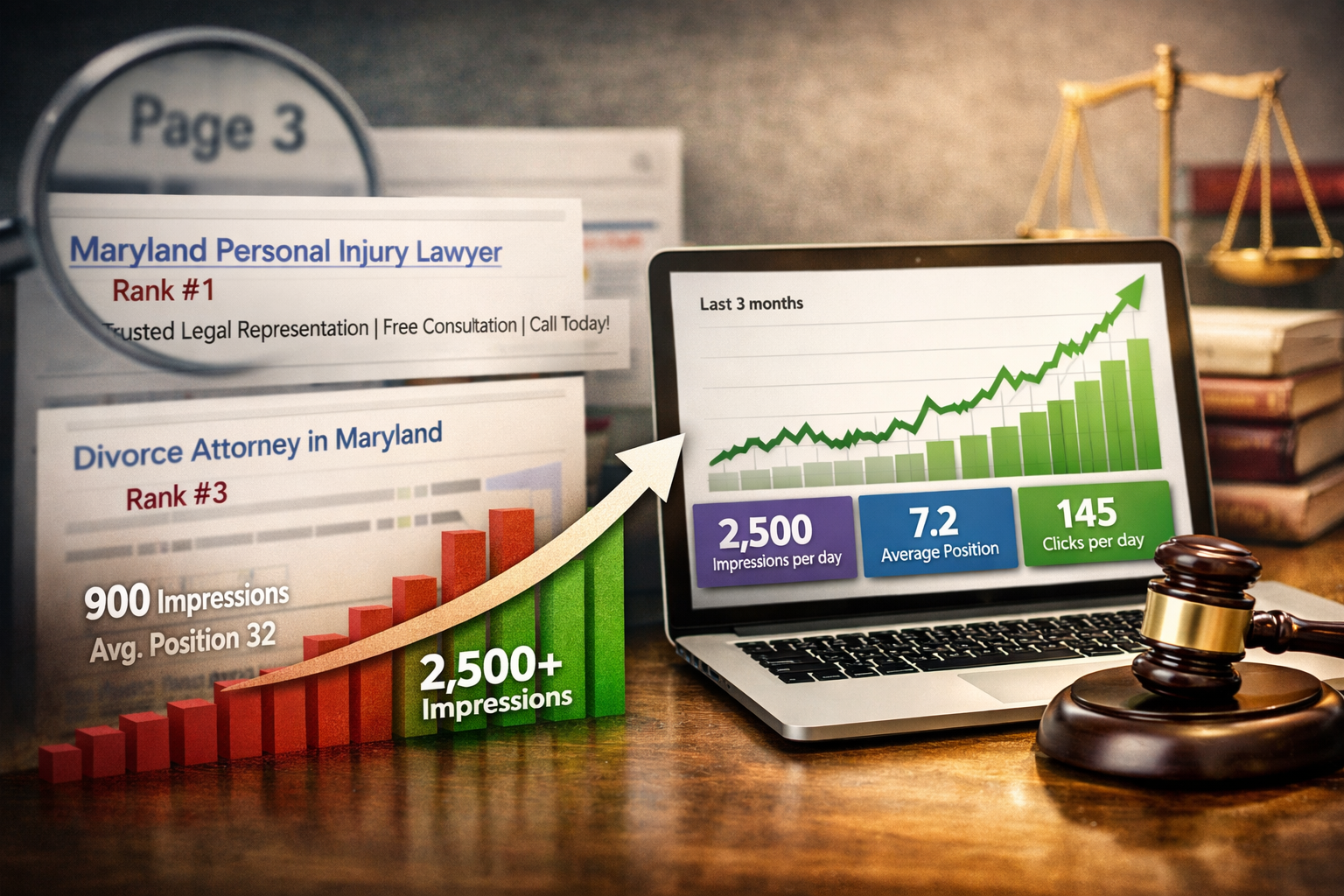
When this Maryland law firm came to Ritner Digital at the end of 2025, they weren't starting from zero — they had a website, some existing content, and a local presence built over years of practice. What they didn't have was search visibility that matched the quality of their work. Their Google Search Console data told the story plainly: average positions buried in the high 20s and low 30s, impression counts that rarely cracked 1,000 per day, and a site that was effectively invisible to the clients who needed them most.
Three months later, the data tells a completely different story.
Where They Started: December 31 – Early January
The baseline data, pulled from the final days of December 2025 and the first weeks of January 2026, is instructive precisely because of how clearly it illustrates the problem.
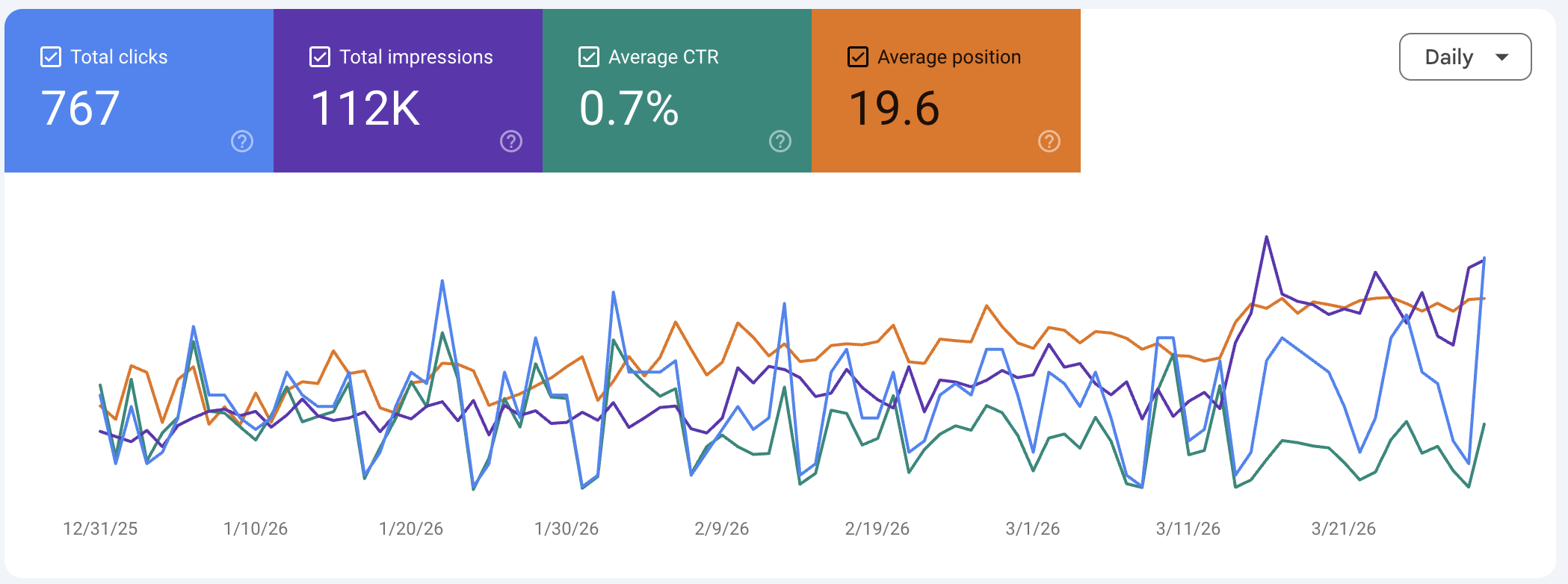
On December 31st, the site logged 9 clicks from 728 impressions at an average position of 29.9. On January 1st: 3 clicks, 672 impressions, position 32.1. January 4th: 4 clicks, 562 impressions, position 32.6. January 7th: 9 clicks, 948 impressions, position 32.9. January 9th: 7 clicks, 900 impressions, position 33.0. January 11th: 7 clicks, 775 impressions, position 32.6.
Let's be direct about what those position numbers mean. An average position in the low 30s means this firm's website was appearing, on average, on the third page of Google search results. Page three. In the legal services category — one of the most competitive, highest-intent search markets in existence — page three is effectively invisible. Studies consistently show that fewer than 1% of searchers ever make it to page three. The firm wasn't just underperforming. It was functionally absent from the searches that should have been driving its growth.
The impression counts confirm it. Fewer than 1,000 impressions per day means a limited number of searches were even surfacing this firm's website at all. The potential audience — people in Maryland searching for legal help, searching for the specific practice areas this firm handles, searching with real need and real intent — was simply not seeing them.
This is the starting line. And it's important to sit with it for a moment, not to be critical of where the firm began, but to understand the magnitude of what the next 90 days would produce.
January: The Work Begins, and the First Signals Emerge
SEO is not a light switch. This is the thing that separates firms who succeed with it from firms who give up on it. The work that happens in month one does not produce its full results in month one. It produces its results in month two, month three, month six. The compounding nature of the discipline rewards patience and penalizes impatience.
That said, even in January, the early signals were present for anyone looking carefully.
The impression counts, while still modest, began showing movement. January 13th: 1,081 impressions. January 22nd: 1,052 impressions, 19 clicks — the highest single-day click total of the month, at a position of 22.9. January 26th: 1,012 impressions. January 28th: 954 impressions with 14 clicks at position 26.6.
More telling than the impression counts was the position data. While the month opened with positions in the low-to-mid 30s, something was shifting underneath. January 6th: position 23.5 with 15 clicks — the strongest day of the entire month. January 22nd: position 22.9. January 23rd: position 23.1. The site was beginning to climb.
What was driving this? The foundational work of an SEO engagement: technical auditing and remediation, on-page optimization of existing content, Google Business Profile improvements, citation cleanup, and the early stages of a content strategy built around the specific practice areas and geographic markets this firm serves. None of these efforts produce overnight results. All of them, done correctly, produce lasting ones.
By the end of January, the average position was still sitting in the mid-to-high 20s on most days — better than where it started, but still with significant room to run. The impression counts were hovering between 800 and 1,100 on most days. Clicks were inconsistent, ranging from single digits to the high teens depending on the day.
The machine was warming up.
February: Momentum Builds, Position Breaks Through
February is where the story becomes undeniable.
The month opens on February 1st with just 2 clicks from 850 impressions at a position of 29.0 — still deep. But within days, something changes. February 2nd: 18 clicks from 1,042 impressions at position 25.9. February 3rd: 11 clicks, position 21.8. February 4th: 11 clicks, position 25.0. February 5th: 11 clicks, 989 impressions, position 22.0.
Four consecutive days of double-digit clicks. For a firm that had been averaging 7–9 clicks per day in early January, this is a meaningful shift. The site is appearing more often, appearing higher, and compelling more people to click.
Then February 6th delivers 12 clicks at position 16.2. February 10th: 8 clicks at position 16.3. February 13th: 17 clicks from 1,403 impressions at position 19.7 — the highest single-day click total in the entire 90-day dataset up to that point.
The position story in February is the real headline. After spending most of January in the high 20s and low 30s, the site begins breaking through in a way that matters. February 10th at 16.3. February 20th at 16.7. February 26th at 13.5 — a position that puts this firm, on that day, appearing on average as the third or fourth organic result across all its tracked searches.
Position 13.5. Compare that to position 33.0 on January 9th. In roughly six weeks, this firm's average search position had improved by nearly 20 spots. That is not incremental progress. That is a site that is being seen and rewarded by Google's algorithm in a fundamentally different way than it was 45 days earlier.
What drove this movement? Content is a significant part of the answer. A law firm that publishes authoritative, well-structured content about its practice areas — content that answers the real questions real people are searching for — gives Google something to rank. Legal searches are often highly specific: "what to do after a car accident in Maryland," "how long does a personal injury case take," "do I need a lawyer for a DUI in Maryland." A firm with content that genuinely addresses these questions will climb. A firm without it will stay buried.
The February data reflects the impact of that content hitting the index and beginning to accumulate ranking signals. It also reflects the compounding effect of the technical and off-page work done in January — work that takes time to register but doesn't stop working once it does.
Impression counts in February tell a parallel story. While January rarely exceeded 1,100 impressions per day, February regularly crosses that threshold and begins pushing toward 1,300 and 1,400. More searches. More visibility. More opportunity.
March: The Breakout
If January was laying the foundation and February was building the walls, March is when the structure becomes unmistakable.
The first days of March continue the trajectory established at the end of February. March 2nd: 11 clicks, 1,679 impressions, position 17.1. March 3rd: 10 clicks, 1,429 impressions, position 17.5. March 5th: 11 clicks, 1,248 impressions, position 17.7. The site is performing consistently at a level that would have seemed like an outlier in early January.
Then something significant happens around March 14th and 15th. The position numbers, which had been gradually tightening through the high teens, make a sudden and dramatic jump. March 14th: position 16.2. March 15th: position 13.2. March 16th: position 13.9 with 2,854 impressions — the highest single-day impression count in the entire 90-day dataset.
2,854 impressions. In early January, this site was generating 562 to 728 impressions on a given day. By mid-March, it is generating nearly three times that volume. The audience of potential clients seeing this firm in search results has expanded dramatically — not because more people are suddenly searching for legal help in Maryland, but because this firm is now appearing for far more of those searches, and appearing much higher in the results when it does.
The position data from mid-March onward is the clearest evidence yet of what sustained SEO investment produces. March 17th: position 12.3. March 19th: position 12.9. March 20th: position 13.3. March 21st: position 13.8. March 23rd: position 12.3. March 24th: position 12.1 — the best average position in the entire 90-day window.
Position 12.1 means this firm is, on average, appearing as the second result on page one of Google across all the searches it ranks for. Page one. For a firm that was on page three twelve weeks ago, this is a transformation.
The click data reflects it. March 17th: 14 clicks. March 18th: 13 clicks. March 19th: 12 clicks. March 20th: 11 clicks. March 24th: 14 clicks. March 25th: 16 clicks. March 30th: 21 clicks from 2,597 impressions at position 12.3 — the strongest single day of the entire quarter.
21 clicks in a single day. From a firm that was generating 3 to 9 clicks per day in early January. That's not a rounding error. That's a fundamentally different level of market presence.
Reading the Full Arc
Stepping back from the daily numbers and looking at the 90-day arc as a whole, several things stand out.
The position improvement is the core of the story. Moving from an average position in the low 30s to a consistent average in the low-to-mid teens represents a complete repositioning of this firm in its local search market. Every position gained near the top of the results page is exponentially more valuable than a position gained in the middle of page two or deeper. A firm at position 12 gets many times more clicks than a firm at position 22, which gets many times more than a firm at position 32. This firm has moved through all three tiers in 90 days.
The impression growth is equally significant. The expansion from sub-1,000 daily impressions in early January to 2,500+ impressions in late March means this firm is now visible to a dramatically larger pool of potential clients. Impressions are the top of the funnel — you cannot get clicks from searches where you don't appear, and you cannot get clients from clicks you never receive. Growing the impression base is the prerequisite to everything else.
The click-through rate story is nuanced. Despite the dramatic improvements in impressions and position, CTR has remained relatively modest — generally in the 0.5% to 1.5% range, with some outlier days. For a law firm with strong position numbers, this suggests there is meaningful upside still available through listing optimization: stronger title tags, more compelling meta descriptions, and the kind of trust signals — review stars, practice area specificity, local relevance — that compel a searcher to choose one result over another. This is a clear near-term opportunity.
The compounding effect is real and it is accelerating. The gains from January built the foundation for February's breakthrough. February's gains set the stage for March's breakout. This is how SEO works when it's done correctly — not as a series of disconnected tactics, but as a system that builds on itself, with each month's work amplifying the impact of everything that came before. The trajectory in this data suggests the second quarter will be stronger than the first, which will be stronger than what follows. The curve is bending upward.
What This Means for a Law Firm Evaluating SEO
The legal services market online is brutally competitive. Personal injury, family law, criminal defense, estate planning — these are categories where national aggregators like Avvo and FindLaw, large regional firms with years of SEO investment, and local competitors all compete for the same high-intent searches. Breaking through in this environment requires real strategy, real content, and real patience.
What this firm's data demonstrates is that breaking through is possible — and that 90 days of focused, well-executed work produces measurable, meaningful results even in a competitive market.
Some specific numbers worth internalizing: this firm went from averaging roughly 8 clicks per day in January to averaging roughly 11 clicks per day in February to averaging roughly 10 clicks per day in March — but with dramatically higher peaks, dramatically higher impressions, and dramatically better position. The daily average understates the trend because the growth is concentrated in the second half of March, where the best days of the entire quarter are clustered. April, if the trajectory holds, will look different again.
For a law firm where a single retained client can represent thousands of dollars in revenue, the math on SEO investment is not complicated. If improved search visibility produces even two or three additional inquiries per month from people who were searching for exactly the kind of legal help this firm provides, the return on investment is clear. If it produces ten additional inquiries — which the trajectory of this data suggests is a realistic outcome at current momentum — the case is even stronger.
The Honest Truth About What SEO Requires
There is no version of this story that doesn't include patience, trust, and a willingness to let the work compound before demanding results.
A law firm that hires an SEO agency and expects page-one rankings in 30 days will be disappointed — not because the work isn't effective, but because that's not how the discipline works. The firms that win in organic search are the ones that make a consistent investment, stay the course through the months where progress is building invisibly beneath the surface, and are positioned to capture the returns when the momentum becomes visible.
This Maryland law firm made that commitment. The data through March 30th shows exactly what that commitment produces.
Position 12.1. 2,854 impressions in a single day. 21 clicks on March 30th from a site that was generating 9 clicks per day three months ago. A search presence that is, for the first time, beginning to match the quality of the legal work being done inside the firm.
That's what a real SEO investment looks like when it's working. And this one is just getting started.
Ritner Digital works with law firms and professional services companies to build search visibility that generates real cases, real clients, and real growth. If you want to understand what your search data is telling you — and what a focused investment could produce — let's talk.
Frequently Asked Questions
Why does my law firm need SEO if we already have a website?
Having a website and being found on Google are two very different things. A website that sits on page three of search results is, for all practical purposes, invisible. Studies consistently show that fewer than 1% of searchers ever click past the first page. If your firm isn't appearing in the top 10 to 15 results for the searches your potential clients are running — "personal injury attorney Maryland," "family law attorney near me," "criminal defense lawyer Baltimore" — your website is not generating the business it should be.
SEO is the work that closes the gap between having a website and being found by the people who need you. For a law firm where a single retained client can represent thousands of dollars in revenue, that gap is expensive.
How is law firm SEO different from SEO for other types of businesses?
Legal search is one of the most competitive categories on the internet. You're not just competing against other local law firms — you're competing against national aggregators like Avvo, FindLaw, and Justia, large regional firms with years of SEO investment, and legal directories that have been building authority for decades. Breaking through in this environment requires a strategy built specifically for the legal market, not a generic approach recycled from an e-commerce or retail playbook.
There are also compliance considerations unique to the legal profession. Attorney advertising rules vary by state bar, and any content strategy needs to be built with those rules in mind. A good legal SEO partner understands this and builds content that is both search-optimized and professionally appropriate.
Beyond competition and compliance, the nature of legal search intent is specific. People searching for a lawyer are not browsing casually. They have a problem — often an urgent, stressful, expensive one — and they are looking for someone they can trust. The SEO strategy has to reflect that reality, prioritizing trust signals, authority, and relevance over volume and gimmicks.
How long does it take to see results from SEO for a law firm?
The data from our Maryland law firm client gives a clear and honest answer: meaningful, measurable results are visible within 60 to 90 days of focused work. That firm moved from average positions in the low 30s to consistent positions in the low-to-mid teens in a single quarter. Impression counts nearly tripled. Daily clicks more than doubled at peak.
That said, 90 days is the beginning of the story, not the end. The trajectory in that data is accelerating — the best days of the quarter are clustered at the end, not the beginning, because SEO compounds. The work done in month one produces results in month two. The work done in month two amplifies the results of month three. By month six, a firm that has stayed the course is operating at a fundamentally different level of search visibility than it was when it started.
Law firms that expect page-one rankings in 30 days will be disappointed. Law firms that commit to a consistent investment over six to twelve months will be competitors in their market in a way they weren't before.
What actually happens during an SEO engagement for a law firm?
A serious SEO engagement for a law firm has several distinct components that work together as a system.
Technical SEO addresses the foundation of the site — page speed, mobile usability, crawlability, site structure, schema markup, and the dozens of under-the-hood factors that determine whether Google can effectively read and rank your content. This work is often invisible to the firm but critically important to the algorithm.
On-page optimization ensures that the pages already on your site are structured and written in a way that signals relevance to Google for the right searches. This includes title tags, meta descriptions, header structure, internal linking, and content quality on every key page.
Content strategy and creation is often where the most significant gains come from. Legal searches are highly specific — people search for answers to specific questions about specific legal situations. A firm with content that genuinely addresses those questions earns rankings that a firm without content simply cannot. This means practice area pages, location pages, blog content, FAQ content, and the kind of authoritative writing that establishes the firm as a credible resource in Google's eyes.
Google Business Profile optimization ensures that the firm's local listing is complete, accurate, and actively managed — because for most local legal searches, the map pack results appear before the organic results, and a well-optimized GBP listing is the entry ticket to that highly visible real estate.
Off-page work — earning links from authoritative sources, building local citations, managing online reputation — builds the external trust signals that tell Google this firm is a credible, established presence in its market.
All of these components work together. Neglecting any one of them limits the impact of the others.
What does average position actually mean, and why does it matter so much?
Average position is Google Search Console's way of telling you where your website appears, on average, across all the searches it shows up for. A position of 1 means you're the first organic result. A position of 10 means you're the last result on page one. A position of 30 means you're on page three.
The reason position matters so much — more than almost any other metric in local search — is the non-linear relationship between rank and clicks. Research consistently shows that the first organic result on a Google search page receives roughly 25 to 30% of all clicks. The second result receives around 15%. By the time you get to position 5, you're looking at 5 to 7%. By position 10, it's under 3%. By position 30, it's essentially zero.
This means that moving from position 30 to position 20 produces a meaningful but modest improvement. Moving from position 20 to position 10 produces a significant improvement. Moving from position 10 to position 5 produces a dramatic one. And moving from position 5 to position 1 or 2 can be transformative for a firm's inbound lead volume.
The Maryland law firm data shows a firm that moved from position 33 to position 12 in 90 days. Every step of that journey produced compounding returns, and the trajectory suggests the most valuable steps — the ones into the top 5 — are now within reach.
Why is click-through rate sometimes low even when position is improving?
Click-through rate measures the percentage of people who see your listing and choose to click on it. Even with strong position numbers, CTR can underperform if the listing itself isn't compelling — if the title tag is generic, the meta description doesn't speak directly to what the searcher needs, or the listing lacks the trust signals that make a potential client choose your result over the one above or below it.
For law firms specifically, trust is the decisive factor in that split-second choice. A listing that clearly states the practice area, the geographic market, and a compelling reason to click — ideally reinforced by star ratings from reviews — will consistently outperform a listing that reads like a placeholder. This is one of the clearest near-term opportunities in the Maryland firm's data: the position improvements are real and significant, but there is meaningful CTR upside available through sharper, more trust-forward listing optimization.
The good news is that CTR optimization is relatively fast work with visible results. Unlike content that takes months to rank, a better title tag and meta description can improve CTR within days of being indexed.
Does having more reviews actually help with SEO?
Yes, in several important ways.
Reviews are one of the strongest trust signals in local search. Google's local algorithm explicitly factors review quantity, recency, and quality into how it ranks businesses in the map pack — the highly visible block of local results that appears above the organic listings for many legal searches. A firm with 200 reviews and a 4.8 average rating will outperform a firm with 20 reviews and a 4.5 average, all else being equal.
Beyond the algorithmic benefit, reviews directly impact click-through rate. A listing with visible star ratings in the search result earns more clicks than one without, because potential clients use reviews as a proxy for trustworthiness before they ever visit your website. In a category as high-stakes as legal services — where the person searching is often dealing with one of the most stressful situations of their life — that trust signal can be the deciding factor.
A steady cadence of new reviews also signals to Google that the firm is active and engaged, which carries its own ranking benefit. Sporadic bursts followed by long silences are less effective than a consistent flow of new reviews over time.
Can SEO work alongside paid advertising (Google Ads) for a law firm?
Yes, and for most law firms in competitive markets, the combination is more effective than either channel alone.
Paid search — Google Ads — produces immediate visibility at the top of the results page, but it stops the moment the budget runs out. The cost-per-click in legal categories is among the highest of any industry, with some practice areas running $50 to $200 or more per click. For a firm relying exclusively on paid search, the economics can be challenging.
Organic SEO, by contrast, takes longer to produce results but generates returns that compound over time and don't disappear when you stop writing checks. A page-one organic ranking earned through content and authority generates clicks month after month at no incremental cost.
The ideal strategy for most law firms is to use paid search to capture demand immediately while organic SEO builds over time — then gradually reduce dependence on paid as organic rankings strengthen. This approach maximizes visibility in the near term while building a more sustainable, cost-efficient foundation for the long term.
How do I know if my law firm's SEO is actually working?
Look for directional trends over 60 to 90 day windows, not day-to-day fluctuations. The metrics that matter most, in order of importance, are average position on your core practice area and location searches, total impressions growth on a month-over-month basis, click volume trends, and — ultimately — the volume and quality of inbound inquiries you can trace back to organic search.
A good SEO partner will connect those dots for you clearly, showing you not just the Search Console metrics but how they relate to the business outcomes you actually care about: consultations scheduled, cases opened, revenue generated. If your SEO report is full of numbers that don't obviously connect to those outcomes, that's worth questioning.
The Maryland law firm data shows all of the right metrics moving in the right direction — position improving, impressions growing, clicks increasing, momentum accelerating. That's what working looks like. It's also what it looks like when a firm has made a real commitment and given the work enough time to compound.
Ritner Digital works with law firms across Maryland and the Mid-Atlantic to build search visibility that generates real cases and real growth. If you want to know what your current search data says about your firm's opportunity — and what a focused investment could produce — we'd like to talk.