3% CTR Over 90 Days: What a Coins & Collectibles Client's Search Data Says About How We Do SEO
There are metrics in SEO that sound impressive until you understand what they actually mean. And then there are metrics that sound modest until you understand how hard they are to achieve.
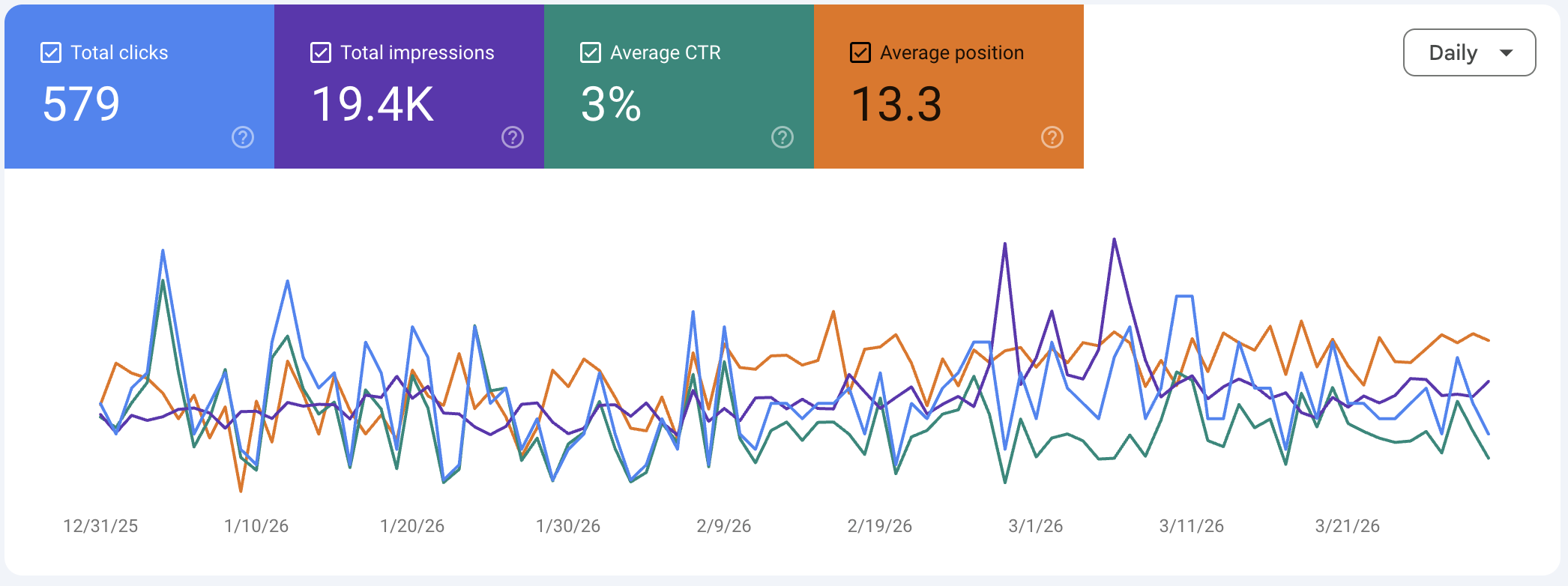
A 3% average click-through rate, sustained across 90 consecutive days of Google Search Console data, is the second kind of metric.
This is the story of a coins and collectibles client we've been working with — a niche, passion-driven retail and buying business operating in one of the more interesting corners of the e-commerce and local search landscape. It's also a story about what a 3% CTR actually represents, why it's rare, what it takes to produce it, and what it tells you about the agency behind it.
First, Some Context on the Market
Coins and collectibles is not a straightforward search category. It sits at the intersection of local retail ("coin shop near me"), specialty e-commerce ("buy silver eagles online"), hobbyist research ("1964 Kennedy half dollar value"), and high-intent buying and selling ("sell gold coins Maryland"). The people searching in this category range from serious numismatists with decades of expertise to grandchildren who just inherited a collection and have no idea what they have.
This diversity of intent makes the SEO challenge genuinely complex. You're not optimizing for one type of searcher or one type of query. You're building a presence that speaks credibly to the expert who wants to know you know what you're talking about, the casual buyer who wants to feel safe, and the seller who wants to trust they're getting a fair deal. Each of those audiences searches differently, clicks differently, and converts differently.
The other complexity is competition. Nationally, major online dealers and auction platforms dominate search for high-volume collectibles terms. Locally, every coin shop in the region is competing for the same "coin dealer near me" queries. Breaking through requires more than basic optimization — it requires a content and positioning strategy that finds the specific intersection of what this business does best and what its potential customers are actually searching for.
Against that backdrop, a 3% CTR over 90 days is not something that happens by accident.
What the Data Looks Like: December 31 – January
The 90-day window opens on December 31st with 6 clicks from 176 impressions at a CTR of 3.4% and a position of 16.1. That opening data point already tells a story — a position of 16 is solidly on page two of Google, yet the site is generating a 3.4% CTR from that position. For context, the industry average CTR for a page-two listing is roughly 1% or less. This site is nearly three and a half times that from day one of the tracking period.
January builds on that foundation in compelling fashion. January 3rd: 8 clicks, 163 impressions, 4.9% CTR, position 13.8. January 4th: 16 clicks from 171 impressions at a 9.4% CTR and position 15.1 — the highest single-day CTR in the entire 90-day dataset, and one of the most remarkable individual data points in any client report we've produced. A position of 15 typically generates clicks from 1 to 2% of viewers. This listing generated clicks from nearly 1 in 10.
January 5th: 10 clicks, 5.3% CTR. January 8th: 8 clicks, 5.5% CTR. January 11th: 10 clicks, 6% CTR at position 19.4 — a position that should statistically generate well under 1% CTR, generating 6 times that. January 12th: 14 clicks from 202 impressions at 6.9% CTR and position 12.3. January 17th: 10 clicks, 4.6% CTR. January 20th: 11 clicks, 5.2% CTR.
The pattern is consistent and it is not subtle. Day after day, this site is generating click-through rates that significantly exceed what its average position would predict. Something about how this site presents itself in search results — the titles, the descriptions, the trust signals, the specificity of what it offers — is compelling people to click at a rate that reflects genuine relevance and genuine interest.
The January average position fluctuates between the low teens and the mid-to-high teens on most days, with some days pushing toward the 20s. Yet even on those deeper-ranking days, the CTR holds. January 24th: position 16.4, CTR 7.4%. January 25th: position 14.9, CTR 4.5%. January 26th: position 17.2, CTR 4.7%.
This is not a site that is ranking number one and passively collecting clicks. This is a site that is earning its clicks through the quality of how it presents itself, regardless of where it appears on the page.
February: Consistency Is the Story
February is where the narrative shifts from impressive individual days to something more valuable: sustained, consistent performance across a full month of varied conditions.
The month opens with a few quieter days — February 1st brings 8 clicks at 4.1% CTR, February 2nd brings 4 clicks at 2%, February 3rd drops to 1 click at 0.6%. But the recovery is immediate. February 5th: 5 clicks, 3.1% CTR. February 7th: 12 clicks from 228 impressions at 5.3% CTR and position 11.6 — one of the strongest click days of the month. February 9th: 11 clicks at 5.8% CTR.
Then the mid-February stretch that illustrates exactly why consistent CTR matters more than peak CTR. February 12th through 16th: 6 clicks at 2.8%, 6 clicks at 3.2%, 5 clicks at 2.4%, 6 clicks at 3.2%, 6 clicks at 3.2%. Five consecutive days with CTR between 2.4% and 3.2%. No dramatic spikes. No crashes. Just reliable, above-benchmark performance day after day.
February 19th: 8 clicks at 4.2%. February 23rd: 7 clicks at 3.5%. February 24th: 8 clicks at 3.7%. February 25th: 10 clicks from just 193 impressions at 5.2% — a day where the site appeared in fewer than 200 searches and still generated double-digit clicks because the people who did see it clicked at a remarkable rate.
February 26th: 10 clicks at 3.5%. February 28th: 8 clicks at 3.3%.
The one notable outlier is February 27th: 3 clicks from 548 impressions at just 0.5%. That single-day spike in impressions with a corresponding drop in CTR is a classic signal of a broad, low-intent query temporarily surfacing the site to a large audience that wasn't specifically looking for what the site offers. It's a reminder that impressions are not inherently valuable — what matters is the quality and intent of the searches driving them. On February 27th, something temporarily sent a lot of low-fit traffic the site's way. The other 27 days of February tell the real story.
The February average position runs mostly in the low-to-mid teens, with some days in the upper teens. The CTR performance relative to those positions remains consistently above industry benchmarks throughout.
March: Position Strengthens, CTR Holds
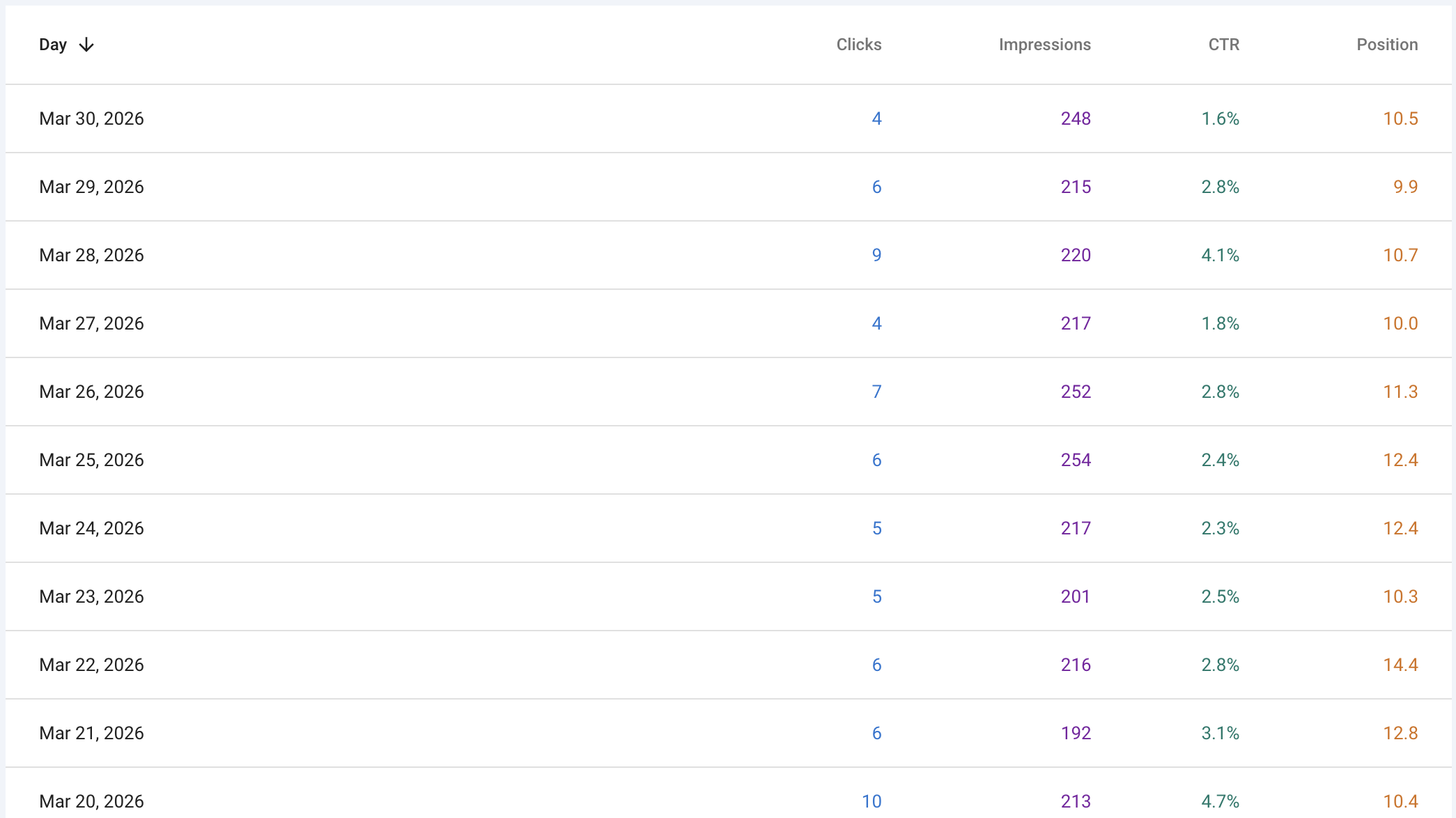
March brings the clearest evidence yet of what this engagement has built. Position numbers that spent January and February in the mid-to-high teens begin tightening into the low-to-mid teens and then into single digits. March 16th: position 9.3. March 18th: position 8.8 — the best average position of the entire 90-day window, meaning this site is, on average, appearing in the top 8 or 9 results across all its tracked searches on that day. March 29th: position 9.9. March 30th: position 10.5.
These are page-one positions. And as position improves, two things happen simultaneously: impression counts begin stabilizing at a level that reflects consistent page-one presence, and the CTR story evolves.
March 10th: 13 clicks from 242 impressions, 5.4% CTR, position 14.5. March 11th: 13 clicks from 260 impressions, 5% CTR, position 10.4. March 14th: 10 clicks, 4% CTR. March 18th: 8 clicks, 4.4% CTR. March 20th: 10 clicks, 4.7% CTR. March 28th: 9 clicks, 4.1% CTR.
The pattern is worth stating plainly: as this site moves onto page one and its listings become more visible to more searchers, the CTR is not declining to meet the page-one average. It is holding — in many cases, exceeding — the performance it showed when the site was ranking in the mid-to-high teens. That means the quality of the listing, the relevance of the content, and the trust signals the site presents are strong enough to perform at or above benchmark at any position on the page.
That is not easy to achieve. Most sites see CTR decline as they move from niche, low-competition positions to broader, more competitive page-one territory, because the new searches driving impressions are less specifically aligned with what the site offers. This site is not showing that pattern. The CTR is holding because the targeting is precise, the content is genuinely relevant, and the listing presentations are compelling across the full range of searches the site appears for.
The 3% Number: Why It Matters and How Rare It Is
Let's talk specifically about why a 3% average CTR over 90 days is worth calling out as a headline achievement.
Google's own data, corroborated by multiple independent studies of search behavior, consistently shows that average organic CTR across all positions and all industries runs somewhere between 1.5% and 2.5%. That average is pulled up by the high CTRs of top-ranked results and pulled down by the near-zero CTRs of page-two and page-three listings.
For a site that spent the first half of this 90-day period with average positions in the mid-to-high teens — solidly on page two for many searches — sustaining a 3% CTR means performing at roughly double the benchmark for those positions, every single day, for three months straight.
That doesn't happen because of luck. It happens because of three specific things done right.
Listing quality. The title tags and meta descriptions on this site's key pages are not generic. They are written to speak directly to the intent of the searcher — to immediately signal relevance, establish credibility, and create a reason to click over every other result on the page. In the coins and collectibles category, this means the listings communicate expertise, trustworthiness, and specificity. A collector searching for a specific coin type or a seller searching for a buyer sees a result that looks exactly like what they were hoping to find.
Content-search alignment. High CTR is ultimately a measure of how well a listing matches what the searcher was looking for. When someone clicks on a result, they are making a prediction: "this is probably what I need." A high CTR means searchers are making that prediction in favor of this site at an above-average rate. That only happens when the content strategy is tightly aligned with actual search intent — when the pages that are ranking are the pages that genuinely answer the questions being asked. This takes real research, real content strategy, and real editorial discipline to execute.
Trust signals. In a category where buyers and sellers are transacting around items that can be worth hundreds or thousands of dollars, trust is not optional. It is the deciding factor. A search listing that communicates legitimacy — through its title, its description, its structured data, its review signals — earns clicks that a generic-looking result does not, even when the generic result ranks higher on the page. Building those trust signals into every element of how this site presents itself in search results is deliberate work, and the CTR data reflects it.
What the Impression Numbers Tell Us
One of the interesting structural features of this dataset is the relatively modest impression counts compared to the other clients in this series. Where the Maryland law firm was generating 2,000+ impressions per day by March and the home services client was in the 500 to 1,000 range, this coins and collectibles client is typically generating 150 to 300 impressions per day throughout the 90-day window, with occasional spikes toward 400 to 550.
This is not a problem. It is a deliberate strategic reality.
The coins and collectibles market is a niche category. The total search volume for specialty numismatic queries, local coin dealer searches, and collectibles buying and selling terms in a regional market is simply smaller than the search volume for legal services or home services. You cannot manufacture impressions that the market isn't generating.
What you can do — and what this engagement has done — is ensure that every impression this site earns is a high-quality impression from a searcher whose intent closely matches what the business offers. When impressions are small in volume but high in quality, CTR rises. When impressions are large in volume but diluted in quality, CTR falls. This client's 3% CTR over 90 days is partly a reflection of the niche nature of the market, and partly a reflection of a targeting strategy that has kept the site's search footprint tightly focused on the searches most likely to convert.
That focus is a choice. A less disciplined approach would chase impression volume at the expense of CTR quality — adding broad, loosely relevant keywords that inflate the impression count while dragging down the click rate. The data shows we made a different choice, and it produced a different and better result.
The Position Story Is Quietly Remarkable
The CTR headline is the obvious story in this data. But the position trend deserves its own attention, because it sets up the next chapter of this client's growth.
The engagement started with this site averaging positions in the mid-to-high teens and occasionally dipping into the 20s. By March, the site is regularly appearing in the low-to-mid teens, with multiple days in the single digits. March 16th at 9.3. March 18th at 8.8. March 23rd at 10.3. March 29th at 9.9.
A site that has moved from positions in the high teens to consistent single-digit and low-double-digit positions is a site that is moving onto page one for an increasing share of its target searches. And a site that is already generating 3% CTR from page-two positions will generate significantly higher CTR as it continues to move up — because the relationship between position and clicks is non-linear and accelerating toward the top of the page.
The implication is straightforward: the best performance from this engagement is still ahead. The CTR discipline established over these 90 days, combined with the position improvements already visible in the data, creates a compounding opportunity that will become increasingly visible in Q2 and beyond.
What This Means for You as a Prospective Client
We are sharing this data because we believe in transparency about what SEO actually produces — not the inflated promises, not the vanity metrics, not the reports that are full of numbers that don't connect to real business outcomes.
A 3% average CTR over 90 days is a real number. It means that for every 100 times this client's website appeared in a Google search result, 3 people clicked through to the site. In a market where the benchmark is 1.5% to 2%, this client's site is performing at roughly double the industry average — consistently, across 90 days, across hundreds of individual data points.
That is the result of specific work done well: keyword strategy that targets the right searches, content that genuinely answers searcher intent, listing optimization that compels clicks, and a patient, compounding approach that prioritizes sustainable performance over short-term spikes.
If you are evaluating SEO agencies and you want to know what separates the ones who produce real results from the ones who produce impressive-sounding reports, ask them about CTR. Ask them to show you 90 days of data. Ask them to explain the relationship between their work and the numbers on the page.
We can answer those questions. This data is the proof.
The Bigger Picture
Across the three clients featured in this series — a 40-year-old Northeast home services company, a Maryland law firm, and a coins and collectibles business — a common thread runs through the data: the work that produces real search performance is disciplined, specific, patient, and measurable.
It is not about gaming the algorithm or chasing trending keywords or inflating vanity metrics to justify a monthly retainer. It is about understanding what a business's potential customers are actually searching for, building a presence that speaks directly and credibly to that intent, and measuring the results in ways that connect to actual business outcomes.
The 3% CTR is a number we're proud of. But what we're proudest of is the work behind it — and the transparency to show it to you in full.
Ritner Digital builds SEO strategies for businesses that want real visibility, real traffic, and real results. If you want to see what your current search data looks like — and what a focused engagement could produce — we'd like to talk.
Frequently Asked Questions
What is click-through rate and why is 3% such a big deal?
Click-through rate — CTR — is the percentage of people who see your website in a Google search result and actually click on it. If your site appears 100 times in a day and generates 3 clicks, your CTR is 3%.
The reason 3% is worth calling out is what it looks like relative to industry benchmarks. Google's own data, and multiple independent studies of search behavior, consistently show that average organic CTR across all positions and all industries runs somewhere between 1.5% and 2.5%. That average is weighted heavily by the high CTRs of top-ranked results — position one on Google typically generates 25 to 30% CTR, while positions in the teens and 20s often generate under 1%.
This coins and collectibles client maintained a 3% average CTR over 90 consecutive days while spending much of that period with average positions in the mid-to-high teens. A page-two listing generating 3% CTR is performing at roughly two to three times the expected benchmark for that position. Sustained across an entire quarter, that performance reflects something structural about how the site presents itself in search — not a lucky spike or a one-time outlier.
For a business in a niche category where every qualified visitor matters, that kind of CTR efficiency is the difference between a search presence that generates real inquiries and one that technically exists but doesn't produce.
Is SEO realistic for a niche business like coins and collectibles?
Not only is it realistic — niche businesses are often the ones that benefit most from well-executed SEO, precisely because the competition dynamics are different from mass-market categories.
In broad consumer categories, you're competing against massive national brands with enormous domain authority and content libraries built over decades. In a niche like coins and collectibles, the competition landscape is more manageable. National platforms like eBay and major auction houses dominate the broadest terms, but the specific, intent-rich searches — the ones that reflect a buyer looking for a particular coin type, a seller looking for a local dealer they can trust, or a collector researching a specific series — are often winnable for a well-optimized local or regional business.
The key is targeting strategy. A niche business that tries to compete for broad, high-volume terms will get buried. A niche business that builds a precise, well-aligned search presence around the specific searches its actual customers are running will punch well above its weight. The 3% CTR in this client's data is direct evidence of that approach working — the site is appearing for searches that closely match what it offers, and the people running those searches are clicking at a rate that reflects genuine relevance.
Why are the daily impression numbers smaller for this client than for other businesses?
Because the coins and collectibles market is a niche category, and niche categories have smaller total search volumes than broad consumer categories. There are simply fewer people searching for "1964 Kennedy half dollar value" or "sell silver coins near me" on any given day than there are searching for "plumber near me" or "personal injury lawyer Maryland."
This is not a problem — it's a market reality that shapes the strategy. When total search volume in a category is limited, the right approach is to capture as high a percentage of that existing demand as possible, at the highest quality level possible, rather than chasing impression volume through loose, low-intent keywords that inflate the numbers without producing real business.
The 150 to 300 daily impressions this client generates are high-quality impressions. The 3% CTR they produce is evidence of that quality. A diluted strategy that chased 1,000 daily impressions through broad, loosely relevant terms would likely produce a 0.8% CTR and fewer actual clicks than the focused approach — because most of those additional impressions would come from searchers who weren't actually looking for what this business offers.
In niche SEO, quality of search footprint beats quantity of impressions every time.
What makes someone click on one search result over another?
This is one of the most important questions in SEO and one of the most underappreciated. Most businesses and agencies focus almost entirely on ranking — getting the position — and pay relatively little attention to what happens once the position is earned. But the click is where the value actually lives.
Several factors determine whether a searcher chooses your result over the ones above and below it. The title tag — the blue linked headline in the search result — is the first and most important signal. It needs to immediately communicate relevance to what the person searched for, while also establishing credibility and creating a reason to click. A generic title like "Home — Acme Coin Shop" loses to a specific, intent-matched title every time.
The meta description — the two lines of text beneath the title — is your 150-character pitch. It doesn't directly affect ranking, but it directly affects CTR. A meta description that speaks to the searcher's specific need, answers an implicit question, and gives a reason to trust this result will consistently outperform a generic or auto-generated one.
Structured data and rich results — review stars, business hours, price ranges, FAQ snippets — add visual trust signals to the listing that make it stand out on the page and increase CTR for searchers who are making a trust-based decision, which in the coins and collectibles category is essentially everyone.
The 3% CTR this client maintained is a direct reflection of getting all of these elements right, consistently, across 90 days of varied searches and positions.
How do you target the right searches for a coins and collectibles business?
Keyword research in this category requires genuine knowledge of the market, not just a keyword tool and a volume threshold. The searches that matter fall into several distinct intent categories, each of which requires a different content approach.
Buying intent searches — people looking to purchase specific coins, currency, or collectibles — require product and category pages that are specific, trustworthy, and clearly transactional. Someone searching "buy Morgan silver dollars" needs to land on a page that immediately confirms you have them, tells them what they need to know to make a decision, and makes it easy to take the next step.
Selling intent searches — people looking to sell a collection or individual pieces — are among the highest-value searches for most coin dealers. "Sell gold coins near me," "where to sell a coin collection," "coin dealer that buys collections" — these searchers are ready to transact, and a site that ranks for these terms and presents compellingly in the listing will capture inquiries that translate directly to inventory acquisition and margin.
Research intent searches — collectors looking up values, history, mintage figures, grading information — represent the top of the funnel. These searchers may not be ready to buy or sell today, but a site that earns their trust through genuinely useful content becomes the dealer they think of when they are ready. This is how content marketing works in a passion-driven category like numismatics — you build the relationship through expertise before the transaction is on the table.
Local intent searches — "coin shop near me," "coin dealer in [city]" — require Google Business Profile optimization alongside on-site SEO, because the map pack results that appear for these searches are driven by different signals than the organic listings below them.
A well-executed strategy addresses all four intent categories simultaneously, building a search presence that captures demand at every stage of the collector and seller journey.
What is the Google Business Profile and does it matter for a coin shop?
The Google Business Profile — formerly Google My Business — is the listing that appears in the map pack when someone searches for a local business. For searches like "coin dealer near me" or "coin shop [city]," the map pack appears prominently above the organic results and captures a significant share of clicks. If your business isn't appearing there, or appearing lower than competitors, you're losing local traffic to businesses that may be less qualified than yours.
For a coins and collectibles business, the GBP is particularly important because the local buyer and seller audience — people who want to come into a shop, have coins appraised, or meet with a dealer in person — often starts their search with local intent. A well-optimized GBP with accurate information, strong reviews, current photos, appropriate categories, and regular posts signals to Google that this is an active, trustworthy local business worth surfacing for those searches.
Reviews are especially important in this category. A collector or seller considering bringing in valuable items — coins, currency, jewelry, estate pieces — is making a trust decision before they make a transaction decision. A GBP with dozens of specific, positive reviews from real customers who describe their experience in detail is one of the strongest trust signals a local coin dealer can have online.
How do reviews affect SEO for a collectibles business?
Reviews affect SEO for a coins and collectibles business in three distinct ways, each of which compounds the others.
They directly influence Google Business Profile rankings. The quantity, recency, and quality of reviews are among the strongest signals in Google's local algorithm. A dealer with 150 reviews and a 4.9 average will outrank a dealer with 20 reviews and a 4.7 average in the map pack for local searches, all else being equal. In a category where trust is the primary purchase barrier, this ranking advantage reflects exactly the kind of business quality signal Google is trying to surface.
They influence click-through rate on both GBP listings and organic results. Star ratings visible in search results increase CTR significantly — searchers use them as a quick proxy for trustworthiness before they ever visit your website. For a business asking people to trust them with valuable items, those stars carry real weight in the click decision.
They influence conversion once a searcher lands on your site or profile. A potential seller researching where to bring a collection will read reviews carefully. Specific reviews that describe fair pricing, knowledgeable staff, and a professional experience will convert that research-phase visitor into an in-store visit. Generic five-star reviews with no detail will not do the same job.
A steady cadence of new reviews — not a burst of 50 reviews in one month followed by silence — is the most effective review strategy for long-term SEO benefit.
Can content marketing work for a coins and collectibles business?
It's one of the highest-leverage SEO investments available in this category, and one of the most underutilized.
The coins and collectibles audience is, by definition, a passionate and research-oriented one. Collectors spend hours learning about the items they pursue. Sellers want to understand what they have before they bring it in. Buyers want to feel confident they're working with a knowledgeable dealer. All of that research happens on Google, and a business with content that answers those questions — authoritatively, specifically, and helpfully — earns rankings, trust, and relationships that no paid ad can replicate.
Practically, this means coin value guides, series overviews, grading explainers, buying guides for specific categories, selling guides that help people understand the process, and local content that establishes geographic relevance. Each piece of content targets a specific cluster of searches, earns its own rankings over time, and contributes to the overall authority of the domain — making every other page on the site easier to rank as a result.
The coins and collectibles category has surprisingly thin content competition in many specific niches. A dealer willing to invest in genuinely useful, expert-level content can carve out search dominance in specific areas that national platforms don't bother to cover thoroughly. That's a competitive advantage that compounds over years, not just months.
What should I expect from an SEO engagement in terms of timeline and results?
The honest answer, supported by 90 days of real data: meaningful, measurable results are visible within 60 to 90 days of focused work, and the trajectory at 90 days typically understates what the next 90 days will produce.
This coins and collectibles client entered the engagement with a functional but underperforming search presence. Within 90 days, the site was generating a sustained 3% CTR — roughly double the industry benchmark — and average positions were tightening from the high teens into the low teens and single digits by March. Those position improvements will continue to translate into CTR and click gains through Q2 and beyond, because the relationship between position and clicks is non-linear and accelerating toward the top of the page.
For a niche business with relatively modest total search volume, the gains aren't measured in thousands of additional monthly visitors. They're measured in the right visitors — qualified, intent-matched searchers who are looking for exactly what the business offers — arriving at a higher rate, more consistently, from a more trusted position in the results. For a coins and collectibles dealer where a single estate purchase or a relationship with a serious collector can represent significant long-term revenue, that quality of traffic is what matters.
The businesses that see the best results from SEO are the ones that make a consistent investment, give the work time to compound, and measure success in business outcomes — inquiries, appraisal appointments, inventory acquisitions, sales — not just rankings and impressions. That's the standard we hold ourselves to, and the 3% CTR data is the kind of evidence we point to when we say the work is producing.
Ritner Digital builds focused, measurable SEO strategies for niche and specialty businesses. If you want to understand what your search presence looks like today — and what it could look like in 90 days — we'd like to show you.