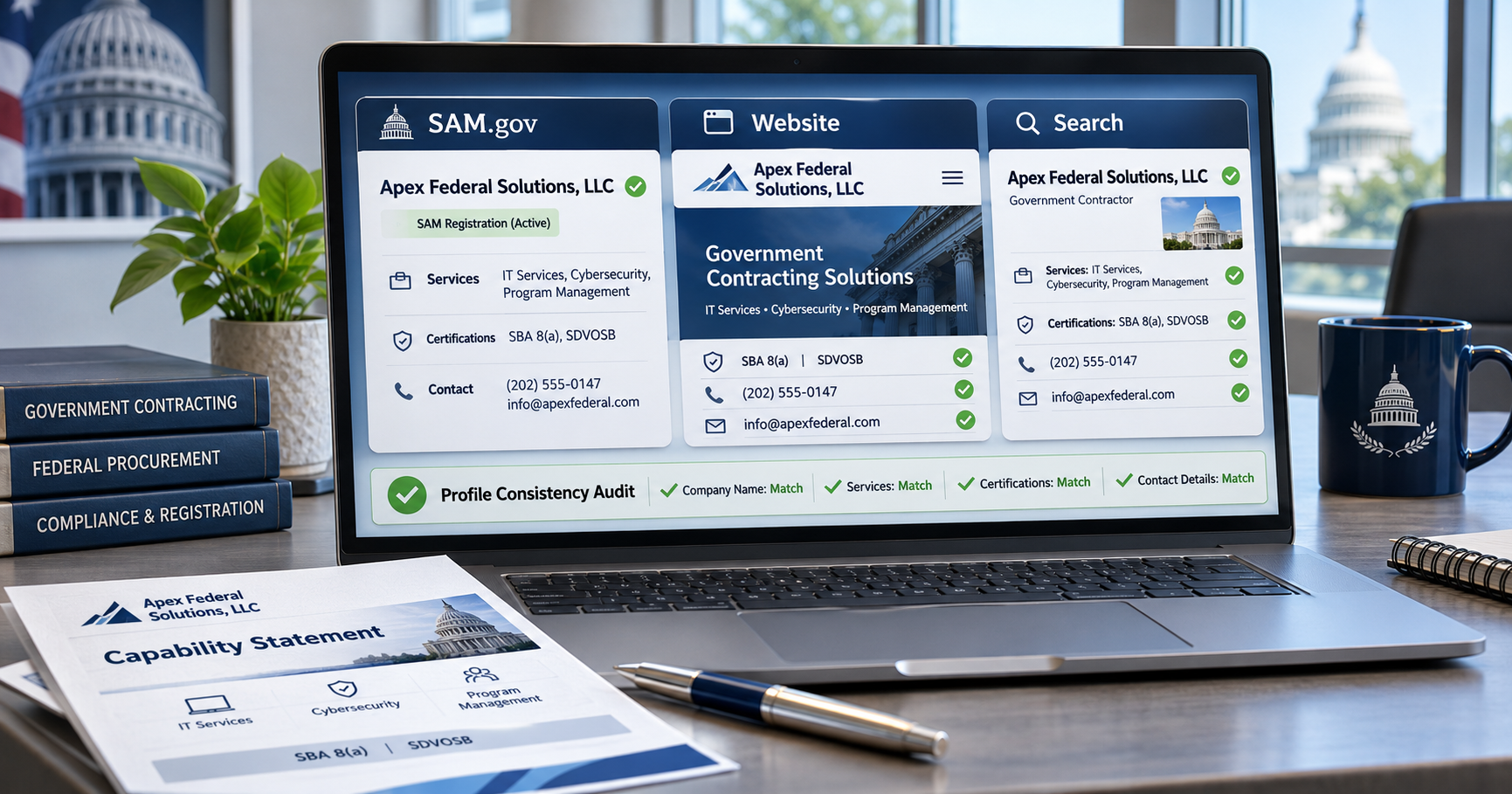
Your government contracting business may have an active SAM.gov registration, a polished capability statement, and a professional website. But what happens when those sources describe different versions of the same company? Here's why consistent business information matters for GovCon visibility, credibility, and teaming opportunities—and how to identify and correct the discrepancies.
Imagine someone is researching your government contracting company.
Maybe it's a business development professional at a potential prime contractor.
Perhaps it's an industry contact who received your capability statement.
Or someone may simply be trying to verify the services your company provides before scheduling a conversation.
They start with your business name.
A Google search brings up your website.
The homepage describes a cybersecurity and cloud engineering company headquartered in Northern Virginia.
So far, everything looks reasonable.
Then the person finds an older company profile.
It describes your business as a general management consultancy.
They review your capability statement.
That document lists a different company name, an outdated address, and several services that don't appear on your website.
Next, they search for your company in federal business records.
The legal entity name looks different from the brand they've been researching.
Now the visitor has questions.
Are these all the same organization?
Did the company change its name?
Does the business operate under a DBA?
Are there multiple related legal entities?
Did the company expand into new services?
Is the capability statement outdated?
And which source should they trust?
There may be perfectly legitimate explanations for every difference.
A government contractor can operate under a recognized brand while maintaining a different legal entity name.
Its registered physical address may differ from its public mailing address.
A capability statement may emphasize particular services for a specific audience.
And a parent company may have subsidiaries with distinct qualifications and registrations.
The problem isn't that every source uses different words. It's that the differences may be difficult to explain—or may reflect genuinely inaccurate information.
For government contractors, this is more than a graphic design issue.
Your public business information helps people understand who your company is, what it does, which qualifications it actually holds, and how to contact it.
Those facts may appear across several systems.
Your website.
Your capability statement.
SBA Small Business Search.
Google Search.
LinkedIn.
Industry directories.
Conference profiles.
And other public-facing materials.
Each serves a different purpose.
But the underlying business identity needs to remain coherent.
Otherwise, a company with legitimate qualifications can become unnecessarily difficult to research.
That matters as government contractors enter FY2027 with evolving capabilities, changing organizational structures, and new business-development priorities.
It also matters for search visibility.
Google's systems use website content and other information to understand organizations and generate search-result features.
But we need to be precise about what that means.
There is no verified rule that making your company information identical across SAM.gov, LinkedIn, and every directory will automatically improve your Google ranking.
What consistent, accurate information can do is reduce ambiguity, support clearer search presentation, and make your business easier for people to understand.
And for a contractor whose marketing goal is to support relevant business-development conversations, that's a worthwhile objective.
Your Government Contractor Has More Than One Public Identity
One reason GovCon branding becomes complicated is that the same organization may have several legitimate names or descriptions.
A company can have a legal business name.
It may operate under a doing-business-as name.
It might use an abbreviated public brand.
It can have separate subsidiaries.
It may participate in a joint venture.
And it may market several distinct capabilities under one corporate identity.
These distinctions are normal.
The challenge is communicating them accurately.
The Legal Entity Name
Your legal entity name identifies the registered organization.
For applicable federal contracting, SAM.gov maintains relevant entity information.
FAR Subpart 4.11 addresses the System for Award Management and explains how federal contracting officers use the legal business name or DBA name associated with the registered Unique Entity ID.
That information is not simply marketing copy.
It is part of the official federal contracting record.
The Public Brand Name
A business may use a shorter or more recognizable brand name in its marketing.
For example, a hypothetical company legally registered as:
“Meridian Federal Technology Services, LLC”
might publicly operate as:
“Meridian Federal.”
That difference is not inherently a problem.
The company should simply make the relationship clear where appropriate.
The Capability Statement Name
The capability statement may use a formal company name, brand name, or both.
Whatever the format, a reader should understand which entity is represented.
This is especially important when qualifications, certifications, or past performance belong to a specific entity.
The Search Result Name
Google may present a website's recognized name in search results.
That displayed site name doesn't always need to be the full legal entity name.
According to Google Search Central's site-name guidance, Google uses website content, structured data, and other signals to generate the site name displayed in search.
The system is automated.
You can provide preferred information, but you don't directly control every search-result presentation.
The Key Distinction
The goal isn't making every name identical.
It's making the relationship between those names understandable.
A recognized brand and a legal entity can coexist. A misleading or unexplained corporate identity is the problem.
Why SAM.gov Is the Starting Point for Official Entity Information
For businesses pursuing applicable federal prime awards, SAM.gov is a foundational system.
The official SAM.gov entity-registration guidance explains that businesses seeking federal awards as prime awardees generally need registration, subject to applicable requirements and exceptions.
The process assigns a Unique Entity ID.
Some organizations may need a UEI without completing a full registration, depending on their activities.
This distinction matters because a marketing website cannot substitute for formal federal registration.
SAM.gov Has an Official Function
It supports federal entity identification and registration.
A corporate website supports public communication and business development.
Those are different responsibilities.
You shouldn't expect a website redesign to correct an official registration error.
And you shouldn't expect a SAM.gov registration to explain your company's technical capabilities as comprehensively as a well-developed website.
Start With the Correct Legal Entity
If your company operates several legal entities, confirm which one holds the relevant registration.
A parent company and subsidiary should not automatically be treated as the same legal contracting entity.
The same caution applies to joint ventures.
Verify Your Business Name
If your legal business name or DBA information has changed, review the applicable SAM.gov requirements and any related contract-administration implications.
Under FAR 4.1102, changes involving a contractor's legal name or DBA can require coordination with the contracting officer and applicable change-of-name procedures.
Don't treat an official entity-name change as a simple website-editing task.
Check Your Unique Entity ID
The UEI is the federal entity identifier issued through SAM.gov.
It replaced the D-U-N-S number for federal entity identification in April 2022.
An old capability statement that still treats D-U-N-S as the required current identifier deserves review.
Don't Copy Every Registration Field Onto Your Website
Your official record may contain information that does not belong in public marketing materials.
Some information may be sensitive, unnecessary, or subject to different disclosure expectations.
A useful website doesn't need to reproduce an entire entity registration.
It needs to communicate accurate, appropriate public business facts.
SBA Small Business Search: Another Important Piece of Your Public Presence
SAM.gov isn't the only official system relevant to small-business discovery.
The Small Business Administration's prime and subcontracting guidance explains that prime contractors use Small Business Search, formerly known as the Dynamic Small Business Search, to identify potential small-business sources.
The SBA recommends keeping profiles complete.
Relevant information can include a capabilities narrative, keywords, NAICS codes, certifications, socioeconomic representations, and performance history.
This creates a practical connection between official business-discovery information and your marketing.
Imagine the Discovery Process
A prospective prime contractor searches for firms with a particular capability.
Your company appears in the relevant results.
The profile describes your services.
The visitor wants additional context.
They open your website.
But the website highlights a different set of capabilities.
Now the visitor has to determine whether the official profile, website, or both are outdated.
Consistency Supports Research
The two sources don't have to use identical sentences.
Your SBA profile may provide a concise narrative.
Your website can offer more detail.
But both should accurately describe the current business.
Don't Assume the Systems Update Each Other Completely
Some business information may be associated with SAM.gov records, while other profile content may require separate updates through SBA systems.
The SBA provides guidance for creating and updating Small Business Search profiles.
The safe approach is to review the relevant information in each system rather than assuming a change in one automatically fixes everything else.
Marketing Cannot Create Certifications
If your company claims a particular socioeconomic status or SBA program certification, verify it through the proper official process.
A badge on your website does not establish certification.
And an agency should not invent one to make the company appear more competitive.
What Google Actually Says About Consistent Organization Information
Here's where the discussion becomes particularly relevant to SEO.
Many articles about business visibility suggest that identical name, address, and phone number information across every website guarantees better search rankings.
That is an oversimplification.
Google does provide guidance supporting accurate and consistent business information.
But different Google products serve different purposes.
And not every GovCon company is eligible for every local business feature.
Google Can Use Organization Structured Data
Google's Organization structured-data documentation explains that adding appropriate structured data to a website can help Google understand an organization's administrative details and distinguish it from other organizations.
The guidance describes properties such as organization name, alternate name, legal name, website URL, logo, contact information, and applicable industry classifications.
It also supports references to the organization's other relevant public profiles.
That provides a more precise technical reason to maintain accurate company information.
Search Results Are Generated Automatically
Google's site-name documentation explains that it considers information from a website's homepage and references elsewhere on the web.
You can provide a preferred name using structured data.
But Google ultimately generates search-result names through automated systems.
Page Titles and Snippets Work Differently
Google may create title links using page titles, headings, on-page text, and external references.
Its title-link documentation explains that outdated or conflicting titles may affect how those results are presented.
Similarly, Google's snippet guidance explains that search snippets are often generated from page content rather than copied directly from a meta description.
That means an outdated company description can remain relevant to search presentation even after a marketing team updates only the homepage headline.
Structured Data Isn't a Guaranteed Ranking Shortcut
Adding Organization markup does not guarantee a particular knowledge panel, search appearance, or ranking position.
Google explicitly states that supported structured data doesn't guarantee enhanced search features.
For government contractors, the value lies in supplying clearer information and improving the experience for people researching the organization.
Good technical SEO should reinforce accurate business identity—not manufacture a search-ranking promise.
A Critical Distinction: Not Every GovCon Company Qualifies for Google Business Profile
This is one of the most important practical points in the article.
A company may want to improve how it appears in Google Search and Maps.
But that doesn't automatically mean it should create a Google Business Profile.
Google has specific eligibility rules.
According to its Business Profile guidelines, an eligible business generally needs a physical location customers can visit or must travel to customers to provide services in person.
The rules also address staffing, signage, service areas, and location requirements.
A Real Office Isn't Always Enough
Some government contractors operate from administrative offices that aren't open to customers.
Others are remote-first businesses.
Some use coworking spaces.
And some rely on virtual office addresses.
These circumstances need to be evaluated under Google's actual eligibility criteria.
A virtual mailing address alone is not an eligible business location under Google's guidance.
Don't Create a Fake Local Presence
A contractor should not establish Google Business Profiles at unrelated addresses simply to rank for federal contracting keywords in Washington, D.C., Arlington, Reston, or other markets.
That can violate Google's policies.
Eligible Businesses Should Still Use Accurate Information
For a qualifying business, Google recommends using the real-world business name consistently across signage, websites, and other recognized materials.
That does not mean adding keywords to the name field.
For example, a company called Meridian Federal shouldn't rename its listing “Meridian Federal Best Government Cybersecurity Contractor Northern Virginia” merely to attract searches.
What If Your Company Isn't Eligible?
You can still improve organic Google Search visibility.
Your website can communicate accurate company information.
Search Console can help you monitor how the site appears in search.
Appropriate Organization structured data may help clarify business identity.
A Google Business Profile is not a prerequisite for being discoverable through organic search.
Seven Places Where GovCon Company Information Commonly Drifts Apart
Now that we've separated the systems, let's examine where problems often develop.
1. SAM.gov and the Public Website
The legal entity name in SAM.gov may differ from the public brand.
That's not automatically wrong.
But the website should not make it difficult to establish the relationship between the brand and the legal entity where that relationship matters.
2. SBA Small Business Search and Capability Pages
The SBA profile may contain a current capabilities narrative.
The website may still describe older services.
That creates an inconsistent picture of the company's focus.
3. Capability Statements and Website Downloads
A business-development team may update a PDF but forget to replace the older file linked from the website.
Visitors may continue downloading outdated information.
4. LinkedIn and the Corporate Website
The LinkedIn company page may emphasize newly developed technical services.
The website may describe a much narrower portfolio.
Or the company may have rebranded without updating the social profile.
5. Conference and Industry Directory Profiles
Industry associations and event organizers may retain older company biographies.
Those descriptions can remain visible long after the event.
A visitor searching the company name may encounter an outdated profile before reaching the current website.
6. Search Results and Outdated Website Pages
A company may update its homepage but leave older service pages, executive biographies, or document downloads unchanged.
Search results can continue directing people toward those older pages.
7. Parent Companies, Subsidiaries, and Joint Ventures
An affiliated entity may hold particular contracts or certifications.
Another entity may own the marketing website.
Without clear explanation, visitors may assume all qualifications belong to the same organization.
This can become more consequential than a simple branding inconsistency.
The solution is to establish which entity owns each qualification and represent the relationships accurately.
The Name, Address, and Phone Number Problem: When Consistency Doesn't Mean Identical
Businesses frequently hear the advice to keep their name, address, and phone number consistent.
For certain local business contexts, that can be useful.
But government contractors often have more complicated organizational structures.
Legal Name Versus Brand Name
A company may have a formal legal entity name and an established public brand.
Both may be legitimate.
The goal is to explain their relationship where relevant.
Not necessarily to eliminate the recognizable brand.
Registered Address Versus Mailing Address
A SAM.gov registration may use a physical business address.
The company may also have a separate mailing address or customer-facing office.
Those locations serve different purposes.
Don't copy an address across all marketing profiles without understanding what it represents.
Office Location Versus Contract Performance Location
A contractor based in Virginia may perform services across several states.
That doesn't mean each federal worksite is one of the contractor's public business offices.
A location used for contract performance should not automatically be marketed as a company branch.
Main Telephone Number Versus Business-Development Contact
Your primary corporate number may differ from a dedicated business-development line.
Those differences can be intentional and useful.
The key is making sure each number reaches the appropriate person and is accurately labeled.
The Better Standard
Ask whether the information is correct for its purpose.
A company should have consistent underlying facts.
But not every system must present the same field in the same way.
The Hidden SEO Problem of Outdated Company Pages
One reason a website can look current while Google presents older information is that websites contain more than homepages.
A contractor may have dozens of pages.
Some may be years old.
Leadership biographies may mention former employees.
Archived blog posts may contain previous contact information.
Old capability statements may remain available at their original URLs.
And a former company name may still appear in title tags.
Search Engines Can Discover More Than Your Main Navigation
A page doesn't necessarily disappear from search just because it is removed from the website's menu.
If it remains accessible and indexed, someone may still find it.
Old PDF Files Can Remain Public
A company may replace a capability statement on its main Downloads page while leaving an outdated file on the server.
That older document could still be accessible through an existing link or search result.
Old Titles Can Create Confusion
Google's title-link documentation explains that page titles and visible headings can influence the text presented in search.
If those elements contain an earlier company name or outdated capability description, they deserve review.
What to Do
Identify important older pages and files.
Determine whether they should be updated, consolidated, redirected, archived, or removed from public access.
If URLs change, follow an appropriate migration process.
Google's site migration documentation explains the importance of redirects and monitoring.
Don't delete useful content indiscriminately.
The objective is to correct outdated information while preserving legitimate website value.
A Fictional Example: One Contractor, Three Different Public Identities
Consider a hypothetical company called Meridian Federal Systems.
The organization began several years ago as a general IT services provider.
It now offers verified cloud infrastructure, cybersecurity engineering, and enterprise IT support.
The business uses “Meridian Federal” as its public brand.
Its legal name is “Meridian Federal Systems, LLC.”
The company has grown, but its public information has evolved unevenly.
What SAM.gov Shows
The official registration uses the company's legal business name.
The appropriate federal identifier is associated with that entity.
This information serves its formal registration purpose.
What SBA Small Business Search Shows
The capabilities narrative emphasizes cloud infrastructure and cybersecurity engineering.
That reflects the company's newer service portfolio.
What the Website Shows
The homepage still says:
“General Information Technology Consulting and Administrative Support.”
The company has not updated the site since a major expansion.
What LinkedIn Shows
The company page uses the short brand name, Meridian Federal.
It emphasizes technology modernization and cybersecurity.
What Google Shows
A search for the business name may surface the company website, LinkedIn profile, and other available public references.
Some descriptions refer to newer services.
Others use older terminology.
A person researching the organization may have difficulty understanding how the information fits together.
The Actual Problem
The legal and brand names may both be legitimate.
There is no reason to force the public website to use a cumbersome legal name in every headline.
But the company needs to clarify its entity identity and update descriptions that no longer reflect its services.
The Better Approach
First, verify the official company records.
Then confirm the correct legal entity and brand relationship.
Next, establish approved descriptions of the current capabilities.
Update the website and current capability statement.
Review Small Business Search, LinkedIn, and other controlled profiles.
Address outdated pages, documents, and search metadata.
Finally, review what appears publicly after the changes have had time to be processed.
What This Doesn't Prove
This is a fictional example.
It doesn't establish that the company would win more federal work after making the changes.
It illustrates how public identity problems can develop and how an organized correction process can resolve them.
How to Audit Your Company's Information Across the Internet
You can conduct an initial audit without purchasing an expensive software platform.
The key is having a consistent process.
Step 1: Identify the Correct Legal Entities
Start internally.
List the actual entities involved in the business.
Identify the relevant legal names, DBAs, parent companies, subsidiaries, and joint ventures.
Clarify which entity holds each certification or contract vehicle.
Step 2: Confirm Official Records
Review the appropriate SAM.gov information.
Where relevant, review SBA Small Business Search and applicable certification systems.
Do not assume a public search result contains every detail you need.
Use authorized access when necessary.
Step 3: Search Your Company Name
Look up the recognized brand name.
Then search the legal name.
Search common abbreviations.
If appropriate, search important former names.
Review what someone unfamiliar with the company may encounter.
Step 4: Review Your Website
Check the homepage, About page, core service pages, leadership biographies, contact page, and capability statement downloads.
Search for old business names and outdated service language.
Step 5: Review Your Controlled Profiles
Inspect LinkedIn and any relevant industry association or event profiles that your company can manage.
Step 6: Separate Errors From Legitimate Variations
A shorter brand name may be fine.
A different mailing address may be appropriate.
But an expired certification claim or incorrect legal entity identifier requires attention.
Step 7: Assign Corrections to the Right Owners
Marketing can update approved website copy.
A designated registration administrator should handle official records.
Technical experts should verify capabilities.
Contracts or compliance personnel should review sensitive claims where appropriate.
Step 8: Record the Changes
Track the original information, approved replacement, responsible person, and completion status.
A simple internal document may be sufficient.
Step 9: Retest Search Visibility
Allow search engines time to process changes.
Review relevant search results and Search Console data.
Don't assume Google will immediately display every preferred update.
Step 10: Establish Ongoing Ownership
Assign someone responsibility for reviewing the information periodically.
Without a maintenance process, the company may recreate the same problems.
What Should You Fix First?
Not every discrepancy has equal importance.
A government contractor should prioritize corrections according to the nature of the problem.
First Priority: Material Official-Record Errors
Incorrect entity information, misrepresented certifications, or other significant official-record issues require attention from the responsible personnel.
The exact correction process depends on the record and circumstances.
Second Priority: Incorrect Public Qualification Claims
If the website inaccurately claims a particular certification, contract vehicle, or past performance, investigate promptly.
Don't wait for a complete redesign.
Third Priority: Business-Development Contact Problems
Broken contact forms, outdated phone numbers, and old email addresses can interfere with legitimate inquiries.
These are often relatively straightforward to correct.
Fourth Priority: Confusing Capability Information
If your website doesn't reflect your current services, update the relevant pages.
This may require technical and leadership review.
Fifth Priority: Search Presentation and Older Content
Address outdated page titles, descriptions, old documents, and other public-facing references where appropriate.
Sixth Priority: Cosmetic Branding Differences
Logo versions, colors, and visual consistency matter.
But they usually shouldn't take precedence over materially incorrect business information.
This sequence helps ensure that a branding project doesn't become a cosmetic exercise while important factual problems remain unresolved.
Organization Structured Data: A Technical Improvement Worth Considering
Once the public company information is accurate, your website may benefit from appropriate Organization structured data.
This is information added to website code to help search engines interpret organizational details.
Google's documentation identifies supported properties such as name, alternate name, legal name, logo, website URL, contact information, and NAICS classification where applicable.
It also supports references to relevant profiles using sameAs.
What This Can Help With
It can provide more explicit signals about which organization the website represents.
It may help Google distinguish the business from similarly named organizations.
It can also help identify preferred logo information.
What It Cannot Guarantee
It doesn't guarantee a knowledge panel.
It doesn't guarantee first-place rankings.
It doesn't automatically correct inaccurate third-party records.
And it doesn't override federal registration requirements.
Why Accuracy Still Comes First
Structured data should match the company's verified public information.
If the markup describes a different legal entity from the site, that can create additional ambiguity.
Likewise, the sameAs property should reference genuinely corresponding organization profiles.
Don't use it to combine unrelated entities merely because they're affiliated or operate in the same industry.
The Practical Approach
Have an appropriate web developer or SEO professional evaluate whether Organization markup makes sense.
Use Google's documentation.
Validate the implementation.
And ensure that the content and structured data agree.
Good SEO reinforces clarity.
It doesn't substitute for it.
How to Measure Whether the Cleanup Worked
A public information cleanup should have measurable outcomes.
But those outcomes need to match the work.
You shouldn't automatically attribute new federal contract revenue to correcting company descriptions.
Instead, start with concrete evidence.
Fewer Material Inconsistencies
How many significant discrepancies existed before the project?
How many were corrected?
More Accurate Public Profiles
Are the relevant company descriptions current?
Do the records represent the intended legal entities?
Better Website Clarity
Can an unfamiliar visitor identify the company's core capabilities?
Correct Search Presentation
Do important search results show the current website and relevant descriptions?
Some result elements remain under Google's automated control.
Functioning Contact Paths
Can prospective partners reach the appropriate business-development contact?
Reduced Internal Confusion
Does the business-development team know where to find approved current materials?
Relevant Search Engagement
Google Search Console can show impressions, clicks, and queries associated with your website.
Its official documentation explains how to monitor search visibility.
Those metrics can help identify changes in discoverability.
But they aren't proof of procurement outcomes.
The Most Useful Result
The company has a more accurate, maintainable public presence.
That is a legitimate business improvement even if it doesn't produce an immediate increase in website traffic.
Why AI Search Makes Accurate Company Information Worth Reviewing
As search experiences evolve, organizations may be discovered through a mixture of conventional search results, generated summaries, and other interfaces.
That makes it tempting to promise that structured data or profile consistency will force an AI system to recognize your company correctly.
No responsible marketer should make that guarantee.
AI-generated search features can vary in how they retrieve and present information.
And published company content may be interpreted alongside other available sources.
Still, there is a straightforward principle.
If your own website contains inconsistent descriptions, outdated business information, and conflicting capability claims, you're giving both human readers and automated systems a less coherent starting point.
Focus on Verifiable Information
Use accurate legal and public-facing business names.
Describe real capabilities.
Maintain current contact details.
Keep official profiles appropriate to their actual purpose.
Don't Create False Signals
Avoid publishing fake office locations, invented customer relationships, or unsupported certifications in an attempt to influence search results.
Treat AI Search Optimization Claims Carefully
An agency may offer services intended to improve how your content is understood and discovered.
But it shouldn't promise control over all AI-generated answers.
Your company should evaluate the actual work, evidence, and limitations.
The most durable strategy is to make authoritative company information accurate and accessible—regardless of which search interface someone uses.
A 30-Day GovCon Company Information Cleanup Plan
A focused project can begin producing improvements without requiring a full website redesign.
The following schedule is illustrative.
Week 1: Establish the Source of Truth
Identify the correct legal entities and approved brand relationships.
Verify official business details.
Collect current capability statements, website information, and public profiles.
Document discrepancies.
Week 2: Correct Material Facts
Address urgent inaccuracies through the appropriate systems and personnel.
Verify certifications and contract vehicle descriptions.
Correct outdated contacts.
Approve revised core capability language.
Week 3: Update Public-Facing Materials
Revise website pages.
Replace outdated capability statements.
Review LinkedIn and relevant controlled profiles.
Correct page titles and other important search metadata where necessary.
Week 4: Validate and Establish Maintenance
Check that updates are published correctly.
Test links and contact forms.
Review structured data if applicable.
Check Search Console for relevant technical issues.
Record what remains outside the company's control.
Assign owners for future updates.
A company with complex legal entities or extensive compliance requirements may need more time.
The objective isn't completing every possible correction in exactly 30 days.
It's establishing a repeatable process.
When This Becomes a Website Redesign Project
Sometimes inconsistent company information is a symptom of a larger website problem.
The company may have expanded into new capabilities.
Its navigation may no longer reflect the service portfolio.
Its content management system may be difficult to maintain.
Or the site may contain so much outdated material that piecemeal edits are impractical.
In those circumstances, a redesign may be worthwhile.
Start With Verified Positioning
Before choosing fonts or layout concepts, establish which organization the website represents and what it actually does.
Review the Site Structure
Decide how services, company information, leadership, approved experience, and contact paths should be organized.
Address Technical Issues
Evaluate mobile usability, accessibility, performance, search indexing, and maintainability.
Preserve Useful Existing Content
If URLs change, plan appropriate redirects.
Don't discard relevant search visibility without a reason.
Make Updates Easier
The company will continue to evolve.
The redesigned site should make it easier for authorized employees or service providers to maintain approved information.
Avoid Cosmetic-Only Redesigns
A new website that still contains inaccurate certifications and inconsistent entity information hasn't solved the main problem.
The work needs to address content accuracy as well as appearance.
Questions to Ask an Agency Before Hiring It for GovCon SEO and Branding
A government contractor considering outside help should ask more than whether an agency can improve rankings.
The provider needs to understand that official federal records and marketing profiles serve different purposes.
Ask the following questions.
How will you identify our correct legal entity and public brand?
How will you distinguish legitimate DBA differences from actual inaccuracies?
Which official business records will our team need to review?
How will you align the website with our current capabilities statement?
How will you handle subsidiaries and joint ventures?
Will you verify current certifications and contracting claims with our authorized personnel?
How will you evaluate our existing Google Search appearance?
Do we actually qualify for a Google Business Profile?
What Organization structured data, if any, is appropriate?
Who will own and maintain the information after the project ends?
A good provider should be able to explain the difference between correcting information and influencing search presentation.
It should also be clear about what it cannot control.
An agency can update a website.
It may assist with approved public profiles.
But it should not independently make legal-entity determinations, change official registrations without authorization, or guarantee rankings.
Frequently Asked Questions
1. Why should government contractors keep company information consistent online?
Consistent, accurate information helps prospective customers, teaming partners, and other audiences understand which company they're researching and what it actually does. It can reduce confusion about capabilities, business status, and contact details. Consistency does not by itself guarantee search rankings or federal contract awards.
2. Should our SAM.gov name match our website name exactly?
Not always. A company may operate under a legitimate public brand or DBA while maintaining a formal legal business name in SAM.gov. The relationship should be clear where relevant. Material inaccuracies in official entity information need to be handled through the proper processes.
3. Does SAM.gov registration improve Google SEO?
SAM.gov registration serves a federal entity and contracting function. It is not a Google ranking service. Accurate public information may help people research your company, but there is no established guarantee that registration or matching fields will directly improve organic rankings.
4. What is SBA Small Business Search?
SBA Small Business Search, formerly Dynamic Small Business Search, is a tool used to identify potential small-business sources. Prime contractors and others may use it to research businesses. Eligible companies should keep relevant capabilities, classifications, certifications, and performance information current.
5. Does SBA Small Business Search automatically match our website?
No. The website is a separately managed digital property. Some official profile information may be connected to other federal systems, but the company must still review its website and relevant profile fields for accuracy. Don't assume one update fixes every public source.
6. Is it bad to use a shortened company name on Google?
Not inherently. A recognized public brand can differ from the formal legal entity name. Google provides ways to identify organization names and alternate names in website information. The key is accurate representation rather than forcing identical language into every context.
7. What is the difference between a legal name and a DBA?
The legal name identifies the registered entity. A DBA is another name under which the business operates, where properly established. The exact relationship and registration requirements depend on applicable law and circumstances. Marketing should not misrepresent one company as a different entity.
8. Should government contractors create a Google Business Profile?
Only when the business meets Google's eligibility requirements. Those generally involve an eligible physical business location or qualifying in-person service activity. A virtual office or mailbox alone doesn't establish eligibility. Companies that don't qualify can still build organic search visibility through their websites.
9. Does consistent name, address, and phone information guarantee higher rankings?
No. Accurate business information is important, but identical NAP data is not a guarantee of better search rankings. Google Search and local Business Profile features follow different systems and guidelines. Avoid claims that copying the same information into directories will automatically produce ranking gains.
10. Should our website publish our UEI and CAGE code?
Some contractors publish verified business identifiers to help people reference the correct entity. Others may choose to provide them through appropriate documents or authorized conversations. If displayed, the information should be accurate and correspond to the intended legal entity.
11. Can we use an old D-U-N-S number on our capability statement?
The D-U-N-S number is no longer the federal governmentwide entity identifier for awards. The Unique Entity ID issued through SAM.gov replaced it in April 2022. Review older capability statement templates and update the relevant fields.
12. What if our company has several subsidiaries?
Maintain clear distinctions among the legal entities. Verify which subsidiary holds each registration, certification, contract vehicle, and relevant performance record. A shared corporate brand should not obscure material differences in qualifications.
13. Do parent companies and joint ventures share certifications automatically?
No. Do not assume that a qualification held by one legal entity applies automatically to another. The applicable program rules and entity-specific facts determine status. Marketing should accurately identify the entity associated with each claim.
14. Can structured data help Google recognize our company?
Appropriate Organization structured data can help Google understand organizational information and distinguish entities. Google's documentation supports properties such as legal name, alternate name, logo, and applicable NAICS information. Structured data doesn't guarantee a knowledge panel or ranking improvement.
15. Why is Google displaying an old description of our company?
Google may use content from your website or other sources when generating search-result features. Old page titles, indexed documents, and outdated public content may contribute to confusion. Correct the source information first, then allow time for search systems to process the changes.
16. Should we delete all old website pages after a rebrand?
Not automatically. Some pages may contain useful information or have existing search visibility. Review each page, update relevant content, and implement appropriate redirects when URLs change. A careful migration is generally preferable to indiscriminate deletion.
17. How can we tell whether our public company information is inconsistent?
Compare official records, the current capabilities statement, your website, relevant controlled profiles, and public search results. Record differences in entity names, services, qualifications, contacts, and corporate relationships. Then determine which are legitimate variations and which are actual errors.
18. Can AI search systems display inaccurate company information?
Automated search systems can present incomplete or inaccurate information. Maintaining verified source content may help clarify the public record, but no company can guarantee that every AI-generated answer will be correct. Monitor important representations and correct sources within your control.
19. Do we need a complete redesign to fix GovCon brand consistency?
Not necessarily. Many issues can be addressed through a focused content audit, updated pages, corrected documents, and better information management. A redesign may be appropriate when the site structure or technology no longer supports the organization.
20. What's the most important first step in a GovCon company information cleanup?
Identify and verify the correct legal entities and core business facts. Then establish an approved source of information that marketing, business development, and technical personnel can use. Correct material inaccuracies before prioritizing cosmetic changes or speculative SEO improvements.
One Company. Multiple Platforms. One Coherent Business Identity.
Government contractors have complicated public information needs.
They may maintain official registrations.
Participate in small-business programs.
Develop capability statements.
Manage websites.
Use professional networks.
Attend industry events.
And appear in directories or search results they don't directly control.
Those systems aren't interchangeable.
Each has a different purpose.
But they all can contribute to how people understand the organization.
When the information is current and coherent, research becomes easier.
A prospective partner can identify the relevant business.
The website explains its capabilities.
The capability statement provides a concise summary.
And official records support the appropriate entity and qualification information.
When the information is inconsistent, the research becomes harder.
An unfamiliar visitor may see several different names, service descriptions, or business details without understanding which are correct.
That doesn't automatically disqualify a contractor from federal opportunities.
It doesn't prove that a contract will be lost.
And it doesn't establish that Google will penalize the company.
But it creates avoidable confusion.
For businesses investing in digital marketing, that confusion deserves attention.
The solution starts with facts.
Verify the legal entity.
Clarify any DBAs or public brands.
Confirm current capabilities.
Check certifications and other qualifications.
Review official profiles.
Update the website.
Correct outdated documents.
And establish a process for keeping everything current.
Then focus on search presentation.
Use accurate page titles.
Maintain useful content.
Consider appropriate structured data.
Review how people discover your company.
And make sure the website answers the questions relevant visitors are likely to ask.
The goal isn't to make every platform display identical text. It's to make every platform communicate a compatible, accurate version of the same business.
That's a more credible approach to GovCon branding.
And a more useful foundation for SEO.
Because the people researching your company shouldn't need to investigate several conflicting identities before understanding what you offer.
Your business may have spent years developing its qualifications.
Your public information should make those qualifications easier—not harder—to understand.
Does Your Government Contracting Company Look Different Everywhere People Find It?
At Ritner Digital, we believe strong digital marketing starts with accurate business information and clear communication.
For government contractors, that means building websites and content that reflect verified capabilities, recognizable company branding, and a consistent public-facing identity.
If your website no longer matches your capability statement, your business has recently rebranded, or your public profiles describe different versions of the organization, a focused digital audit may be a useful starting point.
You may need updated service pages.
Clearer corporate positioning.
A website content refresh.
Better search presentation.
Or a more substantial redesign that reflects the company you've become.
The right solution depends on what the audit reveals.
Ritner Digital helps businesses strengthen website design, search visibility, content strategy, and digital communication around their actual goals.
Contact Ritner Digital to discuss your government contracting website, brand consistency, and opportunities to improve how your company is represented online.
Because your prospects shouldn't have to figure out which version of your company is real.
Your digital presence should make the answer clear.