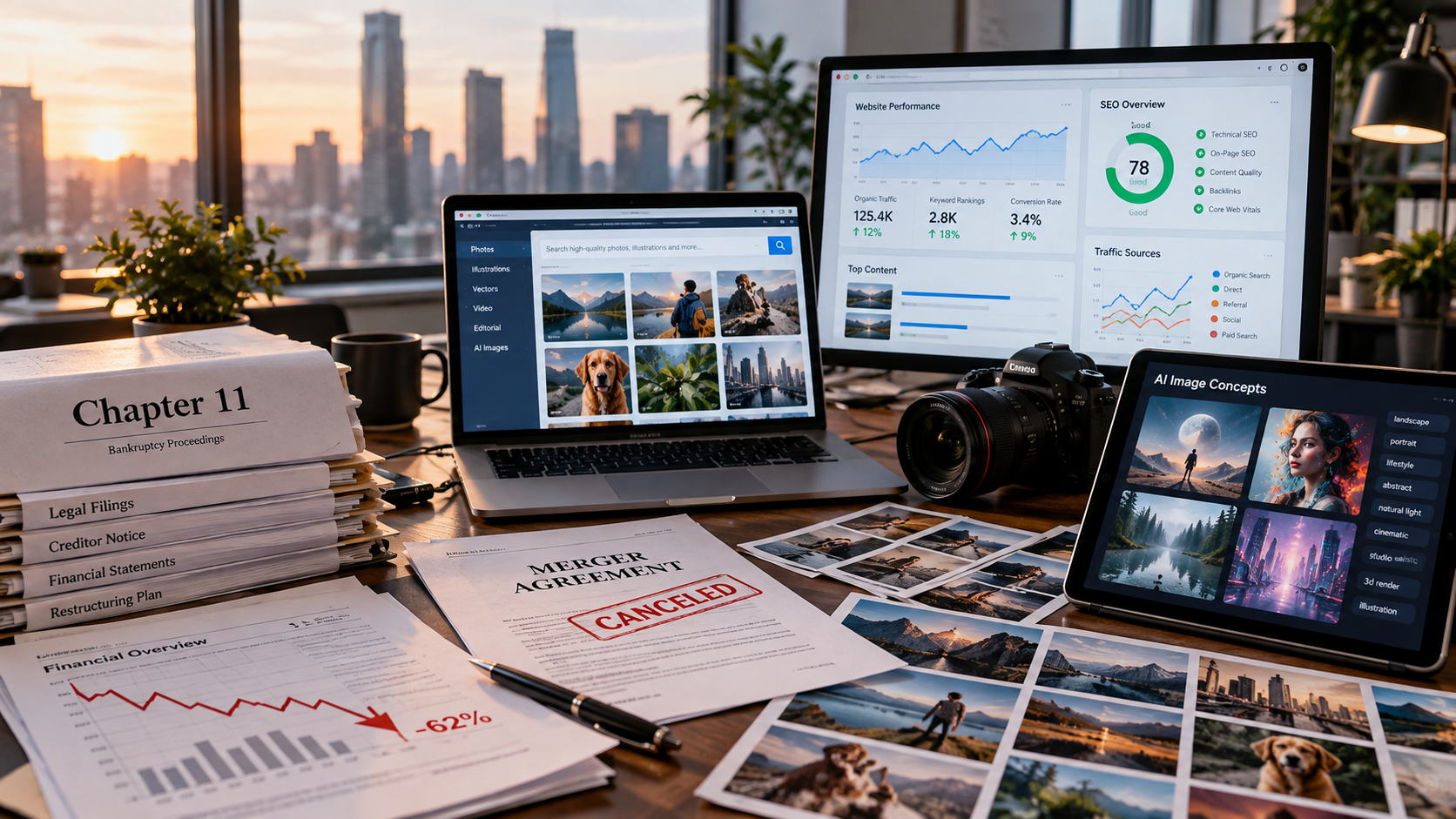
One of the world's most recognizable photography companies has filed for Chapter 11 bankruptcy protection. But the bigger story isn't that stock photography is disappearing. It's how artificial intelligence, image licensing, financial pressures, and changing visual marketing strategies are reshaping an industry that millions of websites depend on.
You've probably used a Getty Images photograph without thinking much about the company behind it.
Maybe you saw one in a news article.
Maybe it appeared in a business presentation.
Maybe you've used stock photography while creating a website, designing an advertisement, or publishing content for your company.
For decades, Getty Images has been one of the most recognizable names in professional photography and visual content licensing.
Its library includes everything from carefully staged business photographs to historic images, major sporting events, entertainment coverage, and breaking news.
So when the company announced that it had filed for Chapter 11 bankruptcy protection on October 21, 2026, the headlines understandably attracted attention.
Getty Images.
Bankruptcy.
Two words that don't sound particularly encouraging when placed together.
But before anyone starts frantically replacing every stock photograph on their website, there's something important to understand.
Getty Images is not announcing that it is shutting down.
The company has entered a planned financial restructuring intended to reduce debt, address certain legal liabilities, and transition to private ownership.
Getty says it expects to continue serving customers, contributors, and partners throughout the process.
The news follows the collapse of its proposed $3.7 billion merger with Shutterstock earlier this year.
And all of this is happening while artificial intelligence is changing how businesses create, purchase, and use visual content.
That combination makes the story especially interesting for anyone working in digital marketing.
Because this isn't simply a business bankruptcy story.
It's a look at the changing economics of creative content.
It's a reminder that licensing matters.
It's a conversation about whether businesses still need professional photography when AI can generate images in seconds.
And it's an opportunity to examine something that often gets overlooked in website design.
The images you choose are part of your marketing strategy—not just decoration.
Let's explore what's happening at Getty Images, why the Shutterstock merger fell apart, how AI is changing the photography industry, and what small businesses should consider when choosing images for their websites.
Editorial note: This article reflects developments reported through October 22, 2026. Getty's restructuring remains subject to the bankruptcy process and applicable approvals. Information about existing image licenses should be interpreted according to the specific license agreement involved.
What Happened to Getty Images?
On October 21, 2026, Getty Images Holdings, Inc. announced that it had initiated voluntary Chapter 11 proceedings in the U.S. Bankruptcy Court for the District of Delaware for certain U.S. entities.
The company described the filing as part of a previously announced restructuring agreement.
According to Getty Images' official October 21 announcement, the plan includes financial backing from members of the Getty family and affiliates of Koch Equity Development.
The proposed transaction includes an equity commitment of up to $533 million, along with changes intended to reduce debt obligations and strengthen the company's financial position.
The company expects to emerge from the restructuring as a privately held business.
The Key Facts
Here's what we know as of October 22, 2026.
It's important to distinguish a proposed restructuring from a completed transaction.
The plan is moving through the bankruptcy process, and Getty has said completion is expected by the end of 2026.
That is the company's stated expectation, not a guarantee.
Does Chapter 11 Mean Getty Images Is Closing?
No.
Chapter 11 is a legal process that can allow an organization to restructure its debts and other obligations while continuing to operate.
Some companies use Chapter 11 to reorganize and emerge as financially restructured businesses.
Others may ultimately follow a different path.
In Getty's case, the company announced a prepackaged plan supported by major financial stakeholder groups.
Getty CEO Craig Peters said the company intended to continue normal operations while addressing its financial structure.
This distinction matters because a business filing for bankruptcy protection is not automatically the same thing as liquidation.
And for Getty's customers, that's a significant difference.
Why Did Getty Images File for Bankruptcy?
Here's where the story becomes more complicated than a headline about AI-generated images destroying stock photography.
Getty has faced several financial and strategic pressures.
Those include substantial debt, legal liabilities involving investor disputes, and the collapse of the proposed Shutterstock merger.
AI competition is also changing the broader visual content industry.
But it would be inaccurate to say that AI alone caused Getty's bankruptcy.
1. Significant Debt Obligations
Getty had substantial outstanding financial obligations.
According to Reuters reporting on October 22, 2026, the company's bankruptcy proceedings involved approximately $1.46 billion in debt.
The restructuring plan is intended to reduce and reorganize aspects of that financial burden.
Debt is not inherently unusual for a large company.
But servicing debt becomes more difficult when financial flexibility is limited or other obligations increase.
2. Investor Litigation
Getty also faced expensive litigation involving investors.
Reuters reported that legal judgments, settlement payments, and potential additional liabilities contributed substantially to the company's financial pressures.
The disputes involved claims concerning investors' ability to exercise warrants.
Those are financial and legal issues that are separate from whether consumers still want professional stock photography.
This distinction is important.
A company can have valuable products and customers while simultaneously facing major capital structure problems.
3. The Failed Shutterstock Merger
Getty's planned merger with Shutterstock was intended to combine two major visual content businesses.
But that deal was ultimately abandoned in July 2026.
The collapse removed an anticipated strategic transaction at a time when Getty was already dealing with other challenges.
4. A Changing Creative Industry
At the same time, photographers, stock libraries, marketing agencies, and creative platforms are navigating rapid changes in AI-generated imagery.
Businesses have more ways to produce visuals than they did even a few years ago.
Some uses that once required selecting stock photographs can now be handled through generative AI or other design tools.
That creates competitive pressure.
But the existence of competition does not prove that AI caused Getty's specific financial restructuring.
The more accurate story is that Getty faced a combination of financial, legal, strategic, and market pressures.
For business owners, this is an important reminder not to confuse an attention-grabbing industry narrative with the full financial explanation.
What Happened to the $3.7 Billion Getty Images–Shutterstock Merger?
In January 2025, Getty Images and Shutterstock announced plans to combine their businesses.
The proposed transaction was valued at approximately $3.7 billion.
The deal attracted attention because it would have brought together two major providers of licensed visual content.
For marketers and publishers, that raised questions about the future of competition, pricing, licensing options, and image availability.
But the merger encountered regulatory obstacles.
The UK Competition and Markets Authority Investigated the Deal
The United Kingdom's Competition and Markets Authority, commonly called the CMA, examined whether the merger could reduce competition.
On May 15, 2026, the CMA announced conditional clearance.
Its findings were more nuanced than simply declaring the entire stock photography merger unacceptable.
The regulator did not identify the same level of concern about global stock content.
Instead, its principal concern involved competition in the supply of editorial content to UK media organizations.
Why Editorial Photography Was Different
Editorial photography includes photographs and videos documenting real people, events, sports, news, and entertainment.
Unlike a generic photograph of an office meeting, an editorial photograph of a particular event may be difficult or impossible to replace with another image.
If two companies both cover an actual sporting event, news conference, or celebrity appearance, combining their businesses may reduce the number of independent sources available to publishers.
The CMA concluded that preserving competition in this area was important.
It said the proposed transaction could proceed if Shutterstock sold its editorial business to a suitable buyer.
Getty Walked Away
Getty ultimately decided not to proceed under that condition.
The merger agreement was terminated on July 7, 2026.
The CMA's official announcement described the termination as a commercial decision.
This is a significant detail.
The regulator conditionally cleared the transaction with a divestiture requirement.
The companies did not complete the merger because Getty elected not to proceed under those circumstances.
For the creative industry, it highlighted something important.
Not all photographs are economically interchangeable.
A generic business photograph, a historic archival image, and an exclusive photograph of a breaking news event serve different purposes.
And that distinction becomes even more important when discussing artificial intelligence.
Why the Stock Photography Industry Is Changing
For years, stock photography offered businesses a relatively convenient solution to a common problem.
They needed professional images.
But they didn't always have the budget, time, or resources to organize a custom photo shoot.
Stock photography filled that gap.
A company could license an image of a professional meeting, family gathering, restaurant, construction site, or countless other scenes.
That model still exists.
But the number of available alternatives has grown.
Businesses Have More Visual Options
Today, a business might obtain visuals through:
Licensed stock photography.
Original professional photography.
Photography created in-house.
AI-generated images.
Custom illustrations and graphic design.
Appropriately licensed or public-domain imagery.
Each option has advantages and limitations.
There is no single correct choice for every project.
Generative AI Changes the Economics of Generic Imagery
Imagine a company needs a conceptual image for a blog post about productivity.
It may be able to generate an illustration without searching a traditional stock library.
Or imagine a marketer needs an abstract background for a presentation.
AI can produce variations quickly.
That convenience puts pressure on certain categories of interchangeable creative content.
But it doesn't eliminate the need for real-world photography.
Authentic Images Are Different
An AI-generated photograph of a fictional restaurant cannot prove what a real restaurant looks like.
A generated image of imaginary employees cannot document a company's actual team.
An illustration of a fictional event cannot replace genuine editorial evidence of something that happened.
These differences matter for credibility, accuracy, and customer expectations.
And they explain why the future of visual marketing is more complicated than choosing between AI and stock photos.
What Is the Difference Between Creative Stock Photography and Editorial Photography?
This is one of the most important distinctions in Getty's business.
Creative Stock Photography
Creative stock imagery is commonly designed for advertising, branding, websites, brochures, presentations, and other promotional projects.
It might depict a family preparing dinner.
A business professional using a laptop.
A scenic landscape.
A medical office.
Or an abstract concept.
The imagery may be staged or produced specifically for licensing.
Getty's creative collections generally include commercial-use licensing arrangements, subject to their terms and restrictions.
Editorial Photography
Editorial imagery documents subjects such as real-world news events, public figures, sports, entertainment, and other matters of public interest.
It may be licensed for descriptive or journalistic purposes.
But editorial images often carry restrictions against commercial, advertising, promotional, or endorsement uses.
According to Getty Images' licensing guidance, editorial photographs are not interchangeable with ordinary creative stock images.
Why This Matters for Business Websites
Imagine a small business owner finds a photograph of a recognizable celebrity on Getty Images.
The photograph is available for editorial licensing.
That doesn't mean the business can place it on its homepage in a way that suggests the celebrity endorses its services.
Likewise, a photograph of a real news event might be suitable for an appropriately licensed editorial article but not for an unrelated advertisement.
The intended use is critical.
An image being available for licensing does not mean it can be used for every possible purpose.
What Getty Images' Bankruptcy Means for Existing Customers
If your company currently uses licensed Getty Images photography, the news may raise questions.
Will your images disappear?
Will your license stop working?
Do you need to remove photographs from your website?
The key point is that Getty has announced plans to continue normal operations during the restructuring.
Its October 21 statement says it does not anticipate disruptions to customers, contributors, employees, vendors, or partners.
That is reassuring.
But individual licensing rights still depend on the relevant agreements.
Existing Licenses Are Not Automatically Voided by the Headline
A Chapter 11 filing is not, by itself, evidence that every customer license has been canceled.
Getty says it expects to continue fulfilling its obligations.
However, specific rights and contracts can depend on their terms and applicable law.
Businesses should retain documentation showing what they purchased and how they are authorized to use it.
Keep Your Licensing Records
For each important licensed image, businesses should maintain:
The source.
The relevant image or asset identifier.
The license agreement or applicable terms.
The name of the licensee.
The date of purchase.
The authorized usage.
Any required attribution.
And information about restrictions or expiration dates.
These records can be especially valuable when websites are redesigned or agencies change.
Check Who Actually Holds the License
Suppose a web designer purchases an image for a client's website.
Who is identified as the licensee?
The agency?
The individual designer?
The business?
Getty's licensing FAQ explains that identifying the appropriate licensee matters and that certain license arrangements have transfer restrictions.
For businesses, the takeaway is practical.
Don't assume that because your website designer downloaded an image, your company automatically possesses every right associated with it.
Clarify licensing ownership and permitted use as part of the project.
Royalty-Free Doesn't Mean Free
This is one of the most misunderstood phrases in stock photography.
A royalty-free image is not necessarily a free image.
Generally, royalty-free refers to a licensing model in which the customer obtains usage rights without paying an additional royalty every time the image is reused within the license terms.
The image may still require an initial purchase or subscription.
And restrictions can still apply.
Royalty-Free Images
Royalty-free licenses often provide broad rights across multiple projects or media, subject to the agreement.
They are commonly used for business websites, advertising, blog content, and presentations.
Rights-Managed Images
Rights-managed licensing may be tied to specific uses.
For example, the license might depend on where the image appears, the duration of use, geographic distribution, or other factors.
Editorial-Use Images
Editorial content is generally restricted to certain descriptive uses and may not be authorized for promotional purposes without additional permissions.
What About Getty Images' Free Embed Feature?
Getty offers an embed feature for certain images on qualifying noncommercial websites or blogs.
But its official guidance says the free embed option is not intended for sites using the imagery to sell products, promote or endorse something, or raise money.
This is particularly relevant to business owners.
Don't assume a free embed is appropriate for a commercial landing page.
If your website is promoting a business, review the specific licensing permissions first.
Why Using Images From Google Search Can Be Risky
One of the most common image mistakes happens before website design even begins.
Someone searches Google Images.
Finds an attractive photograph.
Downloads it.
And uploads it to a business website.
The problem?
Google Images is a search engine, not a blanket licensing service.
A photograph appearing in search results does not automatically mean it is free to use commercially.
The image may belong to a photographer, publication, stock library, business, or other rights holder.
Publicly Visible Doesn't Mean Public Domain
An image can be accessible online while remaining protected by copyright.
The ability to right-click and save a photograph does not determine whether you have permission to publish it.
Giving Credit Isn't Always Enough
Some licenses require attribution.
Others do not.
But simply writing the photographer's name below an image doesn't automatically grant usage rights.
Permission depends on the actual license or another applicable legal basis.
Cropping Doesn't Automatically Make an Image Yours
Editing an image also doesn't necessarily remove copyright restrictions.
Businesses should not assume that a crop, filter, or text overlay makes an unlicensed photograph safe to use.
Keep Image Rights Organized
A well-managed website should have an asset library containing appropriately licensed or original images.
This helps reduce confusion as the business grows and different team members edit its website.
For important commercial campaigns, seek appropriate legal advice when licensing terms or permissions are unclear.
Is AI-Generated Photography Replacing Traditional Stock Photography?
AI-generated imagery is changing the market.
But replacement is not an all-or-nothing question.
Some visual needs are well suited to AI-generated content.
Others strongly benefit from authentic photography.
And certain editorial uses require accurate documentation of actual events.
Where AI Images Can Be Useful
Generative AI may be helpful for conceptual illustrations.
Abstract backgrounds.
Imaginary scenes.
Visual brainstorming.
Early design mockups.
And creative assets where the distinction between real and fictional content is clear.
Where Real Photography Has a Strong Advantage
Original photography is particularly valuable when a business needs to show its real employees, physical location, products, completed projects, or customer experience.
Think about a restaurant.
An AI image might help create an illustrative graphic for a promotional campaign.
But a customer looking at the restaurant's menu may want to see what its food actually looks like.
Similarly, a home remodeling company benefits from showing real completed work.
A dentist's office may want to show its actual environment.
A retailer may need accurate product images.
These photographs provide information that hypothetical imagery cannot.
AI Can Support Creativity Without Replacing Authenticity
A business doesn't need to reject AI to value original photography.
AI can be one tool in the creative process.
The important question is what the image is supposed to communicate.
Is it an illustration?
A product representation?
Documentary evidence?
A brand identity asset?
The answer should guide the choice.
Getty Images Is Participating in Generative AI, Too
There's another detail that makes this story more interesting.
Getty Images isn't simply watching generative AI emerge from the sidelines.
The company offers its own generative AI tools.
According to Getty Images' Generative AI FAQ, its offering uses technology powered by Bria and a model trained on licensed creative content and proprietary data.
Getty positions this approach around commercial use and licensing protection.
Its published terms and FAQ explain that qualifying generated content can be licensed under its standard arrangements, including specified indemnification provisions.
The details matter.
No AI platform can eliminate every possible legal or reputational risk for every use.
Businesses still need to review outputs and understand applicable restrictions.
But Getty's involvement demonstrates that the company recognizes generative AI as part of the industry's future.
Getty's Role Is Evolving
Traditional stock image companies have historically focused on licensing existing photographs and illustrations.
Generative AI creates another potential service.
Instead of selecting only from images that have already been created, customers can request new visuals.
That changes the creative workflow.
It also creates questions about training data, artist compensation, originality, and intellectual property.
The Real Competition May Be About Trust and Rights
AI tools can generate an attractive image.
But commercial users may also care about where the training data came from, what permissions apply, and whether the provider offers meaningful contractual protections.
That creates a possible point of differentiation for established licensing companies.
However, Getty's financial restructuring does not demonstrate whether its AI offerings will ultimately succeed.
That remains a business question.
What Does U.S. Copyright Law Say About AI-Generated Images?
The legal issues surrounding AI-generated creative work are developing.
One important reference is the U.S. Copyright Office's January 2025 report on AI copyrightability.
The Copyright Office concluded that copyright protection depends on sufficient human authorship.
It explained that using AI as a tool does not automatically prevent protection for human-created expressive elements.
But content generated entirely by AI, without sufficient human authorship, does not automatically qualify for copyright protection.
Why This Matters for Brands
Imagine a company creates a distinctive mascot entirely through an AI image generator.
Can it assume the resulting image has the same copyright protection as a fully human-created illustration?
Not necessarily.
The answer may depend on the human contributions and the circumstances.
Likewise, the legal ability to use an AI-generated image and the ability to claim copyright ownership over it are different questions.
Copyright Isn't the Only Concern
Commercial images may also involve trademark, publicity, privacy, contractual, or advertising considerations.
An AI-generated person who resembles a recognizable real individual can create issues even if the image was generated rather than photographed.
An image depicting a business, product, or event inaccurately can also mislead customers.
For businesses, the lesson is not to avoid every AI tool.
It's to understand the rights and responsibilities associated with the images being published.
Why Authentic Photography Matters for Website Design
Let's move away from the bankruptcy filings for a moment.
When someone arrives on your website, the imagery helps create an immediate impression.
What does this business do?
Does it look professional?
Are the products relevant?
Does the company feel approachable?
Can I trust what I'm seeing?
Images help answer these questions visually.
But only if they communicate something useful.
Generic Stock Photography Can Feel Interchangeable
You've probably seen the classic business photograph.
A group of professionals smiling at a laptop.
Everyone is dressed perfectly.
The office is spotless.
The lighting is beautiful.
And absolutely nothing about the image tells you which company you're looking at.
There's nothing inherently wrong with that type of photography.
But if every competing business uses similar visuals, the image contributes little differentiation.
Original Photography Can Show Real Value
A local landscaping business can show completed projects.
A restaurant can show its dishes and dining room.
A contractor can document its workmanship.
A professional service company can introduce its actual team.
These images answer questions that generic stock photographs cannot.
Trust Comes From Accurate Representation
A website should not imply that an AI-generated office is a real location.
It shouldn't use fictional project photographs as proof of completed client work.
And it shouldn't present stock models as actual employees or customers without clear context.
A business may use illustrative imagery while still communicating honestly.
The distinction is whether the image creates a misleading impression about reality.
The best photograph isn't necessarily the most expensive or visually dramatic. It's the one that helps customers understand what they're actually getting.
How Images Affect SEO
Images aren't just part of website aesthetics.
They can also support search visibility.
Google Images, standard search results, and other Google features can display image content.
According to Google Search Central's image SEO documentation, several factors help Google discover, index, and understand images.
These include image accessibility, descriptive text, relevant surrounding content, and technical implementation.
1. Image File Names
A descriptive filename can provide a small clue about an image's subject.
For example:
commercial-building-renovation.jpg
is more informative than:
IMG_9482.jpg
But filenames alone won't make a photograph rank.
They're one part of a larger context.
2. Alt Text
Alternative text, or alt text, communicates the information or function of an image to people who cannot see it.
It can also help search systems understand image content.
Good alt text should be descriptive and relevant.
It should not be stuffed with keywords.
3. Captions and Surrounding Text
Images are easier to interpret when they're placed near relevant written content.
A photograph of a completed kitchen renovation is more useful on a page explaining that project than on an unrelated service page.
4. Image Accessibility
Search engines need to be able to discover appropriate image resources.
An image that is hidden behind inaccessible technical behavior may be difficult for crawlers to retrieve.
5. Page Relevance
A photograph doesn't exist in isolation.
The topic of the page influences how search engines interpret its meaning.
A genuine image paired with useful, specific information can strengthen the page's overall usefulness.
6. Metadata and Licensing Information
Google also supports image licensing metadata.
We'll look at that in more detail shortly.
A Crucial SEO Distinction
Purchasing an expensive Getty Images photograph does not guarantee better Google rankings.
Neither does using AI imagery automatically create an SEO penalty.
Google's published guidance focuses on helping search engines discover and understand useful image content.
The source of the image is not a shortcut to organic ranking success.
Alt Text: One of the Most Misunderstood Parts of Image SEO
Alt text is often approached as an SEO field where marketers insert keywords.
That's an incomplete understanding.
Its primary accessibility purpose is to convey useful information for people who cannot see an image.
The World Wide Web Consortium's Web Accessibility Initiative explains that different types of images require different text alternatives.
Informative Images
If a photograph communicates meaningful information, its alt text should convey that information.
For example:
Renovated kitchen with white cabinetry and a large wooden island.
That description may help someone understand what a remodeling business is showing.
Decorative Images
Some images serve no informational purpose.
They may simply add atmosphere or decoration.
In those cases, an empty alt attribute can be appropriate so assistive technology doesn't announce irrelevant information.
Functional Images
If an image acts as a button or link, its alternative text should communicate the function.
For example, a search icon used as a button needs an accessible name describing the search action.
What Not to Do
Avoid descriptions that repeat the same keyword unnaturally.
For example:
Best website design New Jersey SEO website design small business website design.
That is not useful alt text.
It's keyword stuffing.
Why Accessibility Matters Beyond SEO
A website should work for people using different devices and assistive technologies.
Accessible imagery is part of creating a better website experience.
And that's more important than squeezing another keyword into an image field.
How Image File Sizes Can Affect Website Performance
A visually impressive website can still create a frustrating experience if its images are unnecessarily large.
High-resolution photographs contain data.
More data can mean longer downloads, depending on the file, device, and connection.
If a homepage contains several oversized photographs, the page may load more slowly than necessary.
Image Compression Matters
Compression can reduce file sizes while preserving acceptable visual quality.
The appropriate settings depend on the image and intended display.
A photograph used as a small card thumbnail doesn't necessarily need the same dimensions as a large hero image.
Use Appropriate Formats
Modern image formats such as WebP and AVIF can offer efficient compression.
But compatibility, workflow, and the type of image should guide the choice.
Choose Correct Dimensions
Don't upload an unnecessarily enormous image when the website only displays it at a much smaller size.
Responsive image techniques can help serve appropriate versions for different screen sizes.
Don't Lazy-Load Everything
Lazy loading can improve performance by delaying the loading of images that aren't immediately visible.
However, lazy-loading a critical hero image can make the primary content appear later.
Google's web.dev guidance on Largest Contentful Paint recommends making important images discoverable early and avoiding unnecessary delays to the main visual element.
Image Performance and SEO
Page performance is part of a broader website experience.
But there isn't a magic file-size threshold that guarantees high rankings.
Businesses should balance visual quality, accessibility, usability, and performance.
The objective is a website that looks good and works well.
Can Images Help Businesses Appear in Google Images?
Yes, images can become discoverable through Google Images and other search features when they meet relevant technical and content requirements.
Google recommends placing images on accessible, relevant pages with meaningful context.
Original Images Can Provide Useful Context
Imagine someone searches for examples of a particular type of home renovation.
A business with actual project photography and descriptive project pages may have content relevant to that search.
A generic stock image of a kitchen may be less informative if the page doesn't explain anything distinctive.
That doesn't guarantee an original photograph will outrank a stock photo.
But it demonstrates why real imagery can provide unique value.
Captions Can Explain What the Image Shows
A project caption might identify the type of work completed, relevant materials, or other factual details.
This makes the photograph more useful to visitors.
Image Sitemaps and Technical Access
Google supports mechanisms that can help it discover images.
The implementation depends on the website.
For many small businesses, a properly configured content management system already handles much of the basic image delivery.
Image Search Isn't the Only Objective
A website image may serve other important goals.
Helping visitors understand a service.
Making a product easier to evaluate.
Demonstrating completed work.
Explaining a process.
Supporting brand identity.
SEO matters, but the image should also serve the human being viewing the page.
What Is Google Images' Licensable Badge?
One interesting intersection between Getty's business and SEO is the way search engines communicate image licensing.
Google supports licensing metadata that can make an image eligible for a Licensable badge in Google Images.
According to Google's official image metadata guidance, this information can help people understand licensing terms and locate information about how to obtain permission to use an image.
How Does It Work?
Image publishers can provide certain structured data or IPTC metadata.
Relevant information may include a license URL and a page where the image can be licensed.
Why It Matters for Photographers
A photographer publishing images online may want potential customers to understand that the work is available under specific terms.
Licensing metadata can help provide that information.
Why It Matters for Businesses
If your company uses professional photography, keeping track of the associated rights is important.
And if your business creates and licenses original visual assets, publishing appropriate metadata may help communicate how those images can be used.
It Doesn't Automatically Grant Permission
A Licensable badge indicates that licensing information may be available.
It does not mean anyone can reuse the image without following the relevant terms.
Similarly, a photograph without a visible badge is not automatically free to use.
The actual license still matters.
Does AI Search Change the Importance of Website Images?
AI-powered search is introducing new ways for people to research businesses and evaluate information.
Some search experiences can incorporate visual content, and multimodal AI systems can analyze images in addition to text.
That makes image accuracy and context increasingly interesting topics.
A Photograph Can Provide Useful Evidence
Imagine someone researching a local hotel.
Real images of the rooms and property can help them understand what the business offers.
Or consider a contractor.
Photographs of completed work can show examples of the company's services.
These images provide context that written claims alone may not communicate.
AI-Generated Images Need Clear Context
A generated illustration can be valuable when it is intended to depict a concept.
But presenting fictional imagery as evidence of a real product, property, or result can create misleading impressions.
That's a marketing issue regardless of which AI tool produced the content.
Can Better Images Guarantee AI Recommendations?
No.
There is no evidence that buying Getty Images photographs or producing original photography automatically guarantees inclusion in AI-generated answers.
Google's AI search guidance continues to emphasize established SEO fundamentals.
Businesses should focus on accurate, accessible, useful content rather than unsupported promises of guaranteed AI visibility.
Think Beyond AI Optimization
The most useful images are often the ones that answer customer questions.
What does this business look like?
What is the product?
What work has been completed?
Who will I be working with?
These questions matter whether the customer arrives through Google, an AI assistant, social media, or a referral.
The Risk of Using AI Images That Misrepresent Your Business
AI-generated visuals can be attractive.
They can also make it easy to depict things that don't exist.
This becomes a problem when the image is used as evidence of something real.
Example: A Restaurant
A restaurant could use a clearly illustrative AI image in a conceptual campaign.
But displaying an AI-generated dish as though it were an actual menu photograph may create inaccurate expectations.
Example: A Contractor
An AI-generated luxury bathroom can look impressive.
But a contractor shouldn't present it as a completed project unless that representation is accurate.
Example: A Professional Service Company
A fictional team portrait should not be presented as the company's actual employees.
Example: An Ecommerce Store
A product image should accurately represent the item being sold.
If AI-generated imagery introduces features, materials, or dimensions that aren't present in the actual product, customers may be misled.
Why This Matters Legally and Ethically
The Federal Trade Commission's advertising guidance emphasizes that commercial advertising must be truthful and not misleading.
Using AI doesn't create an exception to that principle.
Businesses should review whether the image accurately represents the offer.
AI can help create visuals. It shouldn't be used to manufacture evidence of products, people, or experiences that don't exist.
Should Small Businesses Stop Using Stock Photos?
No.
Stock photography still serves useful purposes.
A small business may not have the resources to commission custom photography for every page.
A professional stock image can be appropriate for illustrating a general concept.
The question isn't whether stock photography is inherently good or bad.
It's whether the particular image supports the business's message.
When Stock Photography Makes Sense
A blog post explaining a broad concept may benefit from a licensed stock image.
A service page might use an appropriate illustration when no authentic project image is available.
A presentation may need a polished visual that doesn't claim to document the company's operations.
When Original Photography Is Better
Actual business locations.
Real employees.
Products being sold.
Completed projects.
Customer experiences, with appropriate consent.
These are areas where authentic photographs can communicate information that generic imagery cannot.
When AI-Generated Images Can Help
Conceptual graphics.
Abstract illustrations.
Design brainstorming.
Clearly fictional scenes.
Certain visual assets created under appropriate licenses and policies.
A Hybrid Approach Is Often Practical
A business might use original photography for its homepage and important service pages.
Stock images could support educational blog content.
AI illustrations might help explain abstract concepts.
The result can be both practical and distinctive.
The best strategy is not necessarily choosing one source for every image.
It's selecting the appropriate source for each purpose.
The Hidden Cost of Cheap or Free Website Images
Businesses understandably want to control website expenses.
But evaluating imagery only by upfront price can create problems.
An image may be inexpensive while contributing little to the brand.
Another may be free to download but carry restrictions that make it unsuitable for commercial use.
A custom photograph may require more investment but provide unique content the company can use in multiple marketing channels.
Consider Total Value
When selecting an image, think about its intended lifespan.
Where will it appear?
Will it be used on the website, social media, or advertising?
Does the license permit those uses?
Does the image accurately represent the business?
Can it support multiple campaigns?
Consider Differentiation
If competing businesses all use similar stock photographs, visual branding can become interchangeable.
Original photography may help establish recognizable identity.
Consider Legal Clarity
The cheapest image isn't necessarily the least expensive choice if its usage rights are unclear.
Consider Performance
Large images can increase website load times.
Optimization is part of responsible design.
A thoughtful image strategy balances licensing, quality, relevance, performance, and business goals.
A Comparison of Common Website Image Options
The right choice depends on what your business needs to communicate.
A photograph intended to demonstrate real workmanship has different requirements from an image used to illustrate a general blog topic.
What Photographers and Creative Professionals Can Learn From Getty's Restructuring
Getty's bankruptcy also raises questions for photographers and other creative contributors.
Many image libraries depend on the work of professional photographers, illustrators, filmmakers, and other contributors.
Their work creates much of the underlying value being licensed.
Copyright and Licensing Are Different
A photographer may retain copyright ownership while granting a company certain licensing rights.
Those rights depend on the contributor agreement.
A distributor's financial restructuring does not automatically mean contributors can disregard existing contracts.
The American Society of Media Photographers published guidance following Getty's restructuring announcement, encouraging contributors to review agreements, preserve records, and monitor the proceedings.
Why Documentation Matters
Creative professionals should maintain accurate records of licensed work, royalty statements, contracts, and payments.
If a financial or contractual dispute arises, those records may be important.
AI Is Changing Creative Business Models
AI-generated imagery may alter demand for some categories of stock content.
But professional photographers continue to provide something AI cannot recreate as documentary evidence: authentic coverage of actual events and real subjects.
The value of visual authenticity remains substantial.
For businesses hiring photographers, this reinforces the importance of respecting ownership and usage terms.
What the Getty Images Story Reveals About Brand Value
Getty Images has built substantial recognition around professional visual content.
Its name is associated with major events, archives, news photography, and licensed imagery.
But brand recognition doesn't automatically resolve financial problems.
A company can be internationally recognized while facing debt, litigation, and strategic challenges.
That's a useful lesson for businesses of every size.
Brand Awareness Is Not the Same as Financial Health
Being well known doesn't guarantee profitability.
Having a large customer base doesn't eliminate debt obligations.
And offering a valuable product doesn't guarantee the business model can adapt to every market change.
Strong Branding Needs a Sustainable Business
Marketing can help communicate a company's value.
But the business still needs appropriate pricing, operating processes, financial planning, and customer relationships.
A polished brand cannot replace these fundamentals.
Markets Change
Stock photography companies have navigated multiple shifts in digital media.
The transition from physical distribution to online licensing.
Changes in publishing and advertising.
The growth of inexpensive digital photography.
Subscription-based creative platforms.
And now generative AI.
Businesses need to continue evaluating how customers obtain value.
The same applies to local service companies, retailers, and digital agencies.
A strategy that worked ten years ago may need to evolve.
A Practical Image Strategy for Small Business Websites
So what should a business owner actually do with all of this information?
Not every company needs an expensive photography campaign.
But every company should understand how its images are selected, licensed, optimized, and maintained.
Step 1: Audit the Images Already on Your Website
Review your homepage.
Service pages.
Blog posts.
Product pages.
Portfolio.
And any important landing pages.
Identify which images are original, licensed, AI-generated, or obtained from other sources.
If the source or rights are unclear, investigate rather than assuming permission.
Step 2: Prioritize Authenticity Where It Matters Most
Look at the pages that are most important to customer decisions.
Would actual team photography improve clarity?
Would real project photographs answer customer questions?
Could better product imagery reduce confusion?
These may be stronger investments than replacing every decorative image.
Step 3: Organize Your Licensing Records
Maintain a central record of asset sources and applicable rights.
This can prevent problems when a website is redesigned or different employees manage content.
Step 4: Improve Accessibility
Review informative images for appropriate alt text.
Use empty alt text for purely decorative images where suitable.
Make sure complex visual information has a usable text alternative.
Step 5: Optimize File Sizes
Use appropriately sized and compressed images.
Review large homepage visuals.
Consider modern formats where supported.
Step 6: Add Useful Context
Pair meaningful images with clear headings, captions, and relevant page content.
Step 7: Establish AI Image Guidelines
Decide when AI-generated visuals are appropriate.
Require human review.
Avoid misleading representations.
Understand tool licensing and commercial-use terms.
Step 8: Review Performance
Use available website analytics and technical performance tools to understand how pages behave.
Evaluate user experience as well as search visibility.
The goal isn't to have the largest image library.
It's to have visual content that supports the business.
What Does This Mean for the Future of Website Design?
The visual content landscape is becoming more flexible.
Businesses can choose from professional photography, traditional stock libraries, AI tools, and custom design.
That creates opportunities.
But it also increases the importance of good judgment.
Website designers need to think about more than whether a photograph looks attractive.
They need to ask whether it is accurate.
Whether it's properly licensed.
Whether it helps customers understand the business.
Whether it loads efficiently.
And whether it contributes to a coherent brand identity.
Visual Strategy Should Begin Before Design
A common website design mistake is selecting imagery only after the layout is complete.
The designer creates a section.
Then searches for any image that fits the space.
That approach may produce a visually polished page.
But it doesn't necessarily create meaningful communication.
A stronger process considers the purpose of the image from the beginning.
What question should this visual answer?
What should the visitor understand after seeing it?
Is the image demonstrating a real offering or illustrating a general idea?
Great Website Design Is More Than Filling Space
Every visual element competes for attention.
An unnecessary image can distract.
A generic image can contribute little.
An inaccurate image can create confusion.
But the right image can help someone immediately understand a product or service.
That's why thoughtful visual selection remains valuable, regardless of how powerful AI image generators become.
Frequently Asked Questions
Did Getty Images file for bankruptcy?
Yes. Getty Images Holdings, Inc. announced voluntary Chapter 11 proceedings involving certain U.S. entities on October 21, 2026, as part of a planned financial restructuring.
Is Getty Images shutting down?
Getty says it expects to continue operating normally during the restructuring. As of October 22, 2026, the company has not announced that it is closing its visual content licensing business.
Why did Getty Images go bankrupt?
The restructuring follows significant debt obligations, investor-related litigation and legal liabilities, the collapse of its proposed Shutterstock merger, and broader industry pressures. AI-generated imagery is part of the competitive environment, but the filing should not be attributed solely to AI.
Is Getty Images being bought by Charles Koch?
The restructuring plan involves members of the Getty family and affiliates of Koch Equity Development, a Koch-affiliated investment business. The proposed ownership structure would make Getty Images privately held by those investors following completion. It is not accurately described as Charles Koch personally purchasing the company alone.
How much money are the investors committing?
The restructuring agreement includes an equity commitment of up to $533 million, with additional financing of up to $143 million from a Koch Equity Development affiliate to support the process. The exact financial structure involves more than a simple all-cash purchase.
What happened to the Getty Images and Shutterstock merger?
The approximately $3.7 billion proposed merger was terminated in July 2026 after Getty decided not to proceed under a UK regulatory condition requiring the sale of Shutterstock's editorial business.
Did regulators completely block the merger?
The UK's Competition and Markets Authority conditionally cleared the transaction, subject to a divestiture requirement. Getty elected not to continue under those conditions.
Is Shutterstock also bankrupt?
The provided reporting concerns Getty Images' Chapter 11 filing. The failure of the proposed merger does not establish that Shutterstock filed for bankruptcy.
Will existing Getty Images licenses still work?
Getty says it expects normal customer operations to continue. Existing usage rights depend on the specific license agreement and applicable law. Businesses should preserve their records and consult Getty or qualified counsel if questions arise.
Can I continue using Getty Images photographs on my website?
If your business has an applicable license authorizing that use, the bankruptcy announcement alone is not a reason to assume the image must be removed. Verify your individual license terms, especially for restricted or editorial content.
Are Getty Images photographs free?
Most Getty Images photographs require an appropriate license. The company offers some limited free embedding options for qualifying noncommercial uses, but those are not blanket permissions for business websites or advertisements.
Does royalty-free mean I don't need to pay?
No. Royalty-free commonly refers to a licensing model that allows reuse under specified terms without separate royalties each time. An initial purchase or other licensing arrangement may still be required.
What is the difference between creative and editorial stock photography?
Creative stock photography is commonly licensed for commercial and promotional projects. Editorial imagery documents real people and events and often carries restrictions against advertising or endorsement uses.
Can I use a Getty Images celebrity photo in my business advertisement?
Not simply because the photo appears on Getty Images. Editorial licenses generally do not authorize unrelated commercial or promotional uses. Additional rights and permissions may be required.
Can I use images found through Google Images?
Only when you have an appropriate legal basis or permission for the intended use. An image appearing in search results does not automatically make it available for commercial reuse.
Is AI replacing stock photography?
AI-generated imagery is changing demand and providing new options for some creative tasks. However, real-world editorial coverage, authentic business photography, and certain licensed content continue serving purposes that fictional imagery cannot fully replace.
Does Getty Images offer AI-generated imagery?
Yes. Getty Images offers generative AI tools using licensed creative content and proprietary data, with defined commercial licensing and protection terms.
Are AI-generated images automatically copyrighted?
No. In the United States, copyright protection generally requires sufficient human authorship. The U.S. Copyright Office has explained that purely AI-generated material without sufficient human creative control may not qualify for copyright protection.
Are AI-generated images safe for commercial use?
Commercial usability depends on the tool's terms, image content, applicable rights, and intended use. Businesses should review outputs for misleading representations, recognizable protected material, and other concerns.
Are stock photos bad for SEO?
No. Stock photographs are not inherently bad for SEO. Google's image guidance focuses on discoverability, relevant context, descriptive information, and technical implementation.
Do original photographs rank better than stock photos?
There is no universal guarantee that original images outrank stock photography. Original photographs can provide distinctive information and support useful content, but search visibility depends on multiple factors.
What is image SEO?
Image SEO involves helping search engines discover and understand images through technical accessibility, descriptive filenames, appropriate alt text, relevant surrounding content, and other established practices.
What is alt text?
Alt text is a text alternative that conveys the relevant information or function of an image. It supports accessibility and can help search engines understand image content.
Should decorative images have alt text?
Purely decorative images should generally use an empty alt attribute so assistive technologies can ignore them. Informative and functional images require appropriate alternatives.
Can large photographs slow down my website?
Yes. Oversized or poorly optimized image files can increase download times and delay rendering. Appropriate compression, responsive sizes, and sensible loading strategies can help.
What is the Google Images Licensable badge?
It's a search feature that can display licensing information for eligible images when publishers provide relevant metadata. It doesn't automatically grant permission to reuse a photograph.
Can AI-generated images improve website conversions?
They may help in certain contexts, but effectiveness depends on relevance, quality, accuracy, audience expectations, and the broader website experience. AI-generated visuals do not automatically outperform original or licensed photography.
Should small businesses invest in professional photography?
Professional photography can be valuable when authentic images help customers evaluate products, services, teams, locations, or completed work. The appropriate investment depends on the business, audience, budget, and goals.
What is the most important lesson from Getty Images' bankruptcy?
The visual content industry is changing, but businesses still need accurate, appropriately licensed, useful imagery. The best visual strategy focuses on trust, relevance, accessibility, and business goals rather than relying exclusively on stock photos or AI-generated images.
Sources and Further Reading
This article draws on Getty Images' restructuring statements, official regulatory findings, financial reporting, licensing guidance, copyright resources, and search documentation.
Getty Images — Financial Restructuring Announcement — October 21, 2026. Official confirmation of the Chapter 11 filing, financing plan, ownership proposal, and expected continuation of operations.
Getty Images — Restructuring Agreement Announcement — October 12, 2026. Details of the planned restructuring and investment commitments.
Reuters — Getty Images Says Investor Litigation Helped Push It to Bankruptcy — October 22, 2026. Reporting on the company's debt, investor litigation, and court proceedings.
UK Competition and Markets Authority — Getty Abandons Shutterstock Merger Plans — July 7, 2026. Official explanation of the merger's termination.
UK Competition and Markets Authority — Conditional Merger Clearance — May 15, 2026. Details of the regulator's concerns about editorial content competition.
U.S. Securities and Exchange Commission — Getty Images Restructuring Filing — October 2026. Public filing describing the restructuring support agreement and proposed financial terms.
Getty Images — Content Licensing FAQ — Official explanation of royalty-free and rights-managed licensing.
Getty Images — Using Files and Editorial Images — Guidance on image usage, editorial restrictions, and the company's free embed feature.
Getty Images — Content License Agreement — Detailed license terms governing permitted uses and restrictions.
Getty Images — Generative AI FAQ — Information about its AI image generation tools, training approach, and licensing.
U.S. Copyright Office — Copyrightability of AI-Generated Works — January 29, 2025. Summary of the Copyright Office's conclusions concerning AI and human authorship.
Google Search Central — Image SEO Best Practices — Official guidance on helping Google discover and interpret images.
Google Search Central — Image Licensing Metadata — Instructions for providing license information in Google Images.
W3C Web Accessibility Initiative — Images Tutorial — Accessibility guidance for informative, decorative, and functional imagery.
Google web.dev — Optimize Largest Contentful Paint — Guidance on loading important visual content efficiently.
Federal Trade Commission — Advertising FAQs — Official guidance on truthful and nonmisleading commercial advertising.
American Society of Media Photographers — Getty Chapter 11 Restructuring Guidance — Contributor-focused guidance about contracts, payments, and licensing obligations.
Google Search Central — AI Features and Your Website — Guidance on AI-powered search features and relevant SEO practices.
Final Thoughts: Great Images Still Matter. But How We Create and Use Them Is Changing.
Getty Images' bankruptcy is significant.
The company is one of the most recognizable names in professional visual content.
Its proposed merger with Shutterstock would have reshaped parts of the industry.
And its restructuring is taking place while artificial intelligence continues changing creative workflows.
But the story isn't simply that AI has replaced stock photography.
Getty is dealing with a combination of financial, legal, and strategic challenges.
The company expects to continue operating.
And professional imagery still serves important purposes.
For small businesses, the bigger lesson is about making smarter visual decisions.
Stock photography can be useful.
AI-generated images can be useful.
Original photography can be extremely valuable.
But none of those options should be chosen solely because they're convenient or trendy.
The right image should support the message.
It should accurately represent the subject.
It should be appropriately licensed.
It should work well within the website's design.
It should be accessible.
And it should help customers understand something meaningful about the business.
Because website design isn't simply about making pages look attractive.
It's about communicating clearly.
A business can use the most beautiful stock photograph in the world and still fail to explain what makes its services different.
It can generate hundreds of AI images and still have a website that feels generic.
Or it can use a handful of carefully chosen, authentic photographs to communicate exactly what customers need to know.
The future of visual marketing isn't about choosing between photography and AI. It's about knowing when each approach genuinely adds value.
And that's a strategy worth investing in, regardless of what happens next in the stock photography industry.
Your Website Deserves More Than Generic Images and Generic Marketing
At Ritner Digital, we believe effective website design starts with understanding the business behind the website.
Your visuals, content, user experience, SEO strategy, and AI search visibility should work together to communicate what makes your company valuable.
That means choosing images intentionally.
Creating useful content.
Building accessible, responsive pages.
And making it easy for prospective customers to understand your services and take the next step.
Whether you're planning a website redesign, improving your SEO, refining your brand presentation, or evaluating how AI fits into your content strategy, Ritner Digital can help you create a more thoughtful digital presence.
Because your website shouldn't just look professional.
It should help people understand why your business deserves their attention.
Let's build a website and digital strategy that represents your business. Contact Ritner Digital →