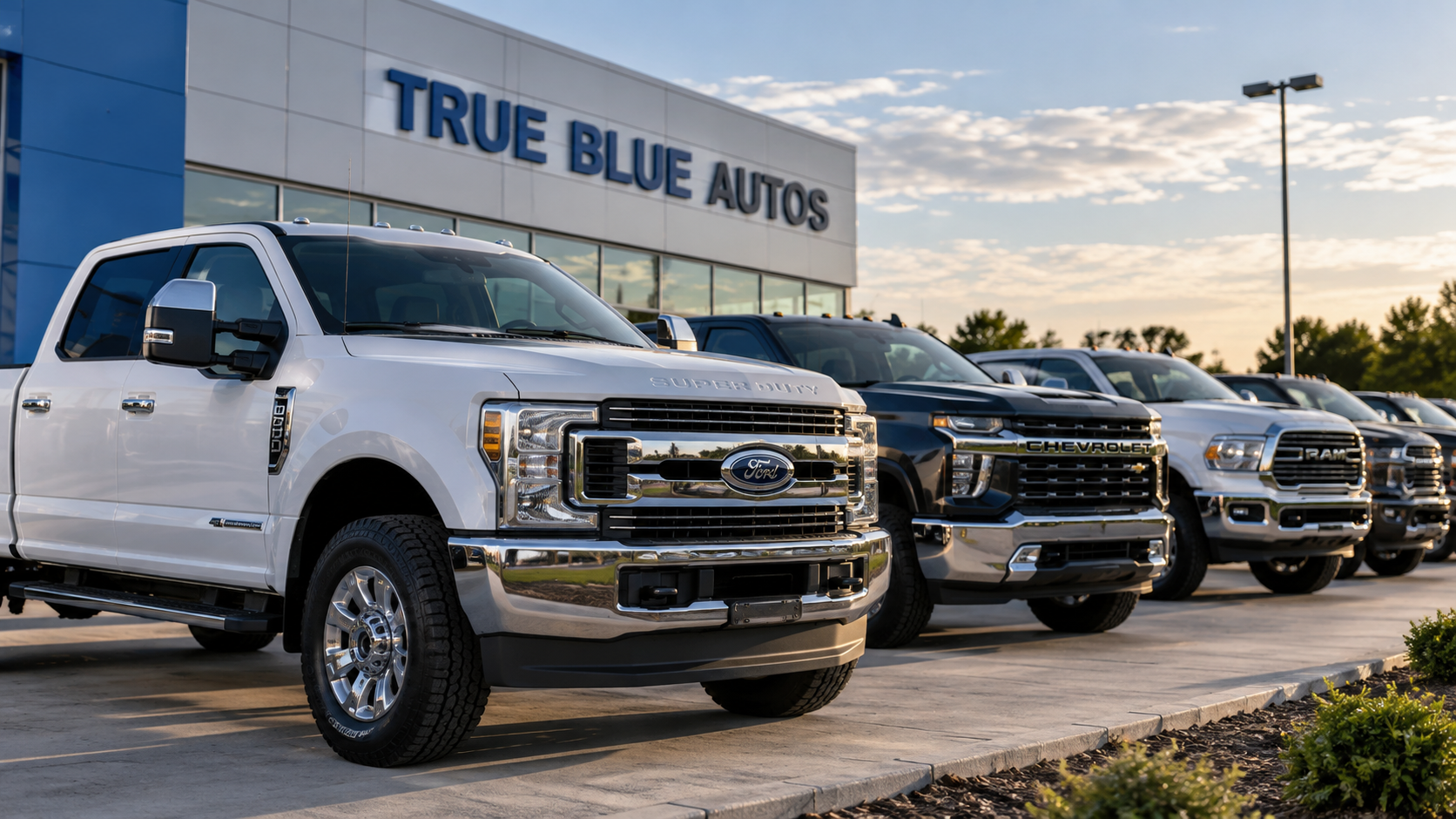
What happens when a dealership stops treating its blog like a collection of announcements and starts building a resource around the questions real buyers ask? A 22-page Ritner Digital performance report reveals measurable growth, the content driving discovery, and the next challenge: turning search visibility into direct customer inquiries.
What does a contractor do before purchasing a commercial truck?
They research.
A lot.
They compare towing capacities. They investigate payload ratings. They wonder whether a Ford F-550 is enough truck for their operation or whether they need something closer to an F-750.
They compare gas and diesel engines.
They research flatbeds, service bodies, and cab-and-chassis configurations.
And if the right truck is located several states away, they start wondering how much shipping will cost.
For a commercial truck dealership, those questions represent something incredibly valuable.
An opportunity to reach potential customers before they know which dealership they're going to buy from.
That's the idea behind the SEO content strategy developed for True Blue Autos, a dealership based in Greensburg, Indiana, specializing in commercial trucks and other vehicles.
Beginning in July 2026, Ritner Digital's SEO engagement focused on strengthening the dealership's ability to reach customers through its own website.
Rather than depending exclusively on people already searching for True Blue Autos by name, the strategy emphasized helpful information for buyers researching trucks, configurations, operating costs, and delivery.
By October, the results showed a meaningful change.
Google Search clicks increased 48.1% between the first and last 30-day periods in the analysis.
Search impressions increased 93.2%.
And several educational articles were beginning to attract visitors independently of the dealership's homepage.
But this case study isn't simply about celebrating bigger numbers.
It's about understanding what those numbers prove, what they don't prove, and how businesses can turn growing search visibility into something more valuable.
Because 50,000 search impressions aren't 50,000 customers.
A visitor reading an article isn't automatically a qualified sales lead.
And better rankings don't guarantee a dealership sells more trucks.
That's why we created a comprehensive, 22-page SEO Performance & Strategy Review for True Blue Autos.
It examines Google Search Console performance, article-level results, search behavior, geographic opportunities, Microsoft Clarity insights, and third-party visibility estimates.
It also identifies where more work is needed.
Let's walk through what the data reveals.
The Results: A 48% Increase in Google Clicks and 93% More Search Impressions
The strongest headline findings come from comparing two equally sized 30-day windows in the Google Search Console data.
Source: Ritner Digital's October 23, 2026 True Blue Autos SEO Performance & Strategy Review, using Google Search Console exports. The first and last 30-day periods fall within the July 22–October 21 observation window. Average position is a daily aggregate, not a claim that every keyword ranked seventh.
Over the full 92 complete days included in the report, Google Search Console recorded:
1,621 Google Search clicks and 123,365 search impressions.
The result that stands out isn't just the increase in clicks.
It's the growth in the number of times Google displayed the dealership's website for relevant searches.
More appearances create more potential opportunities for people to discover the business.
And when those appearances begin producing clicks to helpful articles, the website starts serving a broader audience than customers who already know the brand.
That is the strategic objective behind the campaign.
Explore the Complete 22-Page SEO Performance Report
Want to see the actual numbers, article rankings, trend charts, geographic performance, and conversion opportunities?
The complete report breaks down the findings and explains how the SEO strategy is developing.
The embedded report includes the methodology, Google Search Console performance, a content leaderboard, article case studies, search-query context, geographic targeting, device behavior, Microsoft Clarity insights, and a 90-day improvement plan.
First, What Were We Trying to Accomplish?
Before getting into rankings and traffic, it's important to understand the business objective.
True Blue Autos already had something valuable.
Brand recognition.
People were searching for the dealership by name.
That traffic matters because those customers may already be familiar with the business or actively trying to locate it.
But branded search demand has a natural limitation.
It primarily captures people who already know what they're looking for.
What about everyone else?
The contractor trying to choose between two Ford trucks?
The electrician researching the right service body?
The buyer wondering whether a truck can be shipped from Indiana to another state?
Those people might be potential customers without having heard of True Blue Autos.
That's where informational SEO becomes an opportunity.
The Difference Between Branded and Non-Branded Search
A branded search includes the business's name.
For example:
"True Blue Autos."
A non-branded search describes a need, product, or question without identifying a specific business.
For example:
"Ford F-550 vs F-750."
These searches represent different moments in a customer's research process.
The first may reflect existing brand awareness.
The second represents an opportunity to introduce the brand through useful information.
A dealership that appears only for its own name has a different discovery profile from one that also appears for relevant buying questions.
The Goal Was to Build Owned Search Demand
The term owned search demand describes the opportunity to attract interested visitors directly to a business's own website through relevant search visibility.
It doesn't mean the company owns search results or controls Google's rankings.
Rather, it reflects the strategic value of building content and customer pathways on the company's own digital property.
For True Blue Autos, the goal was to connect educational content with inventory, vehicle inquiries, contact options, and shipping information.
The long-term objective is to develop more opportunities for customers to reach the dealership directly.
That is different from claiming that third-party leads are no longer necessary.
The current report doesn't demonstrate a reduction in third-party lead spending.
It shows progress toward building another source of relevant visibility.
Why Content Marketing Makes Sense for Commercial Truck Buyers
Commercial trucks aren't ordinary impulse purchases.
A buyer may be making a significant business investment.
The wrong configuration can create operational problems.
A truck with insufficient capacity might not support the intended workload.
An unnecessarily large vehicle may introduce expenses the business doesn't need.
And selecting the wrong body or engine can affect how the truck performs in daily use.
Those are practical concerns.
They're also opportunities for useful content.
Good SEO Content Starts With a Customer Problem
Instead of beginning with a keyword and asking how many times it can be placed on a page, begin with the buyer's actual decision.
What are they confused about?
What information would help?
What tradeoffs need to be explained?
What details matter before contacting a dealership?
This approach aligns with Google Search Central's guidance on helpful, people-first content.
Google encourages publishers to create content that provides genuine value rather than pages designed primarily to manipulate search rankings.
For commercial trucks, useful content can explain specific questions about capacity, configurations, costs, and operating requirements.
The Content Should Match the Buying Journey
Not everyone researching commercial trucks is ready to buy.
Someone comparing an F-350 with an F-450 may still be trying to understand what they need.
Someone researching an F-550 flatbed may be narrowing down body configurations.
Someone checking shipping costs may be evaluating whether purchasing from an out-of-state dealership is practical.
Each person has a different question.
A useful content strategy recognizes those differences and provides a natural path toward the next step.
That next step might be another guide.
It might be browsing inventory.
Or it might be requesting availability information.
Good content can help the customer progress without treating every article like a sales pitch.
The Five Content Pillars Behind the Strategy
The True Blue Autos content program was organized around five areas of customer interest.
This structure is important.
It's the difference between publishing disconnected articles and building a connected resource that addresses several stages of the buying process.
1. Commercial Truck Model Comparisons
Model comparisons formed an important part of the content strategy.
Relevant topics included the Ford F-250, F-350, F-450, F-550, F-650, and F-750.
The purpose wasn't simply to publish specifications.
It was to explain how different trucks fit different business needs.
For example, a buyer deciding between an F-550 and an F-750 may need to consider major differences in vehicle class, payload, operating requirements, and the work the truck is expected to perform.
That creates an opportunity for a dealership to help the buyer understand their options.
2. Work-Ready Configurations
Commercial customers often buy trucks to perform particular jobs.
That makes vehicle configuration an important research topic.
The program included content about flatbeds, service bodies, cab-and-chassis options, and related uses.
A contractor hauling building materials has different requirements from an electrician organizing tools and equipment.
The more directly an article addresses those needs, the more useful it can become.
3. Engines and Operating Costs
Truck buyers often consider more than purchase price.
They may research fuel type, maintenance considerations, engine characteristics, and expected operating requirements.
The content program included gas-versus-diesel comparisons and discussion of Ford's 6.7L Power Stroke diesel and 7.3L gasoline engines.
These topics are relevant because engine choice affects the ownership experience.
4. Buying and Shipping
A customer considering a truck hundreds of miles away may have concerns about delivery.
How much will shipping cost?
How long could it take?
What factors change the price?
What should they expect during the process?
Addressing those questions can make researching an out-of-state purchase easier.
For a dealership serving customers beyond its immediate area, that information has strategic value.
5. Geographic Relevance
The campaign also explored content relevant to buyers in Indiana and Ohio.
The objective was to introduce the dealership to people researching commercial vehicles in markets outside Greensburg.
These pages were still early in their development at the time of the report.
More on that shortly.
Bringing the Content Together
Rather than leaving these articles as isolated pages, the strategy includes a central resource: The Complete Guide to Buying and Shipping a Commercial Work Truck.
The guide connects model comparisons, engine discussions, configuration information, and shipping resources.
For visitors, this makes related information easier to navigate.
For the website, it creates a more organized network of relevant pages.
And for the dealership, it provides multiple opportunities to guide readers toward available vehicles.
The Breakthrough Article: Ford F-550 vs. F-750
One of the clearest examples of content-driven search discovery comes from the dealership's Ford F-550 vs. F-750 comparison.
Across the three-month reporting period, the article generated:
101 Google Search clicks, 21,648 search impressions, and an average position of 4.41.
This was the strongest article result by clicks in the report's content leaderboard.
Why is that significant?
Because the subject isn't merely a dealership announcement.
It's a comparison that potential buyers may actively research.
The article addresses questions involving commercial truck classes, capacity, operating requirements, and the practical difference between two vehicle platforms.
That gives the business a chance to enter the conversation before the buyer has selected a dealership.
Search Visibility Creates a New Point of Introduction
Imagine someone researching whether their operation needs an F-550 or F-750.
They encounter a useful comparison published by True Blue Autos.
The article helps them understand the options.
Then they notice that the dealership carries commercial vehicles relevant to the decision.
That's the intended connection between content and commerce.
The guide is not simply there to attract a click.
It's there to create a useful introduction to the dealership.
Ranking Position Isn't the Same as a Guaranteed Result
The report's average position of 4.41 is a Google Search Console metric.
It does not mean the article appeared fourth for every search.
Rankings vary by query, search context, location, and other factors.
Google's Search Console documentation explains how average position is calculated.
Still, the combination of impressions, clicks, and an average position near the top of results offers meaningful evidence that the page is being discovered.
And that is exactly what the content was intended to accomplish.
Another Strong Result: Ford F-350 vs. F-450
The Ford F-350 vs. F-450 comparison produced another strong result.
Across the same reporting period, it generated:
83 Google Search clicks, 20,820 search impressions, and an average position of 6.33.
This article addresses a related but distinct buying decision.
The F-350 and F-450 may appear relatively similar to someone unfamiliar with commercial trucks.
But their available configurations, towing capabilities, and intended applications can make the distinction important.
The article provides context for those differences.
Together, Two Articles Created Meaningful Visibility
Combined, the two comparison pages generated:
184 Google Search clicks and 42,468 search impressions.
Those are page-level results for two specific URLs during the three-month period.
They should not be interpreted as 184 unique buyers or 184 confirmed leads.
But they do demonstrate something useful.
Two educational articles created measurable opportunities for people to find the dealership while researching real commercial vehicle decisions.
That's the practical value of topic-specific SEO.
Beyond Comparisons: Why Supporting Content Matters
Not every customer searches for a comparison between two model numbers.
Some already understand what size truck they need.
They're now investigating the body style, industry application, or logistics of purchasing it.
The True Blue Autos report shows that those supporting topics were attracting search visitors, too.
F-550 Flatbed Buyers Guide
The F-550 Flatbed Truck Buyers Guide recorded 51 clicks and 7,433 impressions during the three-month period.
It also received eight clicks in the latest complete week.
The article addresses a practical configuration decision.
A business purchasing a flatbed may need to consider materials, equipment, body dimensions, and intended use.
This kind of content can help connect informational searches with relevant inventory.
How Much Does It Cost to Ship a Truck?
The truck shipping cost guide recorded 37 clicks and 8,185 impressions.
This subject matters because geographic distance can be a barrier to purchasing.
A buyer might find an attractive truck but hesitate because they're uncertain about transportation costs.
Useful shipping information can help them evaluate whether the purchase is practical.
That doesn't prove the article generated a sale.
But it addresses a genuine question that may arise before a buyer contacts the dealership.
Service Trucks for Electricians
The guide to service trucks for electricians generated 27 clicks and 2,533 impressions.
This is an interesting example of connecting a vehicle category to a profession.
Rather than discussing service trucks in general, the content addresses buyers with particular storage and equipment needs.
That kind of specificity can make an article more relevant to its intended audience.
Why the Variety Matters
Model comparisons, truck bodies, trade-specific applications, and shipping information address different stages of customer research.
Together, they give the website multiple opportunities to provide useful information.
And they establish a content structure that can be expanded when the data reveals new demand.
Why Impressions Increased Faster Than Clicks
Now let's talk about something that might surprise anyone looking only for positive statistics.
True Blue Autos' overall click-through rate actually declined between the first and last 30-day windows.
It moved from 1.55% to 1.19%.
At the same time, clicks increased 48.1%.
How can both things happen?
Because search impressions grew even faster.
More Search Appearances Don't Automatically Mean a Higher Click Rate
Click-through rate, or CTR, measures clicks as a percentage of impressions.
If a website starts appearing for a much larger collection of search queries, its exposure can increase substantially.
But not every appearance will be equally relevant or equally likely to produce a click.
Some queries may reflect early research.
Others may involve search results with strong competing pages or answer features.
And some rankings may be less prominent than others.
That creates a situation where overall CTR falls while total traffic grows.
Why This Isn't Automatically a Negative Result
The decline deserves attention.
But it shouldn't erase the fact that the website received more actual Google clicks.
The more useful question is whether the growing search footprint includes relevant opportunities.
In this case, the report documents increasing exposure for practical commercial-truck topics.
It also identifies specific high-impression pages that could benefit from further optimization.
The Opportunity: Improve Existing Search Results
For example, the F-350 vs. F-450 guide generated 20,820 impressions and 83 clicks, corresponding to an approximate 0.4% CTR.
The F-550 vs. F-750 guide generated 21,648 impressions and 101 clicks, or approximately 0.47%.
Those results suggest opportunities to investigate how people see and respond to the pages in search results.
Possible improvements include reviewing titles, meta descriptions, query intent, and the relevance of information presented early on the page.
But a lower CTR doesn't automatically prove that a page's title is bad.
Search-result layouts, competing content, user intent, and ranking distribution can all influence the result.
This is where SEO becomes an ongoing optimization process rather than simply a publishing schedule.
The Growth Wasn't Limited to One Good Week
One of the strongest signals in the report comes from the most recent weekly data.
Across three consecutive complete weeks, Google clicks increased:
The latest week represented a 23.4% increase over the preceding week.
That pattern is encouraging because it demonstrates that recent growth was not limited to a single daily spike.
The Latest 28-Day View Supports the Trend
The report also found that the latest 28-day period generated 577 clicks and 49,232 impressions.
Compared with the preceding 28-day window:
Clicks increased 10.7%.
Impressions increased 28.7%.
These are separate comparison windows from the first-versus-last 30-day figures.
They shouldn't be mixed together as though they're the same calculation.
But they provide additional context.
Visibility and clicks were continuing to develop.
Why Consistent Reporting Windows Matter
It's easy to make analytics look impressive by comparing a complete month with a partial one.
Or by selecting unusually strong days.
The report avoids that approach by using completed, equally sized reporting windows.
For businesses, this is an important measurement principle.
Choose meaningful date ranges.
Keep comparisons consistent.
And distinguish complete reporting periods from preliminary data.
The most recent 24-hour activity in the report was explicitly treated as preliminary—not as another definitive growth milestone.
What the Search Queries Reveal About Brand Awareness
Here's another important piece of the story.
True Blue Autos already receives considerable branded search activity.
That is a strength.
But the SEO strategy was designed to complement branded demand with new discovery.
In the latest 28-day query export, Google disclosed 299 clicks associated with visible search terms.
Of those:
233 clicks came from branded variants.
66 came from other disclosed search terms.
But the sitewide Search Console total for that period was 577 clicks.
Why the difference?
Google doesn't always disclose every query in its reports.
Privacy protections and reporting behavior can limit visible query-level detail.
Don't Treat a Partial Query Export as the Entire Audience
It's tempting to look at the 233 branded clicks and 66 other clicks and calculate a complete branded-versus-non-branded sitewide percentage.
That would be misleading.
Those counts represent only the queries disclosed in the export.
They don't classify all 577 sitewide clicks.
The appropriate conclusion is more careful.
The visible query sample remains heavily branded.
At the same time, article-level performance shows that the site is attracting visitors through topics that don't require a customer to search for the dealership's name.
That is an important distinction.
Why Article-Level Performance Is Useful
A buyer clicking the F-550 vs. F-750 comparison may have found the dealership through a commercial-truck research question.
The landing page provides a point of introduction.
This kind of discovery complements existing brand traffic.
Over time, the objective is to understand whether those research visits lead to inventory browsing, inquiries, and customer relationships.
Expanding Beyond Greensburg: The Geographic SEO Opportunity
True Blue Autos is based in Greensburg, Indiana.
But commercial-truck purchasing isn't always limited to the buyer's immediate neighborhood.
A contractor may be willing to travel or arrange delivery if the available truck meets their requirements.
That creates a potential opportunity to reach customers in surrounding markets.
The SEO strategy included geographic content relevant to Indiana and Ohio.
However, the report is appropriately cautious about the results.
What the Early Data Shows
Several location-oriented pages were receiving impressions in Google Search.
Examples from the latest 28-day period include:
These figures describe Search Console performance for specific location-targeted article URLs.
They do not establish that every impression came from a person physically located in the named city.
That's an important methodological distinction.
Visibility Comes Before Proven Geographic Demand
These pages are beginning to appear in relevant searches.
But most haven't generated clicks yet.
And the report doesn't establish qualified leads or sales attributable to those pages.
That means it's too early to call the geographic expansion a commercial success.
It is better described as an emerging visibility opportunity.
What Should Happen Next?
Geographic content needs to offer genuine value.
That might mean discussing actual inventory availability, shipping considerations, or needs relevant to commercial buyers in the target market.
It should also provide a clear route to contacting the dealership.
Creating dozens of pages that simply repeat city names is not a strong long-term strategy.
Relevant information matters more than the number of locations mentioned.
Why Mobile Experience Matters So Much
One of the clearest findings in the report involves device usage.
During the three-month Google Search Console reporting period:
68.2% of Google Search clicks came from mobile devices.
Desktop represented 29.0%, while tablets accounted for 2.8%.
That should influence how the website is evaluated.
A Commercial-Truck Buyer May Be Researching From a Phone
Someone may be on a jobsite.
In an office.
At home after work.
Or comparing options during a break.
They may be looking at a detailed comparison article on a relatively small screen.
The website needs to remain understandable in those conditions.
What Mobile Visitors Need
A buyer reading about an F-550 should be able to navigate to relevant inventory without searching through confusing menus.
They should be able to locate contact information.
They should understand how to ask about a vehicle.
And they should be able to read comparison tables without fighting the layout.
Mobile SEO Is Also a User Experience Question
Google's page experience documentation encourages businesses to consider mobile usability, performance, secure connections, and the overall experience.
For True Blue Autos, the report identifies practical priorities.
Clear article-to-inventory links.
Visible calls to action.
Simple inventory navigation.
And attention to performance and layout stability.
The importance of these improvements is supported by actual device data.
This isn't a hypothetical mobile-first recommendation.
Most recorded Google Search clicks during the period came from phones.
Where Visitors Go After They Arrive
Search visibility is only the first part of the customer journey.
Once someone reaches the website, what happens next?
To better understand on-site behavior, the report includes Microsoft Clarity data.
Clarity tracks website sessions and interactions that can help identify how visitors use pages.
From October 1–23, 2026, with the last day partial, the report recorded:
4,461 sessions, 3,570 unique users, 1.94 pages per session, and 48 seconds of active time.
These are broader website behavior metrics.
They are not interchangeable with Google Search Console clicks.
Why the Numbers Are Different
Search Console reports clicks from Google Search.
Clarity records website sessions across multiple traffic sources.
Someone arriving from Facebook, a referral, or a direct visit may appear in Clarity without generating an organic Google Search click.
Likewise, a Search Console click is not automatically a new unique person.
Using the metrics interchangeably can create exaggerated performance claims.
Inventory Is an Important Destination
The report shows substantial activity on the dealership's inventory pages.
The inventory landing page appeared in 1,910 Clarity sessions.
A particular F-750 vehicle listing appeared in 1,041 sessions.
The homepage appeared in 808.
The contact page appeared in 518.
These counts represent sessions containing the named URLs—not necessarily sessions that began there.
They also aren't limited to organic search traffic.
Still, they reinforce an important business principle.
People are using the website to explore actual inventory.
The SEO strategy should support that behavior rather than distract from it.
Content Needs a Natural Route to Inventory
Imagine a visitor finishes reading a comparison explaining why an F-750 might suit their operation.
What's the next logical question?
“Do you have one available?”
The website should make that next step easy.
Not every article needs to be filled with aggressive sales buttons.
But relevant internal links can connect useful information with the customer's next decision.
That is the opportunity.
The Most Important Limitation: More Clicks Doesn't Mean More Verified Leads
This may be the most important section of the entire case study.
The report shows clear organic visibility growth.
It shows increased Google clicks.
It identifies useful articles that are generating search visits.
But it does not establish exactly how many sales came from SEO.
Nor does it confirm that the dealership reduced spending on third-party leads.
And it's important not to pretend otherwise.
Microsoft Clarity Shows Behavioral Events
The report contains the following Clarity smart event counts:
176 “Submit form” events.
25 “Contact us” events.
2 “Request quote” events.
Those are useful signals.
But they should not be presented as 203 verified leads.
Microsoft's Smart Events documentation explains that these events can be inferred or configured from website interaction patterns.
Depending on implementation, a recorded event may not equal a completed, qualified business inquiry.
A button click and a successfully submitted inquiry are not necessarily the same thing.
What Needs to Be Verified?
The next phase should establish whether an event resulted in an actual successful contact.
That may involve Google Analytics 4 event tracking, confirmed form submissions, phone-call records, and customer relationship management data.
A dealership should be able to answer practical questions.
Which article did the customer visit first?
Did the person browse inventory?
Did they submit a valid inquiry?
Was the inquiry relevant to an available truck?
Did it result in a real sales conversation?
And was a sale ultimately recorded?
Why This Matters for SEO Reporting
A report claiming hundreds of leads without verification may sound impressive.
But it doesn't provide a reliable basis for business decisions.
A stronger approach separates visibility metrics from commercial outcomes.
The True Blue Autos report does exactly that.
It presents demonstrated search growth while identifying lead attribution as the next measurement priority.
Where the Website Experience Can Improve
The Clarity data also reveals areas worth investigating.
These aren't necessarily evidence that the website is broken.
They are behavioral signals that can help prioritize improvements.
Dead Clicks
The report recorded 351 sessions containing dead clicks, representing 7.87% of sessions.
A dead click can occur when someone interacts with an element that doesn't respond as expected.
Sometimes the element looks clickable but isn't.
Other times the user may be attempting an action that doesn't exist.
These interactions deserve review.
Especially on inventory and contact pages.
Quick-Back Sessions
The report identified 560 quick-back sessions, representing 12.55%.
A quick back can indicate that someone returned rapidly after visiting a page.
That may reflect unmet expectations or navigation friction.
But it can also occur for other reasons.
The appropriate next step is to inspect relevant sessions and page journeys before assuming every quick back is a failure.
Website Performance
Clarity reported approximate performance signals of:
Largest Contentful Paint: 2.99 seconds.
Interaction to Next Paint: 200 milliseconds.
Cumulative Layout Shift: 0.266.
These measurements suggest areas worth reviewing, particularly loading performance and visual stability.
For example, a page that shifts while someone attempts to tap an inventory link may create unnecessary frustration.
The report recommends further performance investigation.
It does not claim these figures by themselves explain all user behavior or all search performance.
Why Conversion Optimization Matters
The dealership now has more opportunities for search discovery.
The next challenge is ensuring visitors can move smoothly from information to an appropriate action.
That might mean asking about a truck.
Browsing a relevant inventory category.
Requesting shipping details.
Or contacting the dealership.
More organic traffic becomes increasingly valuable when the website can support those transitions effectively.
What About Backlinks, Keyword Rankings, and AI Search?
The report also includes a SEMrush snapshot dated October 23, 2026.
This provides supplementary information about the website's estimated organic reach, keyword footprint, backlinks, and AI search visibility.
The snapshot reported approximately:
528 estimated organic visits.
277 ranking keywords.
1,000 backlinks.
An AI Visibility score of 18.
10 tracked AI mentions.
These figures are useful as directional information.
But they're different from first-party Search Console measurements.
Estimates Aren't the Same as Recorded Google Clicks
SEMrush estimates organic traffic using its own models.
Google Search Console reports actual clicks recorded in Google Search for the verified property.
Those numbers don't have to match.
And the estimated 528 visits should not replace the 1,621 Search Console clicks recorded over the reporting period.
They answer different questions and may cover different windows.
More Backlinks Don't Automatically Mean More Authority
The snapshot showed substantial growth in the backlink count.
But before attributing an improvement in authority, the next step is to examine link quality, unique referring domains, and historical context.
A larger number of links isn't automatically better.
AI Mentions Aren't Website Visitors
The 10 reported AI mentions indicate that the tracking tool identified references within its monitored AI search environment.
They do not represent ten visits.
Ten inquiries.
Or ten sales.
Likewise, an AI Visibility score is a tool-specific metric, not a universal measurement of how often every AI assistant recommends the business.
AI Search Is Still Worth Monitoring
Google explains that established SEO best practices remain relevant to its AI Overviews and AI Mode.
Helpful content, technical accessibility, and clear information continue to matter.
For True Blue Autos, the immediate priority isn't chasing an arbitrary AI score.
It's maintaining useful, accurate vehicle content while measuring how people discover and interact with the dealership.
Why This Is More Than an Automotive SEO Case Study
Although this report focuses on a commercial truck dealership, the underlying strategy applies to many businesses.
A local contractor might create content explaining project materials, timelines, and costs.
A professional service firm might answer questions about its process.
A medical practice might publish appropriately reviewed educational information.
A retailer might explain differences between products.
The principle is consistent.
Answer questions customers have before they know which company to contact.
Educational Content Can Introduce a Business Earlier
Many businesses focus almost entirely on search terms describing their services.
That's important.
But prospective customers may begin researching long before they're ready to request a quote or make a purchase.
Useful content creates another opportunity for discovery.
Specificity Often Matters More Than Volume
A detailed article that explains a real decision may provide more value than several generic posts that cover similar topics superficially.
The True Blue Autos comparison guides demonstrate the potential of specificity.
They address a particular truck decision with information relevant to the intended buyer.
Content Needs to Connect to the Business
Educational content should have a reasonable relationship to the company's offerings.
A dealership writing about commercial truck configurations makes sense.
A business publishing unrelated trending topics solely for traffic may attract visitors who have little interest in its services.
The goal is relevant discovery.
Not traffic for its own sake.
What We'd Prioritize Over the Next 90 Days
The report concludes with a practical roadmap.
And notably, its first recommendation isn't simply to publish as many additional articles as possible.
The next stage emphasizes making better use of the visibility already earned.
First 30 Days: Increase Clicks From Existing Rankings
Begin with articles that already appear frequently in Google Search.
Review their search-query data.
Investigate whether the page title matches what people want to know.
Examine the clarity of the information presented in search results.
Evaluate whether readers can easily move from the article to relevant inventory.
Then monitor the response.
This approach focuses on improving pages with demonstrated search exposure.
By 60 Days: Verify Conversion Pathways
Next, improve attribution.
Confirm which form events represent successful inquiries.
Track important calls and quote requests.
Connect website activity to customer records where appropriate and lawful.
Review mobile interaction friction.
The objective is to understand whether search visitors are becoming relevant business opportunities.
By 90 Days: Expand Proven Topics
Continue developing content around subjects already showing demand.
That may include updating the strongest Ford comparisons.
Creating adjacent content about commercial vehicle configurations.
Improving shipping resources.
And developing geographically relevant information for buyers who may purchase from outside Greensburg.
But expansion should follow evidence.
Not simply a desire to increase the number of published articles.
What We Can Responsibly Say About the Results
Good case studies need an important ingredient.
Honesty about the evidence.
The True Blue Autos report supports several conclusions.
Google Search visibility increased substantially during the observed period.
Recorded Google clicks also increased.
Specific commercial-truck guides generated measurable search discovery.
Recent weekly activity showed further momentum.
And the website now has identifiable opportunities to improve click-through rate, mobile usability, and conversion tracking.
Those are meaningful findings.
But the report does not prove that SEO alone caused every increase.
It does not establish that all article visitors were new customers.
It does not confirm that a certain number of commercial trucks were sold because of the program.
And it does not quantify savings from reduced dependence on third-party leads.
The SEO engagement began July 1, 2026, while the available Search Console exports begin July 22.
That means this is an analysis of observed growth during the engagement, not a strict comparison against a pre-engagement June baseline.
Those distinctions don't diminish the results.
They make the analysis more useful.
A business owner needs to know what is happening and what should be measured next.
Not just receive a collection of flattering statistics.
Five Lessons Other Small Businesses Can Take From This SEO Strategy
Lesson 1: You Don't Need to Wait Until Customers Know Your Name
Branded searches are valuable.
But a business can also reach potential customers by answering questions related to its products and services.
This is especially useful in industries where customers research complicated purchasing decisions.
Lesson 2: Content Should Solve a Problem
The strongest True Blue Autos articles address specific truck comparisons and buying questions.
They aren't generic announcements.
They're resources designed to help someone make a decision.
Lesson 3: More Impressions Are an Opportunity, Not the Finish Line
A search impression is a chance to be discovered.
A click represents a person taking the next step.
A qualified inquiry represents something different again.
Each stage matters.
Lesson 4: Traffic and Revenue Require Different Evidence
Search Console can show clicks.
Clarity can reveal behavior.
Analytics tools can record events.
But sales attribution requires connecting these signals to actual business outcomes.
Lesson 5: SEO Requires Iteration
The next phase of the program is focused on improving existing content, strengthening conversion pathways, and expanding topics supported by data.
That is how a content strategy develops beyond its initial publishing phase.
Frequently Asked Questions
What is commercial truck dealership SEO?
Commercial truck dealership SEO involves improving a dealership's discoverability in search engines for relevant vehicle, inventory, buying, and service-related queries. It can include technical SEO, helpful content, inventory optimization, and local or regional search strategies.
How much did True Blue Autos' Google traffic increase?
The report found a 48.1% increase in Google Search clicks, from 418 to 619, between the first and last 30-day windows within the observed reporting period. This is measured click growth, not a verified increase in sales.
How much did search impressions increase?
Search impressions increased 93.2%, from 27,001 to 52,153, between the comparable 30-day windows.
What reporting dates were used?
The primary three-month Search Console view covered July 22 through October 21, 2026, representing 92 complete days. The report also examined shorter 28-day and seven-day periods and a preliminary rolling 24-hour window.
When did Ritner Digital's engagement with True Blue Autos begin?
According to the report, the SEO engagement began July 1, 2026. The available Search Console exports begin July 22, so the report does not provide a complete pre-engagement baseline.
Which True Blue Autos article performed best?
The Ford F-550 vs. F-750 comparison generated the most clicks among the listed educational articles, with 101 Google Search clicks and 21,648 impressions over the three-month reporting period.
Did the dealership's SEO content generate sales?
The report documents search visibility and traffic growth but does not establish a verified count of sales attributable to SEO. Connecting article visits to qualified inquiries and sales is a priority for the next phase.
Why did click-through rate fall even though clicks increased?
Impressions grew faster than clicks, expanding the number of search appearances. As a result, overall CTR decreased from 1.55% to 1.19% while total clicks increased. Different query types, rankings, and search-result features can contribute to this pattern.
Does ranking on Google's first page guarantee customers?
No. Search rankings may create opportunities for discovery, but they do not guarantee clicks, qualified inquiries, or purchases.
Are educational blog articles useful for dealerships?
They can be, particularly when they address real buyer questions and connect naturally to relevant vehicles or services. True Blue Autos' truck comparison and buying guides demonstrate measurable search visibility for this type of content.
What are branded searches?
Branded searches include a business or product name. For example, someone searching specifically for True Blue Autos is performing a branded search. Non-branded searches can provide opportunities to reach people who aren't yet familiar with the company.
Can a dealership reach customers outside its city through SEO?
Potentially. Relevant content can become discoverable across multiple locations. However, geographic visibility should be evaluated carefully and ultimately connected to real customer inquiries and business outcomes.
What is Google Search Console?
Google Search Console is a free Google tool that helps website owners understand search performance, including clicks, impressions, click-through rate, average position, and other information.
What is Microsoft Clarity?
Microsoft Clarity is a website behavior analytics tool that provides session-level information, interaction signals, and other data to help businesses understand how visitors use their sites.
Are Clarity form events the same as verified leads?
Not necessarily. Automatically detected smart events may represent interaction patterns rather than completed, qualified inquiries. Important conversion events should be validated against successful submissions and business records.
Why is mobile website design important for SEO?
Mobile visitors need to read content, navigate, and take action comfortably. In the True Blue Autos report, 68.2% of recorded Google Search clicks came from mobile devices, making mobile usability a practical priority.
Does content marketing improve AI search visibility?
Helpful, accessible content may support discoverability in some AI-powered search experiences, but inclusion is not guaranteed. Google states that established SEO practices remain relevant to AI Overviews and AI Mode.
Should businesses publish more articles or optimize existing content?
The answer depends on performance. When existing articles already receive substantial search impressions, improving their usefulness, search presentation, and conversion pathways may be a sensible priority before publishing more.
How long does SEO take to work?
There is no universal timeline. Results depend on competition, website history, technical condition, content quality, search demand, and other factors. This case study documents measured growth over a 92-day period within an ongoing engagement, not a guaranteed timeline for other businesses.
What should businesses measure beyond Google rankings?
Useful measures can include relevant search clicks, engagement with important pages, verified inquiries, qualified leads, customer acquisition costs, and sales. The appropriate metrics depend on the business objective.
What's the biggest lesson from this case study?
A business can expand its search visibility by creating content around the questions customers genuinely ask. But sustainable SEO reporting should distinguish discovery metrics from confirmed commercial outcomes.
Sources and Reporting Methodology
This case study is based primarily on Ritner Digital's 22-page “True Blue Autos — Building Owned Search Demand” SEO Performance & Strategy Review, dated October 23, 2026.
The report uses Google Search Console exports, Microsoft Clarity data, a SEMrush snapshot, and the dealership's published website resources.
For readers who want to examine the tools and concepts discussed, the following references provide additional context.
True Blue Autos — Official Website — The dealership's live website, inventory, and customer resources.
True Blue Autos — Complete Guide to Buying and Shipping a Commercial Work Truck — The central content resource connecting comparison, configuration, and shipping information.
True Blue Autos — Ford F-550 vs. F-750 — The highest-click educational article in the report's content leaderboard.
True Blue Autos — Ford F-350 vs. F-450 — Another leading model comparison resource.
True Blue Autos — How Much Does It Cost to Ship a Truck? — An example of content addressing a practical purchasing concern.
Google Search Console — Performance Report Documentation — Definitions and interpretation of clicks, impressions, CTR, and average position.
Google Search Central — Creating Helpful, Reliable, People-First Content — Google's guidance on useful, trustworthy content.
Google Search Central — Understanding Page Experience — Guidance on usability, performance, and mobile experience.
Microsoft Clarity — Smart Events — Documentation explaining website interaction events and how they are configured.
Google Search Central — AI Features and Your Website — Official guidance on AI-powered search features and established SEO practices.
Important Measurement Notes
The 48.1% click growth and 93.2% impression growth compare the first and last 30-day windows within the available observation period.
The 1,621 clicks and 123,365 impressions describe the complete July 22–October 21 Google Search Console period.
Article-level figures are taken from Search Console page exports. Different report views and aggregation methods may not reconcile perfectly.
Microsoft Clarity sessions include traffic from channels beyond organic Google Search and must not be added to Search Console clicks.
SEMrush figures are third-party estimates or tool-specific indicators rather than verified inquiries or sales.
The report does not establish how many purchases or qualified leads can be attributed to SEO, nor does it establish a reduction in third-party lead spending.
Explore the Full 92 Days of Google Search Performance
Explore Every Page Behind the SEO Results
Final Thoughts: The Goal Isn't Just More Traffic. It's More Direct Opportunities.
The True Blue Autos SEO report tells a useful story.
In a little over three months of observed search data, the dealership's Google visibility expanded significantly.
More people encountered its website in search results.
More people clicked through.
And educational pages about commercial-truck comparisons, configurations, and shipping began attracting their own audiences.
Those results show why content marketing can be valuable for businesses with complex products.
Customers often have questions before they're ready to buy.
A website that answers those questions has an opportunity to participate earlier in the decision-making process.
But the case study also highlights something equally important.
SEO doesn't end when someone reaches your website.
The visitor still needs to understand the business.
Find relevant products.
Navigate easily.
And have a straightforward way to contact the company.
The next phase for True Blue Autos is about strengthening those connections and validating the business outcomes.
That means improving pages that already receive search exposure.
Making the relationship between education and inventory clearer.
Reducing unnecessary mobile friction.
And establishing reliable measurement of qualified inquiries and sales.
For Ritner Digital, that's the bigger principle behind this work.
A successful SEO strategy should do more than produce more content or impressive ranking screenshots.
It should create a useful digital resource, attract relevant visitors, and help the business understand what happens next.
Because the ultimate goal isn't simply to be seen by more people.
It's to become discoverable to the right people—and make it easier for them to do business with you.
Ready to Turn Your Website Into a Stronger Source of Customer Discovery?
At Ritner Digital, we help businesses build digital strategies that connect useful content, search visibility, website experience, and meaningful business goals.
Whether you're a dealership, service provider, retailer, or another business trying to reach customers beyond the people who already know your name, your website can play an important role in that process.
Our approach focuses on understanding your audience, identifying relevant search opportunities, developing helpful content, and creating clearer pathways for potential customers.
And just as importantly, we believe reporting should reflect what the data actually shows.
No exaggerated lead counts.
No guaranteed rankings.
No confusing impressions with sales.
Just a thoughtful strategy, measurable progress, and a clear understanding of what to improve next.
If your website isn't attracting the right visitors—or you're ready to understand whether your SEO investment is producing meaningful opportunities—we'd love to discuss your goals.
Let's build a smarter SEO and digital marketing strategy. Contact Ritner Digital →