Headless CMS and Drupal for DC Government & Enterprise Organizations — What You Need to Know
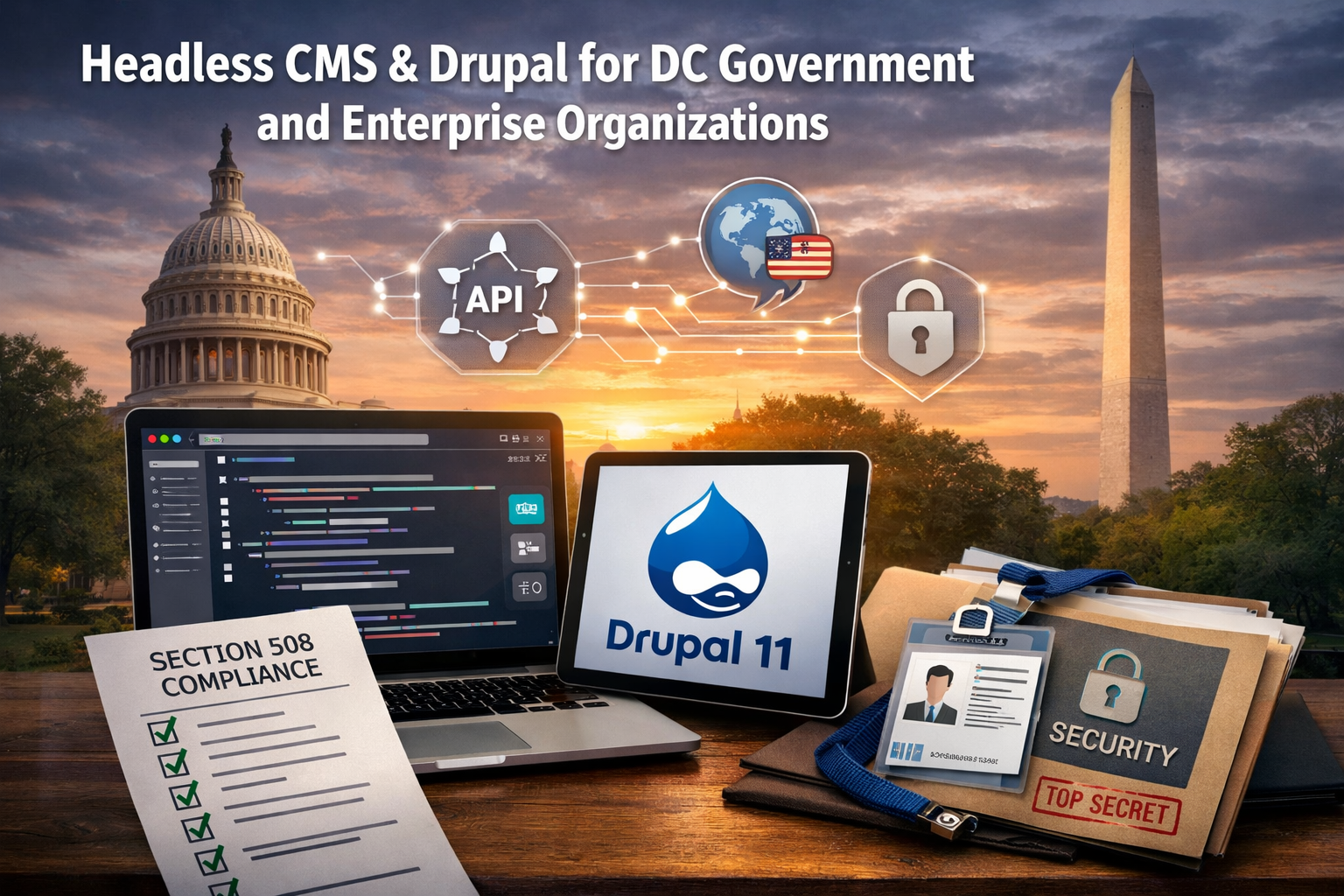
The DC Digital Landscape Is Different
Washington DC isn't like other markets. The organizations that call the DMV home — federal agencies, government contractors, trade associations, defense firms, nonprofits receiving federal funding, and large enterprise businesses — operate under a different set of requirements than a typical small business website.
Security expectations are higher. Content is more complex. Audiences are more demanding. And in many cases, the website itself is part of a procurement or compliance process, not just a marketing tool.
That's why the CMS decisions made by DC-area organizations matter more than most. And it's why Drupal — particularly in a headless or decoupled configuration — has become the platform of choice for serious digital operations in and around the District.
What Is a Headless CMS?
Before diving into why it matters for DC organizations specifically, it helps to understand what "headless" actually means.
A traditional CMS like a standard WordPress or Drupal installation is "coupled" — the backend where content is managed and the frontend where it's displayed are tightly connected. The CMS handles everything: storing content, building pages, and rendering what visitors see in their browser.
A headless CMS separates those two functions. The backend still manages and stores all your content, but instead of rendering pages directly, it delivers that content via an API — typically JSON:API or GraphQL. A separate frontend, often built in React, Next.js, or another modern JavaScript framework, pulls that content and displays it however it needs to.
Why Does This Matter?
The decoupled approach gives organizations much greater flexibility:
The same content can feed a website, a mobile app, a kiosk, a voice interface, or any other channel
Frontend teams can build fast, modern user experiences without being constrained by the CMS templating system
Backend content editors work in a familiar, structured environment regardless of what the frontend looks like
Security is improved because the content management layer is never directly exposed to the public internet
For large, content-heavy organizations — exactly the kind that dominate the DC market — this architecture is increasingly the standard, not the exception.
Why Drupal Is the Right Choice for DC Organizations
There are several headless CMS options on the market. Contentful, Sanity, and Strapi all have their advocates. But for DC government, enterprise, and nonprofit organizations, Drupal consistently stands out — and for good reason.
A Proven Security Track Record
In an environment where a data breach or vulnerability can make headlines and cost contracts, security is non-negotiable. Drupal has one of the strongest security track records of any open-source CMS platform.
The Drupal Security Team operates a formal, structured process for identifying and patching vulnerabilities. Security releases follow a predictable monthly cadence, with emergency patches issued for critical issues. Every release is publicly documented and transparent.
For organizations that need to demonstrate security diligence to government clients, auditors, or procurement officers, Drupal's track record is a genuine asset — not just a checkbox.
Section 508 and WCAG Compliance Built In
For any organization working with or selling to federal agencies, Section 508 compliance is a contractual requirement, not a nice-to-have. Drupal is built with accessibility at its core.
Drupal's default themes are developed against WCAG 2.0 AA standards, and the platform's content editing tools include accessibility guidance to help non-technical users create compliant content. The CKEditor 5 rich text editor in Drupal 11 includes built-in accessibility checks, and contributed modules extend accessibility testing and reporting capabilities further.
This matters enormously in the DC market, where a non-compliant website can disqualify an organization from a federal contract or expose them to legal risk under the ADA.
Structured Content at Scale
Federal agencies, large nonprofits, and enterprise organizations don't have simple content. They manage thousands of pages across multiple content types — press releases, policy documents, staff directories, program pages, event listings, multilingual content, and more.
Drupal was built for exactly this kind of complexity. Its content modeling capabilities — custom content types, fields, taxonomies, relationships, and workflows — are unmatched among open-source CMS platforms. Where WordPress starts to strain under complex content architecture, Drupal thrives.
Enterprise-Grade Multilingual Support
Many DC-area organizations serve audiences that speak multiple languages. Federal agencies are required to provide services in languages beyond English for communities with limited English proficiency. International trade associations and embassies need true multilingual publishing, not just translated page copies.
Drupal's multilingual system is built into core and is the most capable of any open-source CMS. It handles interface translation, content translation, language negotiation, and right-to-left language support out of the box — without requiring third-party plugins or workarounds.
API-First Architecture in Drupal 11
Drupal 11 ships with JSON:API included in core, and the contributed GraphQL module provides a robust alternative for teams that prefer that query style. This makes Drupal 11 a genuinely API-first platform, ready for headless deployments without significant additional configuration.
For organizations building decoupled architectures — a React or Next.js frontend consuming Drupal content via API — Drupal 11 provides a stable, well-documented, and actively maintained backend that can handle enterprise-scale content operations.
Common Use Cases in the DC Market
Government Contractor Websites
Contractors selling to federal agencies need websites that do more than look professional. They need to clearly communicate contract vehicles, past performance, security clearances, and compliance credentials. Drupal's structured content capabilities make it straightforward to build and maintain this kind of information at scale, while the security posture satisfies the scrutiny of government procurement reviewers.
Federal Agency Portals and Intranets
Federal agencies have long been among Drupal's largest users globally. The platform's ability to handle complex permissions and access control, support thousands of content editors with varying roles, and maintain compliance with federal web standards makes it a natural fit. Drupal govCMS is used by government agencies in multiple countries, and dozens of US federal agencies have standardized on Drupal for their public-facing digital properties.
Trade Associations and Advocacy Organizations
DC's trade association and advocacy community manages some of the most content-intensive websites in any industry — member directories, legislative trackers, policy libraries, event systems, and publication archives. Drupal's content modeling flexibility handles all of it without requiring separate tools or platform compromises.
Nonprofits With Federal Funding
Nonprofits that receive federal grants or contracts are increasingly expected to demonstrate Section 508 compliance on their digital properties. Building on Drupal from the start is far more cost-effective than retrofitting a WordPress site for accessibility compliance after the fact.
Headless Drupal in Practice: What the Architecture Looks Like
A typical headless Drupal deployment for a DC enterprise or government organization involves a few key layers.
The Drupal Backend
Drupal serves as the content repository and editorial environment. Content editors use the Drupal admin interface to create and manage content — articles, people, programs, events, documents — using structured content types with defined fields and validation rules. Workflows and editorial approval processes are configured here. Access control ensures that different teams can only edit what they're responsible for.
The API Layer
Drupal's JSON:API module exposes all content as structured API endpoints. A press release becomes an API endpoint that returns the headline, body, author, date, category, and any related content as clean, structured JSON. The frontend consumes these endpoints to render pages.
The Frontend
The frontend is typically built in Next.js or a similar React-based framework. It fetches content from the Drupal API, applies the organization's design system, and renders fast, accessible pages. Because the frontend is fully decoupled, it can be rebuilt, redesigned, or replaced without touching the Drupal content layer.
Hosting and Infrastructure
For DC organizations with elevated security requirements, this architecture allows the Drupal backend to be hosted in a FedRAMP-authorized environment or behind a firewall, while the frontend is served via a CDN for performance. The two layers communicate only through the API, reducing the attack surface considerably.
Drupal 11 Specifically: What's New for Enterprise and Government Users
Drupal 11, released in August 2024, brings several improvements that are particularly relevant for DC government and enterprise deployments.
Automatic Updates
Drupal 11's Automatic Updates feature allows security patches to be applied automatically within defined safety parameters. For organizations that struggle to maintain active patch cadences — a common challenge in government and enterprise environments — this meaningfully reduces the window of vulnerability between patch release and deployment.
Improved Admin Experience
The new Navigation sidebar in Drupal 11 significantly improves the content editing experience for non-technical users. For organizations with large content teams or infrequent editors — common in government and nonprofit environments — a more intuitive admin interface reduces training time and editorial errors.
Project Browser
Drupal 11's Project Browser allows teams to evaluate and install contributed modules directly from the admin interface. For procurement-conscious organizations that need to document and track software dependencies, having a cleaner module management workflow is a practical operational benefit.
Modern Technology Stack
The upgrade to PHP 8.3 and Symfony 7 in Drupal 11 ensures the platform remains on a modern, actively maintained technology foundation — an important consideration for organizations that need to demonstrate to security reviewers that their software stack is current and supported.
What to Look for in a Drupal Partner in the DC Area
Not every web development agency understands the specific requirements of DC government and enterprise clients. When evaluating a Drupal partner, look for:
Experience With Compliance Requirements
Your Drupal partner should understand Section 508 and WCAG compliance at a technical level — not just in theory, but in practice. They should be able to build accessible themes, test against WCAG 2.0 AA criteria, assist with VPAT documentation, and advise on content authoring practices that maintain compliance over time.
Enterprise Content Architecture Experience
Headless Drupal projects live or die on the quality of the content model. A partner with deep Drupal content architecture experience will design a backend that scales cleanly, supports editorial workflows, and exposes well-structured API data to the frontend — rather than one that works for the initial launch and creates technical debt immediately.
Understanding of the DC Market
A partner who understands the DC market — the procurement process, the federal web standards, the mix of government, contractor, nonprofit, and association clients — will ask better questions and build a more appropriate solution than one applying a generic template to every engagement.
Is Headless Drupal Right for Your Organization?
Headless Drupal is a powerful architecture, but it's not the right fit for every situation. It adds complexity and cost compared to a traditional coupled Drupal deployment, and it requires frontend development expertise in addition to Drupal expertise.
It tends to be the right choice when one or more of the following apply:
Your organization needs to deliver content across multiple channels or platforms
You have a large, distributed content team with complex editorial workflows
You need the frontend to be rebuilt or redesigned independently of the content layer
Your security requirements call for separating the CMS from public-facing infrastructure
You're building a custom digital experience that goes well beyond a standard website
For organizations that need a capable, secure, accessible CMS without the overhead of full decoupling, a traditional Drupal 11 deployment remains an excellent choice — and far more capable than most alternatives for complex government and enterprise content needs.
Ready to Talk Drupal?
Ritner Digital specializes in Drupal strategy, architecture, and development for organizations in the Washington DC metro area. Whether you're evaluating a new CMS, planning a Drupal upgrade, or considering a headless architecture for the first time, we're happy to talk through your options.
Get in touch with the Ritner Digital team to start the conversation.
Frequently Asked Questions
What is a headless CMS?
A headless CMS is a content management system where the backend — where content is created and managed — is decoupled from the frontend — where content is displayed. Instead of rendering pages directly, the CMS delivers content through an API that a separate frontend application consumes. This gives organizations greater flexibility to deliver content across multiple channels and build faster, more modern user experiences.
What is the difference between headless and traditional Drupal?
In a traditional Drupal setup, Drupal handles both content management and page rendering. In a headless setup, Drupal manages content on the backend and delivers it via its JSON:API or GraphQL API, while a separate frontend — typically built in React or Next.js — handles what visitors actually see. The content layer and the presentation layer are independent of each other.
Is headless Drupal the same as decoupled Drupal?
Yes, the terms are used interchangeably. Both refer to an architecture where Drupal serves as the content backend and API layer, while a separate frontend framework handles the user-facing presentation. You may also hear the term "fully decoupled" to distinguish it from "progressively decoupled," where Drupal still handles some page rendering while JavaScript frameworks handle specific interactive components.
Why is Drupal so widely used by government organizations?
Drupal has a long history with government organizations because it was purpose-built for complex, large-scale content operations. Its security track record, built-in multilingual support, granular access control, content modeling flexibility, and strong accessibility foundations make it the right fit for organizations that operate under strict compliance and security requirements. Dozens of US federal agencies and government bodies worldwide have standardized on Drupal for their public-facing digital properties.
What is Section 508 and does it apply to my organization?
Section 508 is a federal accessibility law that requires federal agencies and their contractors to ensure their digital products and services are accessible to people with disabilities. It applies to federal agencies directly, as well as any private organization — including contractors, vendors, and nonprofits receiving federal funding — that sells or provides digital products and services to federal agencies. If your organization does any business with the federal government, Section 508 almost certainly applies to you.
How does Drupal help with Section 508 compliance?
Drupal's default themes are developed against WCAG 2.0 AA standards, which is the baseline required for Section 508 compliance. The CKEditor 5 rich text editor in Drupal 11 includes built-in accessibility checks to help content editors create compliant content. Drupal's structured content model also makes it easier to enforce accessibility requirements like alt text, proper heading hierarchy, and descriptive link text at the content entry level, rather than relying solely on frontend fixes.
What is WCAG and how does it relate to Section 508?
WCAG stands for Web Content Accessibility Guidelines — an internationally recognized set of technical standards for digital accessibility published by the W3C. Section 508 adopted WCAG 2.0 Level AA as its required standard for websites and digital content. Practically speaking, if your website meets WCAG 2.0 AA, it meets the web accessibility requirements of Section 508.
What is a VPAT and does my Drupal site need one?
A VPAT — Voluntary Product Accessibility Template — is a document that describes how a digital product or service conforms to Section 508 and WCAG standards. Federal agencies are required to verify that any ICT they procure includes a completed VPAT, also called an Accessibility Conformance Report (ACR). If your organization is selling digital products or services to federal agencies, you will likely need a VPAT. A qualified Drupal partner can help you assess your site against the required criteria and produce the documentation needed.
Is Drupal secure enough for government and federal contractor use?
Yes. Drupal has one of the strongest security records of any open-source CMS. The Drupal Security Team follows a formal, structured process for identifying, addressing, and disclosing vulnerabilities. Security releases follow a predictable monthly schedule, with out-of-cycle emergency patches for critical issues. Drupal is used by the White House, NASA, the US Department of Energy, and dozens of other federal agencies — organizations for which security is a primary requirement, not a secondary consideration.
Can Drupal be hosted in a FedRAMP-authorized environment?
Yes. In a headless Drupal architecture, the Drupal backend can be hosted in a FedRAMP-authorized cloud environment or behind a secure firewall, while the frontend is served separately via a CDN. This separation of layers is one of the security advantages of the headless model — the content management system is never directly exposed to public internet traffic.
What frontend frameworks work with headless Drupal?
The most common frontend frameworks used with headless Drupal are Next.js, Gatsby, Nuxt.js, and plain React. Next.js is currently the most widely adopted choice for Drupal headless projects due to its strong support for server-side rendering, static site generation, and incremental static regeneration — all of which benefit performance and SEO. Your choice of frontend framework should be driven by your team's expertise and your organization's specific performance and hosting requirements.
What is JSON:API and how does Drupal use it?
JSON:API is a standardized specification for building APIs that deliver structured data in JSON format. Drupal 11 ships with JSON:API included in core, meaning every piece of content you create in Drupal is automatically available as a structured API endpoint without custom development. A press release, a staff profile, a policy document — each becomes a clean, structured API response that your frontend can consume and render. This makes Drupal 11 genuinely API-first out of the box.
What is GraphQL and when would I use it instead of JSON:API?
GraphQL is an alternative API query language that allows the frontend to request exactly the fields it needs, rather than receiving a full JSON:API response and filtering client-side. It tends to be preferred by frontend teams that want more precise control over data fetching, particularly in complex applications with many interconnected content types. Drupal's contributed GraphQL module provides a robust GraphQL implementation. For most government and enterprise Drupal projects, JSON:API is sufficient and simpler to work with — GraphQL is worth considering for large, complex decoupled applications with performance-sensitive data requirements.
How does Drupal handle content workflows for large editorial teams?
Drupal's content moderation system allows organizations to define custom editorial workflows — draft, review, approved, published — and assign different roles and permissions to different team members. A content editor might be able to create and submit content but not publish it. A senior editor reviews and approves. An administrator has full control. For government and enterprise organizations with multiple content teams, approval requirements, and audit trail needs, this workflow system is one of Drupal's most valuable capabilities.
How does multilingual content work in Drupal?
Drupal's multilingual support is built into core and covers the full publishing lifecycle. You can translate content types, fields, menus, taxonomy terms, views, and even the admin interface itself. Drupal handles language detection and negotiation, meaning it can serve the right language version based on a visitor's browser settings or URL path. For organizations required to serve content in multiple languages — federal agencies with LEP obligations, international associations, embassies — Drupal's multilingual capabilities are significantly more robust than any other open-source CMS.
How long does a headless Drupal project typically take?
Timeline varies based on scope, but a typical headless Drupal project for a government or enterprise organization — including content architecture, backend build, frontend development, accessibility testing, and launch — generally runs between three and six months. Larger projects involving complex integrations, custom workflows, or data migration from an existing platform can take longer. A well-scoped discovery phase at the start of the engagement is the single best investment in keeping the overall timeline on track.
How much does a headless Drupal project cost?
Cost depends heavily on complexity. A straightforward headless Drupal deployment for a mid-sized organization might start around $50,000–$80,000. Enterprise projects with complex content models, large-scale migration, custom integrations, and rigorous Section 508 testing can range significantly higher. The decoupled architecture does add cost compared to a traditional Drupal build because it requires expertise in both Drupal and modern frontend development. That investment pays dividends in long-term flexibility, performance, and maintainability.
What should I ask a Drupal agency before hiring them for a government or enterprise project?
A few questions worth asking any prospective Drupal partner for a DC government or enterprise engagement: Can you demonstrate Section 508 compliance in your previous work? How do you approach content architecture for complex organizations? Do you have experience with headless or decoupled Drupal specifically? What is your process for accessibility testing and VPAT documentation? Do you have experience working with federal agencies or government contractors? The answers will quickly reveal whether the agency understands the specific requirements of the DC market or is applying a generic approach.
Can Ritner Digital help with an existing Drupal site, or only new builds?
Both. Ritner Digital works with organizations at any stage — whether you're starting a new Drupal 11 project from scratch, upgrading from Drupal 7 or 10, migrating from a different CMS platform, or looking to improve the performance, accessibility, or architecture of an existing Drupal site. If you're unsure where to start, a Drupal audit is often the right first step — it gives you a clear picture of where your current site stands and what the right path forward looks like.
Have a question not covered here? Reach out to the Ritner Digital team — we're happy to talk through your project.