Web Design for DC Law Firms, Nonprofits, and Associations — What Makes a DMV Website Actually Convert
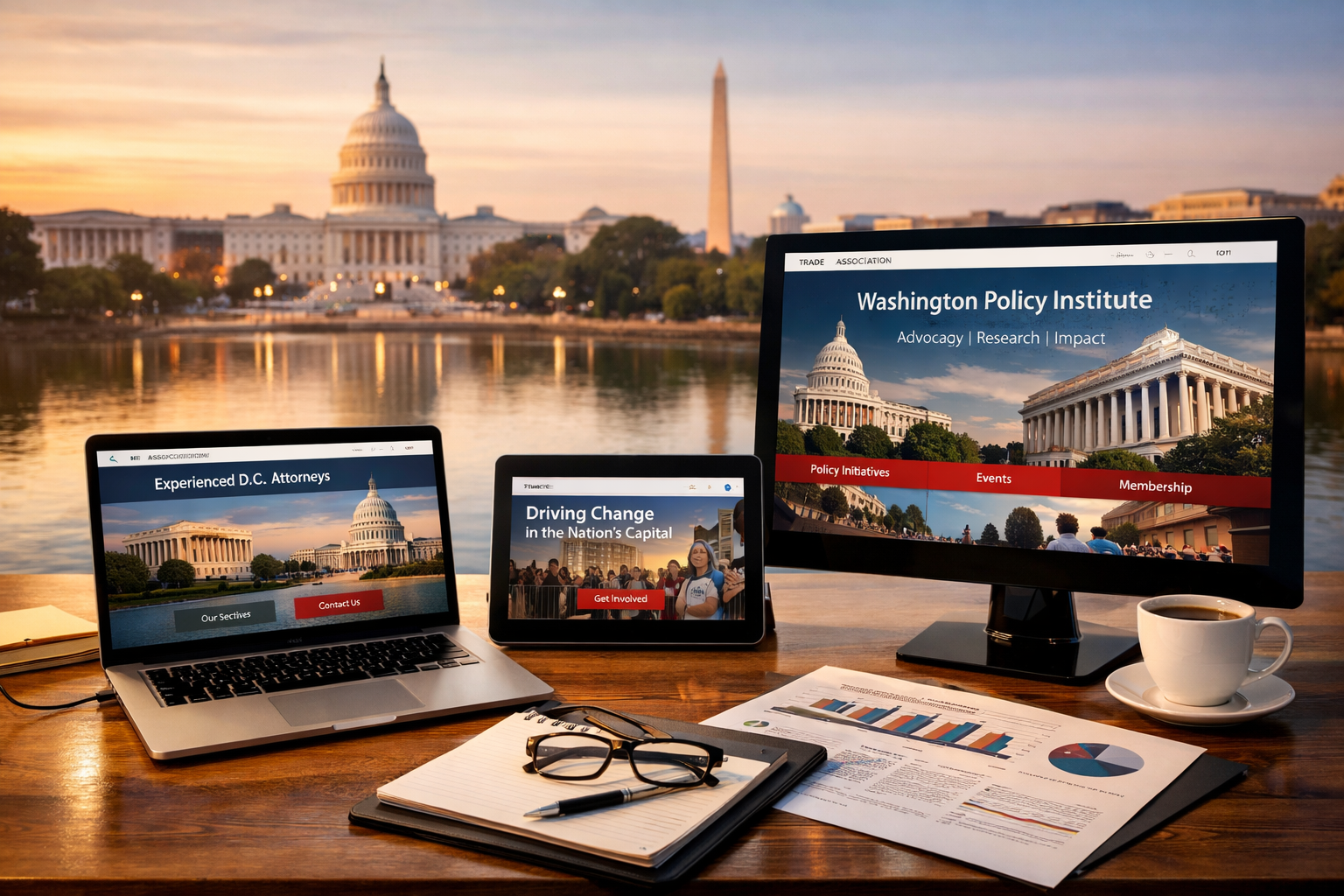
Washington DC Is Not Like Other Markets
Walk into any pitch meeting at a K Street law firm, a Capitol Hill trade association, or a Dupont Circle think tank and you'll notice something quickly: the people in the room have seen everything. They've worked with the biggest agencies in the country. They've sat through hundreds of vendor presentations. They know what a templated website looks like, and they know it immediately.
The DC market is uniquely demanding. The organizations that define this city — law firms, lobbying groups, trade associations, advocacy organizations, nonprofits, and policy institutions — operate in an environment where credibility is currency. Your website isn't just a marketing tool here. It's a credential. It's the first thing a potential client, donor, member, or government contact checks before they decide whether to take your call.
Generic web design fails in DC for a simple reason: it was built for a different audience. A template designed to sell consumer products or attract startup customers communicates the wrong things entirely to a Washington audience that expects professionalism, substance, and authority from the first click.
This guide breaks down what actually makes a DMV website convert — and what separates the organizations that win online from the ones that blend into the background.
Who We're Talking About
The DC-area organizations that need to think hardest about web design credibility include:
Law firms on K Street, in Bethesda, and throughout the DMV — from large litigation practices to boutique regulatory and government affairs firms
Trade associations representing industries from technology and healthcare to agriculture and financial services
Lobbying and government affairs firms that live and die by their reputation with both clients and Capitol Hill contacts
Think tanks and policy institutes whose credibility depends entirely on the perceived quality and rigor of their work
Nonprofits seeking government grants, foundation funding, and corporate partnerships
Professional associations managing memberships, events, certifications, and advocacy on behalf of their industries
What all of these organizations share is an audience that is sophisticated, skeptical, and pressed for time. They are not casual browsers. They are doing due diligence.
What DC Buyers Actually Look For
Before a DC-area decision-maker picks up the phone or fills out a contact form, they've already made several subconscious judgments about your organization based on your website. Understanding what they're evaluating is the foundation of effective DMV web design.
Credibility Before Everything Else
In most markets, the primary goal of a website is to generate interest. In DC, the primary goal is to establish trust. Your audience isn't wondering whether your organization sounds interesting — they're deciding whether you're worth their time.
Credibility signals that resonate in the DC market include visible leadership profiles with real credentials, clearly articulated areas of expertise, evidence of past work and outcomes, client or member rosters (where appropriate), media coverage and congressional testimony, and affiliations with recognized institutions and coalitions.
If a visitor can't quickly answer "who are these people and why should I trust them," your website has already failed its most important job.
Substance Over Style
DC audiences are deeply allergic to vague, buzzword-heavy messaging. Phrases like "innovative solutions," "strategic partnerships," and "driving change" land with a thud in a city full of people who've written actual legislation, argued cases before federal courts, and testified before Senate committees.
Your website copy needs to be specific. What do you actually do? For whom? With what results? The organizations that convert best in this market lead with substance — concrete expertise, defined practice areas, named accomplishments, and clear statements of what they offer and to whom.
Authority Signals That Match the Audience
Different DC audiences respond to different authority signals. A federal contractor audience wants to see contract vehicles, past performance, and clearance capabilities. A nonprofit grant-maker wants to see program outcomes, financial transparency, and organizational leadership. A law firm client wants to see practice area depth, attorney credentials, and relevant case experience.
The mistake many organizations make is using generic authority signals — stock photography of handshakes, vague testimonials, award badges from organizations nobody recognizes — that don't resonate with their specific audience. Effective DC web design speaks directly to the credibility criteria of the actual decision-maker you're trying to reach.
Speed and Respect for Their Time
DC professionals are busy. A website that buries its value proposition under a slow-loading hero animation, requires three clicks to find contact information, or makes visitors scroll through irrelevant content before reaching what they need will lose them immediately.
Respecting your audience's time is itself a credibility signal. A clean, fast, well-organized website communicates organizational competence. A slow, cluttered, hard-to-navigate one communicates the opposite — regardless of how impressive the content is once someone finds it.
Why Generic Agency Templates Fail in DC
Most website templates — and many agency-built sites — are designed around assumptions that don't hold in the DC market.
They Prioritize Visual Flair Over Substance
Consumer-facing templates are designed to create emotional impact quickly. Bold imagery, large headlines, dramatic animations. These work well when you're selling a lifestyle or a product. They work poorly when you're trying to convince a deputy assistant secretary or a Senate staffer that your organization is the right partner for a serious policy challenge.
In DC, visual flair without substance reads as a lack of seriousness. The aesthetic that works here is confident and restrained — professional enough to command respect, clear enough to communicate substance immediately.
They Use the Wrong Social Proof
Generic templates typically feature customer reviews, star ratings, and social media follower counts as social proof. None of these matter to a DC audience evaluating a law firm, an association, or a policy organization.
What matters in this market is a different category of proof entirely: who you've represented, what coalitions you've built, which publications have cited your research, which committees have sought your testimony, and which agencies have awarded you contracts. If your website's social proof section looks like an e-commerce review widget, it's sending the wrong signal.
They're Built for Transactions, Not Relationships
Most commercial web templates are optimized for a single conversion action — buy now, sign up, request a demo. DC organizations rarely operate on a transactional model. The conversion they're after is the beginning of a relationship: a meeting, a membership inquiry, a grant application, a retainer conversation.
This requires a different content strategy. Rather than pushing visitors toward a single call to action, effective DC websites build trust progressively — through thought leadership content, detailed capability statements, visible track records, and multiple low-friction entry points that let visitors engage at their own pace.
The DC Aesthetic: Trust, Authority, and Restraint
If you spend time looking at the websites of the most respected organizations in Washington — the law firms that argue landmark cases, the associations that shape legislation, the think tanks whose papers land on congressional desks — you'll notice a consistent aesthetic sensibility.
Clean, Professional, and Uncluttered
The best DC organization websites are not flashy. They use restrained color palettes, typically anchored in navy, charcoal, white, and a single accent color. Typography is clean and legible, not decorative. White space is generous. The visual language communicates seriousness and stability.
This is not an accident and it's not a lack of creativity. It's a deliberate calibration to the expectations of an audience that equates visual restraint with institutional authority. A website that looks like it belongs in a fashion magazine sends the wrong message to a congressional affairs audience.
Photography That Reflects Real Work
Nothing undermines credibility faster in the DC market than obvious stock photography. Photos of smiling strangers in generic office settings, diverse groups of people pointing at whiteboards, and handshake images that could be from anywhere communicate one thing clearly: this organization doesn't have enough confidence in its real work to show it.
The organizations that convert best in DC use real photography — actual team members, real office environments, genuine event coverage, authentic moments from the work itself. When professional photography isn't possible, high-quality illustration or well-chosen documentary-style imagery performs better than generic stock.
Navigation Built for Due Diligence
DC website visitors often arrive with a specific research purpose. They want to understand your capabilities, evaluate your leadership team, review your past work, and find a way to contact the right person. Your navigation architecture should make this due diligence path frictionless.
This typically means clear top-level navigation covering who you are, what you do, your team or leadership, your work or publications, and how to get in touch. Secondary navigation can handle membership portals, resource libraries, and event listings. The architecture should be logical to someone doing research, not organized around internal department structures that mean nothing to an outside visitor.
Key Pages That Drive Conversion for DC Organizations
The About Page Does Heavy Lifting
In most industries, the About page is an afterthought. In DC, it's often the most important page on the site. Visitors want to know who founded the organization, what their background and credentials are, who leads it today, and what the institutional history looks like.
A strong DC About page tells a coherent organizational story — the founding mission, the evolution of the work, the current leadership team with real bios and credentials, and a clear statement of what the organization stands for. It should feel like a credibility document, not a marketing brochure.
Practice Area and Capability Pages Need Real Depth
Whether you're a law firm describing practice areas, an association describing policy programs, or a contractor describing service lines, these pages need to go beyond surface-level descriptions. Effective capability pages in the DC market include specific examples of past work, relevant case studies or program outcomes, named team members with relevant expertise, and clear explanations of the approach and methodology.
Thin capability pages with one paragraph of generic description and a contact button are a missed opportunity. A visitor who lands on your antitrust practice page or your federal procurement program page is already interested — the page's job is to confirm their confidence and move them toward a conversation.
Leadership and Team Profiles Convert
In service-based DC organizations, people are the product. A potential client hiring a government affairs firm, a foundation evaluating a nonprofit partner, or a federal agency reviewing a contractor proposal is ultimately evaluating the people who will do the work.
Leadership and team profile pages should feature professional headshots, substantive bios that highlight relevant credentials and accomplishments, and — where appropriate — links to published work, congressional testimony, speaking engagements, and media appearances. The more specific and accomplished the profiles look, the more confidence they instill in the visitor making a high-stakes evaluation.
Thought Leadership Builds Long-Term Authority
For think tanks, policy organizations, law firms, and associations, a well-maintained thought leadership section — whether that's a blog, a publications library, a podcast, or a combination — is one of the highest-return investments in the DC digital space.
Organizations that consistently publish substantive, credible content on their areas of expertise show up in search results when decision-makers are researching issues, build ongoing relationships with visitors who return for new content, and demonstrate active engagement with the issues that matter to their audience. Over time, this positions the organization as a go-to resource in its field — which is exactly the kind of authority that drives inbound inquiries from high-value contacts.
Technical Foundations That Matter in DC
Beyond design and content strategy, there are several technical requirements that deserve particular attention for DC-area organizations.
Accessibility and Section 508
Any organization that works with or receives funding from the federal government should ensure its website meets WCAG 2.0 AA accessibility standards, which are the basis for Section 508 compliance. Beyond the compliance requirement, an accessible website serves the full range of your audience — including the significant percentage of DC government professionals who use assistive technology.
Mobile Performance for an On-the-Go Audience
DC professionals are constantly moving — between Hill offices, agency meetings, court appearances, and association events. A significant portion of your website traffic arrives on mobile devices, often in contexts where someone is quickly checking your credentials before a meeting or looking up a contact while in transit. Mobile performance is not optional.
Security and HTTPS
For organizations that handle member data, client information, or government-related content, a properly secured website with current SSL certification is a baseline expectation. A browser security warning on your website in a market full of security-conscious government and legal professionals is a conversion killer.
Site Speed
Page load speed directly affects both user experience and search engine rankings. For a DC audience that expects efficiency and professionalism, a slow website is a subtle but real credibility problem. Core Web Vitals — Google's performance metrics for page experience — should be a standard part of your website health monitoring.
Choosing the Right CMS for a DC Organization Website
The CMS your website runs on affects everything from content management ease to long-term flexibility and security. For DC law firms, associations, and nonprofits, a few platforms consistently perform well.
Drupal remains the strongest choice for organizations with complex content architectures, large content teams, multilingual needs, or strict accessibility and security requirements. Its enterprise-grade capabilities and Section 508-friendly foundation make it particularly well-suited for organizations with government relationships.
WordPress is a viable option for smaller organizations with simpler content needs, provided it's built and maintained properly — with a well-coded custom theme, a minimal plugin footprint, and a disciplined update and security process.
The wrong answer is a consumer website builder that looks polished at launch but can't scale with your content, integrate with your membership or CRM systems, or meet the accessibility standards your audience expects.
What a High-Converting DC Website Actually Looks Like
Putting it all together, the DC organization websites that generate the most qualified inbound inquiries tend to share a consistent set of characteristics. They load quickly and work flawlessly on mobile. They lead with a clear, specific statement of who they are and what they do. They back up their claims with real evidence — named clients, documented outcomes, credentialed team members. They make it easy to find the right contact person and reach out. They publish ongoing thought leadership that keeps them visible and relevant. And they look appropriately serious — professional without being sterile, authoritative without being inaccessible.
That combination doesn't happen by accident. It's the result of intentional design decisions, a content strategy built around the needs of a sophisticated audience, and a technical foundation that supports long-term performance and growth.
Ready to Build a Website That Works in the DC Market?
Ritner Digital works with law firms, associations, nonprofits, and enterprise organizations throughout the Washington DC metro area. We build websites that reflect the credibility of your organization and convert the sophisticated, high-value audiences that define the DC market.
Get in touch with the Ritner Digital team to start the conversation.
Frequently Asked Questions
Why is web design different for DC-area organizations?
Washington DC has a uniquely sophisticated audience. Decision-makers at law firms, trade associations, nonprofits, think tanks, and government contractors are evaluating your website the same way they evaluate any professional credential — looking for evidence of expertise, institutional credibility, and substantive capability. Generic templates and consumer-focused design patterns send the wrong signals to this audience. Effective DC web design is built around trust, authority, and substance rather than visual flair or transactional conversion tactics.
What types of organizations does this apply to?
Any DC-area organization whose primary audience is sophisticated professional or institutional decision-makers. This includes K Street and DMV law firms, federal government contractors, trade and professional associations, lobbying and government affairs firms, think tanks and policy institutes, nonprofits seeking government grants or foundation funding, and professional membership organizations. If your website's job is to establish credibility with a high-stakes audience before a meeting, a contract award, or a funding decision, this applies to you.
Does my organization really need a custom website, or will a template work?
It depends on your audience and what you're asking your website to do. For a DC law firm, association, or nonprofit operating in a competitive environment with sophisticated buyers, a template almost always works against you. Templates are designed around assumptions — consumer purchasing behavior, e-commerce conversion, lifestyle marketing — that don't match the credibility-driven decision process of a DC professional audience. A well-built custom website is an investment that pays back through the quality of the inquiries it generates.
How do I know if my current website is hurting my organization?
A few clear warning signs: your website uses stock photography of people who don't work for you, your About page is thin or vague, your practice area or program pages lack specific examples of real work, your team profiles don't include substantive credentials, your site loads slowly on mobile, or you haven't updated your content in over a year. If any of these describe your current site, it is very likely costing you credibility with the exact audience you're trying to reach.
What does the "DC aesthetic" mean in practice?
It refers to the visual and content sensibility that resonates with a Washington professional audience. Visually it means clean, restrained, and professional — typically a conservative color palette anchored in navy, charcoal, or deep green, legible typography, generous white space, and real photography rather than stock imagery. In terms of content it means specific, substantive, and credential-forward — concrete descriptions of what you do, named accomplishments, credentialed team profiles, and evidence of real work rather than vague positioning language.
What are trust signals and why do they matter for DC organizations?
Trust signals are the elements of your website that help a skeptical visitor conclude that your organization is credible, capable, and worth their time. In the DC market these include visible leadership credentials, named clients or members where appropriate, documented outcomes and case studies, media coverage and citations, congressional testimony or regulatory filings, coalition memberships, and awards or recognitions from institutions your audience actually respects. Generic trust signals — star ratings, follower counts, unattributed testimonials — carry little weight with a DC professional audience and can actually undermine credibility if they feel out of place.
How important is the About page for a DC organization website?
Extremely important — often more so than in other markets. DC decision-makers do serious due diligence before engaging with an organization, and the About page is frequently where that due diligence begins. A strong About page tells a coherent institutional story, establishes the credentials of the founding and current leadership, communicates the organizational mission with specificity, and gives visitors enough context to decide whether your organization is the right fit for their needs. Treating the About page as an afterthought is one of the most common and costly mistakes DC organizations make.
How should law firm websites differ from nonprofit or association websites?
The underlying principles are the same — credibility, substance, authority, and audience-specific trust signals — but the execution differs by audience. Law firm websites should lead with practice area depth, attorney credentials, and relevant experience. Nonprofit websites should emphasize program outcomes, financial transparency, leadership credibility, and alignment with funder priorities. Association websites need to serve multiple audiences simultaneously — members, prospective members, policymakers, and the media — with clear navigation paths for each. The content strategy and information architecture should be built around the specific decision-making process of each organization's primary audience.
What kind of photography works best for DC organization websites?
Real photography of your actual people, offices, events, and work always outperforms stock imagery with a DC professional audience. If budget allows, a professional photography session covering leadership headshots, team photos, office environments, and event coverage is one of the highest-return investments you can make in your website. If a full photography budget isn't available, prioritize real headshots for your leadership team above everything else — authentic team profiles do more for credibility than any other single element of the site.
How much thought leadership content does my organization need?
Consistency matters more than volume. A DC law firm, think tank, or association that publishes two or three substantive pieces per month — well-written, specific, and relevant to its audience — will build more authority over time than one that publishes daily content of mediocre quality. Start with a realistic publishing cadence your team can sustain, focus on topics where your organization has genuine expertise, and optimize each piece for the search terms your target audience is actually using. Over time, a well-maintained thought leadership library becomes one of your most valuable business development assets.
How fast should my website load?
Google recommends that pages load within two to three seconds for a good user experience, and Core Web Vitals scores directly affect your search rankings. For a DC professional audience that values efficiency, a slow website is both a user experience problem and a subtle credibility problem. Key factors affecting load speed include image optimization, efficient code, quality hosting, and use of a content delivery network. A web performance audit is a good starting point if you're unsure where your site stands.
Does my DC organization website need to be Section 508 compliant?
If your organization works with, contracts with, or receives funding from federal agencies, Section 508 compliance is almost certainly a requirement for your digital properties. Beyond the legal obligation, accessibility is simply good practice — an accessible website serves your full audience, including the significant number of DC government professionals who use assistive technology. WCAG 2.0 AA is the standard to meet, and it should be built into your website from the ground up rather than retrofitted after launch.
What CMS should a DC law firm or nonprofit use?
The right answer depends on your organization's size, content complexity, and technical resources. Drupal is the strongest choice for organizations with complex content needs, large content teams, multilingual requirements, or strict accessibility and security requirements — particularly those with government relationships. WordPress is a viable option for smaller organizations with simpler needs, provided it's built with a custom theme, a lean plugin architecture, and a disciplined security and maintenance process. Consumer website builders are generally not appropriate for DC professional organizations where credibility and long-term scalability matter.
How important is mobile optimization for a DC audience?
Critically important. DC professionals are constantly in motion — moving between offices, agencies, Hill buildings, and events. A significant share of your website traffic arrives on mobile devices, often in contexts where someone is quickly verifying your credentials or looking up a contact before a meeting. A website that performs poorly on mobile communicates disorganization and lack of attention to detail to exactly the audience you need to impress. Mobile performance should be a primary consideration in design and development, not an afterthought.
Should my organization's website have a member portal or client login area?
For associations and membership organizations, a member portal is often essential — it provides members with access to exclusive resources, directories, event registration, and other member benefits that justify dues and drive retention. For law firms and nonprofits, a secure client or partner portal can be valuable for document sharing and communication. These features add development complexity and ongoing maintenance requirements, so the decision should be driven by whether the functionality genuinely serves your audience's needs and supports your organization's core mission.
How do I measure whether my website is actually converting?
The metrics that matter depend on your organization's goals. For law firms, meaningful conversion metrics include contact form submissions, phone calls, and consultation requests from qualified prospects. For associations, they include membership inquiries, event registrations, and dues renewals driven by the website. For nonprofits, they include grant inquiry submissions, donation conversions, and partner outreach. Setting up proper goal tracking in Google Analytics — or a comparable analytics platform — is the starting point for understanding whether your website is generating the outcomes your organization needs.
How often should a DC organization redesign its website?
A full redesign every three to five years is a reasonable benchmark for most organizations, assuming ongoing content updates and maintenance in between. The stronger trigger for a redesign is a significant gap between your website's current presentation and the credibility level your organization has reached — if your site no longer reflects who you are, what you've accomplished, or the audience you're serving, that gap is costing you regardless of how recently you last redesigned. Regular content updates, performance monitoring, and accessibility reviews should happen continuously between redesigns.
What is the ROI of a well-designed website for a DC law firm or association?
The return is realized through the quality and volume of inbound inquiries, the reduction in time spent establishing basic credibility during business development conversations, and the long-term compounding value of thought leadership content that consistently attracts the right audience. For a law firm landing a single significant client engagement, or an association converting a major corporate membership, the return on a well-executed website investment is typically realized quickly. The harder calculation is the cost of a website that actively undermines credibility — in missed opportunities that are invisible because the visitor never reached out.
Should I hire a local DC agency or does location not matter?
A partner who understands the DC market — the procurement culture, the federal compliance landscape, the specific credibility expectations of a K Street or Capitol Hill audience — will ask better questions and build a more appropriate solution than one applying a generic approach. That said, what matters most is expertise, track record, and fit. A DC-based agency that specializes in the types of organizations you work with, understands your audience, and has demonstrated results in your space is the right choice — whether they're in Georgetown or working remotely.
Have a question not covered here? Reach out to the Ritner Digital team — we're happy to talk through your project.