How to Build a Marketing Team From Scratch as a Small Business

One of the most common and most expensive mistakes small business owners make when building a marketing team is hiring in the wrong sequence. They hire a social media manager before they have a strategy. They bring on a paid media specialist before their website can convert the traffic. They add headcount before they have clear ownership of any marketing function — and end up with a team where everyone is busy but nothing is actually moving the needle.
Building a marketing team well is about sequencing. It's about understanding which functions are foundational and which are amplifiers, and making sure the foundation is solid before you start stacking specialists on top of it.
This post breaks down the roles, the functions each role owns, the order to build in, and the process flow that connects it all — for a small business that's ready to get serious about marketing.
Start Here: What Functions Does a Marketing Team Actually Need to Cover?
Before thinking about titles and org charts, it helps to map the functions. Every effective small business marketing operation — regardless of team size — needs someone accountable for each of these:
Strategy and positioning. What markets are you going after? What does your brand stand for? Who is your ideal customer and what do they care about? What's the message? This is the foundational layer. Everything else is executing against it. Without it, you're just producing content that points in no particular direction.
Content and SEO. Creating the material that attracts, educates, and converts your audience — blog posts, case studies, email campaigns, landing page copy, video scripts — and making sure it's optimized to be found organically. Content marketing claims 34% of B2B marketing budgets, underscoring its role as infrastructure for demand generation, SEO, and sales enablement. Gtm8020 This is your long-game investment, the one that compounds.
Paid media and demand generation. Running the channels that generate leads now — paid search, paid social, retargeting — while organic channels build. Someone needs to own campaign setup, ad creative, targeting, budget allocation, and performance optimization. These are specialist skills; winging them is expensive.
Social media and community. Building and maintaining presence on the platforms where your audience lives. This isn't the same as paid social — it's the organic side: content publishing, community engagement, brand voice in public. For many small businesses this function is woven into the content role.
Analytics and reporting. Measuring what's working, attributing results to channels, and feeding those insights back into strategy and execution. Only 19% of B2B marketers have integrated AI into daily workflows, and 54% cite lack of resources as their top challenge Gtm8020 — poor measurement is almost always a contributing factor to both problems.
Creative and design. Visual identity, ad creative, social graphics, website design, video. Every piece of content your audience sees is filtered through visual execution. Weak creative undermines strong strategy.
Marketing operations. The systems, tools, automations, and workflows that make the whole engine run — your CRM, your email platform, your marketing automation, your reporting infrastructure. This function often lives invisibly inside other roles until a team gets big enough to need dedicated ownership.
A five-person team can cover all of these. A one-person team covers all of them too — just with less depth and bandwidth. The question isn't whether these functions get covered. It's who covers them and how well.
Phase 1: The First Hire — Get a Generalist, Not a Specialist
If you're building from zero, your first marketing hire should be a marketing generalist — someone who can own the strategy layer while executing across multiple channels. Not a social media manager. Not an SEO specialist. Not a paid ads person. A generalist.
In small teams, marketers are expected to juggle everything — SEO, email campaigns, social media — and covering all essential functions with fewer people is the goal, even if it means team members wear multiple hats. MarketerHire
The title might be Marketing Manager, Head of Marketing, or simply Marketing Director — what matters is the scope. This person's job is to own the strategy, build the foundational infrastructure (website, brand messaging, content calendar, basic analytics setup), and execute across the highest-priority channels while the team is small.
What they need to be good at: strategic thinking, writing and content creation, basic digital advertising, analytics and reporting, and project management. They don't need to be elite at any single specialty — they need to be competent across all of them and excellent at prioritization.
What you should not expect from this person: running a sophisticated six-channel paid media operation, producing broadcast-quality video, and managing a full content program simultaneously. One generalist buys you a real marketing function. It does not buy you a marketing department.
At this stage, fill gaps with agencies and freelancers. A freelance SEO specialist for an initial audit and content strategy. A freelance designer for brand assets and ad creative. A PPC agency for paid media if that channel is a priority. Small teams can cover a lot of ground without overextending their budget by relying on freelancers or agencies for specialized tasks like SEO optimization or graphic design, while keeping the core strategy in-house. MarketerHire
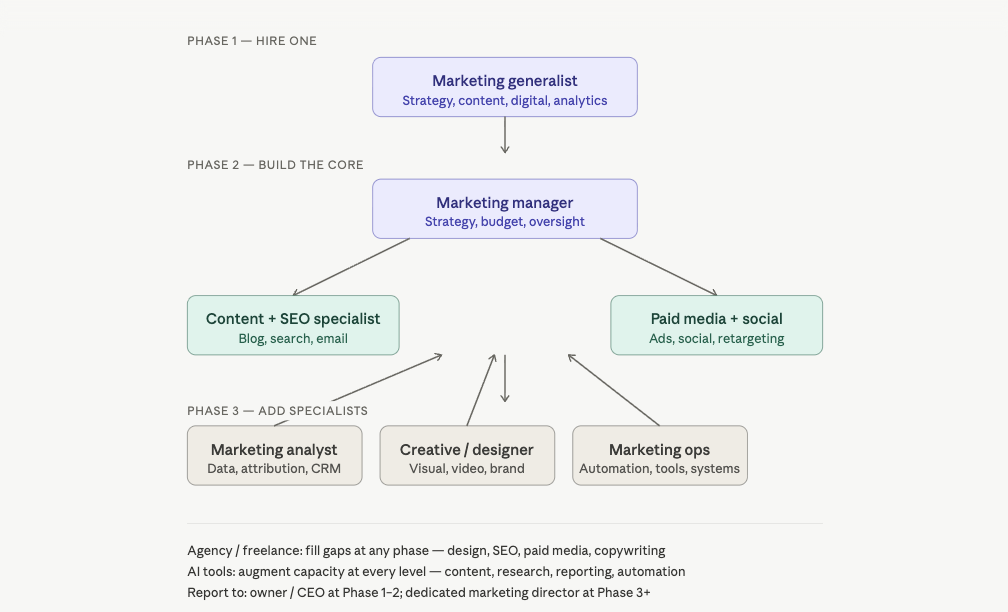
Phase 2: Build the Core — Three Roles That Cover the Fundamentals
Once you have a marketing generalist running strategy and have validated which channels are actually generating results, you're ready to start building a real team. The second phase is about taking the generalist's overloaded workload and distributing it across three focused roles.
The Marketing Manager (your Phase 1 hire, elevated). This person steps up from doing everything to owning strategy, budget, team coordination, and marketing-to-sales alignment. Their job shifts from execution to oversight and direction — setting priorities, managing the editorial calendar, reviewing campaigns, interpreting analytics, and making sure marketing is generating pipeline, not just activity.
Content and SEO Specialist. This role owns the organic growth engine — blog content, SEO strategy, keyword research and optimization, email marketing, and any long-form content assets like case studies, guides, or whitepapers. The skill set here is writing, research, SEO fundamentals, and editorial discipline. Thought leadership and content specifically will see investment increases from more than half of marketers, as it requires deep industry expertise combined with content strategy skills. Gtm8020 A great content person isn't just a writer — they're someone who understands how content connects to search intent and how it moves prospects through the funnel.
Paid Media and Social Specialist. This role owns all paid channels — Google Ads, Meta, LinkedIn, retargeting — plus organic social media management. The skill set is analytical (reading data, optimizing campaigns, managing budgets) and creative (ad copy, creative testing, audience strategy). It's an unusual combination of left-brain and right-brain, and the best people in this role are genuinely comfortable in both modes.
At this phase, you still want external support for things that require specialist depth you can't justify in-house full-time: graphic design, video production, and any highly technical SEO work like link building or site audits. The internal team provides strategy and coordination; external partners provide specialized execution.
Phase 3: Add the Specialists — Three Roles That Deepen Capability
By the time you're adding Phase 3 hires, your marketing engine is producing consistent output and you've got enough scale that the bottlenecks are starting to show up in specific places. Phase 3 is about removing those bottlenecks.
Marketing Analyst. As your campaign volume grows, so does the complexity of understanding what's actually working. The marketing analyst owns data infrastructure — CRM hygiene, attribution modeling, campaign reporting, customer segmentation, and the analytics stack that ties marketing activity to revenue outcomes. Most B2B marketing teams frequently outsource content activities to maintain velocity, but analytics is a function that benefits enormously from internal ownership because it requires deep institutional knowledge about your specific business, customers, and sales cycle. Gtm8020 This is the role that turns a marketing team from a cost center into a measurable growth driver.
Creative Director or In-House Designer. At volume, outsourcing design to a freelancer or agency creates bottlenecks. Turnaround times slow down campaign execution. Feedback loops get long. An in-house creative generalist — someone who can handle social graphics, ad creative, basic video editing, and web assets — dramatically accelerates the team's execution speed and ensures visual consistency across every channel. This doesn't have to be a senior hire; a strong mid-level designer who understands brand standards and can work fast is often more valuable than a highly specialized senior one.
Marketing Operations Manager. This is the role most small businesses add too late, and the one whose absence creates the most invisible drag on team performance. Marketing ops owns the tech stack — your CRM, your marketing automation platform, your email infrastructure, your landing page builder, your reporting dashboards. They build the systems and workflows that let the rest of the team move faster: automated nurture sequences, lead scoring, campaign templates, attribution tracking. Adding a marketing operations manager streamlines processes and ensures campaigns run efficiently across all channels, while cross-functional collaboration with sales, product, and customer success becomes crucial to maintain alignment with marketing goals. MarketerHire
The Process Flow: How the Team Works Together
Having the right roles is half the equation. The other half is having a process that connects them — a rhythm of work that keeps strategy and execution aligned without requiring constant meetings to maintain it.
Here's what a functional small business marketing operation looks like in practice.
Monthly strategy meeting (all hands, 60 minutes). The marketing manager presents last month's results against goals, identifies what worked and what didn't, and sets the strategic priorities for the coming month. Decisions get made about channel focus, budget shifts, and campaign priorities. Everyone leaves with clarity on what they're building toward.
Weekly content and campaign planning (marketing manager + content + paid media, 30 minutes). Tactical coordination on the week ahead. What content is going live? What campaigns are launching? Are there any creative assets that need to be ready by when? This is the session where hand-offs get clarified — the content specialist knows what the paid media person needs, and vice versa.
Bi-weekly analytics review (marketing manager + analyst, 30 minutes). A focused look at the numbers. What's the cost per lead by channel? What's converting? What's the pipeline contribution from marketing? Are there trends in the data that should shift priorities? This session feeds the monthly strategy meeting and allows course corrections before a full month is burned on something that isn't working.
Ongoing editorial calendar (owned by content specialist, visible to all). A shared document or project management tool where all planned content, campaigns, and launches are visible three to four weeks out. This is the team's operating map. It surfaces conflicts, prevents last-minute scrambles, and gives everyone a clear view of what's coming.
Campaign post-mortems (quarterly, 45 minutes). After every major campaign — a product launch, a seasonal push, a content series — the team does a structured debrief. What was the goal? What happened? What would we do differently? Over time, these post-mortems build an institutional knowledge base that makes every subsequent campaign smarter.
The Agency and Freelancer Layer
One structural decision that trips up a lot of small businesses is trying to build an entirely in-house team before they have the revenue or scale to justify it. The more practical model is a hybrid: a small in-house core that owns strategy and coordination, supplemented by external partners for specialized execution.
Most B2B marketing teams consist of 2–5 generalist marketers who handle broad responsibilities, supplemented by outsourced specialists for content creation, design, and technical functions. Gtm8020
The principle is simple: keep in-house the functions that require deep institutional knowledge of your business — strategy, messaging, audience understanding, and analytics. Outsource the functions that require specialized technical skill and can be briefed effectively from the outside — SEO audits, paid media management during the early phase, video production, graphic design, and PR.
As you grow, the balance shifts. Work that was outsourced gets brought in-house as the volume justifies a full-time hire and the institutional knowledge required to do it well has built up. But the hybrid model is almost always more efficient at the small business stage than trying to hire every specialty at once.
The Most Important Thing to Get Right First
All of this — the org chart, the roles, the process flow — only works if the strategic foundation is solid before you start building execution capacity. The most expensive mistake in small business marketing is having a team of three people executing enthusiastically toward an unclear goal.
Before your first hire, you need documented answers to four questions: Who exactly is your ideal customer? What problem do you solve for them that your competitors don't? What does a prospect need to believe to choose you? And which two or three channels are most likely to reach your ideal customer efficiently?
With those answers, every hire you make has a clear north star to orient around. Without them, you're staffing a ship that doesn't have a course.
At Ritner Digital, we help small businesses and growing companies build marketing strategies and teams that actually generate results — not just activity. If you're figuring out where to start or how to scale what you've already built, let's talk.
Frequently Asked Questions
How do I know when I'm actually ready to hire my first marketing person?
The honest signal is when the owner or founder is spending significant time on marketing execution and it's crowding out the work only they can do — selling, managing relationships, running operations. If you're writing your own emails, managing your own social accounts, and trying to run Google Ads between client calls, that's the signal. The other indicator is that you have a real budget to support marketing activity. A marketing hire without a meaningful spend budget to work with is largely a content factory, which may be what you need — but go in with that expectation clearly set. As a rough baseline, if you're doing $750K or more in revenue and marketing isn't a dedicated function, you're probably leaving growth on the table.
Should my first marketing hire be a generalist or a specialist?
Generalist, almost always. The temptation is to hire for the channel that feels most urgent — "we need someone to run our social media" or "we need a paid ads person" — but specialists without a strategist to direct them tend to produce a lot of channel-specific activity that doesn't connect to a coherent growth plan. In small teams, marketers are expected to juggle everything from SEO to email campaigns to social media, and covering all essential functions with fewer people is the goal, even if it means team members wear multiple hats. MarketerHire A good generalist sets the strategy, builds the infrastructure, and executes across the highest-priority channels until the team is big enough to bring in specialists. Hire for range first, depth later.
What's a realistic marketing budget alongside hiring the team?
The team is the engine, but the budget is the fuel — and you can't run one without the other. A marketing manager with no budget to run campaigns is writing content and hoping the algorithm notices. As a rule of thumb, your total marketing investment — people plus spend — should be somewhere between 7% and 15% of revenue depending on your growth ambitions. The split between headcount and channel spend will shift over time, but in the early stages, lean toward channel spend over headcount. Two people and $8,000 a month in media and tools will almost always outperform four people and $2,000 a month. Execution capacity doesn't matter if there's no fuel to run the machine.
What should a marketing manager actually be measured on?
Not vanity metrics. Followers, impressions, and engagement are leading indicators at best and distractions at worst. The metrics that connect marketing to business outcomes are pipeline generated (how many qualified leads came from marketing), cost per lead by channel (so you know where to put more money and where to pull back), lead-to-client conversion rate (which reveals whether marketing is attracting the right people), and revenue influenced by marketing over a given period. If your marketing manager can't tell you those numbers with confidence, the analytics infrastructure isn't in place yet — and that's the first thing to fix, because you can't manage what you can't measure.
When does it make sense to use an agency versus hiring in-house?
Agency relationships make the most sense for specialized, execution-heavy work that would be difficult to justify as a full-time salary — paid media management, SEO, PR, video production, and technical web development are the most common. In-house makes the most sense for functions that require deep institutional knowledge about your business — strategy, messaging, customer understanding, and analytics. Most B2B marketing teams consist of 2–5 generalist marketers who handle broad responsibilities, supplemented by outsourced specialists for content creation, design, and technical functions. Gtm8020 The hybrid model is almost always the right answer for small businesses. The mistake is outsourcing strategy to an agency while keeping execution in-house — that's backwards. Keep the thinking in-house and outsource the doing until you have the scale to justify bringing it in.
What tools does a small marketing team actually need?
Start lean and add tools as the need becomes obvious, not before. The core stack for a small marketing team is a website CMS you can update without a developer, an email marketing platform, a basic CRM to track leads and customers, a project management tool for the editorial calendar and campaign coordination, and Google Analytics plus Search Console for measurement. That's it to start. The mistake is buying a full marketing automation platform, a social scheduling tool, a SEO tool, a design tool, and a reporting platform in month one — and then spending more time managing tools than doing marketing. Add tools when a specific bottleneck makes the investment obvious. The best tool is the one the team actually uses consistently.
How do you keep a small marketing team aligned with the sales team?
Marketing and sales misalignment is one of the most common and most expensive problems in small business growth — marketing generates leads that sales says are unqualified, or sales never follows up on marketing leads, or both. The fix is structural. First, define what a qualified lead looks like in writing — agreed upon by both marketing and sales — so there's no ambiguity about what marketing is trying to produce. Second, set a service level agreement for lead follow-up so marketing knows their leads are being worked. Third, have marketing and sales in the same regular meeting at least monthly, reviewing lead quality together and adjusting the criteria as you learn more about what actually converts. The goal is a feedback loop, not a handoff.
How long does it take to see results from a newly built marketing team?
Longer than most business owners expect, which is why so many teams get restructured or defunded before they have time to prove themselves. Content and SEO take six to twelve months to produce meaningful organic traffic. Paid media can generate leads quickly — sometimes within the first month — but requires two to three months of campaign learning and optimization before performance stabilizes. Brand building and thought leadership compound over twelve to eighteen months. The teams that get results are the ones where leadership commits to a twelve-month runway, measures the right things during that period, and makes adjustments based on data rather than impatience. The teams that fail are the ones that hire in month one, expect results in month three, and restructure in month four.
What's the most common mistake small businesses make when building a marketing team?
Hiring execution capacity before establishing strategic clarity. A social media manager without a defined brand voice and content strategy will post into the void. A paid media specialist without a clear ideal customer profile and offer will optimize toward the wrong audience. A content writer without documented messaging pillars will produce generic material that doesn't differentiate the brand. Before the first marketing hire, a small business owner needs documented answers to four questions: Who exactly is the ideal customer? What problem do you solve that competitors don't? What does a prospect need to believe to choose you? And which channels are most likely to reach them efficiently? With those answers, every hire has a north star. Without them, you're staffing a ship that doesn't have a course.
Ritner Digital helps small businesses build marketing strategies and teams that generate real pipeline — not just activity. Whether you're making your first marketing hire or restructuring what you've already built, let's talk about what the right structure looks like for your business.