
I went to someone else's website to check a backlink. I left with a recommendation for a marketing tool I hadn't planned on reviewing.
That is not how I expected my day to go.
I was updating the Ritner Digital homepage and gathering examples of earned backlinks and mentions to show the kind of digital PR work that makes a brand more visible. One company had linked to my website in an article, so I visited that article to review the placement and decide how to feature it.
Pretty normal SEO housekeeping, right?
Then someone from the team at the website I had just visited found me on LinkedIn, connected with me, and sent a message.
The part that got me? They had identified my actual name and associated me with a company I used to work for. Not my current business—an old employer.
I hadn't filled out a form. I hadn't booked a demo. I hadn't introduced myself or supplied any company information on that site. From my perspective, it was just a cold website visit: I opened an article, looked at the backlink, and went on with my day.
And yet the team apparently had enough visitor-identification information to find my name, attach a professional-company record to it—even if that company was outdated—and contact me directly on LinkedIn.
So, naturally, I asked the only question a marketer should ask in that situation: What technology are you using to do that?
They were kind enough to tell me: RB2B.
Consider this my very public, experience-based recommendation of their website visitor identification software. I'm now studying the pricing, thinking through where it belongs in a sensible B2B marketing stack, and fully prepared to tell other marketers about the experience.
It got my attention by working on me.
There is a technical distinction worth making: from my side, it looked like they had identified a stranger from a cold IP visit. But I can't verify that an IP address alone produced the match. RB2B describes a broader identity-resolution process that can use cookies, device signals, and matching data, with IP addresses playing different roles.
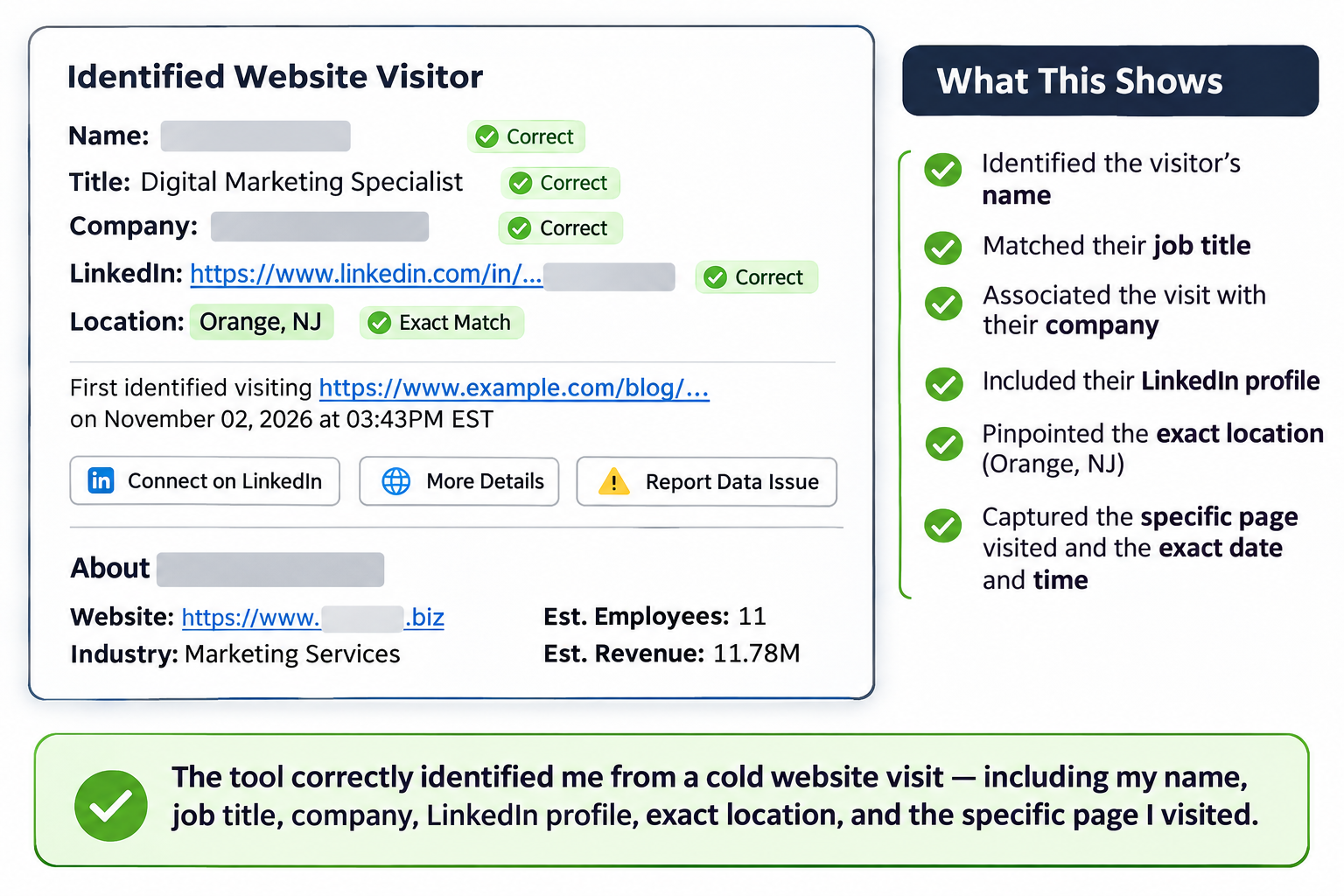
An anonymized version of the actual visitor-identification alert shared with me. The system correctly identified my name, professional title, former employer, and LinkedIn profile from a website visit without a form submission. Even the exact article and visit timestamp were captured. The only detail that wasn't accurate was my precise location.
What I do know firsthand is that my name and a previous employer were surfaced without me submitting a form, and that the team member attributed the capability to RB2B.
That is what made me pay attention.
First, the backlink: why I was on their website at all
Backlinks are links from one website to another. In SEO, they can help search engines discover pages and understand how other sites reference a brand. But a good backlink is more than an abstract ranking signal. It is also a real editorial mention that a human being may click, read, and trust.
Google itself says that the way to earn links naturally is to create unique, compelling content people want to link to. Its spam policies also warn against buying links to manipulate rankings and excessive link exchanges.
In other words, the goal isn't to collect the largest number of random URLs. It's to earn relevant, useful mentions in places that make sense.
That's what I was thinking about as I worked on my homepage.
I wanted visitors to see evidence of earned visibility instead of being asked to take my word for it. So I opened the company's article, checked the context of the link, and considered how it would fit alongside other examples on the site.
The irony is that I was there to examine how my brand appeared on their site. Their marketing system apparently had a way to recognize that I had appeared on theirs.
One link turned into two kinds of marketing lessons: the lasting value of being mentioned on another site, and the possibility of acting on meaningful website traffic before somebody submits a lead form.
The part that stopped me: they had my name and my former company
This was not a situation where a company vaguely recognized a visitor's industry or knew that someone from a certain business had browsed the site.
They identified me by name. They also connected me to a company I had worked for previously.
That second detail is why I was so intrigued. An old employer suggests there was some kind of professional identity record or enrichment information in play. It wasn't merely an anonymous pageview being counted in an analytics dashboard.
Imagine opening a company blog to check an editorial mention, closing it, and then receiving a LinkedIn connection and message from someone on the team—someone who has clearly been able to connect the visit to you.
Now imagine that identification also includes your professional history, but the company association is a step behind reality.
That's exactly the sort of thing that makes me ask questions as a marketer.
Was the person-level identity a strong match? It appeared to be: they found me.
Was the company data perfectly current? No, because the company they associated with me was one I'd left.
That combination is both a strong demonstration of identity resolution and a reminder that enrichment data can lag behind real life.
I did what I think every curious marketer should do. I asked what they had in their tech stack that made this possible.
The answer they shared was RB2B.
I don't know whether an automated alert went to a team member, whether someone manually reviewed a visitor profile, or whether other tools were involved in sending the LinkedIn message. But I know the experience happened, I know my name and past company were identified, and I know which platform the team credited.
A vendor could spend a lot of money trying to explain its value to me in a marketing campaign.
In this case, using the product got my attention more effectively than a conventional sales pitch could have.
What is RB2B?
RB2B is B2B website visitor identification software. Its pitch is simple: a business shouldn't have to treat every person who leaves its site without submitting a form as completely invisible.
According to RB2B's explanation of how the platform works, it can match eligible visitors to individual professional profiles or, when person-level identification is unavailable, to companies.
The resulting information can help a sales or marketing team see who may be researching the business, which pages they viewed, and whether follow-up is appropriate.
Depending on the match and plan, available information can include a name, job title, employer, LinkedIn profile URL, and business email address. RB2B lists person-level and company-level records as different kinds of outputs, and it can route results into tools such as Slack, Microsoft Teams, and supported CRM integrations.
That is a very different experience from opening an analytics dashboard and seeing "one user viewed three pages."
Traditional analytics are excellent for understanding aggregate behavior: which channels drive visits, what content performs, where conversions happen, and where people drop off.
Visitor identification tries to answer an additional question: can this particular visit be matched to a professional or organization that the business can meaningfully serve?
That doesn't mean every visitor is identifiable. It doesn't mean every match is correct. And it absolutely doesn't mean everyone who reads a blog post is ready to buy.
What it means is that some of the traffic marketers already work hard to earn may be more actionable than it first appears.
How can a website identify somebody who didn't fill out a form?
From my perspective, this was a cold visit. I hadn't supplied my name, email, current business, or former employer to the company. So the result felt like being identified through an IP address alone.
Technically, however, a cold visit is not the same as a pure IP-to-person lookup.
RB2B's technical FAQ says IP addresses are not its method for identifying individuals; its product overview describes combining first- and third-party cookies, device identifiers, and network data in an identity-matching system.
IP-related tools, including Demandbase reverse-IP lookup, are used for company-level identification and geolocation.
This matters because a single shared or dynamic IP address is a poor way to establish a specific person's identity. What makes the category impressive is the broader process: when a matching network recognizes an eligible visit, it can potentially link that event to a professional profile and enrich that profile with employment-related data.
That's consistent with the kind of result I experienced—my name plus an old company association—without pretending I have access to the specific matching record that generated it.
Conceptually, the process works like this:
Someone visits a website. The business has installed an identification script, subject to its consent configuration and applicable rules.
The system evaluates available signals. Depending on the visit and environment, those may include network, device, cookie, and other permitted identifiers.
An identity or organization may be matched. An eligible U.S. visit might yield person-level professional information; another visit may yield only the employer or company.
The record gets enriched. When available, professional details and a LinkedIn profile can make the record understandable to a salesperson.
The information enters a workflow. A team might receive an alert, filter the visitor against its ideal customer profile, or decide whether to reach out.
RB2B's contact-level documentation describes that kind of correlation and enrichment. Its company-level documentationalso notes that shared devices, workplace logins, and other circumstances can create incorrect matches.
So if you're picturing a salesperson entering a stranger's IP address into a box and receiving a guaranteed, perfectly current identity, that's not a fair description.
The more accurate explanation is also the more interesting one: modern B2B platforms can connect multiple signals to sometimes resolve what looks like anonymous traffic into usable professional context—and the company field may be outdated even when the person's identity is right.
Why the former-employer detail matters just as much as my name
Getting the correct person's name from an unannounced website visit is striking. Attaching a former employer adds another layer, because it tells us something about both the power and the limitations of contact enrichment.
On one hand, the professional record was specific enough to lead the site's team to me on LinkedIn. That's far more actionable than seeing a chart of unknown users and pageviews.
On the other hand, the company association wasn't current. If a sales team had treated that old employer as proof of where I work now, it could have personalized the outreach incorrectly, assigned me to the wrong account, or decided I was a prospect for a product my former organization needed rather than something relevant to me today.
RB2B's profile data documentation says professional and company information can be added through enrichment sources, and its identification guidance warns that mismatches are possible.
My experience is a practical example of why every identified profile should be treated as a lead to verify, not as an infallible truth.
A name match and a company match are different claims. A historical employer on a profile is not necessarily a person's current employer. And even a correctly identified visitor is not necessarily looking to buy.
The opportunity is real—but so is the need for judgment. If I tested RB2B for my own business or a client, I would specifically measure person-level accuracy separately from current-employer accuracy, because my experience showed that those two things can diverge.
Why this matters for B2B marketing
Most businesses already invest in getting people to a website. They write articles, pursue earned media, publish LinkedIn posts, run paid campaigns, optimize landing pages, and try to build trust through search and AI discovery.
Then what happens?
A lot of people browse and leave. Some come back later. Some may mention the brand in a meeting. A smaller share submit a form, send an email, book a call, or make a purchase.
The standard playbook asks the visitor to raise their hand. Visitor identification asks whether there is a responsible way to recognize relevant interest before that point.
For an agency, that could mean noticing that somebody from a prospective client account looked at a service page. For a software company, it might mean seeing a return visit to integrations or pricing. For a consultant, it could mean recognizing that a business they already wanted to work with has been reading case studies.
There is a meaningful difference between "a stranger opened a blog post once" and "a well-matched company keeps returning to a page explaining our service."
Not every signal deserves an immediate sales message. But some deserve attention. The value isn't just the ability to identify visitors; it's the ability to decide what to do with that information intelligently.
The unexpected connection between backlinks and visitor identification
Here's the marketing lesson I keep coming back to: a backlink is often treated as the end of a campaign when it may actually be the beginning of another interaction.
Imagine a relevant website mentions your brand. The link may create credibility, send referral traffic, and make it easier for interested readers to find you. It might also introduce a prospective buyer who hasn't heard of you before.
If that person clicks through to your website, their behavior may tell you more about what interested them than the original mention alone. Did they read a related article? Open a service page? Look at a case study? Return later?
This is where digital PR, SEO, content strategy, and sales intelligence begin to overlap.
At Ritner Digital, I think about visibility as a connected system. Search helps people discover you. Earned mentions give them reasons to trust you. Useful content answers their questions. A good website helps them act when they're ready.
Visitor identification can potentially add another layer: helping a business recognize qualified interest and follow up in a way that is actually useful.
But the order matters. First, create something worth finding. Then build a thoughtful process for responding to interest. Buying more data won't fix a vague offer, a weak website, or outreach that makes people uncomfortable.
What my experience proves—and what it doesn't
I love this story precisely because it happened without my trying to test the product. I was a marketer doing normal marketer things, and someone else's marketing stack got my attention.
Still, one successful identification is not a controlled study.
What I can say: I opened an article to check an earned backlink without submitting a lead form. The site's team identified my name and associated it with a company I had worked for previously. Someone from that team found and contacted me on LinkedIn. When I asked what technology enabled the identification, they shared RB2B. It was compelling enough to make me seriously consider the product.
What I can't say: I don't know the exact identity signals used in my particular match, whether an IP address was part of that match, the team's complete workflow, or how frequently this would happen across my own client sites. I also haven't completed a paid deployment and independently measured conversion lift or ROI. Importantly, the old-company detail was not current, so I would want to validate employer accuracy before building outreach rules around it.
In other words, this is a real-world encounter and a recommendation to take a serious look, not a claim that I've finished a months-long comparative software test.
I think transparent marketing is more persuasive than inflated marketing anyway. "This happened to me, it got my attention, and here's what the tool does" is a better story than pretending one interaction settles every performance question.
How I'd use visitor identification in a smart marketing stack
If I were evaluating RB2B for a B2B business, I would start with a handful of specific workflows rather than sending every identified visitor straight into an aggressive outreach sequence.
1. Spot visits from ideal-fit companies
First, define what a good-fit customer actually looks like. Industry, company size, geography, job function, problems you solve, and realistic buying potential all matter.
An identity match is a data point; an ideal-customer-profile match is a reason to pay attention.
The most useful alert isn't "someone visited." It's "someone at a company we genuinely help visited relevant pages."
2. Pay attention to higher-intent pages
A visit to a general-interest blog post can indicate curiosity. A visit to a pricing page, service page, implementation guide, or detailed case study may indicate something different. Neither guarantees purchase intent, but context makes the signal stronger.
I would prioritize the pages most associated with serious evaluation and compare those signals with return visits and account fit.
3. Make outreach personal without making it creepy
There is a huge difference between a message that says, "I saw everything you looked at on my website," and one that respectfully offers relevant help.
If somebody appears to be researching a topic you know well, lead with expertise or a resource. Don't recite their browsing history back to them. Don't assume they want a meeting because they clicked a page.
The best follow-up feels like a useful professional introduction, not a surveillance demonstration.
4. Give sales teams context, not noise
If a business sends every page view to its sales team, people will learn to ignore the alerts. The same thing happens when a CRM fills with questionable contacts and duplicates.
I'd set basic rules: prioritize the right accounts, suppress existing customers when appropriate, distinguish repeat interest from casual browsing, and verify that a reported employer is current before assigning a contact or personalizing outreach.
The fact that my own profile surfaced a former company is exactly why I would build that quality check in from day one.
Good signal routing should save time, not create a new inbox full of low-quality leads.
5. Learn which content attracts the right audience
This one is especially interesting for SEO and content marketing. A blog post with thousands of views isn't automatically more valuable than a focused article read by a handful of ideal buyers.
When used responsibly, account-level and person-level insights can help marketers ask whether the content attracting traffic is also attracting the types of people a business is built to serve.
That doesn't replace search rankings, engagement metrics, or conversion reporting. It complements them by adding another perspective on audience quality.
Where I'd draw the line: privacy, consent, and trust
I can be impressed by the technology and still think the ethical questions are important. Actually, I think that's the only reasonable way to evaluate a tool like this.
People don't necessarily expect a business to know their professional identity simply because they read a public webpage. If you're going to use identification technology, the responsibility doesn't end with "the vendor says it's compliant."
RB2B says person-level identification is limited to eligible U.S. traffic, while company-level identification can be available internationally.
Its company-identification guidance explicitly says website operators are responsible for meeting relevant privacy and consent requirements and updating their privacy notices. The vendor also maintains privacy-request and opt-out routes.
For any client deployment, I'd want to check the actual privacy policy, consent-management setup, applicable state and international laws, internal data-retention rules, vendor agreements, and what the sales team is allowed to do with the information. I'd also ask who can access identified profiles and how incorrect matches or opt-out requests are handled.
And there's a more human test: would a reasonable person feel respected by the way we used the information?
A marketer can use a powerful tool responsibly or badly. It's the same with email, analytics, or any kind of lead intelligence. The technology doesn't excuse poor judgment.
If your follow-up is too intrusive, it can damage the very trust your content worked to earn. I would rather miss a marginal opportunity than make a good prospective client feel watched.
RB2B pricing: what I'm looking at
After the team shared the link, of course I went straight to the product and pricing pages. That's what marketers do when another marketer shows them something effective.
According to RB2B's published pricing, as checked on November 3, 2026, the entry-level options are:
Free — $0 per month: company-level identification, with 150 monthly resolutions.
Starter — $79 per month: eligible person-level identification and LinkedIn URLs sent to Slack or Teams, with 300 monthly resolutions.
Pro — starting at $149 per month: adds business email information and broader integrations, starting at 600 monthly resolutions.
Pro+ — starting at $199 per month: premium resolution designed for higher match coverage, starting at 600 monthly resolutions.
RB2B also advertises a seven-day full-featured trial. A "resolution" is an identified visitor delivered by the platform; plan limits, coverage, additional domains, and overage charges affect the actual cost.
Pricing and features can change, so use the live plan comparison rather than treating these numbers as permanent.
The free tier makes the idea approachable. But if the specific experience you're hoping to replicate is person-level LinkedIn outreach, pay attention: the published free plan is company-level only.
The distinction between knowing which company visited and knowing which person visited is a major purchasing decision.
I'm interested, but I'd still want to test it on the traffic that matters before committing to an ongoing subscription.
Is the investment worth it? Here's how I'd judge
I wouldn't buy visitor identification software just to generate exciting Slack notifications. I'd buy it if the team could translate a reasonable number of accurate, relevant signals into conversations that otherwise would have been missed.
Start with the basics: how much eligible traffic does the site get, how many visitors can be resolved, and what proportion fit the business's ideal customer profile?
Then look at what happens next. Are people accepting connection requests? Responding to genuinely useful messages? Booking qualified calls? Becoming customers?
For a practical test, track:
Identified visitors versus eligible traffic, split between person-level and company-level records.
Person-level match accuracy, current-versus-former-employer accuracy, and the percentage of records that fit the ideal customer profile.
High-intent page views and repeat visits rather than raw identified-visitor totals alone.
Positive reply rates, qualified meetings, and real opportunities generated from outreach.
Subscription costs, overages, sales effort, complaints, opt-outs, and closed revenue.
One especially important measurement rule: don't give the tool credit for a customer who was already in an active sales process without accounting for that existing relationship.
Attribution should help you make better decisions, not manufacture a success story.
The goal is not "How many names can I uncover?"
The goal is "Can I create more valuable, welcome conversations without wasting time or harming trust?"
How I would test RB2B before rolling it out
I would use a short, well-defined pilot and make the success criteria clear in advance.
Week one: establish the baseline. Review current traffic, conversion rates, customer profile, high-intent pages, and how quickly the team follows up with existing leads. Make sure your privacy and consent setup is reviewed before adding new tags.
Week two: inspect the data. Are names matched correctly? Are the attached companies current—or are they prior employers, as happened in my case? Are the job titles and LinkedIn profiles useful? Are you receiving person-level matches or mostly company-level information? How much of your traffic is actually eligible for person-level identification?
Week three: try human-led outreach. Select a small number of clearly relevant contacts. Have a real person review the context and decide whether a helpful, low-pressure message is warranted. Track responses, not just messages sent.
Week four: decide based on outcomes. Compare the cost and time invested against qualified conversations, downstream opportunities, and any negative feedback. If it works, improve the workflow. If the data is noisy or the audience isn't a fit, don't force it.
This is an evaluation framework, not a claim that I've already run a four-week RB2B test. I haven't. I'm describing how I'd separate my very memorable personal experience from a repeatable business case.
What good outreach should sound like after an identified visit
The team member who contacted me did something valuable beyond simply appearing in my notifications: the interaction gave me an opening to ask a question, and they answered it.
That exchange created more goodwill than a pushy pitch would have.
If you're going to use intent signals, I'd recommend three principles. Be relevant. Be brief. Give the other person control over whether to continue the conversation.
For example, if your business helps B2B companies improve lead generation, an introduction that offers an insightful resource or a specific observation about the prospect's public business is much better than one announcing you've tracked their recent web activity.
And don't treat a LinkedIn connection request as a license to launch a ten-message sales sequence. The follow-up should feel proportional to the relationship. There is no need to act as though every anonymous browser visit represents an urgent request for a meeting.
The funny part is that I was probably more interested in the technology than whatever was being sold to me. Once the person told me the tool, I started researching it on my own. That's a reminder that transparency, useful conversation, and a little generosity can be better marketing than a hard close.
Who should look at a tool like RB2B—and who probably shouldn't?
I can see a strong case for B2B service providers, SaaS companies, agencies, consultancies, and sales teams that have enough relevant website traffic to surface meaningful opportunities.
It's particularly interesting if your target audience is concentrated in the United States, you know your ideal customer profile, and you already have a disciplined outreach process.
I'd be more cautious for very low-traffic websites, businesses without a defined buyer, consumer brands expecting the same type of person-level B2B workflow, or companies that have not sorted out basic privacy practices.
If your website barely explains what you sell, start there. If your sales process currently ignores people who actually fill out forms, fix that before looking for more names.
And if your audience is predominantly outside the U.S., study the geographic limits of person-level identificationcarefully. Company-level data may still be helpful, but it's not the same product outcome.
My recommendation: yes, look at RB2B
I don't make a habit of endorsing software because of a clever landing page. There are a lot of impressive demos in marketing, and not every one turns into a practical, affordable workflow.
This was different because I wasn't seeking out a demo. I was doing routine work for my own website, visiting a third-party article that linked to me, when I ended up on the receiving end of the very kind of identification and follow-up marketers usually discuss in abstract terms.
My name. A previous company I worked for. A LinkedIn connection and message. No form submission.
That was the sequence. I asked how they managed it, and the team member shared RB2B. The outdated employer was a useful reminder that the data needs checking, but it did not make the experience any less impressive.
That is enough for me to say the tool deserves a place on the shortlist if identifying relevant website visitors is a problem you're trying to solve. I am looking at the pricing, and yes, I expect I'll keep talking about it. It made the concept tangible in a way a dashboard screenshot never could.
Just remember: a useful visitor signal is the beginning of a relationship, not permission to skip the relationship-building part.
The best marketing still looks like being helpful. The software should support that, not replace it.
Frequently asked questions
Can RB2B really identify someone who never filled out a form?
According to RB2B, yes, some eligible visitors can be matched to a professional profile using available identity-network signals and enrichment data. A form submission is not always required. That doesn't mean everyone is identifiable or that every match is accurate.
Read the company's technical overview for how it describes the process.
Does RB2B identify people from an IP address alone?
RB2B's technical FAQ says it does not use IP addresses to identify individuals directly.
Its system uses broader matching signals, while IP data can help with geolocation and company-level lookup. So even though the experience felt like someone had identified me from a cold IP address, I can't claim that an IP address alone revealed my name and former employer.
Can RB2B show a visitor's LinkedIn profile?
On eligible person-level matches, LinkedIn profile URLs are among the professional details RB2B says it can provide. Whether you can receive those profiles, and how they are delivered, depends on the plan and applicable geographic or privacy restrictions.
Check RB2B's feature and pricing information.
Why did RB2B associate me with a former company rather than my current one?
Professional enrichment systems can include historical or stale employer information, and a profile's recorded company affiliation is not always up to date.
I can't tell which source led to the old employer in my particular case. But because the company was former, I would recommend validating current employment before relying on that field for personalized outreach or account-based marketing.
See RB2B's information overview.
Is RB2B free?
RB2B publishes a free, company-level plan and a seven-day trial, with paid plans for person-level identification and additional capabilities.
As of November 3, 2026, paid plans start at $79 per month according to its official pricing page. Check that page for current rates, credits, and limits.
Does RB2B work for visitors outside the United States?
RB2B says person-level identification is restricted to eligible U.S. traffic. Company-level identification is available more broadly, including internationally, subject to product limitations and legal requirements.
That difference matters a lot for global marketing teams.
Is website visitor identification legal?
There isn't one blanket answer for every business or jurisdiction. Your lawful basis, consent mechanisms, disclosures, data processing, and outreach practices all matter.
RB2B provides compliance information and opt-out options, but the website operator remains responsible for its own use of the technology.
Review RB2B's compliance guidance and consult qualified privacy counsel when needed.
Is a website visit the same as buyer intent?
No. Reading a blog post might mean curiosity, research, competitive analysis, or accidental traffic.
Intent gets more meaningful when you combine account fit with the pages viewed, repeat engagement, and other real context. Even then, it should guide a thoughtful decision rather than trigger an assumption that somebody is ready to purchase.
What's the difference between a backlink and visitor identification?
A backlink is a link from another website to yours. Visitor identification is technology used on a website to attempt to match visits to people or companies.
They solve different problems. The connection is that strong content and earned links can bring people to a site, while identification tools may help a business understand some of that resulting interest.
Would I recommend RB2B without having installed it myself?
I'd recommend evaluating it based on what I personally experienced. The team that contacted me identified RB2B as part of its approach, and it was compelling enough to make me research the product.
That is different from claiming I have validated its accuracy, legal fit, or ROI across a client portfolio. A pilot is how I'd make that next decision.
Want your website traffic to turn into something more meaningful?
An earned backlink brought me to someone else's site. Smart follow-up turned that visit into a conversation.
The takeaway isn't that every brand needs to track every visitor. It's that your marketing channels should work together: visibility, credibility, useful content, and a thoughtful path to conversion.
If you want help strengthening your SEO, earning relevant mentions, improving your content strategy, or building a website experience that turns the right attention into real business opportunities, I'd love to hear what you're working on.
Contact Ritner Digital to start the conversation.
Sources and further reading
RB2B — product overview: capabilities and identification approach.
RB2B — how it works: identity signals and matching workflow.
RB2B — pricing and plans: current plan features, limits, and entry-level pricing.
RB2B — company-level identification: coverage, accuracy limits, and consent responsibilities.
RB2B — technological FAQs: the role and limits of IP addresses in person-level identification.
RB2B — profile information fields: identity and employer enrichment information.
Google Search Central — earning links naturally: Google's guidance on why people link.
Google Search Central — spam policies: link schemes and manipulative practices to avoid.
Associated Press — November 2, 2026 report: reporting on the crash and its victims.
KUT / Texas Public Radio — November 2, 2026: confirmation of Adam Robinson's connection with RB2B and Retention.com.
A personal note of condolence
As I prepared this post, I learned the devastating news that RB2B and Retention.com founder and CEO Adam Robinson died in a plane crash in Florida on November 1, 2026, along with his wife, Helen Sharp, their two young children, and five other people.
The deaths were reported by the Associated Press, with KUT and Texas Public Radio also reporting Robinson's leadership of RB2B and Retention.com.
My sincere condolences go to their families, friends, loved ones, and the entire RB2B and Retention.com team. This is an unimaginable loss. I hope everyone affected is given the support, care, and privacy they need.