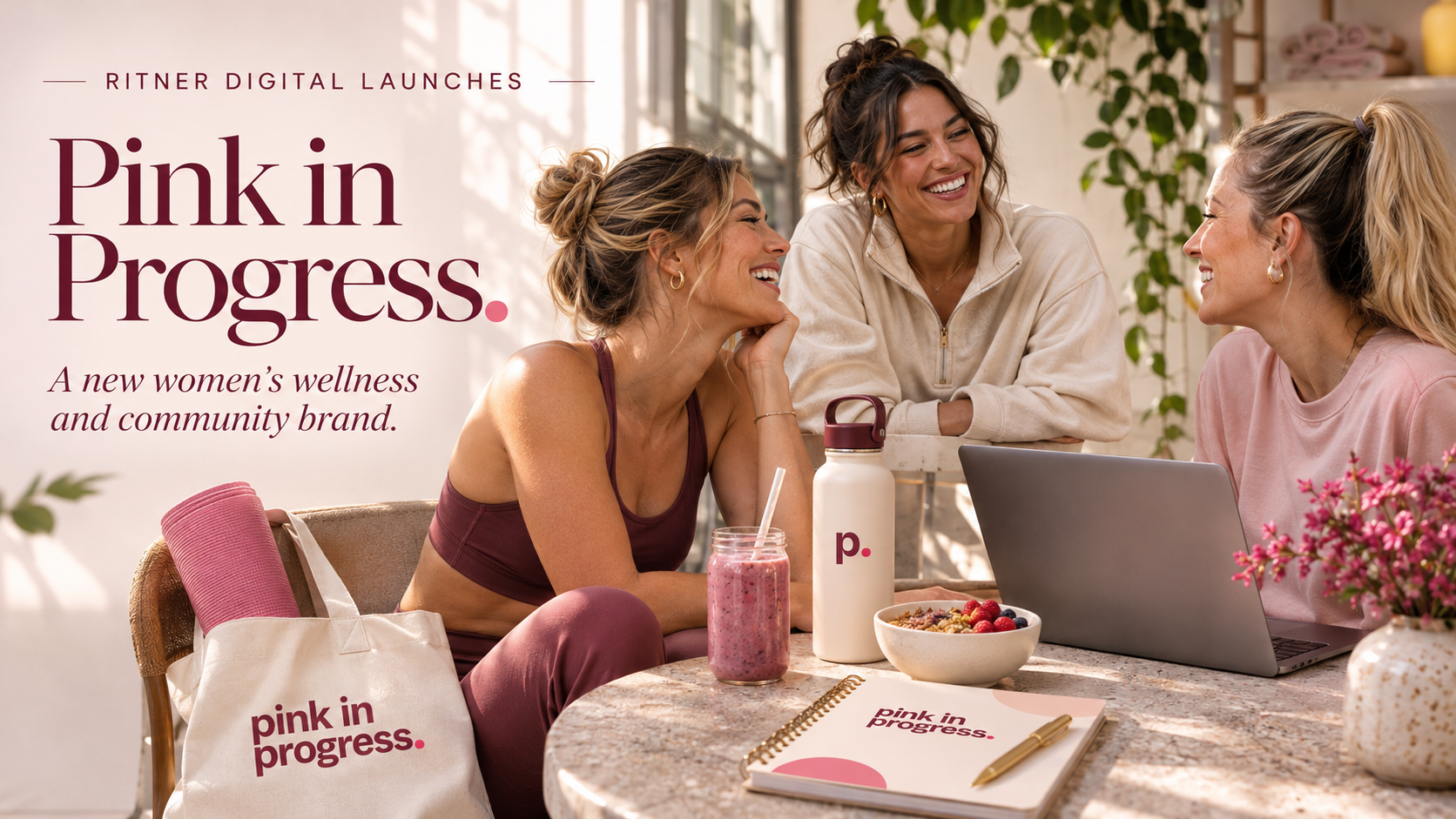
Two brands. Two different audiences. One belief in building something meaningful. Ritner Digital is expanding its brand portfolio with the launch of Pink in Progress, a direct-to-consumer women's wellness and community brand. Here's the story behind both brands, what makes Pink in Progress different, and why we're excited to grow them together throughout 2027.
Some brands begin with a business plan.
Others begin with a problem worth solving.
And sometimes, a new brand begins with a feeling that doesn't quite have a name yet.
The feeling of wanting more energy.
Of wanting to feel stronger.
Of having a calendar full of responsibilities but very little time that feels like your own.
Of realizing that somewhere between work, relationships, motherhood, and everyday life, you've stopped making space for the things that make you feel good.
You want to move more.
You want to take better care of yourself.
You want to spend time with friends.
But you don't necessarily want another complicated routine, another restrictive diet, or another person telling you that you're not doing enough.
You want something that feels possible.
Something encouraging.
Something that fits into the life you're actually living.
And ideally, you don't want to do it alone.
That's the idea behind our newest brand.
Ritner Digital is excited to introduce Pink in Progress, a new direct-to-consumer women's wellness, fitness, and community brand built around small wins, sustainable habits, friendship, and progress over perfection.
This launch represents a new chapter for our growing brand portfolio.
Ritner Digital remains our primary digital marketing practice, helping businesses strengthen their visibility through SEO, AI search, content strategy, web design, digital PR, and performance measurement.
Pink in Progress is something different.
It's a brand designed directly for women.
Women navigating new motherhood.
Women rebuilding routines after difficult seasons.
Women looking for practical fitness and nutrition support.
Women who want more connection, more confidence, and a community that understands that real life rarely follows a perfect schedule.
The two brands serve completely different audiences.
But the more we think about what we're building, the clearer the connection becomes.
Both brands start with understanding people.
Both value useful information over empty promises.
Both are grounded in the idea that small, consistent improvements matter.
And both reject the notion that progress has to happen overnight to be worthwhile.
As we head into 2027, we're looking forward to building these two distinct brands side by side.
Our Story: Two Domains, One Year, and a New Chapter
2026 has been a foundational year for our portfolio.
In January 2026, the Ritner Digital domain journey began.
It marked the beginning of building an independent digital marketing brand focused on helping businesses become easier to find, understand, and choose.
Ritner Digital started with a clear point of view.
Good businesses deserve to be discovered by the people who need them.
Marketing should be useful.
Content should answer real questions.
Search visibility should be connected to business goals.
And agencies should be honest about what they can and cannot deliver.
Throughout 2026, that philosophy helped shape the Ritner Digital website, services, publishing strategy, research, and client work.
We invested in building a recognizable digital presence and an editorial voice that reflects how we think about marketing.
Then came November 2026.
That's when the Pink in Progress domain journey began.
A new website.
A new brand identity.
An entirely different audience.
And an opportunity to apply what we've learned about digital experiences, psychology, content, and community to something outside traditional agency services.
Pink in Progress isn't a new marketing package or a different name for Ritner Digital.
It's a separate brand with its own mission, voice, audience, and long-term direction.
Ritner Digital is business-to-business.
Pink in Progress is direct-to-consumer.
One focuses on business visibility and digital growth.
The other focuses on women's wellness habits, fitness, and finding supportive people.
January 2026 gave us Ritner Digital. November 2026 gave us Pink in Progress. And 2027 is the year we're looking forward to building both.
We're not presenting these young brands as if they've already spent decades in the market.
We're sharing the beginning of the journey.
And we're excited about where it can go.
Meet Pink in Progress: Find Your Strength. Find Your Girls.
The first thing you'll notice about pinkinprogress.com is that it doesn't feel like a traditional fitness website.
It isn't dominated by aggressive workout imagery.
It doesn't lead with before-and-after weight-loss transformations.
It doesn't tell women to push harder, eat less, or work toward an idealized body.
Instead, it opens with a simple invitation:
"find your strength. find your girls."
That sentence captures the brand's purpose.
Pink in Progress brings together three central ideas: fitness, everyday nutrition habits, and community.
The fitness side emphasizes realistic movement and strength-building.
The nutrition side focuses on approachable habits instead of restrictive dieting.
The community side creates opportunities for women to connect through walk clubs, virtual circles, and shared experiences.
What makes the combination interesting is that none of those elements is treated as a complete solution on its own.
A workout plan can be useful.
So can learning how to prepare practical meals.
But having people in your corner matters, too.
Someone to walk with.
Someone who understands why leaving the house with a newborn can feel like an entire production.
Someone to celebrate the little improvements that other people might not notice.
Pink in Progress is built around the idea that wellness should support the life you're living, not become another thing you're struggling to keep up with.
And it has a sense of humor about that life.
The brand's writing feels like a friend sending you a message, not a trainer yelling instructions across a gym.
It's warm.
It's playful.
It's direct.
And it takes the challenges women face seriously without making every conversation feel heavy.
That's an important part of what makes the brand distinctive.
Why the Name Pink in Progress Matters
There's more behind the name than the color.
The phrase in the pink is an old expression meaning being in good health or good spirits.
Pink in Progress takes that familiar idea and gives it a different perspective.
What if feeling good isn't a fixed destination?
What if getting stronger doesn't require returning to a previous version of yourself?
What if you could feel proud of progress even when life is still messy?
The brand's article, What “Getting Your Pink Back” Really Means, explains the philosophy in detail.
It's not about returning to your pre-baby body.
It's not about recreating who you were before a difficult year.
And it's not about achieving a perfect routine.
It's about feeling stronger, more nourished, more energized, and more connected in your life as it exists now.
That distinction matters.
A woman who has just had a baby is not necessarily trying to become exactly who she was before motherhood.
A woman recovering from burnout may not want to return to the same schedule that exhausted her.
Someone navigating grief, divorce, or another major change may be trying to build a different kind of normal.
The name makes room for that.
You're allowed to be in progress.
You're allowed to have good weeks and difficult ones.
You're allowed to start small.
And you're allowed to keep going without turning every setback into a personal failure.
It's a simple brand idea with meaningful emotional depth.
A Wellness Brand That Doesn't Believe in “Bouncing Back”
One of the strongest elements of Pink in Progress is what the brand deliberately refuses to say.
On its homepage, the section called The Pink Promise makes four commitments.
No bounce-back pressure.
No arbitrary food restrictions.
No reducing progress to body size.
And no expectation that women have to do everything alone.
These aren't just editorial preferences.
They help define the experience Pink in Progress wants to create.
Much of conventional fitness marketing relies on urgency.
Get results in thirty days.
Get your old body back.
Eliminate certain foods.
Transform your appearance.
Start over on Monday.
That messaging can make personal wellness feel like another performance standard.
Pink in Progress takes a different approach.
A short walk can count.
A practical meal can count.
A strength session that fits between responsibilities can count.
Reaching out to a friend can count.
And a difficult week doesn't automatically erase the progress made before it.
For women experiencing the physical and emotional changes of motherhood, this approach can be especially relevant.
But the brand is intentionally broader than postpartum wellness.
Its audience includes women in many seasons of life.
A difficult career transition.
A breakup.
Loss.
A demanding year.
Or simply wanting to feel better and build friendships.
Pink in Progress isn't asking women to go backward. It's inviting them to move forward in a way that works for them.
That is a stronger long-term brand philosophy than promising a quick transformation.
The Psychology Behind the Brand: Small Actions, More Helpful Thinking, and Real Support
One of the most interesting parts of Pink in Progress is how naturally its philosophy connects with behavioral psychology.
The brand emphasizes realistic goals, self-reflection, regular check-ins, manageable actions, and a more compassionate response to setbacks.
Several of those ideas resemble principles used in established behavior-change approaches.
Some also overlap conceptually with techniques commonly associated with cognitive behavioral therapy, or CBT.
But an important distinction needs to be made.
Pink in Progress is a coaching and community brand, not a clinical CBT program or mental health treatment service.
Its content does not establish that members are receiving psychotherapy or that the brand offers formal cognitive behavioral therapy.
CBT is an established form of psychotherapy delivered within appropriate professional and clinical boundaries.
The American Psychological Association's definition of cognitive therapy describes approaches that identify and evaluate unhelpful thinking patterns.
The NHS's explanation of CBT thought records similarly discusses examining thoughts, emotions, evidence, and alternative interpretations.
Pink in Progress uses a softer, everyday wellness language to discuss some related themes.
And that distinction is part of its appeal.
Reframing a setback instead of starting over
Imagine planning to work out three times this week.
But your child gets sick.
Work runs late.
And by Friday, you've completed only one session.
An all-or-nothing mindset might turn that into:
"I failed again. I can never stick to anything."
A more balanced interpretation might be:
"This was a difficult week. I managed one session, and I can adjust the plan for next week."
The second interpretation doesn't pretend everything went perfectly.
It recognizes the evidence more fairly.
It also makes it easier to consider a practical next step.
Pink in Progress regularly uses this kind of compassionate, realistic language.
The message isn't that setbacks are imaginary.
It's that a setback doesn't have to become your entire identity.
This resembles the broader principle of examining unhelpful interpretations, but it's presented as ordinary self-reflection—not a substitute for therapy.
Making the next action small enough to begin
The brand also emphasizes manageable behavior.
A short walk.
A simple meal.
A glass of water.
A message to a friend.
These actions may sound almost too small to matter.
But the point is to make the next step achievable.
The Association for Behavioral and Cognitive Therapies describes behavioral activation as an approach involving meaningful activities, observation, and gradual engagement.
Pink in Progress's encouragement to engage in small, worthwhile activities is compatible with general behavioral principles.
That doesn't mean a walk club is clinical behavioral activation treatment.
It means the brand recognizes something practical: people often benefit from having an achievable next action rather than another overwhelming goal.
Noticing progress that isn't visible on a scale
Pink in Progress also encourages women to recognize small improvements.
Perhaps carrying groceries feels easier.
Maybe walking up the stairs requires less effort.
Perhaps a routine has become more consistent.
Or maybe someone has made a new friend.
Its article Non-Scale Wins Our Coaches Celebrate explores these examples.
This approach broadens the definition of progress.
Rather than asking women to judge every week through one metric, the brand encourages them to pay attention to meaningful changes in their daily lives.
That is a useful philosophy because it connects wellness habits with experiences people actually care about.
Not every personal goal needs to produce a dramatic visual transformation.
Sometimes the improvement is simply that everyday life feels a little more manageable.
What Makes Pink in Progress Different From Toxic Positivity
One particularly thoughtful article on the site is titled “Just Be Happy” Isn't the Whole Story.
It addresses an uncomfortable problem in wellness culture.
The tendency to tell people that happiness is entirely a matter of attitude.
Be grateful.
Choose joy.
Think positively.
Look on the bright side.
Those messages can sound encouraging.
But they can also ignore the real circumstances affecting someone's life.
A woman may be exhausted because she lacks childcare support.
She may be overwhelmed by work.
She may be dealing with grief.
She may be navigating difficult relationships or financial pressure.
Those situations aren't necessarily solved by changing her mindset.
Pink in Progress makes room for both internal and external realities.
Your thoughts matter.
Your habits matter.
But your workload, support system, health, relationships, and circumstances matter, too.
That creates a more credible approach to personal growth.
The brand isn't saying women should ignore difficult feelings.
It isn't suggesting they can simply think their way out of every problem.
Instead, it encourages reflection about what can be changed internally and what may need to change externally.
Sometimes a small habit helps.
Sometimes a conversation with a partner helps.
Sometimes joining a community helps.
And sometimes professional medical or mental health support is the appropriate next step.
That balance is what makes the psychology-oriented content more thoughtful than generic motivational messaging.
Pink in Progress believes in personal agency without pretending women control every circumstance in their lives.
That is a distinction we want the brand to maintain as it grows.
Why Community Is More Than an Extra Feature
Many fitness businesses emphasize individual accountability.
You receive a program.
You follow it.
You report your results.
Then you repeat.
Pink in Progress includes one-on-one coaching, but community is not treated as an afterthought.
It's part of the core idea.
The brand's homepage describes walk clubs, virtual circles, local meetups, and opportunities to connect online.
That community-centered approach reflects a genuine need.
The U.S. Surgeon General's advisory on social connection identifies meaningful social relationships as an important contributor to health and well-being.
Its recommendations encourage people to participate in community groups and create opportunities for connection.
Pink in Progress translates that broad idea into approachable experiences.
A walk with other women.
A virtual conversation during a difficult season.
A group where someone can ask a question without feeling embarrassed.
An opportunity to make friends as an adult, when friendship doesn't necessarily happen as naturally as it did in school.
The website's community concept is especially welcoming to new moms.
Stroller walks, flexible meetups, and cameras-optional conversations are designed around the realities of caring for a young child.
But the community extends beyond motherhood.
The journal also explores connection during grief, divorce, career changes, and other transitions.
That's a meaningful strategic choice.
Pink in Progress can begin with a strong focus on new motherhood without defining every woman's experience through that one chapter.
The mission is broader.
It's about helping women feel connected while they're building or rebuilding their routines.
One of Our Favorite Ideas: Walk Clubs That Don't Make Fitness Complicated
There's something appealingly simple about a walk club.
You don't necessarily need expensive equipment.
You don't need to master a complicated workout routine.
And you don't need to be at a particular fitness level to participate in an appropriately designed walk.
You show up.
You move.
You talk.
You meet someone.
Pink in Progress has built walk clubs into its community concept because they combine two parts of the brand's mission.
Movement and connection.
Its article How to Start a Stroller Walk Club in Your Neighborhood provides practical guidance for organizing a group.
The site also invites women to express interest in walk clubs in their own cities.
As of its November 2026 website content, Pink in Progress describes signups in New York City, Los Angeles, Chicago, Austin, Nashville, Dallas, and Miami.
The website also outlines virtual circles and other community events.
Those listings should be understood as the brand's published community plans and invitations, not proof that every listed event or city group has already held an active gathering.
That's an important distinction for a new brand.
We're excited about the potential of building local communities.
But an announced group and an established community with recurring participation are different stages.
The work ahead involves turning that vision into real experiences.
Finding organizers.
Connecting members.
Learning which formats people enjoy.
Creating welcoming spaces.
And making participation manageable for women with busy schedules.
A walk club is a relatively simple concept.
Building a community where people genuinely feel welcome requires care and consistency.
That's work we're excited to continue in 2027.
A Fitness Brand Designed Around Real Schedules
Another reason Pink in Progress stands out is its practical approach to fitness.
Instead of presenting one ideal routine, the website emphasizes flexible plans designed around individual circumstances.
Its one-on-one coaching description outlines a process involving an application, an introductory call, a personalized plan, and ongoing check-ins.
The site also introduces self-paced resources such as The Gentle Rebuild and Strong in 20.
The philosophy behind those offerings is straightforward.
A plan needs to fit the person.
Someone may prefer working out at home.
Another may have access to a gym.
A new mom may need shorter sessions.
A woman returning to exercise after a difficult season may need a gradual beginning.
A demanding work schedule may require flexibility.
The brand doesn't treat those realities as excuses.
They're part of the planning process.
That is a much more useful approach than assuming the best program is always the most intense one.
For postpartum fitness specifically, appropriate medical guidance remains essential.
The American College of Obstetricians and Gynecologists explains that returning to exercise depends on the pregnancy, delivery, recovery, and any complications.
The CDC's pregnancy and postpartum activity guidance also recognizes the benefits of appropriate physical activity while emphasizing individual medical considerations.
Pink in Progress's website states that postpartum coaching begins after clearance from the woman's doctor or midwife and that the program defers to the medical care team.
That boundary is important.
Fitness coaching should support appropriate movement and habits.
It should not present itself as a replacement for medical evaluation or rehabilitation.
Nutrition Without the Food Morality
The nutrition side of Pink in Progress has a similarly approachable personality.
The website emphasizes everyday food habits.
Practical meals.
Protein.
Hydration.
Simple snack ideas.
And food that fits the demands of real life.
The brand doesn't make eating into a moral test.
It avoids language that divides food into good and bad categories.
It doesn't advertise a restrictive diet as the solution to every wellness concern.
And it doesn't treat eating a piece of birthday cake as a setback that needs to be corrected.
Its resource library includes The Pink Plate, which focuses on approachable nutrition habits and meal planning.
The journal also contains practical articles about simple dinners, snacks, and hydration.
What's interesting from a brand perspective is how accessible the subject becomes.
Nutrition content can easily turn into complicated instructions, rigid rules, or an overwhelming amount of information.
Pink in Progress aims for a more conversational approach.
What can someone prepare on a busy day?
What can they eat while managing a demanding schedule?
How can they make a useful habit easier to repeat?
These are everyday questions.
For specialized medical nutrition needs, however, the brand explicitly distinguishes coaching from registered dietitian services.
Its article Coach, Dietitian, or Therapist: Who Does What? explains that health coaching does not replace medical nutrition therapy or mental health treatment.
That kind of transparency matters.
A responsible wellness brand should know the difference between general education, habit support, and professional healthcare.
And it should communicate those boundaries clearly.
The Pink Journal: A Different Kind of Wellness Content Strategy
One of our favorite parts of the new website is The Pink Journal.
It's where the brand's personality really comes through.
The topics extend beyond workouts and nutrition.
There are practical guides.
Personal stories.
Articles about difficult family moments.
Resources for new mothers.
Discussions about friendship and loneliness.
Reflections on grief and starting over.
And explanations of wellness topics that people may feel uncomfortable asking about.
For example, the journal includes articles about:
Finding a workout buddy as an adult.
Building a home workout routine on a limited budget.
Navigating difficult comments about a newborn.
Understanding the differences between coaches, dietitians, and therapists.
Recognizing meaningful progress beyond weight.
Building friendships after major life changes.
Making simple meals during exhausting weeks.
There is even a first-person article about how eating an everything bagel became connected to an unexpected drug-test concern during pregnancy.
That range of subjects is intentional.
Pink in Progress isn't trying to become another generic fitness content library.
It's developing an editorial voice that speaks to the wider experiences of women.
Some topics are practical.
Some are funny.
Some are emotional.
Some require careful research and source verification.
And some ask readers to reconsider advice they may have heard for years.
The brand works best when it combines warmth with a willingness to address real, sometimes uncomfortable situations.
We want the journal to feel like a place where useful information and genuine human experiences can exist together.
The Tone: Warm, Funny, Honest, and Never Preachy
Brand voice can be difficult to define.
Many companies describe themselves as friendly, authentic, or approachable.
But those words don't automatically create a recognizable personality.
Pink in Progress has a more specific voice.
Its public brand guidelines describe the intended personality as warm, honest, encouraging, and real.
The writing should sound like a supportive friend.
Not a lecturer.
Not an aggressive trainer.
Not a wellness influencer insisting that every difficult moment can be solved through more discipline.
That creates room for humor.
It also creates room for vulnerability.
The site talks about messy buns, short workouts, hectic mornings, and the challenges of adult friendship.
But the playful language doesn't have to obscure the information.
The editorial guidelines emphasize clear writing, research, appropriate sourcing, and honesty about limitations.
That's a combination we find particularly compelling.
The brand can sound fun without becoming careless.
It can be encouraging without applying pressure.
It can discuss health-related topics without pretending to be a medical provider.
And it can celebrate progress without defining women's worth through appearance.
For a direct-to-consumer brand, that voice matters.
People aren't simply evaluating a service.
They're deciding whether they want to spend time with the brand.
Whether the tone feels welcoming.
Whether the information feels credible.
And whether the community sounds like a place where they could belong.
The personality isn't just decoration.
It's part of the experience.
The Visual Identity Is Playful, but Deliberate
The website's visual identity is another part of what makes Pink in Progress recognizable.
It uses a distinctive combination of deep berry tones, bright flamingo pink, soft blush colors, and warm cream backgrounds.
The brand guidelines describe the two central colors as Berry and Flamingo.
The typography is bold and expressive.
The imagery emphasizes natural light, everyday settings, movement, friendship, and warmth.
You'll see the visual language in sneakers, flowers, drinks, parks, and ordinary moments that feel personal rather than staged.
There's a playful flamingo identity.
And even the logo's final pink period has meaning.
The brand guidelines describe it as a small statement of confidence.
The name itself is written in lowercase in the logo, with that period completing the wordmark.
These details help turn a collection of colors and typefaces into a recognizable brand system.
But what we appreciate most is that the visual identity supports the brand's message.
It isn't about intimidating people into changing their lives.
It feels welcoming.
Energetic.
Friendly.
Optimistic without being overbearing.
And the published brand guidelines include accessibility considerations, such as legible text contrast and meaningful alternative text for images.
That's important because a brand experience should be usable, not merely attractive.
The visual system is designed to make Pink in Progress feel recognizable across its website, editorial content, community communications, and future experiences.
Why Pink in Progress Is More Than a Fitness Website
The website already introduces several ways women may engage with the brand.
It describes individualized fitness coaching.
Self-paced wellness guides.
Community memberships.
Walk clubs.
Virtual circles.
And opportunities to connect through events.
But the larger ambition isn't simply to sell a workout plan.
It's to build a recognizable consumer brand around a particular philosophy of wellness.
Fitness and nutrition provide practical ways for women to take action.
The journal provides education and connection through content.
Community gives women opportunities to meet and support one another.
Together, those parts can create a richer experience than a single transaction.
That's also why the brand's direct-to-consumer model is distinct from Ritner Digital.
A marketing agency primarily builds relationships with organizations seeking professional services.
Pink in Progress is designed to build relationships directly with individuals who may return for content, coaching, resources, and community experiences over time.
That changes the nature of the work.
The questions become different.
How do we make someone feel welcome?
What information does she need before joining?
How do we make expectations clear?
What does a good community experience feel like?
How do we protect trust when discussing sensitive topics?
How do we make it easy to participate without adding pressure?
Those questions belong at the center of a consumer wellness brand.
And we're excited to keep developing answers throughout 2027.
What Ritner Digital and Pink in Progress Have in Common
At first glance, an SEO and digital marketing agency may seem to have very little in common with a women's wellness community.
One works with businesses.
The other is being developed for individual consumers.
One focuses on websites, search visibility, content, and marketing strategy.
The other focuses on movement, everyday habits, and social connection.
But there are important similarities.
Both start with understanding real people
At Ritner Digital, we want to know what customers are searching for and what information helps them make decisions.
At Pink in Progress, the questions are different, but the principle is similar.
What is someone going through?
What would be useful right now?
What is making the next step difficult?
How can the experience become more approachable?
Neither brand should begin with a generic solution and assume everyone needs the same thing.
Both believe useful content builds relationships
Ritner Digital publishes research and educational content to help businesses better understand digital visibility and marketing decisions.
Pink in Progress publishes wellness, fitness, nutrition, and community content to help women navigate everyday questions.
Different subjects.
The same commitment to providing value before asking for a transaction.
Both value honest communication
An SEO agency shouldn't promise guaranteed rankings or fabricate results.
A wellness brand shouldn't promise guaranteed transformations or pretend coaching can replace medical care.
Both require credibility.
And credibility depends on accurately explaining what the brand can provide.
Both embrace gradual improvement
Search visibility doesn't appear overnight.
A strong editorial presence develops over time.
Building a healthy routine also requires patience.
So does building a community.
Neither brand should rely on the idea that meaningful progress must be immediate.
Both are learning as they grow
A new domain comes with opportunities and limitations.
You build an audience through useful work.
You learn which messages resonate.
You improve the experience.
And you revise assumptions when you discover something new.
That's a meaningful connection between the two brands.
One is a marketing practice.
The other is a wellness community.
Both are being built deliberately.
Why We're Excited to Build a Direct-to-Consumer Brand
Building a consumer brand creates a different kind of opportunity.
With Ritner Digital, much of the work involves helping other organizations communicate with their customers.
We research audiences, develop strategies, improve websites, and create content intended to support business goals.
With Pink in Progress, we're developing the consumer experience itself.
That includes the brand's voice.
The editorial direction.
The website experience.
The community concept.
The ways people learn about the offerings.
And the relationships we're hoping to build.
It's an opportunity to apply marketing and content principles in a different environment while learning directly from the process.
But we're also conscious of the difference between building a brand and proving that the brand works.
A beautiful website isn't automatically a thriving community.
A published membership offering isn't proof of high member satisfaction.
A planned event isn't the same thing as an established local group.
Those milestones have to be earned.
We want to be transparent about that as we move into 2027.
Pink in Progress has its identity, website, published offerings, and editorial foundation.
The next stage is continuing to develop the brand into a meaningful consumer experience.
That means listening.
Testing ideas.
Learning what women actually want.
Supporting the right people.
And building systems that can sustain the experience as participation grows.
The exciting part is that we're at the beginning.
Why the Launch Also Matters for Ritner Digital
Pink in Progress is a separate consumer brand.
But building it is also a meaningful experience for Ritner Digital.
There's something valuable about applying your own strategic thinking to a brand you're developing from the ground up.
You make the positioning decisions.
You determine the editorial priorities.
You create the website experience.
You think about how people discover and evaluate the offering.
You confront the limitations of a new domain.
You consider which content is genuinely useful.
And you have to build credibility without relying on a long history that doesn't yet exist.
Those are challenges many business owners face.
They're also exactly the kinds of challenges a digital marketing practice should understand.
As Pink in Progress grows, the experience of building a consumer brand may inform how Ritner Digital approaches research, content, community, website design, and audience development.
That doesn't mean the brand is being created as a marketing experiment.
It has its own mission and audience.
But operating two different types of brands provides opportunities to learn from both.
One will continue developing around business visibility.
The other around consumer wellness and community.
We look forward to sharing what we learn without presenting future outcomes as accomplishments that have already happened.
The Bigger Picture: Building a Portfolio With Distinct Identities
One of the goals behind this expansion is to build brands that can stand independently.
Ritner Digital has its own audience, services, voice, and purpose.
Pink in Progress has its own identity, offerings, content, and community ambitions.
We don't want Pink in Progress to feel like a marketing agency's side project.
And we don't want Ritner Digital to lose focus on the businesses it serves.
Instead, we're building a portfolio where each brand has room to develop on its own terms.
That requires intentional separation.
The tone that works for a women's community won't necessarily be appropriate for an SEO technical audit.
The customer journey for an agency consultation is different from joining a walk club.
The information a business owner needs before hiring a marketing partner differs from what a woman needs when considering wellness coaching.
Those differences should be respected.
The connection belongs in the values and thinking behind the brands.
Not in forcing them to share the same presentation.
Our goal is to build two recognizable brands that stand for something clear, even though they serve different people.
What We're Looking Forward to in 2027
2027 will be an important year for both brands.
For Ritner Digital, our focus remains on building an independent digital marketing practice centered on meaningful search visibility, useful content, and strong client relationships.
We want to continue helping businesses understand where they stand online, what may be limiting their discoverability, and which investments make sense.
We also want to continue developing the Ritner Digital editorial library around the issues business owners are actually researching.
That includes SEO, AI discovery, websites, digital PR, content systems, and the decisions behind effective marketing.
For Pink in Progress, the priorities are different.
We're looking forward to developing its direct-to-consumer audience, continuing to publish useful wellness content, exploring community growth, and refining its coaching and educational experiences.
The brand already has a distinctive identity and a clear point of view.
The work ahead is about making that identity meaningful in practice.
We want to keep learning how women engage with the content.
Which questions matter most.
Which community formats are genuinely helpful.
What makes participation easier.
And how the brand can support women in a way that remains welcoming, responsible, and sustainable.
We're approaching both brands with ambition.
But also with patience.
Building a recognizable business takes work.
Building a genuine community takes work.
We're excited to do both.
What Success Will Mean for Each Brand
The two brands shouldn't be measured in exactly the same way.
For Ritner Digital, meaningful progress may involve stronger business visibility, appropriate client opportunities, useful publishing, and services that deliver value within the agreed scope.
We want the practice to become increasingly recognizable for thoughtful, honest digital marketing.
For Pink in Progress, success has a different meaning.
It's not simply how many people visit the website.
It's whether women find information they can use.
Whether the community experiences develop into genuine opportunities for connection.
Whether coaching and educational offerings are communicated responsibly.
Whether people feel welcome to participate at their own pace.
And whether the brand remains true to its promise as it grows.
Commercial performance matters for a sustainable business.
But it shouldn't be the only way we evaluate the experience.
A direct-to-consumer wellness brand has responsibilities that go beyond marketing.
It should be careful with health-related information.
It should respect privacy.
It should avoid exploiting insecurity.
And it should be clear about the boundaries between general wellness, coaching, and healthcare.
Those principles are especially important as a new brand establishes its voice and reputation.
What We Won't Compromise as We Grow
A new brand brings opportunities to make big promises.
But it also creates opportunities to build expectations correctly from the start.
For Pink in Progress, we want to protect several principles.
We won't equate women's value with a number on a scale.
We won't present a perfect routine as a requirement for belonging.
We won't treat normal life interruptions as personal failures.
We won't claim that positive thinking solves every difficult circumstance.
And we won't position wellness coaching as a substitute for licensed medical, mental health, or specialized nutrition care.
The brand's published guidelines already emphasize the importance of these boundaries.
For Ritner Digital, the equivalent commitment is to honest marketing.
We won't treat traffic as verified revenue.
We won't invent client results.
We won't promise control over search systems.
And we won't recommend services merely because they sound impressive.
Those commitments are different expressions of the same broader idea.
People deserve accurate information, realistic expectations, and experiences that respect their needs.
It's a philosophy worth carrying into both brands.
Starting With Two New Domains Is Part of the Story
It's easy to look at established brands and see the finished version.
The recognizable name.
The extensive content library.
The community.
The portfolio.
The audience.
The years of work behind it.
It's harder to remember that every established brand had a beginning.
A first website.
A first article.
A first customer.
A first person who signed up.
A first idea that didn't work.
A first revision.
A moment when almost nobody knew the name.
That's where we are in this story.
Ritner Digital's domain began in January 2026.
Pink in Progress's domain began in November 2026.
These aren't decades-old properties with established histories we can simply inherit.
They're brands we're actively building.
That means developing credibility through the work itself.
Creating useful information.
Making thoughtful decisions.
Learning from feedback.
Improving the experience.
And allowing the brands to become more recognizable over time.
We don't know exactly what every opportunity in 2027 will look like.
But we know what we're trying to build.
A marketing practice with a clear voice and meaningful services.
And a women's wellness brand that makes strength, healthy habits, and connection feel more accessible.
We think that's a pretty exciting place to start.
Frequently Asked Questions
1. What is Pink in Progress?
Pink in Progress is a direct-to-consumer women's wellness, fitness, and community brand in the Ritner Digital brand portfolio. Its concept combines realistic fitness coaching, approachable nutrition habits, educational resources, and opportunities for women to connect through walk clubs, virtual circles, and community experiences.
2. Is Pink in Progress owned by Ritner Digital?
Pink in Progress is being launched as a new brand within the same growing portfolio as Ritner Digital. The two brands have different audiences and business purposes. Ritner Digital remains the primary digital marketing practice, while Pink in Progress is being developed as a separate consumer-facing wellness and community identity.
3. When was Ritner Digital started?
The Ritner Digital domain journey began in January 2026. Throughout 2026, the brand developed its digital marketing services, website, research, and editorial content around SEO, AI search visibility, content, web design, digital PR, and related strategy.
4. When did Pink in Progress launch?
The Pink in Progress domain journey began in November 2026. The website and initial editorial content introduce the brand's wellness philosophy, coaching and educational offerings, and community plans. The brand is entering its next stage of development throughout 2027.
5. What is the difference between Ritner Digital and Pink in Progress?
Ritner Digital is a business-to-business digital marketing practice helping organizations improve their visibility and digital experiences. Pink in Progress is a direct-to-consumer brand focused on women's fitness, wellness habits, and community. They share a commitment to useful information and honest communication but operate for different audiences.
6. What does “find your strength. find your girls.” mean?
It's the central tagline of Pink in Progress. "Find your strength" represents practical movement, healthy routines, and personal progress. "Find your girls" represents friendship, encouragement, and community. Together, they communicate the idea that feeling stronger and finding supportive people can be connected parts of wellness.
7. Is Pink in Progress only for new mothers?
No. New mothers are an important audience, but the brand is designed for women in many seasons of life. That can include women navigating career transitions, burnout, grief, divorce, demanding schedules, or simply wanting healthier routines and more meaningful social connection.
8. Does Pink in Progress use cognitive behavioral therapy?
Pink in Progress is not advertised as a clinical cognitive behavioral therapy provider. Its philosophy includes everyday ideas that overlap with general behavior-change principles, such as small goals, self-reflection, noticing progress, and responding more constructively to setbacks. Those themes should not be confused with formal CBT treatment delivered by qualified mental health professionals.
9. Does Pink in Progress provide medical or mental health treatment?
No. The brand describes itself as a coaching and community service, not a medical or psychotherapy provider. Its published guidance distinguishes fitness and habit coaching from licensed healthcare, mental health treatment, and medical nutrition therapy. Individual health concerns should be addressed with appropriate qualified professionals.
10. What makes Pink in Progress different from traditional fitness brands?
Its distinctive features include a progress-over-perfection philosophy, rejection of bounce-back pressure, realistic fitness planning, practical nutrition habits, and a strong emphasis on friendship and community. Its editorial voice is warm, playful, and research-aware rather than aggressively motivational or appearance-focused.
11. What services does Pink in Progress offer or plan to develop?
The website describes individualized coaching, self-paced fitness and nutrition guides, community membership, walk clubs, virtual circles, and events. Availability may differ by offering and location. Interested women should consult pinkinprogress.com for current details and signup options.
12. What is The Pink Journal?
The Pink Journal is Pink in Progress's editorial publication. It covers fitness, nutrition, motherhood, friendships, wellness, personal stories, and difficult life transitions. Its goal is to provide practical, approachable information while establishing the brand's voice and philosophy.
13. What are Pink in Progress's main brand values?
Its public brand guidelines emphasize progress over perfection, connection, honest communication, and encouragement without shame. The brand seeks to help women build sustainable routines while respecting different circumstances, goals, and seasons of life.
14. Will Pink in Progress have communities in different cities?
The website currently describes city-based signups and plans for local walk clubs and community experiences, alongside virtual offerings. Community availability and schedules may evolve as the brand develops. Women can visit the website to express interest and explore current opportunities.
15. How will both brands grow in 2027?
The plan is to continue developing Ritner Digital as an independent digital marketing practice while growing Pink in Progress as a separate direct-to-consumer women's wellness and community brand. Both will focus on relevant content, thoughtful brand experiences, clearer audience relationships, and sustainable long-term development.
16. Where can I learn more about each brand?
You can visit Ritner Digital to explore digital marketing services, SEO, content strategy, and web design. Visit Pink in Progress to learn about women's fitness, nutrition habits, coaching, community, and the Pink Journal.
Two Brands We're Excited to Build in 2027
This announcement marks an important moment for our portfolio.
In January 2026, Ritner Digital began its domain journey.
In November 2026, Pink in Progress began its own.
Now, as we look toward 2027, we're excited to continue growing both.
We want Ritner Digital to remain a thoughtful, independent marketing practice that helps good businesses become more discoverable.
And we want Pink in Progress to develop into a recognizable women's wellness and community brand that makes healthier habits, strength, and connection feel approachable.
Different industries.
Different audiences.
Different kinds of work.
But the same belief in building something useful, treating people well, and making progress through consistent effort.
Neither brand needs to pretend it has already arrived.
We're proud of what we've started.
We're curious about what we'll learn.
And we're looking forward to sharing more as both brands grow.
Here's to Ritner Digital, Pink in Progress, and everything we're building throughout 2027.
Explore our brands:
Ritner Digital — SEO, AI Search, Content, and Digital Marketing
Pink in Progress — Women's Fitness, Wellness, and Community
If you're interested in working with Ritner Digital on your own brand, website, or digital visibility strategy, we'd love to hear about what you're building.
Contact Ritner Digital to start the conversation.
Sources and Further Reading
The information about Pink in Progress's offerings, editorial approach, visual identity, and philosophy is based on its published website and brand materials as reviewed in November 2026. The January and November domain milestones are provided by the brand owner. References to future growth describe intentions rather than completed results.
Pink in Progress — Official Website. The brand's core mission, fitness coaching, nutrition approach, community concept, and published offerings. Visit Pink in Progress.
Pink in Progress — The Brand Guidelines. The brand's identity, voice, colors, typography, messaging principles, accessibility approach, and visual style. Read the brand guidelines.
Pink in Progress — What “Getting Your Pink Back” Really Means. The philosophy behind the name, progress over perfection, everyday strength, and community. Read the article.
Pink in Progress — “Just Be Happy” Isn't the Whole Story. Research-based discussion of mindset, external circumstances, self-compassion, and the limitations of toxic positivity. Read the article.
Pink in Progress — Non-Scale Wins Our Coaches Celebrate. Educational content about strength, energy, habits, and progress beyond body weight. Read the article.
Pink in Progress — Coach, Dietitian, or Therapist: Who Does What? Explanation of coaching scope, professional boundaries, and when specialized healthcare may be appropriate. Read the article.
Pink in Progress — The Pink Journal. The brand's editorial library covering women's wellness, fitness, nutrition, community, and life transitions. Explore the journal.
American Psychological Association — Cognitive Therapy. Definition of cognitive therapy and its approach to identifying and changing unhelpful thinking patterns. Read the definition.
NHS — Thought Record: CBT Self-Help Technique. Explanation of a commonly used cognitive behavioral therapy exercise for evaluating thoughts, feelings, and evidence. Read the guidance.
Association for Behavioral and Cognitive Therapies — Behavioral Activation. Professional explanation of meaningful activities, behavior tracking, and behavioral activation as a therapeutic approach. Read the fact sheet.
U.S. Department of Health and Human Services — Social Connection. The Surgeon General's advisory on the importance of meaningful relationships and community to health and well-being. Explore the advisory.
Centers for Disease Control and Prevention — Pregnant and Postpartum Physical Activity. Official information about physical activity during pregnancy and the postpartum period, including relevant health and safety considerations. Read CDC guidance.
American College of Obstetricians and Gynecologists — Exercise After Pregnancy. Guidance on returning to exercise after childbirth and individual recovery considerations. Read ACOG guidance.
Ritner Digital — Official Website. The primary digital marketing brand's services, positioning, and approach to SEO, AI search, content, digital PR, websites, and measurement. Visit Ritner Digital.
Ritner Digital — Contact. Direct inquiry page for businesses interested in SEO, digital visibility, websites, or marketing strategy. Contact Ritner Digital.