LinkedIn Just Changed Its Algorithm Again — Here's What New York B2B Companies Need to Know
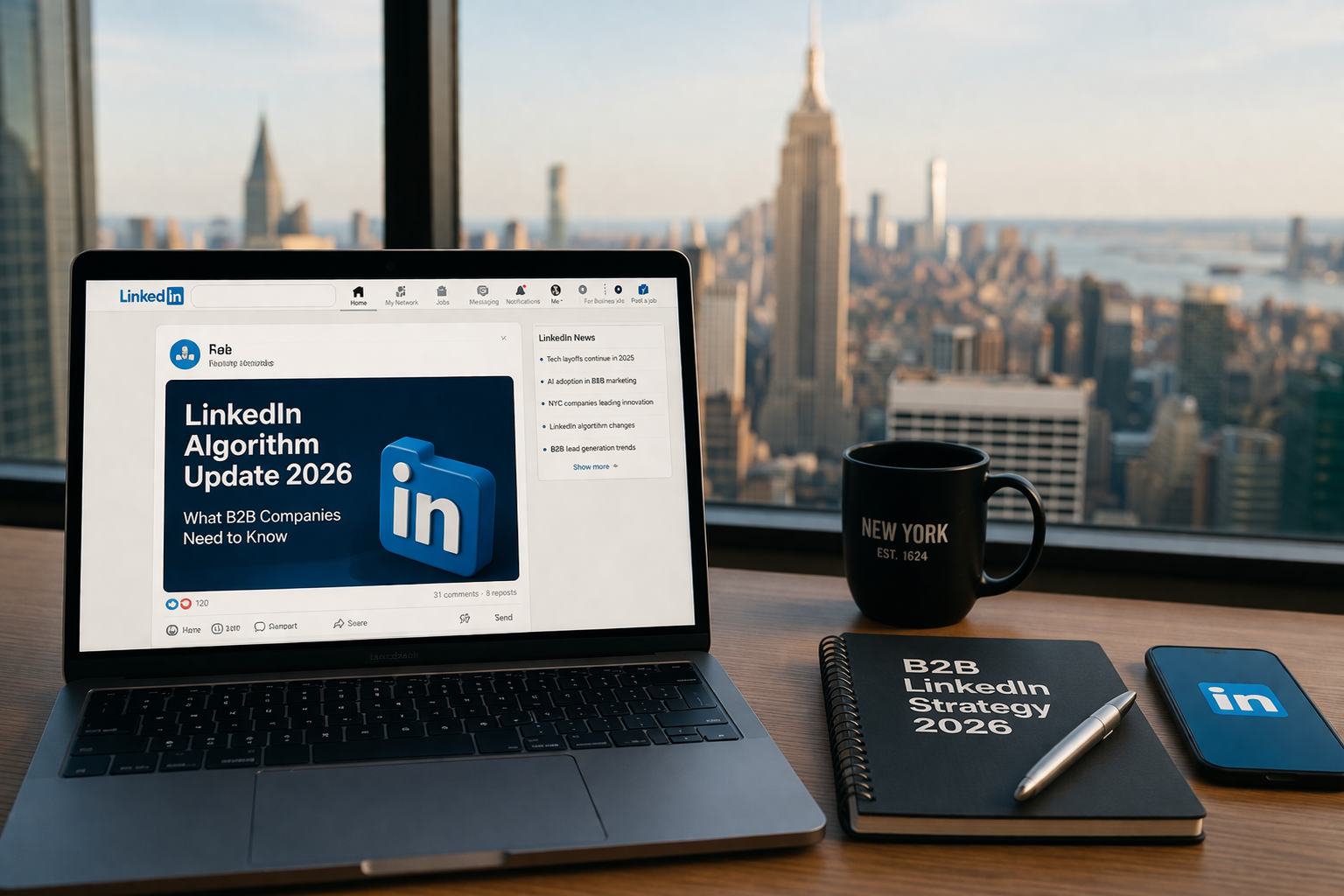
If your LinkedIn content stopped performing the way it used to sometime in the second half of 2025, you're not imagining it and you're not alone. Something real changed — and understanding what changed, why it changed, and what to do about it is the difference between building a LinkedIn presence that generates actual business and publishing into a void while wondering why nothing is landing.
This post is not about generic social media advice. It's a specific breakdown of what LinkedIn's algorithm is actually doing in 2026, what the data shows about reach and engagement, and what New York B2B companies — where LinkedIn is the single highest-value platform for reaching professional decision-makers — need to do differently right now.
Let's start with the scale of what happened.
The Numbers: How Dramatically Organic Reach Has Fallen
The headline from the most comprehensive independent analysis of LinkedIn performance in 2025 is stark. According to the Algorithm InSights 2025 report by LinkedIn expert Richard van der Blom, organic performance on the platform has taken a serious hit: views are down 50%, engagement has dropped 25%, and follower growth is down 59%. Agorapulse
For company pages specifically, the situation is even more pronounced. Organic posts from LinkedIn company pages now reach only about 1.6% of their followers, and content from company pages accounts for roughly 1 to 2% of the overall LinkedIn feed. designACE
Average post reach has fallen to 8 to 12% of followers, compared with 15 to 20% a year ago. The way the algorithm measures and rewards posts has also changed — now rewarding dwell time and meaningful comments rather than just likes or reactions. DowSocial
These are not small adjustments. They represent a structural shift in how LinkedIn distributes content — one that requires a structural shift in strategy in response. The tactics that produced results in 2023 and 2024 are producing significantly worse results now, and the businesses that understand why will be the ones that recover and grow their LinkedIn presence while their competitors keep wondering what went wrong.
What Actually Changed: The 360Brew Shift
The root cause of the algorithmic shift is a model that LinkedIn's engineering team has been developing and gradually deploying called 360Brew. Understanding what it does and why it exists is the foundation of understanding what the new algorithm rewards.
360Brew is an AI foundation model that reads and understands text like a human to rank content, jobs, and connections across LinkedIn. It replaced thousands of specialized ranking algorithms with one unified language-based system. LinkedIn's transition marked a fundamental shift from engagement-driven consistency to AI-powered semantic understanding. The old system relied on specialized ranking models that tracked clicks and connections, rewarding creators who posted consistently on specific topics. 360Brew replaced this with a single 150-billion-parameter AI model that reads and understands text meaning like a human, analyzing professional context and relevance rather than just engagement metrics. WelcomeBerlin
It's worth being clear about what confirmed versus speculative here: LinkedIn has published no engineering blog posts confirming 360Brew is running in the feed and has made no formal announcement of a full rollout timeline. However, LinkedIn's engineering team has published research papers and a detailed engineering blog post on their next-generation feed systems, confirming a shift toward semantic, AI-driven content understanding that rewards consistent positioning, genuine professional conversation, and topic clarity. Empower Agency
What that means practically: the old algorithm was a counting machine. It counted likes, follows, connections, and engagement signals, then used those numbers to decide who to show your content to. The new system is a reading machine. It reads your profile, reads your post, reads the comments, understands the context, and makes a judgment about whether this content reflects genuine expertise on a topic that's relevant to specific professional audiences.
The old algorithm tracked behavior signals. The new system reads your profile text, interprets your engagement history as a sequence, and evaluates whether your content demonstrates relevant expertise. This rewards genuine expertise and punishes gaming strategies that worked under simpler algorithmic logic. First AI Movers
The Seven Specific Changes That Matter for B2B Strategy
1. Personal profiles now dramatically outperform company pages.
The 2026 data settles this definitively: personal profiles generate 8 times more engagement than company pages. The algorithm treats personal content as more authentic and relevant. When a named professional at a firm posts, it shows in more feeds than when the firm's official page posts the same content. LinkedIn users are 3 times more likely to trust content from an individual than from a brand. La Growth Machine
Employee posts outperform company pages by 6 to 8 times in reach and engagement. The company page's average organic reach is now just 2 to 4% of followers. DowSocial
For New York B2B companies, this means the most important LinkedIn investment you can make is not managing your company page — it's developing your partners, executives, and key professionals as visible thought leaders with active personal profiles. The company page matters as a credibility anchor and destination. The people are the distribution engine.
2. Your profile is now part of your content's distribution algorithm.
Before your content is considered for distribution, the algorithm analyzes your profile. Your headline and About section define your content niche in the algorithm's interpretation. Posts outside that niche face a structural disadvantage regardless of quality. Creators who write about leadership on Monday, technical implementation on Tuesday, and industry news on Wednesday confuse the system. Topic consistency over approximately 90 days allows the AI to categorize your expertise and optimize distribution to relevant audiences. First AI Movers
A vague or generic headline weakens your content's distribution not because of an arbitrary rule, but because the system genuinely cannot place your posts accurately. Conversely, a specific, well-crafted profile acts as a relevance amplifier for everything you publish. Empower Agency
If your LinkedIn headline says "Managing Partner at [Firm Name]" with no specificity about what you do or who you serve, you're handicapping every piece of content you publish. If it says "I help New York professional services firms build digital authority | Managing Partner at [Firm Name]," you're giving the algorithm the context it needs to find the right audience for your content.
3. Dwell time has become the primary engagement signal — not likes.
The most important change in how LinkedIn evaluates content quality is the shift from counting engagements to measuring attention. LinkedIn now measures dwell time — the exact number of seconds a user spends looking at your post. Zero to three seconds is labeled as a "click bounce" and signals to the algorithm that your hook was clickbait and the content was poor, leading to limited distribution. Predis
LinkedIn added Saves and Sends to post analytics in late 2025, signaling exactly what the platform now values. LinkedIn is rewarding content people keep, share privately, and talk about — not content that just looks busy. designACE
This completely reframes what "good content" means on LinkedIn. A post that gets 200 likes but everyone just clicks the like button while scrolling past performs worse than a post that gets 50 comments but people actually stop and read for 30 seconds. The metric to optimize for is meaningful attention, not surface engagement.
4. Comment quality massively outweighs comment quantity.
Thoughtful comments of three or more sentences are weighted 15 times heavier than likes. The algorithm prioritizes "meaningful social interactions," so one thoughtful comment is worth far more than ten likes. Predis
LinkedIn's algorithm has shifted to reward back-and-forth discussions, meaning a single thoughtful comment exchange can extend a post's reach for hours. DowSocial
This matters for your content strategy in two directions: how you write posts, and how you engage with other posts. Posts that generate genuine dialogue — where commenters add perspectives, share experiences, and debate points — get extended distribution. Posts that generate 20 "Great post!" comments without substance don't.
Equally, leaving substantive comments on other people's posts — particularly before you publish your own content — signals to the algorithm that you're an active, valuable professional participant rather than a broadcaster. Engaging with others 15 to 30 minutes before and after you post improves reach by up to 20%. DowSocial
5. External links are being actively penalized.
Posts with external links now receive 40% less initial reach. The algorithm wants to keep users on the platform. The strategy that works: post native content first, add links in comments after engagement begins — typically 30 to 60 minutes after posting. La Growth Machine
For New York B2B companies that regularly share blog posts, articles, and resource links, this is a significant tactical change. The content itself should be published natively on LinkedIn — the full insight, the framework, the perspective — with the link to the longer-form version added as a comment once the post is generating engagement. This approach preserves both platform reach and the ability to drive traffic to your website.
6. Engagement pods and coordinated activity are being actively suppressed.
LinkedIn's VP of Product explicitly stated: "Our goal is to make engagement pods entirely ineffective." Comments posted through third-party scripts or browser plugins are now removed from the "Most Relevant" section. Lempod, the most popular pod tool, was banned and removed from the Chrome Web Store. LinkedIn now maps what it calls "Coordinated Activity Rings" — if the same cluster of accounts engages within minutes of a post going live, the entire group gets flagged. Penalties include shadow bans with 60 to 90-day recovery periods, and repeat offenders face permanent suspension. UpGrowth
If any members of your team or professional network are using engagement pods or coordinated commenting tools, this is a significant risk to your entire LinkedIn presence — not just to the individuals involved. The penalty affects the group, not just the individual.
7. AI-generated content is being identified and demoted.
LinkedIn's AI is now smart enough to detect AI-generated content. And it's not rewarding it. Posts that once pulled thousands of impressions are now sitting at a few hundred. It's not a glitch — it's the new normal. Yep
360Brew will penalize "pure" AI text. It detects generic, unedited AI-written text and flags it as low-quality. You can use AI for outlines or brainstorming, but you must edit it to include your personal voice and specific data points. Predis
For New York B2B professionals whose content strategy has relied on AI-drafted posts published with minimal editing, this is a direct explanation for declining reach. The solution is not to abandon AI tools entirely — they can help with ideation, structure, and research — but to ensure that what gets published has been genuinely rewritten in your voice, with your specific observations, your real client insights, and the authentic perspective that comes from actually doing the work.
What the New Algorithm Actually Rewards: The Practical Playbook
Understanding what broke is half the picture. Here's what the 2026 LinkedIn algorithm actively rewards and how to build your strategy around it.
Topic consistency over 90 days. Topic consistency over approximately 90 days allows the AI to categorize your expertise and optimize distribution to relevant audiences. First AI Movers Pick two to three professional topic pillars that reflect your genuine expertise and stay in those lanes. For a New York financial advisory firm, that might be: wealth management for business owners, NYC commercial real estate investment, and succession planning strategy. Every post should live clearly within one of those pillars. The algorithm builds a model of who you are and who should see your content — consistency is what trains that model.
Framework-driven content that earns saves. Expert content like frameworks, industry breakdowns, and valuable insights gets more visibility. Framework-driven posts tend to generate more saves and sends, which are strong indicators of long-term relevance. SocialBee Posts that give someone a mental model, a decision-making framework, or a structured way to think about a professional challenge are the content people save and return to. These are the posts that compound in reach because LinkedIn keeps surfacing them to new audiences who match the engagement pattern.
Starting the post with substantive insight. The algorithm places the highest importance on opening sentences. Content buried deeper in posts receives less algorithmic attention. This isn't about hooks or engagement bait — it's about frontloading substantive insight so the AI immediately understands what value you're offering. First AI Movers Your first line should deliver the core idea, not build to it. The opening line tells the algorithm what this post is about and whether it deserves distribution. It also determines whether human readers click "see more."
Active engagement before and after publishing. Leave five to ten genuine, substantive comments on relevant posts in your topic area before publishing your own content. Reply to every comment on your post within the first hour. This signals genuine professional engagement rather than broadcasting, and extends the distribution window significantly.
Native video with your face and voice. Native content formats like video, carousels, and text posts are getting the most reach. Cleverly LinkedIn's algorithm increasingly favors video, particularly video that features a real person speaking — the authenticity signal that a machine cannot replicate. For New York professionals who have been resistant to video because it feels uncomfortable or time-consuming, this is the format shift that's hardest to ignore in 2026. A 60-second talking head video where you share a genuine professional insight outperforms a polished corporate graphic on almost every metric the current algorithm rewards.
The hybrid model: organic plus Thought Leader Ads. By combining organic creativity with low-budget paid amplification using Thought Leader Ads — perhaps a few hundred dollars per month — you can stay visible to your exact audience without overspending. This hybrid model, using data from your organic posts to inform your ad strategy, is the new baseline for serious B2B marketers. DowSocial Thought Leader Ads allow you to amplify posts from personal profiles with paid targeting, combining the authenticity signal of personal content with the precision of professional audience targeting. For New York B2B companies targeting specific job titles, company sizes, or industries, this is one of the highest-ROI LinkedIn advertising formats available.
The New York B2B Advantage on LinkedIn
Here's something specific about the New York market that makes LinkedIn strategy simultaneously more important and more achievable than in most other markets.
The concentration of high-value professional decision-makers in New York — in finance, legal, professional services, healthcare, real estate, and technology — is unmatched anywhere else in the country. LinkedIn's own targeting allows you to reach CFOs, Managing Directors, General Counsels, and C-suite executives at specific company size ranges in specific industries in a specific metropolitan area. For a New York B2B company trying to reach the right buyers at the right firms, LinkedIn targeting precision is genuinely exceptional.
4 out of 5 LinkedIn members drive business decisions, and 82% of B2B marketers report their greatest success on LinkedIn because users are in a professional mindset, actively researching solutions and vendors. La Growth MachineIn New York, where business development is relationship-dependent and trust is earned through demonstrated expertise before direct outreach, the LinkedIn thought leadership approach — where your content builds recognition and credibility before any sales conversation begins — is particularly well-suited to how deals actually get done.
Smaller organizations with genuine domain knowledge can reach precisely the audiences who need that knowledge if they communicate it clearly and consistently. The playing field isn't level — but it's more level than it was when distribution required either an existing audience or paid promotion. First AI Movers A boutique New York law firm with two partners posting genuinely expert content consistently on a defined legal topic can build meaningful visibility with exactly the right professional audience — the kind of visibility that used to require either a major firm's brand recognition or significant advertising spend.
What to Stop Doing Immediately
The most actionable thing many New York B2B companies can do right now is eliminate the practices that are actively damaging their LinkedIn reach.
Stop posting from the company page as your primary distribution channel. The company page is a credibility anchor and a destination, not a broadcast medium. Redirect your team's content energy to personal profiles.
Stop using engagement pods or any coordinated engagement tool. The penalty risk is real, recoverable only over months, and the short-term reach gains are no longer worth it.
Stop publishing posts that are primarily links to external content without any substantive original thought. These get penalized twice — once for the external link and once for low dwell time when people click through immediately rather than reading.
Stop posting generic AI-drafted content without substantive human rewriting. The algorithm detects it, and the reach hit is real and immediate.
Stop posting with more than three to five hashtags. Using 10 or more hashtags looks spammy and triggers algorithm penalties. The optimal number is 3 to 5 relevant hashtags, focusing on niche hashtags with 10,000 to 100,000 followers rather than massive ones where your content gets buried immediately. La Growth Machine
The Bottom Line
LinkedIn's algorithm in 2026 is harder to game and easier to win through genuine quality than at any previous point in the platform's history. That's both the frustrating part and the real opportunity.
The frustrating part: everything that worked through volume, coordination, and low-effort posting has been systematically disabled. If your LinkedIn strategy was built on those foundations, it's not working anymore.
The opportunity: organic reach has dropped roughly 50% year-over-year, but creators posting authentic, expert-level content are seeing better results than before. Thought leadership is the new growth strategy — the algorithm rewards depth, expertise, and topic consistency over volume and tricks. Yep
For New York B2B companies with genuine professional expertise, relevant industry experience, and real perspectives worth sharing — which describes most of the professional services, financial advisory, legal, technology, and consulting firms operating in this city — the 2026 LinkedIn algorithm is actually well-calibrated to your strengths. The businesses that win on LinkedIn in 2026 are the ones that have been building authentic expertise for years and are willing to share it clearly, consistently, and in their own voice.
The algorithm can't replicate that. And neither can your competitors who are still posting generic content from their company page.
Want help building a LinkedIn strategy for your New York B2B company that's calibrated to how the algorithm actually works in 2026 — not how it worked two years ago?
Ritner Digital builds content and LinkedIn strategies for New York professional services companies, B2B technology firms, and financial services businesses that are serious about generating real visibility and real pipeline from the platform. We help you identify the right topic pillars, develop thought leadership content that earns genuine engagement, and build the profile infrastructure that makes every post perform better.
Talk to Ritner Digital about your LinkedIn strategy →
Sources: Algorithm InSights 2025 Report (Richard van der Blom, analysis of 1.8 million LinkedIn posts), AuthoredUp dataset analysis (3+ million posts), Trust Insights Unofficial LinkedIn Algorithm Guide Q1 2026, LinkedIn Engineering Blog Post "Engineering the Next Generation of LinkedIn's Feed" (March 2026), LinkedIn arXiv Research Papers on 360Brew Foundation Model, DowSocial LinkedIn Algorithm 2026 Analysis, DesignACE LinkedIn Algorithm 2026 Guide, Empower Agency LinkedIn Algorithm Analysis (March 2026), Predis.ai LinkedIn Algorithm Guide 2026.
Frequently Asked Questions
Our LinkedIn company page has thousands of followers. Why is barely anyone seeing our posts?
Because the algorithm has fundamentally changed how it treats company pages, and the shift is significant enough that it requires a complete rethink of where you direct your LinkedIn content energy. Company page organic reach has dropped to roughly 1.6 to 4% of followers — meaning if you have 5,000 followers, your typical post is reaching somewhere between 80 and 200 of them. This isn't a bug or a temporary fluctuation. LinkedIn has deliberately deprioritized company page content in the feed because it performs less well for users than personal content — people engage more with people than with logos, and the algorithm is optimizing for user experience. The practical response is not to abandon your company page — it still matters as a credibility destination, a place where buyers land when they're evaluating your firm, and a hub for your team's professional identity. But it should not be your primary content distribution vehicle. Your partners, executives, and key professionals posting from personal profiles will reach dramatically more of the right people than the same content posted from the company account. The company page supports. The people distribute. That's the architecture that works in 2026.
We've been using an engagement pod where our team members comment on each other's posts to boost reach. Is that actually a problem now?
Yes, and the risk is more serious than most people appreciate. LinkedIn's algorithm actively maps what it calls Coordinated Activity Rings — clusters of accounts that engage with each other's content in consistent, rapid patterns regardless of topic. When this pattern is detected, the penalty applies to the entire group, not just individual accounts. Shadow bans can last 60 to 90 days, during which your organic reach is suppressed significantly without any notification that it's happening. Repeat violations can result in permanent restrictions. LinkedIn's VP of Product publicly stated that making engagement pods entirely ineffective is an explicit platform goal, and they removed the most popular pod tool from the Chrome Web Store entirely. The practical problem is that many professional groups that started as genuine communities have evolved into semi-coordinated engagement structures that the algorithm now treats as inauthentic. If your team is coordinating comments through any kind of system — a group chat, a tool, a scheduled arrangement — the safest course is to stop and let the organic recovery happen over the following weeks. The reach you were manufacturing through coordination is increasingly being replaced with penalties that cost more than the artificial reach was worth.
We have a managing partner who wants to be active on LinkedIn but isn't sure what to post. How do we figure out the right content pillars?
Start with the intersection of three things: what they genuinely know better than most people in their field, what their target clients are actively worried about or trying to solve, and what's happening in their specific industry that creates timely relevance. Pick two to three of those topic areas and stay in them consistently for at least 90 days, because that's the window the algorithm needs to categorize your expertise and optimize distribution to relevant audiences. For a managing partner at a New York professional services firm, this might look like: how a specific type of client deals navigates regulatory complexity they face, what the economic conditions in their specific vertical mean for decision-makers, and the behind-the-scenes realities of the deals or engagements they work on. The test for a good LinkedIn topic pillar is whether the managing partner could speak about it for 30 minutes without notes and say something specific and useful that a buyer couldn't get from a generic Google search. If yes, that's a pillar. The most common mistake is choosing topics that feel professional and safe but are actually generic — leadership lessons, culture observations, industry trends everyone else is covering. The algorithm rewards specificity and genuine expertise because that's what users actually engage with, save, and return to.
Our posts used to get good reach when we shared links to our blog posts. Now the reach has collapsed. What's happening and how do we fix it?
Posts with external links now receive approximately 40% less initial distribution because LinkedIn's algorithm is explicitly designed to keep users on the platform. When you post a link, LinkedIn's system treats it as an invitation for users to leave, which runs counter to the platform's core business objective. The fix is a two-step approach that lets you have both reach and traffic. First, publish the key insight from your blog post natively on LinkedIn — the most valuable takeaway, the framework, the counterintuitive finding, the specific data point — as a standalone LinkedIn post without any link. Write it to stand on its own as genuinely valuable content. Second, after the post has been live for 30 to 60 minutes and has started generating engagement, add a comment to your own post that says something like "Full breakdown here if you want to go deeper" with the link. This structure gives the algorithm what it wants — native, platform-hosted content that people engage with — while still driving traffic to your website for the readers who want more. It requires an adjustment in workflow but the reach difference is significant enough that it's worth building the habit.
How important is LinkedIn video for B2B companies in New York? Our team is resistant to being on camera.
More important than most New York professional services teams are treating it, and the resistance is understandable but increasingly costly from a reach perspective. LinkedIn's algorithm demonstrably favors native video — video uploaded directly to LinkedIn rather than linked from YouTube or Vimeo — and particularly video that features real people speaking. The authenticity signal that a human face and voice carries is something the algorithm is specifically calibrated to reward because it's the content users engage with most deeply and for the longest time. The good news is that polished production quality is not what performs best. A managing partner recording a 60 to 90-second video on their phone in their office, clearly explaining one specific insight about something happening in their industry, consistently outperforms expensive corporate video content on almost every engagement metric LinkedIn tracks now. The resistance to being on camera is real and common among professionals who built their careers before video was a normal part of business communication. The most effective way to overcome it is to start with genuinely low stakes — one short video per week, no studio, no script, just one clear professional insight delivered conversationally. After four to six weeks, most professionals find the discomfort significantly reduced and the engagement data from the videos provides its own motivation to continue.
What's the best posting frequency for LinkedIn in 2026? We've heard everything from once a day to once a week.
The research consistently supports quality over frequency, and the specific guidance from analysis of millions of LinkedIn posts in 2025 points to one excellent post per week being more effective than five mediocre ones. The algorithm now actively penalizes content that generates what it calls "hard negatives" — posts shown to users that received zero engagement — because these teach the system that your content isn't worth surfacing to similar audiences. Posting frequently with low-quality or undifferentiated content actively degrades your distribution baseline rather than just producing neutral low-performing posts. The practical recommendation for most New York B2B professionals is two to three substantive posts per week if you can maintain genuine quality at that pace, or one post per week if that's what you can do well. Supplementing posts with substantive comments on other people's content — five to ten genuine, thoughtful comments on posts from people in your professional network and industry — is an equally important engagement signal that many teams overlook. Comments that you leave on other posts feed the algorithm the same topical consistency signals as your own posts, and they build real relationships with the people whose content you engage with. A strategy of one strong post per week plus daily meaningful commenting often outperforms a strategy of daily posts with minimal engagement activity outside your own content.
LinkedIn Thought Leader Ads keep coming up as a recommendation. What are they and should we be using them?
Thought Leader Ads are a LinkedIn advertising format that allows you to amplify posts from personal profiles — your executives, partners, or key professionals — to targeted paid audiences. Unlike standard LinkedIn ads that come from a company page and often feel promotional, Thought Leader Ads preserve the authentic feel of personal content while giving you the precision targeting of paid advertising. This matters for two reasons. First, personal content performs dramatically better than company content organically, and Thought Leader Ads let you extend that performance advantage into paid distribution. Second, you can target Thought Leader Ads with LinkedIn's professional targeting — specific job titles, company sizes, industries, seniority levels, geographic areas — which for New York B2B companies means you can get the right content in front of CFOs at mid-market financial services firms, or General Counsels at companies between 100 and 500 employees, or whatever specific buyer profile you're targeting. The typical approach is to let a post run organically for 24 to 48 hours, identify which posts are generating strong engagement, and then amplify those with Thought Leader Ads. The organic performance data tells you what's resonating before you spend money amplifying it. Budget-wise, even a few hundred dollars per month of Thought Leader Ads on your highest-performing personal content can significantly extend your visibility with exactly the right professional audience in New York.
Our competitors seem to have large LinkedIn followings built up over several years. Are we too far behind to compete organically?
Not as far behind as you might think, and the 2026 algorithm changes have actually leveled the playing field more than any previous LinkedIn update. Here's why. The old algorithm heavily rewarded existing audience size — large followings meant more initial distribution, which generated more engagement, which generated more distribution. It was a compounding advantage that made it hard for newer or smaller accounts to compete. The new algorithm is more interested in topical relevance and genuine expertise signals than in follower count. A post from a 200-follower account that generates strong dwell time, genuine comments, and saves can outperform a post from a 20,000-follower account that generates low-quality engagement. The algorithm uses early engagement quality to decide how broadly to distribute, and quality now outweighs the follower count advantage. The practical implication is that a New York professional with 500 connections who posts consistently excellent, specific content in a defined expertise area can build meaningful visibility with the right audience within 90 to 180 days of consistent effort. The accounts with large followings built on years of volume-based posting are actually facing their own challenges right now — much of their historical reach was built under algorithmic rules that no longer apply, and they're having to adapt just like everyone else. Start from where you are, focus on genuine expertise rather than follower chasing, and measure success by the quality of conversations and inbound opportunities your content generates rather than by follower count.