Why Your Google Ads Click-Through Rate Dropped in 2025 — And What's Different in 2026
If you've been running Google Ads for your New York business and noticed that your click-through rates started declining in 2025 — and that the decline accelerated through the summer — you're not looking at an underperforming campaign. You're looking at a structural change in how Google search works that affects every advertiser on the platform, and understanding it is the prerequisite for doing anything about it.
This post gives you the specific diagnosis, the data behind it, and a concrete set of adjustments that New York businesses — particularly those in the high-CPC categories that dominate the city's professional service economy — need to make to keep their Google Ads performing in the environment that now exists.
Let's start with the scale of what happened.
The Numbers: How Bad Was the CTR Drop?
The most comprehensive independent study of the impact on Google Ads click-through rates — conducted by Seer Interactive across 3,119 informational queries and 42 organizations, tracking 25.1 million organic impressions and 1.1 million paid impressions from June 2024 through September 2025 — produced findings that are genuinely alarming for anyone running paid search campaigns.
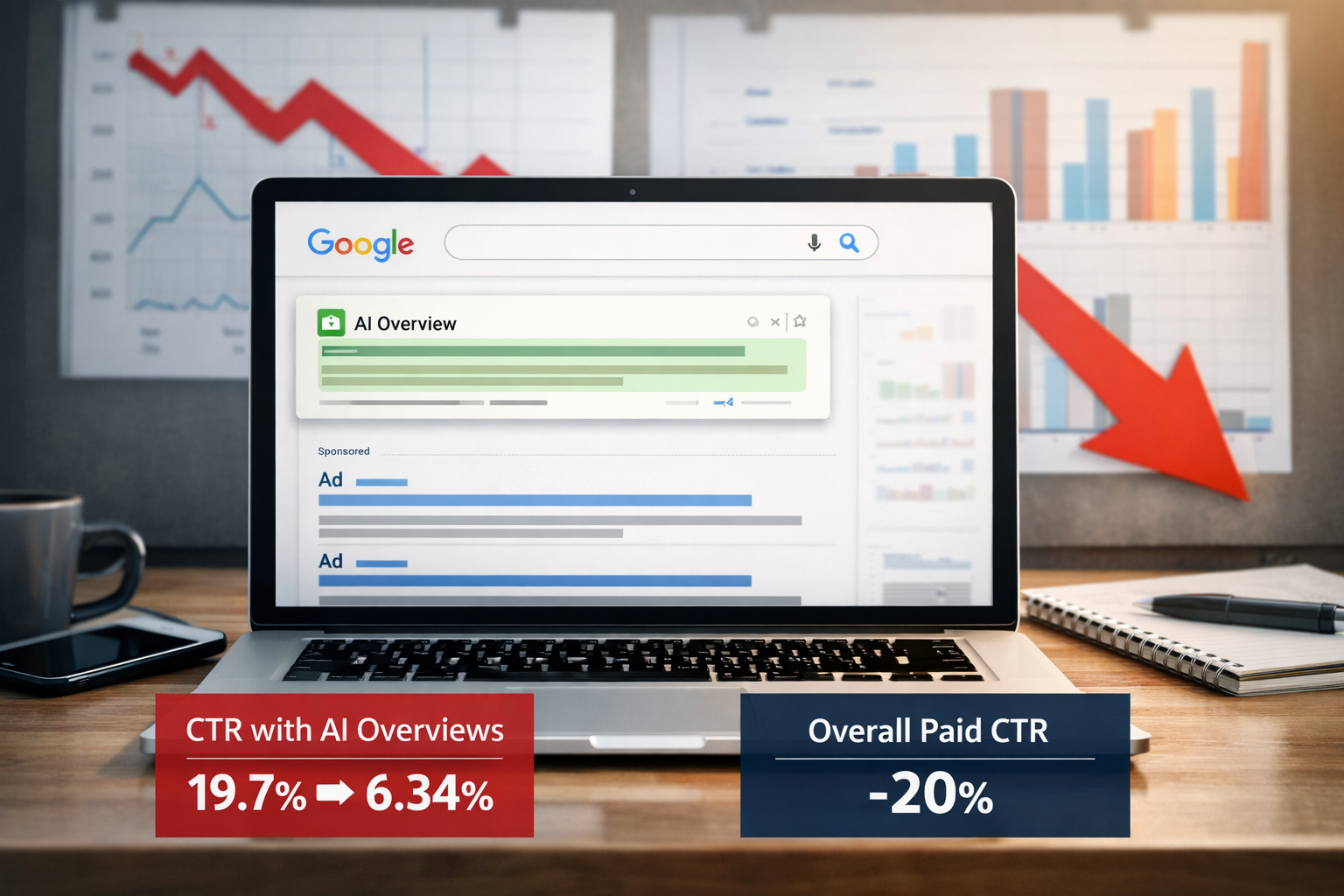
Organic click-through rates for informational queries featuring Google AI Overviews fell 61% since mid-2024, while paid CTRs on those same queries plunged 68%, dropping from 19.7% to 6.34% between June 2024 and September 2025. Search Engine Land
That paid CTR number deserves emphasis. In June 2024, paid CTR on queries with AI Overviews was 19.70%. By September 2025, it had fallen to 6.34%. Seer Interactive Your ad was getting one-third of the clicks it was getting 15 months earlier on the same type of query.
The decline didn't happen gradually. July 2025 showed particularly severe drops, with paid CTR crashing from roughly 11% to 3% in a single month. Dataslayer
And here's the part that makes this more serious than a simple "AI Overviews are stealing clicks" story: even on queries without AI Overviews, organic CTRs fell 41%, settling at 1.62% in September 2025. This suggests users are simply clicking less everywhere. Search Engine Land
Year-over-year data shows a 78% CTR decline in paid search when AI Overviews are on the page and you are not cited in the AI Overview. When AI Overviews are on the page but you are not cited, there is still a 54% decline in paid search. Even when there are no AI Overviews on the page at all, there is still a 20% drop for paid search. Search Engine Roundtable
This last finding is the one that most advertisers miss. The CTR problem is not purely an AI Overviews problem. It reflects a broader behavioral shift — users are migrating to ChatGPT, Perplexity, and other platforms for informational queries before they ever reach Google. They're using TikTok and Reddit as search tools. They're going directly to brands they already know. Google is still capturing their awareness, but their willingness to click on traditional results has declined across the board.
Why This Is Happening: The Three Forces Driving the Decline
Understanding the CTR drop requires understanding the three distinct forces that are each contributing to it, because the fix for each is different.
Force 1: AI Overviews are physically pushing ads down the page.
When an AI Overview pushes paid ads below the fold, it triggers a chain reaction that impacts your profitability: lower CTR leads to fewer clicks, and fewer clicks lead to fewer conversions, shrinking your traffic pipeline. Search Engine Land
Before AI Overviews, the top of a search results page was relatively predictable: your ads appeared above the organic results, in a position where a user's eye naturally landed. With AI Overviews, the page now starts with a large AI-generated text block that can be several hundred words long before any paid ad appears. On mobile — where around 63% of total Google ad clicks now come from smartphones Rudys — the displacement is even more severe because screen real estate is limited and users scroll less.
The ads that still appear above the AI Overview maintain reasonable performance. The ads below it are seeing significant impression share reduction.
Force 2: AI Overviews are answering informational queries that used to generate ad clicks.
This is the subtler and more structurally damaging force. Many paid search campaigns — particularly in B2B professional services, where buyers research extensively before contacting a vendor — historically captured clicks from users who were searching informational queries like "how does commercial lease negotiation work" or "what should I look for in a business attorney." These weren't high-intent "I want to buy now" searches, but they were real buyers in research mode who would click through, read content, get retargeted, and eventually convert.
Adthena's analysis across six major industries from late December 2025 to January 2026 found that in Technology and Telecom, AI Overviews are dominated by comparison content. When Google provides a side-by-side analysis, it satisfies the research phase and may stop users from clicking your ad to learn more. Search Engine Land
These informational and comparison queries are being answered directly in the search results. The click-through that used to happen at the top of the research funnel is increasingly not happening at all.
Force 3: Broader behavioral migration away from Google for early-stage research.
The data suggests bigger shifts beyond AI Overviews. Users now seek answers on ChatGPT, which has 800 million weekly active users, on Perplexity, social platforms, or go directly to trusted brands they already know. Dataslayer
The early part of the B2B buyer journey — the awareness and education phase that used to happen on Google — is increasingly happening on other platforms. By the time a buyer gets to Google and searches with genuine commercial intent, they've already done significant research elsewhere. This compresses the value of top-of-funnel paid search and makes the bottom-of-funnel, high-intent keywords even more critical.
The Silver Lining the Data Actually Shows
Here's the part of this story that generic coverage gets wrong by being too uniformly pessimistic: while overall click volume declined across nearly all query types in 2025, 65% of industries actually saw improved conversion rates. The improved conversion rates reflect AI Overviews pre-qualifying users by answering their basic questions before they click ads, filtering out users who were simply seeking general information without any intention to convert and leaving only high-intent prospects. Search Engine Land
Brands cited in AI Overviews earned 35% more organic clicks and 91% more paid clicks than brands not cited on the same queries. Dataslayer
Branded search and high-intent transactional queries are showing greater resilience, with many advertisers seeing minimal impact on their core conversion-driving terms. Search Engine Land
What the data actually shows is a bifurcation: informational and upper-funnel queries have been devastated, while commercial and transactional queries — the "I'm ready to engage a vendor" searches — have been affected less, and in some cases the traffic quality has improved even as volume decreased.
For New York B2B businesses, where the most valuable traffic was always the high-intent, bottom-of-funnel query rather than the top-of-funnel research query, this bifurcation is more manageable than the headline CTR numbers suggest. The problem is that most campaigns are structured and budgeted as if the top-of-funnel clicks still have the same value they had in 2023 — and they don't.
The Cost Inflation Problem: Fewer Clicks, Higher Prices
The CTR decline has a secondary effect that compounds the damage, and it's one that fewer advertisers are tracking clearly: as clicks have declined, cost-per-click has inflated.
Google Search spending grew 9% year-over-year in Q1 2025, but click growth was only 4%. That 5% gap represents more dollars chasing fewer clicks across many industries. AI Overviews amplify this CPC inflation through several mechanisms — ad positioning dynamics push ads below the AI Overview, double-serving policies concentrate impression share among larger advertisers, and automated bidding systems optimize toward conversion predictions rather than cost efficiency, meaning campaigns are paying premium CPCs as the click inventory shrinks. Search Engine Land
The average cost per lead across all industries rose by 5.13% in 2025. The median cost per acquisition rose by 12.35%, reflecting increased competition across most verticals. Rudys
For New York businesses operating in categories where CPCs are already among the highest in the country — legal services, financial advisory, real estate, B2B technology — this cost inflation compounds on top of already-elevated baseline costs. A New York law firm spending $50 per click in a competitive practice area is now potentially spending $55 to $60 per click for a smaller pool of higher-quality but lower-volume clicks.
The math has changed, and campaigns that haven't been restructured to reflect the new math are either overspending for the results they're generating or underperforming relative to what a properly calibrated campaign would produce.
What New York Businesses Should Actually Do: The Specific Adjustments
Understanding what happened is the first half of this post. Here's the practical response — the specific changes that New York businesses running Google Ads should make now.
1. Audit your campaign structure by query intent and restructure ruthlessly.
The most urgent task for most campaigns right now is segmenting keywords by intent and making explicit budget decisions based on that segmentation. Informational queries — "what is," "how does," "what should I look for" — have seen the most severe CTR decline and the weakest business case for paid investment. Commercial and transactional queries — "hire," "services," "quote," "attorney," "advisor," "agency near me" — maintain stronger performance.
Keyword intent is one of the strongest levers you can pull in Google Ads. Separating campaigns by intent gives you more control over how your budget is used and ensures your budget is focused on traffic that is closest to converting. Directive
For New York professional services firms, this often means dramatically reducing or eliminating spend on broad informational terms and concentrating budget on specific service terms, local intent terms, and decision-stage queries. "Business litigation attorney New York" is a very different query — with very different CTR characteristics — than "how to handle a business dispute," and they should be in different campaigns with different budget allocations reflecting their different conversion economics.
2. Shift budget toward branded and local search where performance holds.
When clients show up in AI Overviews, organic CTR rises from 0.74% to 1.02% and paid CTR increases from 7.89% to 11%. This is because branded queries have a higher base CTR and when featured in an AI Overview, the user is more likely to trust the ad as well. Seer Interactive
Branded search — where someone types your company name or a close variation — has maintained significantly better performance than non-branded search throughout the AI Overview rollout. For New York businesses, this means branded campaigns are now relatively more valuable, not less, and should be protected with appropriate budget and maximum bid caps.
Local intent queries — searches that include "New York," "NYC," "Manhattan," or specific neighborhood modifiers — also tend to have higher commercial intent and lower AI Overview interference, because local search behavior is typically transactional. A query like "corporate attorney midtown Manhattan" is less likely to trigger an AI Overview that satisfies the search intent than a generic "how to handle a contract dispute" query.
3. Implement Enhanced Conversions and offline conversion tracking before changing anything else.
Audit your conversion tracking. Set up Enhanced Conversions and start importing offline conversion data from your CRM. Adffect
This is the most foundational change because everything else depends on the campaign's ability to learn which clicks actually produce business value. Google's automated bidding systems optimize toward the conversion signal you provide. If that signal is "form submitted," the system optimizes for form completions — including from users who submit a form and never become clients. If that signal is "qualified lead became client," the system learns to find more of those users.
For New York professional services businesses with long sales cycles, this means implementing offline conversion imports that feed CRM data back into Google Ads — marking as conversions the contacts that actually became clients at the revenue values those engagements produced. This is technically achievable with HubSpot, Salesforce, or most modern CRMs, and it fundamentally changes the quality of what the campaign optimizes toward.
4. Protect your ad position above the AI Overview with aggressive quality score management.
Research on ad positioning shows that ads appearing above an AI Overview still perform reasonably well. But ads below are seeing a dramatic reduction in impression share and CTR. Search Engine Land
Position above the AI Overview requires the highest Quality Scores — driven by expected CTR, ad relevance, and landing page experience — and sometimes the highest bids on competitive queries. For New York businesses in high-CPC categories, this means treating Quality Score as a financial lever: every point of Quality Score improvement translates directly into lower CPC requirements for the same ad position.
The specific work this requires: tightening the match between your keywords, ad copy, and landing page so all three are speaking to exactly the same searcher intent; using responsive search ads with diverse, high-quality headlines that Google can test to find the highest CTR combinations; and ensuring landing pages load fast and deliver immediately on the promise made in the ad.
5. Use RLSA and customer match to concentrate spend on your warmest audiences.
Remarketing Lists for Search Ads (RLSA) allow you to adjust bids and create specific ad experiences for users who have previously visited your website when they subsequently search on Google. In an environment where cold search traffic is declining in quality and volume, the warm audiences who have already shown interest in your brand are relatively more valuable.
In 2026, you can give Performance Max and search campaigns richer audience hints, including remarketing lists, customer lists, and custom segments based on behaviors or interests. When you combine meaningful audience signals with proper conversion tracking, your campaigns become far more efficient. Analyticsbeyond
For New York professional services companies, RLSA and customer match campaigns targeting website visitors, existing clients, and CRM contacts with competitive service terms are among the highest-ROI paid search investments available. These users have already expressed interest in your brand and are now actively searching — the intent signal is both strong and pre-qualified.
6. Diversify into Demand Gen to rebuild top-of-funnel reach that paid search is losing.
The Power Pack structure recommended for 2026 combines Performance Max for full-funnel cross-channel reach, AI Max for Search to capture high-intent queries, and Demand Gen to drive upper-funnel awareness and consideration at 10 to 20 percent of budget scaling up as you prove ROI. Adffect
Demand Gen campaigns — which run on YouTube, Discover, Gmail, and other Google properties — allow you to reach potential buyers in the awareness and consideration phase on surfaces where AI Overviews don't exist and where ad positioning dynamics are different from traditional search. For New York B2B businesses, YouTube pre-roll ads on business and industry content or Discover feed ads targeting professional interest segments can rebuild the top-of-funnel reach that paid search is losing as informational queries migrate away from Google.
7. Track the right metrics — not just CTR.
Build your 2026 strategy around the assumption that CTRs for high-funnel queries will be 20 to 30% lower than today. Use budget from AI Overview-laden queries to test other ad platforms and focus on lower-funnel searches on Google. Seer Interactive
CTR is no longer the primary performance indicator for Google Ads in the current environment. Winning in 2026 means building relevance, not just beating CTR averages. Watch for impression increases paired with CTR decreases — the "crocodile pattern" — and fix intent match before raising bids. Judge performance by cost-per-lead relative to your target, not CTR alone. BrightBid
The metrics that matter now are: cost per qualified lead (not just cost per conversion), conversion rate of clicks that do occur, lead quality measured by actual sales outcomes, and total pipeline contribution from paid search. These tell you whether your campaigns are generating business, not just whether they're generating traffic.
The NYC Context: Why This Hits Harder Here
For New York businesses, two specific factors make the CTR decline more acute than in most other markets.
First, New York's professional service categories — legal, financial advisory, real estate, consulting, B2B technology — are among the highest-CPC categories in Google Ads anywhere. Legal and consumer services have the highest CPCs due to intense competition and the high lifetime value of a single client, justifying very aggressive bids for high-value keywords. Agrowth When cost-per-click inflates and CTR declines simultaneously, the cost-per-lead math deteriorates faster in high-CPC markets than in average-CPC markets. A 20% CTR decline in a $5 CPC market is a different financial problem than a 20% decline in a $40 CPC market.
Second, New York's sophisticated B2B buyer base is disproportionately represented among the early AI search adopters who are doing their initial vendor research on ChatGPT, Perplexity, and other platforms before reaching Google. Finance professionals, technology executives, attorneys, and senior business leaders in New York are not the last demographic to adopt AI search tools. They're among the first. The migration of early-stage research away from Google is happening faster in New York's professional buyer demographics than in most markets.
This makes the pivots described above more urgent for New York businesses than the national averages might suggest.
Bottom Line: This Is Structural, Not Cyclical
The most important thing to understand about the Google Ads CTR decline of 2025 is that it is not going to reverse. Based on 15 months of consistent decline across nearly every metric, there are no signs of CTR recovery. The search landscape is fundamentally different than it was 18 months ago. Seer Interactive
The businesses that are maintaining Google Ads performance in this environment are not the ones waiting for things to return to normal. They're the ones who restructured their campaigns to concentrate on where performance holds — high-intent transactional queries, branded search, local intent terms — while diversifying into channels and formats that capture the early-stage buyer behavior that search used to own.
That restructuring is not complicated. But it requires acknowledging that the 2022 Google Ads playbook no longer applies — and building a 2026 strategy around how search actually works now.
Running Google Ads in New York and not sure whether your current campaign structure is calibrated to the 2026 search environment — or whether your CTR decline is typical or something fixable?
Ritner Digital audits Google Ads accounts for New York businesses and rebuilds campaign architecture around the intent segmentation, conversion data infrastructure, and bidding strategy that actually drives qualified leads in the current environment. If your cost per lead is rising and your results are declining, let's look at why.
Get a Google Ads audit from Ritner Digital →
Sources: Seer Interactive AIO Impact on Google CTR: September 2025 Update (3,119 queries, 42 organizations, 25.1M impressions), Search Engine Land AI Overviews CTR Impact Analysis, Adthena Paid Search Industry Impact Study (5 million ads, 6 industries, Q4 2025–Q1 2026), Search Engine Land 4 Strategic Paid Search Pivots (February 2026), Directive Consulting B2B Google Ads Best Practices 2026, Adffect Google Ads Strategy 2026, BrightBid Google Ads Benchmarks 2026, Rudys.AI Google Ads Benchmarks 2026 (25+ sources, 100+ statistics), WordStream 2025 Google Ads Benchmarks.
Frequently Asked Questions
Our Google Ads impressions are up but clicks are way down. Is something broken in our account?
Nothing is broken — this is one of the clearest signatures of the AI Overviews effect and it's being reported by advertisers across virtually every industry. The pattern has been given the name "the Great Decoupling" by Google itself: search impressions continue to grow as more queries are processed, but the willingness of users to click on results beneath an AI-generated summary has dropped dramatically. Your account is showing you exactly what the data predicts. Impressions increasing while CTR falls means your ads are being shown — often on relevant queries — but users are getting enough from the AI Overview at the top of the page that they're not scrolling down to click. The question to ask is whether the queries where this is happening are informational queries — how-does, what-is, educational content — or transactional queries where someone is ready to contact a vendor. If the decoupling is concentrated in informational queries, that's expected and the fix is to reduce your investment in those query types and concentrate budget on commercial-intent searches. If the decoupling is happening even on high-intent transactional terms, that's a different problem that requires examining your ad position, quality score, and whether AI Overviews are appearing on those terms specifically.
Our cost per lead is going up even though we haven't changed our bids. Why?
Because the supply of clicks has decreased while the demand for those clicks — the advertiser budgets competing for them — has not decreased at the same rate. When AI Overviews push paid ads below the fold on certain queries, the total number of available ad clicks on those queries shrinks. But the number of advertisers bidding for those clicks has not proportionally decreased. More advertiser dollars chasing fewer available clicks pushes the auction price up. Google Search spending grew 9% year-over-year in Q1 2025 while click growth was only 4% — meaning the market as a whole is paying more per click even without any individual advertiser changing their bids. This dynamic is particularly acute in New York's high-value professional service categories, where CPCs were already elevated and where the competition for the remaining high-quality transactional clicks is intense. The appropriate response is not to keep raising bids to maintain volume — that accelerates the cost inflation. The response is to concentrate budget on query types and audience segments where your conversion rate is strong enough to justify the higher cost-per-click, and to reduce or eliminate spend on query types where the CTR and conversion rate have both deteriorated.
Should we just pause our Google Ads entirely and put the budget somewhere else?
That would be a significant mistake for most New York businesses, and the data supports maintaining paid search investment even in the current environment. The advertisers who pull back on Google Ads right now hand impression share and market position to the competitors who stay in market. High-intent transactional queries — the searches where someone is actively evaluating vendors and ready to engage — are still performing reasonably well even with AI Overviews present. The businesses that go dark on Google Ads aren't escaping the CTR decline problem; they're creating a different problem where qualified buyers searching for their services are finding competitors instead. The right response is restructuring, not retreat. Move budget away from informational and upper-funnel queries where performance has deteriorated. Concentrate on commercial-intent, transactional, branded, and local search queries where clicks still occur and convert. Maintain enough presence that you capture the buyers who are actively looking for exactly what you offer. Pause or reduce the spend categories that are producing expensive, low-quality traffic. That restructuring typically produces better results with the same or lower budget than the original campaign structure did.
We've heard conversion rates actually improved for some industries. How is that possible when CTR is collapsing?
This is the genuinely counterintuitive finding in the data and it makes sense once you understand the mechanism. AI Overviews are answering informational queries directly — the "what is," "how does," "what are the options" searches that used to drive upper-funnel traffic to websites. The users who were clicking through to your website from these informational queries were largely in research mode, not buying mode. They were gathering information, not ready to contact a vendor. AI Overviews have essentially taken over that research-phase function. The users who still click through to paid ads after seeing an AI Overview are disproportionately the ones who weren't satisfied by the summary — which tends to mean they have a more specific, more urgent, higher-intent need. So fewer people are clicking, but the ones who do click are more likely to be serious buyers. For some industries and some query types, this filters the traffic toward higher-quality visitors who convert at better rates. The catch is that if your sales pipeline requires a certain volume of leads — not just a certain quality — a higher conversion rate on dramatically lower traffic volume may not produce enough total conversions to meet your business needs. You need to assess both the rate and the volume together, not treat a higher conversion rate as automatically positive if total lead count has dropped significantly.
What is Enhanced Conversions and do we actually need it?
Yes, you need it, and for most New York B2B businesses it's the single most impactful account change available right now. Enhanced Conversions is a Google Ads feature that allows you to pass hashed first-party data — typically a customer's email address captured at the point of conversion — to Google Ads alongside your standard conversion tracking. Google then matches that hashed data against logged-in Google accounts to attribute conversions that cookie-based tracking would have missed, which is a significant and growing portion of conversions due to browser privacy restrictions, Safari's cookie blocking, and iOS changes. Without Enhanced Conversions, your Google Ads account is optimizing toward an incomplete picture of which clicks actually convert — and automated bidding systems trained on incomplete data make suboptimal decisions. With Enhanced Conversions, the system has a more complete view of real conversion outcomes and can adjust bids more accurately toward the users and query types that produce actual business results. The implementation requires a technical setup connecting your form data or CRM to Google Ads, typically a day or two of work, and it consistently produces measurable improvements in conversion attribution and campaign optimization quality. For New York B2B businesses with long sales cycles, adding offline conversion imports from your CRM — feeding back data on which leads became clients and at what revenue — extends this benefit further by training the bidding system toward your actual business outcome rather than just form submissions.
We're running Performance Max and it seems to be spending our budget but we can't tell where it's going or if it's working. What should we do?
This is one of the most common frustrations with Google Ads in 2026 and it's completely legitimate. Performance Max is designed to give Google's automation broad discretion over where your budget goes across Search, Display, YouTube, Discover, Gmail, and Maps, which makes it genuinely powerful for accounts with strong conversion data but genuinely problematic for accounts without it. The first thing to check is your conversion tracking setup. Performance Max optimizes toward whatever conversion signal you've provided. If that signal is weak — few conversions, no offline conversion data, or conversions that don't reflect actual business value — the campaign will optimize toward whatever it can measure, which may not be what you care about. The second thing is to use the asset group level reporting and channel performance breakdown that Google added in late 2025 to identify where budget is being spent and what's generating conversions. This reporting is read-only — you can't directly control channel allocation — but it tells you whether the campaign is generating results across channels or concentrating spend in areas that aren't driving conversions. Third, add campaign-level negative keywords, brand exclusions if you don't want PMax competing with your branded search campaigns, and search themes to bias the algorithm toward your actual market. These controls are limited but meaningful. If after implementing proper conversion tracking and these controls you still can't attribute clear business results to Performance Max, it may be worth running a controlled experiment comparing Performance Max to a well-structured traditional Search campaign on your highest-value terms.
We're a New York professional services firm in a high-CPC category — legal, financial, consulting. Is Google Ads still worth running given how expensive it's gotten?
Yes, but the economics require clearer justification than they did two years ago, and the campaign structure needs to reflect the current environment rather than a 2022 playbook. The case for maintaining Google Ads in high-CPC New York professional service categories rests on the value of the clients those ads generate, not on the cost of the clicks. A New York litigation attorney acquiring a corporate client through Google Ads at a cost-per-lead of $500 to $800 is making a very favorable economics decision if that client represents $50,000 to $150,000 in fees. A financial advisory firm spending $400 per lead for a client with $500,000 in investable assets is doing the same. The math works when the client lifetime value is high enough to justify the acquisition cost, which in New York professional services is often the case even at inflated CPCs. What has to change is the precision of the campaign: concentrating on the highest-intent queries that produce the most valuable clients rather than casting a wide net across both informational and commercial terms, implementing proper offline conversion tracking so the campaign optimizes toward actual revenue rather than form submissions, and eliminating budget waste on query types where the AI Overview-driven CTR decline has made the economics genuinely unfavorable. The businesses that are getting the best return from Google Ads in New York's high-CPC categories right now are running tight, well-structured campaigns with strong conversion data feeding the algorithm — not broad campaigns hoping volume produces results.
How do we know which specific keywords in our account are being hit by AI Overviews versus which ones are still performing normally?
Google Search Console now includes data that lets you track this at the query level, though the reporting requires some manual work to interpret. The method is to export your query performance data from Search Console and look for queries where your impressions are stable or growing but your click-through rate has dropped significantly — that pattern is the clearest signature of AI Overview presence on those queries. You can then manually search those queries in Google to confirm whether an AI Overview is appearing. From your Google Ads account, pulling a search terms report segmented by campaign and sorting by impressions with the lowest CTR will surface the query types where your ads are being shown but not clicked — these are your highest AI Overview exposure candidates. More advanced tracking is available through tools like Semrush's AI Toolkit or specialized AI Overview monitoring platforms that automatically flag which of your target queries are triggering AI Overviews, how often, and what kind of content appears in them. This query-level intelligence is increasingly essential for making accurate budget allocation decisions because the AI Overview impact is not uniform across query types — it's concentrated in specific informational and comparison intent categories. Knowing exactly which of your terms are affected allows you to reallocate budget with precision rather than making broad cuts that eliminate valuable high-intent traffic along with the low-intent traffic that's been devalued.