GEO vs. SEO: How New York Businesses Should Think About Getting Found in AI Search in 2026
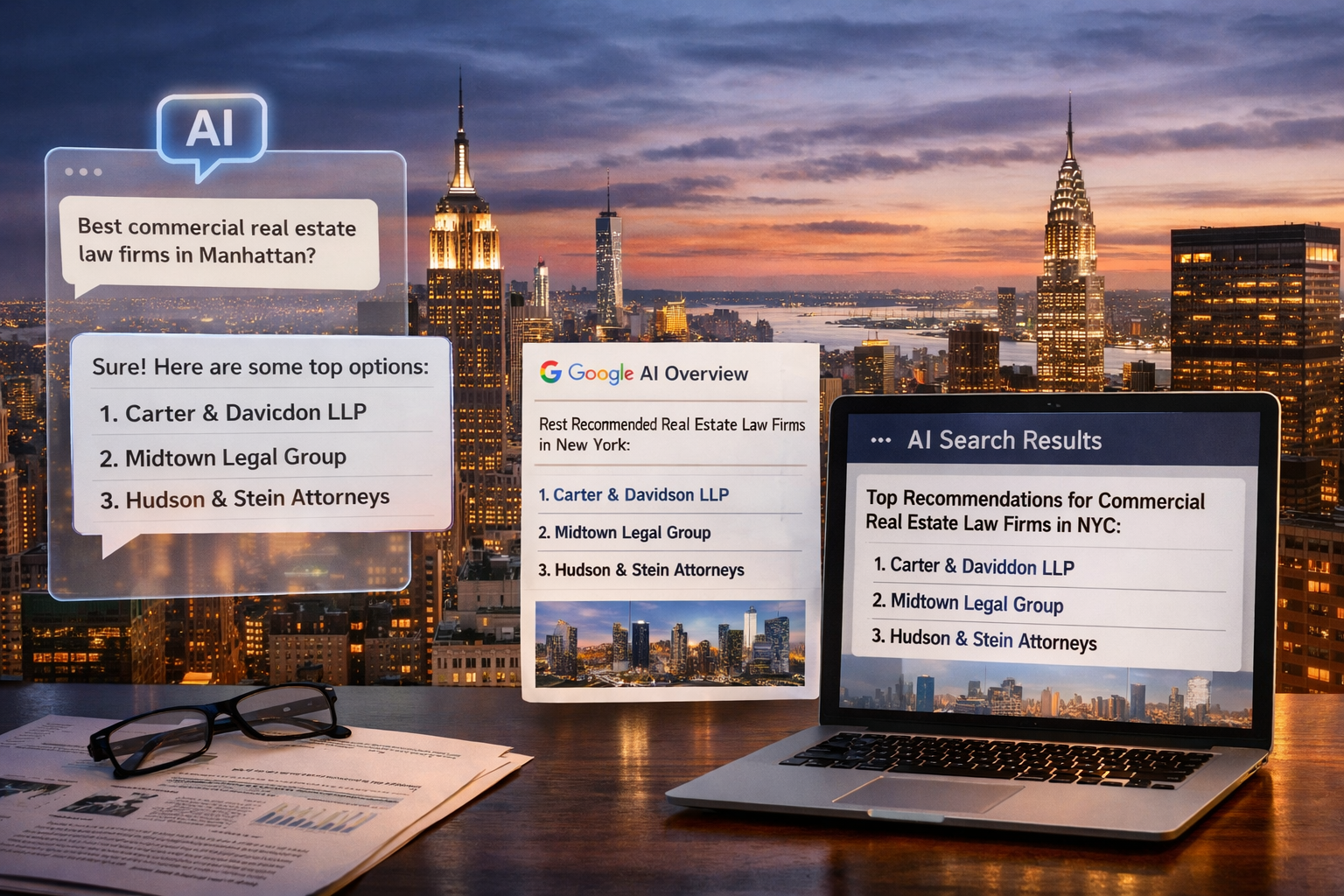
Something fundamental has shifted in how your potential clients find information — and most New York businesses are optimizing for a version of search that is no longer the complete picture.
For the past two decades, getting found online meant one thing: ranking in Google. You published content, earned backlinks, optimized your pages, and climbed the search results. If you hit page one, qualified buyers found you. That model produced results, and for most of that time, it was essentially the whole game.
In 2026, it's still a major part of the game. But it's no longer all of it.
A growing share of your potential clients are not typing queries into Google and scanning a list of ten blue links. They're asking ChatGPT to recommend a law firm that handles commercial real estate disputes in Manhattan. They're asking Perplexity to explain which financial advisors specialize in wealth management for business owners in New York. They're reading a Google AI Overview that synthesizes information from multiple sources into a single answer — and making decisions based on which brands appear in that answer, without clicking through to any individual website.
This is the world that Generative Engine Optimization — GEO — was created to address. And the New York businesses that understand it now, and start building toward it now, will have a meaningful competitive advantage over the ones that figure it out two years from now.
What Is GEO? The Plain-Language Explanation
Generative Engine Optimization (GEO) means optimizing content to appear inside AI-generated answers — like those from ChatGPT, Gemini, and Perplexity — not just rank in traditional search results. GEO helps brands be cited by AI when users ask questions, shifting visibility from traffic and rankings toward authority and mentions in AI outputs. WordStream
The difference between SEO and GEO is best understood through what each one is trying to achieve.
In traditional SEO, success looks like this: a buyer searches "corporate attorney New York," your firm's website appears in position three on Google's results page, the buyer clicks your link, reads your content, and contacts you. The chain is: rank → click → visit → convert.
In GEO, success looks different: a buyer asks ChatGPT "which law firms in New York handle commercial litigation for mid-sized companies," and ChatGPT's response says "several well-regarded firms include [your firm's name], which is known for..." The buyer doesn't click anything. They read the AI's answer, note your firm's name, and later search directly for you or go to your website. The chain is: get cited → get mentioned → build recognition → earn trust → convert.
SEO optimizes content to rank in Google's traditional blue-link results, where 10 URLs compete for visibility. GEO optimizes content to be cited in AI-generated answers, where only 1 to 3 sources are cited per response. AI Rank Lab
That compression — from ten competing links to one to three citations — is why GEO matters so much. In traditional search, being on page one means sharing visibility with nine competitors. In AI search, the answer either mentions your brand or it doesn't. There's far less room, and the stakes of being included or excluded are correspondingly higher.
How Big Is AI Search Actually Getting?
The case for investing in GEO rests on the scale and trajectory of AI search adoption. Here's where things stand.
Nearly a third — 31.3% — of the US population will use generative AI search in 2026, according to an EMARKETER forecast, pushing marketers to optimize for platforms like ChatGPT, Google AI Overviews, and Perplexity alongside traditional search engines. eMarketer
AI-referred sessions jumped 527% year-over-year in the first five months of 2025, according to Previsible's 2025 AI Traffic Report. Frase
1.8 billion users already use generative AI tools. More than 50% of Google searches now show an AI Overview. Google AI Overviews reach 1.5 billion monthly users. ChatGPT has 800 to 900 million weekly active users. Incremys
A McKinsey study estimates that 44% of consumers now use AI as the main source of information for their purchasing decisions. For B2B businesses, the trend is even more pronounced: according to Walker Sands, 90% of B2B buyers integrate generative AI at some point in their buying journey. Mekaa
For New York B2B businesses — professional services, financial advisory, legal, consulting, technology — that last statistic is the one that matters most. Nine out of ten of your B2B buyers are using AI somewhere in their research process. The question is whether your brand appears when they do.
The global GEO market was $886 million in 2024 and is expected to reach $7.3 billion by 2031 — an eightfold increase in seven years, with a compound annual growth rate of 34%, making it one of the fastest-growing digital marketing segments. Incremys
And the first-mover opportunity is real: only 34% of companies have trained their teams in GEO, revealing a skills gap that must be filled quickly. Incremys For New York businesses willing to invest in this now, the competitive landscape is still relatively open.
GEO Is Not a Replacement for SEO — It's an Additional Layer
This is the most important thing to understand before going further, because the framing of "GEO vs. SEO" implies a competition that doesn't exist. They're complementary disciplines with significant overlap.
99% of AI Overviews cite the organic top 10, which means that SEO is still the basis for GEO — you have to rank well first to have a chance of being cited. Incremys
GEO is not a replacement for SEO — it is an additional layer. Brands that excel at GEO in 2026 are typically the same brands with strong traditional SEO foundations. The optimization principles overlap significantly, but GEO adds specific requirements around content structure, citation-friendliness, and data richness that SEO alone does not address. Enrichlabs
The practical relationship between the two works like this: strong SEO gets your content into the pool that AI systems draw from. Strong GEO makes your content the content those AI systems actually choose to cite. You need both.
The core principles behind effective SEO still apply to GEO. You still need to publish high-quality, authoritative content for real users. Your site still needs to be technically accessible. You still need credible signals of trust and expertise. And you still need to understand user intent and deliver clear value. But GEO adds specific requirements — content structure, direct-answer formatting, citation-friendliness, data richness — that SEO alone doesn't require. Search Engine Land
Think of it this way: SEO gets you to the audition. GEO is what gets you the part.
How the Different AI Platforms Actually Work
Understanding GEO requires understanding that "AI search" is not a monolithic thing. ChatGPT, Perplexity, and Google AI Overviews each operate differently, pull from different sources, and require somewhat different optimization approaches.
Google AI Overviews are deeply connected to traditional SEO because they draw on Google's existing search index. Google AI Overviews appear on around 25% of all Google searches and draw on the existing search index, which means traditional SEO signals — domain authority, backlinks, content quality — matter heavily. Mekaa If you rank in the top ten organically for a query, you have a strong probability of being cited in an AI Overview on that query. If you don't rank in the top ten, you almost certainly won't be cited regardless of how well your content is structured for GEO.
ChatGPT operates with a combination of training data and real-time web search via Bing integration. According to a 2025 analysis, around 60% of requests are processed using parametric memory alone — what the model learned during training. For queries requiring recent data, ChatGPT performs a web search and cites the most relevant sources. Wikipedia accounts for nearly 48% of the most cited sources for factual questions, followed by news sites and educational resources. Mekaa This means brand mentions in authoritative publications, Wikipedia presence where relevant, and genuinely well-known brand identity all contribute to ChatGPT's likelihood of citing you.
Perplexity is the most real-time of the major platforms. Perplexity performs a systematic web search for each answer, building responses from web sources in real time with explicit inline citations. The platform particularly favors community content like Reddit and Quora, authentic feedback, and professional and institutional sources. Mekaa Being mentioned in discussions on Reddit, Quora, and professional community forums — not just on your own website — is a specific Perplexity advantage.
AI engines also draw from different source types than traditional search. Reddit, LinkedIn, and YouTube ranked among the most-referenced domains by major large language models in October 2025. eMarketer
The implication for New York businesses: GEO is not purely a website optimization exercise. It's a brand presence and distribution exercise that spans your own content, your mentions in authoritative publications, your activity in professional communities, and your reputation signals across the web.
The Citation Variability Problem
One of the most important things to understand about GEO — and one of the most honest things we can tell you — is that it is significantly less stable and predictable than traditional SEO.
"Almost every GEO response is different from every other GEO response," said Nate Elliott, EMARKETER's principal analyst. "If you query Google with the same question 10 times, you'll get a pretty good sense for what Google's going to tell you. I don't know that we know that for GEO." 40% to 60% of cited sources change month-to-month across Google AI Mode and ChatGPT, making visibility far less stable than organic search rankings. eMarketer
This variability is not a reason to deprioritize GEO — it's a reason to understand it correctly. GEO is a brand authority investment, not a traffic channel with predictable daily returns. When an AI system cites your brand, it signals to the user that your brand is a credible, relevant player in your space. That recognition and trust build over time and across interactions. But you can't set a target of "50 AI citations per month" the way you might target a keyword ranking.
The Washington Post found that visitors from AI platforms converted to subscriptions at four to five times the rate of traditional search visitors, according to the Post's chief revenue officer. eMarketer The traffic that comes from AI citations is high-quality, high-intent traffic — but the volume is currently lower and less predictable than organic search traffic. Think of it as the difference between a referral from a trusted colleague (high-quality, lower frequency) and inbound from Google (potentially high volume, more variable quality).
The Business Case: What Being Cited Actually Does for You
Beyond the abstract argument for AI visibility, there is a concrete business case for GEO investment that ties directly to outcomes New York businesses care about.
Brands cited in AI Overviews earned 35% more organic clicks and 91% more paid clicks than brands not cited on the same queries. Search Engine Land
That paid search number deserves emphasis. A business cited in an AI Overview on a relevant query gets 91% more clicks on their paid ads than a business not cited. The AI Overview citation functions as a trust signal that makes users more likely to click the paid ad below it. This means GEO investment has a measurable positive effect on your Google Ads performance — it's not just an abstract brand-building exercise.
Visitors from AI search are 4.4 times more qualified than those from traditional research, and the proven ROI of GEO investment is estimated at plus 22%. Incremys
For New York B2B businesses where a single new client relationship can be worth tens or hundreds of thousands of dollars, even infrequent but highly qualified inbound from AI platforms represents significant pipeline value.
What GEO Actually Requires: The Practical Tactics
Here is where we move from explanation to action. GEO is achievable for New York businesses of any size, but it requires specific changes to how you approach content, brand presence, and distribution.
1. Answer the question in the first 40 to 60 words.
AI systems that use real-time retrieval evaluate a page's relevance primarily on its opening content. The first 200 words of any article should directly and completely answer the primary query — not build up to the answer. GEO optimizes at the fact level: each statistic, definition, or concept needs standalone clarity. An AI engine might cite one 60-word paragraph from your 3,000-word article, ignoring the rest entirely. Frase
This is the most impactful structural change you can make to existing content. Stop building to the answer. Start with it. If your blog post is about commercial lease negotiation for New York businesses, the first paragraph should directly state the key things businesses should know, not set up context for three paragraphs before getting there.
2. Build in statistics and specific data points every 150 to 200 words.
Research from Princeton University and IIT Delhi found that statistics addition and quotation addition show strong performance improvements across all GEO metrics. The best methods improve upon baseline by 41% on position-adjusted word count and 28% on subjective impression. Adding specific statistics is one of the highest-impact content modifications for AI citation probability. arXiv
AI systems are citation engines. They are looking for specific, citable, credible information that they can synthesize into an answer. A paragraph that says "New York commercial real estate leasing has become more competitive in recent years" is not citable. A paragraph that says "Manhattan office lease prices have risen 6% year-over-year through early 2026 according to StreetEasy data, while Class A vacancy rates have continued to tighten" gives an AI system a specific, attributable fact it can use.
3. Reformat your headers as questions that mirror how people prompt AI.
A header that reads "What Is GEO?" is more likely to be cited for the query "what is generative engine optimization" than a header reading "GEO Overview" or "Understanding GEO." Reformatting headers as questions that mirror actual search and conversational queries is one of the highest-ROI GEO changes you can make to existing content. Use Google Search Console query data to identify the actual questions people are asking, then make those questions your headers. Enrichlabs
People prompt AI conversationally: "What should I look for in a New York business attorney?" "How do I choose a financial advisor in Manhattan?" Your content headers should mirror that phrasing — not just to optimize for GEO, but because it also improves traditional SEO performance on the same queries.
4. Keep content current — AI systems heavily favor freshness.
Over 80% of AI-driven traffic went to pages updated within the past two years. Only 3.6% of AI-referred traffic went to pages older than four years. Seer Interactive
This is a specific and actionable data point. Content older than two years without updates is essentially invisible to AI-driven referral traffic. For New York businesses with existing content libraries, this creates a clear priority: identify your most commercially relevant content, update it with current data, current examples, and current context, and add a visible "last updated" date. The update doesn't need to be a complete rewrite — adding fresh statistics, updating examples to current conditions, and adding a section on what's changed in 2026 can meaningfully improve AI citation probability.
5. Invest in digital PR and off-site brand mentions.
This is the GEO tactic that requires the biggest shift in thinking for businesses that have treated their website as the center of their digital marketing universe. AI systems don't only look at your website. They look at the entire web's conversation about your brand.
"Brand mentions across diverse platforms create a network effect for AI visibility," said Oskar Duberg, a content specialist. "When AI sees your brand referenced in multiple authoritative contexts, it's more likely to include you in responses, even without direct links." WordStream
For New York businesses, this means: earning editorial coverage in publications like Crain's New York Business, The Real Deal, or relevant trade publications; being quoted as an expert source in news articles; participating actively in relevant Reddit communities and professional LinkedIn discussions; contributing guest content to authoritative industry publications; and pursuing podcast appearances where the transcript becomes indexed, citable content.
EMARKETER's Max Willens notes that Reddit alone has 100 million daily active users generating conversations about brands. "Any brand that has wanted to be serious about community, but hasn't started, should absolutely start taking that more seriously now." eMarketer
6. Implement schema markup for structured data.
Schema markup tells AI crawlers explicitly what your content is — an FAQ, a professional service listing, a how-to guide, an article with an author with specific credentials. Implementing proper schema markup is one of the core GEO tactics alongside structured content with direct answers and consistent fact density. Frase For New York professional service firms, FAQ schema on your service pages and article schema with author credentials on your blog content both contribute to AI citation probability.
7. Build topical consistency across your content.
Topic consistency over an extended period allows AI systems to categorize your expertise and optimize distribution to relevant audiences. Brands that post about leadership on Monday, technical implementation on Tuesday, and industry news on Wednesday confuse the system. Consistent topical coverage builds the entity authority that AI systems use to determine whether to cite a brand as an expert source on a specific subject. Enrichlabs
For a New York financial advisory firm, this means consistently publishing content about wealth management, estate planning, business succession, and NYC-specific financial considerations — not occasionally publishing about those topics between posts about unrelated subjects. The depth and consistency of your topical coverage is what builds the entity authority that makes AI systems recognize and cite your brand as a genuine expert.
The Budget Framework: How Much to Invest in GEO
One recommended framework dedicates 40% to core SEO, 25% to digital PR, 20% to data and reporting, 10% to training, and 5% to experimentation. eMarketer
For New York businesses new to GEO, the practical starting point is not a complete reallocation of your marketing budget. Most of the GEO tactics above are modifications to work you're already doing — or should already be doing — as part of a solid content and SEO strategy. Updating existing content for freshness and direct-answer structure, adding schema markup, reformatting headers as questions — these are relatively low-cost changes with meaningful GEO impact.
The larger investment is in digital PR — the earned media coverage, expert citations, and authoritative brand mentions that build the off-site presence AI systems draw from. For New York businesses in professional service categories, this is also one of the highest-ROI marketing investments available for traditional SEO reasons, which makes the GEO benefit an additive advantage rather than a separate budget line.
By early 2026, most enterprise marketing teams have a GEO initiative. Most SMB marketing teams have not started yet — which represents a significant first-mover opportunity. Enrichlabs
The Honest Picture: What GEO Can and Cannot Do
GEO is not a magic channel with clear attribution and predictable monthly returns. The citation variability is real, the measurement infrastructure is still developing, and the landscape is changing fast enough that specific tactics will evolve. Anyone who tells you they can guarantee AI citations in specific platforms for specific queries is overselling what the technology currently allows.
What GEO reliably does is build the kind of brand authority and content infrastructure that makes AI systems more likely to recognize and cite your brand as credible and relevant — and that same infrastructure also strengthens your traditional SEO, supports your digital PR efforts, and builds the kind of brand recognition that makes your paid search ads more effective when users encounter them.
The businesses winning in GEO in 2026 are not chasing a hack. They're building genuine expertise, publishing it clearly, distributing it widely, and earning the brand recognition that makes AI systems — and human buyers — consider them credible sources worth citing.
For New York businesses in professional services, financial advisory, legal, technology, real estate, and B2B consulting — categories where expertise and trust are the primary purchase drivers — GEO is not a stretch. It is the natural extension of what you should already be doing to build your brand, applied to the platforms where your buyers are increasingly spending their research time.
Not sure where your New York business stands in AI search visibility, or which GEO investments would have the most immediate impact for your specific industry and competitive landscape?
Ritner Digital builds GEO and SEO strategies for New York businesses that are serious about being found — not just in Google's traditional results, but in the AI-generated answers that are increasingly shaping how buyers discover and evaluate vendors. We start with where you actually are, and build toward where your buyers are going.
Talk to Ritner Digital about your AI search visibility →
Sources: EMARKETER GEO and AEO FAQ (April 2026), Frase.io GEO Guide 2026, Enrich Labs Complete GEO Guide 2026, Search Engine Land GEO Overview (February 2026), WordStream GEO vs. SEO 2026, Princeton/Georgia Tech/IIT Delhi GEO Academic Research Paper, Seer Interactive GEO Analysis (February 2026), Incremys GEO Statistics 2026, Walker Sands B2B Buyer AI Research, McKinsey Consumer AI Research 2025, Previsible 2025 AI Traffic Report.
Frequently Asked Questions
We've been doing SEO for years and it's working. Do we actually need to worry about GEO right now?
If your SEO is working, that's a genuine asset — and the good news is that strong SEO is the foundation of strong GEO. The two are not in competition. But "SEO is working" and "we're fully visible to buyers who use AI search" are increasingly different statements, and the gap between them is widening. 31.3% of the US population will use generative AI search in 2026. 90% of B2B buyers integrate AI somewhere in their buying journey. If your buyers are asking ChatGPT or Perplexity to recommend firms in your category and your brand doesn't appear in those answers, you're invisible to a growing share of qualified prospects regardless of your Google rankings. The question isn't whether GEO matters — it does, and the trajectory of AI search adoption makes that clearer every quarter. The question is whether you start building toward it now, while the competitive field is still relatively open and first-mover advantages are available, or whether you start in two years when every competitor has figured it out too. Most of the foundational GEO work — updating content for freshness, restructuring it for direct answers, adding schema markup, earning editorial coverage — strengthens your traditional SEO simultaneously. The incremental cost of adding GEO practices to an existing SEO program is lower than most businesses expect, and the opportunity cost of waiting is rising.
How is GEO different from just trying to rank in Google's featured snippets? We've done that before.
Featured snippets and GEO share some underlying logic — both reward content that directly answers a specific question in a clear, extractable format — but the differences are significant enough that they require different strategies. Featured snippets were a single extracted block of text from a single source, appearing at the top of one search engine's results page. GEO is about being cited across multiple AI platforms — Google AI Overviews, ChatGPT, Perplexity, Gemini — each of which has different source selection criteria, different content preferences, and different retrieval mechanisms. Featured snippets were deterministic: if your content matched Google's extraction criteria for a specific query, it appeared consistently. GEO is probabilistic: 40 to 60% of cited sources change month-to-month across AI platforms, meaning citation visibility is inherently less stable than a featured snippet position. Featured snippets were purely about your own website's content. GEO is also heavily influenced by your off-site presence — your brand mentions in publications, community discussions, Reddit threads, LinkedIn posts, and authoritative third-party references. A brand with strong featured snippet performance but weak off-site presence will underperform in GEO relative to what its website content alone would predict. The strategic overlap is real — direct-answer formatting, question-format headers, structured data — but GEO requires a broader brand and distribution strategy that featured snippet optimization did not.
If 99% of AI Overview citations come from the organic top 10, does that mean GEO is really just SEO by another name?
For Google AI Overviews specifically, the connection to organic rankings is tight enough that you're right to notice it. If you don't rank in Google's top 10 for a query, your probability of being cited in an AI Overview on that query is very low. So the foundational work — building domain authority, earning quality backlinks, publishing well-optimized content — absolutely matters for AI Overview citation. But two important nuances complicate the picture. First, ranking in the top 10 is necessary but not sufficient for AI Overview citation. Plenty of top-10 ranking pages are not cited in AI Overviews because their content isn't structured in a way that AI systems can extract clear, citable answers from. The additional GEO work — direct-answer formatting, statistics density, question-format headers, schema markup — determines which top-10 pages actually get cited versus which ones rank but don't appear in the AI summary. Second, Google AI Overviews are only one AI platform. ChatGPT and Perplexity don't use Google's search index as their primary source. They draw from their training data, Bing's index, community platforms like Reddit, and real-time web retrieval that weights different signals than Google's ranking algorithm. A brand can have strong Google AI Overview presence through traditional SEO while having weak ChatGPT and Perplexity presence because it lacks the off-site brand mentions, community presence, and authoritative third-party coverage those platforms favor. Full GEO strategy requires optimizing for all three major platforms, which requires work beyond traditional SEO.
What does "entity authority" mean and why does it keep coming up in GEO discussions?
Entity authority is the degree to which AI systems — and increasingly Google's algorithm — recognize your brand as a definitively real, credibly established, genuinely expert organization in a specific domain. It's the difference between being a collection of web pages that happen to mention certain topics and being a recognized entity that AI systems confidently associate with specific expertise. In traditional SEO, the closest equivalent is domain authority — a measure of how much trust and credibility search engines assign to your website based primarily on the quality and quantity of backlinks. Entity authority is broader and richer. It's built from: your brand name being mentioned consistently across multiple authoritative sources in connection with a specific expertise area, your founders or principals being quoted as expert sources in publications, your content being cited by other credible organizations, your presence in structured knowledge sources, your consistent topical focus across all content you publish, and your activity and mentions in professional communities. For a New York professional services firm, entity authority looks like: consistent coverage in Crain's New York Business and relevant trade publications, partners being quoted as expert sources in articles, a consistent body of published content on a defined set of practice or service areas, Wikipedia presence if appropriate to your firm's scale and history, and brand mentions in professional discussions on LinkedIn and relevant online communities. AI systems use entity authority signals to decide which brands are credible enough to cite as sources on specific topics. Building entity authority is a long-term investment in brand credibility that pays dividends across both GEO and traditional SEO.
Our business is local — we serve New York clients specifically. Does GEO matter for local businesses or is it more of a national brand thing?
GEO matters for local businesses and may actually be more achievable for a well-positioned New York firm than the category implies. Here's why. AI search users asking questions about services in a specific city get city-specific answers. When someone asks ChatGPT "what are the best accounting firms for startups in New York City" or asks Google AI Overview "which wealth management advisors specialize in high-net-worth clients in Manhattan," those queries produce local answers — and those answers cite local businesses. A New York-focused firm with strong local digital PR coverage, consistent content about serving New York clients, and mentions in New York business publications has a meaningful GEO advantage on local queries over national competitors who have no local presence or local content. The practical GEO moves for local New York businesses are: publish content that explicitly addresses New York-specific conditions, regulations, market dynamics, and client situations rather than generic content that could have been written anywhere; earn coverage in New York-specific publications like Crain's, The Real Deal, New York Business Journal, and relevant borough or neighborhood publications; ensure your Google Business Profile is complete and current since it feeds into AI systems' understanding of your local presence; and participate in New York professional community discussions on LinkedIn and relevant local forums. Local specificity is a GEO advantage, not a limitation.
How do we actually measure whether our GEO efforts are working if AI platforms don't give us referral traffic the way Google does?
This is one of the most honest challenges in GEO right now — the measurement infrastructure is significantly less developed than traditional SEO analytics, and anyone claiming precise, reliable GEO attribution is overstating what's currently possible. That said, there are meaningful metrics to track. Direct traffic increases are one of the strongest indirect signals of GEO impact. When AI platforms mention your brand in an answer, users who see that mention often search directly for your brand name or type your URL directly — neither of which shows up as AI referral traffic in your analytics but both of which reflect AI-driven brand awareness. Monitoring your branded search volume in Google Search Console over time gives you a meaningful proxy for whether AI mentions are driving increased brand recognition. AI platform referral traffic is growing and increasingly trackable. Google Analytics 4 can now capture some referral traffic from ChatGPT, Perplexity, and other AI platforms. This traffic is currently small for most businesses but growing rapidly — the 527% year-over-year increase in AI-referred sessions means the absolute numbers are becoming meaningful enough to monitor monthly. Manual citation testing — regularly prompting major AI platforms with the key questions your buyers would ask and tracking whether your brand appears — gives you qualitative intelligence about your GEO position relative to competitors. This is time-consuming but genuinely informative. Tools like Semrush's AI toolkit and specialized GEO monitoring platforms are developing to track brand mention share across AI platforms, though these are still maturing. The honest expectation: GEO measurement in 2026 is directional and proxy-based rather than precise and directly attributable. Treat it as a brand authority investment measured by brand recognition and inbound quality trends rather than a performance channel measured by click-through attribution.
We don't have a big content team. What are the two or three highest-impact GEO moves we can make right now with limited resources?
Three moves, in priority order. First, update your most commercially relevant existing content for freshness and direct-answer structure. Over 80% of AI-driven traffic goes to pages updated within the past two years. Pick your five to ten most important service pages and blog posts — the ones that address the questions your best clients ask most often — and update them with current data, a visible "last updated" date, and a restructured opening paragraph that directly answers the primary question in the first 50 words without preamble. This is the highest-ROI GEO move available because you're improving existing content that already has some authority rather than building from scratch. Second, create a dedicated FAQ page or FAQ sections on your key service pages with question-format headers and direct, concise answers. FAQ content with proper schema markup is among the most frequently cited content in AI answers because it's structured exactly the way AI systems want to extract information — a clear question followed by a clear answer. For a New York professional services firm, this means identifying the 10 to 15 questions your clients ask most often and answering them directly and specifically on your website. Third, pursue one piece of earned media coverage per month in a publication your target clients read. This could be a contributed article in a trade publication, a quote in a news story, a podcast interview, or a guest post on an authoritative industry blog. Off-site brand mentions in credible publications are the GEO signal that website optimization alone cannot replicate, and for New York businesses the concentration of relevant media makes this more achievable than in most markets. These three moves together — content freshness and structure, FAQ optimization, and earned media — address the most important GEO signals across all three major AI platforms without requiring a large team or a complete content overhaul.
Our competitors don't seem to be doing GEO yet. Is it worth getting ahead of them or should we wait until it's more proven?
Get ahead of them, and the data is clear about why. Only 34% of companies have trained their teams in GEO as of early 2026. Most small and mid-sized business marketing teams have not started a formal GEO initiative. This is precisely the window where early movers build advantages that are genuinely difficult for later entrants to close. In traditional SEO, this dynamic is well-documented: the brands that built domain authority and content libraries early hold ranking advantages that competitors who started later spend years and significant budget trying to overcome. GEO is likely to follow the same pattern. The brands that build entity authority, consistent topical content, and off-site brand recognition in the AI search ecosystem now are establishing citation habits — the AI systems' tendency to associate specific brands with specific expertise — that will compound over time. When your competitors eventually start their GEO programs in 2027 or 2028, they'll be competing against brands that have two or three years of consistent entity authority signals already established. The "wait until it's more proven" instinct is understandable but historically costly in digital marketing. The businesses that waited until SEO was fully proven missed the period when organic rankings were easiest to build. The businesses that waited until LinkedIn was fully proven missed the period when organic reach was strongest. GEO is at a similar inflection point now. The tactics are sufficiently understood, the platforms are sufficiently established, and the buyer adoption is sufficiently documented that the investment case is clear. The uncertainty about precise measurement and exact citation mechanics doesn't change the strategic logic of building toward where your buyers are going.