The Invisible Tax of a Weak CEO LinkedIn Profile
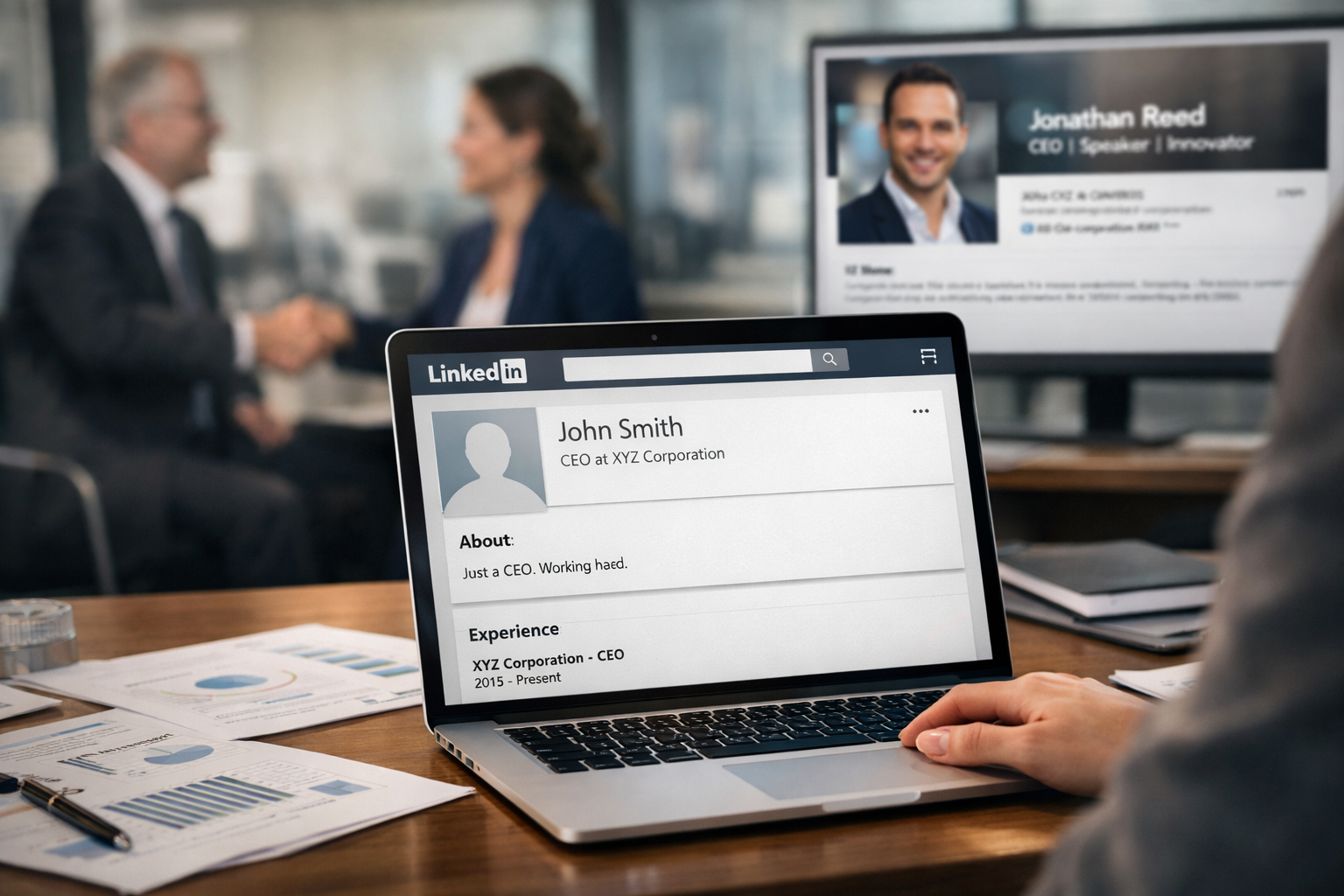
There's a cost your business is paying that never shows up on a balance sheet.
It doesn't appear in your ad spend, your agency retainer, or your software subscriptions. It won't show up in a quarterly review or get flagged in an audit. But it's real, it's consistent, and it compounds quietly every single month — in deals that didn't close, partnerships that never materialized, press coverage that went to a competitor, and top-tier candidates who chose a company with a leader they could actually find online.
The source isn't your product. It isn't your pricing. It isn't even your marketing.
It's your CEO's LinkedIn profile.
The Disconnect That's Costing You More Than You Think
Let's set the scene.
Your company has invested real money into its brand. A well-designed website. A content strategy. Maybe a paid media budget. A company LinkedIn page that's grown to a respectable follower count through consistent posting and community engagement. On paper, the brand looks solid.
Now imagine you're a VP of Operations at a mid-sized company, and you've just received a cold outreach from your sales team. The pitch is compelling. The case studies check out. The pricing is in range. You're intrigued enough to do what every serious buyer does at this stage — you start researching.
You visit the website. You skim the About page. You Google the company name. And then, almost reflexively, you search for the CEO on LinkedIn.
What you find is a profile with 312 followers, a headline that reads "CEO at [Company Name]," an About section that hasn't been touched since the company launched, and a last post dated fourteen months ago sharing a generic industry article with no commentary.
Do you immediately disqualify the vendor? Probably not. But something shifts. A small, almost imperceptible doubt enters the evaluation. You wonder, without quite articulating it: Is this company as serious as their pitch suggests?
That doubt is the invisible tax. And your business is paying it whether you're aware of it or not.
Why CEO Presence on LinkedIn Is a Business Fundamental, Not a Nice-to-Have
There's a persistent misconception that LinkedIn activity is a vanity exercise — a place for personal brand builders and people who like to hear themselves talk. This view is not only outdated, it's actively expensive for the companies whose leadership holds it.
LinkedIn is, by a wide margin, the most important professional search engine in the world. With over one billion members and more than 65 million decision-makers on the platform, it functions as the first stop for due diligence across virtually every professional context — sales, recruiting, partnerships, investment, and media.
When someone wants to know whether your company is legitimate, whether your leadership has credibility, and whether doing business with you is a safe bet, LinkedIn is where they go to find out. Not your website. Not your Glassdoor page. LinkedIn — because LinkedIn shows them a live, unfiltered signal of who your CEO is and how seriously they take their professional presence.
According to LinkedIn's internal data, profiles with professional headshots receive 14 times more profile views than those without. Complete profiles are 40 times more likely to receive inbound opportunities. And executives who post regularly see dramatically higher engagement rates than those who stay silent — which translates directly into visibility with exactly the kind of high-value contacts that move business forward.
But the more important data point isn't about LinkedIn's algorithm. It's about human psychology. Research consistently shows that people make trust decisions about other people before they make trust decisions about companies. Before a buyer trusts your brand, they need to trust your leadership. Before a candidate accepts your offer, they need to feel confident about who's running the organization. Before a journalist quotes your company, they need to believe your CEO is a credible voice worth citing.
A weak LinkedIn presence doesn't just fail to help those trust decisions. It actively works against them.
Where the Tax Gets Collected: The Four Hidden Costs
1. Late-Stage Deal Friction
The most immediately painful place a weak CEO profile costs you is in active sales cycles — particularly in the final stages, when scrutiny is highest and doubt is most dangerous.
Research from Gartner found that B2B buyers are nearly 60% of the way through their purchase decision before they ever engage a vendor directly. The due diligence process is long, and it's increasingly self-directed. Buyers research on their own time, in their own way, and they make preliminary judgments before a single conversation happens.
That process almost always includes looking up the leadership team. Not because buyers are being nosy, but because they're being responsible. Signing a contract, recommending a vendor internally, or committing a meaningful budget to an outside company is a risk. People naturally want to validate that the leadership behind the company is credible, experienced, and visible enough to have a stake in the industry.
When a CEO's LinkedIn profile fails that check — when it looks sparse, stale, or low-effort — it creates friction at exactly the moment your sales team needs the path to be clear. The deal might still close, but it's now fighting against a headwind that didn't need to exist.
And in competitive evaluations, where two vendors are otherwise comparable, that headwind can be the difference.
2. Inbound Opportunities That Never Reach You
Here's the insidious thing about missed inbound opportunities: you never see them. There's no notification that says a potential partner searched for your CEO, found a thin profile, and reached out to someone else instead. There's no record of the conference organizer who was looking for a keynote speaker, found your competitor's CEO with 12,000 followers and a body of published thought leadership, and moved on without ever finding you.
These opportunities are invisible by definition. But they're happening constantly, and the gap between executives who show up in those searches and those who don't is growing wider.
Strategic partnerships frequently begin with a LinkedIn search. An executive at a complementary company is looking for a co-marketing partner, an integration collaboration, or a referral relationship. They search a relevant keyword, find a few leaders who look credible, and send a connection request. If your CEO isn't showing up — or shows up but looks dormant — that opportunity routes to someone else.
The same is true for investment interest, media inquiries, and speaking opportunities. Journalists building a source list, analysts researching a sector, and event organizers filling a panel all use LinkedIn as a primary discovery tool. Visibility on that platform isn't just about ego — it's about being findable by the people who could change the trajectory of your business.
3. Talent Acquisition Losses You'll Never Trace Back to LinkedIn
Recruiting is where a weak CEO presence costs companies in a way that's deeply underappreciated.
A 2023 LinkedIn survey found that 75% of job seekers research a company's leadership team as part of their evaluation process. This isn't limited to senior hires. Across levels, candidates want to know who's running the company, what they stand for, and whether they're the kind of leader worth working for.
For senior candidates — the ones with options, with leverage, and with the experience to ask good questions — a CEO's LinkedIn profile is a meaningful signal. It tells them whether leadership is engaged with the industry. Whether they're invested enough in the company's reputation to maintain a credible public presence. Whether they're someone worth betting a career move on.
When that profile is weak, it raises uncomfortable questions. And the best candidates rarely ask those questions out loud — they just quietly choose the company where the CEO looked like someone they'd want to work with.
The cost here isn't just a single hire. It's the compound effect of a talent pipeline that's slightly weaker than it needs to be, over years, because leadership didn't invest in showing up.
4. Credibility Erosion in Your Existing Network
Perhaps the least obvious cost of a weak CEO LinkedIn presence is what it signals to people who already know the company — existing clients, current partners, industry contacts who've met leadership at events.
These are people who've already made a positive judgment about your business. But they're also people who refer you, advocate for you, and vouch for you in rooms you're not in.
When they casually check your CEO's LinkedIn — because someone they know asks about the company, or because they're preparing an introduction — and they find a profile that looks abandoned, it subtly undermines their confidence. It makes it harder to sell you to someone else. It creates a small but real hesitation before they put their own credibility on the line to recommend you.
Word-of-mouth referrals are among the highest-converting lead sources for most B2B businesses. Anything that creates friction in that process is worth taking seriously.
Anatomy of a Weak CEO Profile: What Buyers Actually See
It's worth being specific about what "weak" means in practice, because it's not always obvious from the inside. A CEO might feel like their LinkedIn is "fine" while their profile is quietly undermining their company's credibility with every visitor.
A generic or title-only headline. "CEO at [Company]" tells a visitor nothing about what the company does, who it serves, or why the leader's perspective is worth paying attention to. A strong headline communicates expertise and value in a single line. A weak one just confirms the person has a job.
An absent or résumé-style About section. The About section is the only place on a LinkedIn profile where someone can speak directly to the visitor in their own voice. When it's missing, it's a missed opportunity. When it's there but reads like a LinkedIn-formatted résumé — third person, job history, list of accomplishments — it fails to do what it should: build a connection, establish a point of view, and give the visitor a reason to trust this person.
No recent activity. LinkedIn rewards consistent activity with visibility, but the human signal matters more than the algorithmic one. When a visitor sees that a CEO last posted fourteen months ago, they draw a conclusion: this person isn't engaged. Whether that's fair or not, it's the inference that gets made.
A low-quality or outdated headshot. First impressions on LinkedIn are visual. A headshot that looks unprofessional, outdated, or low-resolution signals a lack of attention to detail. It's a small thing that carries an outsized amount of weight.
No featured content or external proof points. A CEO who has spoken at conferences, been quoted in publications, written articles, or produced any content worth highlighting has an opportunity to show that work in the Featured section. An empty Featured section is a blank where credibility could be.
A follower count significantly lower than the company page. This one is specifically worth calling out, because it's the most visible signal of a leadership presence that hasn't kept pace with the company's growth. When the company page has 1,000 followers and the CEO has 300, it tells a visitor that someone has been investing in the brand — just not in the leadership. That asymmetry reads as a gap in seriousness.
None of these signals individually are disqualifying. Together, they create a pattern that works against everything your marketing team is trying to accomplish.
The Compounding Problem: Your Brand and Your CEO's Profile Are in Constant Conversation
Here's the dynamic that makes this issue more urgent than most executives realize.
Every piece of marketing your company produces creates curiosity about the people behind it. A compelling LinkedIn ad makes someone want to know who's running this company. A strong case study makes a prospect want to validate the leadership before moving forward. A well-written cold email makes a buyer want to look up the sender's boss.
Your marketing is actively driving traffic to your CEO's LinkedIn profile. Every piece of content you publish, every ad you run, every outreach your sales team sends — all of it creates moments where someone will search for your CEO.
If that profile doesn't convert those visits into trust, your marketing spend is working against itself. You're paying to generate curiosity and then failing to satisfy it.
The flip side is equally true. A CEO with a strong LinkedIn presence creates a compounding return on every other marketing investment. When the buyer finds a credible, active, well-positioned leader, it validates everything else they've seen. The website looks more trustworthy. The case studies feel more credible. The sales pitch lands harder.
Personal credibility amplifies brand credibility. The two are inseparable in the minds of buyers, even when companies treat them as separate concerns.
What a Strong CEO LinkedIn Presence Actually Looks Like
Fixing a weak CEO LinkedIn profile doesn't require becoming a content creator or spending an hour a day on social media. It requires treating the profile as what it actually is: one of the most important pages on the internet for your business.
A headline that communicates expertise, not just title. Something like "Helping mid-market companies reduce operational risk through smarter procurement | CEO at [Company]" does more work than "CEO at [Company]" in every conceivable way.
An About section written in first person with a clear point of view. What does the CEO believe about the industry? What problem does the company exist to solve? Why does this work matter? These aren't fluffy questions — they're the substance of trust-building, and the About section is the right place to answer them.
A posting cadence that signals engagement. Two to four posts per month is enough to maintain a visible, active presence without requiring a significant time investment. The content doesn't need to be revolutionary — it needs to be relevant, consistent, and written with a perspective.
A professional, current headshot. This is the lowest-effort, highest-impact change most CEOs can make. A quality headshot communicates that someone cares about how they show up — which is exactly the signal you want to send.
Featured content that demonstrates credibility. Press mentions, conference appearances, published articles, notable client outcomes — anything that provides external validation of the CEO's expertise belongs in the Featured section.
A follower growth strategy. Follower count is a signal, not a vanity metric. Building it to a level that's consistent with the company's stage and the CEO's industry presence is a legitimate business objective.
The ROI Framing That Changes How Executives Think About This
The most effective way to reframe a CEO's LinkedIn presence is to move it out of the "personal brand" conversation and into the "revenue infrastructure" conversation.
A CEO LinkedIn profile that is credible, active, and well-positioned does several things with measurable business value. It reduces friction in sales cycles. It generates inbound interest from partners, media, and talent. It amplifies every other marketing investment the company makes. It gives existing advocates better tools to refer the company.
None of this requires a massive time investment. It requires the same level of intentionality that gets applied to every other business asset — which is simply the acknowledgment that this matters, followed by the decision to treat it accordingly.
The companies that are winning on LinkedIn aren't necessarily the ones with the biggest budgets or the most followers. They're the ones where leadership understands that personal credibility and company credibility are two sides of the same coin — and where the CEO's profile reflects that understanding.
Stop Paying a Tax You Don't Have To
Every month a CEO's LinkedIn profile sits dormant, underbuilt, or out of sync with the company it represents, the invisible tax is being collected. In deals that got one step further before stalling. In talent pipelines that skew slightly weaker than they should. In partnerships that went to a competitor whose CEO simply looked more credible online.
These losses don't show up in a report. But they're real, they're consistent, and over time they add up to a significant drag on growth that had a straightforward fix.
Your company's LinkedIn page represents your brand. Your CEO's LinkedIn profile represents your leadership. Both need to be working — because your buyers, your partners, your future employees, and your existing advocates are looking at both.
At Ritner Digital, we help companies close the gap between their brand presence and their leadership presence. If your CEO's LinkedIn profile isn't working as hard as your business is, let's talk.
Frequently Asked Questions
How many followers should a CEO have on LinkedIn?
There's no universal benchmark, but a useful rule of thumb is that a CEO's follower count should be roughly proportional to the company's stage and industry footprint. An early-stage startup CEO with 500 followers reads differently than the CEO of a 10-year-old company with 200 employees and 400 followers. As a general target, most established CEOs should be working toward 1,000 followers as a credibility floor — with 5,000 to 10,000 being the range where inbound opportunities start to increase meaningfully. The more important signal, though, isn't a specific number. It's whether the profile looks active and the follower count looks consistent with someone who takes their professional presence seriously.
How often does a CEO actually need to post on LinkedIn?
More than most CEOs think, and less than most social media advice suggests. The sweet spot for most executives is two to four posts per month — enough to maintain a consistent, visible presence without making LinkedIn feel like a second job. What matters more than frequency is quality and consistency. A CEO who posts three times a month with genuine perspective and relevant insight will outperform one who posts fifteen times a month with generic content. The goal isn't to go viral. The goal is to ensure that when someone visits the profile, they see recent activity that confirms this is a person who is engaged, informed, and worth paying attention to.
What should a CEO actually post about on LinkedIn?
The most effective CEO content falls into a few reliable categories. Industry perspective — takes on trends, changes, or challenges in the space the company operates in. Company milestones and culture — wins, hires, partnerships, and behind-the-scenes moments that humanize the leadership. Lessons learned — hard-won insights from building and running the business. Client outcomes — highlighting results in a way that's celebratory rather than promotional. The common thread across all of it is point of view. Generic content that could have been written by anyone in any industry generates very little trust. Content that reflects a specific perspective, expertise, and voice is what builds the kind of credibility that actually moves the needle with buyers, candidates, and partners.
Is a CEO's LinkedIn profile really that important if the company already has strong word-of-mouth?
Yes — and arguably more so. Word-of-mouth referrals are high-intent, but they still require validation. When someone is referred to your company, one of the first things they do is look up the leadership. A referral that lands on a strong CEO profile gets reinforced. A referral that lands on a weak one introduces doubt into what was otherwise a warm lead. Strong word-of-mouth is an asset, but it doesn't replace the need for credibility signals — it actually raises the stakes for them, because the bar for a referred prospect's expectations is already higher.
Can't the CEO just delegate LinkedIn management to someone on the marketing team?
Partially, and with important caveats. The logistics of LinkedIn — scheduling posts, optimizing the profile, managing engagement — can absolutely be supported by a team. What can't be fully delegated is the voice and the perspective. Buyers, candidates, and partners are sophisticated enough to notice when a CEO's LinkedIn reads like it was written by a PR team rather than a human being. The best approach is a collaborative one: the CEO provides the ideas, opinions, and raw material, and a marketing partner or agency shapes it into content that performs. What doesn't work is handing it off entirely and hoping no one notices. They notice.
How long does it take to see results from improving a CEO's LinkedIn presence?
Profile improvements — headshot, headline, About section, Featured content — create an immediate impact because they affect every single visitor from the moment they go live. The compounding benefits of consistent posting take longer, typically three to six months before a meaningful increase in inbound visibility and follower growth becomes apparent. The deals influenced by a stronger profile are harder to attribute directly, but anecdotally, most executives who commit to improving their presence report noticing a shift in how conversations start within the first quarter — more "I've been following your content" openings, more inbound connection requests from relevant contacts, and more frequent mentions of their LinkedIn in sales conversations. The full ROI picture builds over time, but the baseline credibility improvement is immediate.
What's the difference between a CEO's LinkedIn and a company LinkedIn page, and does the company page matter less?
They serve different functions and both matter — but they influence trust in different ways. A company LinkedIn page is where buyers go to understand what the business does, see proof of work, and follow for updates. A CEO's LinkedIn profile is where they go to evaluate the human being behind the company. Research consistently shows that people make trust decisions about people before they make trust decisions about organizations. That means the CEO profile often carries more weight in the due diligence process than the company page does — even when the company page is better maintained. Ideally, both are strong and they reinforce each other. But if a company has to prioritize, investing in the CEO's profile credibility tends to have a more direct impact on the trust decisions that drive revenue.
Does this apply to other members of the leadership team, or just the CEO?
It applies to the full leadership team, though the CEO carries the most weight. In a B2B context, buyers frequently look up the entire leadership team before making a significant purchase decision — particularly the people they'll be working with directly. A CEO with a strong profile and a VP of Sales with a weak one still creates friction in deals where that VP is the primary relationship. The principle scales: the more visible a leadership team member is in the sales or partnership process, the more their LinkedIn presence matters. For most companies, a reasonable priority order is CEO first, then the executive team members who are most customer-facing, then the broader leadership team over time.