Orlando Just Became a $233 Billion Economy — Is Your Digital Marketing Keeping Up?
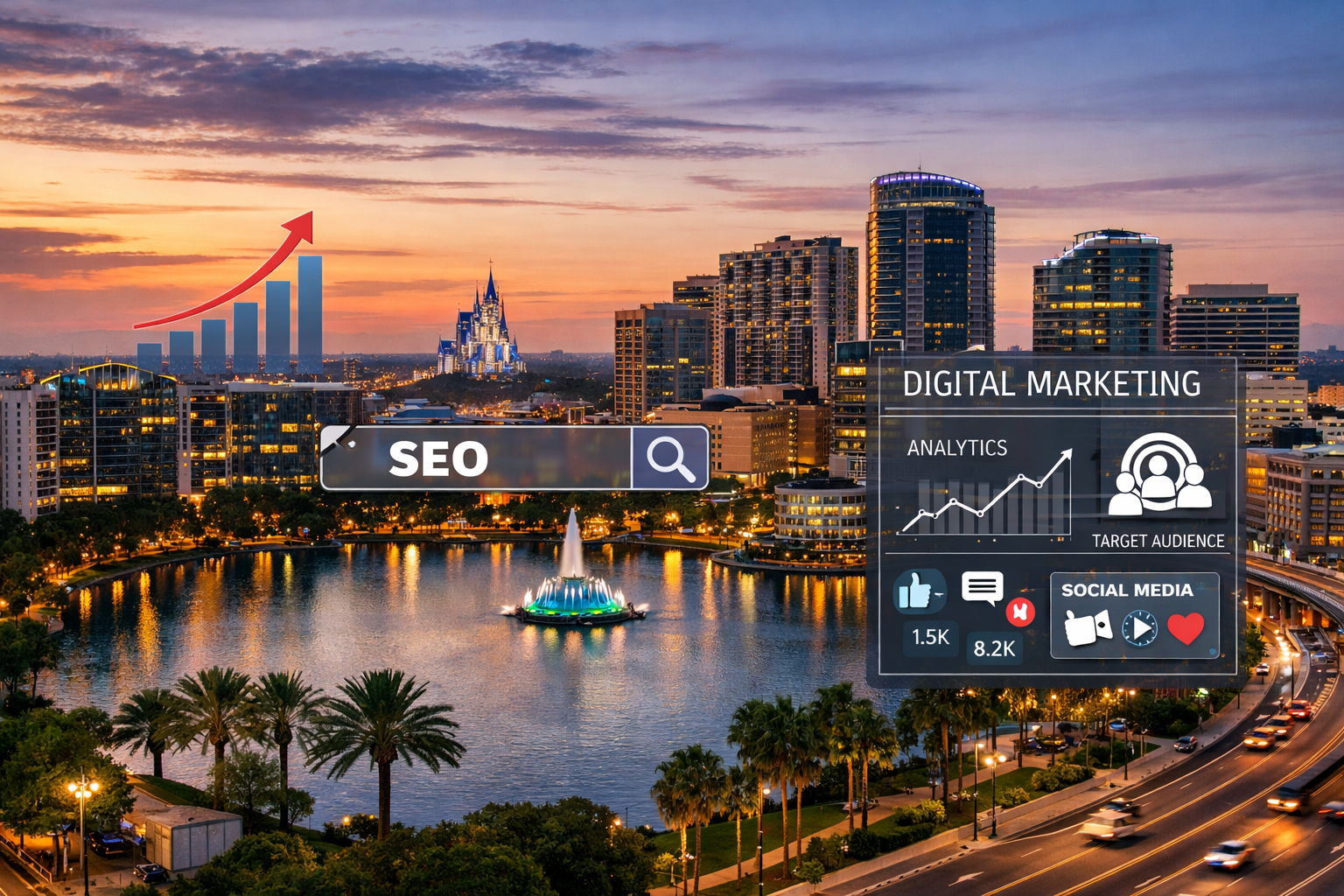
There's a number that every Orlando business owner should have in their head right now.
$233 billion.
That's the size of the Orlando regional economy as of 2024, according to the Orlando Economic Partnership — making it one of the largest regional economies in the entire country. And it didn't get there by accident. The Orlando region has now outpaced U.S. average economic growth for four consecutive years. Orlando Economic Partnership That's not a streak. That's a trend — and it's accelerating.
Here's the part that should make every established Orlando business sit up straight: all of that growth doesn't just create opportunity. It creates competition. More companies moving in. More talent relocating here. More money flowing into the market — and more sophisticated players showing up to compete for the same customers you've been serving for years.
The question for Orlando businesses in 2026 isn't whether the economy is growing. It clearly is. The question is whether your digital marketing is growing with it.
The Numbers Behind the Boom
To understand what's happening to the competitive landscape, you first have to understand the scale of what's happening to Orlando itself.
Orlando added 37,500 new jobs in 2024, with year-over-year employment growth revised to 2.5% — positioning the city at the top of national rankings with the highest job growth rate among the 30 most populous metro areas in the country. Orlando Economic Partnership Key growth sectors included healthcare, tourism, finance, and tech. Corporate expansions from firms like BNY Mellon, JPMorgan, and Charles Schwab have fueled particular strength in the region's finance sector, while a record-breaking 75 million visitors helped maintain momentum in tourism. Orlando Economic Partnership
On the population side, the story is equally striking. Between July 2023 and July 2024, the Orlando metro area added 76,000 new residents, bringing the total population to nearly 2.94 million — roughly 1,500 new residents per week, with nearly 65% of that growth driven by international migration. Orlando Economic Partnership
The Orlando MSA continued that growth into 2025, expanding 1.3% — outpacing Florida's overall rate of 0.8% and ranking as the sixth fastest-growing large metro in the nation. Within Florida, Orlando added almost three times as many new residents as Tampa, while Miami actually lost population. Orlando Economic Partnership
Looking ahead, the latest UCF forecast projects local employment growth of 1.3% in 2026 — above the statewide rate of 0.8% and the national rate of 0.5% — with a longer-term outlook confirming Orlando will be Florida's leading growth center over the next decade, adding more jobs than Miami (which has twice the population) and more than Tampa and Jacksonville combined. Orlando Economic Partnership
This is a city in full economic ascent. But here's what that ascent means for businesses that have been here for years: the market you've been operating in is fundamentally changing, and the competitive environment is intensifying at a pace that most established businesses haven't fully reckoned with.
What Growth Actually Means for Your Competition
There's a comfortable version of the Orlando growth story, and most business owners have heard it: more residents, more visitors, more potential customers. All of that is true. But there's a less comfortable side to the same story that doesn't get nearly as much attention.
Every company that relocates to Orlando brings its marketing budget with it. Every national chain that opens a new location here has already run the same market analysis you're relying on. Every venture-backed startup that plants a flag in Central Florida has a growth team whose entire job is digital customer acquisition.
Orlando's office vacancy rate of 15.3% sits well below the national average of 22.4%, and the market is seeing steady demand for high-quality, amenity-rich space Fortune — a direct reflection of the volume of companies actively choosing Orlando as their next home. For companies weighing a relocation decision, the numbers in emerging innovation hubs like Orlando tell a compelling story. Fortune The businesses making that move aren't coming here to be quiet.
WalletHub ranked Orlando the number one best large city in America to start a new business in 2025, based on 20 key factors including average growth rate per industry, current competition in the area, and investor access to funding. MOVING TO FLORIDA GUIDE That ranking doesn't just attract founders — it attracts well-funded, digitally sophisticated companies that know exactly how to compete online.
For an established Orlando business that has coasted on reputation, referrals, and a website that hasn't been updated since 2021, that's not good news. The competitive environment is becoming more crowded and more digitally mature at the same time.
The Digital Marketing Gap Is Widening
Here's where it gets specific.
Forty-six percent of Google's 8.5 billion daily searches have local intent — and only 64% of small businesses have a local SEO presence. Thelmbmarketinggroup That gap — between the volume of local intent searches and the percentage of businesses optimized to capture them — is where an enormous amount of revenue is quietly being left on the table.
Seventy-eight percent of local searches result in an offline purchase within 24 hours, and 72% of consumers who search for local information on smartphones visit a store within five miles. Thelmbmarketinggroup These aren't passive browsers. They're buyers with intent, searching for exactly what local businesses offer — and going to whoever shows up first.
In Orlando's market, you're competing with both established local businesses and national chains. Local search visibility isn't optional anymore. The businesses winning in local search results aren't necessarily spending the most on advertising — they're the ones who've mastered local SEO strategies that align with how customers actually search. AvantFlow
The stakes of that gap are compounded by Orlando's unique market dynamics. This isn't a typical mid-size city where you can rely on being known in your community. With the Orange County Convention Center hosting major events throughout the year, the flow of potential customers never slows — and neither does the competition. Thrive AgencyOrlando has a constant influx of new residents who don't know the established players yet, new businesses vying for their attention, and national competitors with sophisticated digital strategies already in play.
A business that hasn't invested seriously in its digital presence is functionally invisible to a significant portion of the market that would otherwise be theirs.
The AI Layer That's Changing the Rules
Just as the competitive environment was already intensifying, the underlying mechanics of how customers find businesses are shifting dramatically.
AI was the defining topic in Orlando's business landscape in 2025. Demand for AI skills in the region exploded in the last 18 months, with local monthly job postings seeking AI skills doubling in the last two years to more than 1,000 by late 2025. Orlando Economic Partnership That's a labor market signal — but it's also a signal about how businesses are thinking about operations, customer acquisition, and competitive differentiation.
From a digital marketing standpoint, the AI shift is fundamentally changing how search works. Google's AI Overviews — the AI-generated answer summaries that now appear above traditional search results — are pulling information from authoritative, well-structured sources. Businesses that have invested in consistent, high-quality content are being cited. Businesses that haven't are being skipped entirely, even if they would have ranked on the first page under the old model.
Top-performing agencies in 2026 are building content strategies around topical authority clusters — not individual keywords. AI Overviews pull answers from sites with the broadest, most consistent coverage of a topic. Agencies building structured FAQ content, long-form service pages, and blog ecosystems increase the probability of being cited in AI-generated answers. Agencies still running thin, keyword-stuffed pages are actively hurting their clients in the new landscape. 57clicks
This matters enormously for Orlando businesses, because the bar for what constitutes "good enough" digital marketing just got significantly higher — and it happened quickly. A business that invested in SEO five years ago and has been running on autopilot since may have already slipped out of the positions it worked hard to earn, without even realizing it.
The Specific Risks for Established Orlando Businesses
The businesses most at risk in this environment share a predictable profile. They've been operating in Orlando long enough to have built real brand recognition and a loyal client base. Their revenue has been stable, or growing modestly, without requiring aggressive digital investment. Their digital presence — website, Google Business Profile, social media — reflects where they were three or four years ago, not where the market is today.
For these businesses, the risk isn't immediate collapse. It's slow erosion. New competitors enter the market with modern digital infrastructure already in place. Customers who don't already know the business find competitors first in search. A new cohort of Orlando residents — that 1,500-per-week figure — forms their first impressions of the local market entirely online, and established businesses with weak digital presence simply aren't part of that picture.
Several specific vulnerabilities are worth naming directly.
An outdated or underperforming website. Eighty percent of people use Google Search, and 90% never look past the first page. Huskytaildigital A website that isn't technically optimized for modern search standards — fast loading, mobile-first, structured for AI discoverability — is invisible to the majority of people who would otherwise find it.
A neglected Google Business Profile. Customers are 2.7 times more likely to consider a business reputable if they find a complete Business Profile, and 70% more likely to visit. Thelmbmarketinggroup An incomplete or stale Google Business Profile is one of the highest-leverage problems a local business can fix — and one of the most commonly ignored.
No content strategy. In a market where AI-driven search is increasingly rewarding businesses that demonstrate consistent topical expertise, a business with no content presence is at a structural disadvantage against competitors who are publishing regularly. Hyper-local content — the kind that only a local business could create because it's specific to the community — is difficult for national competitors to replicate and positions local businesses as the obvious authority. AvantFlow This is one of the clearest remaining competitive advantages for established Orlando businesses, and most aren't using it.
Inconsistent or absent paid strategy. Organic search is essential, but in a competitive and growing market, paid search and social advertising fill the gaps that SEO alone can't cover. For most Orlando small businesses, a realistic combined budget for agency fees and ad spend ranges from $1,500 to $5,000 per month. 57clicks Businesses that treat digital advertising as optional are increasingly conceding high-intent searches to competitors who don't.
The New Residents Problem Nobody Talks About
There's one specific dynamic in Orlando's growth story that deserves its own section, because it has a direct and underappreciated impact on local business digital marketing.
Every week, 1,500 new people move to the Orlando region. Many of them are relocating from other states, bringing no existing loyalty to local businesses and no prior awareness of who the established players are in any given category. They form their first impressions of the local market entirely through their phones — Google searches, Instagram feeds, Google Maps reviews, and the digital presence (or absence) of local businesses.
Nearly 65% of Orlando's recent population growth has been driven by international migration Orlando Economic Partnership, adding another layer of complexity. These new residents may be searching in different languages, using different platforms, and responding to different kinds of digital content than the customer base that established Orlando businesses have historically served.
For a business with a strong digital presence — a well-optimized website, a complete and active Google Business Profile, a social media presence that reflects the brand accurately — every new resident who moves to Orlando is a potential new customer who will find them. For a business that's invisible online, that same wave of new residents is a missed opportunity that repeats itself week after week.
This is the most concrete version of the digital marketing gap: in a city adding 1,500 residents per week, the businesses that show up online are growing their addressable market automatically. The businesses that don't are watching it grow around them without being able to participate in it.
What Keeping Up Actually Looks Like
The good news is that "keeping up" with Orlando's growth doesn't require reinventing your entire business. It requires a clear-eyed assessment of where your digital presence stands relative to the competitive environment that now exists — and a commitment to treating digital infrastructure as the business asset it actually is.
That means a website that reflects current technical standards, is optimized for mobile, loads quickly, and is structured for both traditional and AI-driven search. It means a Google Business Profile that's complete, accurate, regularly updated, and actively collecting and responding to reviews. It means a content strategy — even a modest one — that demonstrates consistent expertise and gives search engines a reason to surface your business over competitors who are quieter. It means paid advertising that fills the gaps organic search can't cover and ensures your business is visible to high-intent buyers at the moment they're looking.
None of this is optional anymore in a market the size and growth trajectory of Orlando's. The businesses that have been coasting on legacy reputation are increasingly running a risk they may not see clearly until it's already cost them meaningfully.
The Orlando 2045 Regional Vision is building toward a global creative capital and top-10 innovation hub, anchoring future growth in innovative industries. Orlando Economic Partnership The city is explicitly positioning itself for a more sophisticated, more competitive, more digitally native business environment over the next two decades. The businesses that will win in that environment are the ones making that investment now.
Orlando's economy is $233 billion and growing. The question is whether your digital marketing is positioned to grow with it — or whether you're leaving your share of that growth to competitors who are.
At Ritner Digital, we help Orlando businesses build digital marketing strategies that are built for the market as it is today — not as it was five years ago. If you're ready to stop coasting and start competing, let's talk.
Frequently Asked Questions
Is Orlando's economic growth actually relevant to my digital marketing strategy, or is this just a feel-good local story?
It's directly relevant, and here's why. Economic growth in a metro area doesn't happen in a vacuum — it brings new residents, new businesses, new corporate relocations, and new capital, all of which intensify competition for the same customers you're already trying to reach. When Orlando adds 1,500 residents per week and attracts nationally recognized companies with sophisticated marketing teams, the competitive environment for every local business shifts. If your digital marketing strategy hasn't been updated to reflect the market as it exists today, you're competing with 2021 tools in a 2026 landscape. The economic story isn't feel-good context — it's the reason the urgency is real.
My business has been in Orlando for years and we're doing fine. Why should I be worried?
Established businesses are actually the most at risk in a fast-growing market, precisely because they tend to underestimate the threat. When you've built a loyal customer base and a reliable referral network, it's easy to interpret stable revenue as a signal that nothing needs to change. But what stable revenue doesn't show you is the new customers you're not reaching — the 1,500 people moving to Orlando every week who have no prior knowledge of your business and are forming their first impressions of the local market entirely through search and social. Loyalty from existing customers is an asset. But in a city growing this fast, the businesses that aren't investing in digital visibility are systematically excluded from a large and expanding portion of the addressable market.
What specific parts of digital marketing should Orlando businesses prioritize first?
The priority order for most established Orlando businesses is this: start with the foundation, then build out. The foundation means a technically sound, mobile-optimized website and a complete, actively managed Google Business Profile — because these two assets affect every person who searches for your business or discovers you through local search. Without both of these in good shape, everything else you invest in digital marketing is working at a disadvantage. From there, a consistent content strategy and a targeted paid advertising approach are the next layers. Local SEO — the optimization that helps you show up when people in your area are searching for what you offer — sits across all of these and should be treated as an ongoing discipline rather than a one-time project.
How does the influx of new residents specifically affect local SEO?
New residents are what SEO experts call zero-awareness customers — they have no prior loyalty to any local business, no word-of-mouth context, and no existing relationship with the established players in your category. Their entire discovery process happens online. When they search for a dentist, an HVAC company, a restaurant, an accountant, or any other local service, the businesses that show up are the ones they consider. The businesses that don't show up simply don't exist in their mental map of the local market. In a city adding tens of thousands of new residents every year, that dynamic compounds significantly. Strong local SEO means your business is automatically included in every new resident's discovery process. Weak local SEO means you're invisible to them — potentially for the entire duration of their time in Orlando.
How does AI-powered search change what Orlando businesses need to do differently?
The shift to AI-driven search — particularly Google's AI Overviews — changes the underlying logic of how search visibility works. The old model rewarded businesses that optimized individual keywords well. The new model rewards businesses that demonstrate broad, consistent expertise across a topic area. AI Overviews pull answers from sources that have established topical authority — meaning they've published enough relevant, well-structured content over time that Google treats them as a credible reference. For Orlando businesses, this means a thin website with a few service pages is increasingly insufficient. Businesses that publish consistent, locally relevant content — answering the real questions their customers are asking, in depth — are far more likely to be surfaced in AI-generated results than those that don't. The good news is that most local competitors haven't made this shift yet, which means businesses that start now still have a meaningful first-mover advantage.
How much should an Orlando business realistically budget for digital marketing in 2026?
Budget varies by industry, competitive intensity, and the current state of your digital presence, but there are reasonable benchmarks. For most established Orlando small to mid-size businesses, a combined monthly investment in agency fees and paid advertising in the range of $2,500 to $6,000 per month represents a serious, competitive posture. Businesses investing less than that are often underfunding relative to what the market now requires to maintain meaningful visibility. The more useful framing, though, is return rather than cost — a business generating $50,000 per month in revenue that invests $3,000 per month in digital marketing is spending 6% of revenue to protect and grow its customer base, which is well within the range most financial advisors would consider prudent for marketing overall. The real risk isn't overspending on digital marketing — it's underspending while competitors don't.
What's the difference between what worked in digital marketing five years ago in Orlando versus what works now?
Five years ago, the bar for competitive digital marketing in Orlando was meaningfully lower. A reasonably well-optimized website, a Google Business Profile with decent reviews, and some basic local keyword targeting was enough to maintain solid visibility in most categories. That's no longer true. The competitive set has grown significantly as more businesses have relocated here and more established businesses have increased their digital investment. AI-driven search has raised the bar for content quality and topical depth. Mobile-first indexing and page experience signals have made technical website quality a more critical ranking factor. And the sheer volume of local intent searches — driven by Orlando's growing population — has made the stakes of ranking well versus ranking poorly much higher. The businesses that built a digital presence in 2019 and haven't updated it since are operating on infrastructure that predates most of the changes that now determine who wins in local search.
Does this apply to B2B businesses in Orlando, or mainly consumer-facing companies?
It applies equally to both, though the mechanisms work somewhat differently. For consumer-facing businesses, the dynamic is primarily about local search visibility and discovery — being found when someone in Orlando searches for what you offer. For B2B businesses, the dynamic is more about credibility and authority — when a potential client researches your company before a meeting, before signing a contract, or before referring you to a colleague, what they find online either reinforces or undermines their confidence. In a market growing as fast as Orlando's, B2B businesses face the additional challenge of competing for attention from a buyer pool that now includes decision-makers at newly relocated companies who have no prior awareness of any local vendors. In both cases, the businesses with a stronger, more current digital presence are systematically advantaged over those without one.