Local SEO for Banks: How to Dominate "Near Me" Searches in Every Branch Market
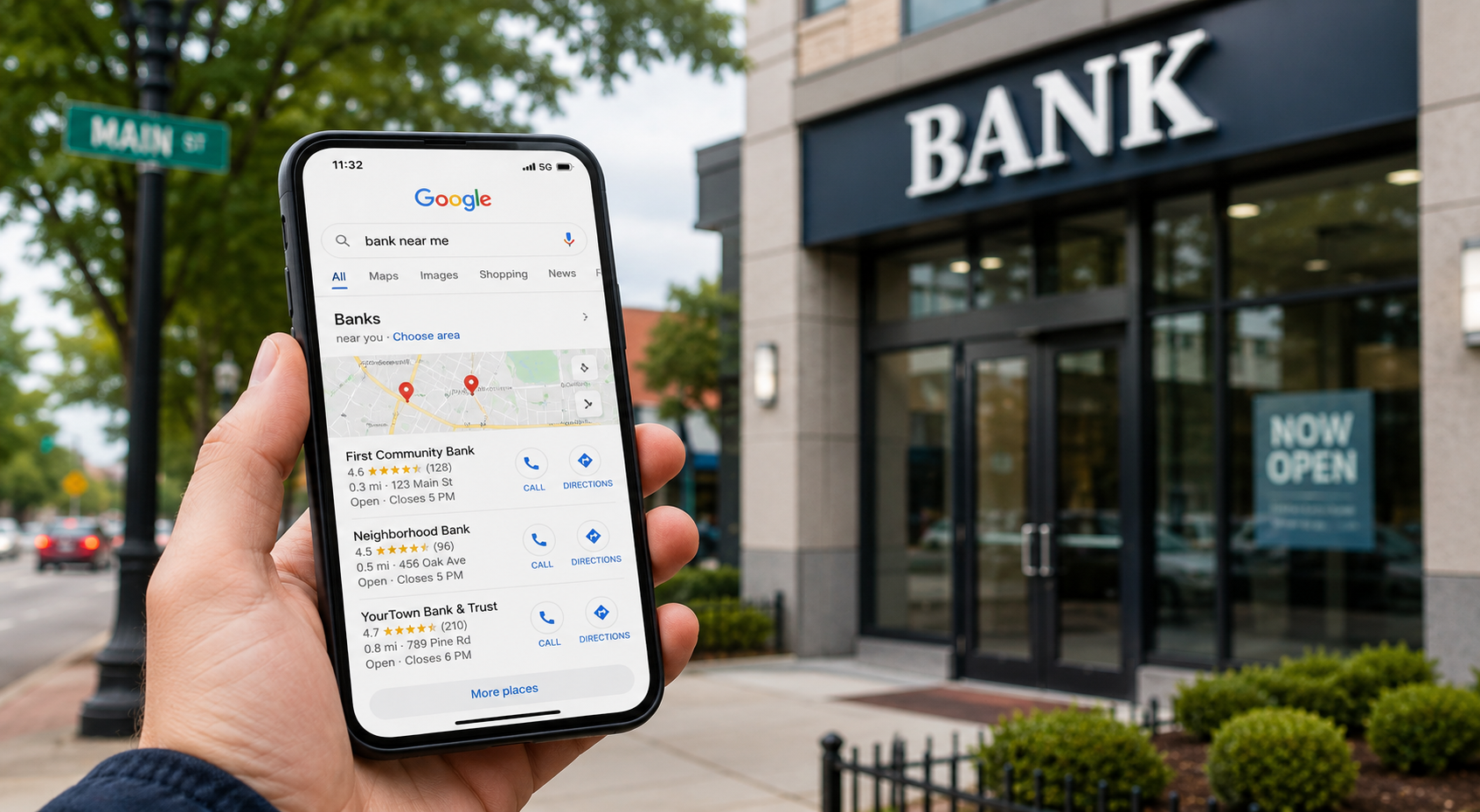
"Bank near me" gets roughly 71,000 searches a month, and about 90 percent of them come from a phone. Picture the moment behind that number: someone just moved to town, graduated, started a business, or walked away from a bad experience at another bank. They're standing on a sidewalk or sitting in a parking lot, and they want a branch they can walk into today. They pull out their phone, type three words, and tap one of the three listings Google shows them on a map.
That little three-listing box — the local pack, or "3-pack" — is the most valuable real estate in banking, and it has almost nothing to do with the size of your marketing budget. The bank that appears there captures the majority of the clicks. The banks that don't watch those customers walk into a competitor's branch instead. This guide is about how to win that box in every market you serve, not just your headquarters city.
Why "near me" is the battlefield where banks actually win
Despite a decade of digital-banking growth, physical branches still decide the highest-stakes financial moments. Around 65 percent of consumers still want a local branch they can visit, and the moments that drive someone to search — opening a checking or savings account, applying for a mortgage, setting up business banking, resolving a complex problem — are exactly the ones where people want to sit across from a human being. Roughly 80 percent of consumers check a bank's website before visiting in person, and an estimated 71 percent of financial decisions now begin with online research. The branch visit hasn't disappeared; the path to it just runs through search first.
Here's why that matters strategically: the local pack runs on a different algorithm than the one ranking the rest of Google. It weighs three things — relevance (does this branch match what was searched), proximity (how close is it), and prominence (reputation and review strength). None of those three is "marketing budget." A national bank can spend millions on television and still lose a neighborhood search to a well-optimized local branch, because local search rewards signals money can't simply buy. As multiple 2026 analyses put it, a bank or credit union with a handful of branches but fully optimized profiles, an active review strategy, localized content, and consistent listings can outrank a national chain in the local pack.
The multi-branch problem most banks get wrong
If you operate more than one branch, you face a challenge a single-location business doesn't: you have to win "near me" in every market simultaneously. This is where most banks leak the most value, and the failure is usually structural rather than strategic.
The single most common mistake is using one page to list all branches, or a dynamic map widget, instead of giving each location its own page. That approach forfeits a major local SEO opportunity, because every physical branch is a distinct asset that can rank for searches in its own city, county, and town. Think of local SEO as a branch-level performance layer inside your brand: a national or regional bank needs visibility saturation across every market it serves, with each branch discoverable and competitive in its specific geography. Without intentional management, branches in smaller or secondary markets quietly develop visibility gaps — the brand is strong nationally but invisible locally, eroding acquisition exactly where you have a physical presence.
There's a compounding risk at scale, too. Inconsistent name-address-phone data, incomplete listings, and unmanaged reviews across dozens or hundreds of branches don't just hurt individual locations — they dilute your entire system's authority and confuse both search engines and customers. Footprint integrity is its own ranking factor once you're past a few branches.
So the work below has to be done per branch, treated as an operating system rather than a one-time project. Here's the playbook.
Pillar 1: A fully optimized Google Business Profile for every branch
Your Google Business Profile is the single most important asset for local visibility — it controls your map pack ranking and the information customers see first. It's not a directory listing; it's your digital branch lobby.
Claim and fully optimize a profile for each location, never just headquarters. Each needs a correct and consistent name, address, and phone; accurate hours including holidays; the right primary category (Bank or Credit Union) plus relevant secondary categories; a thorough description that naturally incorporates services and local language; and a complete services list. Then go past the basics most banks stop at. Use local branch phone numbers rather than centralized 800 numbers, since local numbers reinforce geographic relevance. Add high-quality, regularly updated photos of the exterior, interior, ATMs, and staff — branches with strong photos see significantly more engagement. And use GBP posts to highlight promotions, new services, and community events, an underused tool that keeps each profile active and locally relevant. Profile signals tend to start moving within 14 to 30 days, making this the fastest lever you have.
Pillar 2: A unique, genuinely local page for every branch
Each branch needs its own landing page on your main website — never a separate domain, which fragments your authority. The fatal error is the copy-paste page where only the city name changes; duplicated location pages do nothing for rankings.
Make each page unmistakably local in ways a national template can't replicate. Mention nearby landmarks, name the branch manager, and reference community events the branch sponsors. Embed a Google Map for directions. Use "[service] in [city]" phrasing naturally in headers and copy. A high-impact tactic: interview one staff member per branch and turn it into a "Meet Our Team" spotlight with a photo, which gives Google fresh, original content tied to that specific local entity. Where it fits, create dedicated product-by-market pages too — "VA Loans in [City]," "First-Time Homebuyer Programs in [County]" — and add a mortgage calculator to branch pages to increase time on page and demonstrate expertise. Aim for genuinely helpful, original content rather than thin filler; one institution's localized content-authority strategy drove a 340 percent organic traffic increase in three months.
Pillar 3: Reviews — the prominence engine
Review quantity, recency, and your response rate all feed local pack rankings directly, and reviews do double duty by building trust before a customer ever clicks: 87 percent of consumers use Google to evaluate local businesses and 76 percent read reviews before deciding. For banks, much of your local market is pre-screening you on your profile before they'd ever respond to an ad.
The system to build: ask, don't wait, because most happy customers won't review you unprompted — train tellers and service reps to ask after a positive interaction. Make it frictionless with QR codes on receipts or flyers linking straight to your review form. And respond fast, ideally acknowledging every review within 48 hours, since engagement itself is a signal. When reviews mention specific products — a good mortgage or auto loan experience — that keyword-rich language reinforces your relevance for those exact searches. Importantly, review velocity often matters more than your absolute star rating, so a steady flow of recent reviews beats a high average that's gone stale.
Pillar 4: The technical signals — NAP, schema, and mobile
Two technical fundamentals quietly determine whether the work above pays off. First, NAP consistency: your name, address, and phone must match across your site, your profiles, and every directory citation. Inconsistency suppresses local rankings and, at scale, dilutes system-wide authority — so run a citation audit to find and fix duplicates and errors across your branches.
Second, schema markup, which tells search engines and AI systems exactly what to display. Implement LocalBusiness (or Bank/CreditUnion) schema on your homepage and every branch page, with address, hours, phone, geo-coordinates, and services. Add FinancialProduct schema with accurate rates and terms on product pages, and FAQPage schema on educational content. Underpinning all of it, your site has to be fast and mobile-first — with 90 percent of "near me" banking searches happening on phones, a slow or clunky mobile experience loses customers before they reach the branch. All of this operates under YMYL rules, so accuracy, current rates, and proper disclaimers are non-negotiable.
Pillar 5: Extend "near me" into AI answers
"Near me" is no longer only a Google Maps behavior. Customers increasingly ask conversational engines — "what's the best bank near me?" or "which banks offer first-time homebuyer programs in [city]?" — and the answer is shaped by many of the same local signals: listing strength and consistency, review quality and recency, citation presence across authoritative directories, and the content on your location pages. That overlap means the five pillars above are already building your AI visibility.
Two cautions, though. AI visibility is harder to earn than traditional local rankings, so it warrants dedicated attention rather than being treated as a free side effect. And AI recommendation lists rarely repeat identically, so consistency and breadth of presence matter more than any single optimization. Structure your branch FAQs as concise, answer-first content; keep your facts consistent across the web so engines don't default to third-party aggregators; and test it directly by asking ChatGPT and Google's AI Overviews about banks in your markets to see whether you're named. Where you're absent is where your biggest near-term opportunity sits.
Measure branch visits, not just rankings
Rankings and traffic are directional indicators, not the goal. What matters is account openings, loan applications, and branch visits. Connect organic search to those outcomes: track which keywords and pages drive form submissions, measure how organic converts versus other channels, and tie each branch's local visibility to its actual new-customer numbers. The framing that wins budget isn't "impressions up 30 percent" — it's "local search produced X account openings and $X in deposits at these branches."
That connection is also the honest case for the channel. Paid ads stop producing the moment the budget stops; local SEO builds equity that compounds for years, with a steady-state cost per lead approaching zero. The banks that consistently win share the same habits: fully optimized branch-level profiles, regularly published local content, fast review responses, and fast mobile sites with real branch pages — repeated across every market, treated as an ongoing discipline tied to branch KPIs.
The bottom line
Dominating "near me" isn't about outspending the national banks. It's about out-executing them in every individual market — claiming each branch's profile, building genuinely local pages, generating fresh reviews, fixing the technical signals, and extending all of it into AI answers. Do that across your footprint and you turn each branch into its own local winner, capturing high-intent customers at the exact moment they're ready to walk in. Leave it undone and a competitor down the street takes that account, that mortgage, that business relationship instead.
Want to know how your branches rank for "near me" in every market you serve? Ritner Digital builds the branch-level local and AI search visibility that puts banks in the map pack — and in AI answers — across their entire footprint. We'll audit where each location stands and show you the gaps costing you walk-ins. Book a free strategy call → and get clear next steps within one business day.
Sources: AJ Creative Studios (2026 local SEO for banks guide); Bank Marketing Strategies; SEOProfy; Matchbox Design Group; Lengreo (SEO for Banks 2026); BankBound; Digispot AI; Local Falcon; Media Search Group; BNTouch (local SEO benchmarks & timelines); BrightLocal 2024 consumer survey; ABA Banking Journal 2026 marketing trends.
Frequently Asked Questions
What is the local pack (or 3-pack) and why does it matter for banks?
The local pack is the box of three business listings with a map that Google shows at the top of local search results — for queries like "bank near me" or "credit union in [city]." It matters because it sits above the regular organic results and captures the majority of clicks for local searches. Since "bank near me" alone draws roughly 71,000 searches a month with about 90 percent on mobile, the banks that appear in the 3-pack capture high-intent customers at the exact moment they're ready to open an account or visit a branch. If you're not there, those customers are walking into a competitor's branch instead.
How do I do local SEO for a bank with many branches?
Treat every branch as its own micro-market, not your whole institution as one entity. Each location needs its own claimed and optimized Google Business Profile, its own unique landing page on your main website (never a separate domain), and its own review-generation effort. The most common mistake is listing all branches on one page or a single map widget, which forfeits the chance to rank in each individual market. At scale, footprint integrity also matters: inconsistent NAP data and unmanaged reviews across dozens of branches dilute your entire system's authority, so consistency is its own ranking factor.
How long does local SEO take to work for a bank?
Google Business Profile signals often start moving within 14 to 30 days, making profiles your fastest lever. First appearances in the 3-pack for lower-competition queries typically take 60 to 90 days, and compounding lead growth builds over roughly 120 to 180 days. Competitive metro markets sit at the longer end. The tradeoff is durability: unlike paid ads that stop producing the moment the budget ends, local SEO compounds for years, with a steady-state cost per lead approaching zero.
Can a community bank really outrank Chase or Bank of America locally?
In local search, yes. The local pack rewards relevance, proximity, and prominence rather than raw marketing budget or national domain authority. A national bank can spend millions on advertising and still lose a neighborhood search to a well-optimized local branch with complete profiles, fresh reviews, and genuinely local content. National banks are often weak at the hyperlocal level — generic branch pages, centralized 800 numbers, no community-specific content — which is exactly the gap a focused community bank can exploit in its own market.
Do I need a website, or is a Google Business Profile enough?
You need both. A Google Business Profile alone can rank for "bank near me" queries, but a website with unique branch pages, LocalBusiness and FinancialProduct schema, and genuinely local content is what converts the searcher into a customer and compounds over time. The profile gets you found; the branch page closes the loop with directions, services, staff, and a clear path to apply or visit. Together they cover both the discovery moment and the conversion.
How should I measure local SEO success for my branches?
Look past rankings and traffic, which are directional indicators rather than the goal, and tie local visibility to business outcomes: account openings, loan applications, and branch visits per location. Track which keywords and pages drive form submissions, measure how organic traffic converts versus other channels, and connect each branch's local visibility to its actual new-customer numbers. The framing that earns budget isn't "impressions up 30 percent" — it's "local search produced this many account openings and this much in new deposits at these branches."