The "Pour Gasoline on It" Mentality: Marketing Lessons from Vayner, Serhant, and the Operators Who Mastered Attention
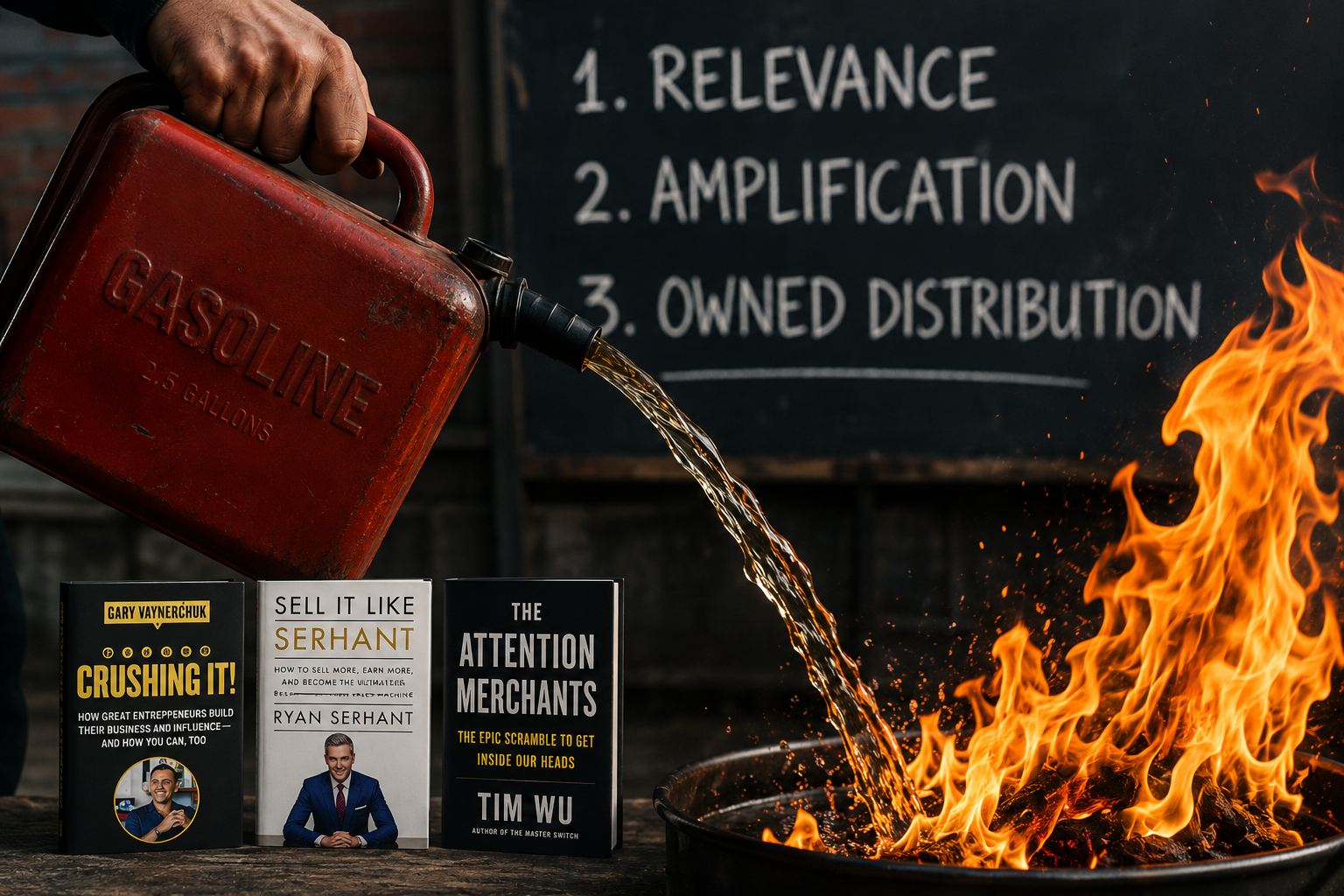
There's a rare breed of operator who doesn't see marketing as a budget line. They see it as a fire — and their genius is knowing exactly where to pour the gasoline. Find something already catching, a creator, a piece of content, a format that's working, and feed it until it explodes. Dave Portnoy built Barstool this way. Gary Vaynerchuk turned VaynerMedia into a sprawling holding company this way. Ryan Serhant turned a single real estate license into the most-followed brand in his industry this way. The phrase Barstool's former CEO used for it — find great talent and "pour gasoline on them to make their brand explode" — is the closest thing the modern attention economy has to a mission statement.
And here's the exciting part for anyone serious about SEO and AI search in 2026: these operators cracked the attention game years before the search world caught up. The exact principles that made them legends — relevance over reach, volume over polish, owning your distribution, amplifying what's already proven — are now, almost word for word, the principles that decide whether Google ranks you and whether ChatGPT cites you. They wrote the playbook before the rest of us knew there was a game. Let's learn from the masters.
Lesson 1: Relevance is the new scale — and the masters saw it first
Vaynerchuk has been years ahead of the curve, and his 2026 message is razor-sharp. Speaking at NRF's Big Show, he declared the old way dead: the era of trusting your gut "like you're Don Draper in 1965" is over, replaced by a smarter model where you create at scale, let real consumer data reveal what works, and then put money behind the winners. His best line cuts deep: for 70 to 80 years, advertising "used working media dollars to hide bad creative." Those days are gone, and he saw it coming.
What makes him brilliant is that he named the mechanism precisely: "the AI algorithms as written are based on relevance." Followers don't win anymore — the relevance of the individual post does. That's exactly how modern search and AI retrieval work. Google rewards relevance and intent-match over raw brand size. AI engines pull from whichever content most clearly answers the specific question, not from whoever's biggest. Vaynerchuk's "macro to micro" shift — high-volume, specific content for narrow audiences — is the same move from broad keywords to precise, long-tail, intent-matched content that wins SEO and AI citations alike. He didn't just predict the attention economy; he described the search economy before it arrived.
The takeaway: Stop chasing one giant keyword you'll never own. Produce a high volume of specific, genuinely useful content that answers real questions. That's what ranks, and that's what AI extracts.
Lesson 2: Amplify what's proven — the sequencing genius
The masterstroke in the gasoline mentality is the sequence: prove first, amplify second. Vaynerchuk insists media dollars should "only amplify and scale good creative," where good means it actually earned views — not boardroom approval. Let the audience vote before you spend. It's such a disciplined, almost scientific approach to something most brands do on pure faith.
And it maps perfectly to search. The smartest SEO move available is also the most ignored: publish, watch which pages quietly overperform in Search Console, then pour everything — internal links, updates, backlinks, expansion — onto the proven winners. The same compounding logic rules AI search, where models keep returning to sources that already performed well. You're not guessing where to build; you're letting the data show you where the fire already burns, then feeding it relentlessly. That's the operator's edge applied to your content library.
The takeaway: Find the pages already overperforming relative to their effort. Those are your gasoline candidates. Expand them into dominant topic clusters and watch them compound.
Lesson 3: Own your distribution — the lesson they all live by
Every one of these greats is obsessed with owning the pipe, never renting it. Portnoy fought ferociously for the Call Her Daddy IP and bought all of Barstool back for a single dollar to reclaim total control. Serhant, on stage at SXSW London in 2026, delivered the principle perfectly: "It used to be that content was king. Today, habit is kingdom" — controlling distribution matters more than producing content, which is why he built a community for lifetime value instead of chasing one-off views. That's a man who understands leverage.
This is the entire case for SEO and owned content over rented ads, and the data is overwhelming. Paid traffic dies the instant the budget does; organic visibility compounds for years. AI takes it even further: Yext research found 88% of AI citations on financial-services queries come from brand-owned or brand-managed sources. The single biggest lever in whether AI recommends you is content you own and control. The masters never rent their audience from an algorithm they can't influence — they build an owned asset the algorithm has no choice but to reckon with.
The takeaway: Treat your website and content library as the compounding asset. Paid is gasoline you pour on top — but the fire must be something you own, because that's what Google's index and AI's citation engines actually draw from.
Lesson 4: Consistency and volume — the discipline behind the magic
What looks like effortless virality is actually relentless discipline. Serhant runs a "content matrix" — a simple grid crossing what the content gives the audience (entertain, educate, encourage) with which side of his personality delivers it — engineered to produce fresh, on-brand content consistently. His own mantra says it all: "Content is Consistency, Really." Vaynerchuk's machine runs on "document, don't create," capturing constantly and repurposing one idea across every platform, tuned to each. It's a content factory built on volume and reps.
Search rewards that exact discipline. Google favors fresh, regularly updated content — one analysis found content updated within 30 days earns 3.2x more AI citations than stale content. A consistent cadence builds the topical authority that signals expertise to both Google's standards and AI retrieval. The brand publishing one genuinely useful piece a week for a year crushes the one that perfected a single pillar page and walked away. The masters proved that volume, done with relevance, is how you build the surface area to get found everywhere.
The takeaway: Build a repeatable content system, not a one-off campaign. A steady cadence of useful content, repurposed across formats, compounds into authority that ranks and gets cited.
Lesson 5: The human element — the moat no competitor can copy
Beneath all the scale, every one of these operators wins on something beautifully un-automatable: a real human at the center. Vaynerchuk's whole mission is to be "the poster child of the person who built the biggest, baddest empire and did it by being a good dude." Serhant teaches that your brand is "how people perceive you when you're not in the room," built through storytelling, transparency, and personality. Portnoy made his own authentic life the product. They understood that people connect to people, and they leaned all the way in.
In 2026, that instinct is also a hard ranking advantage. Google's E-E-A-T framework — Experience, Expertise, Authoritativeness, Trustworthiness — rewards real author credentials, demonstrated experience, and genuine authority. AI systems weight entity recognition, brand authority, and third-party mentions when choosing whom to cite. The "real person people care about" these masters cultivate is, in search terms, a strong, recognizable entity with authentic authority — exactly what Google and AI are built to surface. Serhant's third branding phase is literally an SEO strategy: "shout it from the mountaintop through third-party validation — thought leadership, press coverage, community involvement." That's digital PR and link building, delivered with a motivational grin.
The takeaway: Put real, credentialed humans at the center of everything. Author bios, genuine expertise, a real point of view, and earned third-party coverage are the E-E-A-T and entity-authority signals that decide rankings and citations.
The thread that ties it all together
Strip away the personalities and the masters run one beautiful playbook: create relevant content at volume, let real data reveal what's catching, pour resources onto the proven winners, own the distribution so the gains compound, and keep a real human at the center so the whole thing can't be faked. That is — almost exactly — the winning formula for SEO and AI search in 2026. The convergence is stunning once you see it: the attention economy and the search economy now run on the same rules, because the same relevance-driven algorithms govern both.
These operators didn't have a secret. They had a sequence and the discipline to run it harder than anyone else. The brands that dominate search and AI visibility over the next few years will be the ones who realize the fire-and-gasoline mentality was never just about social — it's about how attention itself now works, everywhere a machine decides who gets seen. The masters lit the way. The smart move is to follow it.
Want to build search and AI visibility that compounds like theirs? Ritner Digital runs exactly this playbook — relevant content at volume, the authority signals AI engines trust, and owned distribution that ranks and gets cited across Google, ChatGPT, Perplexity, and Gemini. We find what's already working for your brand and pour gasoline on it. Book a free strategy call → and get clear next steps within one business day.
Sources: VaynerMedia (Gary Vaynerchuk 2026 marketing strategy); NRF Big Show 2026 (Vaynerchuk keynote); Retail TouchPoints; Performance Marketing World; Wild Mail (GaryVee funnel analysis); LBBOnline (SXSW London 2026, Serhant & Hegarty); BAM (Serhant content matrix); Young and Profiting podcast; Brand It Like Serhant; Yext (AI citation research).
Frequently Asked Questions
What does the "pour gasoline on it" marketing mentality actually mean?
It's an amplification-first approach: rather than spreading budget evenly and hoping, you find something already working — a creator, a piece of content, a format catching attention — and pour resources onto it to make it explode. The phrase comes from Barstool's model of finding great talent and "pouring gasoline on them." Operators like Gary Vaynerchuk and Ryan Serhant run the same play: prove what works with real audience data first, then concentrate amplification on the proven winners instead of betting on unproven ideas.
How do Gary Vaynerchuk's marketing ideas apply to SEO and AI search?
Almost directly. Vaynerchuk argues that "relevance is the new scale" and that modern algorithms reward the relevance of individual content over follower count or brand size — which is exactly how Google and AI engines like ChatGPT now decide what to rank and cite. His shift from broad "macro" marketing to specific "micro" content maps onto the SEO move from broad keywords to precise, intent-matched, long-tail content. And his rule that media dollars should only amplify proven creative is the same logic as identifying your overperforming pages and pouring resources onto them.
What can Ryan Serhant teach about content strategy for search?
Three things. His "content matrix" — a grid for producing fresh, on-brand content consistently — models the steady publishing cadence that builds topical authority for SEO and AI citation. His principle that "habit is kingdom" and that controlling distribution beats producing content is the case for owned content over rented paid reach. And his third branding phase, "shout it from the mountaintop through third-party validation," is essentially digital PR and link building — the earned coverage that creates the authority and entity signals Google and AI systems reward.
Why is owning your distribution important for AI search visibility?
Because rented reach disappears and owned assets compound. Paid traffic stops the moment your budget does, while organic visibility builds for years. In AI search specifically, Yext research found 88% of AI citations on financial-services queries come from brand-owned or brand-managed sources — meaning the single biggest lever in whether AI recommends you is content you own and control. The gasoline operators never rent their audience from an algorithm they can't influence; they build owned assets the algorithm has to draw from.
Does consistency really matter more than perfect content?
For both attention and search, yes. The operators win on volume and reps, not occasional perfection — Vaynerchuk's "document, don't create" and Serhant's "content is consistency" both prioritize a steady cadence. Search rewards the same discipline: Google favors fresh content, content updated within 30 days earns roughly 3.2x more AI citations than stale content, and a consistent publishing rhythm builds the topical authority that signals expertise. One genuinely useful piece a week for a year beats one perfected pillar page you never touch again.
How does the "human element" affect rankings and AI citations?
The real-person authenticity these operators cultivate is, in search terms, a strong, recognizable entity with genuine authority signals — exactly what algorithms surface. Google's E-E-A-T framework (Experience, Expertise, Authoritativeness, Trustworthiness) rewards real author credentials and demonstrated expertise, and AI systems weight entity recognition, brand authority, and third-party mentions when deciding whom to cite. Putting credentialed humans, genuine point of view, and earned third-party coverage at the center of your content isn't soft branding — it's a hard ranking and citation advantage.