
We received a political mailer in Gloucester County, New Jersey, that looked more like an emergency warning than a conventional campaign advertisement. As marketing professionals, we wanted to examine what the design is doing, how its claims are presented, and why negative advertising deserves a closer look.
There's something interesting about receiving political advertising in the mail.
Unlike a social media advertisement, you can't scroll past it before it arrives.
Unlike a television commercial, you can't change the channel.
It shows up at your house, carrying a message someone has paid to put directly in front of you.
And sometimes, that message is designed to be impossible to ignore.
Recently, we received a political campaign mailer in Gloucester County, New Jersey, with two enormous words across the front:
FRAUD ALERT.
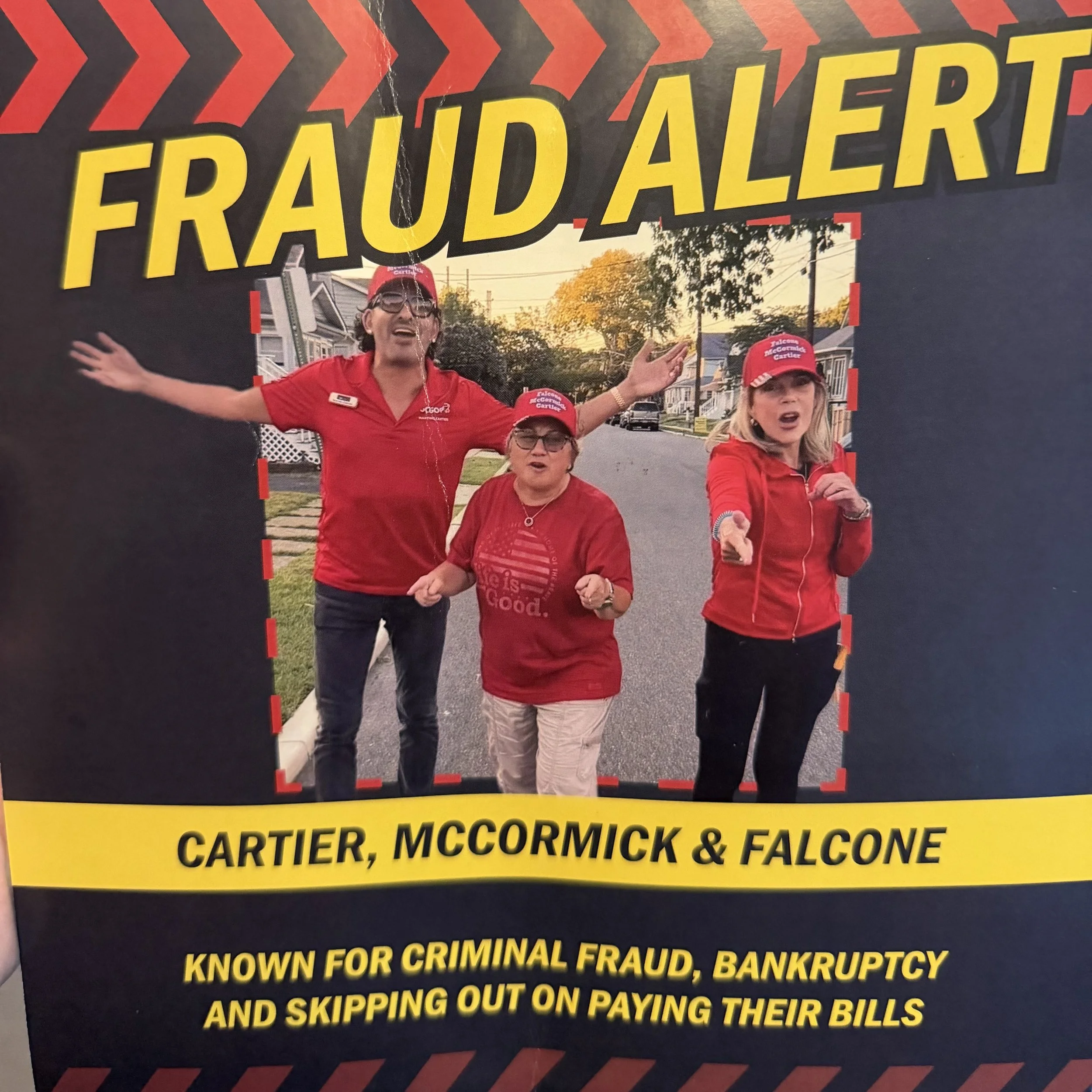
Front cover
Gloucester County political campaign mailer with a large yellow Fraud Alert headline and photographs of three candidates.
Not particularly subtle.
The oversized yellow lettering sits against a dark background, surrounded by bright red warning graphics. Beneath it are photographs of three local political candidates: Martino Cartier, Barbara McCormick, and Katherine Falcone.
The mailer goes on to make serious allegations involving financial conduct, bankruptcy, tax payments, lawsuits, and an insurance-fraud-related case.
On the reverse, the language becomes even more aggressive, using terms such as “con,” “irresponsible,” “extreme,” and “expensive.”
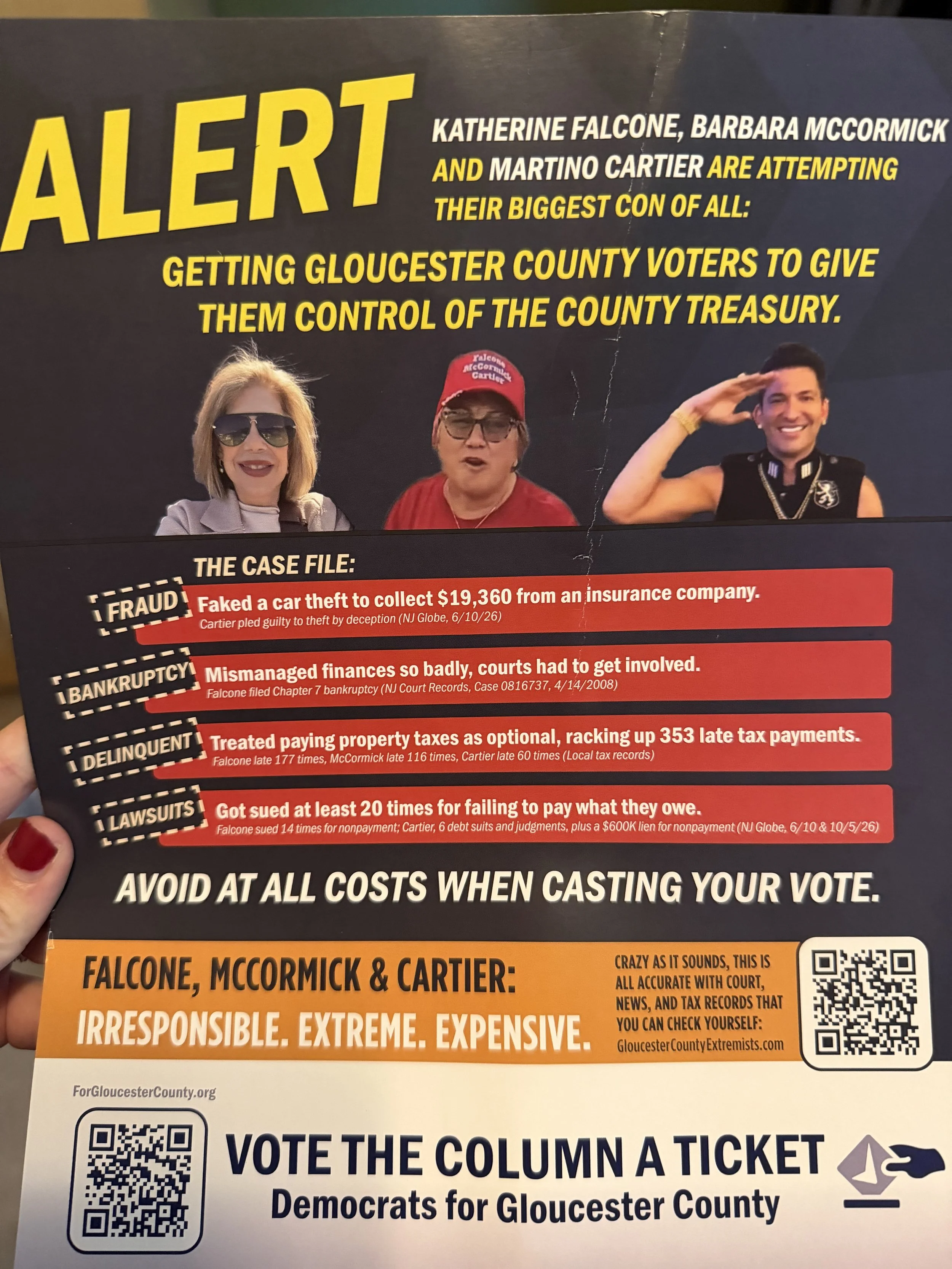
Interior
Reverse of Gloucester County political mailer showing accusations, source references, QR codes, and a campaign message.
It also includes QR codes directing recipients toward campaign-related websites.
And tucked into the mailing is an important disclosure identifying who paid for it: the New Jersey Democratic State Committee.
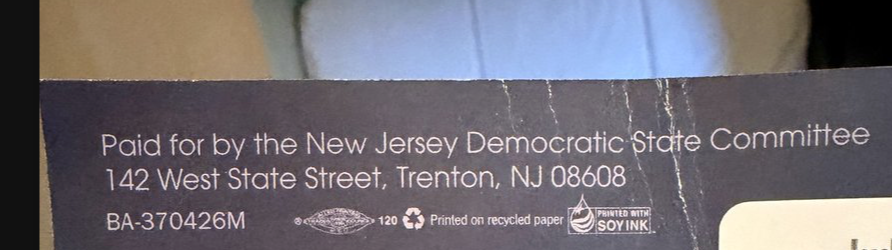
Disclosure
Political mailer disclosure identifying the New Jersey Democratic State Committee as the paying organization.
As someone who works in digital marketing, my immediate reaction wasn't simply to the politics.
It was to the advertising.
The color choices.
The visual hierarchy.
The headline.
The messaging strategy.
The emotional triggers.
The source citations.
And the decision to package several different accusations into one alarming presentation.
Because this isn't just a piece of election literature.
It's a marketing communication.
And it raises some interesting questions.
When does attention-grabbing advertising cross the line into unnecessarily manipulative messaging?
Why do campaigns use fear, accusation, and personal attacks so frequently?
Does negative advertising actually work?
And what can businesses learn about trust, reputation, and communication from the way political mailers are designed?
Let's take a closer look.
Editorial note: This article is an independent marketing and media literacy analysis of a political mailer received in October 2026. It is not an endorsement of or opposition to any candidate or party. Claims made in the mailer are identified as claims unless separately supported by credible reporting or public records. The analysis concerns the advertising approach, not a determination of anyone's eligibility or suitability for public office.
First, What Exactly Was in the Gloucester County Mailer?
The mailer concerns the 2026 Gloucester County commissioner election.
According to New Jersey Globe's March 9, 2026 reporting, the Republican candidates selected for the county commissioner race included Martino Cartier, former Monroe Township Councilwoman Katherine Falcone, and Barbara McCormick, a retired U.S. Air Force colonel and nurse.
The piece we received focuses its criticism on these three candidates.
Its front cover uses a massive yellow “FRAUD ALERT” headline, with the candidates photographed together below.
The headline makes a collective accusation about criminal fraud, bankruptcy, and unpaid bills.
Inside, the mailer includes what it calls a “case file,” with four sections addressing different allegations.
The sections cover a historical insurance-related case involving Cartier, a bankruptcy filing attributed to Falcone, alleged late property tax payments, and lawsuits or debt-related judgments.
The mailer uses smaller text to identify some purported sources, including newspaper reporting and court or tax records.
The bottom includes a voting message favoring the Democratic slate.
Finally, the disclosure photographed separately states:
“Paid for by the New Jersey Democratic State Committee,” followed by a Trenton mailing address.
That sponsorship information is important because political communications should be evaluated with an understanding of who is funding the message.
What Has Been Independently Reported?
Some underlying matters have been covered by local journalism.
For example, a June 10, 2026 New Jersey Globe investigation reported that Cartier admitted to theft by deception in connection with an insurance claim involving a vehicle approximately two decades earlier.
The article described court records, restitution, and participation in New Jersey's Pre-Trial Intervention program.
That reporting provides context for one of the allegations appearing in the mailer.
But it does not automatically establish that every statement in the advertisement is accurate.
The specific numbers concerning late tax payments, bankruptcy details, lawsuits, and outstanding obligations would need to be examined against the relevant source documents, with attention to dates, outcomes, and the people involved.
This distinction matters because an advertisement can contain some well-supported facts while also presenting those facts in a way that creates broader impressions.
For this article, we're not conducting a comprehensive legal or financial investigation into the candidates.
We're analyzing the advertising.
And from that perspective, the first thing worth examining is the design.
1. The “Fraud Alert” Headline: When Advertising Borrows the Language of Emergency Warnings
The first thing you notice isn't a candidate's platform.
It isn't a discussion of county services.
It isn't an explanation of the responsibilities of a county commissioner.
It's the warning.
FRAUD ALERT.
The wording and visual presentation borrow from the language commonly associated with consumer safety notices, breaking-news graphics, and urgent warnings.
This is an intentional-looking design choice in the sense that the visual elements are organized to communicate alarm. The designers' actual internal intentions, however, aren't available from the mailer alone.
Why Yellow, Red, and Black Grab Attention
The design uses a dark background, oversized yellow text, and bright red accents.
These elements create strong visual contrast.
The warning-style arrows surrounding the headline reinforce the sense of urgency.
The overall effect is difficult to miss.
From a graphic design standpoint, the hierarchy is obvious.
The reader is expected to encounter the headline first.
Everything else becomes secondary.
And that includes the supporting information.
Attention Comes Before Context
This is one of the central concerns with fear-based advertising.
The emotional frame is established before the reader has examined the evidence.
The word “fraud” is a serious allegation.
When it appears in enormous lettering directly above photographs of several people, the reader may associate the entire group with that accusation.
Only later does the mailer differentiate its underlying claims.
In fact, the supporting allegations address different people and different types of financial or legal circumstances.
A bankruptcy filing is not inherently a criminal offense.
A lawsuit is not automatically proof of wrongdoing.
A late tax payment is not equivalent to a fraud conviction.
And a particular individual's documented legal history should not automatically be attributed to everyone photographed alongside them.
These distinctions are fundamental.
But the visual design encourages readers to absorb a collective negative impression before examining the differences.
That's a messaging risk.
The Marketing Lesson
High-contrast headlines can be useful.
Urgent language can be appropriate when a genuine warning requires immediate attention.
But the emotional intensity of the headline should be proportionate to what the evidence actually supports.
A strong design directs attention toward relevant information.
It shouldn't make careful examination feel optional.
2. The Problem With Grouping Different Accusations Together
One of the most consequential features of this mailer is how it combines several different accusations beneath one overall narrative.
The candidates are presented together.
The front cover introduces a broad accusation.
The reverse provides a collection of different legal and financial claims.
The reader is invited to view them as a unified pattern.
This is where guilt by association becomes an important concept.
What Is Guilt by Association in Advertising?
Guilt by association occurs when an individual or group is portrayed negatively because of an association with someone or something else, without sufficiently establishing that the negative characterization applies to them individually.
The Annenberg Public Policy Center's media literacy materials identify guilt by association as a recognizable technique used in political communication.
The problem isn't that political candidates can't be discussed together.
People running on the same slate may appropriately be evaluated as a group on shared policy positions or proposals.
The concern arises when different individual allegations are combined in a way that can blur responsibility.
An Accusation About One Person Isn't Automatically an Accusation About Three
Consider the structure of the mailer.
One historical criminal matter is associated with a particular individual.
Another section references a bankruptcy involving someone else.
Additional sections discuss alleged tax and debt issues.
These may each be legitimate subjects for careful public examination.
But they don't automatically represent the same type of conduct.
And they shouldn't necessarily carry the same implication.
When a headline applies a criminal-sounding warning to an entire group, the advertisement risks creating an interpretation broader than its individual source material establishes.
That is a problem of framing.
The Difference Between Facts and Conclusions
A factual statement can describe a documented event.
An interpretation can argue why that event matters.
An accusation can allege wrongdoing.
Those are different forms of communication.
A responsible presentation should help readers understand the difference.
Instead of relying on a collective label, a more transparent information format would identify each person, the specific record being discussed, the relevant date, and the outcome.
Readers could then evaluate each matter independently.
The goal should be clarity rather than the automatic transfer of negative associations.
3. “The Case File”: How Design Creates the Appearance of Authority
Another notable feature is the section labeled “The Case File.”
This choice of wording is interesting from a marketing perspective.
A case file sounds official.
It suggests investigation.
Documentation.
Evidence.
Perhaps even a law enforcement process.
The advertisement reinforces that atmosphere with stamps resembling labels for fraud, bankruptcy, delinquency, and lawsuits.
But the design of a document does not establish its authority.
Visual Authority Is Not the Same as Evidentiary Authority
Marketers frequently use visual cues to signal credibility.
A healthcare website might use professional imagery and clinical design.
A financial services website might use restrained typography and organized charts.
An educational resource might include citations and data tables.
These elements can help people understand a presentation.
But they can also create an impression of reliability before the underlying content has been evaluated.
The same principle applies here.
Calling a group of allegations a “case file” doesn't make the advertisement equivalent to an official investigative report.
It's still a campaign communication.
The Importance of Identifying the Source
The mailer includes small references to newspaper reporting and court or tax records.
That's better than providing no source indication at all.
But it introduces another question.
Can an ordinary reader reasonably identify and examine the cited documents?
Some citations are abbreviated.
Some are small relative to the headline.
And the overall presentation moves quickly from accusation to conclusion.
A Citation Should Help Someone Verify a Claim
A useful citation should ideally make it straightforward to identify:
The specific document or article.
The date of publication or record.
The individual involved.
What the original source actually established.
Whether the matter was an allegation, filing, judgment, admission, or resolved proceeding.
Without that context, the appearance of sourcing can become more prominent than the practical ability to verify the information.
The marketing lesson is simple.
Citations should function as pathways to evidence, not merely as visual decorations that make a message look authoritative.
4. Why the Difference Between a Lawsuit, Bankruptcy, and Fraud Matters
One of the biggest problems in emotionally charged advertising is the tendency to treat different legal and financial concepts as interchangeable.
They aren't.
Let's separate a few.
A Lawsuit Is Not a Verdict
Being sued means a legal claim has been brought.
It does not automatically mean the person being sued committed the alleged wrongdoing.
The outcome matters.
Was the case dismissed?
Was it settled?
Did a court issue a judgment?
Was liability admitted or determined?
Without knowing the answer, the number of lawsuits alone provides limited context.
Bankruptcy Is Not Automatically Fraud
Bankruptcy is a legal process addressing debts and financial obligations.
People and businesses may file for bankruptcy for different reasons.
The fact of a bankruptcy filing does not establish criminal fraud.
An advertisement discussing bankruptcy should be clear about the type of filing, date, and what actually occurred.
Late Payments Are Not Identical to Criminal Conduct
Late property taxes may be relevant to questions about financial management.
But the specific circumstances matter.
Were the payments ultimately made?
Over what period?
How is a “late payment” counted?
Does the cited number refer to separate bills, installments, or other entries?
These questions cannot necessarily be answered from a large number printed on a campaign mailer.
Historical Criminal Matters Require Precise Descriptions
A documented criminal matter is different from an unresolved allegation.
But even then, accurate reporting should distinguish the charge, admission or plea, court disposition, and any subsequent proceedings.
It should also provide dates.
That is especially important when an incident occurred many years before the present election.
Historical facts don't cease to exist because time passes.
But time and legal disposition are relevant context.
Why This Matters for Every Advertiser
Imagine a business advertisement describing a competitor as fraudulent based only on an old civil lawsuit.
That could create a misleading impression.
Or imagine a company claiming that a competitor's bankruptcy proves its products are unsafe.
The conclusion wouldn't follow automatically from the financial event.
Responsible marketing requires distinguishing evidence from inference.
That principle shouldn't disappear simply because a communication concerns politics.
5. Why Negative Advertising Feels So Powerful
There's a reason negative messages can attract attention.
Human beings don't process every piece of information equally.
Negative information can sometimes receive greater attention or influence than similarly sized positive information.
Psychologists have studied this phenomenon for decades.
But the effect is context-dependent.
It doesn't mean every negative advertisement will be persuasive.
And it certainly doesn't mean that an alarming headline is automatically trustworthy.
Negativity and Attention
A large accusation creates an immediate question.
Is something wrong?
Is there a danger?
Should I be concerned?
The reader may feel compelled to investigate.
This helps explain why an advertisement built around an alarming headline can be memorable.
Emotional Arousal
Words such as “fraud,” “con,” and “extreme” carry emotional weight.
They can communicate alarm, anger, suspicion, or urgency.
The mailer repeatedly uses this type of language.
From an advertising perspective, it's a high-intensity emotional presentation.
That may increase the likelihood of being noticed.
But being noticed isn't the same as being believed.
The Risk of Emotional Overload
If every message is presented as an emergency, urgency can lose its usefulness.
Consumers may begin treating the material as another example of exaggerated advertising.
Others may respond emotionally without examining the specifics.
Neither outcome is necessarily conducive to careful understanding.
And that's where the distinction between attention and informed judgment becomes important.
6. Does Negative Political Advertising Actually Work?
This is one of the most interesting questions in political marketing.
Because despite the prevalence of attack advertisements, the research is more complicated than the familiar assumption that negativity wins elections.
What a Major Meta-Analysis Found
A 2007 meta-analysis published in The Journal of Politics examined research on negative political campaigns.
The researchers found that negative campaigning tended to be more memorable and could increase knowledge about campaigns.
However, the evidence did not consistently establish that negative campaigning was an effective method for winning votes.
The review also found no reliable overall evidence that negative campaigning consistently depressed turnout, although small negative associations appeared for measures such as political efficacy and trust in government.
That's a much more nuanced conclusion than simply saying negative ads always work or always fail.
More Recent Research Shows Different Effects
A study published in Management Science found that the effects of positive and negative advertising can differ depending on the outcome being measured.
The authors found stronger evidence that positive advertising could encourage turnout, while negative advertising could reduce an opponent's share of support in their model.
Other studies have found limited, mixed, or context-dependent effects.
For example, research published in Electoral Studies examined political television advertising during a midterm election and found that turnout effects varied with the balance between positive and negative messaging.
The Important Distinction
Negative advertising may attract attention.
It may make information memorable.
It may change perceptions in some contexts.
But no one should assume that a dramatic attack mailer automatically produces the result its sponsor intended.
And even if a communication achieves a short-term objective, that doesn't settle whether its factual presentation is fair or its long-term effects are desirable.
Effectiveness and ethics are separate questions.
7. What Is Mudslinging in Political Advertising?
Mudslinging is a common term for campaigning that emphasizes personal attacks, disparagement, or attempts to damage an opponent's reputation.
But not every negative statement about a political candidate qualifies as unfair mudslinging.
This distinction is essential.
Criticism Is a Legitimate Part of Elections
Candidates for public office can appropriately face scrutiny about their conduct, decisions, public statements, policies, and records.
Investigative reporting can uncover genuinely important information.
Political advertisements can also draw attention to documented controversies.
A campaign doesn't become unethical simply because it raises an uncomfortable issue.
The Concern Is How the Information Is Presented
The more serious concerns arise when advertising relies on misleading context, unsupported accusations, guilt by association, or emotionally charged language that obscures important distinctions.
Consider the difference between identifying a specific public record and applying a sweeping moral label.
The first allows readers to examine evidence.
The second encourages a conclusion before the reader has evaluated that evidence.
Why Mudslinging Can Be a Problem
There are several potential harms.
It can divert attention from policy and governance questions.
It can make political information more difficult to evaluate.
It can reward dramatic accusations over careful explanations.
And it can reinforce a media environment in which every disagreement is framed as evidence of personal corruption or extreme misconduct.
However, research does not support claiming that all negative campaigning necessarily lowers turnout or damages democracy.
The more defensible criticism is that poorly contextualized attacks can undermine the quality of information available to voters, whether or not they are electorally effective.
8. What the Mailer Doesn't Explain About County Government
One of the marketing decisions worth examining is what the mailer prioritizes.
There is extensive space devoted to negative claims about the opposing slate.
The visible material provides much less explanation of the responsibilities of county commissioners or detailed proposals from the slate the mailer supports.
The communication emphasizes character and financial management concerns.
That may reflect what its sponsor considered most relevant.
But a reader trying to evaluate county government still needs additional information.
What Do County Commissioners Do?
County commissioners in New Jersey are involved in county government responsibilities, which can include budgets, county services, infrastructure, and administration under applicable state and local law.
The exact arrangements and responsibilities can vary by county.
For Gloucester County voters, a complete understanding of the election would involve both the candidates' relevant records and their positions on county government.
Why Issue Information Matters
A voter researching a county election may reasonably want to know:
What responsibilities does the office have?
What has the current county government accomplished?
What changes are the competing candidates proposing?
How would those proposals affect county operations?
What evidence supports the candidates' claims?
A communication focused almost entirely on accusations answers a different set of questions.
It may be intended to raise concerns about trust.
But it doesn't substitute for an examination of the office itself.
The marketing lesson is that a compelling message can still be incomplete.
9. The Fine Print: Who Paid for This Political Mailer?
One of the most revealing details appears in the third photograph.
The mailing includes a political identification statement naming the New Jersey Democratic State Committee and its Trenton address.
That matters because political advertising is sponsored communication.
Understanding the source allows readers to interpret the message in context.
Why Sponsorship Disclosure Matters
New Jersey's Election Law Enforcement Commission requires covered political communications to include identification information concerning who paid for them.
According to NJ ELEC's candidate FAQ, the identification statement generally includes the name and address of the sponsoring committee, person, or organization.
The National Conference of State Legislatures also summarizes New Jersey's political advertising disclaimer requirements.
The visible mailer does identify a sponsor.
Whether its exact placement, sizing, and format satisfy every applicable legal requirement would require a separate compliance review.
This article makes no finding that the mailer violates New Jersey election law.
Legal Disclosure and Effective Transparency Aren't Identical
From a design perspective, there is another question.
How readily can someone identify the sponsor?
The large warning headline is immediately visible.
The political identification statement appears in much smaller lettering on a separate portion of the mailing.
That creates a difference in visual prominence.
A reader might remember the accusation without remembering which organization paid to distribute it.
This is an important concept in advertising ethics.
A required disclosure can be present while still receiving comparatively little attention.
A more transparent presentation makes both the message and its sponsorship understandable.
The Same Standard Should Apply Across Parties
This isn't a criticism reserved for one political organization.
If a Republican committee, Democratic committee, independent group, or commercial advertiser uses similar warning-style messaging and minimally prominent sourcing, the same questions apply.
Who paid for it?
What is being claimed?
What evidence supports it?
What impression is the design creating?
Fair analysis requires consistent standards.
10. Political Mail Is Advertising, Not Official Election Mail
A voter receiving an alarming political flyer might wonder whether it's an official warning.
That's why it's important to distinguish political campaign mail from official election communications.
According to the United States Postal Service, political mail and official election mail are different categories.
Political mail can include material produced by candidates, political parties, campaign committees, or advocacy organizations.
Official election mail comes from authorized election officials and concerns election participation or administration.
Why the Distinction Matters
An official election notice and a persuasive campaign advertisement have different purposes.
A government election notice might provide voting instructions or ballot information.
A campaign mailer is intended to communicate a political message.
The recipient should be able to distinguish them.
Warning-Style Design Can Create Ambiguity
The phrase “Fraud Alert” resembles the language of public warnings.
That doesn't establish that the sender intended to impersonate an official agency.
And the flyer does identify a political sponsor.
But the design raises a useful media literacy question.
Does the visual presentation make the nature of the message immediately clear?
A reader should recognize that they're viewing a political advertisement making claims about candidates—not an independently issued fraud warning from an investigative authority.
This distinction matters regardless of the party responsible for the mailing.
11. QR Codes: When a Paper Advertisement Becomes a Digital Marketing Funnel
Let's move from the physical design to the digital strategy.
The mailer contains two QR codes.
One is associated with a website presenting additional material critical of the candidates.
The other appears alongside the preferred electoral slate.
This is a classic example of using direct mail to encourage online engagement.
A QR Code Connects Offline and Online Marketing
A person receives printed material.
The material creates curiosity or concern.
A QR code offers a path to more information.
The visitor scans it and may enter a campaign website.
From a marketing perspective, this connects a physical advertisement to a digital destination.
It's the same basic structure that commercial businesses use when placing QR codes on brochures, packaging, posters, or event materials.
But a QR Code Doesn't Make a Claim More Credible
A QR code is a navigation tool.
It is not a fact-check.
Its presence doesn't establish that the linked content is accurate, independent, or authoritative.
A destination operated by a campaign or affiliated organization may provide additional arguments supporting that campaign's position.
That can be useful for understanding what the sponsor is alleging.
But it's not necessarily independent verification.
The Website Address Matters
The printed flyer includes a domain framed around the term “extremists.”
That is a loaded political descriptor.
From a branding standpoint, a website name can frame the user's expectations before they read its content.
A neutral-looking source and a clearly partisan advocacy site serve different functions.
Readers should recognize the distinction.
QR Code Safety Matters, Too
The Federal Trade Commission warns that QR codes can sometimes conceal malicious or misleading links.
That does not mean these particular QR codes are malicious.
It means readers should check the destination before opening unfamiliar links, especially when a QR code comes from unsolicited material.
A URL or QR code can provide access to information.
It doesn't establish the information's reliability.
12. How Political Advertising Connects to SEO and AI Search
Here's where this becomes especially relevant to Ritner Digital.
The story of a political mailer doesn't necessarily end when the recipient puts it down.
Someone may search the candidates' names.
They may look up the alleged court records.
They may visit the campaign websites.
They may search the committee that paid for the advertisement.
Or they may ask an AI assistant to summarize the controversy.
At that point, a physical mailing has become part of a much larger digital information environment.
Search Results Can Contain Competing Narratives
A search about a candidate may return reporting, official statements, public records, political websites, social media discussions, and other content.
Different sources serve different purposes.
A campaign website advocates for a particular position.
An official court record documents a legal proceeding.
A news article reports and contextualizes information.
A social media post may contain firsthand commentary or unsupported allegations.
Readers benefit from knowing which category of source they're examining.
What Happens When AI Summarizes the Information?
AI-powered search can make research more convenient by combining information from multiple sources.
But summaries may omit context.
For example, an AI-generated answer could mention a lawsuit without explaining its outcome.
It could repeat a strong accusation from a campaign website without adequately attributing it.
Or it could merge information about several people into one narrative.
These are possible failure modes, not findings about how a specific AI system has handled this mailer.
Google's guidance on AI search features explains that AI-powered search draws on information through evolving search systems and that established SEO practices remain relevant.
But inclusion in an AI response isn't a guarantee of accuracy.
What Businesses Should Learn
The same source evaluation issues matter for commercial brands.
A customer might encounter outdated information about a business.
An AI system might summarize inaccurate claims from a third-party website.
A competitor might publish misleading promotional content.
The strongest response is not to flood the internet with unsupported counterclaims.
It's to maintain accurate information, provide clear documentation where appropriate, and make credible sources easy to locate.
For political and commercial information alike, search visibility and factual reliability are separate qualities.
13. Can Mudslinging Harm a Brand's Reputation?
In commercial marketing, reputation isn't built through a single advertisement.
It's influenced by the consistency between what a business promises and what people experience.
A similar communication principle applies to political organizations.
The public may evaluate not only the accusations being made, but also the manner in which they're presented.
Tone Communicates Something About the Sender
An aggressive advertisement communicates urgency.
It may also communicate that the sponsor considers the subject serious.
But audiences can interpret the same presentation differently.
Some may see it as necessary scrutiny.
Others may see it as excessive.
Still others may simply disregard it.
The mailer itself doesn't provide evidence showing how Gloucester County recipients responded.
Without audience research, we can't conclude whether it improved or damaged perceptions of its sponsor.
Marketing Trust Depends on Credibility
A company that constantly exaggerates competitors' weaknesses can create concerns about its own communication practices.
A brand that makes claims without useful context may invite closer scrutiny of its other messages.
The broader principle is not that organizations should avoid criticism.
It's that criticism should be accurate, proportionate, and understandable.
Short-Term Attention Has Long-Term Consequences
Advertising is often evaluated according to immediate response.
Did people notice it?
Did they visit the website?
Did the message travel?
But trust can develop or deteriorate over repeated interactions.
If audiences come to expect exaggerated language, they may become less responsive to future warnings.
That's a potential reputational cost worth considering.
It is not a demonstrated outcome for this particular mailer.
14. Why This Mailer Is an Interesting Example of Marketing's Ethical Tradeoffs
A graphic designer could reasonably observe that the flyer has a strong visual hierarchy.
A copywriter could identify a clear headline and emotional framing.
A direct-mail marketer could recognize its offline-to-online conversion structure.
Those are recognizable advertising techniques.
But technically competent communication isn't necessarily responsible communication.
Attention Is Valuable, but Not Sufficient
The design attracts attention.
That is one function of advertising.
However, the most prominent message is broader and more emotionally charged than the individually described allegations.
That creates a risk that readers will absorb the characterization without reviewing the supporting distinctions.
Fear Can Crowd Out Understanding
The advertisement provides multiple claims in a limited amount of space.
Large labels compete with small citations.
Readers are shown accusations and conclusions in rapid succession.
What becomes less prominent is the context necessary to evaluate each statement.
Personal Attacks Can Displace Substantive Information
The mailer primarily discusses the people running rather than detailed proposals concerning the responsibilities of county government.
Character and financial history can be relevant subjects of scrutiny.
But they are not the only information needed to evaluate public office.
Design Can Create an Impression Beyond the Words
The combination of photographs, warning labels, and criminal terminology can create an overall impression that exceeds what any individual cited item may establish.
That is one of the central ethical risks in this particular presentation.
Transparency Should Be Practical
The sponsor is identified.
Some sources are referenced.
QR codes are provided.
But useful transparency also requires that a reader can readily evaluate what each source supports.
A citation that's difficult to interpret offers less practical value than a clearly identified, independently accessible record.
15. How Does This Mailer Compare With More Transparent Advertising Practices?
The following table summarizes the marketing techniques visible in the photographed mailer and the communication principles they raise.
This is not a legal compliance assessment.
It's a communication design framework.
And the same standards can be applied to political organizations across the spectrum.
16. What Can Businesses Learn From a Political Attack Mailer?
Even businesses that have no interest in political campaigns can learn something from this example.
Because the techniques involved aren't limited to elections.
Commercial advertising also uses urgency, fear, comparison, bold claims, and emotional imagery.
Sometimes those techniques are appropriate.
Sometimes they create unnecessary credibility problems.
Lesson One: Don't Confuse Attention With Trust
A dramatic headline can generate curiosity.
But the value of that curiosity depends on what people discover next.
If the supporting information doesn't substantiate the impression created by the headline, the communication may undermine confidence.
Lesson Two: Be Specific About Claims
Don't imply more than your evidence supports.
If you're describing a competitor's publicly documented limitation, identify the limitation accurately.
Avoid turning a narrow fact into an unsupported blanket conclusion.
Lesson Three: Make Sources Useful
If your website cites data, link to the original research whenever practical.
Explain relevant dates and limitations.
Distinguish your interpretation from the source's actual findings.
A source link should help readers evaluate the information.
Lesson Four: Be Transparent About Sponsorship
Sponsored content should be identified appropriately.
Customers should understand when they're encountering advertising.
The Federal Trade Commission's Native Advertising Guide explains the importance of avoiding misleading impressions about the commercial nature of content.
Different laws apply to political advertising, but the broader communication principle remains relevant.
Lesson Five: Don't Build a Brand Entirely Around Criticizing Others
Explaining meaningful differences between offerings can help customers make choices.
But constant personal attacks, exaggerated comparisons, or hostility may provide little information about the advertiser's own value.
A business still needs to explain what it does well and why customers should consider its services.
Lesson Six: Design for Understanding
Good design should help people absorb important information accurately.
The most visually prominent element shouldn't systematically overshadow the qualifications necessary to interpret it.
Lesson Seven: Think About the Digital Afterlife
Advertisements can be photographed, shared, indexed, discussed, and summarized.
A message intended for a limited mailing audience can reach people who never received the original piece.
That makes accurate presentation especially important.
17. Why Negative Advertising Is Not Automatically Unethical
There's an important distinction to preserve.
If a candidate has a documented public record relevant to the responsibilities of office, it's legitimate for that record to be examined.
If a company makes misleading claims about a product, competitors and consumers can appropriately challenge those claims.
If a public official makes an inaccurate statement, reporters and others can investigate and correct it.
Criticism plays an important role in accountability.
The Ethical Question Is About Evidence and Presentation
Was the claim accurately stated?
Was important context omitted?
Was the criticism proportionate?
Did the communication distinguish facts from allegations?
Could an ordinary reader reasonably verify the source?
Those questions are more useful than a blanket rule declaring every negative advertisement wrong.
The Problem With Overstatement
The statement “negative ads always work” isn't supported by the research.
Neither is the claim that negative advertisements always reduce turnout.
And not every criticism of a political opponent is mudslinging.
The more defensible standard is to evaluate the quality, relevance, and presentation of the information.
Why Consistency Matters
An attack shouldn't be assessed more favorably simply because someone agrees with the sponsor.
Likewise, serious documented concerns shouldn't automatically be dismissed because they are raised in a negative advertisement.
The source and the evidence matter more than partisan preference.
That's an important media literacy principle for anyone evaluating political advertising.
18. How to Evaluate an Aggressive Political Mailer Before Believing It
A useful takeaway from this example is that voters and consumers of information can apply a simple verification process.
The objective isn't to assume every attack advertisement is false.
It's to understand what is established and what remains an interpretation.
Identify the Sponsor
Look for the “paid for by” statement.
Who funded the communication?
Is it a political party, candidate committee, PAC, or other organization?
Separate the Claims
If multiple accusations appear together, evaluate them individually.
Don't assume that evidence concerning one person proves allegations about another.
Find the Original Source
A newspaper citation may lead to a legitimate investigation.
A court reference may identify a filing.
A tax record may document a payment history.
Read what the source actually says rather than relying on the advertiser's summary alone.
Look for Dates
A matter from 2006 and an allegation from 2026 involve different time periods.
Both may be relevant to different questions, but the date is part of the factual context.
Distinguish Allegations From Outcomes
Was someone accused?
Did they admit conduct?
Was there a court finding?
Was a lawsuit resolved?
Did an appeal change the outcome?
These distinctions matter.
Examine the Language
Notice terms that communicate conclusions rather than evidence.
Words such as “con,” “fraud,” and “extreme” can function as accusations or evaluative labels.
Ask what specifically supports their use.
Consider What's Missing
Does the advertisement provide relevant policy information?
Does it explain the office involved?
Does it offer enough context to evaluate the claims?
What questions remain unanswered?
The point is not to disregard criticism.
It's to examine it carefully.
19. The Bigger Marketing Question: Are We Rewarding the Loudest Message?
This mailer illustrates a tension at the center of modern advertising.
Attention is limited.
Competition for that attention is intense.
And advertisers often respond by making their messages more dramatic.
Bigger headlines.
More emotional language.
Higher contrast.
Stronger accusations.
More urgency.
But louder communication isn't necessarily better communication.
A message can be memorable without being complete.
It can be effective at attracting attention while still creating misleading impressions.
And it can contain accurate details while omitting context that changes how those details should be understood.
The Challenge for Marketing Professionals
Marketers are responsible for making communication understandable and compelling.
But effective communication shouldn't be measured only by whether someone stops to look.
It should also consider whether the message accurately conveys its meaning.
That principle becomes especially important when the subject involves serious allegations about real people.
The Role of Media Literacy
The Annenberg Public Policy Center has developed resources examining techniques such as guilt by association, misleading visual framing, and the use of out-of-context material in political advertising.
These tools help explain why the appearance of an advertisement matters alongside its literal words.
A photograph can imply an association.
A headline can broaden a claim.
A warning graphic can create urgency.
And selective presentation can lead readers toward conclusions without explicitly explaining the entire reasoning.
Understanding those techniques is valuable whether you're consuming political advertising or creating commercial marketing.
Frequently Asked Questions
What is negative political advertising?
Negative political advertising is campaign communication that criticizes an opponent, their policies, conduct, record, or qualifications. It can range from evidence-based comparisons to personal attacks and emotionally charged accusations. Not all negative advertising is inherently misleading or unethical.
What is mudslinging in politics?
Mudslinging generally refers to personal attacks or disparaging claims intended to damage another political figure's reputation. The term is often applied to advertising that emphasizes negative characterizations rather than substantive issues, although reasonable people may disagree about where legitimate criticism ends and mudslinging begins.
Does negative political advertising work?
Research has produced mixed results. Some studies suggest negative advertisements can be memorable or affect candidate evaluations. Major meta-analyses have not consistently found that they are more effective than positive advertisements at winning votes. Effects can differ by context and the outcome being measured.
Why do political campaigns use attack ads?
Attack ads can attract attention, introduce critical information, and frame issues concerning an opponent. They may also reflect a campaign's assessment of its communication priorities. Without access to a specific campaign's internal planning, the precise intention behind any individual advertisement cannot be established solely from the finished piece.
Are political attack ads legal?
Political advertisements are subject to applicable laws, including disclosure and other requirements. Negative criticism is not automatically unlawful. Whether a specific advertisement violates a law depends on its content, circumstances, jurisdiction, and legal standards.
Who paid for the Gloucester County mailer discussed in this article?
The photographed mailer includes a disclosure identifying the New Jersey Democratic State Committee, with an address in Trenton, New Jersey, as the paying organization.
Which candidates appear on the mailer?
The mailer features Martino Cartier, Barbara McCormick, and Katherine Falcone, who were selected as Republican candidates for Gloucester County commissioner in 2026.
Are all the allegations in the mailer true?
The photos show what the mailer alleges, but they do not independently establish each claim. New Jersey Globe has reported on a historical theft-by-deception matter involving Cartier. The remaining financial and legal claims require examination of the relevant records, dates, and outcomes before making definitive conclusions.
Why is the “Fraud Alert” headline significant?
The headline uses warning-style language associated with serious misconduct and places it above photographs of multiple people. From a communication perspective, this can create a collective impression before readers examine which allegations relate to which individuals.
Is filing for bankruptcy the same as committing fraud?
No. Bankruptcy is a legal process for addressing financial obligations. A bankruptcy filing does not, by itself, establish fraud or other criminal wrongdoing.
Does being sued prove someone did something wrong?
No. A lawsuit is a legal claim. Its existence does not automatically establish liability. The allegations, procedural history, disposition, and any relevant judgments are necessary context.
What is guilt by association in a political advertisement?
Guilt by association occurs when a negative conclusion about one person is extended to others because of their association, without sufficient evidence that the conclusion applies to them individually.
Do negative political ads reduce voter turnout?
The research is mixed. Some studies have found demobilizing effects in particular settings, while meta-analyses and other studies have not found a reliable overall turnout reduction. It would be inaccurate to claim that every negative ad discourages voting.
Why do political mailers use red and yellow?
High-contrast colors can help messages stand out. Red and yellow are also commonly associated with warnings and cautionary information. Their meaning depends on context, and using those colors does not establish that an advertisement is misleading.
Are QR codes on political advertisements reliable sources?
A QR code simply directs a device toward digital content. It does not independently verify the accuracy or neutrality of the destination. Readers should examine the website's sponsor, sourcing, and factual claims.
Is political campaign mail the same as official election mail?
No. The USPS distinguishes political mail, which communicates campaign or advocacy messages, from official election mail produced by authorized election officials for election administration and participation.
Do political ads have to identify who paid for them?
Covered political communications generally must include relevant sponsorship identification under applicable federal or state laws. New Jersey has political identification requirements administered by its Election Law Enforcement Commission.
Can negative advertisements damage the advertiser's reputation?
Potentially, depending on how audiences interpret the communication. Aggressive or poorly supported claims may create credibility concerns. But the actual effect requires evidence; it cannot be assumed solely from an advertisement's tone.
What does negative political advertising have to do with SEO?
Political advertisements can generate searches for people, organizations, allegations, and news stories. Search results may include official documents, campaign websites, independent reporting, and commentary. SEO and digital discoverability influence which sources people may encounter, although no campaign controls every result.
Can AI search repeat misleading political claims?
AI-powered systems can produce inaccurate or incomplete summaries, including failures to preserve context or attribution. For consequential factual claims, readers should verify information through credible reporting and relevant original records.
What should businesses learn from political mudslinging?
Businesses can learn the importance of proportionate claims, useful evidence, transparent sponsorship, and responsible comparison. Attention-grabbing communication can create awareness, but long-term credibility depends on whether the claims and overall impression are trustworthy.
Sources and Further Reading
The reporting, legal context, marketing psychology, and research in this article are informed by the following resources:
New Jersey Globe — Gloucester GOP Settles on Commissioner Candidates — March 9, 2026. Reporting identifying the Republican county commissioner slate.
New Jersey Globe — From Insurance Fraud to Moochie the Monkey: A South Jersey Candidate's Complicated Past — June 10, 2026. Reporting on Martino Cartier's historical legal and financial matters, including the theft-by-deception case.
New Jersey Election Law Enforcement Commission — Candidate Committee FAQs — Official guidance concerning political communication sponsorship disclosures.
National Conference of State Legislatures — Political Advertisement Disclaimers — State-by-state explanation of political advertising identification requirements.
United States Postal Service — Election Mail — Official guidance distinguishing political mail from official election mail.
Annenberg Public Policy Center — Could Lincoln Be Re-elected Today? — Media literacy resources exploring political advertising techniques, including guilt by association.
Annenberg Public Policy Center — A Guide to Effective Fact-Checking — Guidance on identifying misleading visual framing, selective context, and other advertising tactics.
Lau, Sigelman & Rovner — The Effects of Negative Political Campaigns: A Meta-Analytic Reassessment — The Journal of Politics, 2007. Review of research into negative campaigning, persuasion, turnout, and political attitudes.
Lau & Rovner — Negative Campaigning — Annual Review of Political Science, 2009. Overview of negative campaigning research and methodological limitations.
Management Science — Disentangling the Effects of Ad Tone on Voter Turnout and Candidate Choice — Research examining different effects of positive and negative political advertising.
Electoral Studies — The Mobilizing and Demobilizing Effects of Political TV Ads — Research examining how advertising tone and volume relate to turnout.
Federal Trade Commission — Scammers Hide Harmful Links in QR Codes — Consumer guidance on evaluating QR code destinations.
Federal Trade Commission — Native Advertising: A Guide for Businesses — Guidance on transparency and misleading commercial advertising presentations.
Google Search Central — AI Features and Your Website — Official information about AI-powered search, technical eligibility, and SEO practices.
Final Thoughts: A Loud Advertisement Isn't Necessarily a Trustworthy One
The Gloucester County mailer we received is an interesting example of how political advertising uses design, psychology, and emotionally charged language to compete for attention.
It's bold.
It's visually aggressive.
And its message is difficult to ignore.
But the larger question is what happens after it captures that attention.
Does the advertisement help people understand the underlying facts?
Does it clearly distinguish different individuals and legal circumstances?
Are the citations sufficiently accessible to support independent verification?
Does the presentation preserve meaningful context?
And does the information help the audience understand the responsibilities and issues involved in the election?
These are important questions regardless of which political party produces the advertisement.
Criticism and accountability have legitimate places in political communication.
But serious allegations deserve careful sourcing and accurate framing.
An emotionally powerful design shouldn't replace the reader's opportunity to examine evidence.
For businesses, the same lesson applies.
You can create dramatic headlines.
You can use contrasting colors.
You can build elaborate advertising campaigns and landing pages.
But if your communication exaggerates, obscures, or misrepresents important information, attention alone won't make it trustworthy.
At Ritner Digital, we believe the most useful distinction isn't between boring marketing and exciting marketing.
It's between marketing that merely captures attention and marketing that communicates something meaningful.
Good marketing should be compelling enough to notice and credible enough to examine.
That's a standard worth applying to everything from political mailers to digital advertising, SEO content, and AI-generated information.
Your Marketing Should Build Trust, Not Just Grab Attention
At Ritner Digital, we believe effective marketing starts with clarity, credibility, and a real understanding of the audience.
Your website, SEO strategy, content, branding, and AI search visibility should communicate what makes your business valuable without relying on exaggerated claims or unnecessary fear.
Whether you're building a new website, improving your digital presence, or developing more effective content, the goal should be to help people discover your business, understand what you offer, and confidently take the next step.
Because getting attention is only part of the job.
Earning trust is what gives that attention value.
Let's build marketing that communicates clearly and earns trust. Contact Ritner Digital →