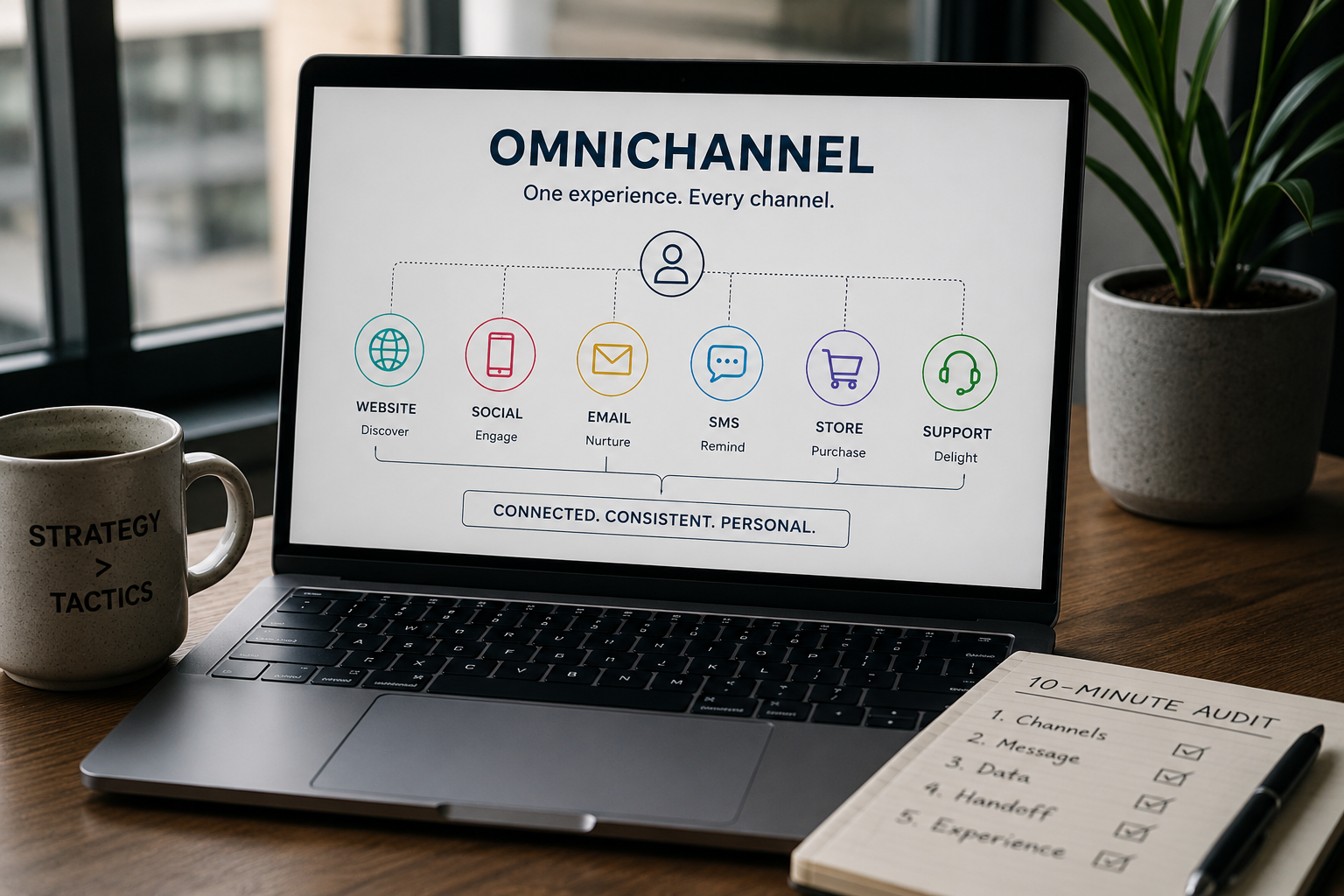
Sit through enough agency pitches and you'll hear it. Somewhere around slide eleven, after "synergies" and before "holistic," comes the big one: omnichannel.
It gets said with a certain weight. A pause after it. Sometimes a slow nod. The implication is that omnichannel is a sophisticated capability — something complex and expensive that only a serious agency can deliver, and that your business is probably failing at right now without knowing it.
Here's the thing. Omnichannel does mean something real. It's just embarrassingly simple, and the gap between how simple it is and how impressively it gets said is where a lot of agency fee inflation lives.
Let's take the air out of it.
What omnichannel actually means
Strip away the presentation voice and here's the definition. A "channel" is just a place where your brand meets a customer — your website, your Instagram, your email list, your Google Business Profile, your storefront, your phone line.
Multichannel means you're present on more than one of those. That's it. If you have a website and an Instagram account, congratulations, you are multichannel. Formally, multichannel marketing is the practice of using more than one channel to communicate with customers, where each channel operates independently, with its own strategy, messaging, and goals.
Omnichannel means those channels are connected, so the customer's experience carries across them instead of restarting each time. As Salesforce puts it, multichannel marketing involves engaging customers across multiple independent platforms, whereas omnichannel marketing integrates all of those platforms to create a unified, seamless customer journey. The practical test: a customer can pick up on one channel where they left off on another. BloomreachMailchimp
That's the whole concept. Multichannel is being in several places. Omnichannel is those places knowing about each other.
Read that back and notice what's missing: any hint of complexity that would justify the reverent tone. There's no proprietary technology in the definition. No secret methodology. It's "make sure your stuff is consistent and connected." Your grandmother running a shop who remembers what a regular customer asked about last week is doing omnichannel. She just doesn't bill for it.
For most businesses, it's literally two channels
Here's where the jargon gets most disconnected from reality. Agencies pitch omnichannel like it's an orchestral arrangement across a dozen touchpoints. Salesforce notes that on average, companies market across 10 channels. That's a real number for enterprise brands with the teams to match. Bloomreach
But if you're a local service business, a small e-commerce brand, a dealership, or a practice, your actual reality is usually two channels that matter and a couple that barely register. For most, it's your website and your social presence. Maybe email. Maybe your Google Business Profile.
So when an agency sells you "omnichannel strategy," what they are frequently describing — and what you actually need — is: does your Instagram match your website, and does someone who finds you on one get a coherent experience when they land on the other?
That's it. That's the deliverable. And when you phrase it that way, two things happen. First, it stops sounding like a capability you need to buy and starts sounding like a standard you should expect. Second, you can immediately tell whether you have it, because you can check it yourself in about ten minutes.
The ten-minute omnichannel audit you can run right now
Skip the discovery workshop. Open your phone and do this:
Go to your Instagram (or main social) profile. Read the bio. Look at the last nine posts. What do they say you do, who for, and what's the vibe?
Tap the link in your bio. Where does it land? Is it the homepage, or a page relevant to what you're currently posting about?
Read the first screen of that page on your phone. Does it say the same thing your social profile said? Same offer, same tone, same visual identity, same promise?
Try to do the obvious next thing — book, buy, call, or contact. How many taps? Does it work on mobile?
Check your Google Business Profile. Do the hours, photos, and description match reality and match everything above?
If a stranger could move through those steps without ever feeling like they'd switched companies, you're doing omnichannel. If your Instagram is warm and personality-driven but your website is corporate and stiff, or your social is pushing a promotion your site doesn't mention, or the bio link dumps everyone on a homepage that ignores what brought them there — you have a gap. A very fixable, very unglamorous gap.
Notice that nothing in that audit required a platform, a data warehouse, or a retainer. It required paying attention.
So why does the word get inflated?
A few reasons, and they're worth naming plainly.
Big words justify big invoices. It's harder to charge a premium for "we'll make your Instagram and website say the same thing" than for "we'll architect your omnichannel brand experience." Same work. Different perceived value.
Jargon creates information asymmetry. If you don't know what a word means, you can't evaluate whether it's being delivered. Vocabulary that makes a client feel behind is vocabulary that makes them easier to sell to. As one industry analysis notes, these terms have become examples of definitions getting lost in the noise, with the lines so blurred that even marketers debate them constantly. Salesforce
It's often used to mean "we'll add more channels." This is the sneakiest version, because it's backwards. Adding a TikTok, a Pinterest, and a podcast to a brand whose website and Instagram already contradict each other doesn't make you omnichannel. It makes you inconsistent in more places. The whole point is connection, not quantity — having a presence on multiple platforms is no longer a guaranteed recipe for success; it's the connectivity between platforms that defines modern customer experience. Bloomreach
Where the concept genuinely earns its keep
Now, in fairness — and because the point isn't to be cynical, it's to be accurate — the underlying idea does matter. A lot.
The reason consistency across channels is worth caring about is that customers don't experience your channels separately. They experience you. Someone finds you on Instagram, clicks to your site, maybe gets an email, maybe calls. To them that's one continuous impression of one company. Every seam they notice — a different tone, a promotion that doesn't exist on the site, a phone number that's out of date — is a small deposit of doubt.
And the business results back this up. One 2026 analysis found that companies with strong omnichannel strategies retain 89% of their customers, compared to 33% for companies with weak omnichannel engagement. That's a real, enormous gap. The concept is not fake. What's inflated is the mystique around it, and the implication that achieving it requires something exotic.
The distinction matters because the fix is usually cheap and the framing is usually expensive. Most brands don't need an omnichannel platform. They need someone to look at their five touchpoints, notice the three places they contradict each other, and fix them.
What to ask when an agency says "omnichannel"
If you're evaluating a proposal and the word shows up, don't nod. Ask:
"Which specific channels do you mean, for my business?" If they can't name them concretely — your site, your Instagram, your GBP, your email — it's filler.
"What's inconsistent right now?" A real answer means they actually looked. A vague one means they're selling a category, not a diagnosis.
"Are you connecting my existing channels, or adding new ones?" Both can be valid, but they're completely different projects with different costs. Make them say which.
"How will I know it worked?" Consistency should produce something measurable — better conversion from social traffic, fewer drop-offs, more direct inquiries. If the deliverable is a deck, that's a deck.
Good agencies will answer these instantly and specifically, because they've already done the looking. The questions aren't hostile — they're just the difference between buying a diagnosis and buying a vocabulary word.
The takeaway
Omnichannel isn't a scam. It's a real idea wearing a suit three sizes too big.
Underneath the word is a standard any business can understand and most can meet: be consistent everywhere a customer might find you, and make sure moving between those places feels like one company, not three. For the majority of businesses, that's your website and your social presence, plus a couple of supporting touchpoints — not a ten-channel orchestration.
If an agency uses the word to make the work sound bigger than it is, that tells you something about how they'll communicate with you for the rest of the relationship. The best marketing advice is almost always sayable in plain English. If someone can't say it plainly, it's worth asking whether they understand it — or whether the fog is the point.
At Ritner Digital, we try to say things in plain English — partly because it's more honest, and partly because clear thinking and clear language are the same skill. If you want a straight look at where your brand experience is inconsistent and what it would actually take to fix it, get in touch with Ritner Digital. We'll tell you what we'd do and what it's worth, without the vocabulary tax.
Frequently Asked Questions
What does "omnichannel" actually mean?
It means your marketing channels are connected, so a customer's experience carries across them instead of restarting each time. A "channel" is just a place where your brand meets a customer — your website, Instagram, email list, Google Business Profile, storefront, phone. As Salesforce frames it, multichannel marketing involves engaging customers across multiple independent platforms, whereas omnichannel integrates all of those platforms to create a unified, seamless customer journey. The practical test is simple: can a customer pick up on one channel where they left off on another? That's the whole concept — no proprietary technology required. BloomreachMailchimp
What's the difference between multichannel and omnichannel?
Multichannel is being in several places. Omnichannel is those places knowing about each other. Multichannel marketing means using more than one channel where each operates independently, with its own strategy, messaging, and goals — a promotion on Instagram might look nothing like your email newsletter. Omnichannel connects them so the messaging, tone, and experience stay coherent as someone moves between them. If you have a website and an Instagram account, you're already multichannel. Whether you're omnichannel depends entirely on whether those two agree with each other.
How many channels do I actually need?
Far fewer than most pitches imply. Salesforce notes that on average companies market across 10 channels, but that number reflects enterprise brands with the teams to support it. For most local service businesses, small e-commerce brands, dealerships, and practices, the reality is two channels that genuinely matter — usually your website and your main social presence — plus a couple of supporting touchpoints like email and your Google Business Profile. Getting two channels perfectly consistent beats being scattered across eight. Bloomreach
Is omnichannel marketing just a buzzword?
The idea is real; the mystique around it is inflated. Customers don't experience your channels separately — they experience you — so every seam they notice (a different tone, a promotion that isn't on your site, an outdated phone number) deposits a little doubt. The business impact is measurable: one 2026 analysis found companies with strong omnichannel strategies retain 89% of customers versus 33% for those with weak omnichannel engagement. So it matters. What's overblown is the implication that achieving it requires something exotic, when for most businesses the fix is simply making a handful of touchpoints agree with each other.
How can I tell if my business is "omnichannel" without hiring anyone?
Run a ten-minute audit on your phone. Open your main social profile and read the bio and last nine posts — what do they say you do, for whom, and in what tone? Tap the link in your bio and see where it lands. Read the first screen of that page on mobile and ask whether it says the same thing your social profile did. Then try to do the obvious next thing (book, buy, call) and count the taps. Finally, check that your Google Business Profile matches all of it. If a stranger could move through those steps without feeling like they switched companies, you're doing omnichannel. If not, you've found your gap.
Won't adding more channels make me omnichannel?
No — and this is the most common misunderstanding. Adding TikTok, Pinterest, and a podcast to a brand whose website and Instagram already contradict each other doesn't make you omnichannel; it makes you inconsistent in more places. The point is connection, not quantity. As Salesforce puts it, having a presence on multiple platforms is no longer a guaranteed recipe for success — it's the connectivity between platforms that defines modern customer experience. Fix the consistency of what you have before you expand the footprint. Bloomreach
Why do agencies make omnichannel sound so complicated?
A few honest reasons. Big words justify big invoices — it's harder to charge a premium for "we'll make your Instagram and website say the same thing" than for "we'll architect your omnichannel brand experience," even when it's the same work. Jargon also creates information asymmetry: if you don't know what a term means, you can't evaluate whether it's being delivered. And the terminology genuinely has gotten muddy — one industry analysis notes these terms have become examples of definitions getting lost in the noise, with marketers themselves debating the boundaries constantly. Salesforce
What should I ask an agency that pitches me omnichannel?
Four questions, and good agencies answer them instantly. First, "which specific channels do you mean for my business?" — if they can't name yours concretely, it's filler. Second, "what's inconsistent right now?" — a real answer means they actually looked; a vague one means they're selling a category rather than a diagnosis. Third, "are you connecting my existing channels or adding new ones?" — both can be valid, but they're different projects with different costs. Fourth, "how will I know it worked?" — consistency should show up as better conversion from social traffic, fewer drop-offs, or more direct inquiries. If the deliverable is just a deck, that's a deck.