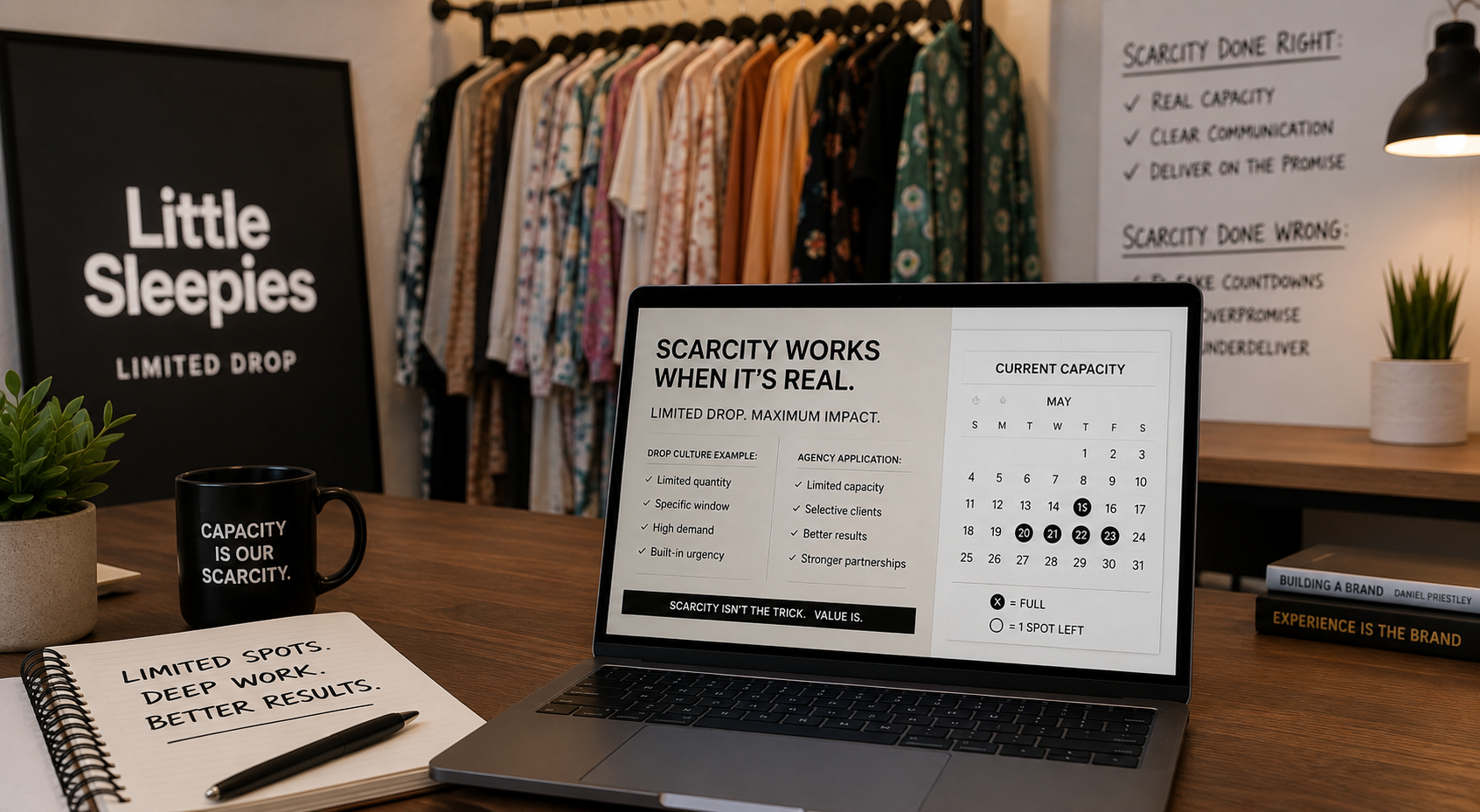
If you've ever watched a print of children's bamboo pajamas sell out in minutes — with a resale market springing up on Facebook overnight — you've seen one of the most effective marketing models of the last decade up close. Brands like Little Sleepies, Supreme, and the entire sneaker-drop economy have turned scarcity itself into the product. The pajamas are nice. The frenzy is the business.
Which raises an interesting question for those of us who sell services instead of products. If you run a marketing agency, can any of that work for you? You don't have "1,000 units" to sell out. Your product is your team's time, your capacity, your expertise. There's no midnight drop, no resale market, no limited print run.
And yet the psychology that powers the drop model has nothing to do with pajamas or sneakers. It's about how human beings assign value — and understood properly, it translates directly to a service business like an agency. This post breaks down how the limited-drop model actually works, how to apply its principles to agency retainers and engagements, and, crucially, where the line is between genuine urgency and the fake kind that will torch your reputation.
Why the drop model works at all
Start with the mechanics. A limited drop is a release model where new products are available for only a short period, or in very small quantities — scarcity is the defining feature, whether through intentionally low production or a limited-time purchase window. Once the window closes or inventory sells out, they usually won't be restocked. A streetwear brand issues 1,000 pairs of a sneaker, sells them on its app for 24 hours, and when the window shuts, they're gone. shopify
Why does that make people frantic? Because of a well-documented quirk of human psychology. As one breakdown of the strategy puts it, scarcity marketing taps into our desire for things that are rare or hard to get; when we perceive an item as being in short supply, we instinctively place a higher value on it. Psychologists tie this to reactance theory — the finding that when people feel their freedom of choice is threatened, they become more motivated to secure the option before it disappears. Take away the ability to "buy it later," and suddenly people want it now. Marketing Maverickshopify
Two psychological levers do most of the work. The first is FOMO — the fear of missing out that drives quick decisions. The second is exclusivity — the status of belonging to a group that got something others couldn't. As one analysis notes, owning something few others can have makes us feel special and part of an elite group, transforming a purchase into a status symbol. And there's a compounding effect: scarcity generates its own marketing. Instead of paying for extended ad campaigns, the drop itself becomes the promotion, with fans and influencers amplifying the excitement across social media. Marketing MaverickMarketing Maverick
Here's the part that matters for an agency: none of those levers require a physical product. FOMO, exclusivity, reactance, and social proof are about access and timing, not inventory. And access and timing are exactly what a service business controls.
The agency's version of "limited stock" is capacity
An agency has a natural, honest scarcity built into its business model, and most agencies actively hide it. It's called capacity.
You can only take on so many clients before quality drops. You only have so many strategist hours in a month. A good agency turns work away — or should — because overloading the team is how you produce mediocre work and burn people out. That constraint is real. The drop model simply says: stop apologizing for your capacity limit and start treating it as the exclusive, finite thing it actually is.
This is the reframe. A retailer manufactures scarcity by choosing to print only 1,000 units. An agency doesn't have to manufacture anything — the scarcity is genuine. There are only so many seats. The move is to make that truth visible instead of pretending you can serve infinite clients on demand.
Consider how differently these two statements land:
"We'd love to work with you! We have availability whenever you're ready."
"We take on four new clients per quarter to protect the quality of our work. We have two seats left for Q3, and then the next opening is October."
The first sounds eager and, frankly, a little desperate — the marketing equivalent of a shelf that's always fully stocked with something nobody's rushing to buy. The second communicates demand, standards, and a real deadline. It triggers reactance ("wait, I might not be able to get in") and exclusivity ("they don't take everyone") — using nothing but the truth about your capacity.
Five ways to apply drop thinking to agency services
Here's how the model translates into concrete moves for an agency's core services — retainers, sprints, audits, and specialized engagements.
1. Cohort-based onboarding instead of rolling intake. Rather than onboarding clients whenever they sign, batch them. "We onboard a new cohort of clients on the first of each quarter." This is the agency version of a scheduled drop — it concentrates demand into a window, creates a natural deadline, and lets you onboard more efficiently. It also makes "we're full for this cohort, next opening is Q4" an honest, powerful sentence.
2. Limited-run specialized engagements. Package a high-value, finite offering: "We're taking on five GEO audits this quarter." A specialized, capacity-capped engagement borrows the limited-edition structure directly. It's genuinely scarce (you really can only do five well), it signals expertise, and it gives prospects a concrete reason to move now rather than "sometime."
3. Founder or senior access as the exclusive tier. The most finite resource in any agency is the senior people's time. Structuring a premium tier around genuinely limited access — direct strategist involvement, a capped number of those relationships — mirrors the exclusivity lever honestly. There are only so many hours; selling them as the scarce, premium thing they are is just accurate pricing.
4. Real deadlines tied to real constraints. Seasonal capacity, a genuine rate change, a cohort cutoff — these are legitimate deadlines. The key is that specificity beats vagueness every time. As one 2026 scarcity guide notes, "won't last long" and "while supplies last" are weak because they give the customer nothing concrete to react to, compared with a precise "only 14 left" or "offer ends Thursday at 11:59pm." For an agency: "Two Q3 seats left" beats "limited availability" by a mile. Spiffy Checkouts
5. Let the work create the social proof. The drop model's flywheel is that sell-outs generate buzz that fuels the next drop. The agency equivalent: publicly noting when you're at capacity, sharing a waitlist, showing the outcomes that made you full. When prospects see that others want in and can't always get in, that's social proof — when people see others clamoring for something, they tend to want it too. You don't fake the line out the door; you make the real one visible. shopify
The line you cannot cross: fake scarcity
Now the essential caveat, and it's the whole reason this post is worth writing rather than a manipulation checklist. Everything above works only if the scarcity is real. The moment it's fabricated, it doesn't just fail — it actively destroys trust, and it does so faster than most people realize.
The evidence here is blunt. One analysis found that fake urgency does not just fail to convert — it actively damages future conversion potential; once a customer catches you lying about scarcity, they never trust your offers again, and every future promotion is viewed with suspicion. And customers do catch it. Research shows fake urgency backfires within just two to three customer interactions — once people notice reset timers or false claims, trust drops around 41% and repeat purchases decline sharply. The reputational spread is worse in a connected world: a single viral complaint about deceptive urgency can damage reputation more than any promotion could help, and regaining credibility after being caught is far harder than maintaining it. Spiffy Checkouts + 2
There's a legal dimension too. Under the FTC Act, false scarcity and urgency can fall under deceptive practices if your marketing manipulates consumers into decisions based on exaggerated or fabricated claims. "Only two seats left" when you'd happily take twenty isn't clever positioning — it's a claim you'd have to defend.
For an agency, the stakes are even higher than for a retailer, because your scarcity claims are a live demonstration of your own marketing ethics. A prospect evaluating whether to trust you with their brand's reputation is watching how you handle yours. If they sense a fake countdown or a permanently "almost full" calendar, you haven't just lost a deal — you've shown them exactly the kind of marketing you'd do on their behalf. The credibility damage is doubled.
The good news, backed by the same research, is that authentic scarcity is simply more effective anyway. Real constraints convert meaningfully better than fabricated ones and create sustainable conversion lifts without the trust penalty of manipulation. And the sweet spot is transparency plus constraint: showing customers exactly why something is limited — real capacity, seasonal availability — outperforms vague "limited time" claims. "We cap at four clients a quarter so the work stays excellent" isn't a trick. It's a standard, stated out loud. ThedigitalmarketingThedigitalmarketing
How to know if your scarcity is honest
A simple test, before you publish any capacity-based urgency: would the claim survive the customer refreshing the page, or coming back next week? The fastest way to get caught is a deadline that resets or an "almost full" that's been almost full for six months. If a prospect declined today and came back in October, would your story still be true? If yes, you have real scarcity and you should absolutely communicate it. If no, you have a fake countdown timer with an agency logo on it — and it will cost you more than it makes.
Ask yourself:
Is the limit real? (Would taking one more client genuinely hurt the work?)
Is the deadline real? (Does something actually change at that date?)
Is the exclusivity real? (Do you actually turn people away?)
Could you explain the constraint out loud to the customer and have it make them respect you more, not less?
If you can answer yes to those, drop thinking isn't manipulation. It's just honesty about a real constraint, communicated with the confidence that most agencies are too timid to use.
The takeaway
The limited-drop model looks, on the surface, like a trick that only works for streetwear and pajamas. But strip away the merch and what's left is a set of truths about human psychology — we value what's scarce, we act when we might miss out, we want what others want — and a business model honest enough to make its real constraints visible.
An agency already has the constraint. You have finite capacity, finite senior hours, and standards that mean you can't and shouldn't serve everyone. Most agencies bury that behind "we're always available!" enthusiasm that quietly signals the opposite. The lesson from Little Sleepies isn't to invent scarcity. It's to stop hiding the scarcity you already have — and to communicate it with the same confidence a brand does when it knows the drop will sell out.
At Ritner Digital, we help brands build marketing that's persuasive and honest — because the two aren't in tension, they compound. If you want strategy, SEO, GEO, and campaigns built on real positioning rather than gimmicks, get in touch with Ritner Digital. And yes — we take on a limited number of new clients at a time, on purpose.
Frequently Asked Questions
What is the "limited drop" model?
It's a release strategy where something is available only for a short window or in very small quantities, so scarcity becomes the defining feature. As one breakdown describes it, limited drops make products available for only a short period or in very small quantities, and once the window closes or inventory sells out, they usually won't be restocked. Streetwear brands, sneaker labels, and apparel companies like Little Sleepies use it to turn scarcity itself into the appeal — the product is nice, but the "get it before it's gone" pressure is what drives the frenzy. shopify
Why does scarcity make people want something more?
Because of how humans assign value. When we perceive something as being in short supply, we instinctively place a higher value on it, which creates urgency. Psychologists connect this to reactance theory: when people feel their freedom of choice is threatened, they become more motivated to secure the option before it disappears. Two levers do most of the work — FOMO (the fear of missing a one-time opportunity) and exclusivity (the status of belonging to a group that got in when others couldn't). Notably, none of those levers require a physical product; they're about access and timing, which is exactly what a service business controls. Marketing Maverickshopify
Can a marketing agency really use a model built for physical products?
Yes, because the psychology behind it has nothing to do with inventory. An agency has a genuine, built-in form of scarcity that most agencies actively hide: capacity. You can only take on so many clients before quality drops, and you only have so many senior hours in a month. A retailer manufactures scarcity by choosing to print 1,000 units; an agency doesn't have to manufacture anything, because the constraint is already real. The move isn't to invent scarcity — it's to stop pretending you can serve infinite clients on demand and make your real capacity limit visible.
What are concrete ways an agency can apply drop thinking?
A few that map cleanly onto agency services: onboard clients in quarterly cohorts instead of rolling intake, so demand concentrates into a window with a natural deadline; offer limited-run specialized engagements ("we're taking five GEO audits this quarter"); structure a premium tier around genuinely limited senior or founder access; tie real deadlines to real constraints like seasonal capacity or a rate change; and let your actual results and waitlist create social proof rather than faking a line out the door. Each one borrows the drop model's structure while staying anchored to something true about your business.
Isn't creating urgency just manipulation?
Only if the scarcity is fake. Authentic scarcity — a real capacity cap, a real deadline, a real limit on how many clients you'll take — is simply honesty about a constraint, communicated with confidence. Fabricated scarcity is manipulation, and it backfires badly: research shows fake urgency backfires within just two to three customer interactions, with trust dropping around 41% once people notice reset timers or false claims. The reassuring part is that authentic scarcity actually converts better anyway and does so without the trust penalty of manipulation. Real constraints, stated plainly, aren't a trick — they're a standard. ThedigitalmarketingThedigitalmarketing
How do I know if my scarcity is honest or fake?
Use a simple test: would the claim survive the customer coming back next week? If a prospect declined today and returned in October, would your story still be true? A deadline that resets or an "almost full" calendar that's been almost full for six months is a fake countdown timer with your logo on it. Ask yourself whether the limit is real (would one more client genuinely hurt the work?), whether the deadline is real (does something actually change on that date?), and whether you could explain the constraint out loud and have it make the customer respect you more. If yes to all, it's honest urgency worth communicating.
Why is fake urgency riskier for an agency than for a retailer?
Because your scarcity claims are a live demonstration of your own marketing ethics. A prospect deciding whether to trust you with their brand's reputation is watching how you handle yours — so a fake countdown or a permanently "almost full" calendar doesn't just cost you one deal, it shows them exactly the kind of marketing you'd do on their behalf. There's also a legal dimension: under the FTC Act, false scarcity and urgency can qualify as deceptive practices when marketing manipulates people with fabricated claims. For an agency, the credibility damage of getting caught is effectively doubled.
What's the single biggest mistake agencies make here?
Hiding the scarcity they already have. Most agencies bury their real capacity limit behind "we're always available!" enthusiasm that quietly signals the opposite — the marketing equivalent of a shelf that's always fully stocked with something nobody's rushing to buy. Specificity is also routinely missed: vague phrases like "limited availability" are weak because they give prospects nothing concrete to react to, while "two Q3 seats left, next opening in October" lands. The fix isn't manufacturing urgency; it's communicating a genuine constraint with the confidence a brand uses when it knows the drop will sell out.