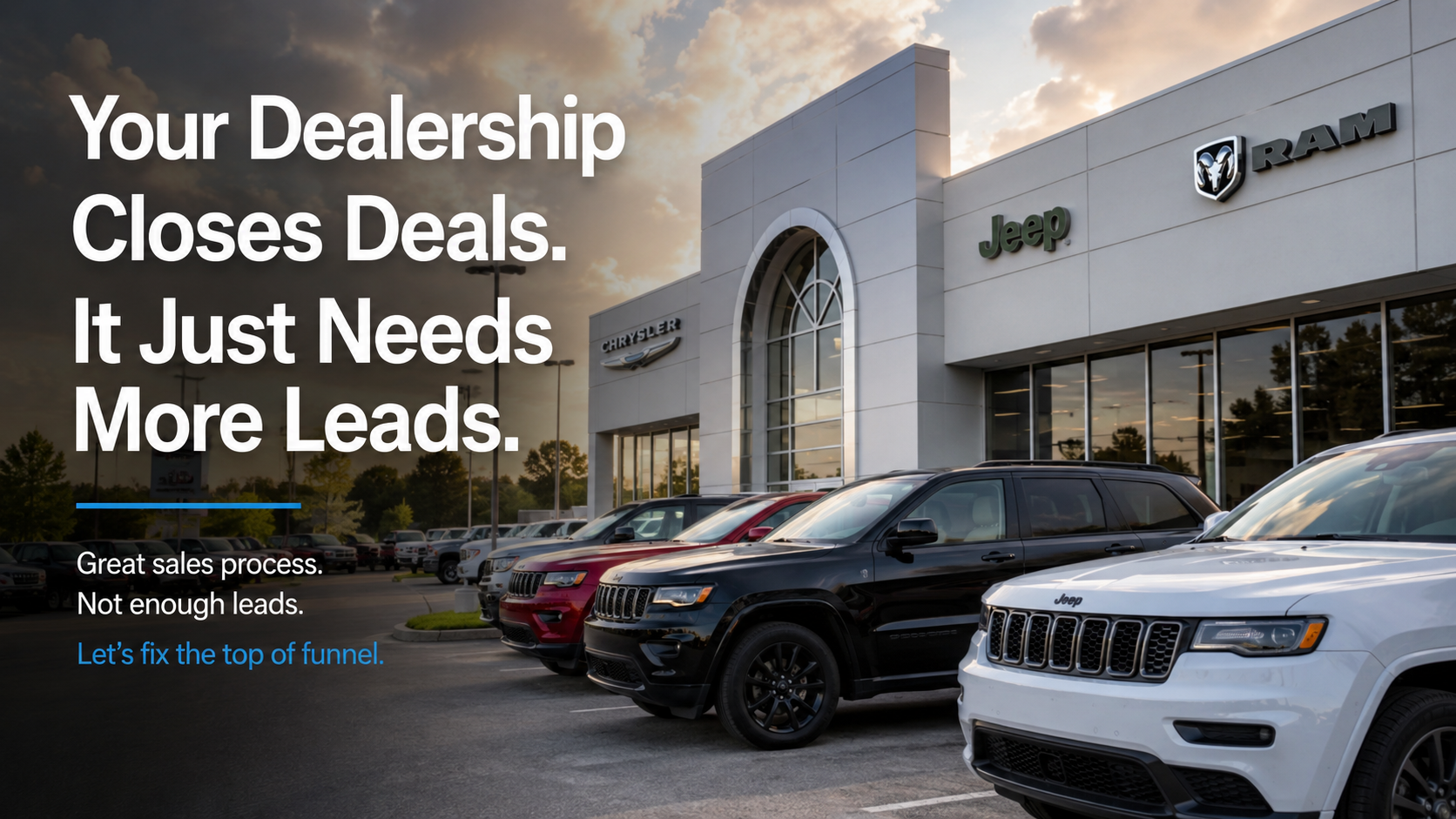
There's a specific kind of frustration that only happens to good dealerships.
Your sales process works. Your team knows how to handle an up. Your appointment-set rate is strong, your show rate is solid, and when someone walks onto your lot or picks up the phone, you close them at a rate you're genuinely proud of. Everything after the lead comes in is dialed.
And that's exactly why the problem is so maddening: none of that skill matters if the leads never show up in the first place.
We recently heard from a Chrysler-Dodge-Jeep-Ram dealership in metro Atlanta that put it about as clearly as anyone could. Their processes once a lead comes in are excellent. Their appointment and closing percentages are strong. They don't need help selling cars. They need more prospects to consider them in the first place. That's it. That's the whole problem.
If that sounds like your store, this post is for you. Because a top-of-funnel problem is a completely different animal than a sales problem — and the fixes are different too.
Why "just buy more leads" is the wrong instinct
When a dealership realizes it needs more prospects, the reflex is usually to spend more on the third-party portals — Cars.com, CarGurus, Autotrader — or to crank up whatever's already running. More budget, more leads, problem solved. Right?
Not quite, and the math is why. Third-party lead costs have been climbing for years while the quality of those leads has, at best, held flat. One 2026 industry breakdown lays out the brutal arithmetic: a dealership generating most of its leads from portals at an effective cost of around $225 per lead is paying roughly $18,000 a month for about 80 leads — and those same leads are being sold to your competitors down the road at the same time. You're renting access to a shopper who's simultaneously being pitched by three other stores.
Compare that to what leads cost when you generate them yourself. Well-optimized Google Vehicle Ads campaigns in 2026 typically achieve a cost per lead between $25 and $45, and automotive search advertising more broadly runs a cost per lead in the range of roughly $29 to $52 depending on quality score, location, and keyword strategy. Leads you generate through your own site and campaigns are exclusive — they belong to you, not to whoever else paid the portal that month. TXC Auto
So the instinct to "buy more leads" isn't wrong because leads are bad. It's wrong because it doubles down on the most expensive, least exclusive source you have, instead of building the cheaper, exclusive sources you own. For a store that already closes well, that's leaving money on the table twice over.
The real diagnosis: a visibility problem, not a sales problem
Here's the reframe. A dealership that closes well but starves for leads doesn't have a sales problem or even really a leadproblem. It has a visibility problem. Not enough of the right people in your market know you exist, or find you, at the moment they're deciding where to shop.
And in 2026, that moment happens almost entirely online, on a phone, before a shopper ever contacts a single store. Over 60% of car-shopping searches now happen on mobile devices, and the shopper has usually done the bulk of their research before they raise their hand anywhere. If your store isn't showing up — in search results, in the AI answers people now ask, on the maps pack, in the retargeting that follows a browser around — you're not in the consideration set. And you can't close a deal you were never considered for. PPC Chief
The good news for a store like the Atlanta CJDR dealership: this is the fixable half of the funnel. You've already solved the hard, human part — the part that depends on training, culture, and hustle. What's left is a mechanical, measurable problem: getting more qualified in-market shoppers to find you. That's a problem with known levers.
Where the leaks usually are
When we look at a dealership that's converting well but under-fed at the top, the shortfall almost always traces to a handful of specific gaps. Here's what we tend to find.
1. The website converts far below what it should. This is the quiet killer. The industry average conversion rate for a generic automotive website is only 2 to 4%, while top-performing pages with strong personalization, clear calls to action, and fast load times reach 20 to 30% or higher. If you're driving traffic to a site converting at 3%, you're paying for five times the visitors you should need. Fixing the destination is often cheaper and faster than buying more traffic — and every percentage point of conversion improvement adds leads at zero additional media cost. PPC Chief
2. Mobile is leaking the most. Since the majority of shopping starts on a phone, a site that isn't genuinely fast and mobile-optimized will lose more than half its potential leads before they ever fill out a form. This is usually the single highest-leverage fix, and it's invisible on a desktop demo. PPC Chief
3. The channel mix is lopsided. Most dealerships over-invest in the vehicle-sales portion of the funnel and badly under-invest in service — even though service is the best unit economics in the entire business. Auto service converts at around 14.7% with a cost per lead near $28.50 — the highest conversion rate and lowest cost per lead of any automotive segment — yet service receives less than 15% of most dealerships' marketing budgets. That misallocation is one of the biggest quiet opportunities in the whole industry, and service customers are your future car buyers. LandingGarage
4. Spending without measuring past the click. The dealerships winning in 2026 aren't the ones spending the most — as we wrote in our complete breakdown of dealership advertising costs, they're the ones spending with the most discipline, tracking from impression all the way to vehicle sold, and reallocating continuously based on what the data actually shows. If you can't see which channels produce leads that close — not just leads that come in — you can't fix the mix.
The encouraging part: the economics are moving in your favor
If all of that sounds like a lot of ground to make up, here's the context that should make you optimistic. Dealership digital advertising is currently working better than it has in years.
Recent 2026 data drawn from thousands of franchised dealerships found a 37.3% year-over-year surge in dealership digital ad conversions, paired with a 14.8% drop in cost per lead — the lowest CPL recorded in the trailing twelve months. The reason is smarter targeting and AI-powered automation letting dealers reach the right in-market shoppers and spend less to acquire each one. In other words: a dealership that gets its top-of-funnel and its website right in 2026 is doing so in the most favorable cost environment in recent memory. Ritner Digital
For a store that already closes at a high rate, that's the dream setup. Better ad efficiency, plus a proven ability to convert what comes in, is a genuinely powerful combination — as long as the front of the funnel is actually built.
What "more prospects" actually looks like when it's done right
So what does fixing a visibility problem involve? For a CJDR dealership specifically, it comes down to being present and competitive across the places in-market shoppers actually look, and making sure that once they find you, the path to raising their hand is frictionless. Concretely:
Own your local search presence. When someone in your metro searches for your models, "Jeep dealer near me," "Ram 1500 for sale," or your competitors' names, you need to be there — in the organic results, in the map pack, and increasingly in the AI-generated answers shoppers now read instead of clicking. Note that intent-heavy local queries like "car dealerships near me" are also the most competitive and expensive on paid search, often exceeding $10 to $20 per click, which is exactly why building organic and AI visibility for those terms pays off so much — it's traffic you don't re-buy every month. LandingGarage
Run disciplined, exclusive paid campaigns. Google Vehicle Ads and search campaigns pointed at high-intent, model-specific and conquest keywords generate exclusive leads at a fraction of portal costs. The key word is disciplined — tracked to the sale, not just the click, and continuously reallocated.
Fix the destination before you scale the traffic. A faster, mobile-first, conversion-optimized website and personalized landing pages don't just add leads — they lower the cost of every lead you generate, because more of the traffic you already have converts. Research consistently shows personalized landing pages featuring a specific salesperson convert 50 to 80% better than generic dealership pages. PPC Chief
Don't ignore the service funnel. Given its best-in-class economics, a service-side marketing push is often the fastest ROI available to a dealership — and it feeds the sales funnel over time.
Measure everything to the sale. Impression to click to lead to appointment to sold. When you can see the full path, you can pour budget into what closes and starve what doesn't.
None of this is exotic. It's the unglamorous, mechanical work of building a top of funnel that matches the quality of your bottom of funnel. For a store that already closes, it's the missing half of the machine.
Why dealerships come to us
The dealerships that reach out to us usually sound a lot like that Atlanta CJDR store. They're not struggling. They're good— often very good — at the part of the business that happens once a customer is engaged. They have tight processes, strong closers, and appointment and show rates they've worked hard to earn. What they don't have is a predictable, measurable, exclusive flow of new prospects feeding all that talent.
That's the problem we solve. We're an SEO, GEO, and digital advertising agency that helps dealerships get found by in-market shoppers and turn more of their existing traffic into leads — without simply renting more expensive, non-exclusive leads from the portals. We look at your actual numbers: where your spend goes, what it produces, where the leaks are, and what the highest-leverage fixes are for your market and your store. Sometimes that's search visibility. Sometimes it's a website that's quietly losing half its mobile traffic. Sometimes it's a channel mix that's ignoring the most profitable part of the funnel. It's always specific to you, and it's always measured to the outcome that matters — not activity, but leads that your team can close.
Because here's the truth: a great sales process is the hardest thing to build in this business, and you've already built it. Getting more of the right people to consider you is the solvable part. You shouldn't have a lot full of talent waiting on prospects that never arrive.
If your dealership closes well but just needs more people to close, let's talk. We'll take a clear-eyed look at where your leads come from, what they cost, where your funnel is leaking, and what it would take to feed your sales team the exclusive, qualified prospects it's built to convert. Book a free strategy call with Ritner Digital — no pressure, no jargon, just an honest read on what's actually holding your lead volume back and how to fix it.
Frequently Asked Questions
Why does my dealership close deals well but still not have enough leads?
Because closing and lead generation are two completely different problems, and being great at one tells you nothing about the other. A strong close rate means your process, your team, and your follow-up are dialed once a customer is engaged — that's the hardest part of the business to build, and you've built it. But leads come from visibility: being found by in-market shoppers before they ever contact a store. If not enough of the right people in your market know you exist or find you at the moment they're deciding where to shop, your sales talent never gets an at-bat. It's a top-of-funnel problem wearing the disguise of a lead problem, and the fixes are entirely different from anything you'd do to sell more effectively.
Should I just buy more leads from Cars.com or CarGurus?
It's the common reflex, but it's usually the most expensive way to solve the problem. Third-party portal lead costs have climbed for years while quality has stayed flat, and those leads aren't exclusive — the same shopper is sold to several competing stores at once. One 2026 breakdown showed a dealership generating most of its leads from portals at an effective cost around $225 each, paying roughly $18,000 a month for about 80 non-exclusive leads. By contrast, well-optimized Google Vehicle Ads campaigns in 2026 typically achieve a cost per lead between $25 and $45, and those leads belong only to you. Buying more portal leads doubles down on your priciest, least-exclusive source instead of building the cheaper ones you own. TXC Auto
What's a good cost per lead for a car dealership in 2026?
It depends heavily on channel and market, but the benchmarks give useful goalposts. Automotive search advertising generally runs a cost per lead in the range of roughly $29 to $52, and well-optimized Google Vehicle Ads campaigns typically land between $25 and $45. Service is the standout: auto service converts at around 14.7% with a cost per lead near $28.50 — the best unit economics of any automotive segment. The most important thing to know is that your real benchmark is your own brand and market, not a national average — CPCs alone swing widely, from around $1–$3 on branded searches to $10–$20+ on high-intent "dealerships near me" queries. TXC AutoLandingGarage
Is the problem my website or my traffic?
Very often it's the website, and that's good news because it's cheaper to fix than buying more traffic. The average generic automotive site converts at only 2 to 4%, while top-performing pages reach 20 to 30% or higher. If you're sending traffic to a site converting at 3%, you're paying for roughly five times the visitors you should need. Mobile is usually where the most leaks are — with over 60% of car shopping starting on a phone, a site that isn't genuinely fast and mobile-optimized loses more than half its potential leads before anyone fills out a form. Every point of conversion improvement adds leads at zero additional media cost, which is why fixing the destination often beats scaling the traffic. PPC ChiefPPC Chief
Isn't digital advertising getting more expensive and less effective?
Actually, the opposite is happening right now, which makes this a good moment to fix your funnel. Recent 2026 data across thousands of franchised dealerships found a 37.3% year-over-year surge in digital ad conversions paired with a 14.8% drop in cost per lead — the lowest recorded in the trailing twelve months. The driver is smarter, AI-powered targeting reaching the right in-market shoppers for less money. For a dealership that already closes well, that combination — cheaper, more efficient ad spend plus a proven ability to convert what comes in — is a genuinely strong position, as long as the top of the funnel is actually built to feed it. Ritner Digital
What part of the funnel is most dealerships ignoring?
Service. It has the best economics in the entire business — the highest conversion rate and lowest cost per lead of any automotive segment — yet it receives less than 15% of most dealerships' marketing budgets. That misallocation is one of the biggest quiet opportunities in automotive marketing, and it compounds: today's service customer is often tomorrow's vehicle buyer. A dealership feeding its sales funnel while starving its service funnel is usually leaving the fastest available ROI on the table. LandingGarage
How do I know where my ad spend is actually leaking?
By measuring past the click, all the way to the sale. Most dealerships can see clicks and leads but lose the thread after that — so they can't tell which channels produce leads that actually close versus leads that just come in and go nowhere. The dealerships winning in 2026 track the full path from impression to click to lead to appointment to vehicle sold, then continuously reallocate budget toward what closes and away from what doesn't. If you can't see that full picture, the first fix isn't spending more — it's getting the measurement in place so every dollar after that is spent with discipline.
What does Ritner Digital actually do for a dealership like mine?
We help dealerships get found by in-market shoppers and convert more of their existing traffic into exclusive leads — without simply renting pricier, non-exclusive leads from the portals. We start with your real numbers: where your spend goes, what it produces, where the funnel leaks, and the highest-leverage fixes for your specific market and store. Sometimes that's search and AI visibility for the terms shoppers use; sometimes it's a website quietly losing half its mobile traffic; sometimes it's a channel mix ignoring the most profitable part of the funnel. It's always specific to you, and always measured to the outcome that matters — leads your team can close, not just marketing activity.