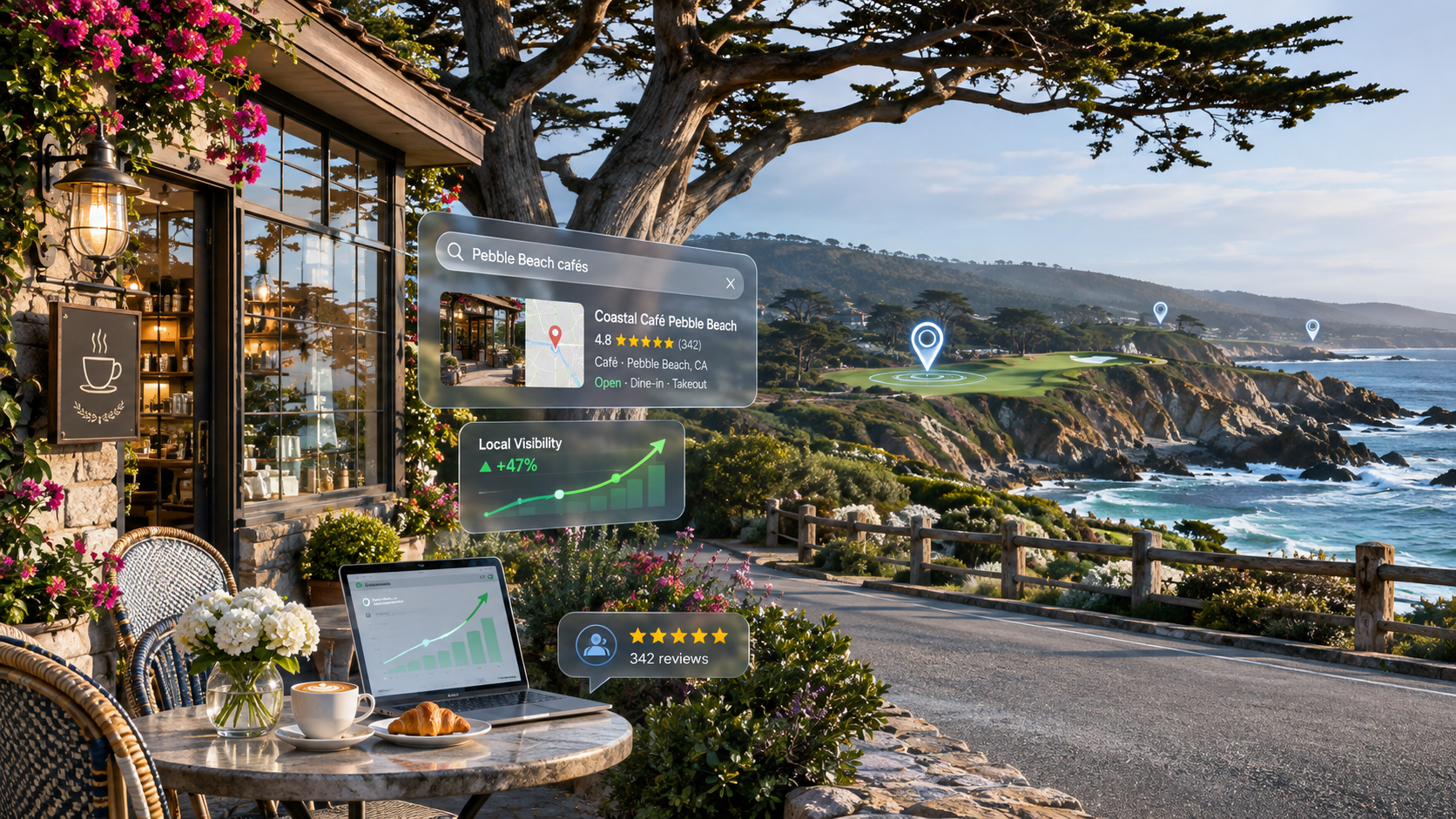
Pebble Beach has one of the most recognizable names on the California coast. But a prestigious location, strong reputation, and loyal customers don't automatically make a local business easy to find online. In 2027, effective local SEO will still begin with a fundamental goal: helping the right people discover your business when they're searching for what you offer.
Pebble Beach doesn't have a recognition problem.
The name is associated with spectacular coastal scenery, world-class golf, luxury hospitality, and the distinctive character of California's Monterey Peninsula.
People know Pebble Beach.
They recognize the name even if they've never visited.
But being located in a recognizable destination doesn't mean every business serving that destination is equally visible.
A property management company might have an excellent reputation among longtime homeowners but barely appear when someone searches for management services in the area.
A landscaping contractor might receive consistent referrals while remaining difficult to discover through Google Maps.
A local service provider could have years of experience working with Pebble Beach residents without having a website that clearly explains its capabilities.
And a hospitality-related business might be well known among returning visitors but nearly invisible to someone planning their first trip.
These businesses may be respected.
They may provide excellent service.
They may have strong relationships and established customer bases.
Yet potential customers who don't already know their names can struggle to find them.
That's the difference between having a reputation and having local search visibility.
Reputation is what people know about you.
Local SEO helps people who don't know you yet discover that your business may be relevant to their needs.
The two should work together.
A business shouldn't have to abandon referrals, personal relationships, or traditional reputation-building to become more discoverable online.
But relying exclusively on those advantages can leave meaningful opportunities unexplored.
As businesses prepare for 2027, the objective shouldn't be to chase every new search trend.
It should be to strengthen the fundamentals that help customers find accurate information, understand services, evaluate credibility, and take the next step.
For Pebble Beach businesses, that requires a strategy that reflects the area's distinctive geography, visitor activity, surrounding communities, and service expectations.
It also requires understanding what local SEO can realistically accomplish.
No agency can guarantee that a company will rank first for every nearby search.
And being physically close to a prestigious destination doesn't automatically create search authority.
But businesses can improve how clearly they communicate who they are, where they operate, what they offer, and why they're relevant.
That's where an effective Pebble Beach SEO strategy begins.
Pebble Beach Has a Unique Local Search Environment
Pebble Beach is not an ordinary commercial district.
It's a coastal community on the Monterey Peninsula, known internationally for golf, scenic experiences, residential properties, and hospitality.
The official Pebble Beach Resorts guide to 17-Mile Drive describes a route connecting coastal viewpoints, beaches, forests, and iconic golf destinations.
The area's proximity to Carmel-by-the-Sea, Pacific Grove, and Monterey also creates a regional environment in which people may search across multiple nearby communities.
For local businesses, this distinction matters.
A search for a service associated with Pebble Beach may come from several different audiences.
A resident might need property maintenance.
A homeowner who lives elsewhere might be arranging work on a Pebble Beach property.
A visitor might be looking for dining, shopping, transportation, or another nearby experience.
A local business owner might be searching for a contractor or professional service provider.
These searchers may use similar location terms, but their underlying needs differ.
Someone searching for "Pebble Beach landscaping" may have a different objective from someone searching for "landscaping near Pebble Beach" while planning work on a property in Pacific Grove.
Likewise, a visitor searching for restaurants near Pebble Beach may be more concerned about accessibility, hours, and driving directions than the precise municipal designation of the business.
A strong local SEO strategy recognizes those differences.
It doesn't treat the area as a single keyword to repeat throughout a website.
It treats Pebble Beach as a real place with distinct customer needs.
Why Reputation Alone Doesn't Guarantee Visibility on Google
Word-of-mouth recommendations remain valuable.
For many service-based businesses, they represent trust earned over years of consistent work.
But referrals depend on existing relationships.
Search can introduce a business to someone who doesn't share those connections.
Consider a homeowner who recently purchased a property in the area.
They might need landscape maintenance, interior design, home repairs, or property management.
They may not know which companies local residents commonly recommend.
Their initial research may begin with Google.
They might search:
"property management Pebble Beach CA"
"landscape maintenance near Pebble Beach"
"home remodeling contractor Monterey Peninsula"
"interior designer Pebble Beach"
These are illustrative search phrases, not verified keyword-volume claims.
The important point is that the searcher is expressing a specific need.
A business that relies entirely on personal referrals may never enter that person's consideration set unless its digital presence is discoverable.
An effective local SEO strategy helps close that gap.
It makes the business easier for new customers to identify while reinforcing the reputation it has already earned.
What Will Actually Matter for Pebble Beach SEO in 2027?
Because 2027 is still ahead, no one can responsibly claim to know every Google ranking-system change that will occur during the year.
Search interfaces, AI features, and local discovery experiences may evolve.
But the practical starting point is well established.
Google's official guidance on improving local rankings identifies three primary factors influencing local results:
Relevance
How well does the business match the customer's search?
A company with accurate categories, services, and descriptive business information is easier to understand than one with incomplete or misleading details.
Distance
How far is the business from the location relevant to the search?
Google considers proximity when presenting local results.
A business cannot simply optimize its website and remove the geographic realities that influence local rankings.
Prominence
How well known is the business?
Google considers signals including information from across the web, links, reviews, and ratings when evaluating local prominence.
These factors provide a useful framework for planning.
Relevance connects your business to the customer's need.
Distance connects it to the location.
Prominence reflects aspects of its reputation and wider presence.
A strong strategy addresses what the business can genuinely improve rather than promising to control every ranking factor.
Your Google Business Profile Is a Core Part of Local SEO
One of the most important starting points for Pebble Beach local SEO is an accurate Google Business Profile.
Google Business Profile allows eligible businesses to manage how they appear on Google Search and Maps.
According to Google's Business Profile documentation, businesses can provide information such as their locations, service areas, phone numbers, hours, and websites.
They may also share photos, interact with reviews, and communicate other relevant details.
For a local business, this information can influence whether someone understands what it offers before visiting the website.
Imagine a potential customer comparing service providers.
One listing has a clear business category, current hours, relevant photos, and an accurate website link.
Another has incomplete information, outdated hours, and an unclear description.
The first may be easier for that customer to evaluate.
That does not guarantee a higher ranking.
But it provides a better informational foundation.
What Pebble Beach businesses should review
Begin with the basics:
The real business name, without unnecessary search keywords.
The most accurate primary business category.
Relevant secondary categories, where appropriate.
A legitimate address or service-area configuration.
Current phone number and website.
Correct normal and special hours.
Accurate services and business attributes.
Relevant, current photos.
Customer reviews and appropriate responses.
Google recommends keeping business details complete and accurate because incomplete information can reduce a profile's usefulness for relevant searches.
A business profile should represent the business as it actually operates.
Not the business it thinks will rank more easily.
Pebble Beach Service-Area Businesses Need to Be Especially Careful
Not every company serving Pebble Beach is physically located within Pebble Beach.
A contractor might operate from Monterey.
A property maintenance provider might be based in Pacific Grove.
A designer might work from Carmel-by-the-Sea while regularly serving properties throughout the peninsula.
Those companies may legitimately serve Pebble Beach customers.
But serving an area is not the same as having a storefront or staffed office there.
Google's official Business Profile eligibility and representation guidelines distinguish between storefront businesses and service-area businesses.
Eligible service-area businesses can represent the areas where they travel to customers.
However, businesses must use genuine locations and cannot create listings at virtual offices that don't meet Google's requirements.
A company shouldn't invent a Pebble Beach office to appear more local.
It shouldn't use a mailbox as though it were a staffed customer-facing location.
And it shouldn't create duplicate business profiles for every surrounding community unless separate locations genuinely satisfy the applicable rules.
This matters because a misleading location strategy can create profile problems and misrepresent the business to customers.
A better approach is straightforward:
Be accurate about where you're based and equally clear about where you provide services.
A business can explain its Pebble Beach service experience without claiming a physical presence it doesn't have.
That is better for customers and more consistent with platform requirements.
Local SEO Should Reflect the Entire Monterey Peninsula When Appropriate
Pebble Beach businesses operate within a larger regional context.
Depending on the service, customers may search using Pebble Beach, Carmel-by-the-Sea, Pacific Grove, Monterey, or a broader Monterey Peninsula description.
That creates opportunities to explain the actual geographic reach of a business.
For example, a landscaping company might serve residential properties across several nearby communities.
Its website could describe those service areas clearly.
But the company shouldn't automatically publish a separate, nearly identical page for every location.
A meaningful location page should provide information specific to that audience.
For Pebble Beach, that might involve legitimate details about the types of properties served, consultation processes, access considerations, or project experience.
For Monterey, the relevant information might differ.
The objective is to help customers understand whether the business can serve them.
Google's spam policies specifically address doorway abuse, including substantially similar pages targeting different cities primarily to funnel users to the same destination.
The safer strategy is to create useful, distinct pages where real differences justify them.
Don't create dozens of location pages simply because there are dozens of nearby place names.
A Pebble Beach Location Page Should Do More Than Mention Pebble Beach
One of the most common local SEO mistakes is assuming that adding a geographic keyword automatically creates a useful local page.
A business might publish:
"Pebble Beach Services"
Then repeat the location name throughout the page without explaining anything distinctive.
That provides little value.
A strong local page should help someone determine whether the business meets their needs.
Imagine a company offering residential landscape maintenance in Pebble Beach.
A useful page might explain its actual service offerings, relevant property experience, scheduling process, consultation requirements, and service coverage.
It might answer whether the company handles ongoing maintenance, seasonal projects, or specialized work.
If access arrangements affect service visits, the page can explain how those details are coordinated.
It should include accurate contact information and a relevant next step.
The page should not invent completed projects or imply experience with local properties that the company hasn't earned.
The difference is substance.
A useful local page demonstrates a genuine relationship between the service and the place.
A weak page simply inserts the location into generic promotional language.
Reviews Help Translate Offline Reputation Into Online Credibility
Pebble Beach businesses may build strong reputations through personal relationships and referrals.
But new customers won't necessarily have access to those recommendations.
Online reviews can make some of that customer experience visible.
Google's local ranking guidance identifies reviews and positive ratings among the factors that can support local prominence.
Reviews can also help prospective customers evaluate businesses independently.
Someone researching a contractor may want to understand communication quality, reliability, or how previous customers describe the experience.
Someone comparing hospitality-related businesses may be interested in service, convenience, and the details of a visit.
Reviews provide additional perspectives beyond the business's own description.
Building an ethical review process
A good review strategy is systematic without being manipulative.
Make it easy for actual customers to share feedback.
Use the official Google review link or QR code where appropriate.
Ask for genuine reviews without demanding a particular rating.
Respond professionally to feedback.
Avoid sharing private customer information in public replies.
Google's review request guidance allows businesses to share review links and QR codes but prohibits offering incentives for reviews, including discounts or free products.
The goal isn't to create a perfect-looking reputation.
It's to make authentic customer experiences easier to evaluate.
Accurate Business Information Matters Beyond Google
A local business's information may appear across several online environments.
These can include Google, Apple Maps, Bing, industry directories, professional associations, and other relevant platforms.
Customers may encounter different listings while researching the same business.
If the information conflicts, the experience can become confusing.
Perhaps one source displays an outdated phone number.
Another shows incorrect operating hours.
A third links to a previous website.
A business may have moved but still appear at its former address.
Correcting these discrepancies is a practical part of local SEO and broader digital presence management.
The basic information often called NAP—name, address, and phone number—should accurately reflect the business.
For a service-area company that doesn't publish its address, the approach must also respect the rules of the relevant platform.
Consistency shouldn't require exposing a private residential address.
Nor should businesses create fake listings simply to appear in more locations.
Prioritize accurate information on meaningful platforms rather than purchasing large quantities of low-quality directory placements.
A reliable online presence starts with details customers can trust.
Your Website Must Answer the Questions Your Business Profile Cannot
A Google Business Profile can introduce a business.
But it isn't always sufficient to explain complex services.
A property management company may need to discuss different engagement types.
A contractor may need to explain consultation, scheduling, and project requirements.
A professional service provider may need to establish qualifications and clarify its approach.
A hospitality-related business may need to describe accessibility, reservations, or logistical considerations.
These questions often require more detail than a business listing can reasonably provide.
That's where the website becomes essential.
A strong local SEO strategy connects business listings with useful website content.
The listing makes the business easier to discover.
The website helps visitors understand the offering.
Supporting articles answer questions.
Contact pathways help interested customers take the next step.
These elements should work together.
A business with an excellent Maps listing but a confusing website may still struggle to convert interest into meaningful inquiries.
Local SEO should make your business easier to find and easier to choose.
Pebble Beach Businesses Need to Understand Different Types of Local Search Intent
Not every search containing "Pebble Beach" represents the same customer need.
A practical strategy starts by distinguishing several types of intent.
Service searches
These come from people looking for someone to perform a specific job.
Examples might include:
"Pebble Beach property manager"
"house painter near Pebble Beach"
"Pebble Beach landscape design"
These searches may be relevant to residential and professional service companies.
Visitor searches
These come from people exploring the area or planning a visit.
Examples might involve dining, activities, transportation, shopping, or visitor services.
The searcher may care about convenience, availability, directions, and whether a business is accessible from their planned route.
Research searches
These come from people trying to understand a decision.
Examples might include:
"what to consider when maintaining a coastal home"
"how to choose a property manager on the Monterey Peninsula"
"questions to ask before hiring a landscape designer"
These searches may occur before someone is ready to contact a provider.
Branded searches
These occur when someone already knows the company's name.
Branded searches are important, but they don't tell the complete story of discoverability.
A business that appears reliably for its own name may still have limited visibility for service-category searches.
That difference should influence how local SEO success is measured.
Visitor-Focused SEO Requires More Than Attractive Photography
Pebble Beach has an internationally recognized visitor identity.
The official 17-Mile Drive visitor information highlights coastal scenery, golf courses, and prominent destinations along the route.
It also explains that entrance conditions and access arrangements apply.
For a business serving visitors, this context matters.
Someone planning an activity may need practical information before deciding where to go.
Can visitors access the business without special arrangements?
Is a reservation required?
Where should they park?
Are there seasonal hours?
Does the service operate inside or outside a gated area?
Are there additional travel or admission considerations?
These questions should be answered accurately when relevant.
A business shouldn't suggest that it is located inside Pebble Beach if it operates in a neighboring community.
Nor should it imply that access fees or restrictions are waived when they aren't.
The best local content helps customers plan realistically.
Beautiful photographs can support the presentation.
But useful details help someone make a decision.
Search Visibility for Residents Is Different From Search Visibility for Visitors
Businesses serving permanent or part-time residents often need a different approach from those focused on tourism.
Residents may prioritize continuity, reliability, professional qualifications, and ongoing service relationships.
Visitors may prioritize convenience, availability, location, and a clearly described experience.
For example, a company providing residential property services might need content about maintenance programs, consultation processes, and the types of work it performs.
A visitor-oriented business might need accurate hours, booking information, directions, and details about what the customer should expect.
Both can benefit from strong local SEO.
But their content strategies shouldn't be identical.
The target audience determines which questions matter.
This is why a generic "SEO for Pebble Beach businesses" checklist isn't sufficient by itself.
The technical foundations may overlap.
The actual website content should reflect the business model.
Useful Local Content Can Help People Discover You Before They Know Your Name
A business doesn't need to publish an article every day to improve its local relevance.
But thoughtful content can support questions that service pages don't fully answer.
Consider a property management business.
It might publish an educational article about the questions owners should ask when selecting a property manager for a second home.
A landscaping company could explain considerations involved in maintaining residential landscapes near coastal environments, with recommendations reviewed by appropriately qualified professionals.
An interior design practice might explain its consultation process and how projects are coordinated across locations.
A service provider could publish a guide to preparing for an initial estimate.
These articles should be based on genuine knowledge.
They shouldn't exaggerate local expertise or make unsupported claims about legal requirements, property conditions, or specialized technical matters.
The goal is to help someone research a real decision.
Google's helpful-content guidance emphasizes original, reliable information that serves an intended audience.
For local businesses, that means writing about questions customers actually ask.
Not publishing endless variations of the phrase "best business in Pebble Beach."
Technical SEO Still Matters for Local Businesses
Local SEO is not only about Maps listings and reviews.
Your website also needs to be accessible to search engines and usable by visitors.
Technical problems can interfere with otherwise useful content.
A service page may be difficult to discover because internal links are missing.
A mobile visitor may struggle with an oversized navigation menu.
An outdated website may contain broken pages or unnecessary redirect chains.
Important information may be hidden behind interactions that are difficult to use.
An inquiry form might fail without the business realizing it.
These issues deserve attention.
Google's SEO Starter Guide recommends useful site organization, descriptive content, crawlable links, and maintaining information over time.
For a local business, a technical review should examine important service and location pages, indexing, navigation, mobile functionality, page experience, and conversion pathways.
The objective isn't to achieve a perfect score in every automated tool.
It's to identify problems that make the website harder to discover, understand, or use.
A technically sound website creates a better foundation for local visibility.
LocalBusiness Structured Data Can Clarify Your Website Information
Structured data provides a standardized way to describe certain information on a webpage.
For local businesses, appropriate markup can identify details such as business type, name, address, location, and operating hours.
Google's official LocalBusiness structured data documentation explains supported properties and implementation requirements.
This can be useful when a website presents accurate, relevant business information.
However, structured data isn't a magic ranking switch.
Adding markup doesn't guarantee a rich result, a local map ranking, or an AI recommendation.
It also shouldn't contradict the visible website content.
If the business operates from a legitimate address, the information should match what the company accurately publishes.
If the business has multiple genuine locations, those may require appropriate individual details.
A service-area business should be careful not to use markup to imply storefronts that don't exist.
The best implementation helps systems understand real information.
It doesn't manufacture information for search engines.
Local Links and Community Visibility Can Strengthen Your Broader Presence
A business's reputation isn't limited to reviews.
Relevant online mentions and links can contribute to broader discoverability and credibility.
For Pebble Beach businesses, meaningful relationships might include professional associations, legitimate local organizations, industry publications, business partnerships, and appropriate regional directories.
The important word is meaningful.
A link from a relevant organization because the business participated in a genuine event or contributed useful information has a clear reason to exist.
Purchasing hundreds of unrelated links merely to influence search rankings is a different activity.
Businesses should focus on authentic relationships and legitimate visibility opportunities.
For example, a company may participate in a local professional association, contribute educational expertise to a relevant publication, or maintain an accurate directory listing with an organization to which it actually belongs.
These activities can help people encounter the business outside its own website.
They may also support search discovery where legitimate links or mentions result.
The goal should be earned visibility rather than artificial authority.
AI Search in 2027: Prepare for Discovery Without Chasing Predictions
AI-assisted search is an important area to monitor as businesses plan for 2027.
People may use conversational systems to explore local options, compare businesses, or ask detailed questions.
But the exact presentation and ranking behavior of future systems cannot be predicted with certainty.
Fortunately, Google's guidance on AI search features emphasizes that foundational SEO practices remain relevant.
Google recommends useful original content, a clear technical structure, accessible pages, accurate business information, and content that people genuinely value.
These priorities are consistent with effective local SEO.
For Pebble Beach businesses, the practical focus should be clear.
Explain what you do.
Represent your location accurately.
Maintain current business information.
Provide genuine evidence of expertise.
Answer relevant customer questions.
Make your website accessible.
Build a trustworthy public presence.
Don't pay for promises that an agency can guarantee recommendations from AI assistants.
And don't assume that special files, invented references, or artificial mentions are substitutes for useful content and accurate information.
The best preparation for evolving discovery tools is a business that is easy to understand across the web.
Seasonal and Event-Related Searches Require Accurate Information
Pebble Beach's public identity is connected to recreation, hospitality, and major golf events.
That can create changing information needs throughout the year.
A hospitality-related business may experience different inquiries around significant visitor periods.
A local service provider may need to communicate modified schedules.
An appointment-based business may need to explain availability during busy periods.
These possibilities should be evaluated using the company's actual customer and operational data.
They shouldn't be assumed to create the same seasonal pattern for every business.
Google provides tools for maintaining special business hours, including changes associated with holidays and events.
That functionality matters because outdated hours can mislead customers.
A business preparing for an event-heavy period should review its operating schedule, website details, booking processes, and contact information.
If visitor access or transportation arrangements are relevant, those should also be explained accurately.
Event-related content should serve genuine customer needs.
Publishing repetitive pages for every named event without useful information is not a sustainable local SEO strategy.
Why Mobile Experience Is Essential to Local Discovery
Local searches frequently involve immediate practical questions.
Someone wants a phone number.
They want directions.
They need to determine whether a business is open.
They may be comparing several options while away from a desktop computer.
For Pebble Beach businesses serving visitors, mobile usability can be especially important.
But it also matters for homeowners, service customers, and professional buyers.
A website shouldn't require repeated zooming to read service information.
Phone numbers should be easy to use.
Forms should be manageable on smaller screens.
Navigation should help people find important pages without confusion.
Location and contact details should be readily accessible.
A mobile-friendly website is not simply a smaller version of a desktop design.
It should support the tasks visitors are trying to complete.
That may mean giving greater prominence to directions for a visitor-oriented business or to consultation information for a professional service provider.
The appropriate design depends on customer intent.
How to Measure Pebble Beach Local SEO Without Confusing Visibility With Revenue
A local SEO strategy needs meaningful measurement.
But businesses should distinguish between becoming more visible and generating commercial results.
Google Search Console can show which searches lead people to a website and how pages perform in organic search.
Its performance documentation explains metrics such as clicks, impressions, click-through rate, and average search position.
These can help identify whether relevant pages are appearing more frequently.
Google Business Profile performance information can also help businesses examine selected interactions with their listings, depending on available reporting features.
However, neither search impressions nor website clicks directly proves that a new customer was acquired.
A useful reporting approach should connect visibility with business activity where possible.
For example, a property management company might track relevant consultation inquiries.
A contractor might measure qualified estimate requests.
A hospitality business might examine attributable reservations or booking inquiries.
A professional services firm might track consultations that match its preferred client profile.
It's also helpful to review which inquiries are coming from the intended service area.
The ultimate question is not simply whether the business appears for more searches.
It's whether its digital presence is helping the right customers discover it and take appropriate action.
A Practical 90-Day Pebble Beach Local SEO Plan
Local SEO becomes more manageable when the work is organized into clear priorities.
A 90-day initiative can help a business establish the fundamentals, improve important content, and create a process for ongoing maintenance.
The following is a planning framework, not a guarantee of ranking improvements within three months.
Days 1–15: Audit the existing local presence
Begin with a review of how the business currently appears online.
Search for the business name and relevant service categories.
Inspect the Google Business Profile, website, and important directory listings.
Check whether contact details are accurate.
Review the services, categories, photos, and operating information.
Identify whether the business serves customers at a genuine location, travels to customer properties, or operates a hybrid model.
Review relevant website analytics and current search performance if available.
The goal is to establish a baseline.
Days 16–30: Correct the foundational information
Update inaccurate business details.
Resolve any legitimate listing duplication or address concerns.
Improve service descriptions and categories.
Review primary website pages.
Correct broken links and make important information easier to locate.
Ensure that customer contact options function properly.
If the business has a real service area spanning Pebble Beach and surrounding communities, explain that accurately.
Do not create fictional locations.
Days 31–45: Improve the most important service pages
Identify the services most relevant to the company's intended customers.
Rewrite vague descriptions.
Explain who the service is for, what it includes, and how customers begin.
Add relevant evidence, qualifications, and genuine work examples.
Clarify geographic service coverage where appropriate.
Avoid creating separate location pages unless they offer meaningful additional information.
Days 46–60: Strengthen reviews and useful content
Establish an ethical review-request process.
Respond appropriately to customer feedback.
Identify recurring questions from actual customers.
Publish or improve educational resources that answer those questions.
A single substantial guide may be more valuable than several repetitive articles.
Prioritize relevance.
Days 61–75: Improve local credibility and user experience
Review relevant regional listings and professional associations.
Correct conflicting contact information.
Evaluate mobile usability and website performance.
Make sure service pages connect logically to contact pathways.
Where appropriate, examine structured data implementation and technical search issues.
Focus on improvements that address identifiable problems.
Days 76–90: Review results and plan the next quarter
Compare relevant visibility and inquiry metrics with the baseline.
Review which pages attract useful engagement.
Identify changes in qualified leads or consultations where reliable records exist.
Evaluate whether the intended service area is being represented accurately.
Document remaining technical, content, and listing issues.
Then set priorities for ongoing work.
Local SEO is not finished when the first round of updates is complete.
Business information changes, customer questions evolve, and search environments continue developing.
A sustainable process matters more than a one-time checklist.
Local SEO Mistakes Pebble Beach Businesses Should Avoid in 2027
Some tactics create activity without supporting a credible long-term presence.
Others can actively create problems.
1. Assuming a prestigious location guarantees visibility
Pebble Beach's reputation does not automatically transfer to every business associated with the area.
Customers still need relevant information about the individual company.
2. Creating fake local offices
A business should not invent a Pebble Beach address or use an ineligible virtual office to appear closer to searchers.
3. Repeating "Pebble Beach" unnaturally
Keyword repetition cannot replace useful service information.
4. Publishing identical pages for every nearby community
Location pages should reflect genuine differences and provide value.
5. Buying fake reviews or rewarding positive ratings
Reviews should come from authentic customer experiences and comply with platform policies.
6. Ignoring website conversion problems
Visibility is less useful when customers cannot understand services or complete an inquiry.
7. Claiming guaranteed local map rankings
Google explicitly states that businesses cannot pay for or request better local rankings.
8. Treating AI search as a reason to abandon local SEO fundamentals
Accurate listings, useful pages, and strong technical foundations remain important.
9. Focusing only on traffic volume
A smaller number of relevant inquiries may be more useful than a large amount of unrelated traffic.
10. Treating local SEO as a one-time project
Business details, content, reviews, and technical performance require periodic review.
How Much Should a Pebble Beach Business Invest in Local SEO?
There is no single appropriate SEO budget for every business.
A small appointment-based provider has different needs from a multi-location service company.
A company with an accurate website and established Google Business Profile may require targeted improvements.
Another with outdated pages, inconsistent listings, and significant technical problems may need more substantial work.
The appropriate investment depends on existing visibility, competition, service economics, website condition, and business goals.
Before committing to a large campaign, understand what work is being proposed.
Ask whether the provider has evaluated the actual website.
Ask which problems it intends to address first.
Request an explanation of what will be measured.
Understand which tasks are one-time corrections and which require ongoing effort.
And be skeptical of guaranteed results that depend on systems the provider cannot control.
An effective proposal should connect the work with the business's real priorities.
Not simply sell the largest package available.
The Future of Pebble Beach SEO Is About Discoverability, Clarity, and Trust
Pebble Beach's reputation creates a distinctive environment for local businesses.
The destination has recognition.
Its communities have longstanding relationships.
Its visitors arrive with specific plans and expectations.
But businesses still need to make themselves discoverable to the people who don't already know them.
That's the opportunity local SEO can help address.
A Google Business Profile introduces the company.
Accurate information helps customers understand where and how it operates.
Relevant service pages explain what it offers.
Authentic reviews provide additional perspectives.
Useful content answers questions.
Technical SEO helps search engines and people access that information.
And appropriate measurement helps determine whether increased visibility supports meaningful business outcomes.
The search environment of 2027 may look different from today's.
But local businesses don't need to base their strategies on unverified predictions.
They can begin by improving the information, experiences, and credibility signals they already control.
Pebble Beach may be famous. Your business still needs to be findable.
The strongest local SEO strategy helps make that possible without relying on the area's reputation alone.
Frequently Asked Questions
1. What is Pebble Beach local SEO?
Pebble Beach local SEO is the process of improving a business's visibility for relevant searches associated with Pebble Beach, California, and its surrounding service areas. It can include Google Business Profile optimization, accurate business information, useful location and service pages, local content, reviews, and technical website improvements. The objective is to help relevant customers discover and evaluate the business.
2. Why do Pebble Beach businesses need SEO if they already have strong reputations?
A strong reputation can generate referrals and repeat customers, but it doesn't guarantee visibility among people who don't already know the business. Local SEO helps make a company discoverable through service and location searches. This may be particularly relevant for new residents, property owners who live elsewhere, visitors, and people comparing unfamiliar service providers.
3. What are the most important local SEO ranking factors in 2027?
As of the latest verified Google guidance, local search rankings primarily consider relevance, distance, and prominence. Relevance concerns how well a business matches the search, distance considers geographic proximity, and prominence incorporates how well known the business is. Google may update its systems during 2027, so businesses should monitor official guidance rather than rely on predictions about future algorithm changes.
4. Can a Monterey or Carmel business rank for Pebble Beach searches?
A business located in a nearby community may appear for relevant Pebble Beach searches, depending on factors including relevance, distance, prominence, and the searcher's location. However, serving Pebble Beach doesn't guarantee a particular ranking. Businesses should accurately describe their real location and service coverage instead of creating misleading addresses or profiles.
5. Does a service-area business need a physical Pebble Beach office for local SEO?
No. An eligible service-area business may serve Pebble Beach customers without operating a storefront there. Its Google Business Profile must represent its legitimate location and service model in accordance with Google's requirements. Businesses should not use fake addresses, ineligible virtual offices, or duplicate listings to suggest a physical presence they don't have.
6. How can a Pebble Beach business improve its Google Maps visibility?
Begin with an eligible, verified Google Business Profile. Maintain accurate categories, location or service-area information, hours, phone numbers, and website details. Provide helpful photos where relevant, support authentic customer feedback, and ensure the website clearly explains the business's services. Visibility also depends on factors outside the business's direct control, including distance from the searcher.
7. Are customer reviews important for Pebble Beach SEO?
Yes. Google identifies review signals as part of local prominence, and reviews may help prospective customers evaluate businesses. Companies should request genuine feedback from actual customers and respond professionally. Offering incentives for reviews or manipulating ratings violates Google's policies and can create account restrictions.
8. Should local businesses create separate pages for Pebble Beach, Monterey, Carmel, and Pacific Grove?
Only when separate pages provide genuinely useful, location-specific information. A company serving several communities may benefit from clear explanations of its service areas, but publishing nearly identical pages that simply replace the city name can create low-value content. Google warns against doorway pages created primarily to target similar location searches.
9. How is Pebble Beach SEO different for visitor-oriented businesses?
Visitor-oriented businesses may need to emphasize practical information such as directions, hours, booking requirements, accessibility, availability, and relevant area logistics. Businesses serving residents may prioritize recurring services, qualifications, consultations, and long-term relationships. The technical SEO fundamentals overlap, but the most useful content depends on customer intent.
10. Does local SEO help businesses appear in AI search results?
Strong local SEO foundations can support a business's broader discoverability by making its information accurate, accessible, and understandable. Google's current AI search guidance emphasizes established SEO practices and useful content. However, no agency can guarantee that an AI assistant will recommend a particular local business.
11. How long does local SEO take to produce results?
There is no guaranteed timeline. Correcting inaccurate business information may improve the customer experience relatively quickly, while competitive organic visibility can require ongoing work. Results depend on the business's existing presence, competition, website condition, and search demand. Businesses should establish a baseline and review progress over time rather than expect guaranteed rankings by a fixed date.
12. What should a Pebble Beach business track to measure local SEO performance?
Useful indicators include relevant search impressions and clicks, Google Business Profile interactions where available, qualified inquiries, consultation requests, reservations, and attributable sales activity. The appropriate measures depend on the business model. Increased traffic can be useful, but it should not automatically be treated as increased revenue.
13. Is a Google Business Profile enough for local SEO?
A complete Google Business Profile is an important foundation, but it doesn't replace a useful website. Businesses with more complex services may need detailed explanations, service-area information, qualifications, booking options, and supporting educational content. An integrated approach helps customers move from discovery toward an informed decision.
14. What is the first step for a Pebble Beach business starting SEO in 2027?
Start with an audit of the existing digital presence. Review Google Business Profile eligibility and accuracy, search visibility, important website pages, local business information, mobile usability, reviews, and inquiry pathways. Prioritize corrections based on actual problems and business goals before investing in extensive new content or additional services.
Help Your Pebble Beach Business Get Found Beyond Word of Mouth
Your reputation matters.
The work you've completed, the relationships you've built, and the customers who recommend you are valuable parts of your business.
But your next customer may not know any of those people.
They may be searching Google, exploring nearby services, comparing providers, or asking an AI assistant where to begin.
Your digital presence should help them recognize your business as a relevant option.
At Ritner Digital, local SEO is part of a broader approach to making businesses easier to find and understand.
From Google Business Profile optimization and technical SEO to location pages, content strategy, and performance measurement, the focus is on building visibility that connects with real business goals.
Whether your business is based in Pebble Beach or serves customers across the Monterey Peninsula, a useful strategy begins with understanding what your customers search for and whether your website and business information answer those needs.
A strong local reputation deserves a digital presence that helps new customers discover it.
Contact Ritner Digital to discuss your local SEO and search visibility strategy.
Sources and Further Reading
The following official resources and supporting references inform the local SEO recommendations in this article. The 2027 planning guidance is based on documentation available as of November 2026.
Google Business Profile — Tips to Improve Your Local Ranking on Google. Official explanation of relevance, distance, prominence, reviews, and accurate local business information. Read Google's guidance.
Google Business Profile — Guidelines for Representing Your Business on Google. Eligibility requirements, legitimate addresses, service-area businesses, storefronts, and restrictions on misleading business locations. Read the guidelines.
Google Business Profile — Get Started With Google Business Profile. Official information on managing business details, photos, contact information, and reviews across Google Search and Maps. Read the overview.
Google Business Profile — Create a Google Link or QR Code to Request Reviews. Instructions for requesting authentic reviews and restrictions against incentivized feedback. Read the documentation.
Google Business Profile — Edit Your Business Hours. Guidance on maintaining standard and special operating hours, including changes associated with holidays and events. Read the documentation.
Google Search Central — SEO Starter Guide. Guidance on search fundamentals, website structure, useful content, internal linking, and technical accessibility. Read Google's SEO Starter Guide.
Google Search Central — Creating Helpful, Reliable, People-First Content. Guidance on trustworthy sourcing, original research, content usefulness, and demonstrated expertise. Read the guidance.
Google Search Central — Spam Policies for Google Web Search. Rules addressing doorway abuse, scaled low-value content, and other attempts to manipulate search rankings. Read the policies.
Google Search Central — LocalBusiness Structured Data. Technical documentation for describing local business details through supported structured data. Read the documentation.
Google Search Central — Optimizing for Generative AI Features on Google Search. Guidance on foundational SEO, original content, technical clarity, and visibility in AI-assisted search experiences. Read the guide.
Google Search Console — Performance Report. Information about measuring search impressions, clicks, click-through rate, and average position. Read the documentation.
Pebble Beach Resorts — 17-Mile Drive. Official information about Pebble Beach's visitor environment, scenic route, destinations, and access considerations. Explore 17-Mile Drive.
Pebble Beach Resorts — Frequently Asked Questions. Official visitor information addressing transportation, location access, and resort logistics. Read Pebble Beach FAQs.
Ritner Digital — Search Engine Optimization. The practice's approach to technical SEO, local visibility, Google Business Profiles, website architecture, and measurement. Explore Ritner Digital SEO services.