People Love to Write Off SEO. Our Leads From Scottsdale and Tampa Would Disagree.
SEO is dead.
SEO takes too long.
Nobody clicks organic results anymore.
AI killed search.
If you have been in a marketing meeting in the last three years you have heard at least one of these. They get said with the same confident energy as the "websites don't matter" crowd — by people who either had a bad experience with SEO done poorly, or who are selling something that benefits from SEO being dismissed, or who simply have not seen what a properly executed national SEO strategy actually produces.
We have.
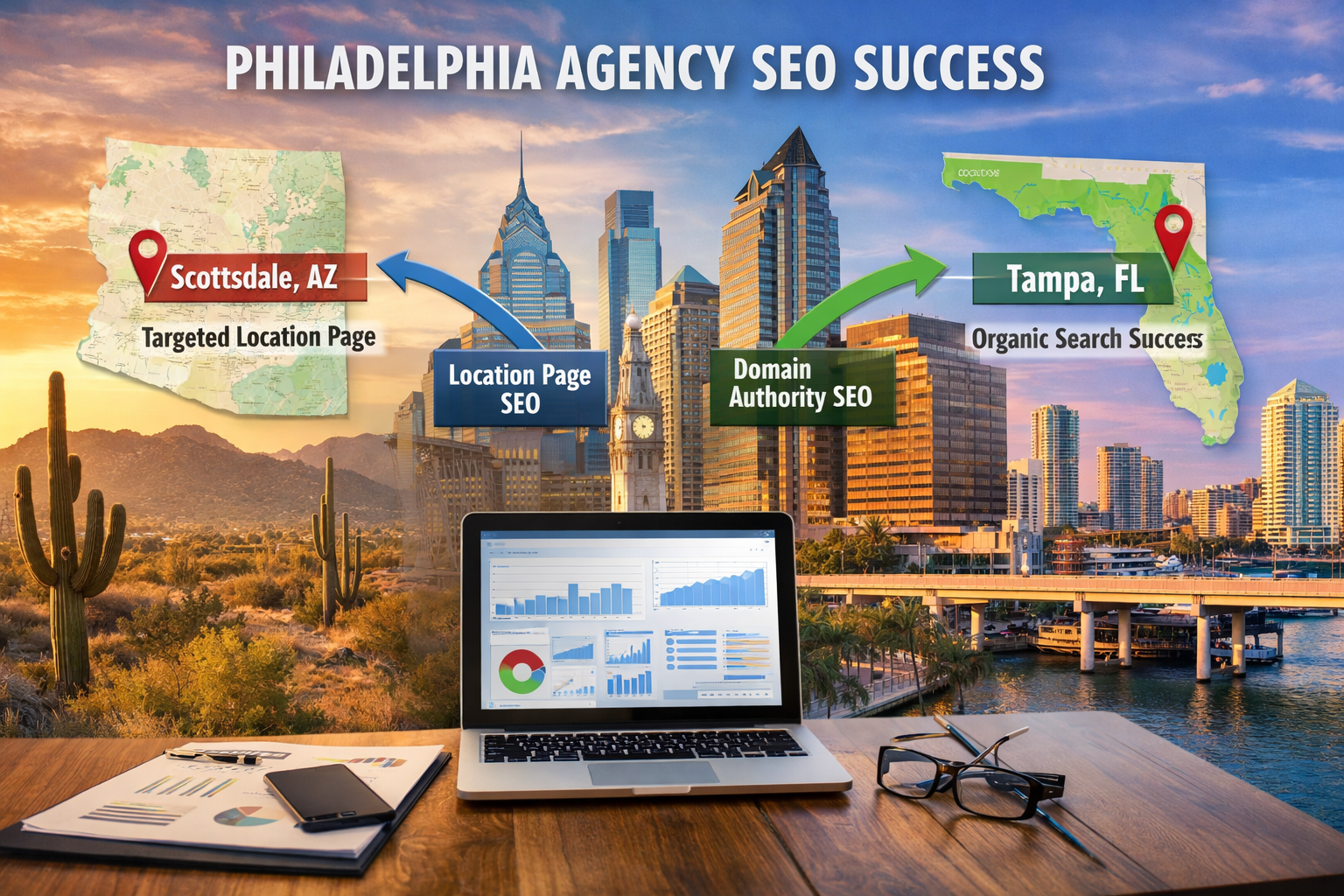
This month — not this year, this month — Ritner Digital received an inbound lead from a commercial real estate developer in Scottsdale, Arizona and an inbound lead from an apartment valet trash and bulk junk removal services company in Tampa, Florida.
We are a Philadelphia marketing agency. Here is what makes this story interesting — and what makes it a genuinely useful illustration of how SEO actually works at its best.
The Scottsdale lead came in through a location page we had built specifically targeting the Scottsdale market. That is the SEO playbook working as designed — identify a market, build a page targeting it, earn the ranking, receive the lead. Deliberate, strategic, measurable.
The Tampa lead? We do not have a Tampa location page. We were not targeting Tampa. We had not built any content specifically aimed at the Tampa market. That lead came in because our domain authority and our broader content presence was strong enough that Google surfaced us as a relevant result for whatever that prospect searched — without us ever specifically pursuing their market.
Two leads. Two different SEO mechanisms. Both working. Both generating inbound inquiries for a Philadelphia agency from markets hundreds of miles away without a dollar of paid advertising behind either of them.
That is the full picture of what a working national SEO model looks like — and it is worth understanding both parts of it.
Why People Write Off SEO — And Why They're Wrong
Bad SEO Created a Generation of Skeptics
The SEO industry spent a significant portion of the 2010s earning its bad reputation. Keyword stuffing. Link farms. Exact-match anchor text schemes. Content written for crawlers rather than humans. Black hat tactics that produced short-term ranking gains and long-term algorithmic penalties. Agencies that charged monthly retainers for work nobody could explain, delivering reports full of metrics that had no relationship to business outcomes.
If your experience with SEO involved any of that — and a lot of businesses' experiences did — your skepticism is understandable and historically justified. You paid for something that did not work, or worked briefly before Google updated its algorithm and wiped out whatever gains had been made.
That version of SEO is genuinely dead. Good. It should be.
What replaced it is harder to game, slower to show results, and significantly more durable when done correctly. Modern SEO is built on content that actually answers questions people are asking, on technical site infrastructure that makes it easy for search engines to understand what a business does and who it serves, on genuine topical authority built through consistent and credible publishing, and on the kind of patient compounding investment that produces inbound leads from markets you never specifically targeted — because your content and your domain authority were strong enough that Google trusted you to be relevant there anyway.
That last part is the Tampa lead. And it only happens when the foundation is genuinely strong.
"AI Killed SEO" Is the New "SEO Is Dead"
Every few years a new version of the SEO obituary gets written. Google's algorithm updates were supposed to kill it. Social media was supposed to replace it. Mobile was supposed to break it. Voice search was supposed to make it irrelevant. AI is the latest chapter in that narrative — the argument being that if ChatGPT and Perplexity are answering questions directly, nobody is clicking through to websites anymore and therefore ranking in search does not matter.
The problem with this argument is the same problem every previous version had: it confuses a change in the landscape with the elimination of the opportunity. Yes, AI Overviews and zero-click searches mean that some informational queries no longer generate website visits. Yes, some users are starting their research in AI tools before ever going to Google. These are real shifts that any serious SEO strategy needs to account for.
But here is what is also true: Google still processes more than 8.5 billion searches per day. High-intent commercial searches — the searches that produce leads and customers, not just readers — still generate clicks to websites at high rates because people making purchase decisions want to evaluate sources, not just receive summaries. And the AI systems that are answering questions are synthesizing content from websites — meaning the businesses with the strongest content and the most authoritative web presence are the ones being cited and recommended by AI, not the ones being replaced by it.
SEO did not die when AI arrived. The bar for what good SEO looks like got higher. The businesses that clear that bar are generating inbound leads from markets they never advertised in. We know because it happened to us this month — twice, through two different mechanisms.
"It Takes Too Long" Is a Planning Problem, Not an SEO Problem
The timeline objection to SEO is the most legitimate of the common criticisms — and it is still being used wrong. SEO does take time. Meaningful organic search visibility for competitive terms in most markets takes months to build, not days. Anyone telling you otherwise is either lying or selling you something that will not last.
But "it takes time" is an argument for starting sooner, not an argument for not starting. The domain authority that allowed Tampa to happen — a market we never specifically targeted producing an inbound lead anyway — was built over time through consistent content investment, technical SEO work, and the accumulation of trust signals that tell Google this is a site worth ranking. That does not happen in ninety days. It also does not stop happening once it starts. It compounds.
The businesses generating consistent inbound leads from organic search today made the investment months or years ago. The businesses that dismissed SEO because it takes too long are no closer to that compounding engine today than they were when they made that decision — and they are further behind the competitors who did not wait.
The Two SEO Mechanisms — Both Working Simultaneously
The Deliberate Play: Location Pages and Targeted Market Expansion
The Scottsdale lead illustrates the most intentional version of geographic SEO expansion — building location-specific pages that target specific markets you want to penetrate. This is a well-established tactic and one of the most direct ways a business can use SEO to expand its geographic reach without expanding its physical footprint.
A location page built correctly is not a thin page that swaps city names into a generic template. It is a genuinely useful, locally relevant page that addresses the specific market — its competitive landscape, its business environment, the specific challenges or opportunities that make it distinctive as a market for whatever you are offering. It signals to Google that your business has genuine relevance in that geography, not just a passing reference to the city name.
For businesses looking to expand into new regions — new metro areas, new states, adjacent markets — a coordinated location page strategy is one of the most cost-effective tools available. The investment is in content creation and the ongoing SEO maintenance of those pages. The return is inbound leads from markets you have targeted without the overhead of physical presence, local advertising spend, or sales team deployment in each new geography.
The Organic Spillover: When Domain Authority Does the Work for You
The Tampa lead is the more interesting story from a pure SEO perspective — and the one that illustrates what a genuinely strong organic foundation produces over time.
We did not build a Tampa page. We did not target Tampa. We did not do anything specifically aimed at generating leads from the Tampa market. But our domain authority — the accumulated trust signal that Google assigns to a site based on the quality of its content, the strength of its backlink profile, the consistency of its technical performance, and the overall credibility of its web presence — was strong enough that when a property management services company in Tampa searched for whatever they searched for, Google decided we were a relevant enough result to surface.
This is the compounding return that makes SEO genuinely different from paid advertising as a long-term investment. A paid search campaign generates leads in the markets you are bidding in, for the keywords you are bidding on, for exactly as long as you are paying for it. A strong organic foundation generates leads in markets you deliberately targeted and in markets you never thought to target — because Google's assessment of your site's authority and relevance extends beyond the specific pages you built and into the broader topical territory your site has established credibility in.
The Tampa lead was not luck. It was the downstream return on the content investment that built the domain authority that made it possible. That is the SEO model at full maturity — and it is what we are trying to build for every client we work with.
Why Both Mechanisms Matter and Neither Is Sufficient Alone
The deliberate location page strategy without strong underlying domain authority produces thin pages that do not rank. The domain authority without deliberate geographic targeting produces organic spillover into markets you did not plan for — which is valuable but not a substitute for a coordinated expansion strategy.
The combination is what produces a genuinely scalable national SEO model. Strong domain authority built through content quality, technical excellence, and topical credibility gives every deliberate location page a foundation to rank from. Deliberate location pages expand the geographic surface area from which inbound leads can come. Each reinforces the other — and the whole becomes significantly more valuable than the sum of its parts.
That is the model. Scottsdale was deliberate. Tampa was organic spillover. Both produced leads. Neither cost a dollar in paid advertising.
Who This Model Works For — And Who We Want to Help Build It
Automotive Groups
Automotive groups — multi-location dealership networks, used vehicle retailers, specialty automotive services — are one of the most compelling opportunities for this kind of national SEO model. The search volume around automotive purchase decisions, service needs, financing questions, and brand comparisons is enormous and geographically distributed across every market the group operates in.
The common pattern in automotive group marketing is heavy investment in paid search for immediate inventory promotion and thin investment in organic authority building. The result is customer acquisition cost that scales linearly — every lead costs what the paid search platform charges for it, forever. An organic SEO investment running alongside the paid program builds a compounding lead source that reduces that cost over time. The dealership groups that built organic authority years ago are generating a portion of their leads today at near-zero marginal cost. The ones that did not are still paying full freight for every click.
A multi-location automotive group is also one of the best use cases for the deliberate location page model — building market-specific content for every geography the group serves, creating a coordinated organic presence that covers every market simultaneously rather than running separate paid campaigns in each one.
Professional Services Firms
Law firms, accounting firms, financial advisors, management consultants, engineering firms — the professional services category represents some of the highest-value SEO opportunities in the market. The combination of high search intent, high deal value, and long client lifetime creates economics where a single organically generated lead can produce returns that dwarf the cost of the content investment that generated it many times over.
Professional services firms also benefit disproportionately from the domain authority spillover mechanism — the Tampa effect. A law firm that has built genuine topical authority in its practice areas will receive inbound inquiries from prospective clients in markets it never specifically targeted because its content established credibility that extends beyond the geographies it deliberately pursued. For a firm looking to expand its geographic reach without opening new offices or hiring new business development personnel in each market, this organic spillover is exactly the kind of leverage that makes SEO one of the highest-return marketing investments available.
Property Management and Real Estate Services
The Tampa lead itself — an apartment valet trash and bulk junk removal services company — illustrates precisely how this model works for businesses serving the property management and real estate ecosystem. Property management companies, real estate developers, multifamily housing operators, HOA management firms, and the vendors that serve them all operate in a market with significant and consistent search volume from decision-makers who are actively looking for solutions to specific operational problems.
A service company that builds content authority around the specific challenges property managers face becomes the answer that shows up when property managers in new markets search for those solutions. The commercial real estate developer in Scottsdale found us through a deliberate location page. The Tampa property management services company found us through organic domain authority. Both mechanisms are available to service businesses in this vertical — and the ones building both simultaneously are expanding their geographic reach without expanding their marketing budget proportionally.
Healthcare and Wellness Practices
Multi-location healthcare practices, specialty medical groups, dental service organizations, and wellness brands operate in a category with some of the highest search intent volume in the entire economy. People searching for healthcare solutions are almost always in an active decision-making process and the conversion value of an organically generated patient or client lead is significant.
The location page model is particularly valuable for healthcare groups expanding into new markets — building authoritative, locally relevant pages for each new geography establishes organic search presence in new markets ahead of or alongside physical expansion. And the domain authority spillover model generates inbound inquiries from patients willing to travel or seek remote consultation in specialties where the brand has established genuine online authority.
Home Services and Contractor Networks
Regional and national home services brands — HVAC, plumbing, electrical, roofing, remodeling, landscaping — operate in a category where local search intent is extremely high and where the combination of location-specific SEO and broader domain authority can produce significant inbound lead volume across multiple service markets simultaneously.
A contractor network operating across multiple states that builds organic search authority in each of its markets reduces its dependence on paid lead generation platforms — the home services aggregators that charge significant fees for leads that are simultaneously being sold to multiple competitors. Organic leads generated through SEO are exclusive. The prospect found you specifically. The economics of owned organic lead generation versus purchased shared leads in home services are dramatically favorable to the brands that have made the SEO investment — and the location page model maps directly onto how these businesses are already organized by service territory.
The Conversation We Want to Have
What We Are Looking to Build
We are not looking to sell SEO as a commodity service measured by keyword rankings and monthly traffic reports. The model that generated inbound leads from Scottsdale and Tampa for a Philadelphia agency — one through deliberate targeting, one through organic domain authority — is the model we want to build for the right clients.
The conversation we want to have is with business owners and marketing decision-makers who understand that sustainable inbound lead generation requires genuine investment in content authority and technical SEO foundation, who have enough patience to let the compounding returns build over the timeline they actually take to build, and who are interested in what it looks like when a business starts receiving leads from markets it never specifically targeted because the SEO foundation is strong enough to make that happen.
We are specifically looking to work with automotive groups, professional services firms, property management and real estate service businesses, healthcare practices, and contractor networks that have real search demand in their categories and are ready to build the organic engine that captures it.
What Working With Ritner Digital on SEO Looks Like
We start with an honest assessment of where you are — your current organic visibility, your competitive landscape, the search demand that exists for what you offer, and the realistic gap between where you rank today and where the opportunity is. We build a strategy that combines both mechanisms: deliberate location page development for the markets you want to target, and broader domain authority investment through content and technical SEO that creates the conditions for organic spillover into markets you did not specifically target.
We measure it in business outcomes — inbound leads and qualified traffic — not just rankings and domain authority scores. Rankings are inputs. Leads are outputs. The model we build is pointed at the output.
And we build it the same way we built our own — because the Scottsdale and Tampa leads did not come from a case study we designed to prove a point. They came from actually doing the work.
The Bottom Line
Two inbound leads this month. One from a market we targeted deliberately with a location page. One from a market we never targeted at all — because the domain authority we built was strong enough that Google surfaced us there anyway.
That is the full picture of what SEO actually does when it is done correctly. It is not just about ranking for the keywords you targeted in the cities you built pages for. It is about building a foundation of authority and relevance that produces returns in places and from prospects you never specifically planned for — because Google's assessment of your credibility extends further than your deliberate targeting does.
Scottsdale was the strategy working. Tampa was the strategy working better than the strategy. Both are available to the automotive groups, professional services firms, property management companies, healthcare practices, and contractor networks that are ready to build this model for themselves.
The businesses writing off SEO are leaving those leads for someone else. We would rather help you be the someone else.
Frequently Asked Questions
The Scottsdale and Tampa Story
Q: What exactly happened with the Scottsdale and Tampa leads — can you break it down simply?
Two inbound leads came in this month from markets hundreds of miles from our Philadelphia headquarters — no paid advertising, no referrals, no cold outreach on our end. The Scottsdale lead came through a location page we had deliberately built targeting the Scottsdale market. We identified Scottsdale as a market we wanted to reach, built a page specifically aimed at ranking for relevant searches in that geography, earned the ranking, and received the lead. The Tampa lead is the more interesting one — we do not have a Tampa location page. We were not targeting Tampa. We had not built any content specifically aimed at the Tampa market. That lead came in because our overall domain authority and content presence was strong enough that Google decided we were a relevant result for whatever that prospect searched, even in a market we had never deliberately pursued. One lead was the strategy working as designed. One lead was the strategy working better than the strategy. Both are real mechanisms and both are available to businesses that build the right SEO foundation.
Q: Is the Tampa lead just luck or is there a repeatable mechanism behind it?
It is not luck — it is the downstream return on a foundation that was deliberately built, even if Tampa specifically was not part of the plan. Domain authority is Google's assessment of how credible, trustworthy, and relevant your site is across the topics it covers. That authority does not stop at the geographic boundaries you deliberately targeted. When your site has built genuine authority in your category — through content quality, technical SEO performance, backlink credibility, and consistent publishing — Google extends that authority into searches and markets that your deliberate targeting never reached. The Tampa lead happened because the foundation was strong enough to earn relevance in a market we never built for. That is repeatable. It happens when the foundation is genuinely strong, not when you get lucky. The way to get more Tampa leads is to keep building the foundation that made the first one possible — not to hope for lightning to strike again.
Q: What did the Scottsdale location page actually contain that made it rank?
A location page that ranks is not a thin page that swaps a city name into a generic template and calls it local SEO. That approach used to work and has not worked for years. A location page that earns a ranking in a competitive market is a genuinely useful, locally relevant page that addresses the specific market — its business environment, its competitive landscape, the specific challenges or opportunities that make it distinctive as a market for the services being offered. It signals to Google that the business has genuine relevance in that geography through substantive content, not just a mention of the city name. It is structured correctly so Google understands what the page is about and who it serves. And it sits on a domain with enough overall authority that Google trusts it to rank for competitive terms in a market where the business does not have a physical presence. All three of those elements — content substance, technical structure, and domain authority foundation — have to be in place for a location page to earn and hold a meaningful ranking.
Q: How many location pages do you recommend building and how do you decide which markets to target?
The number is less important than the quality and the strategic logic behind the selection. Building fifty thin location pages targeting fifty cities is not a national SEO strategy — it is a shortcut that Google has become very good at identifying and discounting. The right approach starts with identifying the markets where genuine business opportunity exists — where the search demand for your services is meaningful, where the competitive landscape in organic search is winnable given your current domain authority, and where converting a lead from that market into a client or customer is realistic given your operational capacity to serve it. For most businesses starting a location page program, building five to ten genuinely strong pages in the highest-priority markets and earning rankings in those markets produces better results than building thirty thin pages that rank for nothing. Quality compounds. Quantity without quality does not.
Understanding SEO Skepticism
Q: What is the most legitimate criticism of SEO and how do you respond to it?
The timeline is the most legitimate criticism and it deserves a straight answer rather than a dismissive one. SEO genuinely takes time. Building the domain authority that produced the Tampa lead did not happen in ninety days. Building the content and technical foundation that earned the Scottsdale location page its ranking did not happen in ninety days. For businesses that need leads next week, SEO is not the answer — paid search is, and there is nothing wrong with that. The honest response to the timeline criticism is that it is an argument for starting sooner, not an argument for not starting. The businesses generating consistent organic inbound leads today made the investment months or years ago. The businesses that dismissed SEO because it takes too long are no closer to that compounding engine today than they were when they made that decision. The question is not whether you want leads next week or next month — it is whether you want a lead generation system in eighteen months that does not require you to pay for every single lead it generates. If the answer is yes, the time to start is now, not when the timeline feels more convenient.
Q: How do you respond to the argument that AI has made SEO irrelevant?
By pointing out that AI and SEO are not in opposition — they are increasingly the same investment. When someone asks ChatGPT, Perplexity, or Google's AI Overview a question and receives an answer, that answer was synthesized from content that exists on the web. AI does not generate knowledge from nothing. It retrieves and synthesizes existing information from websites, articles, and published content that real businesses created and published on domains they control. A business with no website and no published content is invisible to AI search — it has given AI systems nothing to work with. The businesses appearing in AI-generated answers are the businesses with strong, authoritative, well-organized web presences that AI systems can find, read, and confidently cite. The content investment that earns organic search rankings and the content investment that earns AI citation are the same investment. Far from making SEO irrelevant, AI search raises the bar for what good SEO looks like and rewards the businesses that meet that bar in two channels simultaneously.
Q: What about the argument that paid search is just faster and more predictable than SEO?
Paid search is faster and more immediately predictable — and it is also more expensive per lead, stops generating leads the moment you stop paying for it, and gets more expensive over time as competition for the same keywords increases. SEO is slower to build and less immediately predictable — and it generates leads at lower marginal cost once established, continues generating leads independent of ongoing spend, and gets more valuable over time as domain authority compounds. These are not competing arguments for one approach being better than the other. They are descriptions of two tools with different characteristics that serve different functions in a complete marketing program. The businesses that run both — paid search for immediate lead volume and SEO for compounding long-term lead generation — have the most resilient customer acquisition model. The businesses that run only paid search are entirely dependent on their ad budget for every lead they receive, forever. The businesses that run only SEO are leaving immediate opportunities on the table while the organic foundation builds. The answer is both, sequenced intelligently based on the business's stage, budget, and timeline requirements.
The National SEO Model
Q: How does a business based in one city generate leads from completely different markets through SEO?
Through two mechanisms that work simultaneously and reinforce each other. The first is deliberate geographic targeting — building location-specific pages that address the markets you want to penetrate, structured and written in ways that earn rankings for relevant searches in those geographies. The second is domain authority spillover — the organic extension of your site's credibility into markets you never specifically targeted, because Google's assessment of your site's authority and relevance is not confined to the geographic boundaries of your deliberate targeting. The Scottsdale lead was the first mechanism. The Tampa lead was the second. A business that builds both — deliberately targeting its highest-priority markets with location pages while simultaneously investing in the domain authority that enables organic spillover — is building geographic reach that expands in two directions at once. And critically, neither direction requires a physical presence, a local advertising budget, or a sales team deployed in each new market.
Q: What is domain authority and how does a business actually build it?
Domain authority is Google's overall assessment of how credible, trustworthy, and relevant a website is — the accumulated trust signal that determines how broadly and confidently Google will rank that site's content across topics and geographies. It is not a single metric — it is the composite result of multiple signals including the quality and depth of the content published on the site, the quality and quantity of other credible sites that link to it, the technical performance of the site including load speed and mobile experience, the consistency and accuracy of the information it presents, and the length of time it has been publishing quality content. Building domain authority is not a single tactic — it is the ongoing result of doing many things correctly over a sustained period. Publishing genuinely useful content in your category consistently. Earning backlinks from credible sources through content that other sites find worth referencing. Maintaining technical SEO fundamentals that make the site fast, accessible, and easy for search engines to crawl. And being patient enough to let the compounding effect of those investments build over the timeline it actually takes to build. There is no shortcut to genuine domain authority — which is exactly why the businesses that have built it have a competitive advantage that is difficult to replicate quickly.
Q: Is the location page model scalable or does it hit diminishing returns at some point?
It scales well when executed correctly and hits diminishing returns when executed incorrectly. Building a small number of genuinely strong, locally relevant location pages in high-priority markets and earning real rankings in those markets is highly scalable — each page that ranks produces ongoing inbound leads from that market without ongoing incremental cost. Building a large number of thin, templated location pages that swap city names into generic content does not scale — Google identifies and discounts this approach, the pages do not rank, and the investment produces nothing. The practical ceiling for a location page program is the number of markets where you can build genuinely useful, locally distinctive content and where your domain authority is sufficient to rank competitively. For most businesses that ceiling is well above the number of markets they are actively pursuing — the limiting factor is content quality and strategic discipline, not the model itself.
Industry-Specific Questions
Q: How does the national SEO model apply specifically to automotive groups?
Automotive groups are one of the best use cases for the combined location page and domain authority model because the business is already organized by geography — multiple locations serving multiple markets — and because the search demand in automotive is enormous, specific, and geographically distributed. A dealership group with locations in five markets should have location-specific SEO presence in each of those markets built on a shared domain authority foundation that makes every individual location page stronger than it would be on a standalone site. Beyond the location pages, automotive groups have significant content opportunities in vehicle research, financing guidance, service education, and local market insights that build domain authority while addressing the specific questions automotive buyers are searching for at every stage of their purchase journey. The groups that build this foundation reduce their dependence on paid search for every digital lead — which in automotive is a significant cost reduction given how competitive paid automotive keywords are.
Q: For professional services firms specifically, what does the content strategy look like?
Professional services content strategy is built around demonstrating genuine expertise in the firm's practice areas — publishing content that answers the specific questions prospective clients are searching for when they are in the process of identifying whether they need professional help and evaluating who to hire. For a law firm, that means practice area content that addresses the questions people ask when they are facing the situations the firm handles — not just "what is a personal injury attorney" but the specific, detailed questions that someone who has just been injured and is trying to understand their options is actually searching for. For an accounting firm, it means content around the specific tax situations, business structures, and financial challenges that the firm's ideal clients navigate. The content that earns both organic rankings and AI citation in professional services is substantive, specific, and genuinely useful to the prospective client who finds it — not generic enough to be safe and not promotional enough to be useless. Firms that publish that kind of content consistently build topical authority that extends their geographic reach far beyond the markets they have physical presence in.
Q: How long before a property management service company in a new market would expect to see inbound leads from an SEO investment?
For a deliberately targeted market with a well-built location page, on a domain with existing authority, meaningful ranking improvement typically begins within three to six months and lead generation from those rankings typically follows within six to twelve months. For a domain that is earlier in its authority-building journey, the timeline extends accordingly — the location pages need the domain authority foundation beneath them to rank competitively, and building that foundation takes time. For organic spillover into non-targeted markets — the Tampa mechanism — the timeline is less predictable because it is a function of when domain authority crosses the threshold where Google begins extending it into new geographic territory. What is predictable is the direction: every month of consistent SEO investment moves the timeline forward, and every month of inaction moves it further away. The businesses receiving organic inbound leads from new markets today started building the foundation that made those leads possible at some point in the past. The best time to start is the same as it always is.
Q: We are a contractor network operating across multiple states. How would you approach our SEO differently than a single-location business?
A multi-state contractor network has both more complexity and more opportunity than a single-location business in SEO terms. The complexity is in managing consistent brand signals, NAP data accuracy, and content quality across a large number of locations simultaneously — the things that create confusion for search engines when done inconsistently are multiplied across every location in the network. The opportunity is in the network effect of multiple locations building shared domain authority — a well-structured multi-location SEO program makes every individual location stronger than it would be as a standalone site, because the domain authority built by the network benefits every location page within it. The approach we would take starts with the technical foundation — a unified domain architecture with properly structured location pages, consistent and accurate business information across every directory and citation source, and Google Business Profile optimization for every location. On top of that foundation goes the content program — building topical authority in the specific service categories the network covers, creating locally relevant content for the highest-priority markets, and developing the kind of educational and trust-building content that earns backlinks and domain authority over time. The result is a network where every location benefits from the authority built by every other location — which is a compounding advantage that no collection of independent single-location sites can replicate.
Q: What is the first thing a business should do if they want to start building toward this kind of national SEO model?
Get an honest assessment of where you actually are before spending a dollar on execution. That means understanding your current organic visibility — what you rank for, what you do not rank for, and what the gap is between your current position and where the real search demand in your category is. It means understanding your domain authority relative to the competitors who are currently ranking for the terms you want to rank for — because that gap determines the timeline and investment required to compete. It means understanding what search demand actually exists for your services in the markets you want to penetrate, so that the location pages you build are targeting real opportunity rather than geographic markets where nobody is searching for what you offer. And it means being honest about your content capacity — who is going to create the genuinely useful, authoritative content that earns rankings and domain authority, on what timeline, and to what standard of quality. Starting with that honest assessment produces a strategy that is calibrated to your actual starting point rather than a generic SEO playbook that was built for someone else's situation. That is where we start with every client — and it is where we would start with you.
Ritner Digital is a Philadelphia-based digital marketing agency generating inbound leads for clients across the country through SEO, content strategy, web design, and paid media. To talk about what a national SEO model could look like for your business, visit ritnerdigital.com or call (703) 420-9757.