Ritner Digital's Top Swag and Conference Giveaway Picks for 2026
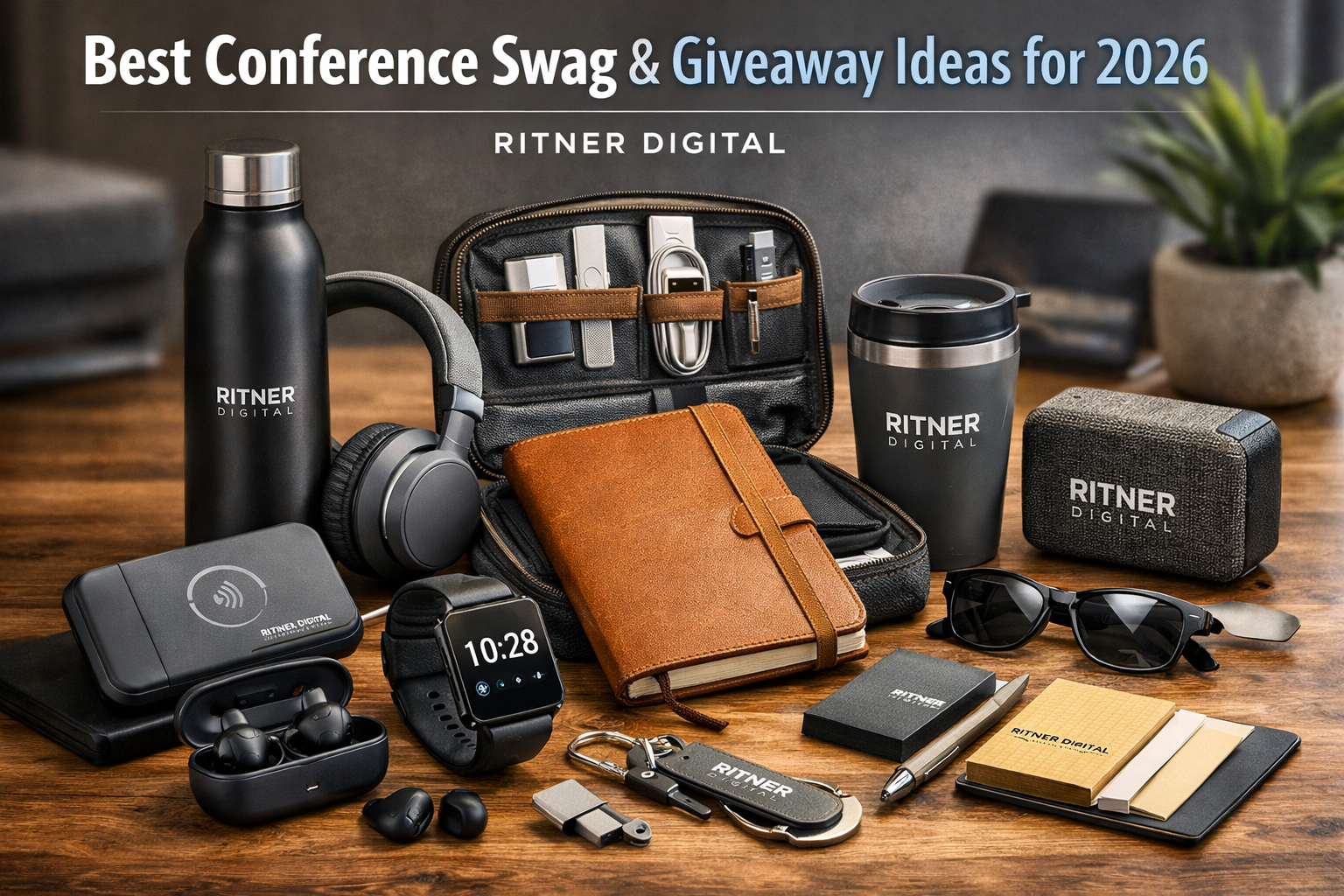
Let's settle something first.
Swag is not dead.
Every few years someone writes a think piece about how branded merchandise is a waste of marketing budget and nobody wants another cheap pen with a logo on it. And they're half right — nobody wants another cheap pen with a logo on it. But that's an argument against bad swag, not against swag itself.
Done right, conference giveaways and branded merchandise are one of the highest-ROI tactile marketing investments a business can make. A genuinely useful, well-made piece of branded merchandise sits on someone's desk, travels in their bag, gets used in meetings, and puts your name in front of them — and everyone around them — every single day. That's ambient brand exposure that no digital ad can replicate.
The key word is genuinely useful. The graveyard of conference swag is full of stress balls, cheap tote bags, and USB drives that nobody needed in 2019 and nobody needs now. The brands that win at swag in 2026 are the ones giving people things they actually want to keep — things that are high quality, relevant to how professionals actually live and work, and branded with enough restraint that the item itself is the draw rather than the logo being the distraction.
Here are our top picks for 2026 — the swag that gets kept, gets used, and keeps your brand visible long after the conference ends.
1. Premium Insulated Tumblers and Bottles
This category has been hot for several years and it's not cooling down — because it works. A high-quality insulated tumbler from a brand like Stanley, YETI, Hydro Flask, or their well-made private label equivalents is something people genuinely use every single day. It goes to the office, to the gym, on the commute, to the next conference. Every time it's out on a desk or a table, your logo is visible.
The reason this category keeps winning is quality differentiation. A $8 tumbler with a logo screams budget. A $35 to $50 premium insulated bottle with tasteful logo placement says something completely different about your brand. The item quality communicates brand quality — and in a conference environment where every vendor is handing out something, a genuinely premium item stands out immediately.
For 2026 the specific trend is toward cleaner, more minimal branding — a small logo or wordmark rather than a full wraparound print, premium matte or powder coat finishes in neutral colors, and lid designs that are actually functional rather than the flimsy plastic lids that come on budget versions. If you're going to do tumblers, do them right. The difference in cost between a forgettable one and a genuinely great one is $15 to $20 per unit. The difference in how long people keep them is years versus the trash can before they leave the conference hall.
Best for: Any business attending conferences where professionals are the audience. Universal appeal, universal utility.
Budget range: $25 to $55 per unit for premium versions worth giving.
2. High-Quality Notebooks and Journals
In a world where everyone is staring at a screen all day, a genuinely nice notebook is a surprisingly powerful piece of swag — because it fills a real need in a tactile, satisfying way that a digital tool doesn't.
The key word again is quality. A flimsy spiral notebook with a logo on the cover ends up in the recycling bin. A hardcover, lay-flat notebook with thick paper, a ribbon bookmark, and an elastic closure — something that feels like it belongs on a professional's desk — gets used. Leuchtturm1917 and Moleskine are the gold standard references here. Branded versions of notebooks at this quality level run more than a budget notebook but produce dramatically better results in terms of retention and daily use.
For 2026 the trend is toward dot-grid or mixed-format notebooks rather than pure lined — because professionals are using notebooks for everything from meeting notes to quick diagrams to personal journaling, and dot-grid serves all of those uses better than lined paper alone. Pairing a quality notebook with a good pen — a matte black ballpoint or rollerball that actually writes well — is a combination that consistently gets positive reactions at conferences and trade shows.
The notebook-and-pen combination also has a practical advantage: it's relatively compact and lightweight to ship or carry to a conference, which matters for logistics, and it has a natural price point that feels premium without breaking the per-unit budget.
Best for: Professional services, consulting, financial services, B2B technology — any business whose clients are knowledge workers who value quality tools.
Budget range: $18 to $35 per unit for notebook alone, $25 to $45 for notebook-and-pen combo.
3. Portable Chargers and Power Banks
The universal pain point of every conference, every trade show, and every long travel day is a dying phone battery. A well-made portable charger solves that problem — which means it gets used immediately, often at the conference itself, where everyone around the person using it can see your logo.
This category has matured significantly and the quality range is wide. The budget versions feel cheap, charge slowly, and often stop working within a few months. The quality versions — from brands like Anker, Mophie, or equivalent — are slim, fast-charging, support multiple device types including USB-C, and last for years. For 2026 the specific trend is toward slim, card-style chargers that fit in a wallet or a front pocket rather than the bulkier brick-style power banks that dominated earlier years.
The branding opportunity here is significant because power banks travel. They go to airports, hotels, coffee shops, and the next conference. A well-branded power bank with a clean logo and premium finish is mobile advertising that goes wherever your client goes — which is a different kind of exposure than something that sits on a desk.
One practical consideration: check airline regulations for lithium battery capacity before ordering in bulk for conference giveaways. Most events and airlines have limits on battery capacity that affect which power bank specifications are appropriate for conference distribution.
Best for: Technology companies, any business with a travel-heavy client base, conferences where mobile connectivity is a pain point.
Budget range: $20 to $45 per unit for quality versions worth giving.
4. Branded Apparel — But Only If You Do It Right
Branded apparel is the highest-risk, highest-reward category in conference swag. Done wrong — a stiff polo with a logo embroidered on the chest in a size that fits nobody — it ends up in a donation bag within a week. Done right, it becomes something people actually wear, which is the most powerful form of walking brand advertising that exists.
The difference between apparel that gets worn and apparel that gets donated comes down to three things: quality of the garment, subtlety of the branding, and relevance to how people actually dress.
For 2026 the apparel categories that are winning at conferences are premium quarter-zip pullovers and lightweight performance jackets in neutral colors — navy, charcoal, black, olive — with small, tasteful logo placement on the chest or sleeve. Not a giant logo across the back. Not a bright color that screams "I got this free at a conference." A well-made garment in a color someone would have bought themselves, with branding subtle enough that it reads as a quality piece rather than a walking advertisement.
The brands that are doing this well are using blanks from premium manufacturers — Charles River, Cutter & Buck, Patagonia, Arc'teryx for higher budgets — rather than the commodity apparel brands that produce the stiff, uncomfortable garments that define bad conference swag. The per-unit cost is higher but the likelihood of the item being worn in public — where it actually functions as brand advertising — is dramatically higher.
Size selection is a practical challenge for conference giveaways. The solution most brands are moving toward is offering size selection at the booth — attendees pick up a card, enter their size online, and receive the item shipped directly. This eliminates the waste of ordering inventory in sizes nobody wants and produces a better impression because the recipient gets something that actually fits.
Best for: Brands with strong visual identity and enough budget to do apparel properly. Not recommended for tight per-unit budgets.
Budget range: $45 to $95 per unit for premium apparel worth wearing.
5. Desk and Workspace Accessories
As remote and hybrid work has become permanent for a large portion of the professional workforce, home office and desk setups have become something people care about and invest in. Branded desk accessories that are genuinely well-made tap into that investment mentality — they go on a desk that gets used every day, in a space the person has put effort into creating.
The specific items that are winning in this category for 2026 include premium cable organizers and cord management solutions — genuinely useful for anyone with a laptop setup. Wireless charging pads with clean branding that sit on a desk and charge devices throughout the day. Minimalist desk organizers in materials like concrete, wood, or brushed metal that look like something someone would buy rather than something they received for free. Phone and tablet stands in premium materials. Small succulent or plant kits that add life to a workspace and carry a small branded card rather than a logo stamped on the pot.
The underlying principle is the same as every other category on this list: the item has to be something the recipient genuinely wants in their space. If it looks like swag, it gets treated like swag. If it looks like something they would have bought themselves, it becomes part of their daily environment — and your brand becomes part of their daily environment with it.
Best for: B2B companies whose clients work primarily from offices or home offices. Particularly strong for technology, financial services, consulting, and professional services.
Budget range: $15 to $50 per unit depending on item and material quality.
6. Premium Tote Bags and Utility Bags
Before you roll your eyes — we're not talking about the flimsy canvas tote bags that every conference has been giving away for twenty years. We're talking about genuinely well-made utility bags that solve a real problem people have at conferences and in daily life.
The specific items performing well in 2026 are structured tote bags in waxed canvas or heavy-duty materials with interior organization — a laptop sleeve, card pockets, a water bottle holder — that function as a real everyday bag rather than a grocery bag with a logo. Conference-specific tote bags designed to hold a laptop, a notebook, a water bottle, and all the materials someone accumulates during a multi-day event are genuinely useful during the conference and continue to be used afterward.
Crossbody bags and small utility pouches in quality materials are also performing well — compact enough to be practical, premium enough to be worth keeping, and useful enough to travel well beyond the conference.
The branding approach that works here is the same as apparel: small and tasteful rather than large and prominent. A small embossed or embroidered logo on a quality bag reads as a brand mark. A large printed logo on a cheap bag reads as advertising nobody asked for.
Best for: Any conference with a multi-day format where attendees need to carry materials. Strong for professional services and B2B brands.
Budget range: $25 to $65 per unit for quality versions worth keeping.
7. Experiential and Consumable Swag
Not all great conference swag is a physical object you keep forever. Some of the most memorable conference giveaways are experiences or consumables — things that create a moment rather than a memento.
Premium food and beverage gifts are experiencing a significant resurgence in conference swag. Locally sourced items — artisan coffee from a roaster in your city, small-batch chocolate, premium hot sauce, specialty snacks — create a memorable, shareable moment and communicate something genuine about your brand's personality and local identity. For a Philadelphia-based agency like Ritner Digital, showing up at a conference with something from a well-regarded Philly maker is a conversation starter and a brand statement simultaneously.
Curated gift boxes that combine several small premium items — a quality candle, a small notebook, a specialty snack, a branded item — create an unboxing experience that feels thoughtful rather than transactional. These work particularly well as follow-up gifts sent to key prospects or clients after a conference rather than as broad giveaways at a booth.
Experience-based giveaways — a free audit, a consultation, a strategy session, a tool subscription — are technically swag too, and they're often the highest-converting giveaway a B2B company can offer at a conference. They get your best prospects into a conversation rather than just into a tote bag.
Best for: Brands with strong local identity, companies targeting a smaller number of high-value prospects rather than mass conference foot traffic.
Budget range: $15 to $75 per unit depending on the specific items included.
8. Tech Accessories for the Modern Professional
Beyond power banks, the broader category of everyday tech accessories offers strong swag opportunities for 2026 — because these are items professionals use constantly and the quality range is wide enough that a genuinely good version stands out immediately.
Premium cable sets — braided USB-C cables in a quality carrying case — are unglamorous but consistently useful. Everyone needs cables and everyone has experienced a cheap cable failing at the worst possible moment. A set of high-quality braided cables in a clean branded case is the kind of swag that gets used immediately and remembered positively.
Webcam covers and privacy screens speak directly to the security consciousness of today's professional audience — small, practical, and subtle enough to use every day. Blue light blocking glasses in a clean branded case are increasingly popular as screen time concerns have gone mainstream. Laptop stickers and custom die-cut stickers in premium vinyl — not the cheap paper stickers of a decade ago — are experiencing a genuine resurgence among younger professionals who use them to personalize their devices.
Wireless earbuds are the highest-impact tech swag available but also the highest-cost — quality versions that people will actually use run $50 to $150 per unit, which makes them appropriate for high-value prospect gifting rather than broad conference giveaways.
Best for: Technology companies, marketing agencies, any brand whose audience skews toward tech-forward professionals.
Budget range: $8 to $35 per unit for most tech accessories, $50 to $150 for wireless earbuds.
The Swag You Should Stop Giving Away in 2026
As important as knowing what to give is knowing what to retire. Here's what to leave off your conference swag list this year:
Cheap pens. Unless it's a genuinely premium pen — a Pilot G2, a Fisher Space Pen, a Uni-ball that actually writes beautifully — a branded pen communicates nothing except that you bought the cheapest item available. If you're going to do pens, do one great pen rather than a handful of forgettable ones.
Stress balls and foam toys. These had a moment. That moment was 2008. Nobody needs a stress ball and nobody is keeping one with your logo on it.
Cheap USB drives. Cloud storage has made USB drives nearly obsolete for most professionals. A cheap USB drive in 2026 is a relic and a waste of budget.
Lanyards. Unless you're organizing the conference itself, giving away lanyards is the most forgettable swag decision you can make. They get used for the duration of the conference and thrown away in the hotel room.
Anything that obviously cost under $5. Budget swag doesn't save you money. It communicates that your brand doesn't value quality — which is the last message any business should be sending at a conference where they're trying to win new clients.
The Underlying Principle of Great Swag
Everything on this list reflects the same underlying principle: great swag is something the recipient would have bought themselves.
If you hold up your conference giveaway and can honestly say "a professional in my target market would genuinely want to own this independently of my logo being on it" — you have good swag. If the logo is the only reason anyone would take it — you have marketing material, not merchandise, and the distinction shows.
The best branded merchandise does two things simultaneously: it delivers genuine value to the recipient, and it keeps your brand visible in a positive context for as long as the item is in use. A premium tumbler that someone uses every day for three years is three years of daily brand exposure. A cheap keychain that gets lost in a drawer is nothing.
Invest in fewer, better items. Brand them with restraint. Give them to the right people rather than everyone who walks by your booth. That's the formula for conference swag that actually builds brand loyalty — and it's been the formula for as long as great merchandise has existed.
One More Thing
At Ritner Digital, we help businesses build brands that people want to be associated with — in their digital presence and in the physical world. If you're thinking about your conference presence, your brand identity, or your marketing strategy for 2026, we'd love to talk about how to make every touchpoint — digital and physical — work harder for your business.
Reach out to Ritner Digital here.
Ritner Digital is a Philadelphia-based full-service digital marketing agency helping businesses build digital presence that converts, ranks, and grows. Learn more at ritnerdigital.com.
Frequently Asked Questions
How much should we budget for conference swag per person?
It depends on who you're giving it to and what you want the item to communicate about your brand. For broad conference giveaways — items you're handing to anyone who stops at your booth — a per-unit budget of $15 to $35 produces items quality enough to keep without breaking the overall swag budget. For targeted giveaways to high-value prospects, key clients, or VIP attendees, spending $50 to $100 per person on something genuinely premium is almost always worth it. The math is simple: if a single new client from a conference is worth $5,000 or $50,000 to your business, spending $75 on a gift that makes a lasting impression on the right ten people is a better investment than spending $5 on something forgettable that you hand to two hundred people.
Should we put our logo on everything or is less branding better?
Less is almost always more when it comes to swag branding in 2026. The items people keep and use are the ones that look like something they would have chosen themselves — and most people don't choose to wear or carry items with large, prominent logos unless the brand itself is a status symbol. A small, tastefully placed logo or wordmark on a quality item reads as a brand mark and communicates confidence. A large logo splashed across a cheap item reads as advertising and communicates desperation. The goal is for the quality of the item to do the work — your logo is there to take credit for a good experience, not to scream for attention.
Is it better to give swag to everyone at a conference or focus on specific people?
For most B2B businesses, targeted is dramatically better than broad. Handing a premium item to fifty highly relevant prospects creates fifty meaningful brand touchpoints. Handing a cheap item to five hundred random conference attendees creates five hundred forgettable ones — most of which end up in the trash before the conference is over. Know who your ideal conference prospect is before you order anything. Bring enough quality items for the people you actually want to connect with, and resist the pressure to have something for everyone who walks by your booth. Scarcity actually works in your favor — an item that not everyone gets is an item that feels worth having.
What swag works best for virtual or hybrid conferences?
Virtual and hybrid conferences have created a strong market for mailed swag boxes — curated packages sent directly to attendees before or after a virtual event. The advantage of mailed swag is that you can include higher-quality items than you'd typically hand out at a physical booth, the unboxing experience creates a memorable moment, and the items arrive in a context where the recipient has time to appreciate them rather than juggling them with a badge and a tote bag full of other things. The most effective virtual swag boxes for 2026 combine one premium branded item — a quality notebook, a tumbler, a tech accessory — with a few locally sourced consumables and a handwritten or personally addressed note. The personal touch matters more in a virtual context where human connection is harder to create.
How far in advance should we order conference swag?
For standard items with straightforward branding, four to six weeks is generally sufficient. For custom or premium items — apparel with embroidery, items requiring special materials or finishes, anything with complex packaging — eight to twelve weeks is safer. The most common swag mistake we see is ordering too late and being forced to choose from whatever is available on a rush timeline — which almost always means lower quality and higher cost. Build your conference swag planning into your broader event marketing calendar at least two to three months out and you'll have enough lead time to get exactly what you want at the right price.
What's the best swag for making an impression at a trade show versus a networking event?
Trade shows and networking events call for different approaches. At a trade show where you have a booth and significant foot traffic, you need items that are compact enough to hand out at volume, appealing enough to draw people to your booth, and quality enough to be kept rather than discarded — tumblers, notebooks, tech accessories, and premium consumables all work well in this context. At a networking event where you're meeting a smaller number of people in a more personal setting, the right swag is more like a gift than a giveaway — something thoughtful and specific that reinforces the conversation you just had. A well-curated small gift presented to someone you've had a genuine conversation with creates a far stronger impression than the same item handed to everyone who passes your trade show booth.
How do we measure whether our conference swag is actually working?
The most direct measure is follow-up conversion — how many of the people you gave swag to ended up in a meaningful business conversation, a discovery call, or a new client relationship. Tracking this requires connecting your conference interactions to your CRM so you can follow the journey from "received swag at conference" to "became a client." Beyond conversion tracking, pay attention to the qualitative signals: are people complimenting the item, posting about it on LinkedIn, or mentioning it when they follow up with you? Those signals tell you whether your swag is landing as a quality experience or disappearing into the noise. If you're not getting any of those signals, it's worth reconsidering either the item itself or how you're distributing it.
Should our swag reflect our brand identity or just be universally appealing?
Both, and the best swag does both simultaneously. A universally appealing item — a premium tumbler, a quality notebook, a useful tech accessory — gets kept by the widest range of recipients. But an item that also reflects something genuine about your brand identity creates a stronger connection between the item and your business in the recipient's mind. For Ritner Digital, that might mean locally sourced Philadelphia products that reflect our South Philly roots. For a financial services firm, it might mean premium, understated items in conservative materials that reflect the brand's positioning. For a creative agency, it might mean bold colors and unexpected formats that reflect the brand's personality. The goal is an item that feels like it could only have come from your brand — not just a generic premium item with your logo on it.
Can swag actually build long-term brand loyalty or is it just a short-term impression?
Done right, genuinely yes. The psychology behind effective merchandise is well-documented — when someone uses a branded item regularly, that item creates repeated positive brand associations over time. Every time someone reaches for the tumbler you gave them, they have a micro-interaction with your brand. If the item is high quality and the association is positive, that interaction reinforces their perception of your brand as one that delivers quality. Over months and years of daily use, those micro-interactions compound into genuine brand affinity. That's not a small thing. It's why the most sophisticated brands have always invested in quality merchandise — not as a gimmick but as a genuine brand-building tool that operates in the physical world the way great digital marketing operates online.