The Best Conferences on AI Search and Zero-Click Strategy in 2026
Let's start with the numbers that make this conversation urgent.
More than 80% of all searches now end without a single click. Searches triggering AI Overviews show an average zero-click rate of 83%. ALM Corp Around 93% of AI Mode searches end without a click — more than twice the rate of standard AI Overviews. ALM Corp And the traffic impact is already being felt: organic click-through rates for queries featuring Google's AI Overviews have dropped 61% since mid-2024, falling from 1.76% to just 0.61%. ALM Corp
Read those numbers again.
This isn't a trend on the horizon. It's happening right now, in your market, to your organic traffic. The businesses and marketing teams that are figuring out what to do about it are pulling ahead. The ones waiting for the dust to settle are watching their search presence quietly erode while writing the same monthly invoice to an SEO agency running a 2022 playbook.
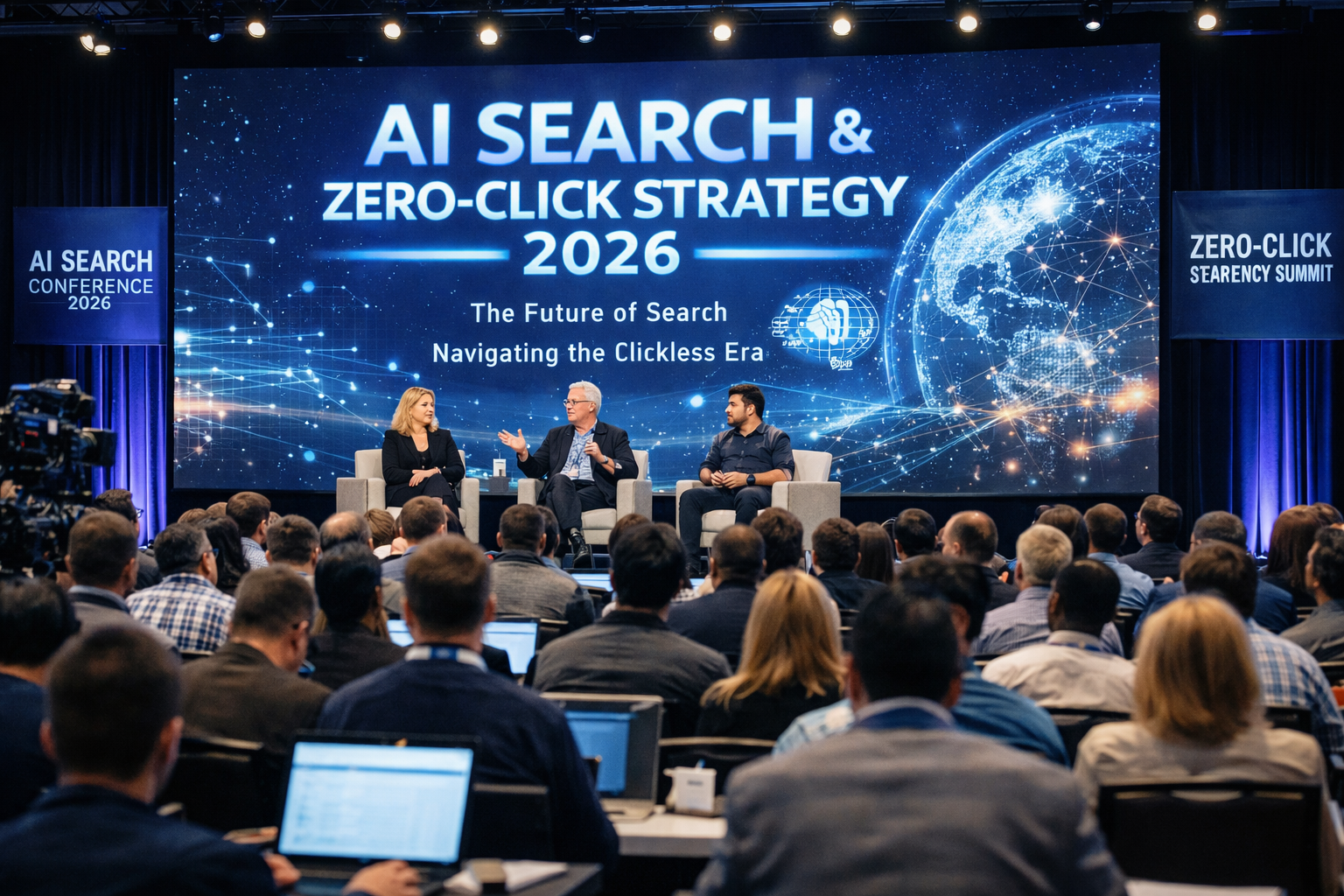
The conferences on this list are where the people figuring it out are gathering in 2026. Where practitioners, researchers, platform insiders, and strategists are sharing what they know — not what sounds good in a deck, but what's actually working in a search landscape that has been structurally rewritten by AI.
Every conference on this list is grappling with the same central question: when the click isn't guaranteed, how do you define visibility, measure impact, and build a strategy that survives? Here's where to find the answers.
The SEO and Search-Specific Conferences — Start Here
1. SEO Week
📅 April 27–30, 2026 📍 Center 415, New York City, NY 🔗 seoweek.org 💰 $599–$1,999 (prices increase as tiers sell out)
If you only go to one pure-SEO event in 2026, this is the one. ALM Corp
SEO Week is the most immersive multi-day experience currently available for practitioners going deep on search strategy in the AI era. The 2026 edition follows four distinct themes across four days: Day 1 covers technical foundations and search algorithms, Day 2 focuses on user behavior and search intent, Day 3 addresses platform relationships and dependencies, and Day 4 looks at emerging trends and future-proofing strategies. ALM Corp
What makes SEO Week worth the trip to New York is the density of serious people in the room. It brings together engineers, strategists, and creators shaping search's next era SEO Week — not conference tourists. The attendee base skews heavily toward senior SEOs, agency leaders, and in-house directors who are actually building and running search programs at scale. The conversations that happen between sessions are as valuable as what happens on stage.
Located on Fifth Avenue between 37th and 38th in Midtown Manhattan, Center 415 offers over 30,000 sq ft of open-plan event space across two floors SEO Week — and if last year's Busta Rhymes afterparty is any indication, the off-stage experience holds up too.
Best for: SEO directors, digital marketing leaders, agency strategists, and anyone who needs to make fundamental strategic decisions about their search program in the AI era.
2. SMX Advanced
📅 June 3–5, 2026 📍 Westin Boston Seaport District, Boston, MA 🔗 searchengineland.com/smx/advanced 💰 $1,295–$1,795
SMX Advanced will take place Wednesday, June 3 through Friday, June 5, 2026 at The Westin Boston Seaport District — a 100% in-person experience. Search Engine Land
SMX Advanced is the gold standard for experienced practitioners who want technical depth rather than introductory content — and in 2026 that reputation is more relevant than ever. The agenda is put together by the Search Engine Land editorial team, which means sessions are tightly focused on what's actually working rather than what sponsors want you to hear.
The format assumes you already know the basics. Sessions go deep on technical SEO, advanced strategy, and hands-on problem solving. In the context of 2026, SMX Advanced is especially valuable for teams balancing innovation with fundamentals Inflection — because the businesses that abandon traditional SEO entirely in favor of GEO will find that the fundamentals still matter, and the ones ignoring GEO will find their traffic continuing to erode. SMX Advanced is one of the few conferences that takes both sides of that tension seriously.
Invite-only Mastermind roundtables with small groups of senior marketers are a highlight — the kind of high-signal peer conversation you can't replicate at larger, more general events.
Best for: Experienced SEO professionals, technical search strategists, and agency teams that need both tactical depth and strategic clarity on navigating traditional SEO and AI search simultaneously.
3. The GEO Conference
📅 June 18, 2026 📍 National Union Building, Washington, DC 🔗 geo-conference.com 💰 Limited tickets — first-come, first-served
This is the official conference on Generative Engine Optimization — a full-day event dedicated to understanding AI SEO and how to show up in AI-generated results like ChatGPT, Claude, and Gemini. Geo-conference
If your biggest challenge right now is GEO and AI Overview strategy, this is the most targeted event on the 2026 calendar. It's one of the very few events built specifically around optimizing for generative engines rather than traditional search — which means the content is more developed, more specific, and more practically useful than the GEO sessions you'll find bolted onto general search conferences.
Unlike a traditional trade show, there are no sales booths and thousands of people — it's intentionally designed to be smaller with a limited number of attendees to foster meaningful and intimate connections. Geo-conference Past attendees have included representatives from Anthropic, Google, Perplexity, Semrush, Adobe, Accenture, Amazon, and more.
The June 2026 conference will include two tracks: Marketing for those in marketing roles, and Technical for those in technical roles. Geo-conference No recordings are released after the event — what's discussed in the room stays in the room, which keeps the content candid and the conversations frank.
A private yacht reception along the Potomac River caps the day for selected attendees — a nice touch for an event that takes the networking side as seriously as the learning side.
Best for: Content strategists, SEO professionals, digital marketing directors, and agency practitioners who need deep, focused, tactical content on GEO and AI citation strategy specifically.
4. Pubcon Pro Virtual 2026
📅 January 14, 2026 (already occurred — recordings available) 📍 Virtual — StreamYard 🔗 pubcon.com 💰 Registration includes replay access to last 3 conferences
Pubcon Pro Virtual 2026 ran on January 14 as a short, high-signal day for teams adapting to AI answers, blended search experiences, and shifting attribution. Pubcon Pro
The event has already happened — but the recordings are available and worth your time if you missed it. The agenda covered GEO tactics for getting cited in AI answers and assistants, entity and schema workflows that scale across large sites, and measurement fixes when referral signals get noisy. Pubcon Pro
It's a single track, no filler, built for operators — best for agency owners, directors, senior strategists, and anyone selling SEO or AI search work in 2026. Pubcon Pro The signal-to-noise ratio is genuinely high, and the virtual format makes it accessible without a travel budget. Keep an eye on Pubcon's site for the next virtual event later in the year.
Best for: Marketing teams, in-house SEO managers, and small agency teams that need high-quality, tactical content on AI search adaptation at an accessible price point.
5. BrightonSEO San Diego
📅 September 15–16, 2026 📍 San Diego Convention Center, San Diego, CA 🔗 brightonseo.com/events/san-diego-2026 💰 Starting at $530 (prices rise April 16, 2026)
The world's largest search marketing conference returns to its new home at the San Diego Convention Center for September 15–16, 2026. brightonSEO
BrightonSEO has grown from a small meetup above a Brighton pub into the most attended SEO conference on the planet — and the US edition has rapidly established itself as the premier West Coast search event. The decision to move to the San Diego Convention Center reflects the event's rapid growth and increasing significance within the global digital marketing community. brightonSEO
The format rewards teams that divide and conquer — sessions span technical SEO, content strategy, digital PR, AI search, and GEO, meaning you can send multiple people and have each one go deep in a different track. The US edition has developed particularly strong content around SEO for SaaS and enterprise software, with dedicated sessions on AI Overviews, LLM search engines, and site architecture for AI comprehension.
Included in your ticket is access to Hero Conf — one of the world's leading PPC conferences — making the combined event one of the best value propositions in the search marketing calendar.
Best for: Content strategists, SEO practitioners of all experience levels, and marketing teams that want breadth of coverage across search, content, and paid — all in one place.
6. Demand & Expand
📅 2026 dates TBC 🔗 inflection.io
Demand & Expand isn't a traditional SEO conference — but in 2026 it earns a spot on this list for a specific reason.
While it isn't a traditional SEO conference, topics like AEO and GEO, attribution in a zero-click world, and AI-first demand strategies show up alongside lifecycle and GTM discussions. Inflection If your SEO efforts are tightly connected to pipeline, revenue, and expansion metrics — which they should be — Demand & Expand offers a more realistic view of how search fits into modern go-to-market execution than a pure-SEO conference does.
The value here is context. Most search conferences talk about rankings and traffic. Demand & Expand talks about what rankings and traffic are supposed to produce — revenue, pipeline, and business growth. For marketing leaders and business owners who need to connect their search investment to business outcomes rather than just channel metrics, this is one of the most practically relevant conversations happening in 2026.
Best for: Marketing directors, growth leaders, and anyone whose SEO program needs to be directly connected to pipeline and revenue metrics rather than reported in isolation.
The Big Platform Conferences — For Search Infrastructure Intel
7. Google Cloud Next
📅 May 11–13, 2026 📍 San Francisco, CA 🔗 cloud.google.com/next
This is where Google signals what's coming in AI search before it hits.
Google Cloud Next is a top AI conference where Google debuts the infrastructure that powers its search engine, with talks, interactive demos, workshops, and Q&A sessions. ALM Corp For digital marketing and SEO teams, the value is early intelligence — understanding where Google's search algorithms and conversational interfaces are heading before those changes show up in your analytics.
This isn't a search marketing conference in the traditional sense. The audience is more technical and the content is more infrastructure-focused. But the strategic intelligence available here — about where Google is investing, what its AI systems are being built to do, and how its search products are evolving — is directly relevant to anyone building a long-term search strategy. The sessions that matter most for search marketers are the ones on AI Overviews infrastructure, the evolution of Search Generative Experience, and the integration of Gemini into Google's search products.
Best for: SEO directors, marketing leaders, and agency strategists who want platform-level intelligence on where Google is taking AI search.
8. NVIDIA GTC
📅 April 6–9, 2026 📍 San Francisco, CA 🔗 nvidia.com/gtc
More technical than any other conference on this list — but worth understanding for a specific reason.
NVIDIA GTC is one of the premier AI conferences of 2026 focused on inference and agentic AI — exactly what powers the next generation of search bots. ALM Corp The infrastructure that makes AI search possible — the compute, the inference architecture, the agentic systems that crawl, process, and surface content — is being built on NVIDIA's technology. Understanding what's happening at that infrastructure level gives you early signal on what AI search systems will be capable of next.
This conference isn't for everyone on a marketing team. But for technical SEOs, engineering-adjacent marketing leaders, and anyone building a GEO program who wants to understand the underlying mechanics of how AI systems retrieve and process content, GTC is where that conversation happens at the highest level.
Best for: Technical SEO specialists and engineering-adjacent marketing leaders who want to understand the infrastructure driving AI search evolution.
The Numbers Behind Why This All Matters
Before you finalize your 2026 conference calendar, it's worth having the full data picture in front of you — because the scale of what's happening in search is still not fully understood by most business owners and marketing leaders.
More than 80% of all searches now end without a single click, redefining what SEO success means. ALM CorpIndividual websites have experienced an average CTR drop of 34.5% when AI Overviews appear for their target keywords. ALM Corp
These aren't projections. They're current reality. And they mean that a marketing program built entirely around ranking position and organic traffic — without accounting for AI citation, zero-click visibility, and the emerging GEO discipline — is a program optimized for a search landscape that no longer exists.
The conferences on this list are where the strategic and tactical response to this reality is being built. The practitioners speaking at SEO Week, The GEO Conference, and SMX Advanced are the ones doing original work on what comes next — not commentators summarizing what others discovered, but researchers and operators sharing what they've learned from running real programs in real markets against real competitors.
What to Do Before You Go
Attending the right conference is valuable. Showing up prepared is what turns that value into something actionable for your business.
Before any conference on this list, pull your Google Search Console data and look at your click-through rate trends over the past 12 months. If your impressions are holding or growing while your clicks are declining, that's the zero-click effect showing up in your own data — and it's the context that will make every session on AI search and GEO immediately relevant rather than abstractly interesting.
Ask yourself: when someone asks Claude, ChatGPT, or Perplexity for a recommendation in my industry and my market, does my business come up? If you don't know the answer, finding out is the most important thing you can do before investing a week in conferences about AI search.
Ritner Digital offers a free marketing audit that includes an assessment of your current AI search visibility alongside your traditional search performance. It's the fastest way to understand where you stand — and what you should prioritize when you come back from whichever conference you attend.
Ritner Digital is a Philadelphia-based full-service digital marketing agency specializing in SEO, GEO, AI search optimization, paid advertising, web design, and more. We help businesses build digital presence that performs in traditional search and AI search simultaneously. Learn more at ritnerdigital.com.
Frequently Asked Questions
Why are there so many new conferences specifically about AI search and GEO in 2026?
Because the search landscape has changed more in the past 18 months than it did in the previous decade — and the existing conference content hasn't kept up. Most traditional SEO conferences were built around a world where ranking in Google's organic results was the primary objective. That world still exists but it's rapidly shrinking. The zero-click rate for AI Overview searches is now 83%. AI Mode ends without a click 93% of the time. The practitioners and researchers who are actually solving for this new reality needed a place to share what they're learning — and The GEO Conference, the AI search tracks at SEO Week, and the GEO-focused programming at SMX Advanced are filling that gap. The volume of new conferences and tracks dedicated to these topics is a direct reflection of how urgent the strategic shift has become.
Which conference on this list is best if I can only attend one in 2026?
It depends on your role and what you need most. If you're a practitioner or agency strategist who wants the deepest, most technically rigorous content on AI search strategy in an immersive format, SEO Week in New York from April 27–30 is the answer. If your primary challenge is specifically GEO and getting cited in AI-generated answers, The GEO Conference in Washington DC on June 18 is the most targeted and focused event available. If you want a broader conference that covers traditional SEO, GEO, paid search, and content strategy across multiple tracks with the largest attendee community, BrightonSEO San Diego on September 15–16 gives you the most coverage for the investment. For senior practitioners who want no-fluff technical depth from Search Engine Land's editorial team, SMX Advanced in Boston from June 3–5 is the gold standard.
Are these conferences worth the cost for a small or mid-size business owner versus just an agency or in-house team?
Yes, with a caveat. The tactical depth at conferences like SMX Advanced and SEO Week is calibrated for practitioners — the people executing search programs every day. A business owner who doesn't have a working knowledge of SEO fundamentals may find the content difficult to apply directly. That said, The GEO Conference and Demand & Expand are structured more accessibly for business leaders and marketing decision-makers who need strategic clarity on where search is going rather than tactical implementation guides. For most business owners, the higher-ROI investment is to send your agency partner or in-house marketing leader to the right conference and debrief with them on what it means for your specific business — rather than attending yourself and trying to translate highly technical content into business strategy on the fly.
What's the difference between attending in person versus watching recordings afterward?
The content is roughly the same. The value is not. In-person attendance at conferences like SEO Week and SMX Advanced produces a disproportionate amount of its value through the conversations that happen between sessions — in hallways, at dinners, during networking events — that never get recorded. The specific insight that changes how you approach your search program is often not something a speaker said on stage. It's something a practitioner at the table next to you mentioned offhand that opened up a completely different way of thinking about a problem you've been stuck on. Recordings capture the formal content. They can't capture the informal learning. For conferences where the networking quality matches the content quality — SEO Week and The GEO Conference in particular — in-person attendance is worth the investment if budget allows.
How do I know which sessions to prioritize at a multi-track conference like BrightonSEO?
Come with specific questions rather than a general intention to learn. Before you arrive, identify the two or three most pressing strategic or tactical challenges in your current search program — a declining CTR trend you can't explain, a GEO strategy you haven't built yet, an attribution problem that's making it impossible to connect your search investment to revenue. Then build your session schedule around those specific questions rather than trying to attend everything that sounds interesting. The sessions that produce the most actionable takeaways are the ones you walk into with a specific problem in mind. The ones that feel interesting but don't connect to anything you're actively working on tend to produce notes you never look at again.
The Pubcon Virtual 2026 event already happened in January. Is it still worth accessing the recordings?
Absolutely. The content covered — GEO tactics for getting cited in AI answers, entity and schema workflows that scale, measurement fixes for broken attribution, and local and ecommerce visibility tactics in AI-blended results — is directly applicable to the current search environment and will remain relevant throughout 2026. The pace of change in AI search means that content from January 2026 is still substantially current in a way that conference recordings from two or three years ago aren't. Pubcon's registration includes replay access to the last three conferences, which means you're getting a significant volume of high-signal practitioner content for a relatively modest investment. Keep an eye on their site for additional virtual events later in the year.
What should I do with what I learn at these conferences once I'm back in the office?
The most common conference mistake is coming back with pages of notes and no clear plan for what to do with them. Before you leave for any conference, identify the one to three things you're most hoping to change or implement when you return — and treat finding the answer to those specific questions as your primary objective. When you're back, schedule a debrief with your team or your agency partner within the first week while the context is fresh. Share the two or three most relevant insights with the people who can act on them — not a full download of everything you heard, but the specific things that are most directly applicable to your current situation. Then build at least one of those insights into an actual campaign or strategy change within the first thirty days. Conferences that produce no change in what you're actually doing are conferences that didn't produce ROI.
How do I make the case to my leadership team that attending one of these conferences is worth the budget?
Lead with the data that makes the strategic context undeniable. Organic click-through rates for queries featuring Google's AI Overviews have dropped 61% since mid-2024. More than 80% of searches now end without a click. If your business depends on organic search traffic — and most businesses do — that trend has a direct, calculable impact on your pipeline and revenue. The question isn't whether the AI search shift is happening. It's whether your team is building the capability to navigate it before it materially affects your results or after. Framing conference attendance as an investment in building that capability early — rather than catching up reactively — is usually a more compelling case than justifying the cost on its own terms.
What is Ritner Digital doing to stay current on AI search and GEO developments?
We're actively engaged in these conferences and communities — not as passive observers but as practitioners building and running GEO programs for real clients in real markets. We follow the researchers and practitioners doing original work in AI citation and zero-click strategy, we run our own experiments, and we bring what we learn directly into the programs we build for clients. If you want to understand where your business currently stands in AI search and what it would take to build real visibility in it — without waiting for your next conference — a conversation with our team is the fastest way to get there. Request your free audit here.