Same English, Completely Different Playbook: Marketing Trends in the US vs. Singapore in 2026
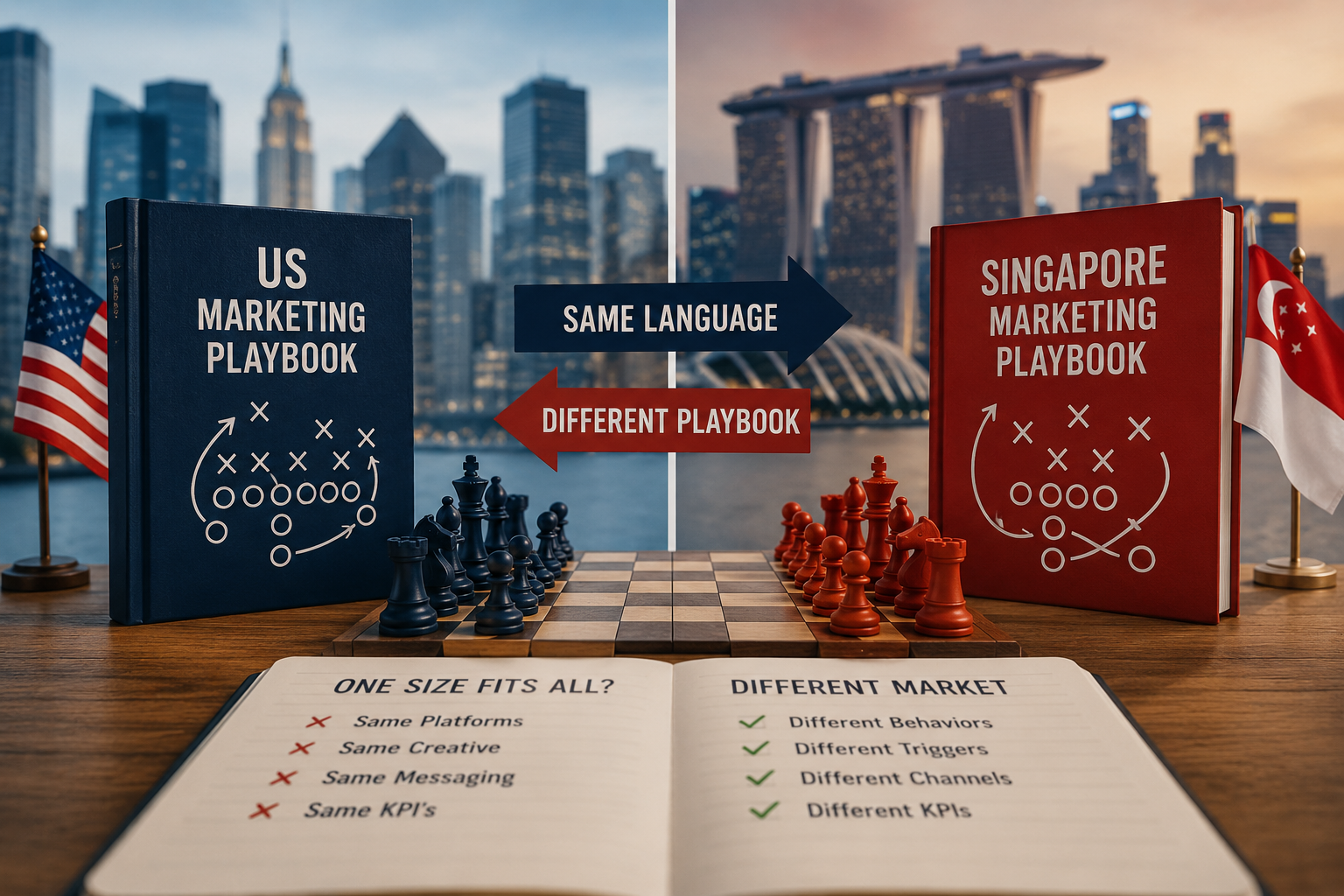
There is a version of this conversation that goes badly. A US-based brand decides to expand into Singapore, assumes that because English is widely spoken the playbook translates, and proceeds to run the same campaigns, on the same platforms, with the same creative, at the same cadence. The results are predictably mediocre. The brand concludes that Singapore is a hard market. Singapore is not a hard market. It is a different one — and the difference is significant enough that it deserves its own framework, not a regional adaptation of a US strategy.
We covered the US versus UK divergence in a previous piece that broke down why the same language does not mean the same consumer. Singapore takes that lesson several levels further. Here, the language question is just the starting point. The platform stack is different. The regulatory environment is different. The consumer psychology is measurably more research-intensive. The messaging ecosystem is built on apps that most US marketers have barely thought about. And the purchase journey — from discovery to conversion — runs through channels that would surprise any American brand manager who hadn't done the homework first.
This is the homework.
The Macro Picture: Two Economies, Two Consumer Mindsets
The American consumer economy in 2026 is large, resilient, and still spending. Real GDP grew 2.8% in 2024 and accelerated to 3.8% growth in the third quarter of 2025, with the Federal Reserve's rate cuts providing some relief on borrowing costs. American consumers — particularly millennials — are spending on experiences and immediate gratification, driven by a psychology that treats the present as the only controllable timeframe. That mindset produces fast purchase cycles, strong influencer-driven conversion, and a consumer who is willing to move quickly when a brand creates the right conditions.
Singapore's consumer psychology is different in ways that matter immediately for marketing. Singapore's social media users display sophisticated consumption habits — 78% are likely to research products online before purchasing, compared to a global average of 54%. They read reviews thoroughly and engage critically with branded content. This is not a market that impulse-buys from a TikTok ad. It is a market that uses that TikTok ad as the beginning of a research process, moves to reviews, checks competitors, and converts when it is satisfied — not when urgency is manufactured. Hashmeta
Singapore's digitally sophisticated, multilingual consumer base expects seamless experiences across channels. The government's Smart Nation initiatives continue to accelerate digital adoption across all sectors. The result is a market that is simultaneously more digitally mature than most and more demanding of brands that want to earn its trust. Marketingagency
The implication for strategy is immediate. American campaigns built around urgency and aspirational storytelling need to be rebuilt around credibility and specificity for Singapore. The emotional entry points are different. The conversion timeline is longer. The payoff for getting it right is a consumer who becomes a significantly more loyal customer than the American equivalent — but only if you do the work to earn that loyalty first.
The Platform Stack: Where This Gets Genuinely Counterintuitive
WhatsApp and Telegram Are Infrastructure, Not Channels
If you run marketing in the United States, WhatsApp is probably an afterthought. A platform you use personally, maybe, for a group chat — but not a serious business communication channel. In Singapore, that assumption is wrong in a way that will cost you.
WhatsApp holds approximately 84% market penetration in Singapore, significantly ahead of its closest competitor, Telegram, which reaches roughly 38% of internet users. WhatsApp maintains its position as the default for personal connections and trusted business relationships, while Telegram attracts users seeking larger group capabilities, channels for content distribution, and enhanced privacy features. Hashmeta
WhatsApp's dominance in Singapore represents a fundamental shift in how Singaporeans communicate and how businesses must engage with customers. With daily active usage rates exceeding 95% and adoption across virtually all demographic segments, WhatsApp has evolved from a messaging app into essential digital infrastructure. Hashmeta
For US marketers, this creates a channel imperative that has no real American equivalent. In Singapore, brand-to-consumer communication through WhatsApp is expected, not exceptional. The traditional funnel has fragmented into a complex web of touchpoints spanning TikTok discovery, Shopee Live consideration, WhatsApp consultation, and in-app purchase — often within the same shopping session. Hamilton Sherwind
Telegram plays a complementary and distinctive role. Unlike many markets where Telegram serves primarily as a messaging app, in Singapore it functions as a significant content distribution and community building platform through its Channels and Groups features. Government agencies, media outlets, and businesses leverage Telegram to distribute updates to large audiences efficiently. Hashmeta
The brands winning attention in 2026 Singapore are the ones building owned micro-communities — Telegram groups, Discord servers, Substack subscribers, paid newsletters, WhatsApp Channels — instead of chasing follower count on platforms they do not own. A 2,000-person Telegram group of buyers beats a 200,000-follower TikTok account that drives no leads. Best Marketing
In the US, brand community building tends to happen on Instagram, Facebook Groups, or LinkedIn. In Singapore, the action is in messaging apps — and brands that are not building there are conceding a significant engagement surface to competitors who are.
TikTok Shop Is a Primary Commerce Channel, Not an Experiment
American brands have been cautious about TikTok Shop — and for good reason, given the regulatory uncertainty around TikTok's future in the US market. Singapore has no such hesitation. In Singapore, TikTok Shop has grown rapidly, with some businesses reporting that it has become their second or third largest e-commerce channel. The key shift is that social media is no longer just an awareness and consideration channel — it is a conversion channel with its own checkout infrastructure. Marketingagency
68% of social media users in Singapore have made purchases directly through social platforms, significantly higher than the regional average of 51%. Brands leveraging shoppable posts see conversion rates 3.2x higher than those directing to external e-commerce sites. Hashmeta
The American social commerce market is growing but has not yet reached the same level of behavioral integration. In Singapore, the social-to-purchase journey happens inside the platform. Directing a Singaporean consumer off-platform to a website to complete a purchase introduces friction that a well-optimized TikTok Shop or Instagram Shopping experience eliminates. Brands entering the Singapore market need to have their in-platform commerce infrastructure ready before they run campaigns, not as an afterthought.
Xiaohongshu (Little Red Book) Is Not Optional for Certain Categories
Xiaohongshu has gained significant traction among Singapore's Chinese-speaking population and bilingual youth. For brands targeting Chinese Singaporeans, dedicated Mandarin content on platforms like Xiaohongshu delivers exceptional returns. Hashmeta
This is a platform that does not exist in the American marketing toolkit. It sits somewhere between Pinterest and Instagram, with a heavily review-driven content model that has particular influence in beauty, lifestyle, fashion, and food categories. For any brand operating in those verticals in Singapore, Xiaohongshu is not a niche experiment — it is a primary research platform for a significant portion of their target audience.
The US equivalent does not exist. This is not a gap that can be bridged by repurposing American content.
The Multilingual Imperative
Singapore has four official languages: English, Mandarin, Malay, and Tamil. English is the primary language of business and general communication. But multilingual content performs 47% better in Singapore compared to English-only posts. Hashmeta
Brands that produce content in multiple languages are reaching substantially larger, more engaged audiences than those that publish in English alone. Even for brands that are not running full multilingual campaigns, incorporating Chinese, Malay, or Tamil terms in English content can increase relatability and engagement. Elite AsiaHashmeta
For live commerce specifically, bilingual or multilingual hosting in English and Mandarin, or English and Malay, can significantly expand audience reach. Marketingagency
The American market has its own multilingual opportunities — Spanish-language marketing being the most significant — but the cultural expectation in Singapore that a brand will make some effort to communicate across the dominant linguistic communities is stronger and more uniformly applied. A brand that publishes only in English in Singapore is not just missing reach. It is making a cultural statement that sophisticated Singaporean consumers will notice.
Influencer Marketing: Scale Versus Credibility
The US Model: Scale and Speed
American influencer marketing operates at the top of a global scale curve. The industry is mature, highly professionalized, and built around reach metrics that the Singapore market cannot match in absolute numbers. Mega-influencers with millions of followers drive trend cycles that move fast — a viral moment can produce a measurable sales spike within 48 hours. The US consumer, particularly in younger demographics, has been trained by a decade of influencer content to move quickly on creator recommendations.
The Singapore Model: Trust and Community
Singapore's influencer ecosystem is smaller in absolute scale but operates on a different trust model. Influencer marketing trends in Singapore in 2026 prioritize revenue attribution over impressions. A mid-tier skincare brand that shifted from celebrity campaigns to 50 micro-influencers across TikTok and Instagram saw the strategy perform through community-driven authenticity. FY Ads Singapore
Singaporean social commerce consumers are research-oriented, price-sensitive, and heavily influenced by reviews and social proof. They compare prices across platforms, read reviews before purchasing, and are more likely to buy from brands that respond quickly to enquiries. Marketingagency
The implication is that a Singapore influencer strategy built around a handful of celebrity accounts with large followings will underperform relative to a strategy built around a larger number of credible micro-influencers with genuine community authority in specific niches. The Singaporean consumer is doing the research. The influencer needs to be a trusted node in that research process, not just a reach vehicle.
With stricter advertising transparency expectations, Singapore brands must ensure consumers can identify sponsored content clearly. Consumers demand honesty, and regulatory bodies are watching. The regulatory environment makes undisclosed or ambiguously disclosed sponsorships a legal risk as well as a trust risk — which means Singapore influencer strategy needs to be built around genuine credibility, not borrowed reach. FY Ads Singapore
The Regulatory Environment: PDPA Is Not Optional
This is the section that American brands entering Singapore most frequently underestimate, and it is the one where the consequences of underestimating it are most severe.
Singapore's Personal Data Protection Act — the PDPA — governs how consumer data can be collected, stored, used, and disclosed. Singapore's PDPA continues to be enforced actively, with fines for non-compliance increasing in both frequency and severity. Non-compliance can result in fines of up to SGD 1 million. Businesses need robust consent management systems for email marketing, remarketing, and data collection — a simple checkbox is no longer sufficient. Clear, specific consent is required for each data use case. Marketingagency
Singapore's PDPA evolution continues, with the Personal Data Protection Commission issuing more enforcement actions and advisory guidelines, providing clearer — and sometimes stricter — interpretations of consent requirements, data breach notification obligations, and cross-border data transfer rules. Marketingagency
For American brands accustomed to a patchwork of state-level privacy laws — California's CPRA being the most significant — and still operating with relatively broad third-party data capabilities, Singapore's PDPA requires a genuine operational adjustment. The marketing technology stack that works in the US may not be compliant in Singapore without modification.
The modern privacy-first stack — GA4 plus server-side GTM plus Conversions API plus first-party data CRM — is more accurate, not less, than the old cookie-based stack. It just takes setup work. Best Marketing
Critically, Singapore's regulatory environment has produced a consumer who has internalized privacy expectations. The brands that treat privacy as a trust-building opportunity rather than a compliance burden will earn consumer loyalty. Being transparent about data practices is a genuine differentiator in a market where consumers are increasingly privacy-aware. Marketingagency
The US market is moving toward this eventually. Singapore is already there.
Social Commerce: Both Markets Are In, But the Infrastructure Is Different
US Social Commerce
American social commerce is primarily driven by Instagram and Facebook, with TikTok growing rapidly in the under-35 demographic. The US market has strong influencer-to-purchase pathways, particularly in beauty, fashion, and consumer goods. Around 58% of American shoppers have purchased a product after seeing it on social media, and the Facebook commerce ecosystem alone reaches tens of millions of monthly active buyers.
American social commerce tends to be impulse-adjacent — the creative creates desire, the purchase follows relatively quickly, and the friction between seeing a product and buying it has been reduced significantly by in-app checkout features.
Singapore Social Commerce
Platform penetration in Singapore for social commerce as of 2026 includes TikTok — particularly strong with 18-to-34-year-olds — Instagram dominant for fashion, beauty, and lifestyle, Facebook providing broad demographic reach especially among 30-to-55-year-olds, YouTube growing through Shopping features, and WhatsApp and Telegram playing an important supporting role through conversational commerce — customers messaging businesses directly to enquire about and purchase products. Marketingagency
The most important operational difference: in Singapore, the research phase between discovery and purchase is longer and more deliberate. Singaporean social commerce consumers are research-oriented, price-sensitive, and heavily influenced by reviews and social proof. They compare prices across platforms, read reviews before purchasing. Marketingagency
This means the social commerce funnel in Singapore needs more content supporting the middle — comparison posts, detailed reviews, responsive customer service through WhatsApp, and user-generated content that functions as social proof — than the American equivalent, which can move faster from awareness to conversion.
AI in Marketing: The Same Tool, Different Constraints
Both markets have moved past treating AI as an experiment. In 2026, AI capabilities are embedded in virtually every marketing platform — from campaign creation to audience targeting to performance optimization. Marketingagency
The difference between the US and Singapore is not in AI adoption but in the constraints around it. American brands have broader latitude for AI-driven personalization, largely because the data environment still allows more of the inputs that make personalization work. Singapore's PDPA constraints mean that the same personalization strategies available in the US may require different consent architecture in Singapore.
The brands winning in 2026 are those combining AI efficiency with human editorial oversight. Singapore's multilingual consumer base creates additional complexity — AI content generation needs to be reviewed for cultural and linguistic accuracy across communities in a way that single-language markets do not require. Marketingagency
Leading Singapore brands are using AI for creative iteration, audience research, and predictive modeling — not as a replacement for strategy, but as amplification of human insight. That framing applies equally in the US, but the specific applications differ based on what the data environment allows. Hamilton Sherwind
AI Search and GEO: A Convergence Point
This is one area where the US and Singapore are moving in the same direction at roughly the same pace, though the starting points differ.
ChatGPT, Perplexity, Gemini, Google AI Overviews, and Meta AI now intercept a meaningful share of the queries that used to send a click to a website. Similarweb data shows nearly 60% of Google searches end without any click. Gartner forecasts another 25% drop in classic search volume by end of 2026. For Singapore SMEs, this is not a future trend — it is current reality. Best Marketing
Search behavior is no longer limited to Google. Audiences in Singapore are discovering brands through TikTok search, Reddit threads, YouTube Shorts, LinkedIn carousels, and AI assistants that summarize "best options" without sending a click. Audienceintelligence
The GEO response — building content designed to be cited by AI systems rather than just ranked in traditional search — is relevant in both markets. But Singapore's multilingual environment creates an additional layer of complexity. Content that earns AI citations in English may not earn them in Mandarin or Malay. Brands building GEO strategies for Singapore need to think about AI visibility across languages, not just across query types.
As we've written about the entity problem, AI search systems reward brands that are clearly and consistently defined across multiple sources. In Singapore's multilingual environment, that means being clearly defined across multiple languages — which is a significantly higher bar than the US market requires.
Ad Spend and Budget Allocation: Where the Markets Diverge Sharply
With over 88% of Singaporeans using smartphones, mobile advertising is increasingly vital. Mobile ad spending is expected to reach $1.2 billion, reflecting a 15% increase — driven by the shift in consumer behavior toward mobile-first interactions. 70% of marketers in Singapore prioritize data analytics in their campaigns. Research And Markets
Most Singapore SMEs allocate between SGD 3,000 and SGD 15,000 per month on digital marketing, depending on industry and growth goals. Larger enterprises may spend SGD 30,000 to SGD 100,000 or more monthly. In 2026, businesses should prioritize video content creation, first-party data infrastructure, and AI-powered advertising over traditional display advertising and generic content. Marketingagency
The US market, with its enormous scale, operates at significantly higher absolute spend levels — US digital advertising is a market measured in hundreds of billions of dollars annually. But Singapore's per-capita digital sophistication means that efficient, well-targeted spend in Singapore can produce outsized returns relative to budget. The market is small enough that a brand with a genuinely differentiated presence in a specific community or category can become the dominant voice without requiring the budget that the US market demands.
Singapore brands allocate an average of 34% of digital marketing budgets to social media advertising. Cost-per-click in Singapore averages SGD $0.85 to $1.45, varying significantly by platform and industry. Hashmeta
ESG and Purpose-Driven Marketing: A More Serious Signal in Singapore
Singapore consumers are increasingly making purchasing decisions based on a brand's environmental and social credentials. Transparent ESG communication on social media — including supply chain transparency, carbon commitments, and community investment — is becoming a meaningful brand differentiator in 2026. Elite Asia
American brands have engaged with purpose-driven marketing for years, but the consumer response has been uneven — sometimes rewarded, sometimes treated as performative. In Singapore, where regulatory bodies have shown willingness to act on misleading claims through frameworks like the Protection from Online Falsehoods and Manipulation Act, ESG communication requires genuine substance rather than brand positioning.
Singapore's regulatory environment for social media marketing includes the Protection from Online Falsehoods and Manipulation Act, which empowers authorities to act against misinformation, making factual accuracy in marketing claims especially important. Hashmeta
The practical implication: a Singapore market entry strategy that leads with ESG credentials must have those credentials documented and verifiable. The consumer will check. The regulator may as well.
What This Means for Your Strategy
The US and Singapore are not just two markets with the same English and different accents. They require different channel architectures, different consumer journey models, different regulatory compliance frameworks, and different approaches to the relationship between brand and buyer.
For US-focused marketing: Scale, speed, and platform ubiquity are still your primary levers. Social commerce through Meta and TikTok remains highly effective. AI-powered content and GEO visibility are becoming table stakes. American consumers respond to urgency, social proof, and creator endorsement more immediately than almost any other market in the world. Build for speed.
For Singapore-focused marketing: Build for trust first, conversion second. WhatsApp and Telegram brand communication are not optional extras — they are expected infrastructure. Multilingual content meaningfully outperforms English-only content. The PDPA is a floor, not a ceiling — treating privacy as a genuine brand value earns trust in a way that compliance alone does not. The research phase is longer. Invest in the content that supports it. An SEO and content strategy designed for Singapore needs to account for multi-platform discovery, not just Google.
For brands operating in both markets: Build separate frameworks with a shared brand identity. The platform mix, the conversion timeline, the influencer strategy, the messaging app presence, and the tone of your content all need to flex between markets in ways that go far beyond translation. What converts an American consumer in 48 hours may take a Singaporean consumer eight touchpoints and two weeks. Plan for both timelines simultaneously rather than trying to run one strategy with regional adaptations.
As we noted in our US vs. UK piece, the two-market playbook is more work. The US versus Singapore version is even more so. But for brands willing to do it right, the Singaporean consumer who chooses you after thorough research becomes a significantly more durable customer than the one who converted on impulse. That loyalty compounds in ways that a market built around speed rarely produces.
Sources cited in this piece:
Marketing Agency SG — Digital Marketing Trends 2026: What Singapore Businesses Need to Know
Elite Asia — Top Digital and Social Media Trends in Singapore in 2026
Best Marketing Singapore — 10 Digital Marketing Trends Singapore SMEs Cannot Ignore in 2026
Hashmeta — WhatsApp Statistics Singapore: Complete Guide to Messaging Trends
Hashmeta — Social Media Statistics Singapore: Complete Data & Marketing Insights
Hashmeta — Social Media Landscape in Singapore: Complete Strategy Guide
Marketing Agency SG — Social Commerce in Singapore: The Complete Guide for 2026
Marketing Agency SG — Digital Marketing Trends Singapore: What to Watch in 2026
Research and Markets — Singapore Digital Advertising and Martech Market
Audience Intelligence Asia — Digital Marketing Trends 2026 Singapore Guide
Internal resources referenced:
Same Language, Different Playbook: Marketing Trends in the US vs. UK in 2026
You Don't Have a Content Problem. You Have an Entity Problem.
Ritner Digital helps brands build smarter marketing strategies across US and international markets. If you're trying to figure out what your strategy actually needs to look like in a market you haven't cracked yet, let's talk.
Frequently Asked Questions
Do I really need a completely separate strategy for Singapore, or can I adapt my US approach?
You need a separate strategy, not an adaptation. The distinction matters because an adaptation starts from the wrong place — it takes US assumptions and tries to modify them for a different market, which means the underlying architecture is still built for American consumer behavior. A genuine Singapore strategy starts from the Singapore consumer: research-intensive, multilingual, operating through messaging apps that don't exist in the US marketing toolkit, and converting on a longer timeline that requires more trust-building content at every stage. The platform mix, the influencer model, the regulatory compliance requirements, and the purchase journey all differ enough that adapting an American playbook will consistently underperform against a framework built specifically for Singapore.
What is the single biggest mistake US brands make when entering the Singapore market?
Ignoring WhatsApp and Telegram as brand communication channels. For an American marketer, these feel like personal messaging apps — not business infrastructure. In Singapore, they are business infrastructure. WhatsApp has 84% market penetration with daily active usage rates exceeding 95% across all demographic segments. Telegram functions as a legitimate content distribution and community building platform. Brands that build their Singapore presence on Instagram and Facebook while ignoring messaging apps are building on half the platform foundation the market expects. The Singaporean consumer may discover you on TikTok, research you on Google, and then message you on WhatsApp before deciding to buy. If that final touchpoint isn't there, the conversion doesn't happen.
How does the PDPA affect marketing operations in Singapore compared to US privacy laws?
More directly and with more immediate operational consequences than most US brands expect. Singapore's Personal Data Protection Act requires explicit, specific consent for each data use case — not a blanket checkbox — and non-compliance carries fines of up to SGD 1 million. Unlike the US patchwork of state-level laws, the PDPA applies uniformly across the entire Singapore market and is enforced actively, with the number and severity of enforcement actions increasing in recent years. For practical marketing operations, this means your consent management system, your analytics setup, your email marketing permissions, and your retargeting infrastructure all need to be reviewed for PDPA compliance before you run a single campaign. Brands that treat the PDPA as a legal checkbox rather than an operational requirement will find themselves either non-compliant or running campaigns with significantly constrained targeting capability.
Is influencer marketing effective in Singapore, and does it work the same way as in the US?
Effective yes, same way no. The American influencer model rewards scale — large followings, fast trend cycles, immediate conversion driven by urgency and creator authority. The Singapore model rewards credibility and community trust. Singaporean consumers are significantly more research-oriented than American consumers before they purchase — they use creator content as the beginning of a research process, not the end of one. This means mega-influencer campaigns that drive fast conversion in the US tend to underperform in Singapore, while micro-influencer strategies built around genuine community authority in specific niches consistently outperform. A Singapore influencer strategy should prioritize whether the creator is trusted within their specific community over whether they have the largest following available in the budget.
Why does multilingual content perform so much better in Singapore if English is widely spoken?
Because Singapore's four official languages — English, Mandarin, Malay, and Tamil — represent four distinct cultural communities that each have their own content preferences, platform behaviors, and expectations of brands that want to reach them authentically. English is the lingua franca of business and general communication, but it is not the primary emotional language for a significant portion of the population. Content that incorporates Mandarin for Chinese Singaporean audiences, or Malay for the Malay community, signals that a brand has made a genuine effort to speak to that community rather than treating Singapore as a single homogeneous English-speaking market. The 47% engagement uplift for multilingual content is not about translation — it is about cultural recognition, and Singapore's consumer base responds to it measurably.
How does social commerce work differently in Singapore versus the United States?
The penetration rates are higher, the research phase is longer, and the platforms involved are different. In Singapore, 68% of social media users have already purchased directly through social platforms, compared to a regional average of 51% — and projections point to 78% penetration by 2026. That is a market where in-platform commerce is the norm, not an emerging feature. The key operational difference from the US is that the Singaporean consumer's purchase journey involves more deliberate research between discovery and conversion — comparing prices across platforms, reading reviews, and often sending a WhatsApp message to the brand before committing. Brands entering Singapore through social commerce need their in-platform checkout infrastructure ready before they run campaigns, and they need the supporting content — reviews, comparisons, responsive customer service — that the research-oriented Singapore buyer expects to find.
What is Xiaohongshu and do I actually need to be on it?
Xiaohongshu — also known as Little Red Book — is a Chinese social platform that sits between Pinterest and Instagram, with a heavily review-driven content model that has particular influence in beauty, lifestyle, fashion, and food categories. In Singapore, it has significant traction among Chinese-speaking Singaporeans and bilingual youth. Whether you need to be on it depends entirely on your target audience and product category. If you are marketing beauty products, skincare, fashion, home goods, or food and beverage to Singapore's Chinese community, Xiaohongshu is not a niche experiment — it is a primary research platform for a meaningful portion of your target audience, and being absent from it means being absent from a significant part of their purchase research process. If you are marketing B2B services or targeting primarily English-speaking professional audiences, it is a lower priority. Know your audience before you decide.
How does AI search and GEO strategy need to change for the Singapore market?
The core GEO principles — building content that earns AI citations rather than just ranking in traditional search — apply in Singapore as strongly as in the US. Nearly 60% of Google searches end without any click in Singapore, and the same AI systems that intercept queries in the US are operating in the Singapore market. What changes is the multilingual dimension. A GEO strategy for Singapore that only optimizes for English-language AI citations is leaving Mandarin-language query visibility entirely on the table. Brands building serious AI search visibility in Singapore need to think about entity clarity and content depth across the languages their target audiences are actually using, not just the one that is most convenient to produce. The entity-building principles are the same — named authorship, specific claims, external validation, consistent brand presence — but the execution surface is broader.
How long does it take to build genuine brand presence in Singapore versus the US?
Longer, for reasons rooted in consumer psychology rather than market mechanics. The Singaporean consumer's research-intensive buying behavior means that brand trust compounds more slowly but more durably than in the US. An American brand can build significant awareness quickly through well-funded influencer campaigns and paid social, and convert that awareness to sales within weeks. In Singapore, the same budget will generate awareness that takes longer to convert because the consumer is spending more time in the research phase — comparing options, reading reviews, and checking whether the brand has a credible presence across the channels they trust. The payoff is that once a Singaporean consumer chooses your brand after that research process, the lifetime value of that customer tends to be higher than a customer acquired through impulse-driven American marketing. Budget for a longer awareness-to-conversion window and build the content infrastructure to support the research phase, not just the discovery moment.
What is the most important content investment for a brand entering the Singapore market?
Trust-building content that supports the research phase — detailed product information, genuine customer reviews, comparison content, and a responsive WhatsApp or Telegram presence that gives consumers somewhere to take their questions before committing to a purchase. The instinct of most brands entering a new market is to invest heavily in awareness content — ads, influencer campaigns, social posts designed to generate reach. In Singapore, that investment will underperform unless it is supported by the credibility content that the research-oriented Singaporean consumer will look for after seeing the awareness-stage creative. Think of the awareness spend as opening a door. The research-phase content is what determines whether the consumer walks through it.