SEO and AI Search in Singapore in 2026: What's Actually Changed and What to Do About It
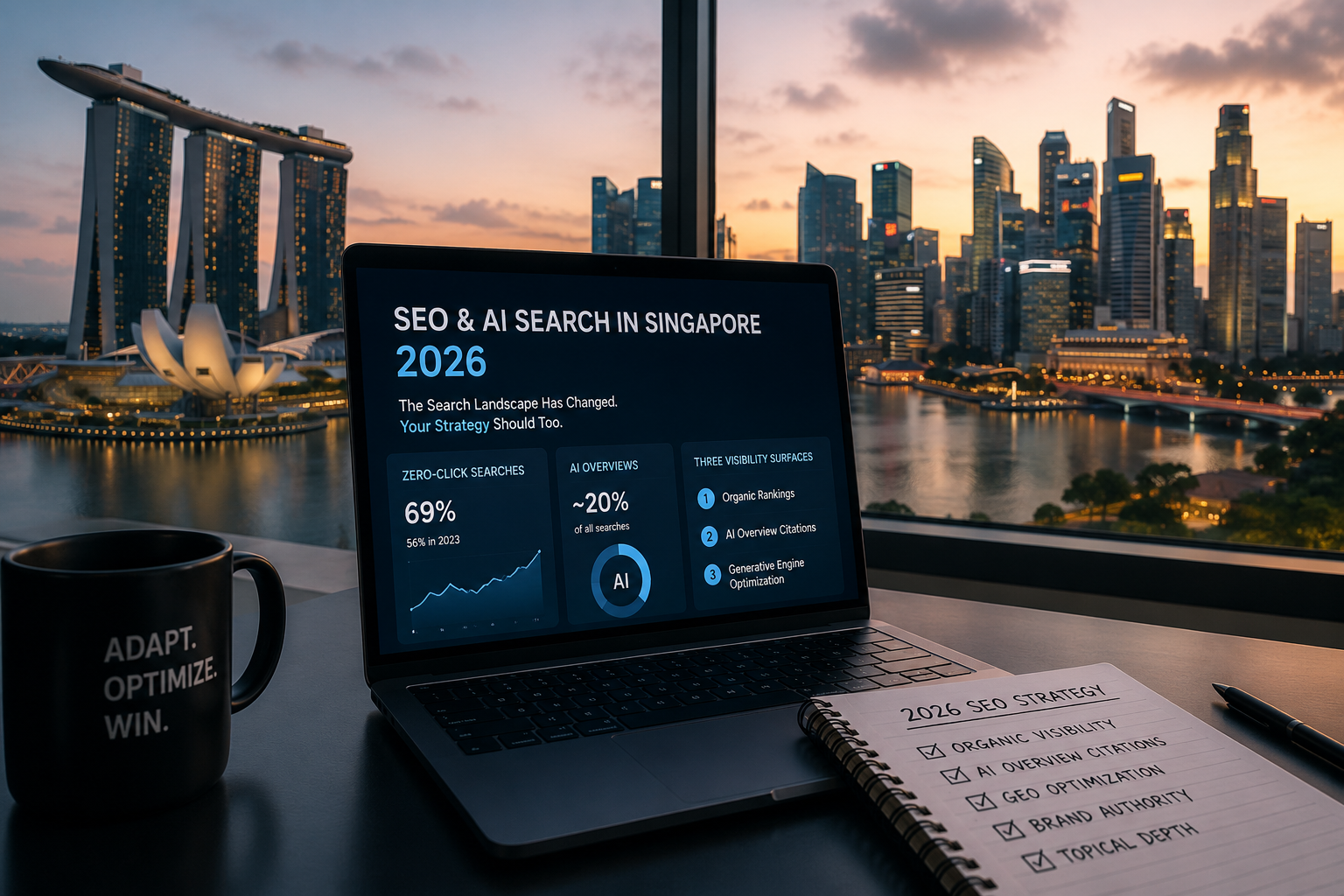
If you are running a Singapore business and your SEO strategy looks the same as it did in 2023, you are not just slightly behind. You are optimizing for a search landscape that no longer exists.
The structural changes to search in Singapore over the past eighteen months have been faster and more consequential than anything that came before them. Google's AI Overviews now sit above traditional organic results for the majority of commercial queries. Zero-click searches jumped from 56% to 69% in a single year. Entirely new disciplines — Answer Engine Optimization and Generative Engine Optimization — have moved from experimental edge concepts to line items in agency proposals and CMO budgets. From 2024 to 2026, the industry sentiment in Singapore shifted from skepticism to absolute faith. Businesses no longer view AI search as a futuristic trend but as a present-day necessity. StridecProgramming Insider
This is the honest state of SEO and AI search in Singapore right now. Not the version that makes the transition sound manageable with minor adjustments. The version that explains what has actually changed, what the data shows, and what a Singapore business needs to do differently to stay visible in a search environment that has fundamentally reorganized itself around AI.
The Three Jobs That SEO Now Has to Do Simultaneously
The first thing to understand about Singapore SEO in 2026 is that there is no longer a single surface to optimize for. There are three distinct visibility jobs, each with different content requirements, different signal stacks, and different success metrics.
Search engine optimization in Singapore in 2026 is the work of getting a business found across three surfaces at once: organic Google rankings, AI Overview citations, and the wider generative-engine ecosystem — ChatGPT, Perplexity, Gemini, Copilot. Treating any of those three as the whole job, the way most agencies still do, leaves money on the table. Stridec
The three jobs are distinct in ways that matter. Ranking number one organically does not guarantee AI Overview citation — Google's AI Overview often cites pages ranked four through fifteen if they answer the sub-intent more cleanly. Being cited in Perplexity does not move your Google ranking. The signals that win each job overlap — substantive content, strong entity, technical hygiene — but the optimization tactics diverge. Buying SEO without specifying which jobs are in scope is how Singapore businesses end up with ranking-only deliverables when they wanted citation visibility too. Stridec
Most traditional SEO programs in Singapore are still delivering against job one only — organic rankings — and measuring success accordingly. The businesses pulling ahead in 2026 are the ones that have identified and resourced all three jobs, built content strategies that address each, and built measurement frameworks that track visibility across all three surfaces simultaneously.
The Zero-Click Reality and What It Actually Means
The zero-click conversation has been happening for years. In Singapore in 2026, it is no longer a conversation about a trend. It is a description of how the majority of searches resolve.
Google holds a 94.15% search market share across all devices in Singapore. AI Overviews now appear in approximately 20% of all Google searches, up sharply from 6.49% in January 2025. Zero-click searches account for 69% of Google queries, meaning your brand must be visible on the results page itself, not just ranked in the top ten. Audienceintelligence
The implication is direct and uncomfortable for any business that has built its digital strategy around organic traffic volume: for Singapore businesses, a significant majority of people searching for information related to your products, services, or industry are getting their answers without ever visiting your website. If your SEO strategy is built entirely around driving clicks, you are optimising for a shrinking pool. AI Studio Singapore
Organic click-through rates for queries featuring Google's AI Overviews have plummeted by 61% since mid-2024, dropping from 1.76% to just 0.61%. Individual websites have experienced an average CTR drop of 34.5% when AI Overviews appear for their target keywords, with some studies showing drops as high as 79% for top-ranking organic results. ALM Corp
The critical reframe here is that zero-click does not mean zero value. It means the value has moved from the click to the citation. The brands winning in a zero-click environment are those that optimise for visibility and brand impression, not just traffic. Brand visibility metrics — how often your brand is mentioned in featured snippets, AI Overviews, knowledge panels, and AI-generated answers — are now as important as click-through rates. AI Studio Singapore
A Singapore business whose brand appears in the AI Overview answering a relevant query has influenced the searcher even if they never visited the website. That influence is real and it compounds. The measurement frameworks that most Singapore businesses are using — traffic, rankings, CTR — are not capturing it.
What GEO and AEO Actually Are — and Why the Distinction Matters
The terminology can be confusing, and the confusion is worth clearing up because the disciplines are genuinely different, even though they overlap significantly in practice.
GEO — Generative Engine Optimization — is the practice of optimizing your content and digital presence so that AI-powered systems cite, reference, or recommend your brand when generating answers. It operates across ChatGPT, Perplexity, Google AI Overviews, Gemini, and Copilot. Unlike traditional SEO, where you are competing for a position on a results page, in AEO you are competing to be the answer itself. This requires a different set of signals: entity authority, structured data, citation patterns, content comprehensiveness, and the kind of factual reliability that AI models trust. AI Studio Singapore
Traditional SEO was built around ranking in Google's organic results. GEO operates on a different logic. It is less about where you appear in a list and more about whether AI systems trust you enough to cite you when synthesizing an answer. That trust is built through entity clarity, external validation, content specificity, and consistent brand signals across the web — not through keyword density or link velocity. Rank Tracker
In 2026, AEO and GEO are line items in agency proposals and CMO budgets. The work overlaps heavily with classic SEO — clear answers near the top of the page, FAQ schema, topical clusters, E-E-A-T signals — but layers on entity-rich writing, brand mentions across Reddit, LinkedIn, and Quora, and emerging signals like the llms.txt file. Best Marketing
The practical distinction for a Singapore business: your traditional SEO program is building the foundation that GEO and AEO build on. You cannot skip the foundation. But a traditional SEO program alone, without the additional entity and citation work that GEO requires, will produce a site that ranks reasonably well in organic results and is largely invisible in AI-generated answers. In 2026, that is a significant competitive disadvantage.
The Singapore-Specific Complications
The global dynamics of AI search apply in Singapore — but several Singapore-specific factors make the optimization problem more complex than it is in a single-language, single-culture market.
The Multilingual Search Dimension
Singapore's four official languages — English, Mandarin, Malay, and Tamil — create a search environment that does not exist in most Western markets. A Singapore business optimizing only for English-language search is already leaving a significant share of potential visibility on the table. In the AI search context, the problem compounds.
Predictive intent analysis in Singapore's multilingual market now allows for proactive content adjustments before trends peak. Singapore's digital economy is one of the most advanced globally, with over 50% of searches expected to be voice-driven or conversational. Conversational and voice queries in Mandarin or Malay produce different AI Overview responses than the same queries in English — and the sources those responses cite may be entirely different from the sources cited in English responses. Sotavento Medios
A comprehensive GEO strategy for Singapore requires thinking about entity clarity and content depth across the languages your target audiences are actually using. The entity-building work that earns AI citations in English does not automatically translate to visibility in Mandarin or Malay search. Brands with genuine multilingual content depth have a meaningful advantage over English-only competitors in Singapore's AI search environment.
The Mobile-First Search Behavior
Mobile search accounts for 96% of online queries in Singapore. The implications for SEO extend beyond the standard mobile-first indexing requirements — they affect how zero-click behavior manifests, how AI Overviews appear in mobile results, and what content structures perform best in a market where the vast majority of search happens on a phone. W360 Group Pte Ltd
Mobile users are 66% more likely to experience zero-click searches than desktop users. In a market where 96% of searches are mobile, this means the zero-click rate in Singapore is almost certainly higher than global aggregates suggest. The implication for Singapore businesses is that optimizing for SERP visibility — appearing in the AI Overview, the featured snippet, the local pack — is even more critical than in desktop-heavy markets, because mobile users are less likely to scroll past the AI-generated content at the top of their screen. Ekamoira
The PDPA and First-Party Data Constraint on Measurement
Singapore's Personal Data Protection Act creates a measurement problem that does not exist in the same form in markets with looser data regulations. As PDPA enforcement has tightened, the tracking capabilities that traditional SEO measurement relied on have become less reliable. Businesses must ensure their martech stack complies with PDPA requirements — particularly around consent management, data minimization, and the right to access and correct personal data. Marketingagency
The practical consequence for SEO measurement: GA4 consent mode, server-side tracking, and privacy-compliant analytics infrastructure are not optional extras in Singapore. They are the baseline for producing measurement data that is both accurate and legally defensible. A Singapore business running standard analytics without PDPA-compliant consent architecture is operating with unreliable data and regulatory exposure simultaneously.
The .sg Domain and Local Entity Signals
Singapore-specific signals that matter for local SEO include .sg domain weighting, SGD pricing schema, and Singapore English versus US English differentiation. Stridec
For AI search specifically, connecting your brand entity to Singapore-specific references — government bodies like IMDA and ESG, local industry associations, Singapore-specific regulatory frameworks — builds the kind of local entity clarity that AI systems use to place a brand accurately within a geographic and industry context. A Singapore business that is a clearly defined entity within Singapore's digital ecosystem will be cited more confidently in Singapore-relevant AI-generated answers than one whose entity signals are generic or geographically ambiguous.
The Citation Economy: What AI Systems Actually Reward
Understanding what earns AI citations is the foundational question for any Singapore business building a GEO strategy. The research on this is now substantial enough to be actionable.
Comparison pages with three tables earn 25.7% more citations. Validation pages with eight list sections earn up to 26.9% more citations. Shortlist pages averaging ten or fewer words per sentence earn 18.8% more citations. These are not arbitrary style preferences — they reflect what makes content easily parsable and citable by AI systems that are synthesizing answers under time constraints. Structure that makes information extractable is structure that earns citations. Position Digital
LLMs cite different content types for different intents. 45.48% of informational queries cite articles, while 40.86% of commercial queries cite listicles. Listicles, articles, and product pages are the most common citations in AI Mode, ChatGPT, and Perplexity. Position Digital
The entity dimension is equally important. E-E-A-T is evaluated by AI systems not through on-page signals like author bios or credentials pages, but through off-site validation: which authoritative publications mention or link to your brand, which trusted third-party platforms reference you, and what the broader web consensus is about your credibility. ALM Corp
This is the point that most Singapore businesses — and most Singapore SEO agencies — are not yet acting on. Building AI citation authority requires external validation, not just internal content production. A Singapore business that publishes excellent, well-structured content but has no external citations from credible industry sources, no brand mentions across authoritative platforms, and no third-party validation of its expertise will consistently be passed over in favor of competitors whose external citation profile is stronger.
As we have written in our piece on entity authority, the distinction between a site that has a lot of content and a site that AI systems recognize as an authority entity is the defining competitive variable in the current search environment. Singapore is no exception.
The Paradox at the Center of AI Search Strategy
Here is the tension that every Singapore business building an AI search strategy has to navigate: you need traditional SEO strength to earn AI citations. But optimizing only for traditional rankings wastes the citation opportunity. Stridec
A page at position one has a 58% chance of being cited by ChatGPT. By position ten, that drops to 14%. Traditional rankings still matter enormously for citation probability. But 28.3% of ChatGPT's most cited pages have zero organic visibility. The signals that earn AI citations are related to but not identical to the signals that earn traditional rankings. Position DigitalPosition Digital
The practical resolution: traditional SEO and GEO are not competing priorities. They are sequential ones, with significant overlap. A Singapore business that builds strong topical authority through deep, well-structured content — the foundation of traditional SEO — is also building the content infrastructure that GEO requires. The additional GEO-specific work — entity disambiguation, external citation building, structured data that declares what your brand is and does, content formats that AI systems can extract from efficiently — layers on top of that foundation rather than replacing it.
Traditional SEO is not dead in Singapore in 2026, but it has fundamentally changed. The core principles of technical optimisation, quality content, and authority building remain important. However, SEO now must be integrated with AEO and GEO to capture visibility across both traditional search results and AI-generated answers. AI Studio Singapore
What the Highest-Performing Singapore Brands Are Doing Differently
The gap between Singapore businesses that are navigating this transition successfully and those that are still running 2023-era SEO programs is becoming visible in data.
Companies using AI-first SEO strategies achieve 3.2x higher lead generation and 47% faster ranking improvements. The highest-performing agencies demonstrate consistent ROI exceeding 400%. Stridec
The specific practices that separate the leaders from the laggards are consistent across the market:
They are building content that answers specific, real questions with direct, structured responses in the first paragraph — not burying the answer after three paragraphs of context. AI systems extract from the beginning of pages, not from well-crafted conclusions.
They are investing in FAQ schema, structured data markup, and content formats that make information easily parsable — because structuring content with clear H2 and H3 question headers, direct answers in the first paragraph, and FAQ schema markup is the format AI systems prefer when selecting sources for their summaries. Audienceintelligence
They are building external citation profiles deliberately — through digital PR, industry publication contributions, authoritative directory presence, and third-party mentions that AI systems can cross-reference when evaluating whether a brand is credible enough to cite.
They are measuring AI visibility alongside traditional metrics. Businesses that track their AI Share of Voice alongside traditional organic traffic have a far more accurate picture of their search performance in 2026. Measurement frameworks that only count clicks are invisible to the majority of search interactions that now happen above the organic results. AI Studio Singapore
And they are doing the entity work that most SEO programs skip entirely. Local entity mapping — connecting your brand to Singaporean entities such as government bodies like IMDA, local landmarks, and regional industry standards — builds topical authority that AI systems use when determining whether a brand is the credible local source for a given query. Sotavento Medios
The Content Format Implications for Singapore
Content strategy for Singapore AI search in 2026 looks different from content strategy for traditional SEO in specific, actionable ways.
Topical depth beats keyword breadth. A Singapore business that covers its core service area with genuine comprehensiveness — pillar content, supporting cluster content, FAQ content, comparison content, case studies — builds the topical authority signal that AI systems use to evaluate whether a source is comprehensive enough to cite. A business with 200 thin posts across many topics builds neither topical authority nor citation credibility.
Named authorship with verifiable local credentials matters more in Singapore's AI search environment than in markets where English-language international authority signals dominate. An article written by a named professional with documented Singapore-specific expertise — MAS-regulated financial background, MOH-registered healthcare credentials, Singapore Bar-admitted legal experience — carries stronger E-E-A-T signals for Singapore-relevant queries than the same article published without named authorship.
Content that references Singapore-specific data, regulations, pricing, and case studies earns local citation authority that generic content cannot match. Global templates scale easily, but local familiarity converts better. Examples that reflect real regulatory environments, pricing expectations, and industry nuance resonate faster. For Singapore businesses competing with regional or international players, contextual precision becomes an advantage. -
The content velocity question — how much to publish and how often — is answered differently in the AI search context than in traditional SEO. If your SEO strategy is still built entirely around driving clicks, you are optimizing for a shrinking pool. Publishing volume for the sake of keyword coverage produces diminishing returns when the majority of informational queries are answered by AI before anyone clicks. Quality, depth, and citability beat quantity in the current environment consistently. AI Studio Singapore
What This Means for Singapore Businesses Specifically
The transition from traditional SEO to a combined SEO-GEO-AEO strategy is not optional for Singapore businesses that depend on search for lead generation and brand visibility. The timeline for when this becomes critical varies by industry — businesses in categories where AI Overviews are already dominant for primary queries are already feeling it — but the direction is uniform.
The businesses that build citation authority now are building an asset that compounds. Generative engine optimization is no longer an emerging concept in Singapore. It is an active competitive front, and the brands that are investing in it now are building citation authority that will compound over time. Rank Tracker
The businesses waiting for the landscape to settle before investing are watching competitors build citation profiles that will be significantly harder to displace once established. AI search citation behavior has a network effect — brands that appear consistently in AI-generated answers build the brand recognition that generates the branded searches that further reinforce citation frequency.
Our work on SEO and GEO for clients across industries reflects what the Singapore market data confirms: the gap between businesses that have made this transition and those still running traditional keyword-ranking programs is widening. The measurement frameworks that show this clearly are the ones that track AI visibility alongside traditional organic metrics — and increasingly, the businesses with the cleanest data on their AI search performance are the ones making the best decisions about where to invest next.
The playbook for Singapore in 2026 is not complicated. Do the traditional SEO work well — technical hygiene, content depth, authority building. Layer the GEO work on top — entity disambiguation, structured content, external citation building, multilingual visibility where relevant. Measure both surfaces with frameworks that capture what is actually happening in search, not just what was happening three years ago.
That is the whole strategy. The execution is where most Singapore businesses need genuine expertise — and where the distance between agencies that understand this shift and those that have simply renamed their SEO service "AI SEO" becomes commercially significant.
Sources cited in this piece:
AI Studio SG — SEO Trends Singapore 2026: What's Changed and What Works Now
Stridec — Search Engine Optimization Singapore: What It Means in 2026
Stridec — How AI is Changing SEO for Singapore Businesses in 2026
Audience Intelligence Asia — AI SEO Singapore: How Businesses Win with AI-Driven Search in 2026
Best Marketing Singapore — 10 Digital Marketing Trends Singapore SMEs Cannot Ignore in 2026
Ranktracker — 5 Best Generative Engine Optimization Agencies in Singapore (2026)
ALM Corp — AI Overviews and Zero-Click Searches: Adapting Your SEO Strategy for 2026
Digital Applied — Zero-Click Search Statistics 2026: Complete Data Guide
GoodFirms — SEO Statistics 2026: AI Search, Rankings & Zero-Click Trends
Marketing Agency SG — Digital Marketing Trends 2026: What Singapore Businesses Need to Know
Elevăn August — Top 7 Digital Marketing Trends Singapore Brands Should Watch in 2026
Internal resources referenced:
You Don't Have a Content Problem. You Have an Entity Problem.
Same Language, Different Playbook: Marketing Trends in the US vs. Singapore in 2026
If your Singapore search strategy is still measured by rankings and traffic alone, you're tracking the wrong things. Let's talk about what the full picture actually looks like. →
Frequently Asked Questions
Is traditional SEO still worth investing in for a Singapore business in 2026?
Yes, but not in isolation and not with the same measurement framework you were using three years ago. The core disciplines of traditional SEO — technical hygiene, content depth, authority building, topical coherence — are still the foundation that everything else builds on. The research consistently shows that pages ranking in the top ten organically are significantly more likely to earn AI citations than pages outside the top twenty. The mistake is treating traditional SEO as the complete program rather than the foundation of a broader visibility strategy that also covers AI Overview citation and generative engine optimization. A Singapore business that invests only in traditional SEO is building half the infrastructure the current search environment requires. A Singapore business that skips traditional SEO to chase GEO tactics is building on nothing. The sequence matters: do the traditional work well, then layer the GEO work on top of it.
What is the actual difference between SEO, GEO, and AEO — and do I need all three?
SEO optimizes for rankings in Google's traditional blue-link results. AEO — Answer Engine Optimization — optimizes specifically for being cited inside AI-generated answers, whether in Google's AI Overviews or in conversational AI tools like ChatGPT and Perplexity. GEO — Generative Engine Optimization — is the broader discipline that covers your entire digital presence as it relates to how AI systems understand, trust, and cite your brand. In practice, the work overlaps significantly. Strong topical content, clear entity definition, structured data, and external validation contribute to all three. The distinction that matters for budget and prioritization is that GEO requires work that traditional SEO programs do not typically include — entity disambiguation, external citation building across authoritative platforms, content formats specifically designed for AI extraction, and measurement frameworks that track AI visibility as a distinct metric. You need all three, but the entry point is understanding which surfaces your target audience is currently using and where your competitors are already visible.
Why are zero-click searches such a problem for Singapore businesses specifically?
Because Singapore's mobile-first search behavior amplifies the zero-click effect more than in desktop-heavy markets. Globally, mobile users are 66% more likely to experience zero-click searches than desktop users — and in Singapore, mobile accounts for 96% of online queries. That combination means the effective zero-click rate for a Singapore audience is almost certainly higher than global averages suggest. The practical consequence is that building your entire digital strategy around driving organic traffic to your website assumes a click-based journey that the majority of your Singapore searchers are not taking. The businesses winning in this environment are not panicking about zero-click. They are reorienting their measurement frameworks around visibility and citation rather than traffic, and building the content that earns brand impressions in the AI-generated answers their audience is actually reading.
How does Singapore's multilingual environment complicate GEO strategy?
Significantly, and in ways most English-centric GEO frameworks do not address. AI systems generate different responses to the same query in different languages — and the sources they cite for a Mandarin-language search are often entirely different from the sources they cite for an English-language search on the same topic. A Singapore business that has built strong English-language entity authority and citation signals may still be effectively invisible in Mandarin or Malay AI-generated answers for the same category. For businesses targeting Chinese-speaking Singaporeans, Malay-speaking communities, or Tamil-speaking audiences, the GEO work needs to include content production, external citation building, and entity signals in those languages — not just English translations of existing content. The multilingual dimension is one of the most significant ways Singapore's GEO challenge differs from what a US or UK brand faces, and it is consistently underinvested in by Singapore businesses running English-first digital strategies.
How do I know if my current SEO agency in Singapore is actually doing GEO or just calling traditional SEO by a new name?
Ask three specific questions. First, can they show you where your brand currently appears in AI-generated answers for your most important queries — in ChatGPT, Perplexity, and Google AI Overviews specifically? If they cannot answer that question with data, they are not doing GEO. Second, what is their methodology for building external citation authority — the off-site validation that AI systems use to determine whether a brand is credible enough to cite? If the answer is essentially link building reframed, that is traditional SEO with a GEO label. Third, how are they measuring AI visibility as a distinct metric alongside traditional organic performance? A genuine GEO program has a measurement framework that tracks citation frequency and AI share of voice. A renamed SEO retainer measures rankings and traffic. The distinction between these two is what separates agencies that have built genuine GEO capability from those that have added GEO to their service page without the underlying methodology to deliver it.
What content types earn the most AI citations for Singapore businesses?
The research is now specific enough to be actionable. Comparison pages with multiple structured tables earn significantly more citations than equivalent narrative content. FAQ sections with direct, concise answers in response to specific question formats earn disproportionate citation rates relative to their length. Listicles and shortlist-format content dominate commercial query citations. For informational queries, well-structured articles with clear H2 and H3 question headers and direct answers in the first paragraph outperform content that buries the answer after extensive context. For Singapore specifically, content that references local data points — Singapore-specific pricing, MAS or MOH or IMDA regulatory context, local case studies with named organizations and specific outcomes — earns local entity authority that generic content cannot replicate. The consistent principle across all of these formats is extractability: AI systems cite content that makes it easy to identify and pull a specific, verifiable claim without needing the surrounding context to make sense of it.
How long does it take to see results from a GEO strategy in Singapore?
Faster than traditional SEO for AI citation visibility, slower than paid search for immediate traffic impact. AI-first SEO approaches in Singapore typically show initial citation improvements within four to eight weeks of implementation, with meaningful and sustained citation frequency developing over three to six months. The caveat is that this timeline assumes the foundational work — entity definition, structured content, technical hygiene — is either already in place or being built simultaneously. Businesses starting from a weak SEO foundation will need to build that foundation before GEO tactics produce meaningful results. The compounding dynamic is the most important long-term consideration: brands that appear consistently in AI-generated answers build brand recognition that generates branded searches that further reinforce citation frequency. Early movers in a category build citation authority that is genuinely difficult for late movers to displace, which is why the investment case for starting now is stronger than the case for waiting until the approach is more established.
Should Singapore businesses optimize for Google AI Overviews specifically or for all AI search platforms?
Both, but with different prioritization based on where your audience actually searches. Google holds a 94.15% search market share across all devices in Singapore, which means Google AI Overviews are the AI search surface with the largest reach for most Singapore businesses by a significant margin. However, Perplexity is growing rapidly among research-oriented users, ChatGPT is becoming a significant product and service discovery tool, and LinkedIn increasingly surfaces in professional AI search results. The practical approach is to build the content and entity infrastructure that performs well across all platforms — because the signals that earn Google AI Overview citations substantially overlap with the signals that earn ChatGPT and Perplexity citations — while prioritizing Google AIO optimization for immediate impact given its market dominance in Singapore. Track your citation rate across multiple platforms from the start so you can see where you are gaining ground and where gaps remain.
What is the most important single thing a Singapore business can do right now to improve its AI search visibility?
Audit your top five service or product pages and restructure each one so it leads with a direct, specific answer to the primary question that page addresses — in the first paragraph, in plain language, without preamble. Most Singapore business pages bury their most citable content behind context-setting introductions, brand narrative, and qualification language. AI systems extract from the beginning of pages. A page that takes three paragraphs to get to the answer it is supposedly about is a page that AI systems pass over in favor of a competitor page that answers immediately. This single structural change — leading with the answer, supporting it with evidence below — improves citation probability across all AI platforms simultaneously, requires no technical changes, and can be implemented immediately. It is not the complete GEO program, but it is the highest-leverage first step for most Singapore businesses whose content was written for human browsing rather than AI extraction.