SpaceX Just Became the Biggest IPO in History. Here's the Visibility Lesson Every B2B Brand Should Steal From It.
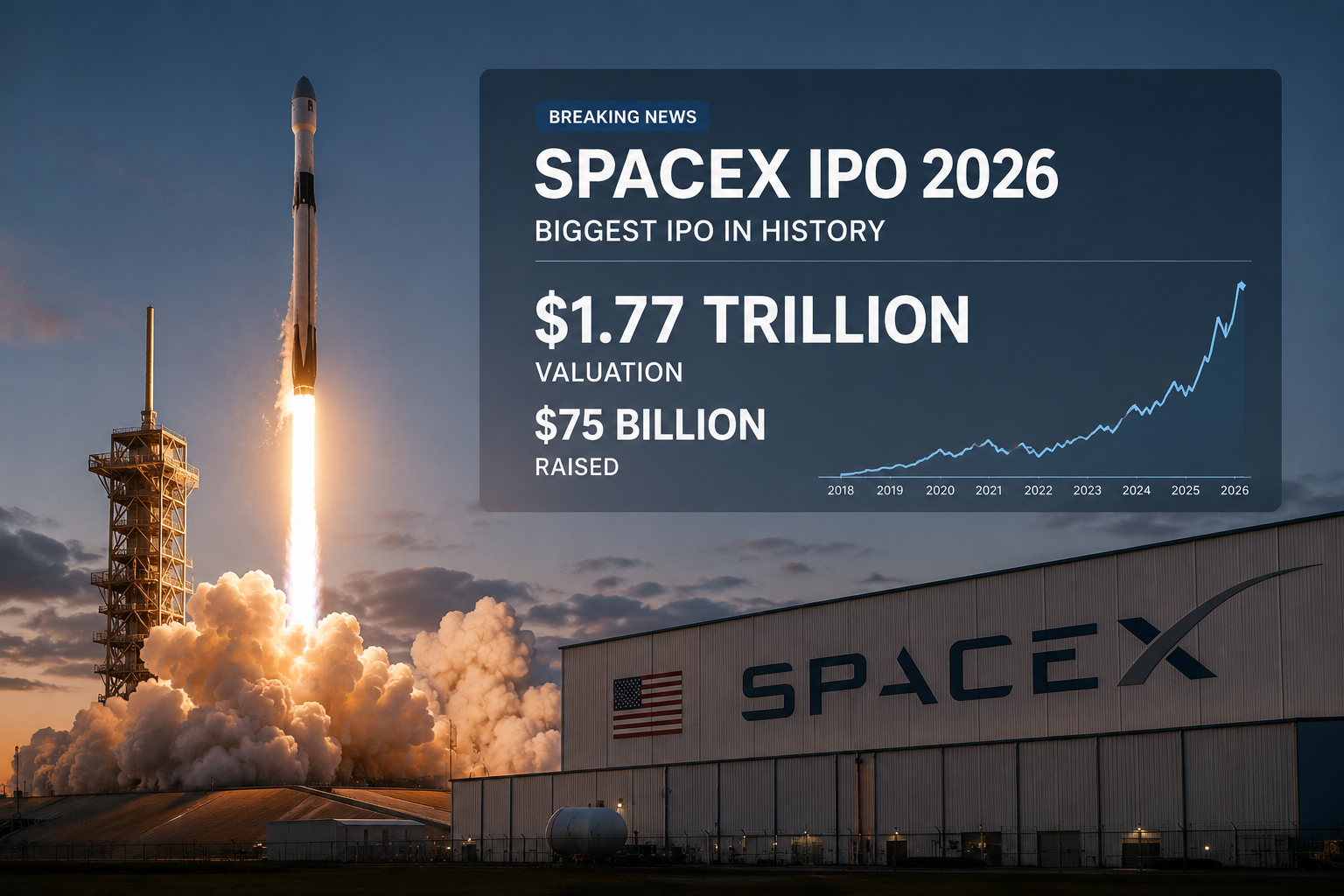
On June 12, 2026, SpaceX blasted into public markets and raised roughly $75 billion at a valuation of about $1.77 trillion — the largest initial public offering ever recorded. Elon Musk's rocket, satellite, and AI company began trading on the Nasdaq under the ticker SPCX, and the debut dominated every feed, every newsletter, and — more to the point for us — every AI search engine on the planet.
Here's why a B2B search agency is writing about a rocket company: the SpaceX IPO is a live, real-time case study in who gets found, who gets trusted, and who gets cited when an entire market is asking the same question at once. Below, we'll cover what actually happened — and then the part most marketers will miss: what this event quietly reveals about how AI search now decides which brands get named and which get buried.
First, What Actually Happened
SpaceX priced its IPO at a fixed $135 per share, selling 555.6 million shares to raise approximately $75 billion, giving the company a valuation around $1.77 trillion. That makes it the seventh-largest U.S. company by market capitalization, surpassing Tesla.
To grasp the scale: the deal is more than triple the size of Alibaba's, previously the largest U.S. IPO, and it dwarfs Saudi Aramco's $29 billion record from 2019. When shares opened, SpaceX debuted at $150 — about 11% above its IPO price— and the pop made Elon Musk the world's first trillionaire.
Demand was staggering. The offering drew more than four times the available shares, with total demand surging past $250 billion. In a break from Wall Street norms, SpaceX reserved as much as 30% of the deal for retail investors, and retail orders alone topped $100 billion.
That's the news. Now here's where it gets interesting for anyone who cares about being found online.
The Real Story: Millions of People Asked AI About SpaceX — and AI Decided Who to Cite
When an event this big breaks, buyers don't open ten browser tabs anymore. They ask ChatGPT, Perplexity, Gemini, or Claude: "Should I buy SpaceX stock?" "What's a fair valuation for SPCX?" "Who are the best alternatives to SpaceX for space exposure?"
And in that moment, the AI engine makes a decision in milliseconds: which sources to retrieve, which brands to name, and which to leave out entirely.
Notice what those engines pulled from in the section above — Bloomberg, CNBC, Variety citing Morningstar, IBTimes, TechTimes. Those publications didn't get cited because they shouted the loudest. They got cited because they had authority, structured and crawlable content, and a track record the models already trust. That's not a media phenomenon. That's exactly how AI search decides which B2B vendors get recommended when your buyer asks for a shortlist.
Search has split in two: the index Google ranks, and the answer engines your buyers actually ask. The SpaceX moment is just a high-volume, high-speed demonstration of a rule that's now true every single day in your category, quietly, without a dashboard showing you the misses.
Three Lessons the SpaceX IPO Teaches About AI Search Visibility
1. Authority is what gets you cited — not keywords
The valuation debate around SpaceX is brutal. At roughly $18.7 billion in 2025 revenue against a $1.77 trillion valuation, the company is trading at around 94 to 96 times revenue — versus Meta at 22x and Amazon at 18x at their IPOs. Even NYU's Aswath Damodaran, the "Dean of Valuation," modeled intrinsic value at roughly $1.3 trillion.
Here's the parallel: whose valuation take did the AI engines surface? The ones from named, credentialed, repeatedly-cited authorities. AI search runs the same logic on B2B vendors. It doesn't recommend the brand that stuffed the most keywords onto a page — it recommends the one with entity authority: a clear, consistent, well-referenced identity the models have seen vouched for across the web. Authority is the moat. Keywords are table stakes.
2. Demand spikes reward the brands that were already visible
Retail demand topped $100 billion in days. But the publications that captured that attention didn't start publishing on June 12 — they'd built trust over years, so when the surge came, they were the answer. You cannot build authority during the spike. You build it before, so you're the name the engine already trusts when your category suddenly heats up.
Most B2B brands learn this the hard way: a competitor's launch, a regulatory change, or a viral moment drives a flood of "best [your category]" queries — and they're invisible for all of it because the authority work never got done. The window to be cited closes the moment the question gets asked.
3. Being everywhere beats being on one platform
SpaceX's debut is also a referendum on the broader AI IPO wave — Anthropic and OpenAI filed confidentially within days of each other, forming a $3.6 trillion AI IPO pipeline. Different engines covered it differently, emphasized different sources, framed the risk differently.
That's the daily reality of AI search: ChatGPT, Gemini, and Claude retrieve, reason, and recommend differently — so a brand can win one and be completely invisible on another. Optimizing for "Google" alone now leaves the majority of your buyers' questions answered by engines you never showed up in. Visibility has to be built across all of them at once.
Why This Matters for Your Pipeline
If your buyers are asking AI engines for recommendations in your space — and they are — then every week you're not building authority is a week a competitor is becoming the cited answer instead of you. That compounding runs both directions. The brands that invest now own the rankings and the AI citations later. The ones that wait spend years clawing back ground they could have held from the start.
The SpaceX IPO will be a footnote in six months. But the mechanic it demonstrated — authority decides who gets cited, and citations decide who gets chosen — is the permanent new shape of search. That's the engine we build.
This article references publicly reported figures for informational and analytical purposes and does not constitute financial or investment advice.
Frequently Asked Questions
How big was the SpaceX IPO?
SpaceX raised approximately $75 billion at a valuation of about $1.77 trillion, making it the largest initial public offering in history — more than triple the size of Alibaba's previous U.S. record and well above Saudi Aramco's $29 billion debut in 2019. Shares priced at $135 and opened around $150 on June 12, 2026 under the Nasdaq ticker SPCX.
Why is an AI search and SEO agency writing about the SpaceX IPO?
Because the event is a real-time demonstration of how AI search works. When millions of people asked ChatGPT, Perplexity, Gemini, and Claude about SpaceX, those engines instantly chose which sources to retrieve and which brands to name. That same mechanic — authority decides who gets cited — is exactly how AI search decides which B2B vendors get recommended when your buyer asks for a shortlist.
What is AI search optimization, and how is it different from regular SEO?
Traditional SEO focuses on ranking pages in Google's index. AI search optimization (sometimes called GEO, or generative engine optimization) focuses on getting your brand retrieved, trusted, and cited by answer engines like ChatGPT, Perplexity, Gemini, and Google's AI Overviews. The goal isn't just a blue link — it's being the name the AI recommends. It relies heavily on entity authority, structured content, and earned trust signals rather than keywords alone.
Why do some brands get cited by AI and others don't?
AI engines favor sources with established authority, consistent entity identity, crawlable and well-structured content, and a track record the models already trust. Keyword density barely moves the needle. As the SpaceX coverage showed, the publications that got cited were the ones with credibility built up over time — not the ones that published fastest. The same is true for B2B brands in your category.
Can I build AI search visibility quickly during a trending moment?
No — and that's the core lesson. Authority is built before the spike, not during it. When demand surges in your category, the engines surface the brands they already trust. You can't manufacture that overnight, which is why the brands that start building authority now own the citations later, while those who wait spend years catching up.
Do different AI engines recommend different brands?
Yes. ChatGPT, Gemini, and Claude retrieve, reason, and recommend differently, so a brand can win one engine and be completely invisible on another. Optimizing for Google alone leaves the majority of your buyers' AI-driven questions answered by engines you never appeared in. Visibility has to be built across all of them.
How do I find out if AI engines are recommending my business?
Start with an AI search audit: ask the major engines the questions your buyers ask ("best [your category] for [use case]," "alternatives to [competitor]") and see whether your name comes up — and what it's cited alongside. Ritner Digital runs these audits and builds a forecast showing the visibility, leads, and pipeline an authority-first strategy can produce. Book one here.
Want to Be the Brand AI Engines Recommend?
At Ritner Digital, we build the authority, content, and domain trust that get B2B brands found and cited across Google, ChatGPT, Perplexity, and Gemini — then we publish the data to prove it works. We've been graded by the engines themselves, cited by industry publications, and we report our own Search Console numbers in the open.
When your buyers ask AI first, make sure it's naming you.
Book a free strategy call — a real read on your search and a clear next step. Let's talk →