"What Should I Take Before Drinking?" Is Now an AI Question — and Most Supplement Brands Are Losing the Answer
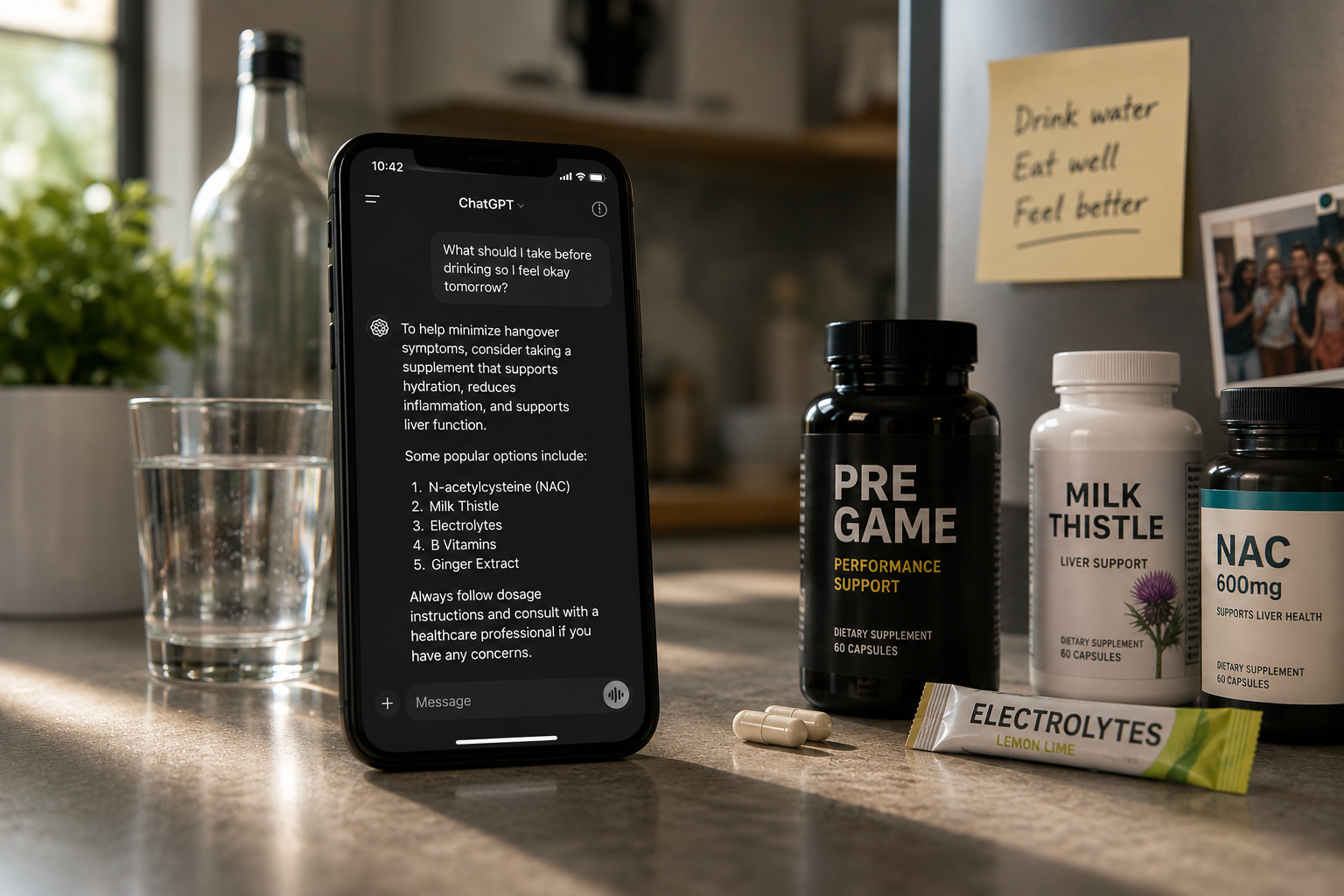
The pre-alcohol and hangover-supplement category is having a moment. Pre-drinking probiotics, liver-support blends, electrolyte shots, NAC capsules, B-vitamin formulas — the shelf is crowded, demand spikes every wedding season and holiday stretch, and paid acquisition is hotter than ever.
But there's a quiet shift underneath all that demand that most brands in this space haven't reckoned with: the buyer's first question no longer goes to Google. It goes to AI. And when someone asks ChatGPT, Perplexity, or Gemini "what should I take before drinking so I feel okay tomorrow?", the engine doesn't hand back ten links to browse — it hands back a recommendation. For a whole category of brands, that recommendation is being decided right now, every day, with no dashboard showing who's winning and who's invisible.
We study how AI search picks winners. Here's what's happening in this category, and why being a genuinely good product isn't enough anymore.
The Demand Moved to the Answer Engines — and the Questions Don't Name Brands
A few years ago, a curious drinker searched "best hangover cure" and skimmed the results. Today they ask a conversational question and act on the answer, often without clicking anything. For supplement and functional-beverage brands, that's a structural problem, because the buyer almost never frames the question around a brand. They frame it around the problem:
"What can I take before drinking to avoid a rough morning?"
"Is there anything that actually works for hangovers, or is it all hype?"
"Best thing to take before a wedding where I'll be drinking all day?"
"Does anything break down the stuff in alcohol that makes you feel bad?"
None of those contain a brand name. So the engine has to choose who to name. And that choice isn't won by whoever has the best formula — it's won by whoever the engine understands most clearly and trusts most deeply. That's the entire game now, and it's invisible on a standard ad-performance report.
The Three Ways Supplement Brands Are Losing in AI Search
1. They get flattened into a generic list
Ask an AI assistant about pre-drinking supplements and you'll typically get a roundup: milk thistle, NAC, B-complex, electrolytes, a probiotic or two, a liver-detox blend — all listed together as interchangeable "hangover pills." Published roundups do the same thing, grouping mechanistically different products into one undifferentiated list.
If your product works on a genuinely different mechanism — say, breaking down acetaldehyde rather than just replacing electrolytes — that distinction is your entire competitive advantage. But when the engine flattens you into "here are 8 hangover supplements," that advantage disappears. The buyer sees a commodity, not a breakthrough. Being scientifically distinct means nothing if the engine can't tell you apart.
2. They get swept into the category's skepticism
This category carries real doubt. Outlets like TIME have pointed out that evidence for most hangover-prevention supplements is low-quality, and AI engines absorb that skepticism. When a buyer asks "do these even work?", the engine reasons from what it can find — and a brand without a clearly established, well-cited scientific identity gets swept into the general "probably doesn't work" verdict.
The brands that escape it are the ones whose mechanism, testing, and published data are legible and citable to the engine. Corroborated science doesn't just inform the buyer; it tells the AI which brands to trust and which to lump in with the doubt.
3. They win one engine and vanish on the others
ChatGPT, Gemini, Perplexity, and Claude retrieve, reason, and recommend differently. A brand can be the top suggestion on one and completely absent on another — and most brands have no idea which engines they're winning or losing, because they're only watching Google. Optimizing for one channel leaves the majority of your buyers' AI-driven questions answered by engines you never appeared in.
This Is an Authority Problem, Not a Product Problem
Here's the reframe that matters for any founder or marketer in this space: the fix usually isn't a better product. The strong brands in this category already have that. The fix is making the engines understand and trust what the product is, so they describe it accurately and recommend it confidently. Three moves define that work.
Establish the entity, not just the keywords. AI engines don't recommend the page that repeats "pre-alcohol" the most. They recommend the brand they can model as a distinct entity — with a defined mechanism, a credentialed origin, and a category of its own. When that identity is consistent across your owned content and the wider web, the engine stops grouping you with everything adjacent and starts naming you as the specific answer.
Make the science legible and citable. Skepticism is beaten with corroboration. The brands that win the "does it actually work?" reasoning are the ones whose quality data, studies, and patents are structured so engines can find, parse, and cite them. Real science that lives in an AI-readable format becomes the proof that earns the recommendation — instead of evidence that's true but invisible.
Win every engine, on every framing of the question. Buyers ask the same need a dozen ways — "before drinking," "wedding season," "feel good tomorrow," "acetaldehyde," "does anything actually work." Visibility means showing up as the trusted answer across all the major engines and across every natural-language version of the problem your product solves.
Why This Matters Before Your Next Busy Season — Not During It
Demand in this category spikes hard and predictably: wedding season, summer, the holidays. And here's the rule that catches brands every time: you cannot build authority during the spike. When millions of people are asking the engines what to take before a night out, the engine recommends the brand it already trusts. The authority work has to be done ahead of the wave so you're the name that surfaces when it hits.
Every season you're winning paid and losing the AI answer, a competitor is quietly becoming the default recommendation — and that position compounds. The brand that owns the engine's trust this season owns it next season too, at zero marginal ad spend. The brands that start building now hold the AI citations for years. The ones that wait spend those years clawing back ground they could have owned from the start.
If your category is full of products that get described as interchangeable, that's not a weakness — it's the opening. The first brand the engines learn to describe as distinct and trustworthy wins the recommendation for the whole category. That's the work we do.
This article references publicly available information and is for analytical purposes only. It does not constitute medical advice, and supplement claims belong to individual manufacturers.
Frequently Asked Questions
Why would a supplement brand with a great product still lose in AI search?
Because AI engines recommend based on what they can understand and trust about a brand, not on product quality alone. If your differentiation isn't structured in a way engines can parse, they flatten you into a generic category — describing a distinct product as just another item on a list. The product is strong; the brand's legibility to AI is the gap.
What is AI search optimization for DTC and supplement brands?
It's the practice of getting your brand retrieved, correctly described, and recommended by answer engines like ChatGPT, Perplexity, Gemini, and Google's AI Overviews when buyers ask need-based questions ("what should I take before drinking?"). It centers on entity authority, legible product science, and structured content — so the engine names you as the answer instead of a competitor or a generic roundup.
Why do AI engines lump distinct products in with generic competitors?
Because they default to the broadest category they can confidently identify. If your unique mechanism, origin, and proof aren't clearly and consistently established across the web, the engine has nothing to separate you on — so it groups you with everything adjacent. Establishing a distinct entity is what breaks you out of the list.
How does AI search handle categories with a lot of skepticism?
It absorbs the skepticism. When published sources question whether a category works, engines reason from that doubt unless a brand provides clear, citable evidence to stand apart. Structuring your science so engines can find and cite it is how you separate your brand from the category's general reputation.
Can't I just wait until my busy season to fix AI visibility?
No — that's the most common and costly mistake. Authority compounds over time and can't be manufactured during a demand spike. When the season hits, engines recommend the brands they already trust. Building that trust ahead of the wave is the entire advantage.
How do I find out how AI engines currently describe my brand?
Start with an AI search audit: ask the major engines the real questions your customers ask, and see whether your brand appears, how it's described, and who it's listed alongside. Ritner Digital runs these audits and builds a visibility and pipeline forecast from the results. Book one here.
Want AI Engines to Recommend Your Brand by Name?
At Ritner Digital, we build the authority, content, and structured science that get DTC and B2B brands found, correctly described, and cited across ChatGPT, Perplexity, Gemini, and Google — then we publish the data to prove it works. We've been graded by the engines themselves and report our own search numbers in the open.
When your buyers ask AI first, make sure it understands exactly what makes you different — and names you for it.
Book a free AI search audit — a real read on how the engines see your brand, and a clear next step. Let's talk →