"Best Hands-Free Dog Leash?" Is Now an AI Question — and Almost Every Brand Is Invisible in the Answer
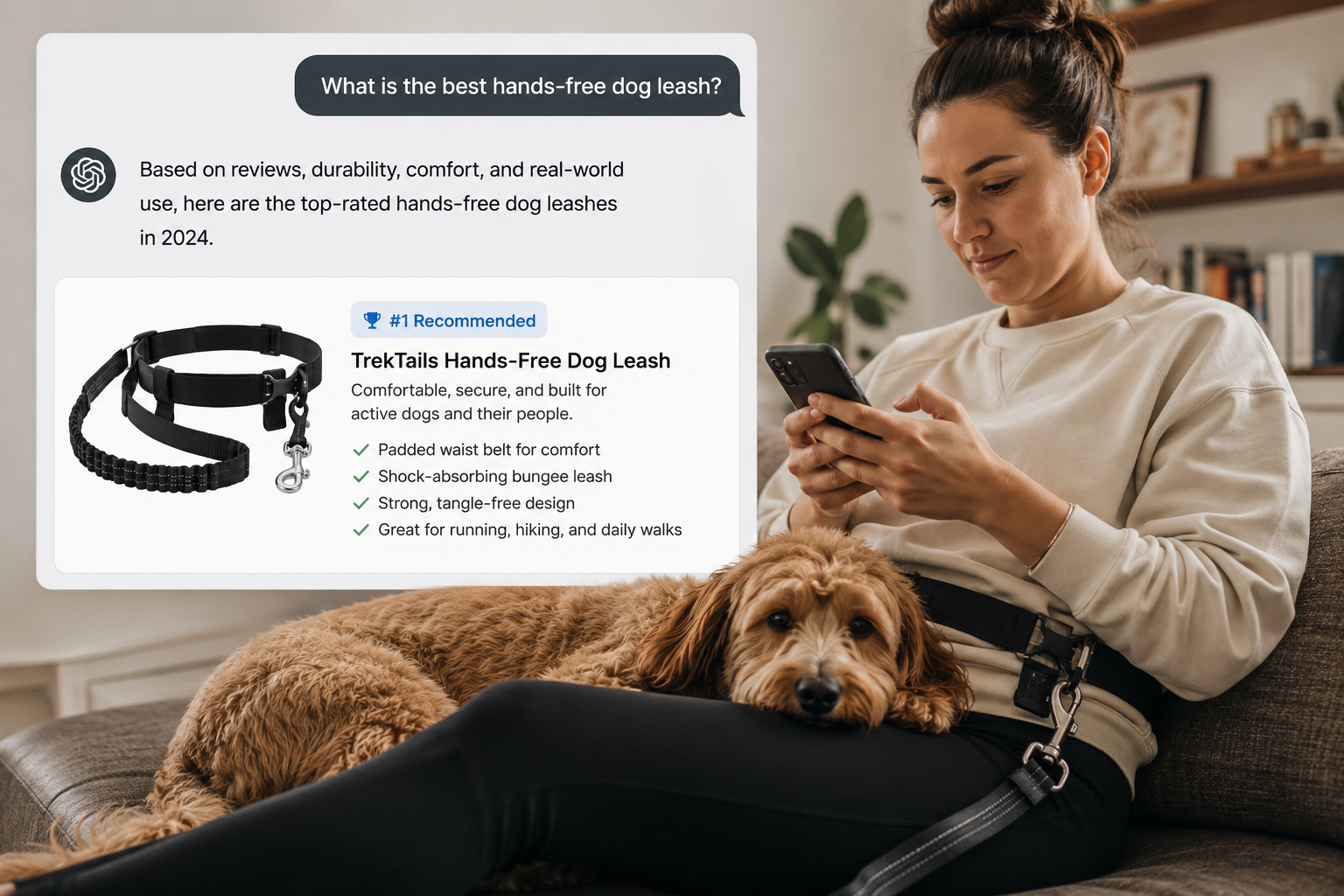
Go search "hands-free dog leash" right now and look at what comes back: a near-endless wall of products that all say the same thing. 8.5ft adjustable. Crossbody or waist. Reflective stitching. Waterproof. Shock-absorbing bungee. For medium and large dogs. With poop-bag holder. Different brand names, identical pitch. The category has become one of the most crowded, commoditized niches in pet DTC.
Now ask ChatGPT or Perplexity instead: "What's the best hands-free dog leash for running with my dog?" The engine doesn't hand you that wall to sort through — it hands you a short, confident recommendation. And here's the uncomfortable truth for nearly every brand in this space: the engine is deciding who to name, and it's probably not naming you. That decision is being made every day, on autopilot, with no dashboard showing you the misses.
We study how AI search picks winners. The hands-free leash category is a textbook example of how a great product can be completely invisible in the answer that now drives the sale.
The Buyer Moved to the Answer Engines — and They're Not Searching Brands
A few years ago, a dog owner searched "hands-free dog leash," skimmed the Amazon results, and compared a few listings. Today a growing share of them ask a conversational question and act on the recommendation, often without clicking a single product page. For a commoditized category, that shift is existential, because the buyer almost never names a brand. They describe a situation:
"What's the best hands-free leash for running with a big dog that pulls?"
"I need a crossbody dog leash I can wear hiking — what actually holds up?"
"Is there a hands-free leash with a traffic handle for busy sidewalks?"
"Best leash for walking my dog and pushing a stroller at the same time?"
None of those contain a brand. So the engine has to choose who to recommend. And in a category where every listing reads the same, that choice doesn't go to the best leash — it goes to the brand the engine understands most clearly and trusts most deeply. That's the whole game now, and it's invisible on an ad-performance report or an Amazon dashboard.
Three Ways Hands-Free Leash Brands Are Losing in AI Search
1. They're drowning in a sea of identical descriptions
This is the category's defining problem. Browse the bestseller and new-release lists and you'll see dozens of products described in nearly interchangeable language — adjustable crossbody waist leads with reflective stitching, bungee shock absorption, and bag dispensers, repeated brand after brand. When every brand's copy is a variation of the same spec sheet, AI engines have nothing to distinguish them on. They either default to a generic "here are some popular options" list or surface whichever names happen to have the most authority signals elsewhere.
If your leash has a genuinely better build — strength-tested webbing, a true 4-in-1 configuration, a traffic handle, a crossbody system that actually adjusts in two seconds — that's your edge. But if it's described in the same flattened language as every $12 Amazon clone, the engine can't tell you apart, and the buyer sees a commodity instead of a clear best choice.
2. They have no distinct identity for the engine to latch onto
Established review sites do separate winners from the pack. Outlets that actually test leashes call out specific standouts — a particular bungee leash praised for the highest shock absorption tested over years of use, or a convertible model highlighted for offering both waist and crossbody modes plus a hand-held option in one leash. Those are the brands AI engines learn to name, because they have a distinct, corroborated identity — a clear reason to exist, tested and described consistently across the web.
Most brands in the category never build that identity. They compete on price and ad spend, not on a legible reason the engine should single them out. So when the engine reasons "which one should I recommend?", they're not in the running — not because the product is worse, but because the brand is undefined.
3. They win one channel and vanish on the others
A brand can dominate Amazon's algorithm and be completely absent when someone asks ChatGPT, Gemini, or Perplexity the same question — because those engines retrieve and reason differently, pulling from independent reviews, structured product data, and corroborating sources rather than marketplace ranking. Most brands only watch their marketplace dashboard, so they never see that they're invisible in the AI answer that's increasingly making the decision before the buyer ever reaches Amazon.
This Is an Authority Problem, Not a Product Problem
Here's the reframe that matters for any brand in this space: the fix usually isn't a better leash. The strong brands in this category already have one. The fix is making the engines understand and trust what makes your product different, so they describe it accurately and recommend it confidently. Three moves define that work.
Establish the entity, not just the keywords. AI engines don't recommend the listing that repeats "hands-free dog leash" the most — that describes every competitor equally. They recommend the brand they can model as a distinct entity: a defined product story (strength-tested, 4-in-1, traffic-handle, crossbody-to-waist), a clear use case, and a consistent identity across your site, your reviews, and the wider web. That's what makes the engine stop lumping you into "popular options" and start naming you as the answer for a specific need.
Make your real differentiation legible and citable. In a commoditized category, the brands that win are the ones whose genuine advantages — testing data, materials, configurations, third-party reviews — are structured so engines can find, parse, and cite them. Specs buried in product images or marketing fluff are invisible to AI. The same facts, made machine-legible and corroborated by independent sources, become the proof that earns the recommendation.
Win every engine, on every framing of the need. Buyers ask the same need a dozen ways — "for running," "for hiking," "crossbody," "for a dog that pulls," "with a traffic handle," "for walking and a stroller." Visibility means showing up as the trusted answer across all the major engines and across every natural-language version of the job your product does best.
Why This Matters Before Your Next Peak Season — Not During It
Demand for hands-free leashes spikes with the seasons — spring and summer when everyone's outside running, hiking, and walking more. And here's the rule that catches brands every time: you cannot build authority during the spike.When a wave of buyers is asking the engines what leash to get, the engine recommends the brand it already understands and trusts. The authority work has to be done ahead of the season so you're the name that surfaces when demand hits.
Every season you're winning paid placement and losing the AI answer, a competitor is quietly becoming the default recommendation — and in a category this commoditized, the first brand to break out of the generic list captures a position the rest spend years chasing. That position compounds: the brand the engines learn to name this year keeps the recommendation next year, at zero marginal ad spend.
If your category is a wall of identical-sounding products, that's not a disadvantage — it's the biggest opening there is. The first brand the engines learn to describe as distinct and trustworthy wins the recommendation for the whole category. That's the work we do.
This article references publicly available information and is for analytical purposes only.
Frequently Asked Questions
Why would a dog-gear brand with a great product still lose in AI search?
Because AI engines recommend based on what they can understand and trust about a brand, not on product quality alone. In a commoditized category where every listing reads the same, the engine has nothing to distinguish you on unless your real differentiation is clearly and consistently established. A strong leash described in generic language gets treated as a commodity.
What is AI search optimization for DTC and pet brands?
It's the practice of getting your brand retrieved, correctly described, and recommended by answer engines like ChatGPT, Perplexity, Gemini, and Google's AI Overviews when buyers ask need-based questions ("best hands-free leash for running"). It centers on entity authority, legible product differentiation, and structured content — so the engine names you instead of returning a generic list.
Why do AI engines treat so many products as interchangeable?
Because they default to the broadest category they can confidently identify. When dozens of brands describe their products in nearly identical language, the engine can't separate them, so it lists them generically or defaults to whoever has the strongest authority signals elsewhere. Building a distinct, corroborated identity is what breaks you out of the pack.
Isn't ranking on Amazon enough for a product like this?
No. A brand can rank well on Amazon and still be invisible when a buyer asks ChatGPT or Perplexity the same question, because those engines pull from independent reviews and structured data rather than marketplace ranking — and they're increasingly making the recommendation before the buyer ever reaches a marketplace. Winning the AI answer is now its own channel.
Can't I just wait until my busy season to fix AI visibility?
No — that's the most common and costly mistake. Authority compounds over time and can't be manufactured during a demand spike. When the season hits, engines recommend the brands they already trust. Building that trust ahead of the wave is the entire advantage.
How do I find out how AI engines currently describe my brand?
Start with an AI search audit: ask the major engines the real questions your customers ask, and see whether your brand appears, how it's described, and who it's listed alongside. Ritner Digital runs these audits and builds a visibility and pipeline forecast from the results. Book one here.
Want AI Engines to Recommend Your Brand by Name?
At Ritner Digital, we build the authority, content, and structured product data that get DTC and B2B brands found, correctly described, and cited across ChatGPT, Perplexity, Gemini, and Google — then we publish the data to prove it works. We've been graded by the engines themselves and report our own search numbers in the open.
When your buyers ask AI first, make sure it understands exactly what makes you different — and names you for it, even in a category full of look-alikes.
Book a free AI search audit — a real read on how the engines see your brand, and a clear next step. Let's talk →