
Your customers don't want to fill out a form, schedule a meeting, or download another PDF. They want to solve a problem, achieve something meaningful, or make a better decision. Your marketing should make that value clear before asking them to take the next step.
"Contact us."
"Get started."
"Book a call."
"Sign up today."
"Learn more."
You've probably seen these phrases thousands of times.
They're everywhere.
On websites. In emails. At the end of blog posts. On landing pages. Inside advertisements. Beneath social media posts.
They're called calls to action, or CTAs.
And they serve an important purpose.
They tell people what to do next.
But there's something these familiar phrases often leave out.
Why should someone want to do it?
A business owner doesn't wake up excited to complete another inquiry form.
A marketing director isn't hoping to add another sales meeting to their calendar.
A homeowner doesn't necessarily want to request three more estimates.
And a potential customer doesn't care about increasing your website's conversion rate.
They care about what happens after taking that action.
The business owner wants more qualified customers.
The marketing director wants to understand why their campaigns aren't producing the expected results.
The homeowner wants confidence that a project will be completed properly.
The prospective client wants to make a decision without wasting time or money.
That's the distinction highlighted in the accompanying graphic attributed to Tim Stoddart (@TimStodz).
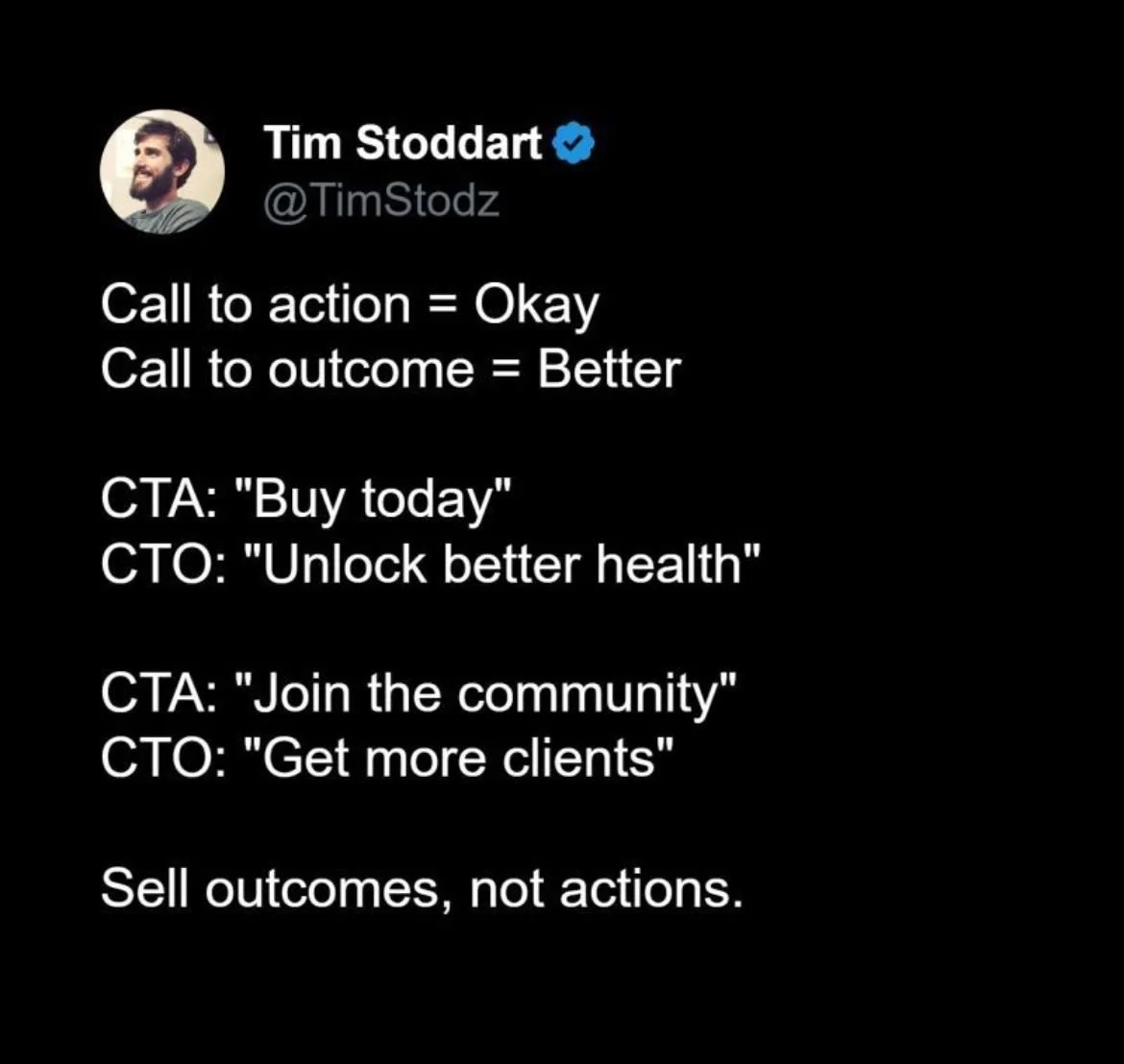
The message is simple:
"Call to action = Okay. Call to outcome = Better."
Instead of merely telling someone to buy, join, or sign up, explain the meaningful result they're trying to achieve.
It's a useful way to rethink marketing copy.
But there's also an important nuance.
A persuasive outcome doesn't replace the need for a clear next step.
The strongest marketing connects both.
Tell people what they stand to gain. Then make it obvious what happens when they click.
That combination is where better website messaging begins.
What Is a Call to Outcome?
A call to outcome, sometimes shortened to CTO, is a copywriting approach that emphasizes the benefit or desired result associated with taking an action.
Instead of focusing only on the action itself, it communicates why that action matters.
For example:
Traditional CTA: "Schedule a consultation."
Outcome-focused message: "Get clarity on what's keeping your website from generating qualified inquiries."
Traditional CTA: "Download our guide."
Outcome-focused message: "Learn which website improvements are worth prioritizing before paying for a redesign."
Traditional CTA: "Join our newsletter."
Outcome-focused message: "Get practical search and marketing insights you can use to make better decisions."
The difference is perspective.
A traditional CTA often describes what the business wants the visitor to do.
An outcome-focused message explains what the visitor hopes to accomplish.
Neither approach needs to stand alone.
In fact, the best implementation may use an outcome-focused headline followed by a clearly labeled button.
For example:
Headline: Find out what's limiting your local search visibility.
Supporting copy: Review the business information, website issues, and search questions worth investigating first.
Button: Request a Local SEO Audit.
The headline communicates the value.
The supporting copy explains the offer.
The button identifies the next action.
That is usually more informative than a vague promise followed by another vague button.
Why "Get Started" Often Isn't Enough
"Get Started" isn't automatically a bad button label.
In some interfaces, it's perfectly appropriate.
If someone has already decided to begin a clearly explained process, the wording may be sufficient.
The problem occurs when a business uses the phrase without establishing what the visitor is starting.
Imagine landing on a digital marketing agency's homepage.
The hero section says:
"Digital Solutions for the Modern Business."
Beneath it is a button:
"Get Started."
Get started with what?
An SEO audit?
A paid advertising campaign?
A website redesign?
A consultation?
A monthly agreement?
The visitor has to work to understand the offer.
Now imagine a different homepage:
Headline: Help more of the right customers find your business.
Supporting text: SEO, content, and website improvements built around how your customers search and evaluate providers.
Button: Discuss Your Visibility Goals.
The second version is more specific.
It connects the service to the customer's objective.
And it explains what kind of interaction the button will begin.
The difference isn't that one phrase contains a magical conversion keyword.
It's that the second experience requires less interpretation.
According to the Nielsen Norman Group's research on microcopy, interface labels help users understand the purpose of controls and what will happen when they interact with them.
That matters because a button isn't simply a decorative marketing element.
It's part of the customer's decision-making experience.
When people understand both the value and the next step, they have more information for deciding whether to proceed.
People Don't Buy Marketing Services. They Buy the Possibility of a Better Business Outcome.
Consider the way digital marketing services are commonly described.
"Technical SEO."
"Content marketing."
"Google Ads management."
"Website design."
"Digital PR."
These are legitimate services.
But they describe categories of work.
They don't automatically explain the business problem that work is intended to address.
A company doesn't necessarily want SEO because it enjoys the process of optimizing title tags.
It may want prospective customers to find its services more easily.
A business doesn't usually commission a new website because it wants to purchase a collection of page templates.
It may need a more effective way to communicate its capabilities and convert relevant interest into inquiries.
An organization doesn't invest in content simply because it wants another article on its blog.
It may need to answer customer questions, support its sales process, or become more discoverable in a new market.
The service is the mechanism.
The outcome is the reason someone considers investing.
This distinction helps businesses write more relevant marketing messages.
Instead of describing only the activities involved, explain why those activities may matter.
That doesn't mean abandoning service descriptions.
Prospective customers still need to know what they're purchasing.
It means connecting the service to a meaningful purpose.
Sell the value of the work, then explain what the work actually involves.
A Call to Action Answers "What?" A Call to Outcome Answers "Why?"
Think about the questions a visitor considers before making a decision.
What is this?
Is it relevant to me?
Why should I care?
What will I receive?
How much effort will it require?
What happens after I click?
Can I trust this business?
A basic CTA often answers only one of those questions.
It tells the visitor what action to perform.
A stronger marketing message addresses the reason for the action and reduces uncertainty about what happens afterward.
For example:
"Submit" explains the mechanical action.
"Request Your Website Review" explains what is being requested.
"Find out which website problems are worth fixing first" explains why the review may be valuable.
Put together, those messages create a more complete interaction.
This is consistent with research from the Baymard Institute on button clarity, which emphasizes the importance of descriptive microcopy, visual prominence, and helping users understand the intention of interface controls.
The research focuses substantially on ecommerce experiences, so its findings shouldn't be treated as direct conversion guarantees for service-business websites.
But the underlying usability principle is relevant.
People need to understand what they're choosing.
A message that communicates value without explaining the action can create confusion.
And a button that identifies an action without explaining its value can feel unpersuasive.
The best experience connects both.
The Three Parts of an Effective Outcome-Focused CTA
A useful way to approach this is through three components.
1. The outcome: What does the customer want to accomplish?
Start with the problem or goal.
Does the visitor want to understand why their website isn't generating leads?
Are they trying to become more visible in Google Maps?
Do they want to compare providers before making an investment?
Are they trying to determine whether a website redesign is necessary?
The outcome should reflect a real customer need rather than a benefit the business invented for marketing purposes.
2. The offer: What can your business genuinely provide?
This is where credibility matters.
A website audit can identify problems.
It cannot guarantee more revenue.
An SEO consultation can help evaluate visibility opportunities.
It cannot guarantee first-place rankings.
A content strategy can organize educational publishing around relevant customer questions.
It cannot promise that every article will generate a client.
Your offer should describe something you can reasonably deliver.
3. The action: What happens next?
Finally, make the interaction clear.
Will the visitor request an audit?
Schedule a call?
View a portfolio?
Download a checklist?
Receive a proposal?
The action should be understandable without requiring the person to guess what happens behind the button.
Consider this example:
Outcome: Understand why your website isn't attracting qualified inquiries.
Offer: A focused review of your search visibility, service pages, and contact experience.
Action: Request a Website Audit.
These components support one another.
The customer understands what the potential benefit is, how the business proposes to help, and what action will begin the process.
That's stronger than relying on one clever phrase.
Why a Call to Outcome Is Not a Guaranteed Result
There's an important line between explaining a desired outcome and promising to deliver it.
The original screenshot uses examples such as "Unlock better health" and "Get more clients."
Those phrases illustrate the concept of outcome-focused messaging.
But businesses should be careful about adopting them as unconditional promises.
"Get more clients" may imply that a particular purchase or action will reliably increase customer acquisition.
"Unlock better health" may suggest a health benefit that requires appropriate evidence.
Not every company can substantiate those outcomes.
The Federal Trade Commission's advertising guidance explains that promotional claims must be truthful, non-deceptive, and supported by appropriate evidence.
The FTC also evaluates implied claims.
That means wording can create a misleading impression even when it doesn't explicitly contain a guarantee.
This matters for marketing agencies in particular.
It's tempting to use statements such as:
"Double your leads."
"Dominate Google."
"Guarantee more sales."
"Turn every visitor into a customer."
Without proper substantiation, these messages can mislead readers.
A more responsible approach communicates an outcome the service is designed to support.
For example:
"Find opportunities to attract more qualified inquiries."
"Understand what's limiting your local visibility."
"Build a website that makes it easier for customers to take the next step."
These statements describe purposes and potential benefits without automatically promising a specific result.
Outcome-focused marketing should increase clarity, not exaggerate certainty.
Don't Sell the Dream and Hide the Process
Some marketers interpret outcome-focused messaging as permission to ignore the work involved.
That can create another problem.
A business may advertise:
"Grow faster."
"Get more customers."
"Transform your business."
But offer almost no explanation of what the company actually does.
Those phrases can sound attractive.
They can also be so broad that they're nearly meaningless.
What service is being offered?
What will the customer receive?
How long does the work take?
What information will be required?
What limitations should the customer understand?
A credible business should be able to answer those questions.
Consider the difference between these two marketing messages.
Version A: Unlock explosive business growth.
Version B: Understand where your website is losing relevant customer inquiries and which improvements deserve attention first.
The second message is narrower.
It may not sound as dramatic.
But it is more concrete.
The business is communicating a specific type of value.
It can explain the work involved.
And the customer can evaluate whether the offer is relevant.
For many service businesses, that clarity is more useful than an extravagant promise.
Ten Before-and-After Examples of Outcome-Focused Marketing
The easiest way to apply this idea is to examine familiar marketing messages and consider how they could become more useful.
The following examples are illustrative copywriting alternatives, not proven A/B-test winners.
1. Local SEO
Generic CTA: Contact Us for SEO.
Outcome-focused message: Help nearby customers discover your business when they search for the services you provide.
Clear next step: Request a Local SEO Review.
Why this works as a starting point:
It connects SEO with the reason a local business might care.
It also frames the review as an opportunity to understand visibility rather than promising a particular ranking.
2. Google Maps visibility
Generic CTA: Improve Your Google Rankings.
Outcome-focused message: Find out why your business is missing from relevant Google Maps searches.
Clear next step: Check My Local Visibility.
This is especially appropriate when a company has a legitimate Maps visibility problem.
The message focuses on diagnosis.
It doesn't promise that a specific ranking can be purchased.
3. Website redesign
Generic CTA: Start Your Website Project.
Outcome-focused message: Give prospective customers a clearer reason to trust your business and contact you.
Clear next step: Discuss My Website.
A redesign may involve visual improvements.
But the customer's deeper concern may be how effectively the website communicates its services.
The outcome should reflect that purpose.
4. Website audits
Generic CTA: Book a Website Audit.
Outcome-focused message: Understand which website problems are worth fixing before investing in a redesign.
Clear next step: Request a Website Audit.
This example works because it connects the service with a decision the customer is trying to make.
The customer isn't simply purchasing an audit.
They're seeking clarity about the next investment.
5. Content marketing
Generic CTA: Get Our Content Services.
Outcome-focused message: Answer the questions your future customers are researching before they contact you.
Clear next step: Explore Content Strategy.
The outcome connects publishing with customer education and discoverability.
It also reflects why meaningful content can matter before a sales conversation begins.
6. Digital PR
Generic CTA: Learn About Link Building.
Outcome-focused message: Build a stronger public presence through relevant coverage and useful contributions.
Clear next step: Discuss Digital PR.
This communicates the intended value without guaranteeing press coverage, backlinks, or rankings.
7. Paid advertising
Generic CTA: Start Google Ads Today.
Outcome-focused message: Reach people actively searching for your services and learn which campaigns attract suitable inquiries.
Clear next step: Review My Ad Strategy.
The wording connects paid search to relevant demand and measurement.
It doesn't imply that spending money automatically produces profitable customers.
8. Luxury home services
Generic CTA: Request a Quote.
Outcome-focused message: Plan your project with a clear understanding of the work, process, and next steps.
Clear next step: Request a Project Consultation.
For some premium services, the customer may value confidence and clarity as much as the initial price.
A consultation-focused action can be more appropriate than an instant quote if the business genuinely requires project discovery.
9. Professional services
Generic CTA: Schedule a Meeting.
Outcome-focused message: Get a clearer understanding of your options before committing to a service.
Clear next step: Schedule an Initial Consultation.
This frames the consultation as a way to become more informed.
Any regulated professional claims or obligations still require appropriate review.
10. Email newsletters
Generic CTA: Subscribe.
Outcome-focused message: Get practical ideas for improving your website, search visibility, and marketing decisions.
Clear next step: Sign Up for Marketing Insights.
The reader understands what kind of content they'll receive.
The action is still straightforward.
The offer should also describe the actual newsletter frequency and content accurately.
Across all ten examples, the pattern is consistent.
The action hasn't disappeared.
It has been placed inside a more meaningful explanation.
The Best Outcome-Focused CTAs Begin With Customer Research
A business can invent attractive-sounding outcomes all day.
More growth.
More success.
More customers.
More freedom.
More confidence.
But those messages may not reflect what actual customers care about most.
A residential contractor's customers may be more concerned about communication and reliability than speed.
A professional services firm's prospects may prioritize expertise and confidentiality over convenience.
An established business considering SEO may want an explanation of its current visibility problems before purchasing ongoing services.
Those differences matter.
A useful approach begins with questions.
Why do customers contact the business?
What problem usually motivates the inquiry?
What worries them before making a decision?
Which questions appear repeatedly during discovery?
What would make the next step feel worthwhile?
What information helps someone determine whether the business is a good fit?
The answers can improve CTA copy.
Instead of assuming every visitor wants "more leads," a marketing agency might discover that its intended clients are struggling with poor-quality inquiries.
That would change the message.
The business may be more interested in attracting fewer but better-qualified opportunities.
Research helps identify those distinctions.
The best outcome isn't necessarily the most impressive-sounding one. It's the one that matters to the customer.
Outcome-Focused Copy Should Match the Buyer's Stage of Readiness
Not every website visitor is ready to contact a business.
Someone reading an introductory blog post may be learning about a problem.
Another visitor may be comparing services.
Someone reviewing a portfolio may be closer to requesting a proposal.
A person on a contact page may already know what they want.
The appropriate CTA depends on that context.
Early-stage visitors
An early-stage visitor may need information before considering a service.
A suitable message could be:
"Understand the five issues that commonly make a service website difficult to use."
The action might be:
"Read the Website Checklist."
That creates a logical next step without demanding a sales conversation.
Evaluation-stage visitors
Someone comparing potential approaches may want decision support.
For example:
"Determine whether your website needs targeted improvements or a full redesign."
The action might be:
"Explore the Redesign Guide."
Decision-stage visitors
A person considering professional help may need a direct engagement pathway.
For example:
"Get a focused assessment of the search and website issues worth prioritizing."
The action might be:
"Request a Visibility Audit."
This approach respects the customer's readiness.
It also prevents the website from treating every visitor as an immediate sales opportunity.
A call to outcome is most useful when it reflects what the person is trying to accomplish at that moment.
Your Homepage Needs a Larger Outcome, Not Just a Bigger Button
Homepages often contain the most generic marketing messages.
"Welcome to Our Website."
"Innovative Solutions."
"Your Partner in Excellence."
"Let's Work Together."
These phrases may communicate tone.
But they often provide limited information about the business's purpose.
A stronger homepage connects three questions.
Who do you help?
What problem do you address?
What should someone do next?
Consider a hypothetical local SEO agency.
A generic homepage might say:
"Full-Service Digital Marketing Agency."
The button says:
"Contact Us."
A more useful version might say:
"Make your business easier to find when customers search for what you do."
Supporting copy could explain:
"SEO, local search, and website improvements built around relevant customer questions and measurable business goals."
The action:
"Discuss Your Search Visibility."
The revised homepage gives visitors more context.
It doesn't promise guaranteed rankings.
It doesn't require readers to understand every marketing acronym.
And it connects the offering with a problem a potential customer can recognize.
The website still needs evidence, services, and a useful navigation structure.
But the first impression becomes more informative.
Why Your CTA Can't Carry the Entire Value Proposition
Sometimes a business tries to solve a weak landing page by rewriting one button.
"Submit" becomes "Unlock My Future."
"Contact Us" becomes "Transform My Business."
"Get Started" becomes "Achieve Success."
These changes may sound more energetic.
But they don't necessarily help users understand the offer.
If the page hasn't established credibility, clarified the service, or addressed important questions, the button has very little supporting information.
Conversion optimization involves the complete experience.
The headline matters.
The body copy matters.
The evidence matters.
The form matters.
The design matters.
The transition to the next page matters.
In its introduction to conversion-focused design, CXL emphasizes visual clarity, prioritizing important actions, and reducing unnecessary distractions.
That is a useful reminder.
A clever button isn't a substitute for a coherent page.
The visitor needs to understand the value before deciding whether the action is worthwhile.
The outcome makes the action desirable. The page makes the outcome credible.
Explain What Happens After Someone Clicks
One of the most overlooked conversion problems is uncertainty about the next step.
Imagine a button labeled:
"Unlock Better Results."
The visitor clicks.
Will they receive a download?
Will they be asked to pay?
Will a salesperson call them?
Will they enter a subscription?
Will they be redirected to a scheduling tool?
The phrase doesn't answer those questions.
This is why direct, descriptive actions still matter.
Baymard's checkout usability research recommends clearly labeling what happens next rather than relying on generic "Continue" buttons.
Although that research concerns ecommerce, the principle is helpful for service businesses too.
A consultation form should explain what happens after submission.
For example:
"Share a few details about your website. We'll review your inquiry and respond to discuss whether an audit makes sense."
That statement should reflect the company's actual process.
If the business can't promise a same-day reply, it shouldn't advertise one.
If the form leads to a paid assessment, that should be clear before the customer commits.
A useful CTA makes the immediate action understandable.
A useful supporting message explains what that action is intended to help accomplish.
Outcome-Focused Language Should Reduce Risk, Not Create Pressure
People sometimes hesitate to submit forms because they're uncertain about what follows.
They may worry about unwanted sales calls.
They may wonder whether the service is too expensive.
They may not know whether their problem is relevant.
They may be concerned about committing to something before receiving enough information.
A well-written page can address those concerns.
For example:
Outcome: Understand which marketing issues deserve attention first.
Process: Share your website and a short description of your goals.
Expectation: Receive a response explaining the appropriate next step.
This is more specific than asking someone to "Unlock Growth."
It can also feel more respectful.
The business is inviting an inquiry, not implying that the visitor must immediately commit to a large project.
The goal isn't to remove every barrier through aggressive persuasion.
It's to help someone make an informed decision.
Sometimes that means explaining pricing.
Sometimes it means clarifying whether a consultation is free or paid.
Sometimes it means telling visitors when the service may not be appropriate.
Trustworthy communication supports better-qualified conversations.
A Good Outcome-Focused CTA Can Qualify Leads Before the Form
Businesses sometimes evaluate CTAs only by how many people click.
But a higher click-through rate doesn't necessarily mean the message is better for the business.
Imagine a digital marketing agency offering a specialized technical audit.
One button says:
"Get More Customers."
Another says:
"Request a Technical SEO Audit."
The first may appeal to a broader range of people.
But many of those visitors may not actually need a technical SEO audit.
The second identifies the offer more precisely.
It may attract fewer clicks while producing more relevant inquiries.
That is a hypothetical possibility, not a predicted test result.
The important lesson is that conversion quality matters.
A website should attract the right interactions, not simply the largest possible number of them.
Outcome-focused language should help potential customers recognize whether the offer is appropriate.
For example:
"Find out whether technical issues are limiting your website's search visibility."
This communicates a benefit and identifies the type of problem being investigated.
The next step can remain:
"Request a Technical SEO Audit."
The visitor knows why the offer exists and what the service involves.
That is useful qualification before the inquiry begins.
Outcome-Based Messaging Works Especially Well for Professional Services
Professional services often involve intangible deliverables.
Customers may not fully understand what they're purchasing before an engagement.
A business owner considering a marketing strategy may not know what a discovery phase includes.
A company evaluating website design may not understand how information architecture affects the project.
A prospective consulting client may have difficulty distinguishing different providers' methods.
When the service is difficult to evaluate, explaining the purpose becomes particularly important.
But so does explaining the process.
A professional services firm can communicate both.
For example:
Headline: Make a more informed decision about your next marketing investment.
Supporting copy: Review your current visibility, website, and customer acquisition priorities before choosing a channel.
Action: Request a Strategy Conversation.
This message doesn't guarantee improved revenue.
It offers a more informed planning process.
That may be valuable to a buyer who is uncertain about the right next step.
It also sets a more appropriate expectation for the conversation.
The business is inviting diagnosis and planning, not promising immediate transformation.
Luxury Businesses Should Sell Confidence, Not Just Prestige
This principle is especially relevant to established businesses in places such as Pebble Beach, Carmel-by-the-Sea, and other premium markets.
Luxury marketing often uses broad language.
"Exceptional Service."
"Unparalleled Excellence."
"Elevated Experiences."
"Timeless Craftsmanship."
Those phrases may be appropriate elements of brand voice.
But they aren't always specific enough to explain the customer's desired outcome.
A homeowner considering a substantial project may want confidence in the process.
A property owner working from another location may prioritize reliable communication.
An interior design client may want a carefully coordinated experience.
A professional services customer may need privacy, expertise, and clarity.
A strong message should reflect the actual service and the reasons customers value it.
Consider a hypothetical residential design practice.
Generic CTA:
"Begin Your Journey."
Outcome-focused message:
"Explore a design process built around your property's needs and the way you want to live."
Clear next step:
"Request a Design Consultation."
The language remains premium.
But it provides more information.
It doesn't rely entirely on the impression of exclusivity.
And it makes the engagement process easier to understand.
The Psychology of a Useful Marketing Promise
A visitor considering a CTA is making a small decision.
They evaluate the potential benefit against the effort, uncertainty, and risk involved.
If the offer appears irrelevant, they have little reason to continue.
If the process appears confusing, they may hesitate.
If the claims seem exaggerated, they may question the credibility of the provider.
And if the button is difficult to understand, they may not know what they're choosing.
An outcome-focused message can help clarify the value of the action.
But clarity shouldn't be confused with psychological manipulation.
There's no universal phrase that overrides a customer's preferences or guarantees a conversion.
The purpose of good marketing copy is to communicate the offer effectively.
Not to pressure people into actions they don't understand.
The Nielsen Norman Group's microcopy guidance describes how small pieces of interface language can inform, influence, and guide interaction.
That framing is useful.
Marketing copy has a persuasive role.
But it also has an informational responsibility.
A visitor should understand the next step well enough to decide whether it is appropriate.
The best outcome-focused marketing respects that decision.
Your CTA Has to Work for Accessibility, Too
A persuasive button still needs to be understandable to people using assistive technology.
A label such as "Unlock It" may make sense only when someone has read the surrounding visual headline.
For a screen reader user reviewing a list of links, it may be less clear.
The W3C Web Accessibility Initiative's guidance on meaningful link text recommends describing the destination or purpose rather than relying on vague language such as "click here."
That doesn't mean every button must contain a lengthy explanation.
It means the action should be identifiable through the label and appropriate context.
Consider:
"See the Guide."
Versus:
"Read the Website Audit Guide."
The second identifies the destination more specifically.
Similarly:
"Get Started."
Versus:
"Request an SEO Consultation."
The second clarifies the action.
The same principle applies to links within blog posts.
Descriptive wording helps people understand where they'll go before selecting a link.
Outcome-focused persuasion should never make the interface less usable.
Why Outcome-Focused Messaging Belongs in Blog Posts, Not Just Buttons
A blog post can help someone understand a problem before they're ready to speak with a provider.
That means the call to action should relate to what the article has explained.
Imagine an article about businesses that don't appear prominently in Google Maps.
The reader has just learned about verification, business categories, distance, prominence, and website relevance.
A generic ending says:
"Contact us for digital marketing services."
That isn't necessarily wrong.
But it disconnects the next step from the problem the article explored.
A more relevant conclusion might say:
"If your business appears for its own name but not for the services customers search, a local SEO review can help identify which factors deserve attention."
Then the button could say:
"Discuss a Local SEO Audit."
The message continues the article's educational purpose.
It doesn't suddenly switch into an unrelated sales pitch.
The same approach can be used across content categories.
An article about website redesigns can lead to an audit.
An article about SEO costs can lead to budget planning.
An article about content strategy can lead to a discussion about customer questions and publishing priorities.
The outcome should connect to the reader's reason for being there.
Your Email Marketing Should Sell the Value of Opening, Not Just the Action of Clicking
Outcome-focused copy also applies to email.
A generic email might say:
"Check out our latest blog."
That message centers the publisher's activity.
The reader is being asked to visit because the business published something.
A more relevant version might say:
"Not sure whether your website needs a redesign? Here are the issues worth checking first."
Now the reader understands the potential value.
The link might say:
"Read the Website Audit Checklist."
This communicates both the benefit and the action.
The same principle can improve newsletters, follow-up messages, and educational sequences.
Instead of promoting a webinar only with "Register Now," explain what attendees will learn.
Instead of asking recipients to download an ebook, describe the decisions it can help them make.
Instead of urging a prospect to schedule a meeting, clarify what the conversation is intended to accomplish.
As always, the offer should be accurate.
Don't promise a complete strategy when the resource is a short introductory overview.
The outcome should match what the reader will actually receive.
Social Media CTAs Need the Same Discipline
Social media encourages short, attention-grabbing language.
That can make outcome-focused copy appealing.
But it can also encourage exaggerated promises.
"Want more customers?"
"Ready to dominate your industry?"
"Unlock massive growth."
These statements may attract attention.
They don't necessarily establish a useful reason to engage.
A better approach is to identify a specific question or problem.
For example:
"Your Google Business Profile appears for your company name but not your services. Here are three things to check before paying for more SEO."
The next step might be:
"Read the full guide."
Or:
"See the local search checklist."
The message communicates useful information rather than relying entirely on hype.
For service businesses, this can also improve the quality of the audience.
People experiencing the described problem have a reason to pay attention.
Others can move on without being pressured by an overly broad promise.
Calls to Outcome Also Belong in Sales Conversations
This concept isn't limited to written marketing.
It applies to how businesses describe their work during discovery calls.
A marketing agency might say:
"We offer monthly SEO management."
That's accurate, but incomplete.
A more useful explanation could be:
"We investigate what is limiting your search visibility, prioritize the improvements that fit your goals, and measure whether the work is helping relevant customers discover your business."
The second statement connects the service with its purpose.
It also explains the nature of the engagement.
Similarly, a web designer might say:
"We build custom websites."
Or:
"We help businesses organize their services, communicate their capabilities, and create a clearer path for interested visitors to contact them."
Again, the stronger explanation is not necessarily the one making the largest promise.
It's the one helping the customer understand why the service exists.
That clarity can improve qualification.
A potential client can better determine whether the offering fits their needs.
How to Audit Your Existing Calls to Action
Before rewriting every button, examine how your website currently communicates value.
Start with the pages that matter most.
The homepage.
Core service pages.
High-traffic educational articles.
Landing pages.
Contact forms.
And important email campaigns.
For each major CTA, ask five questions.
1. What problem brought this visitor here?
A person searching for a website audit may have different priorities from someone searching for web design pricing.
2. What does the visitor hope to accomplish?
Identify the desired outcome in plain language.
3. What can the business genuinely offer?
Don't advertise a result that depends on unknown conditions.
4. Does the page explain the offer before asking for action?
A button can't rescue a page that never explains the service.
5. Does the button accurately describe what happens next?
Someone should know whether they're requesting information, beginning a purchase, downloading a resource, or scheduling a consultation.
This review may reveal that the problem isn't the CTA wording at all.
Perhaps the website needs clearer services.
Maybe the offer is poorly defined.
The contact process may be confusing.
Or the page may attract people who aren't suitable customers.
In those situations, rewriting a few buttons won't solve the underlying issue.
The Outcome-Focused CTA Rewrite Framework
A practical rewrite process can follow five steps.
Step 1: Identify the current action
Write down the existing CTA exactly as it appears.
For example:
"Contact Us."
Step 2: Identify the customer's real question
Why would someone contact the business?
Perhaps they're uncertain why their website isn't generating qualified inquiries.
Step 3: Define the value of the first interaction
What can the business reasonably provide?
Maybe it can review the situation and discuss whether an audit is appropriate.
Step 4: Write the outcome-focused message
For example:
"Understand what may be limiting your website's ability to attract relevant customer inquiries."
Step 5: Write an accurate action label
For example:
"Discuss a Website Audit."
Then review the full page.
Does the copy support the promise?
Is the process clear?
Does the destination match the button?
Does the business have the capacity to deliver what the message describes?
The objective is consistency.
A strong marketing promise should survive contact with the actual customer experience.
Why You Should Test Outcome-Focused Copy Instead of Assuming It Wins
The idea of focusing on outcomes is compelling.
But that doesn't mean an outcome-focused CTA will outperform an action-focused CTA in every situation.
A button that says "Download PDF" may be exactly what a user wants when the action is clear and immediate.
A button that says "Add to Cart" is useful in an ecommerce interface because it identifies a familiar action.
A more elaborate phrase might actually create uncertainty.
Likewise, a short "Book a Call" button can work well when the surrounding page has already established the reason for the meeting.
The best copy depends on context.
That's why testing matters.
A business might compare two versions of a service-page hero section.
Version A:
"SEO Services for Local Businesses."
"Contact Us."
Version B:
"Help more nearby customers discover your services."
"Request a Local Visibility Review."
If the test changes both the headline and button, any difference in performance cannot be attributed solely to the button wording.
That distinction matters.
A controlled test should define the hypothesis, audience, primary metric, and scope of changes.
Smaller businesses may not have enough traffic to run statistically meaningful experiments quickly.
In those cases, customer feedback and usability testing can provide useful qualitative information.
Avoid declaring a winner based on a handful of clicks.
The purpose is to learn what communicates value more effectively to the intended audience.
Measure the Outcome After the Click, Not Just the Click Itself
An outcome-focused marketing message should be evaluated against more than button clicks.
Suppose a new CTA attracts significantly more visitors to a contact form.
That sounds promising.
But what happens next?
Do people complete the form?
Are the inquiries relevant?
Do prospects understand what they requested?
Are they expecting a service the business doesn't provide?
Do those inquiries become appropriate opportunities?
These questions matter.
Google Analytics supports recommended events such as generate_lead for initial lead actions and close_convert_leadwhen a qualified lead becomes a customer.
Google's official event documentation explains the intended meaning of these measurements.
A business can use a combination of analytics, CRM information, and sales feedback to understand the quality of interactions.
But attribution remains imperfect.
Not every customer decision can be traced to one CTA.
And a higher click-through rate doesn't guarantee more revenue.
The measurement process should focus on the business's actual goals.
A service provider may prefer a smaller number of suitable consultations over a large volume of inquiries that don't match its offering.
The best CTA isn't necessarily the one that gets the most clicks. It's the one that helps the right people take a useful next step.
A 30-Day Plan to Improve Your Website's Calls to Outcome
Businesses don't need to rewrite their entire website overnight.
A focused month can help improve the most important messages.
Week 1: Identify the pages that matter
Review the homepage, service pages, high-value blog posts, and contact page.
Document the current calls to action.
Identify the primary customer task associated with each page.
Review available engagement and inquiry data.
The objective is to understand where the visitor journey may be unclear.
Week 2: Research customer motivations
Review genuine inquiry questions, discovery notes, and frequently discussed concerns.
Ask customers or prospects what they hoped to accomplish when they contacted the business.
Identify differences between the language the company uses internally and the language customers use to describe their problems.
Choose one or two important pages for improvement.
Week 3: Rewrite the message and clarify the next step
Develop outcome-focused headlines or supporting copy.
Make sure the offer is specific.
Use a clear action label.
Review the page for substantiation, accessibility, and consistency.
Test the contact process.
Ensure that clicking the CTA leads to the expected destination.
Week 4: Evaluate and refine
Review available data and customer feedback.
Consider whether more people understand the offer.
Check whether inquiries remain relevant.
Identify confusion or unexpected assumptions.
Where traffic is sufficient, establish a controlled testing plan.
Otherwise, gather qualitative feedback and monitor changes without overinterpreting small samples.
The goal after 30 days isn't to claim a guaranteed conversion increase.
It's to build a more accurate and useful connection between the customer's desired outcome and the business's actual offer.
How Ritner Digital Thinks About Outcomes
At Ritner Digital, the objective of digital marketing isn't simply to create more activity.
It's to help businesses become easier to find, easier to understand, and more relevant to the people they want to serve.
That includes SEO, AI search visibility, content strategy, digital PR, website design, and performance measurement.
But those service categories aren't the end goal.
A local business may need customers to discover it in relevant searches.
A professional service provider may want a website that explains its expertise more clearly.
A company entering a new market may need useful content that demonstrates its capabilities before the first client relationship develops.
Another may need to understand whether its current marketing investment is producing meaningful opportunities.
The appropriate work depends on the problem.
That's why the strongest marketing message often begins with the customer's objective rather than a list of deliverables.
Ritner Digital's published approach emphasizes connecting strategy, content, and performance to how people actually discover businesses.
That philosophy fits naturally with outcome-focused marketing.
But an ethical outcome message still needs boundaries.
SEO cannot guarantee rankings.
Content cannot guarantee sales.
A new website cannot guarantee a particular conversion rate.
And a marketing audit cannot solve a problem simply by identifying it.
The value lies in understanding the situation, recommending appropriate work, and communicating clearly about what the service can accomplish.
That is a stronger foundation for an ongoing relationship than a dramatic promise with no evidence behind it.
Stop Asking People to Act Before Giving Them a Reason
The most important lesson from the Tim Stoddart graphic isn't that every CTA should be replaced with a new acronym.
It's that marketers need to think about the person on the other side of the button.
Why would they care?
What are they trying to accomplish?
What uncertainty are they trying to resolve?
What will they actually receive?
A business owner doesn't want another marketing meeting.
They may want clarity about why their website isn't producing the right inquiries.
A homeowner doesn't necessarily want to submit a quote request.
They may want confidence that they've found someone qualified to handle an important project.
A potential customer doesn't want to be pushed through a conversion funnel.
They want to solve a problem or make a decision.
Marketing should respect that.
It should explain the value.
It should substantiate its claims.
It should identify the next step.
And it should make the process easy to understand.
That doesn't make traditional calls to action obsolete.
It makes them more useful.
A call to action tells someone what to do. A call to outcome gives them a reason to want to do it.
The strongest marketing delivers both.
Frequently Asked Questions
1. What is a call to outcome in marketing?
A call to outcome is a marketing message that emphasizes the benefit or desired result associated with taking an action. Instead of focusing only on instructions such as "Contact Us" or "Sign Up," it explains why the customer might find the action worthwhile. A strong implementation also clearly identifies what happens next.
2. What is the difference between a CTA and a CTO?
CTA stands for call to action. It typically asks someone to perform an action, such as scheduling a consultation or downloading a resource. CTO, or call to outcome, is a copywriting term used to describe messaging focused on the result the customer hopes to achieve. CTO is a useful strategic concept, not a replacement for clear interface labels or a universal industry standard.
3. Are calls to outcome better than traditional calls to action?
Not automatically. Outcome-focused copy can help communicate value, but descriptive action labels are also important. The most effective wording depends on the audience, offer, page, and customer journey. A clear "Download Guide" button may work better than a vague outcome promise. Businesses should evaluate the complete experience rather than assume one style always wins.
4. What are some examples of outcome-focused CTAs?
Examples include "Find out what's limiting your Google Maps visibility," "Understand which website problems deserve attention first," and "Learn how to evaluate your next marketing investment." These messages communicate the potential value of an interaction. They can be paired with straightforward buttons such as "Request an Audit," "Read the Guide," or "Schedule a Consultation."
5. Why do generic CTAs sometimes underperform?
Generic phrases such as "Get Started" or "Learn More" may not explain what the visitor will receive or why the action matters. This can create uncertainty when the surrounding page is also vague. However, generic labels aren't inherently ineffective. Their usefulness depends on whether the page already provides enough context and makes the next step obvious.
6. Should every website button describe an outcome?
No. Some buttons should remain direct action labels, particularly in forms, checkout flows, downloads, and other familiar interfaces. "Submit Application," "Download PDF," or "Place Order" may provide necessary clarity. Outcome-focused messaging often works best in the headline or supporting text, with the button accurately describing the action.
7. Can outcome-focused messaging improve website conversions?
It may improve clarity and relevance, potentially supporting more useful interactions. But conversion improvements aren't guaranteed. The result depends on the offer, audience, design, page content, and overall customer experience. Test changes where practical and evaluate lead quality rather than relying exclusively on clicks.
8. How can service businesses use calls to outcome?
Service businesses can identify the real problems motivating inquiries and connect their offers to those needs. A website designer might focus on making services clearer to prospective customers. An SEO provider might offer to investigate visibility barriers. A contractor might emphasize understanding project requirements and next steps. The message should match the actual service process.
9. How do I avoid making misleading outcome promises?
Describe what your service is designed to support without guaranteeing results you cannot substantiate. Avoid unsupported statements such as "Double Your Leads" or "Guaranteed First-Place Rankings." Explain the process and relevant limitations. The FTC requires advertising claims, including implied claims, to be truthful and appropriately supported.
10. Can I use calls to outcome in blog posts?
Yes. A blog post can explain a problem and offer a relevant next step connected to the reader's reason for visiting. For example, an article about website performance might invite readers to discuss an audit. The transition should be natural, and the offer should reflect what the business can genuinely provide.
11. Are outcome-focused CTAs appropriate for luxury brands?
Yes, provided the tone fits the business and the message remains accurate. Luxury service customers may value clarity, discretion, expertise, reliability, or a well-organized process. A call to outcome can communicate those priorities more specifically than generic phrases about exclusivity. The action should still be easy to understand.
12. What is the best CTA for an SEO agency?
There isn't one universally best CTA. A business researching local rankings may respond to an invitation to review its Maps visibility. Someone comparing agencies may prefer a consultation about scope and strategy. A visitor reading an educational article may want another guide. Match the message to the page's purpose and the visitor's likely needs.
13. How should businesses test calls to outcome?
Start with a clear hypothesis and identify the page, audience, and primary measurement. If possible, compare versions through an appropriately designed test with sufficient traffic. Avoid changing several elements and attributing any result entirely to button wording. Also examine inquiry relevance and downstream outcomes rather than only click-through rates.
14. How do accessibility guidelines affect CTA wording?
Links and buttons should have understandable labels that communicate their purpose. Descriptive text helps users, including people who navigate with assistive technology. Outcome-focused messaging should not obscure what happens after a click. Labels such as "Request an SEO Audit" may be clearer than vague phrases such as "Unlock It."
15. What's the biggest mistake when writing outcome-focused marketing copy?
One major mistake is replacing a vague action with an even vaguer promise. "Transform Your Future" may sound persuasive but provide little useful information. Another is promising results the business cannot guarantee. Effective outcome-focused messaging identifies a real customer need, presents a credible offer, and explains the next step.
Better Marketing Starts With a Better Question
What do you want your customers to do?
That's an important question.
But there's a better one to ask first.
What are your customers trying to accomplish?
Once you understand that, your website, content, search strategy, and calls to action can communicate more meaningful value.
At Ritner Digital, the work begins with understanding how people discover businesses, what questions they need answered, and what may be preventing them from taking the next step.
That might involve improving search visibility, clarifying website messaging, developing useful content, or evaluating how marketing activity connects to business goals.
The right solution depends on the situation.
And the right message should explain that solution honestly.
If your website attracts attention but doesn't clearly communicate why someone should contact you, that's worth investigating.
If your calls to action sound like instructions rather than useful offers, there may be an opportunity to improve them.
If you aren't sure what your prospective customers actually want from your website, that's a good place to begin.
Don't just ask people to click. Give them a clear reason to care.
Sources and Further Reading
Tim Stoddart (@TimStodz) — Call to Action vs. Call to Outcome. The accompanying user-provided social media graphic introduces the distinction between asking for an action and communicating the desired outcome. Used here as the starting point for editorial analysis, not as proof that outcome-focused copy always converts better.
Nielsen Norman Group — The 3 I's of Microcopy: Inform, Influence, and Interact. Research-based discussion of how short pieces of interface text help people understand and interact with digital products. Read the article.
Baymard Institute — Button Design: Best Practices for Optimal UI Buttons. Research on clear button labels, visual hierarchy, consistent styling, and helping people understand an action. Read the research.
Baymard Institute — Ecommerce Checkout UX Optimization. Guidance on descriptive button labels and avoiding uncertainty about the next step in a user journey. Read the guide.
CXL — Introduction to Conversion Design. Discussion of how visual clarity, hierarchy, and the prominence of important actions influence conversion-focused design. Read the guide.
Federal Trade Commission — Advertising FAQs: A Guide for Small Business. Official guidance on truthful advertising, substantiation, implied claims, and avoiding deceptive marketing. Read the FTC guidance.
W3C Web Accessibility Initiative — Writing for Web Accessibility. Guidance on meaningful link text and communicating destinations and actions clearly. Read the accessibility guidance.
W3C — Understanding Link Purpose (In Context). Accessibility guidance explaining why users should be able to identify a link's purpose from its label or relevant context. Read the WCAG explanation.
Google Analytics — Recommended Events. Official documentation on measuring lead generation and customer acquisition events, including generate_lead and close_convert_lead. Read the documentation.
Google Search Central — Creating Helpful, Reliable, People-First Content. Official guidance on providing original, accurate, useful information that serves the audience. Read Google's guidance.
Ritner Digital — Official Website. The practice's published approach to SEO, AI search visibility, content, digital PR, web design, and performance measurement. Visit Ritner Digital.