Tableau Conference 2026: Why TC26 Is the Most Important Data Event of the Year
There are conferences that recap what happened. And there are conferences that define what happens next.
Tableau Conference 2026 is firmly in the second category.
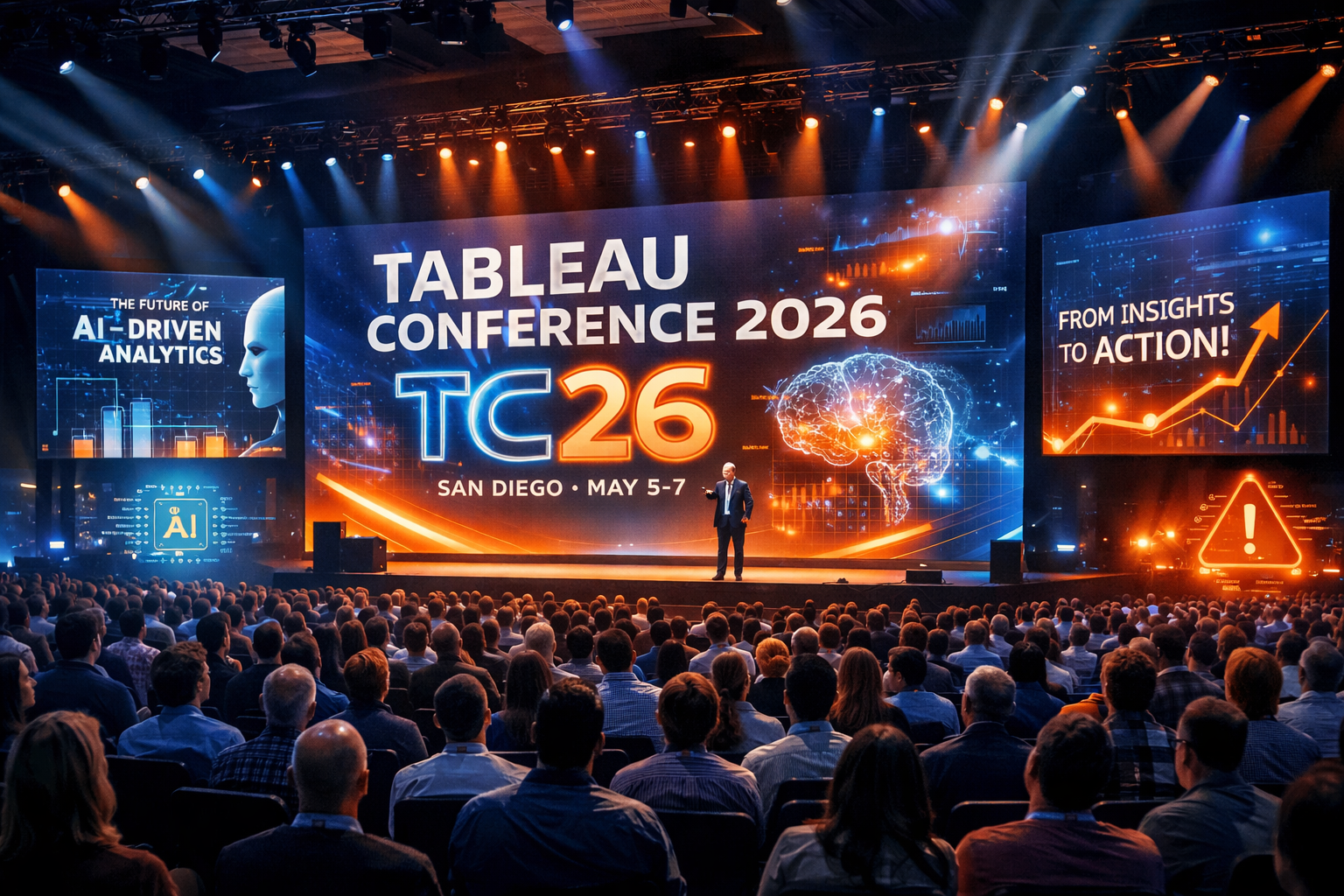
Taking place May 5–7 in San Diego, TC26 is positioned around a single, consequential idea: a truly interoperable world where Tableau moves with you across tools, tabs, and teams — where trusted data lives in everyday work and where insights become decisions instantly. Salesforce
That framing isn't marketing language. It reflects a genuine inflection point in how enterprise analytics works — and more importantly, in what organizations can now expect from the data they've spent years collecting. If your organization runs on Salesforce CRM, uses Tableau for reporting, or simply wants to understand where business intelligence is heading in the age of agentic AI, TC26 is where that future gets demonstrated, debated, and defined.
Here's what makes it worth your attention — and what to expect when you get there.
The Problem TC26 Is Built to Solve
To understand why this year's conference carries unusual weight, it helps to understand the problem sitting at the center of it.
Most organizations today have more data than they've ever had. CRM systems are full of customer records, interaction histories, pipeline data, and behavioral signals. Data warehouses hold years of transactional and operational data. Marketing platforms generate engagement data daily. Finance systems track every dollar in and out.
And yet, according to a Salesforce survey of more than 500 U.S. business leaders, over 75% are under pressure to prove the value of their data — and more than half admitted they aren't confident they can find, analyze, and interpret it effectively. Salesforce Ben
This is what Salesforce calls the "data paradox" — the uncomfortable reality that data abundance has not automatically produced decision-making clarity. Most organizations are data-rich and insight-poor, not because the data isn't there, but because the infrastructure for turning data into action at scale hasn't caught up with the volume of data being generated.
TC26 is Salesforce and Tableau's most comprehensive answer yet to that problem. Every major theme of the conference — agentic analytics, interoperability, governance, data culture — is a direct response to one dimension of the data paradox. Understanding those themes before you arrive means you'll get significantly more value from the sessions and conversations that unfold over the three days.
Theme One: Agentic Analytics — The Shift From Reactive to Proactive Intelligence
The most significant conceptual shift at TC26, and in enterprise analytics more broadly, is the move from traditional business intelligence to what Salesforce calls agentic analytics.
Traditional BI has largely followed a labor-intensive model where people manually analyze data to generate insights and then take action in separate systems — with analysts juggling data preparation, ETL processes, table calculations, and dashboard creation, sometimes spending hours or even days on tasks that still leave executives searching for the right answers. Tableau
Agentic analytics represents a significant evolution beyond this model, moving past static visualizations to autonomous AI agents that augment and accelerate every stage of the journey from data to insights to action — engaging in dynamic, conversational interactions, anticipating user needs, and automating complex analytical workflows. Tableau
In practice, this means the difference between pulling a report and having an agent surface the insight before you knew to ask the question. A sales leader doesn't need to run a pipeline analysis to find out which deals are at risk — an agent monitors the data continuously and flags the anomaly with context and suggested action. A marketing analyst doesn't need to build a year-over-year comparison from scratch — users can now perform automated time-series comparisons via natural language, asking something like "show me year-over-year growth for sales," and the platform instantly visualizes the comparison and calculates the percentage change. Atrium
TC26 will show agentic analytics live in action across the conference Salesforce, with dedicated sessions, product demonstrations, and hands-on training opportunities specifically designed to help attendees understand how to implement it in their own organizations. For anyone who has heard the term "agentic AI" and wondered what it looks like in a real enterprise analytics context, this is where the concrete answers are.
The three core AI capabilities powering this experience in Tableau Next are worth understanding before you arrive. Data Pro is a skill that helps prepare, model, and visualize data to speed up the analytics journey. Concierge allows users to ask questions and get analytical answers in natural language, identifying root causes, providing visualizations, and suggesting actions. Inspector provides a structured view of the underlying query — surfacing the data sources, metrics, fields, and filters used to generate any answer, ensuring transparency and alignment with governed semantics. Salesforce BenTogether, these three capabilities represent Tableau's vision for what every data interaction should feel like: conversational, proactive, and immediately actionable.
Theme Two: One Interoperable Portfolio — Breaking Down the Data Silo Problem
The second major theme of TC26 is interoperability — and it addresses one of the most persistent frustrations in enterprise data strategy.
Most organizations don't have a single data platform. They have Salesforce for CRM, a separate data warehouse like Snowflake or Databricks, various cloud storage solutions, legacy on-premise systems, and a mix of analytics tools that don't naturally talk to each other. Every time a user needs to combine data from two of these environments, they face friction — data movement, format mismatches, security permissions, and the perennial problem of inconsistent definitions where "revenue" means something different in the CRM than it does in the finance system.
Salesforce is addressing this foundational challenge by co-leading the Open Semantic Interchange alongside industry leaders including Snowflake and dbt Labs — creating a common, vendor-neutral specification that ensures context, meaning, and data results are preserved across every platform organizations use. The goal is simple: business meaning should be defined once and understood everywhere. Tableau
Tableau Next is built as an open, interoperable, API-first platform that brings insights to everyone in every workflow, with native integration with Agentforce and the ability to connect to existing Tableau Cloud, Tableau Server, and CRM Analytics assets without forcing organizations to abandon their existing investments. Salesforce
For organizations that have spent years building Tableau dashboards and Salesforce CRM workflows, this is critical reassurance. Current Tableau assets remain supported and Tableau Next is designed to interoperate with them — semantic definitions from Tableau Next can be reused in legacy assets, and data can flow between Tableau Desktop, Prep, and Next in a hybrid scenario. Frontline 1st The migration path is designed to be gradual and additive, not a forced wholesale replacement.
TC26 will feature live demonstrations of how Tableau works together with existing solutions Salesforce, including direct use cases for Salesforce users who want to understand how their CRM data connects to the broader Tableau analytics ecosystem. For Salesforce customers specifically, CRM Analytics automatically inherits existing Salesforce security, role hierarchies, and permissions — providing world-class governance and compliance standards without requiring organizations to rebuild their security model from scratch. Tableau
The practical implication for attendees is this: if your organization has debated whether to consolidate your analytics stack or maintain a multi-tool environment, TC26 will provide the clearest picture yet of what a genuinely interoperable data infrastructure looks like — and what it makes possible.
Theme Three: A Trusted Foundation — Governance That Scales With AI
One of the most underappreciated dimensions of the AI moment in enterprise analytics is the governance challenge it creates. As AI agents begin making or recommending decisions based on data, the question of whether that data is accurate, governed, and trustworthy becomes more consequential than it has ever been.
An AI agent that surfaces incorrect insights confidently is more dangerous than a static dashboard with wrong numbers — because the agent acts on its analysis in ways that a passive report cannot. This makes data governance not a compliance checkbox but a direct prerequisite for getting value from agentic AI at all.
Tableau's approach to this challenge centers on a robust semantic layer for consistent data definitions, quality, and lineage — combined with a transparency requirement that agentic analytics must never be a "black box," with clear visibility into how every insight and recommendation is generated. Tableau
Tableau Semantics acts as a unified semantic layer for Tableau Next and Agentforce, ensuring consistent data definitions so AI agents can deliver accurate, meaningful insights across every user and every workflow in the organization. Salesforce Ben This is the technical foundation that makes it possible for a sales rep, a finance analyst, and a customer service agent to all ask questions of the same data and receive answers based on the same underlying definitions — without each team maintaining its own version of the truth.
TC26 sessions will specifically address how to leverage a comprehensive, interoperable portfolio to address any data and analytics use case Tableau, with a dedicated focus on governance strategies that scale alongside AI adoption rather than creating bottlenecks that slow it down. For data leaders who are being asked by their organizations to enable AI-powered analytics while also maintaining compliance and data quality standards, these sessions represent some of the most practically useful content at the conference.
Theme Four: Data Culture — Upskilling the Humans Behind the Data
The most sophisticated analytics platform in the world produces limited value if the people using it can't translate data into stories, decisions, and action. This is the human dimension of the data paradox — and TC26 addresses it directly through a sustained focus on data culture and data storytelling.
Salesforce's research found that data literacy is non-negotiable for organizations trying to get value from data investments, but there is a significant gap between the pressure leaders feel to demonstrate data value and the confidence their teams have in actually working with data effectively. Salesforce Ben
Building a genuine data culture — one where analytical thinking and data fluency are distributed across an organization rather than concentrated in a specialist analytics team — requires investment in both tools and people. TC26 addresses both sides of that equation.
The conference offers more than 150 hands-on training opportunities alongside 300-plus expert-led sessions Salesforce, designed to meet attendees at every skill level from beginner analysts building their first dashboards to advanced data architects designing enterprise semantic models. Attendees can also book Tableau Doctor appointments for one-on-one expert advice on their specific data challenges Salesforce — a rare opportunity to get personalized guidance on problems that generic conference sessions rarely address with sufficient specificity.
Beyond the formal sessions, the Tableau DataFam community itself is one of the most powerful assets the conference offers. The community is exceptionally welcoming, and the connections made over three days in San Diego routinely translate into ongoing peer relationships, mentoring dynamics, and collaborative problem-solving that extends well past the conference itself. Rollstack For data professionals who work in organizations where they're the only or one of few Tableau power users, the conference community provides a peer group that's genuinely hard to replicate elsewhere.
The Iron Viz competition — where three finalists each take 20 minutes, one data set, and compete to produce the most compelling data visualization Salesforce — is both entertainment and education, demonstrating the range of what's possible in data storytelling at the highest level of craft. For anyone who wants to understand what exceptional data communication looks like, watching Iron Viz live is a more effective education than almost any formal training.
What TC26 Means for Salesforce and CRM Users Specifically
For organizations whose data journey runs primarily through Salesforce, TC26 carries specific and immediate relevance.
The central promise of agentic analytics — turning data into proactive, actionable insight — is perhaps most powerful in the CRM context, precisely because CRM data is the most directly connected to revenue outcomes. Pipeline health, customer churn risk, upsell opportunity identification, sales rep performance coaching, and customer service resolution optimization are all use cases where the difference between a static dashboard and a proactive AI agent translates directly into revenue impact.
CRM Analytics enables every Salesforce user to access actionable, AI-powered insights in their flow of work — answering questions, predicting outcomes, getting recommendations, and taking action from the point of insight — all without requiring extensive technical training or reliance on specialist data teams. Tableau
The practical implication is that the CRM data most organizations have spent years building — customer records, interaction histories, pipeline stages, support tickets — can now function as an active growth engine rather than a passive record-keeping system. The question TC26 is designed to answer is not whether this is theoretically possible, but how specifically to make it work in your organization, with your data, in your existing Salesforce environment.
TC26 will feature keynotes from executive peers demonstrating how they're using Tableau and Agentforce together to make smarter, faster decisions while protecting their data Salesforce — real-world validation from organizations that have moved beyond the pilot stage and are seeing measurable business outcomes from agentic analytics at scale.
What to Expect Across the Three Days
Understanding the structure of TC26 helps attendees make the most of a conference that is, by any measure, dense with content and activity.
The official schedule runs from approximately 8 a.m. to 5 p.m. each day, with free breakfast available each morning from 7 to 9 a.m. The San Diego Convention Center is downtown on the waterfront, across from Petco Park and steps from the Gaslamp Quarter — large and walkable, with the atmosphere of a professional community rather than a stiff corporate event. Rollstack
For those who want to maximize their technical preparation, a Tableau Bootcamp runs May 3–4, providing two additional days of dedicated training before the main conference begins, with Tableau certification exams available for attendees who want to earn credentials. Salesforce
Across the three main conference days, the content breaks into several distinct types. Keynotes set the strategic direction and announce product innovations. Technical breakout sessions go deep on specific features, use cases, and implementation challenges. Theater sessions offer shorter, focused demonstrations of specific capabilities. Hands-on training workshops provide structured, interactive learning in a lab environment. And roundtables create space for peer conversation and community-led problem solving.
Attendees can also engage with Tableau experts directly, explore product innovations, and participate in community events including Iron Viz and Data Night Out. CMSWire The social dimension of TC26 is not incidental to the conference value — for many attendees, the conversations that happen between sessions, at evening events, and in the Data Village expo are where the most immediately applicable insights emerge.
The most practical advice for first-time attendees is to plan your session schedule in advance but build in flexibility. The conference is large enough that navigating between sessions in different parts of the convention center takes time, and the most interesting conversations often happen unexpectedly. Prioritize the sessions most directly relevant to your current challenges, identify the two or three product demonstrations most important for your organization's roadmap, and treat everything else as a bonus.
Why This Year Specifically Matters
Every Tableau Conference is significant within its community. TC26 is significant beyond it — because the themes it's advancing represent decisions that every data-driven organization will need to make in the next 12 to 24 months regardless of whether they attend.
The shift from traditional BI to agentic analytics is not a future possibility. Tableau Next launched to general availability in June 2025, and existing Tableau and CRM Analytics products continue to be supported alongside it Tableau — meaning the transition has already begun, and organizations that understand it earliest will have the longest runway to build competitive advantage from it.
The governance challenge that comes with AI-powered analytics is not going away — it is intensifying as the stakes of data-driven decisions increase. The interoperability problem that has fragmented enterprise data stacks for years has a genuine technical solution being built in real time, with TC26 as its most comprehensive public demonstration yet.
For data professionals, analysts, CRM users, executives, and anyone whose organization runs on data — which is to say, every organization — TC26 is the clearest window available into where the next chapter of enterprise analytics is being written.
The data your organization has collected is either sitting there, or it's driving action. TC26 is about making sure it's the latter.
At Ritner Digital, we help businesses turn their Tableau and Salesforce data into a real growth engine — from dashboard strategy and CRM optimization to building the kind of data infrastructure that actually drives decisions. If TC26 is showing you what's possible, we can help you get there. Let's talk.
Frequently Asked Questions
Who should attend Tableau Conference 2026?
TC26 is designed for a broader audience than most people assume. The obvious attendees are data analysts and Tableau power users who want to stay current on product developments and sharpen their technical skills — and there is more than enough content at that level to justify the trip on its own. But the conference is equally valuable for business leaders and executives who want to understand how data strategy is evolving and what decisions their organizations need to make in the next 12 to 24 months. Salesforce CRM administrators and operators who haven't thought deeply about the analytics layer sitting on top of their data will find TC26 particularly eye-opening. Marketing leaders, sales operations professionals, finance teams, and anyone who regularly makes decisions based on dashboards and reports will come away with a clearer understanding of what those tools are capable of and where the gaps in their current approach are. The short version: if your work involves data in any meaningful way, there is content at TC26 built specifically for you.
What is agentic analytics and why does it matter for my organization?
Agentic analytics is the shift from passive, report-based business intelligence to proactive, AI-driven insight and action. In traditional BI, a human formulates a question, builds or runs a report, interprets the results, and then decides what to do — a process that can take hours, days, or longer depending on the complexity of the analysis and the availability of the analyst. Agentic analytics changes that model by deploying AI agents that continuously monitor data, surface relevant insights before a human thinks to ask for them, and in some cases take automated action directly within existing business workflows. The practical stakes are significant. In a CRM context, this means a sales agent that flags at-risk deals before they slip, a service agent that identifies customers likely to churn before they do, and a marketing agent that surfaces campaign performance anomalies in real time rather than in the next weekly report. For organizations that have invested in Salesforce and Tableau, agentic analytics represents the next layer of return on that investment — and TC26 is the most concentrated place to understand how to capture it.
How does TC26 relate to Salesforce specifically — is this just a Tableau event?
TC26 is formally the Tableau Conference, but the integration between Tableau and the broader Salesforce platform has become deep enough that the two are effectively inseparable in terms of what the conference covers. Tableau Next — the next generation of the analytics platform being showcased at TC26 — is built natively on the Salesforce platform, powered by Hyperforce, and integrated directly with Agentforce, Salesforce's agentic AI layer. CRM Analytics, which provides analytics within the Salesforce CRM workflow itself, is also a significant part of the TC26 content program. For Salesforce customers, TC26 is not a parallel event to Dreamforce — it is a deep, technically specific exploration of the analytics and data strategy layer that sits on top of everything Salesforce does. If Dreamforce is where Salesforce announces what's coming, TC26 is where practitioners learn how to actually build it and make it work.
What is the Open Semantic Interchange and why should I care about it?
The Open Semantic Interchange is one of the most strategically significant announcements in enterprise data in recent years, and it gets less attention than it deserves because it sounds technical even though its implications are very practical. The core problem it solves is this: most organizations use multiple data platforms, and every time they add a new platform or tool, they have to rebuild their business logic — what "revenue" means, how "customer" is defined, what counts as a "closed deal" — from scratch in the new environment. This is expensive, error-prone, and creates the fragmented, inconsistent data landscape that makes analytics so frustrating. The Open Semantic Interchange, co-led by Salesforce alongside Snowflake and dbt Labs, creates a vendor-neutral standard for preserving business meaning across platforms — so that definitions built once in one system travel correctly to every other system in the stack. For organizations managing data across Salesforce, a data warehouse, and multiple analytics tools, this is the technical foundation that makes a genuinely unified data strategy possible rather than aspirational.
We already have Tableau dashboards set up. Does TC26 still offer value, or is it mainly for people just getting started?
TC26 is arguably more valuable for organizations with existing Tableau investments than for those just getting started, for two reasons. First, the transition to Tableau Next — and the agentic analytics capabilities that come with it — is directly relevant to every organization that has already built a Tableau practice. Understanding what those capabilities mean for your existing dashboards, semantic models, and workflows, and how to migrate gradually without disrupting what's already working, is exactly the kind of practical knowledge that TC26 sessions are designed to deliver. Second, the most useful conference content for experienced Tableau users isn't the introductory sessions — it's the advanced technical breakouts, the peer conversations with other practitioners who've solved similar problems, and the direct access to Tableau product managers and engineers who can answer specific implementation questions that no documentation fully addresses. The Tableau Doctor appointments alone — one-on-one expert sessions for your specific data challenges — are worth the trip for organizations with complex existing environments.
How does data governance fit into the agentic analytics picture, and is this something we need to address before adopting AI-powered analytics?
Governance isn't a prerequisite you have to fully solve before adopting agentic analytics — but it is a dependency that becomes more visible and more consequential as AI involvement in your analytics increases. The reason is straightforward: an AI agent making recommendations or taking automated actions based on your data is only as trustworthy as the data it's working with and the definitions it's using. If your organization has inconsistent metric definitions, stale data in some pipelines, or unclear ownership of data quality, those problems don't disappear when you add AI — they get amplified, because the AI operates at a speed and scale that makes errors harder to catch and more expensive to correct. TC26 sessions on governance are not about building a perfect data foundation before you start — they're about understanding what level of governance is required for which use cases, how to build governance infrastructure in parallel with AI adoption rather than as a separate prior project, and how to use Tableau's semantic layer tools to create the consistency that agentic analytics depends on. The practical framing is: start with AI use cases that depend on your cleanest, most governed data, and build outward from there.
What's the difference between Tableau Next and the Tableau our team already uses?
Tableau Next is the next generation of the Tableau analytics platform, built natively on the Salesforce platform rather than as a standalone product. The existing Tableau products — Tableau Desktop, Tableau Cloud, Tableau Server, and CRM Analytics — continue to be fully supported and actively developed, so there is no immediate pressure to migrate. What Tableau Next adds is the agentic analytics layer: AI agents built into the analytics experience, a workflow engine that connects insights directly to action, a semantic layer that ensures consistent data definitions across the platform, and a marketplace for sharing and reusing analytics components across teams and organizations. For teams currently using Tableau Cloud or Tableau Server, Tableau Next is designed to interoperate with existing assets rather than replace them — semantic definitions and visualizations built in existing environments can connect to Tableau Next, and the migration can happen gradually as use cases warrant it. TC26 is the best place to develop a concrete understanding of what that migration path looks like for your specific environment and when it makes sense to begin.
Is TC26 worth the investment for a smaller organization or is it primarily designed for enterprise teams?
TC26 is genuinely valuable at multiple organizational scales, though the ROI calculus looks different depending on size. For enterprise teams, the value is straightforward: 300-plus sessions, direct access to product leadership, peer connections with other large-scale Tableau operators, and the ability to bring multiple team members who can divide and conquer across different content tracks. For smaller organizations, the calculus requires more intentionality but the return can be proportionally higher — because a small team making the right strategic decisions about data infrastructure early will compound those decisions over years, while a small team that makes the wrong decisions will compound those too. The most valuable TC26 investment for a smaller organization is typically less about attending every session and more about clarity on three specific questions: what is our current data strategy missing, what capabilities should we be building toward in the next 12 months, and what does our Salesforce and Tableau environment need to look like to support the business goals we're working toward. Those questions have very concrete answers at TC26, and arriving with them clearly defined makes the conference significantly more useful regardless of organizational size.