The Window Is Open: Why April 1 to Memorial Day Is the Most Important B2B Push of the Year
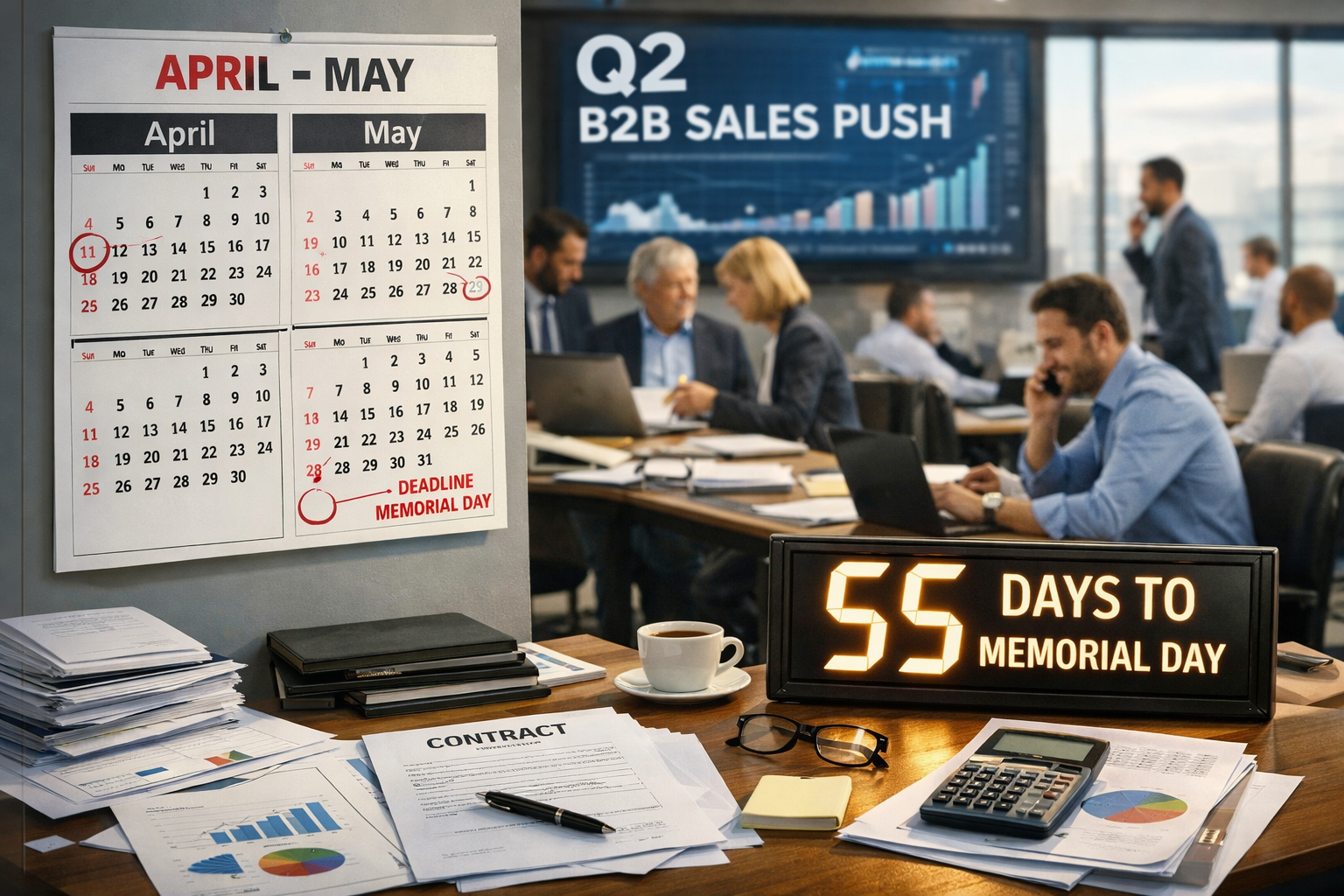
There is a window in every business year that separates the companies that hit their numbers from the ones that spend Q3 wondering what happened.
It opens on April 1st. It closes on Memorial Day weekend.
Fifty-five days. Eight working weeks. The single most concentrated period of B2B deal-making, contract signing, partnership activation, and pipeline conversion in the entire calendar year — and most organizations are either not treating it with the urgency it deserves, or they're walking into it with a Q1 that didn't deliver what it was supposed to.
If that's you, this post is worth reading carefully. Because the window is open right now, and it won't be open much longer.
Why This Window Exists and Why It's Not Negotiable
B2B buying behavior follows a rhythm that is remarkably consistent across industries, company sizes, and economic cycles. That rhythm is driven not by strategy but by human nature — specifically, by the way business professionals mentally segment the year and the way that segmentation affects their willingness to make decisions.
Q1 is the planning quarter. Budgets have just been approved. Teams are being assembled. Goals are being set. Decision-makers are often still calibrating what the year looks like before committing to significant vendor relationships or partnership structures. There's action in Q1, but there's also a lot of deliberation — a lot of "let's revisit this in a few weeks" and "we want to see how January shakes out first."
Then April arrives, and the calculus shifts.
By April 1st, the planning phase is over. Q1 results are in. Executives know whether they're ahead of plan, on plan, or behind — and they're making decisions accordingly. The teams that came up short in Q1 are urgently looking for solutions. The teams that are ahead of plan are looking to press the advantage before summer slows everything down. And the teams that are exactly on plan are acutely aware that they need to build pipeline now to protect their Q3 position, because summer is coming and summer is when B2B pipelines quietly erode.
This shared awareness — felt simultaneously by buyers, sellers, decision-makers, and executives across the business landscape — creates a concentrated window of decision-making energy that has no equivalent in any other part of the year. Prospects who have been sitting on proposals suddenly move. Partnerships that have been in preliminary conversation get formalized. Contracts that have been reviewed and revised get signed. Budget that has been allocated but not deployed gets committed.
And then Memorial Day weekend arrives, and it is as if someone flips a switch.
What Happens After Memorial Day: The Summer Slowdown Is Real
The summer slowdown in B2B is not a myth, not an excuse, and not something that strategic brilliance can fully overcome. It is a structural feature of how business decisions get made when key stakeholders are unavailable, distracted, or mentally checked out of anything that requires significant deliberation.
Decision-makers take vacations. The buying committees that need to align before a contract gets signed are suddenly missing one member, then another. Follow-up emails that would have received same-day responses in April sit unanswered for two weeks. Proposals that were on the verge of moving forward get pushed to "after Labor Day" — a phrase that, once uttered, functions as a soft kill for deals that don't have exceptional momentum behind them.
This isn't a phenomenon unique to any single industry. It plays out across professional services, technology, marketing, consulting, manufacturing, financial services, and virtually every other B2B category. The specific intensity varies — companies selling into hospitality or travel-adjacent industries may feel it more acutely; companies with longer enterprise sales cycles may experience it as a slowdown in new deal initiation rather than a halt in existing deal progress — but the directional reality is universal. Summer is the hardest time to close new B2B business, and the companies that arrive at Memorial Day with thin pipelines and unsigned contracts are facing a very difficult four months.
The window from April 1 to Memorial Day exists precisely because of what comes after it. Sophisticated B2B organizations treat this period not as the beginning of a sales push but as the closing chapter of the first half — the moment when everything that was planted in Q1 needs to convert, because the window for conversion is closing.
The Q1 Reckoning: What Your Pipeline Data Is Actually Telling You
Here is the question that every CEO, founder, and sales and marketing leader should be sitting with right now, in the first week of April: did Q1 deliver what you needed it to deliver?
Not whether the quarter was "pretty good" or "directionally positive." Whether it delivered the specific lead volume, pipeline coverage, and revenue contribution that your 2026 plan requires to stay on track.
If the answer is yes — if Q1 came in at or above plan on leads, pipeline, and closed revenue — then the task for this window is straightforward: press the advantage. Double down on what's working, accelerate the conversations that are in motion, and use the energy of the spring push to build the pipeline coverage that will protect Q3 and set up Q4.
If the answer is anything other than a clear yes — if leads came in below expectations, if pipeline coverage is thinner than it should be, if the deals you expected to close in Q1 pushed into Q2 or beyond — then this window is not just an opportunity. It is an urgent intervention point.
Here's why. A Q1 that underdelivers on pipeline doesn't self-correct in Q2. It compounds. Leads that weren't generated in January, February, and March are not in your funnel now. The pipeline that should have been building is thinner than your plan assumed. And the deals that should have closed in Q1 are now competing for attention during the same window where every other vendor in your market is also pushing to close before summer.
If your marketing didn't deliver in Q1, you don't have the luxury of waiting for Q2 to gradually improve. You have eight weeks to close the gap — and you need the right partner helping you do it.
Why This Window Demands a Different Level of Marketing Intensity
The April-to-Memorial Day window is not a time for patience, experimentation, or gradual optimization. It is the time for maximum marketing intensity — a concentrated effort to convert every viable prospect in your pipeline, reactivate every lead that went cold in Q1, generate net-new demand through channels with the shortest time-to-conversion, and ensure your brand is showing up with the urgency and authority that matches the energy of the market.
This requires marketing that operates at a level that most internal teams — particularly at small and mid-size B2B companies — are not resourced or structured to sustain. And it requires a clear-eyed assessment of where the gaps are and how quickly they can be closed.
The most common gaps in B2B marketing entering the spring window fall into several predictable categories.
Lead generation volume that isn't matching plan. If Q1 leads came in below expectation, the problem is almost never that "the market isn't there." It's that the demand generation strategy isn't reaching the right buyers at the right frequency through the right channels. Fixing this in an eight-week window requires both immediate tactical adjustments — paid search, LinkedIn advertising, targeted outbound — and a content strategy that gives those channels something worth promoting.
A pipeline full of prospects who went quiet. Q1 produces a specific kind of frustration: prospects who engaged, showed interest, consumed content, maybe even took a meeting — and then went silent. Reactivating these prospects requires a different approach than cold outreach. It requires relevant, timely content that gives them a reason to re-engage, combined with a follow-up sequence that meets them where they are in their decision process rather than starting the conversation over from scratch.
A brand presence that doesn't communicate urgency or authority. In the spring push, buyers are moving. When they search for vendors, evaluate options, and research decision-makers, they form judgments quickly. A business whose website looks dated, whose LinkedIn presence is sparse, and whose content hasn't been updated since Q4 of last year is sending exactly the wrong signal at exactly the wrong moment. The companies that win the spring window are the ones that look credible, current, and confident when buyers are actively evaluating options.
A sales and marketing misalignment that's slowing deals down. The spring window is also where the friction between sales and marketing becomes most visible and most costly. Marketing generates leads that sales considers unqualified. Sales pursues opportunities that marketing hasn't supported with relevant content. Follow-up is inconsistent. Proposals go out without the supporting collateral that would make them more compelling. These gaps exist in virtually every B2B organization, and closing them during the spring push requires coordination and urgency that rarely happens organically.
The Specific Plays That Win the Spring Window
Given the eight-week timeline and the specific dynamics of the April-to-Memorial Day period, some marketing investments have significantly higher expected return than others. The following are the plays that have the most direct impact on the metrics that matter in this window: leads, pipeline, and closed revenue.
LinkedIn demand generation targeting active buyers. In B2B, LinkedIn is where decision-makers are most reachable and most receptive to relevant content. A well-executed LinkedIn campaign — combining thought leadership content from key executives, targeted paid promotion to specific company and role profiles, and a consistent follow-up approach for inbound engagement — can generate meaningful pipeline in weeks rather than months. The spring window, when buying intent is highest, is the highest-return moment to run these campaigns.
Content that speaks to Q1 pain points. The buyers most likely to move in April and May are the ones who came out of Q1 behind plan and are actively looking for solutions. Content that names that pain specifically — that speaks to what it means to be behind on lead generation heading into summer, or what the cost of a thin pipeline is when Q3 visibility gets murky — reaches those buyers at exactly the moment they're most motivated to act. Generic content about your services doesn't accomplish this. Specific, timely, pain-aware content does.
Proposal and pipeline acceleration support. Every B2B company has deals in the pipeline that haven't closed yet. Some of those deals are stuck because the prospect needs more information. Some are stuck because the internal champion doesn't have what they need to sell the decision internally. Some are stuck because the proposal doesn't compellingly address the specific objections that are preventing a decision. Sales enablement content — case studies, ROI frameworks, comparison guides, objection handlers — that directly supports the deals currently in motion can meaningfully accelerate close rates during the spring window.
Retargeting campaigns for Q1 website visitors. Everyone who visited your website in Q1 and didn't convert is a warm prospect who already knows you exist. Retargeting campaigns that reach these visitors with specific, relevant messaging — particularly during the spring push when their buying intent may be higher than it was when they first visited — are among the most cost-efficient demand generation plays available. The audience is already qualified by virtue of their prior interest; the job of the retargeting campaign is simply to give them a compelling reason to take the next step now.
Executive LinkedIn presence as a trust accelerator. As every sales leader knows, deals get done faster when buyers trust the people they're buying from. In the spring window, when deals need to move quickly, anything that accelerates trust-building has outsized value. A CEO or founder who is active and credible on LinkedIn — publishing relevant content, engaging with their network, demonstrating visible expertise in the problems they solve — shortens the credibility gap that slows down B2B deals. This is not a long-term brand play in the spring window. It is a direct sales support mechanism.
The Math of Missing This Window
It's worth being explicit about what the cost of a slow spring looks like in financial terms, because the urgency of this window is sometimes easier to feel than to quantify.
Consider a B2B business with an average deal size of $50,000 and a 90-day average sales cycle. A deal that enters the pipeline in the first week of April can realistically close before the end of June — before summer takes hold and before Q2 closes. A deal that enters the pipeline in the first week of June is looking at a September or October close date at best — after the summer slowdown, after the back-to-school distraction, and in competition with every other deal that also got pushed to Q3.
The difference between those two scenarios is not the quality of the deal. It is the timing of the demand generation that surfaced the opportunity. And the timing of the demand generation is a direct function of when marketing investment was made.
Every week of delay in activating the spring push is a week of pipeline that slides to the right — from Q2 to Q3, from Q3 to Q4, from Q4 to "maybe next year." At a $50,000 average deal size, a business that generates four fewer deals in Q2 because it didn't activate marketing aggressively in April has a $200,000 gap to explain in its Q2 results — and a Q3 pipeline that's thinner than it should be heading into the second half.
That math scales proportionally at every deal size. The window is not an abstraction. It is a revenue number, and it is being determined right now.
If Q1 Didn't Deliver, This Is the Moment to Fix It
The most important decision any B2B leader can make in the first weeks of April is whether their current marketing approach is capable of closing the gap that Q1 left open — and if it isn't, how quickly they can change that.
The honest assessment for most businesses that came out of Q1 below plan is that the marketing infrastructure that produced those results is not going to produce dramatically different results in Q2 without a meaningful change. A strategy that generates leads slowly doesn't suddenly accelerate without intervention. A content presence that isn't converting visitors doesn't improve on its own. A pipeline that isn't being actively worked from both a marketing and sales perspective doesn't fill itself.
The businesses that will make the most of the April-to-Memorial Day window are the ones that make that assessment honestly and act on it quickly. Not in May. Not after another few weeks of hoping the numbers improve. Now — while there are still eight weeks of the highest-intent buying period of the year left to work with.
At Ritner Digital, we work with B2B companies that need their marketing to perform — not eventually, but now. If Q1 didn't deliver what your plan required, and you need a partner who can close that gap before the summer window shuts, let's talk. Eight weeks is enough time to move the needle. But only if you start today.
Frequently Asked Questions
Is the April to Memorial Day window really that universally significant, or does it depend on the industry?
The window is real across virtually every B2B category, though the intensity varies by industry. Professional services, marketing, technology, consulting, financial services, and legal all experience the spring push and summer slowdown in roughly the same pattern. Industries with longer enterprise sales cycles — large-scale manufacturing, enterprise software, commercial real estate — may experience it less as a hard cutoff and more as a meaningful deceleration in new deal initiation. Industries more closely tied to seasonal consumer behavior may feel the summer slowdown more acutely than others. But the underlying dynamic is consistent regardless of category: buyers are most active and most willing to make decisions in the spring, key stakeholders become increasingly unavailable after Memorial Day, and the pipeline consequences of a slow spring are felt throughout Q3. The specific numbers shift by industry — the window might effectively run slightly longer in some sectors, slightly shorter in others — but the directional reality that April through late May is the highest-leverage period of the first half holds broadly across B2B.
What if our sales cycle is longer than eight weeks? Does this window still matter?
It matters even more. A common mistake in B2B marketing is conflating the timing of pipeline generation with the timing of deal closure. If your average sales cycle is 90 days, 120 days, or longer, the deals that will close in Q3 and Q4 are being won or lost right now based on whether your demand generation is surfacing the right opportunities in April and May. The leads that enter your pipeline in the last week of April are the deals that close in late July or early August — before summer fully takes hold. The leads that don't enter your pipeline until June are looking at September or October closes at best, putting them in direct competition with every other deal that also got pushed to Q3. For businesses with long sales cycles, the spring window isn't about closing deals by Memorial Day. It's about generating the pipeline that will sustain Q3 and protect Q4. Missing the spring generation window with a long sales cycle creates a revenue gap that doesn't show up until Q3 — which is precisely when it's hardest to fix.
We had a decent Q1 — not great, but not terrible. Should we still be treating this window with urgency?
Yes, and here's the specific reason why. "Decent but not great" in Q1 almost always means pipeline coverage heading into Q2 is thinner than the plan assumed. Pipeline coverage — the ratio of pipeline value to revenue target — is the leading indicator that determines whether a quarter closes on plan. If Q1 generated 80% of the leads it was supposed to generate, your Q2 pipeline coverage is probably somewhere between 70% and 85% of where it needs to be, depending on your conversion rates. That gap doesn't feel catastrophic in early April. It feels very consequential in late June when you're trying to understand why Q2 came in light and why Q3 visibility is murkier than expected. The businesses that treat a decent Q1 as a reason to maintain current marketing intensity and the businesses that treat it as a warning sign requiring additional investment in the spring window end up in very different places by Labor Day. The spring window rewards urgency even when things are going reasonably well — because the cost of doing less is a thinner pipeline heading into the hardest part of the year to generate new business.
What are the most common reasons B2B companies underperform in Q1, and how quickly can those be addressed in Q2?
The most common Q1 underperformance drivers fall into a small number of recurring categories. The first is insufficient demand generation reach — the marketing simply isn't touching enough of the right buyers at the right frequency to build the pipeline the plan requires. The second is a content and credibility gap — prospects are being reached but the brand presence, case studies, and thought leadership content aren't converting interest into conversations. The third is sales and marketing misalignment — leads are being generated but the handoff, follow-up, and sales support infrastructure isn't converting them efficiently. The fourth is channel mix mismatch — marketing investment is concentrated in channels that don't match where the target buyer actually spends their attention. Each of these can be meaningfully addressed within a Q2 timeframe, but the speed of impact varies. Paid channels — LinkedIn advertising, Google search, targeted display — can generate results within weeks. Content and thought leadership build more gradually but compound over time. Sales enablement improvements that address the conversion gap between lead and close can show results within the same quarter when executed with focus. The key is diagnosing accurately which problem is the actual constraint, rather than applying generic solutions that address the symptom rather than the cause.
How do we know if our marketing partner is actually capable of delivering results in an eight-week window?
The honest answer is that not every marketing agency is structured or resourced to deliver meaningful results in a compressed timeframe — and the ones that aren't will rarely tell you that upfront. There are a few reliable signals to look for. The first is whether the agency leads with strategy or tactics. An agency that immediately jumps to tactical recommendations without first understanding your pipeline situation, your buyer profile, your current lead sources, and your Q1 results is likely optimizing for activity rather than outcomes. The second is whether they can show you specific, attributable results from compressed timelines with comparable clients — not general case studies with vague metrics, but specific examples of what they generated, for whom, and in what timeframe. The third is whether they ask hard questions about your sales process and pipeline before committing to marketing deliverables — because the agencies that understand B2B know that marketing results are only valuable if the sales infrastructure can convert them. A partner who talks about leads without asking about your close rate, your sales cycle, and your current pipeline coverage is not thinking about your actual business outcome.
Should we be running paid advertising or focusing on organic content during this window?
Both, but with different roles and different timelines. Paid advertising — LinkedIn campaigns, Google search, retargeting — is the right tool for the spring window because it generates results on a timeline that matches the urgency of the moment. A well-structured LinkedIn campaign targeting the right company sizes, industries, and roles can produce meaningful inbound interest within two to three weeks of launch. A retargeting campaign reaching Q1 website visitors with specific messaging can reactivate warm prospects within days. These are the channels to prioritize for immediate pipeline impact. Organic content — blog posts, thought leadership, SEO — operates on a longer timeline and won't produce meaningful new pipeline within an eight-week window if you're starting from scratch. However, organic content serves a critical supporting role during the spring push: it gives paid campaigns something compelling to promote, it provides the credibility layer that converts paid traffic into actual conversations, and it feeds the executive LinkedIn presence that accelerates trust with active prospects. The right answer for the spring window is paid channels for reach and pipeline generation, with organic content as the credibility infrastructure that makes the paid investment more efficient.
What does "retaining a marketing partner" actually look like in practical terms for a B2B company that hasn't worked with an agency before?
The onboarding process for a well-run B2B marketing agency should be faster and less disruptive than most business leaders expect — particularly in a spring window situation where time is the primary constraint. The first step is a clear diagnostic: understanding your business model, your buyer profile, your current lead sources, your Q1 performance against plan, and the specific gaps that need to be addressed. This shouldn't take weeks — a focused discovery conversation and a review of your current marketing assets and analytics can produce a clear picture within days. From there, a competent agency should be able to launch initial demand generation activities — paid campaigns, content promotion, LinkedIn strategy — within the first two weeks of engagement. The early weeks are also when sales and marketing alignment gets established: understanding your sales process, your pipeline stages, and what a qualified lead actually looks like to your sales team, so that marketing investment is generating the right kind of conversations rather than just volume. For companies that haven't worked with a marketing agency before, the most important thing to establish upfront is clear accountability — specific metrics the engagement will be measured against, a reporting cadence that gives visibility into what's working and what isn't, and a communication structure that keeps marketing and sales leadership aligned throughout the spring push.
What happens to the deals that don't close before Memorial Day — are they lost?
Not lost, but significantly harder. The deals that are in active negotiation heading into Memorial Day weekend have a reasonable chance of closing in early June if the momentum is strong and the internal champion is motivated. The deals that are in earlier stages — proposals out, conversations ongoing, interest expressed but no formal evaluation underway — are the ones most at risk of summer stall. The practical reality is that B2B deals that don't close before the summer slowdown typically fall into one of three buckets. The first is deals with strong internal champions who keep the process moving despite vacations and distractions — these close in July or August with consistent follow-up and good sales support content. The second is deals that get formally pushed to Q3 — "let's pick this back up after Labor Day" — and require a complete re-engagement effort in September, competing with every other Q3 initiative. The third is deals that quietly die during the summer because the momentum that was building simply dissipates when key stakeholders become unavailable. The best protection against buckets two and three is entering Memorial Day weekend with deals that are as far along in the process as possible — which is exactly why the marketing intensity of the April-to-Memorial Day window matters so much. Every week of acceleration during the spring push is a week of insurance against the summer stall.