
Rolling Window vs. Fixed Date Range: What's the Difference, and Why Does Your Reporting Keep Using Both?
Your dashboard says "last 28 days." Your invoice says "June 1–30." Both are date ranges — so why do they never agree? In this guide, we break down the difference between rolling windows and fixed date ranges in plain English: a fixed range is a photograph (stable, citable, calendar-shaped), while a rolling window is the view out a moving car (always current, recalculated daily). We cover where each shows up — from Google Search Console's 28-day window to trailing-twelve-month revenue — the signature traps of each (spike anniversaries, five-Monday months, overlapping snapshots), and the one rule that prevents most reporting arguments: monitor on rolling, record on fixed.
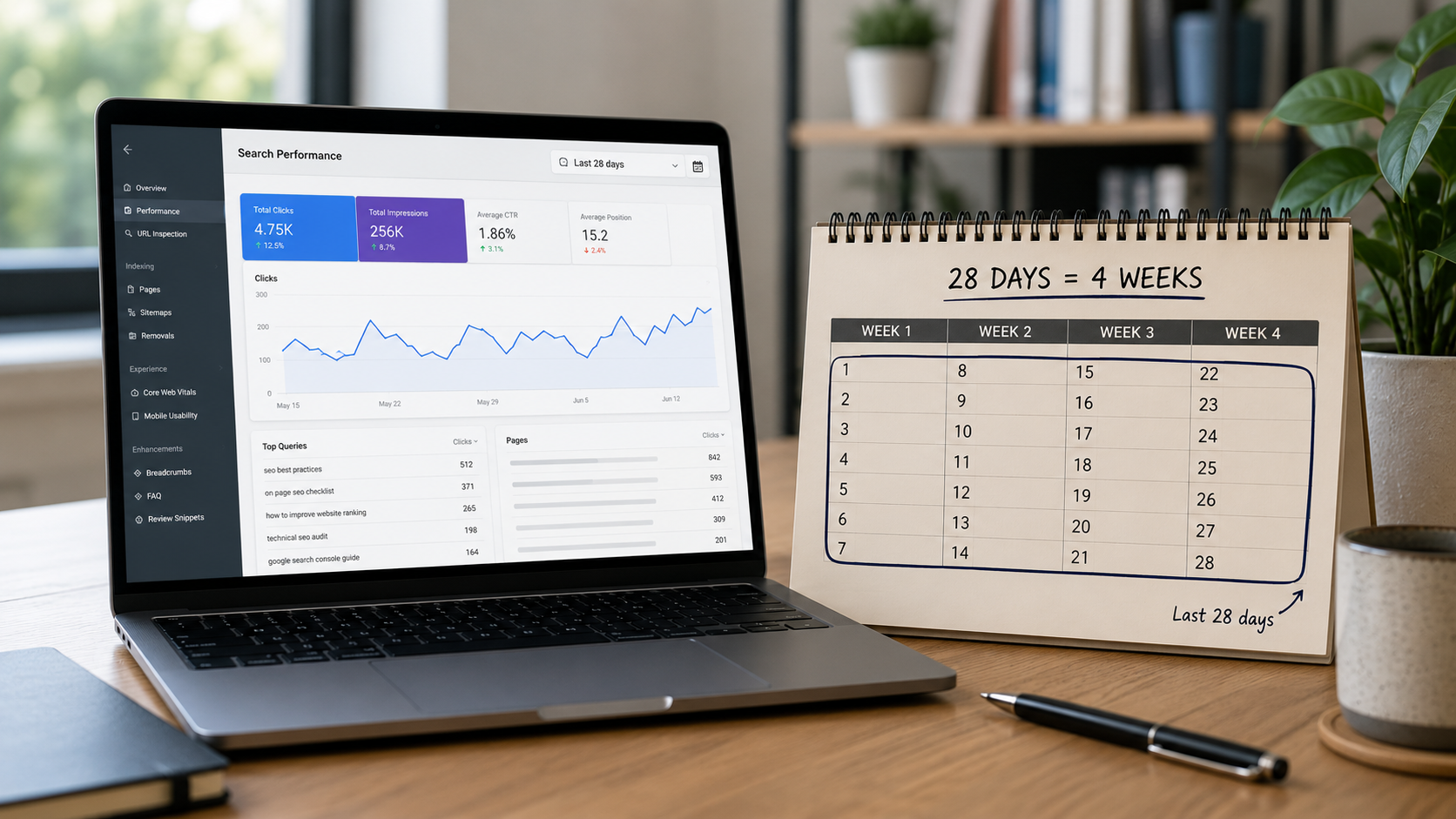
What Does "28 Days" Mean in Google Search Console? (And Why It's 28 and Not 30)
The number 28 is everywhere in Google Search Console — the Performance report, the Insights page, the Achievements milestones, even the emails. But what does "last 28 days" actually mean, and why 28 instead of 30? The answer is smarter than it looks: 28 days is exactly four weeks, so every window contains the same number of each weekday, making any period cleanly comparable to any other. In this guide, we explain how the rolling window really behaves — including why your totals can drop when nothing is wrong, why Achievement badges stay even when your clicks dip back down, why GSC never matches Google Analytics, and the "spike anniversary" effect that causes most false traffic panics.