The 7 Questions Cherry Hill Businesses Should Ask Before Hiring a Marketing Agency
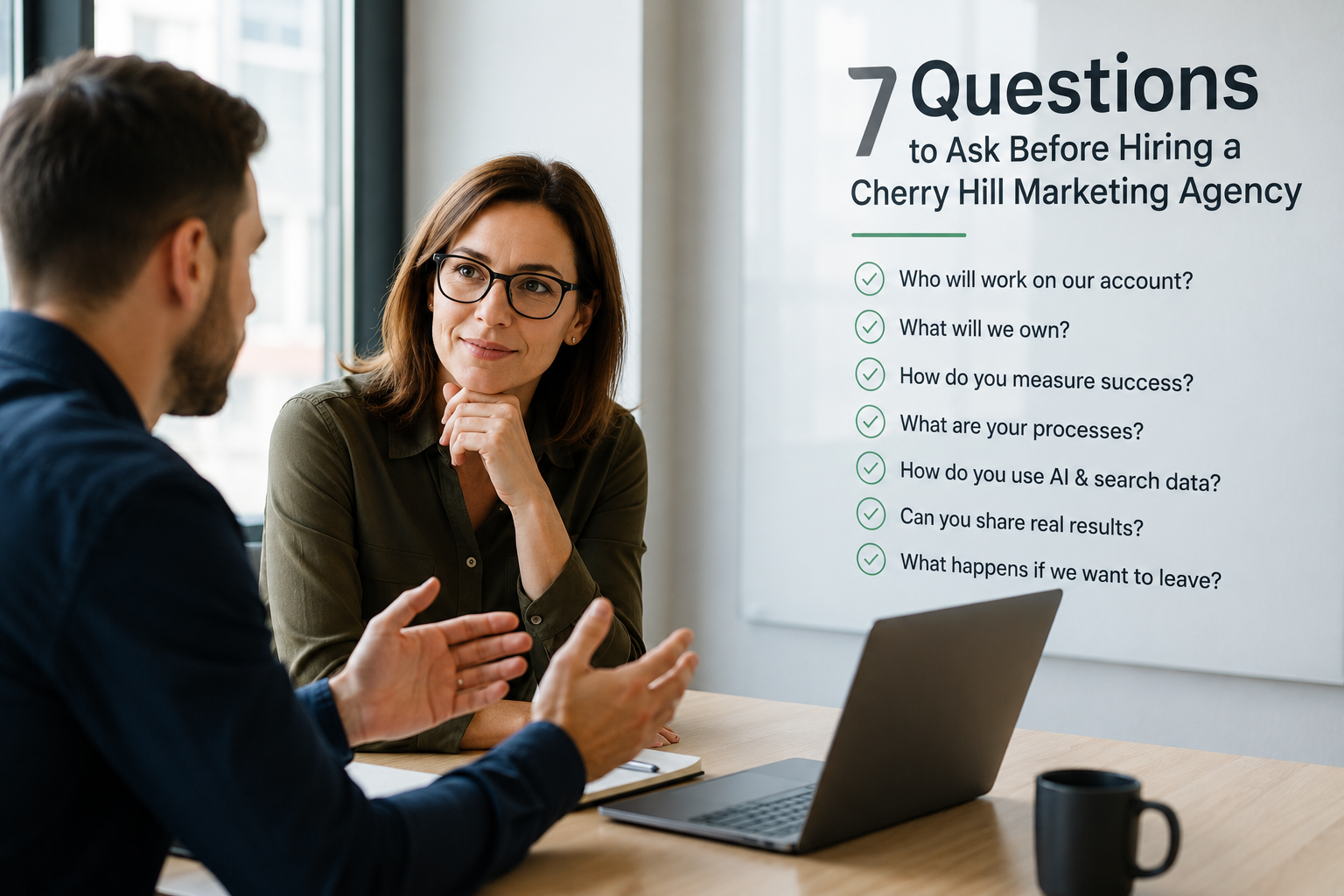
If you run a business in Cherry Hill, you don't need to go looking for a marketing agency. They're already looking for you.
Sitting at the center of one of the most commercially dense stretches in South Jersey — the Route 70 corridor, Haddonfield Road, the retail gravity of Cherry Hill Mall pulling shoppers from three counties — Cherry Hill businesses get pitched constantly. Philadelphia agencies cross the bridge for you. National "growth partners" cold-call you. Local freelancers DM you. Everyone has a case study, everyone has a proprietary process, and everyone promises leads.
And yet the most common story we hear from Cherry Hill and Camden County business owners isn't "we've never tried marketing." It's "we tried an agency, paid for a year, and have no idea what we got."
That outcome is preventable — not with better luck, but with better questions asked before you sign. The research backs this up in an uncomfortable way: according to Focus Digital's 2026 agency churn report, delivery dissatisfaction is now the #1 reason clients leave their agency, cited by 48% of departing clients — yet agencies themselves rank it seventh on their list of why clients leave. Read that again. The single biggest reason businesses fire their agency is one most agencies don't even think is a problem. The gap between what you're buying and what they think they're selling is where your budget goes to die.
The good news: when the fit is right, these relationships genuinely last. The ANA and 4As' 2025 tenure study found the average client-agency relationship now runs about seven years — more than double the 3.2-year average from 2016 — and notably, independent agencies keep clients longer (7.3 years) than big holding-company shops (5.8).
Seven good years or one confusing, expensive one. The difference is usually determined in the first meeting, by whether you asked the seven questions below.
Question 1: "Who will actually do the work on my account?"
This is the question that exposes more than any other, and almost nobody asks it.
At many agencies — especially the larger ones pitching Cherry Hill businesses from Philadelphia or beyond — the person selling you is not the person serving you. You'll meet a sharp, senior strategist in the pitch. Then your account gets handed to a coordinator two years out of school juggling fourteen other clients, and the senior person reappears only at renewal time. In the industry this is politely called "the pitch team problem." From your side of the table, it's a bait and switch.
What to ask specifically: Who writes my content? Who touches my website? Who do I email when something's wrong, and how many other accounts does that person handle? Will I ever talk to the person doing the actual work, or only an account manager relaying messages?
What a good answer sounds like: Names. Specific humans, with specific roles, who you can meet before signing. At a boutique shop or an independent consultant, the answer might be "me — you'll work directly with the person doing the work," which is precisely why many small businesses get better outcomes at smaller shops. There's no dilution when there's nothing to dilute.
Red flag: "You'll have a dedicated account team." Teams don't write your content. A person does. Find out which one.
Question 2: "Can you show me results for a business like mine?"
Not results in general. Results for your kind of business, in a market like yours.
Marketing is not one skill — it's a dozen, and they're niche-dependent. The playbook that fills a restaurant on a Friday night does nothing for a family law firm, and the strategy that works for a family law firm is useless to a used truck dealership. An agency with beautiful national e-commerce case studies may have never once fought for a spot in a local map pack, which is where most Cherry Hill businesses actually live or die.
We're opinionated about this because we've seen the difference specialization makes. In automotive, for example, knowing how dealership advertising costs actually break down by channel — what a lead costs from Facebook versus organic versus the third-party listing sites — changes every budget recommendation. In legal, the economics and the competition are so different that law firm marketing is essentially its own discipline. Generalists optimize generically.
What to ask specifically: Show me a client in my industry, or at least my situation — similar size, similar local competition. What did you do, what did it cost, and what changed in their actual lead volume (not just their traffic)?
What a good answer sounds like: A real example with real numbers, including the timeline and the bumps. Honest case studies include the part where month two was quiet.
Red flag: Logos without stories, or case studies where the only metric is "increased impressions by 400%." Impressions don't sign checks.
Question 3: "What exactly will you do each month — and what does it cost?"
Vagueness is the business model of bad agencies. "We'll manage your SEO," "we'll handle your socials," "we'll optimize monthly" — these are not scopes. They're permission slips to do very little while invoicing on schedule.
Every legitimate proposal should read like a list of deliverables a reasonably informed person can verify: how many pieces of content, which pages get optimized, what happens with your Google Business Profile, what technical work is included, what the reporting covers. If you can't tell from the contract what you'd be entitled to complain about, you'll never be able to complain.
Price transparency is the same test. We feel strongly enough about this that we published our market's actual numbers — see our full breakdown of what SEO really costs in South Jersey in 2026, with survey data cited. The short version: most Cherry Hill-area businesses should expect $1,000–$2,500/month for competitive local work, and anyone charging dramatically less is necessarily doing dramatically less, whatever the proposal implies.
What to ask specifically: Walk me through a typical month on my account, deliverable by deliverable. Then: if I asked you in month four to show me everything you'd done so far, what would you show me?
Red flag: A price with no itemized scope, or a scope with the word "ongoing" doing all the heavy lifting.
Question 4: "Do I own my website, my accounts, and my content?"
Here's a horror story we see in South Jersey more often than you'd believe: a business fires its agency and discovers the agency owns the website. Or the Google Business Profile is under the agency's email. Or the ad account — with all its years of performance history — belongs to the agency, and leaving means starting from zero. The relationship was a rental, and the landlord is keeping the furniture.
Everything built with your money should belong to you. Your domain, your website, your Google Business Profile, your Google Search Console and analytics, your ad accounts, your content, your reviews. The agency should be an authorized user on accounts you own — never the other way around.
What to ask specifically: If we part ways in a year, what leaves with you? Am I the owner (not just a user) on my Google Business Profile, analytics, Search Console, and ad accounts? Is the website built on a platform I control, and do I keep it?
What a good answer sounds like: "You own everything; we request access." Full stop, no asterisks.
Red flag: "The website is included in your monthly fee" (translation: you're leasing it), or any hesitation about admin access to your own accounts.
Question 5: "How will you measure success — and can I verify it myself?"
An agency that controls both the work and the scoreboard has a conflict of interest the size of the Ellisburg Circle. Reporting should be built on tools you can log into yourself — Google Search Console, Google Analytics, your Google Business Profile insights, your call tracking — so that every number in the monthly report is checkable, not just presentable.
And insist that reporting connects to business outcomes: calls, form fills, direction requests, booked appointments. Rankings and traffic are leading indicators, useful but easily cherry-picked. (They're also genuinely confusing without context — early in a campaign, metrics interact in ways that alarm owners unnecessarily; we wrote about why impressions can drop while your average position improves precisely because so many clients have been spooked by a half-explained chart.)
One more layer worth demanding in 2026: verification of lead delivery. It's shockingly common for website inquiries to be submitted but never reach the owner's inbox — broken form notifications, chat widgets nobody's logged into, messages routing to a departed employee's email. A diligent agency tests your contact paths end-to-end, because a lead that's generated but never received is worse than no lead at all: you paid for it and then ghosted the customer.
What to ask specifically: Which accounts will I have owner access to? Will reports show calls and form fills, not just rankings? Have you ever caught a client's lead pipeline silently failing — and how would you catch mine?
Red flag: Proprietary dashboards as the only reporting source, or a "trust us" posture about data you're paying to generate.
Question 6: "What's your plan for AI search?"
This is the 2026 question, and it's rapidly becoming the great filter between agencies that are paying attention and agencies coasting on a 2019 playbook.
A growing share of your future customers won't start on Google at all. They'll ask ChatGPT, Perplexity, or Google's AI Overviews — "best orthodontist in Cherry Hill," "family lawyer near Marlton," "who's a good HVAC company in Camden County" — and receive a short list of recommended businesses instead of ten blue links. Either your business is in that answer, or a competitor is.
The industry has already repriced around this. GoodFirms' 2026 agency survey found that 54.3% of agencies raised prices in 2025–2026, and 37% of those cited AI search optimization (GEO/AEO) as the primary reason. The work is real: structuring content so AI systems can cite it, building the entity signals that get a business named in AI answers, and tracking whether assistants actually recommend you. But because it's new, it's also where vague sellers hide. Anyone can add "AI-powered" to a proposal.
The test is evidence. We hold ourselves to it: a meaningful share of our own site's visitors now arrive directly from ChatGPT, Gemini, and Claude, and we've generated first-ever AI-assistant referrals for local clients within 60 days. Whoever you interview, make them show, not tell. (For the bigger picture on how this shift is restructuring the entire agency industry, see our essay on why the agency model is breaking.)
What to ask specifically: What are you doing to make my business show up when someone asks an AI assistant for a recommendation? Can you show me evidence — your own or a client's — of traffic or referrals from AI platforms?
Red flag: A blank stare, a subject change, or "AI search is just SEO." (It overlaps heavily. It is not identical, and the pricing surveys prove the market knows it.)
Question 7: "What happens if this doesn't work out?"
Ask about the divorce before the wedding. It's the fastest way to learn an agency's real confidence level.
Look at the contract's exit terms: how long is the commitment, what does cancellation require, and what happens during the transition? Twelve-month lock-ins with auto-renewal and 90-day cancellation notice are common — and they're a tell. An agency that's confident in its work doesn't need a contract to trap you; the results do the retaining. (Recall the ANA data above: the relationships that last seven-plus years aren't held together by cancellation clauses.)
Month-to-month or short initial terms shift the risk where it belongs — onto the provider to keep earning the retainer. Just pair that with realistic expectations on your side: organic marketing compounds over months, so judge the work and communication monthly, and the results quarterly.
What to ask specifically: What's the minimum commitment and why? What does offboarding look like — do I get all files, access, and documentation? Have you ever recommended a client stop or downsize because it wasn't working?
What a good answer sounds like: Short commitments, a documented offboarding process, and — the gold standard — a story about a time they told a client the honest, unprofitable thing.
Bonus: The Questions a Good Agency Will Ask You
The interview runs both ways, and you can grade an agency by its curiosity. Before quoting you a dollar, a serious provider should be asking: What's a new customer worth to you? Where do your leads come from today — and are you sure? Who are you actually losing business to in Cherry Hill (the answer is often not who owners assume)? What's your capacity — can you even handle 30% more calls? What happened with your last marketing effort, and why did it end?
An agency that quotes you a price without asking any of this isn't pricing your situation. It's pricing its package. You're the variable that didn't matter.
The Cheat Sheet: Seven Questions, Seven Red Flags
Who does the work? → Red flag: "a dedicated team" with no names.
Results for businesses like mine? → Red flag: logos without numbers, or impressions-only case studies.
What exactly do I get monthly, at what price? → Red flag: "ongoing optimization" with no itemized scope.
Do I own everything? → Red flag: agency-owned websites and accounts.
How is success measured, verifiably? → Red flag: proprietary dashboards you can't audit.
What's the AI search plan? → Red flag: no evidence, or "that's just SEO."
What if we part ways? → Red flag: long lock-ins with auto-renewal.
Print it. Bring it to the pitch meeting. Watch which questions make them shift in their chair.
Frequently Asked Questions
How much should a Cherry Hill business budget for a marketing agency?
For SEO and local search work, most single-location Cherry Hill businesses in competitive niches land between $1,000 and $2,500/month, with high-stakes verticals like legal and medical running $2,500–$5,000+. We published a full, source-cited breakdown in our South Jersey SEO pricing guide.
Should I hire a Philadelphia agency or a South Jersey one?
Talent exists on both sides of the bridge — but pricing differs sharply, because Philly agencies carry Philly overhead and price for Center City competition. If your customers are in Camden County, a provider who knows this market often delivers the same scope for meaningfully less, with the added advantage of actually understanding where Cherry Hill customers come from.
Is a freelancer or small shop riskier than a big agency?
Different risks, not more risk. Big agencies risk dilution — your account handled by whoever's assigned this quarter. Independents risk capacity. Notably, the ANA/4As data shows independent agencies actually keep clients longer than holding-company agencies (7.3 vs. 5.8 years). Judge any provider — including us — on proof, scope clarity, and direct access to the person doing the work.
How long before I should expect results?
Judge communication and delivered work monthly from day one. Judge search results on a 60–90 day horizon for early signals and 4–9 months for lead flow you can feel, depending on competition. Anyone promising page one in 30 days is planning to be unreachable in 60.
What's the single biggest mistake local businesses make when hiring an agency?
Signing without a verifiable scope. Nearly every bad-agency story we hear in South Jersey traces back to the same root: the owner couldn't say precisely what they were owed each month, so they couldn't tell whether they were getting it. Question 3 exists to make that impossible.
Ask Us the Seven Questions
Here's a standing offer: bring this exact list to a conversation with us. We'll answer all seven, in writing, before you spend a dollar — including the awkward ones about what happens if it doesn't work out.
If you're a Cherry Hill or South Jersey business trying to figure out whether an agency, a freelancer, or nobody at all is the right next move, reach out. Twenty minutes, straight answers, and if we're not the right fit, we'll tell you who might be.
Ask your seven questions → Contact Ritner Digital
Ritner Digital is a South Jersey digital marketing practice specializing in SEO and AI search optimization for small and midsize businesses — dealerships, law firms, contractors, and local service companies across Camden, Gloucester, and Burlington counties.