My Impressions Dropped But My Average Position Went Up in Google Search Console — What Does That Mean?
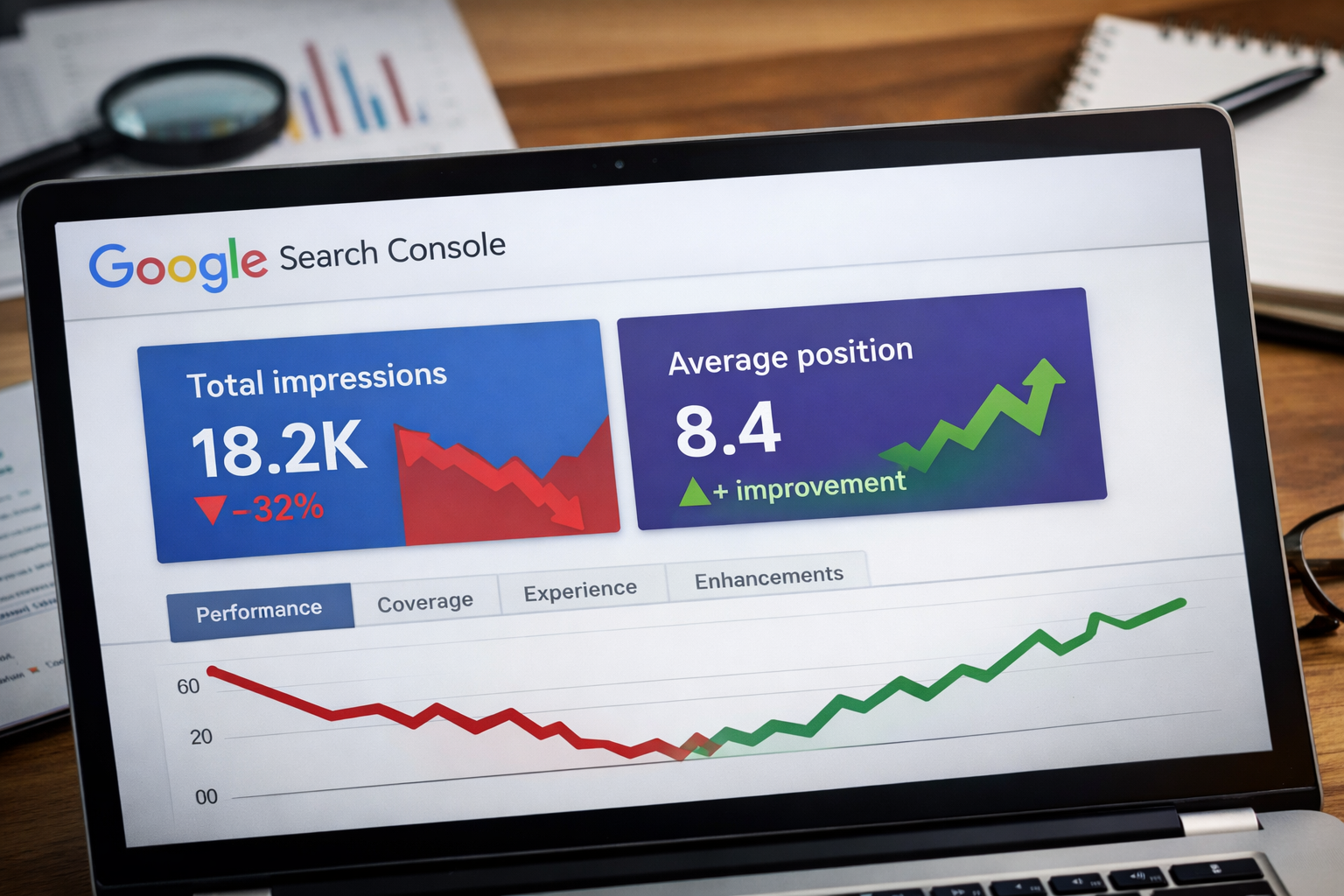
You log into Google Search Console, pull up your performance report, and something catches your eye. Your impressions are down. Noticeably. But your average position — the number that represents where your pages are ranking in search results — went up. Higher ranking, fewer impressions. That feels like it should be good news, but the drop in visibility has you second-guessing everything.
What's actually going on?
This is one of the most misunderstood combinations of metrics in all of SEO, and it comes up constantly for small business owners who are paying attention to their data but aren't sure how to interpret what they're seeing. The short answer is: it's usually not bad news. In many cases, it's a sign that something is working. But understanding why requires understanding how these two metrics relate to each other — and where most people's intuition about them goes wrong.
First, a Quick Refresher on What These Metrics Actually Mean
Before we get into the interpretation, it helps to be precise about the definitions.
Impressions in Google Search Console count how many times any URL from your site appeared in Google search results. Every time your page showed up in someone's search — whether they clicked it or not — that's an impression.
Average Position is the mean ranking of your URLs across all the queries that triggered an impression. A lower number is better: position 1 means you're showing up first, position 10 means you're at the bottom of the first page, position 11 and beyond means you've fallen to page two or further.
So when your average position goes from, say, 18 to 9, that's a significant improvement. You're ranking higher. But if your impressions dropped at the same time, it means fewer searches triggered your pages to appear at all — even at that higher position.
How can both things be true simultaneously? A few different explanations, and they're worth understanding one by one.
Reason 1: You Were Ranking for a Lot of Low-Value, Long-Tail Queries — and Now You're Not
This is the most common explanation, and it's actually good news wrapped in confusing packaging.
Here's how it works: Google Search Console counts an impression every time your page appears for any search query, including obscure, highly specific, low-volume searches that might have accidentally matched your content. If you were previously triggering impressions for dozens or hundreds of long-tail queries that nobody was really searching — ranking at position 40 or 50 for things that barely move the needle — those impressions were inflating your total impression count without doing your business any real good.
When Google refines its understanding of what your content is actually about, or when algorithm updates tighten the relevance matching, you might stop appearing for those peripheral queries. Impression count drops. But the queries you are showing up for are more relevant, more competitive, and higher in the results — which is why your average position improves.
You lost quantity. You gained quality. For most small businesses, that's a trade worth making.
Reason 2: Seasonal or Demand Shifts in Search Volume
Average position is calculated based on the queries that actually generated impressions. If overall search volume for your category drops — seasonally, or because of a shift in how people are searching — fewer searches trigger your pages, which means fewer impressions. But your ranking for those searches hasn't changed or may have improved.
Think of a landscaping company in late autumn. Fewer people are searching for lawn care services as the season winds down. Impressions drop naturally because the searches aren't happening at the same volume. But the pages that aregetting triggered are showing up higher than before. Same ranking improvement, different demand environment.
This is why it's essential to look at impression and position data alongside the actual query report in Search Console — not just the top-line numbers. If your impressions dropped in a category of searches that also dropped in volume, the algorithm didn't do anything to hurt you. The market just got quieter.
Reason 3: Your Content Got More Focused — and Google Rewarded It
Sometimes impression drops paired with position improvements happen because your site or a specific page became more topically focused. You cleaned up thin content, tightened your keyword targeting, or published more authoritative material around a specific subject.
Google rewards topical authority. When it has a clearer picture of what your page is genuinely about and who it's genuinely for, it ranks it higher for the searches that matter — and stops trying to show it for searches where it's only a marginal match. The result is exactly what you're seeing: fewer impressions across the board, but better positions on the queries that are actually relevant to your business.
This is the SEO equivalent of going from being a generalist to being a specialist. Specialists get called in for the specific problems they solve. Generalists get considered for everything and hired for less.
Reason 4: A Competitor Dropped Out of the Results
It's worth considering the competitive landscape. If a competitor who was outranking you for certain queries got penalized, lost rankings, or removed content, your pages may have moved up in their absence — without any change on your end. Meanwhile, if that competitor was also driving a category of searches that your pages were triggering impressions for, their disappearance from those results could reduce the total pool of queries your pages appear in.
This is less common than the other explanations but worth being aware of, particularly in competitive local markets where a small number of players dominate certain searches.
Reason 5: Google's Featured Snippets and SERP Features Are Changing the Picture
Google search results pages look very different than they did five years ago. Featured snippets, People Also Ask boxes, local packs, image carousels, knowledge panels, and AI-generated summaries now occupy significant real estate at the top of many results pages. These features can affect both impressions and positions in ways that aren't always intuitive.
If Google added a featured snippet or an AI overview for a query your page was previously ranking for, your organic listing may have been pushed further down the visual page — even if your technical position number stayed the same or improved. Users might be getting their answers from the SERP feature without ever clicking through to your page, which reduces impressions and clicks even when your ranking is technically strong.
Conversely, if your page earned a featured snippet for a high-value query, your average position for that query might be reported as position 1, which pulls your average position number up — but the overall impression volume from that query might actually decrease if the snippet is satisfying user intent without requiring a click.
What to Actually Do With This Information
Understanding why these metrics moved is more useful than reacting to the movement itself. Here's how to approach it practically.
Pull the query report and compare. In Search Console, go to the Performance tab, click Queries, and look at which specific searches gained impressions and which lost them. Are the queries you lost impressions for ones you actually care about? Are the queries you gained position on more valuable than the ones you lost? This is where the real story lives.
Look at clicks, not just impressions. Impressions without clicks don't grow your business. If your clicks stayed stable or increased while impressions dropped, you're likely getting more relevant traffic even at lower volume. That's a win.
Check for seasonal patterns. Pull a year-over-year comparison if you have enough data. If the same dip happened around the same time last year, you're probably looking at demand seasonality rather than an algorithm issue.
Don't panic about the impression number in isolation. Impressions are a vanity metric when they're not connected to clicks, conversions, or actual business outcomes. A smaller number of highly relevant impressions that convert is worth more than a large number of peripheral impressions that don't.
Look at your top pages individually. Rather than reading the aggregate numbers, filter by your most important pages — your homepage, your service pages, your highest-traffic blog posts — and see how each one is performing on its own. A site-wide impression drop that's driven by one underperforming page tells a very different story than a broad decline across all your content.
When Should You Actually Be Concerned?
Not every impression drop paired with a position improvement is benign. There are scenarios worth taking seriously.
If your clicks dropped significantly alongside your impressions, that's worth investigating. A rising average position should generally produce more clicks, not fewer. If position is going up and clicks are going down, something unusual is happening — possibly a SERP feature capturing your traffic, possibly a mismatch between your title tags and what searchers are actually looking for.
If the queries you're losing impressions for are your core commercial terms — the searches most directly tied to how customers find your business — that's more concerning than losing impressions on peripheral informational queries. Losing visibility on "plumber in [your city]" is a different conversation than losing impressions on "history of plumbing."
And if the trend has been consistently downward for impressions over multiple months, with no clear seasonal explanation, it's worth a deeper technical audit of your site — checking for crawl issues, indexing problems, duplicate content, or penalties that might be suppressing your visibility.
The Bottom Line
A dip in impressions alongside a rise in average position is usually a sign that your SEO is maturing, not declining. You're showing up for fewer searches, but the ones you're showing up for are more relevant, more competitive, and more likely to actually drive business.
The businesses that get tripped up by this combination are the ones treating impressions as the headline metric. Impressions tell you how often Google considered your pages. Clicks tell you how often searchers chose them. Conversions tell you how often those searchers became customers. The further down that chain you can measure, the better picture you have of whether your SEO is actually working.
If you're staring at your Search Console data and still not sure what the numbers are telling you — or whether your SEO is pointing in the right direction — that's exactly the kind of conversation we have with business owners every day.
Want to Know What Your Search Console Data Is Actually Telling You?
Data without interpretation is just noise. At Ritner Digital, we dig into the numbers behind your website — Search Console, analytics, rankings — and translate them into a clear picture of what's working, what isn't, and exactly where to focus next.
No jargon. No vanity metrics. Just a clear read on your digital presence and a plan to improve it.
Ritner Digital helps small businesses understand and improve their digital presence — from search rankings to lead generation. Ready to know what your data is actually saying? Let's talk.
Frequently Asked Questions
Is it bad if my impressions dropped in Google Search Console?
Not necessarily — and often it's the opposite of bad. Impressions count every time your page appeared in any search result, including obscure, low-value queries that were never going to bring you real business. If your impressions dropped but your average position improved, there's a good chance Google got more precise about when to show your pages — and is now showing them higher for the searches that actually matter. Context is everything with this metric.
Why would my average position go up if fewer people are seeing my site?
Because the two metrics measure different things. Average position measures where you rank on the searches that triggered an impression. Impressions measure how many searches triggered one. You can rank higher on a smaller set of searches — which is exactly what happens when Google tightens its relevance matching and stops showing your pages for queries where you were only a loose fit. Higher position on fewer, better queries is usually a net positive.
How do I know if the impression drop is a problem or not?
Look at your clicks. If your clicks stayed the same or increased while impressions dropped, you're getting more relevant traffic — which is what actually grows your business. If your clicks dropped significantly alongside your impressions, that's worth digging into further. Impressions without clicks don't pay the bills. Clicks that convert do.
What is average position in Google Search Console exactly?
It's the mean ranking position of your pages across all the queries that generated impressions during a given time period. Position 1 means you're appearing first in search results for that query, position 10 means you're at the bottom of the first page, and anything above 10 means you've fallen to page two or beyond. A lower number is always better — so if your average position went from 18 to 9, that's a meaningful improvement.
Could a Google algorithm update have caused this?
Possibly, but not necessarily in a negative way. Algorithm updates frequently improve the relevance matching between content and queries, which can cause pages to stop appearing for peripheral searches while rising in the results for their core topics. If the update hurt you, you'd typically see both impressions and clicks decline along with a drop in position — not a position improvement. A position improvement alongside an impression drop usually points to refinement, not penalty.
What's the difference between impressions and clicks in Search Console?
Impressions count how many times your page appeared in search results. Clicks count how many times someone actually clicked through to your site. A page can have thousands of impressions and very few clicks if it's ranking low, if the title and description aren't compelling, or if a featured snippet is answering the searcher's question before they need to click anything. Clicks are the metric that actually drives traffic. Impressions tell you about visibility.
What are featured snippets and how do they affect these numbers?
Featured snippets are the boxed answers that appear at the top of many Google search results pages — the direct answer Google pulls from a webpage and displays before the organic listings. If Google added a featured snippet for a query your page was previously ranking for, users may be getting their answer directly from the results page without clicking through to your site. This can reduce both impressions and clicks even when your technical ranking is strong or improving.
Should I be worried if the trend has been going on for several months?
A brief dip is usually not cause for alarm. A consistent multi-month decline in both impressions and clicks, with no clear seasonal explanation, is worth a closer look. In that scenario you'd want to check for technical issues like crawl errors, indexing problems, or content that may have been flagged by a recent algorithm update. A single data point is noise. A trend is a signal.
What queries should I actually be paying attention to in Search Console?
Focus on the queries that are most directly tied to how customers find your business — your core service terms, your local search terms, and any branded searches. These are the impressions and positions that actually matter. Losing visibility on high-intent commercial queries is a different situation entirely from losing impressions on informational or peripheral searches that were never going to convert into business anyway.
Can Ritner Digital help me make sense of my Search Console data?
Absolutely. Search Console is full of useful data that most business owners either don't look at or don't know how to interpret. We dig into the numbers, identify what's actually working and what needs attention, and translate it all into plain language with a clear plan attached. If you've been staring at your analytics wondering what it all means, that's exactly the kind of conversation we'd love to have.