What Does It Mean to "Stop a Scroll" — And Why Your Business Depends on It
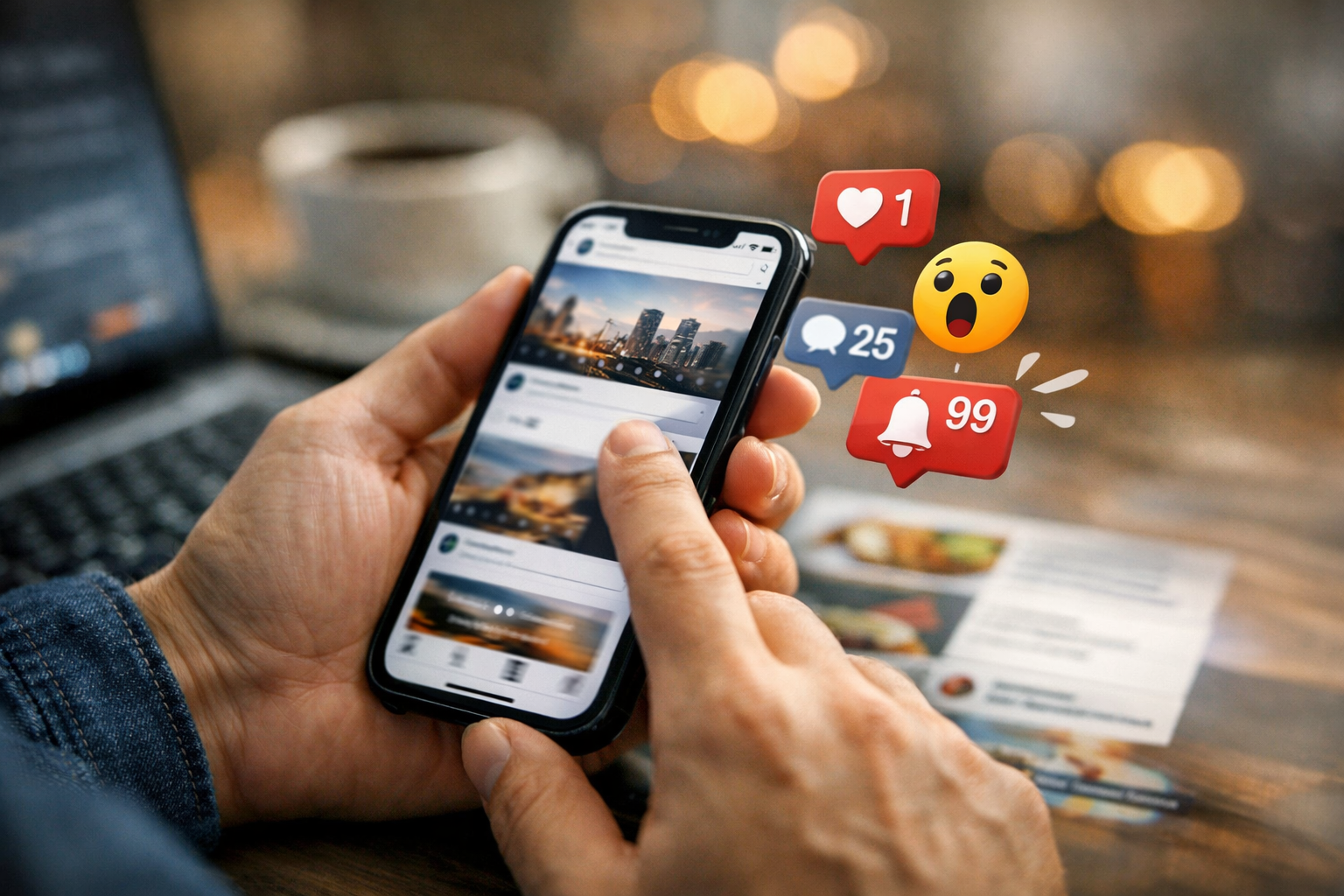
Picture this: someone is sitting on their couch at 9pm, phone in hand, thumb moving faster than they're even thinking. LinkedIn notifications, Facebook updates, a video of someone's dog, an ad for shoes, a post from a local business, another ad, a motivational quote, a news headline — all of it blurring together in an endless stream.
Then something makes them stop.
They don't know exactly why. They just stopped. Their thumb paused. Their eyes focused. And for the next few seconds — maybe longer — that piece of content had their complete attention.
That's a scroll stop. And for your business, it's one of the most valuable things that can happen on social media.
The Attention Economy Is Real, and It Is Brutal
We talk about social media "engagement" like it's a marketing metric. But at its core, it's a fight for human attention — and human attention has never been more scarce or more competed for.
The average person scrolls through roughly 300 feet of social media content every single day. That's the height of the Statue of Liberty, covered in posts, ads, videos, and updates, consumed daily before most people even realize they've been doing it. Your post is somewhere in that 300 feet. So is every other business in your industry. So is every friend, family member, news outlet, and entertainer your audience follows.
The algorithm doesn't care that you spent an hour on your post. It cares whether people stopped. Whether they clicked. Whether they commented. Whether they shared. Every platform — LinkedIn, Facebook, Instagram — uses engagement signals to decide whether your content deserves to be shown to more people or quietly buried. A post that stops scrolls gets amplified. A post that doesn't gets forgotten inside of 20 minutes.
This is why "just posting consistently" isn't enough. Consistency without scroll-stopping content is just a consistent way to be ignored.
What Actually Makes a Scroll Stop
There's no single formula — if there were, everyone would use it and it would stop working immediately. But there are consistent principles behind content that earns attention, and understanding them changes how you think about every post you create.
It Creates a Pattern Interrupt
The human brain is a prediction machine. It's constantly scanning its environment for what comes next, and when something breaks the expected pattern, it pays attention. On social media, that means your content needs to do something unexpected — visually, structurally, or in terms of what it says.
A post that opens the same way as the last 50 posts someone scrolled past won't register. A post that opens with a counterintuitive claim, an unusual image, a surprising statistic, or a format the eye hasn't seen in a while — that creates a pattern interrupt. The brain catches it.
This doesn't mean you have to be shocking or provocative. It means you have to be different from what surrounds you in the feed at that moment.
It Triggers an Emotional Response
Attention follows emotion. Content that makes someone feel something — curious, amused, validated, surprised, challenged, seen — earns the pause that purely informational content rarely does.
This is why "5 Tips for Better Business Efficiency" gets scrolled past while "The business advice I followed for 10 years that was completely wrong" gets clicked. Both are informational. Only one creates an emotional pull before the person has read a single word of the actual content.
The emotion doesn't have to be dramatic. Curiosity is enough. Familiarity is enough. Recognition — "that's exactly my situation" — is enough. The key is that something in the post has to touch a nerve before the reader has decided to commit to reading it.
It Communicates Value Instantly
Scroll-stopping content earns the pause, but it has to immediately answer the question every reader is silently asking: why should I spend my next 30 seconds here instead of continuing to scroll?
That answer needs to be visible before the person has done any work. In the first line. In the headline. In the visual. In the first three words of the caption. If the value isn't obvious in the first half-second of contact, most people won't give you a second half-second to explain yourself.
This is why the opening line of a LinkedIn post is worth more than the entire rest of it. It's the only part that shows before the "see more" cutoff. It's your one shot to make someone decide the post is worth their time.
It Looks Like It Belongs to a Real Person
There is a category of content that gets scrolled past at record speed: content that looks corporate. Stock photos of handshakes. Generic motivational quotes in branded templates. Posts that could have been written by any business in any industry.
Audiences in 2025 have a finely tuned radar for inauthenticity. Content that feels produced for the sake of being produced — rather than because someone actually had something to say — reads immediately as noise. And noise gets ignored.
The posts that stop scrolls tend to feel like they came from a real person with a real opinion, a real story, or a real perspective. Even for businesses, the more human the voice, the more the content performs.
What Doesn't Stop Scrolls (But Most Businesses Keep Doing Anyway)
Understanding what works is only half the picture. The other half is recognizing the habits that are quietly tanking your social media performance.
Announcements nobody asked for. "We're excited to announce that we've updated our website!" Nobody cares. Not because your website isn't great, but because this type of content offers nothing to the reader. There's no story, no tension, no reason to stop.
Generic inspirational quotes. These were overused five years ago. Today they're so common they're essentially invisible. If your content strategy relies heavily on motivational quotes, you're filling a content calendar without filling anyone's feed with something worth reading.
Posts that bury the point. Long preambles. Excessive context-setting. Posts that take three paragraphs to get to the thing they actually wanted to say. The feed has no patience for this. If you can't get to the point in the first line, you've already lost most of your audience.
Selling before earning attention. A post that leads with your product, your service, your offer — before establishing any reason for the reader to care — is essentially an ad that nobody opted into. It can work when done with skill and context. Most of the time, it just confirms to the algorithm that your content isn't resonating.
Visual content that doesn't stand out. A blurry photo taken in bad lighting. A Canva template that looks exactly like every other Canva template in the feed. Visuals that are technically present but don't actually do any work. If the image or graphic isn't earning the stop on its own, it's not helping.
Platform Matters: LinkedIn vs. Facebook
Stopping a scroll on LinkedIn requires different content than stopping one on Facebook. The audiences are in different mindsets, the feeds look different, and what earns engagement on each platform reflects those differences.
On LinkedIn, the scroll stop often comes from professional credibility. A counterintuitive business take. A personal story with a professional lesson attached. A specific, data-backed insight that challenges conventional wisdom in your industry. The audience is in work mode — they're looking for things that make them better at what they do, or that make them feel seen in the professional challenges they face.
On Facebook, the scroll stop is more likely to come from community and relatability. A story that feels personal. Something funny or unexpectedly honest. Content that reflects the experience of your local audience. Facebook users are in a different gear — more social, more casual, more likely to engage with something that makes them feel connected than something that makes them feel informed.
Writing the same post for both platforms and copying it across is one of the most common social media mistakes small businesses make. It's not that the content is bad — it's that it wasn't built for the platform it's landing on.
Why This Is Harder Than It Looks
None of this is complicated in theory. In practice, doing it consistently — week after week, post after post, across two platforms with different audiences and different rules — is genuinely difficult.
It requires knowing your audience deeply enough to predict what will resonate. It requires a creative process that generates fresh angles rather than recycling the same handful of ideas. It requires writing skills that go beyond competence into genuine craft. And it requires enough distance from your own business to see it the way your audience sees it — which is one of the hardest things for any business owner to do.
This is why so many businesses post consistently and see nothing. They're showing up. They're putting content out. But the content isn't doing the one thing that makes social media actually work for a business: stopping the scroll long enough for someone to pay attention.
Scroll-Stopping Content Is a System, Not a Stroke of Luck
The businesses that consistently produce content that performs aren't just naturally creative. They have a system. They know their audience. They have a defined brand voice. They understand what their content is supposed to accomplish on each platform. They test, they track, and they iterate.
At Ritner Digital, building that system is exactly what we do. We develop the strategy, create the content, and monitor what's working — so your social media presence is actively building your business instead of just filling space in someone's feed.
Ready to Actually Be Seen?
If your posts are going out and the crickets are coming in, the problem isn't that you're not trying hard enough. It's that content without strategy doesn't stop scrolls — it joins the noise.
Let's change that.
Book a Free Social Media Strategy Call →
Ritner Digital helps small businesses build social media that actually works — from scroll-stopping content to full lead generation systems. Ready to be seen? Let's talk.
Frequently Asked Questions
What does "stopping a scroll" actually mean in plain terms?
It means your content made someone pause instead of keep scrolling. On any social media platform, people move through their feed fast — sometimes without consciously registering most of what they see. A scroll stop is the moment your post broke through that autopilot and earned someone's actual attention. For a business, that pause is the first step toward a like, a comment, a click, or a conversation.
How do I know if my content is stopping scrolls?
Your analytics will tell you. On LinkedIn and Facebook, look at your impressions versus your engagement rate. High impressions with low engagement usually means people saw your post but kept moving. A strong engagement rate — clicks, reactions, comments, shares — means people stopped. Reach and saves are also strong indicators that content earned genuine attention rather than just appearing in a feed.
Does every post need to be scroll-stopping?
Not every post will be a home run, and that's fine. But every post should be trying to earn attention rather than just filling a slot on the calendar. The businesses that consistently perform on social media aren't the ones who go viral occasionally — they're the ones who show up repeatedly with content that's relevant, specific, and human enough to make their audience stop more often than not.
Is scroll-stopping content just about being controversial or provocative?
Not at all. Controversy can stop a scroll, but it can also damage your brand and attract the wrong kind of attention. The most effective scroll-stopping content for a small business is usually specific, honest, and relatable — not edgy. A post that says "here's the mistake I made running my business in year one" will outperform a generic hot take almost every time, because it's real, it's specific, and it creates curiosity without manufactured drama.
What's the most important part of a post for stopping a scroll?
The opening line, without question. On LinkedIn, everything before the "see more" cutoff is your entire argument for why someone should keep reading. On Facebook, the first sentence of your caption is what the algorithm and your audience judge in the first half-second. If that line doesn't create curiosity, emotion, or immediate value, most people will never see the rest of what you wrote — no matter how good it is.
Why do my posts get impressions but no engagement?
Impressions mean the post appeared in someone's feed. Engagement means they did something with it. A gap between the two almost always points to one of three things: the opening line didn't earn the stop, the content didn't deliver on whatever the opening line promised, or the post didn't have a clear reason for the reader to take action. Sometimes it's all three. Fixing this is usually a combination of stronger hooks, more specific content, and a clearer call to action.
Does the visual matter as much as the copy?
On Facebook and Instagram, the visual often does the stopping before the words even register. A strong image or graphic earns the pause that the copy then has to keep. On LinkedIn, text-forward posts — particularly ones with a strong first line — can stop scrolls entirely on their own. The safest approach is to treat both as equally important: a great visual with a weak opening line loses the reader the moment they glance at the caption, and strong copy underneath a forgettable image may never get read at all.
How often should I be posting to build momentum on LinkedIn and Facebook?
Consistency matters more than frequency. Posting three times a week with content that's been thought through will outperform posting every day with filler. For most small businesses, two to four posts per week per platform is a sustainable and effective cadence — as long as each post is actually trying to earn attention rather than just maintain a streak.
Why does my competitor's content seem to perform better even though mine looks just as good?
Usually the answer is specificity and voice. Content that performs well tends to be specific to a particular audience, problem, or perspective — not broad enough to apply to everyone. If your content could have been written by any business in your category, it won't stand out from any of them. The businesses that win on social media have a recognizable point of view and write to a specific person, not to everyone at once.
Can Ritner Digital help me create content that actually stops scrolls?
That's exactly what we do. We develop the strategy behind your content — the audience, the voice, the angles, the platform approach — and we create posts built to perform, not just to exist. If your social media presence feels like a lot of effort for not much return, that's the conversation we'd love to have.