The Auto Sales LinkedIn Loophole: Why Personal Social Branding Works But a Personal Lead-Gen Website Doesn't
A car salesperson can build a LinkedIn following of 40,000 automotive buyers. They can post daily. They can film Tuesday-morning walkarounds from the showroom floor. They can go on TikTok and become a recognizable face in the industry. Dealerships not only allow this — many actively encourage it, train for it, and hold it up as a model for other salespeople to follow.
That same car salesperson cannot build a personal lead-generation website with a domain like BobSellsFords.com that advertises vehicles, quotes prices, runs finance specials, and captures leads into a CRM they own. That crosses a legal line. Dealers don't allow it. When they find out a salesperson has built one, they usually shut it down, ask for it to be taken down, or in some cases terminate the salesperson's employment over it.
On the surface, this looks arbitrary. Both are personal channels. Both build a personal brand. Both generate leads. Both display the salesperson's name and face. If one is fine, why isn't the other?
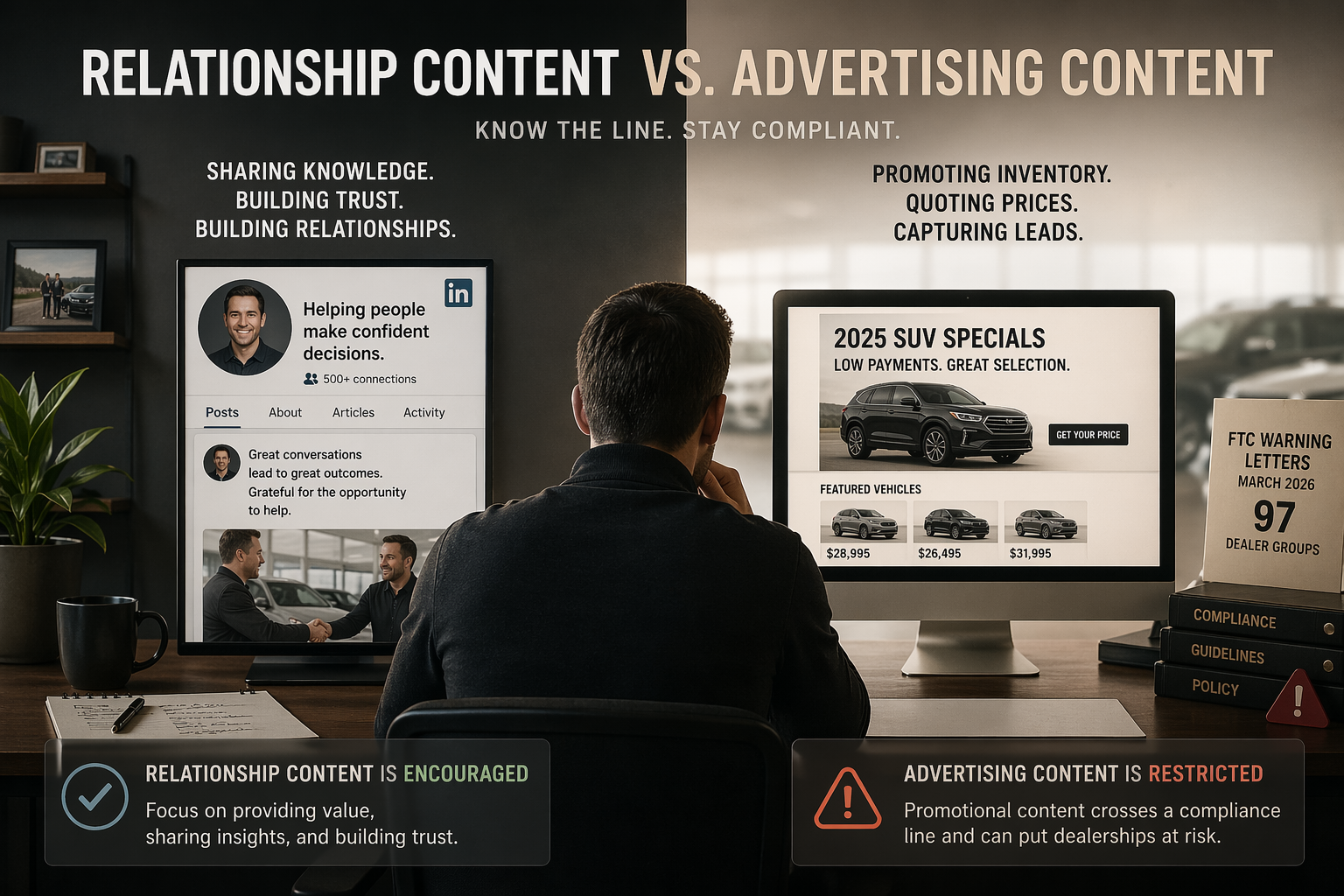
The answer is that the distinction isn't really between social media and websites. It's between relationship content and advertising content, and that distinction happens to map roughly — but not perfectly — onto how salespeople actually use those two channels. Once you understand what the FTC and state regulators are actually enforcing against, the line becomes sharp and the rule becomes clear. The personal brand on LinkedIn is safe because it's almost always relationship content. The personal lead-gen website is dangerous because it's structurally built to produce advertising content — the exact thing regulators are currently pursuing auto dealers over.
Let's walk through why.
What Regulators Are Actually Targeting
To understand why a personal website is a compliance problem for a car salesperson while a personal LinkedIn is generally fine, you have to start with what the regulatory regime in automotive is actually aimed at. It's not aimed at personal branding. It's not aimed at salespeople being visible. It's aimed at deceptive price and product advertising — specifically, the kind of advertising that causes consumers to come to a dealership or make a purchase decision based on information that turns out not to be accurate or available.
The FTC made this explicit in March 2026, when the Commission sent warning letters to 97 auto dealership groups nationwide addressing their advertising and sales practices. The letters — which were followed by extensive industry commentary from compliance attorneys — focused on a specific set of practices: advertising a price that doesn't reflect all required fees, advertising a price that reflects rebates or discounts not available to all consumers, advertising a price that fails to account for required down payments, conditioning advertised prices on dealer financing, and requiring consumers to buy additional items not reflected in the advertised price. Every single one of those practices is an advertising practice. Every single one involves making a representation about a vehicle, a price, or a deal that then turns out not to match what the consumer actually gets.
This is the compliance universe that auto dealers live in. The FTC Act, the Truth in Lending Act, the Consumer Leasing Act, state dealer advertising statutes, and the body of case law that's built up around auto advertising all target one thing: representations about vehicles, prices, terms, and deals. That's the substance regulators care about. And critically, that's the substance that brings dealerships the biggest fines and the most public enforcement risk — even a single non-compliant advertisement by an employee can expose the entire dealership to liability, according to compliance attorneys who work with dealerships on FTC matters.
Now layer in a crucial legal fact. The dealership is responsible for that content no matter who actually publishes it. The Virginia Automobile Dealers Association, reacting to the FTC's March 2026 warning letters, put it this way in guidance to its members: social media posts with offers are advertising, and if a salesperson's posts violate federal or state laws applicable to advertising, the dealership can be held liable in a government regulatory action. When employees use their own social media accounts, the dealership has no control — but the dealership will be held responsible for those posts. Legal analysis in the trade press has echoed this point: a dealership can be exposed to FTC action when its employees advertise vehicles on their personal social media accounts, which is why some dealers completely prohibit employees from advertising vehicles on social media, and others limit them to simply sharing the dealership's own posts.
This is the rule you have to hold in your head to understand everything else: the dealership owns the compliance risk for any vehicle advertising published by its employees in any channel, and regulators are actively enforcing against advertising that misrepresents prices, fees, or terms.
Why Most LinkedIn Personal Branding Doesn't Trigger Any of This
Now look at what a typical car salesperson's LinkedIn presence actually consists of. They post about their own career journey. They post client delivery photos — the customer smiling next to their new car in the showroom — with a caption thanking the customer. They post opinions about the industry, reactions to news stories, thoughts on EVs versus hybrids, tips for first-time buyers, jokes about the sales life. They comment on other people's posts. They connect with everyone they meet. They share the dealership's official posts. They respond to DMs from past customers. They build a following by being interesting, visible, and consistent.
None of that is advertising in the regulatory sense. None of it quotes a specific price on a specific vehicle that may not be available to all consumers. None of it promotes a finance offer with terms that have to comply with TILA disclosures. None of it claims a rebate that's conditional on credit score. None of it advertises a specific VIN at a specific price. The content is about the salesperson as a professional, the customer experience, the industry as a whole, and the relationship between the salesperson and their network. It's personal brand content and relationship content, which sits largely outside the advertising compliance regime that regulators actually enforce.
There are real compliance considerations even here. If a salesperson tags the dealership, they should identify themselves accurately — "Sales Consultant at ABC Ford" — so consumers understand whose employee they're dealing with. If they share the dealership's ads, they're sharing advertising, but the advertising has already been cleared by the dealership's compliance process. If they wade into politics or post something offensive, they can damage the dealership's reputation even if they haven't violated an advertising law. Industry compliance guidance routinely tells dealers to write social media policies that address these edge cases — not because personal branding is dangerous, but because the narrow set of situations where personal social posts cross into advertising or reputational harm need to be clearly bounded.
What dealerships have learned, over roughly fifteen years of social media existing in the industry, is that well-behaved personal social branding is a huge upside with manageable downside. A salesperson with 10,000 real followers drives referrals, repeat business, and walk-in traffic. The content is mostly relational, the legal exposure is mostly low, and with a basic social media policy in place the dealership can capture nearly all of the upside while controlling nearly all of the risk. FTC guidance has long acknowledged that a company generally isn't liable for the "rogue employee" who violates a clear, well-communicated policy — which means a written social media policy isn't just a nicety, it's an actual compliance shield.
Why a Personal Lead-Gen Website Is a Different Animal Entirely
Now consider what a personal lead-gen website is built to do. The entire purpose of the site is to advertise vehicles and capture leads. It has inventory pages, pulled from the dealership's feed or hand-curated by the salesperson. It shows prices, probably with monthly payment calculators. It promotes finance specials, lease specials, trade-in offers, and bonus cash events. It runs a blog with SEO-optimized posts about the best F-150 deals this month or how to lease a Tacoma with zero down. It has a contact form that routes leads directly to the salesperson's personal email or CRM, bypassing the dealership's intake system.
Every single element of that site is advertising. Not relationship content. Not thought leadership. Not brand-building. Advertising — claims about vehicles, prices, terms, incentives, and deals that the consumer is expected to rely on in deciding whether to reach out. And every single element of it is, from a compliance standpoint, the dealership's responsibility, because the salesperson is a licensed employee of the dealership and the vehicles being advertised belong to the dealership's inventory and license.
This is where the compliance math becomes impossible. If the salesperson's website advertises a Ford F-150 at $42,500 and the dealership's actual price — once required fees are included — is $44,100, that's exactly the kind of deceptive pricing the FTC just warned 97 dealer groups about. If the site promotes a lease special that's only available to customers with 740+ credit scores and doesn't disclose that limitation "clearly and conspicuously," that's a state advertising violation. If the site shows a vehicle that sold last week and hasn't been updated, that's advertising an unavailable vehicle, which the FTC has repeatedly called out. If the site runs a banner for a "$2,000 off" event without properly disclosing the conditions, that's a CARS Rule problem. If the site's financing disclosures don't meet TILA requirements, that's a federal lending law violation.
And because the dealership is legally responsible for every one of those potential violations, the dealership is forced to treat the personal website as its own advertising. It has to be reviewed. It has to be archived under the recordkeeping rules the FTC imposes on dealers. It has to be kept in sync with inventory changes in real time. It has to be audited for compliance every time a regulation changes. In practice, no dealership is willing to take on that ongoing compliance burden for one salesperson's personal site — especially when the salesperson might leave in six months and now the dealership has a rogue advertising asset out in the wild under someone's personal domain, with no operational control over what it says.
This is why dealers who find out a salesperson has built a personal lead-gen website almost always shut it down. It's not because they're against the salesperson's success. It's because the site creates an unmanageable compliance exposure that the salesperson isn't capable of solving and the dealership isn't willing to absorb.
It's Not Really About Channel — It's About Content Type
The cleanest way to see the rule is to notice that it isn't really about social media versus websites. It's about relationship content versus advertising content. Social media happens to be dominated by relationship content in practice, and websites — especially lead-generation websites — are dominated by advertising content in practice. That's why the channel-level rule works as a rough approximation. But the moment you test the edges, the real rule becomes obvious.
A salesperson's personal LinkedIn post thanking a customer for buying a Bronco is relationship content — safe. That same salesperson's LinkedIn post saying "2024 Bronco Outer Banks, $38,900, message me to lock it in" is advertising content, and it's exactly the kind of post that VADA warned about after the FTC's March 2026 letters. It's on LinkedIn, but it's not safe. It's advertising, it's the dealership's responsibility, and it exposes the dealership if the price isn't fully inclusive of required fees or isn't available to all consumers.
Conversely, a salesperson's personal website that's structured as a professional bio page — headshot, bio, testimonials, contact form, no vehicles, no prices, no deals — is relationship content. It's safe. It builds a personal brand. It drives referrals. It's the functional equivalent of what the LinkedIn profile does. What makes the typical car salesperson's lead-gen website a problem isn't that it's a website — it's that the website is almost always built around vehicle advertising, because that's how automotive lead generation has historically worked. If you stripped all the vehicles, prices, deals, and finance content off the site and left just the personal brand, you'd have something most dealerships would have no objection to.
Real estate salespeople, because they're independent contractors who own their own businesses and aren't bound by dealer advertising regulations, can put all of that vehicle-equivalent content on their own sites — listings, prices, market data, deal content — because they're the licensed entity doing the advertising and the compliance falls on them. An automotive salesperson can't, because they're not the licensed entity. The dealership is. And the dealership can't absorb the compliance risk of content it doesn't control.
What This Means in Practice for Auto Salespeople and the Dealerships That Employ Them
The practical framework that falls out of this is cleaner than most salespeople realize, and it's worth stating plainly.
Safe, encouraged, and high-ROI: Personal LinkedIn, Instagram, TikTok, and Facebook presences built around the salesperson's professional identity, customer relationships, industry commentary, delivery photos, team culture, and general brand content. A personal bio site that introduces the salesperson, lists testimonials, and directs interested buyers to contact the dealership. Engaging with the dealership's official content. Building a genuine following of people who know, like, and trust the salesperson. This is the automotive version of personal branding, and it works — the top social media salespeople in the industry have built real pipelines through relationship content alone.
Dangerous and usually prohibited: A personal website or personal social channel that advertises specific vehicles, specific prices, specific finance or lease terms, specific incentives, or specific deals. Any content where the salesperson is making a commercial representation about a vehicle or price that a consumer might act on. Any channel that captures leads into a personal CRM outside the dealership's compliance oversight. Any ad spend — Meta ads, Google ads, LinkedIn ads — buying reach for that kind of content under the salesperson's personal name.
The gray zone that requires dealership input: Content that's mostly relational but references vehicles specifically. Video walkarounds of inventory. "Just got this one in, let me know if you want to check it out" posts. Delivery photos that mention the model and year but not the price. Inventory highlights without price or terms. These generally aren't advertising in the strict regulatory sense, but they're close enough to it that sophisticated dealerships give their salespeople written guidance on what's in-bounds, what's out, and what needs to be run past the marketing or compliance team before posting.
The dealerships winning at this in 2026 have written social media policies for their salespeople, provide template content and pre-cleared assets, train salespeople on what the advertising boundary actually is, and integrate their salespeople's personal channels with the dealership's CRM so leads from personal-brand content can still be captured, tracked, and followed up on without the salesperson having to run their own independent infrastructure. That's the structure that gets the upside of personal branding without the compliance exposure of independent advertising.
The Real Takeaway
The reason personal LinkedIn branding works and personal lead-gen websites don't isn't that one is social and the other is owned media. It's that one is a relationship channel that happens not to trigger the advertising compliance regime, and the other is an advertising channel that triggers it in the most direct way possible. The moment a salesperson's social content starts quoting prices and terms, the social channel becomes just as dangerous as the website. And if a salesperson's website stopped quoting prices and became a pure professional presence, it would stop being dangerous — but it would also stop being the lead-gen engine the salesperson was trying to build.
For auto dealerships, this means the marketing playbook is clear. Build a strong dealership website with professional compliance oversight. Invest heavily in your dealership's paid advertising, SEO, and inventory marketing. Support your salespeople in building legitimate personal brands in the relationship-content space — social media, video, personal presence — and give them the policies, templates, and training to do it safely. Do not let them run independent vehicle-advertising operations in their own names, because the compliance math simply doesn't work no matter how good the salesperson is.
For individual salespeople, this means your personal brand ceiling is higher than you think in the relational space and lower than you think in the advertising space. The top automotive salespeople on LinkedIn, TikTok, and Instagram aren't quoting prices. They're being interesting, being visible, and being the person their followers already trust when the time comes to buy a vehicle. That's the model that scales. The personal lead-gen website model, as attractive as it looks on the surface, is a compliance trap that will either get shut down by your dealership or get your dealership fined by the FTC — neither of which ends well for your career.
Ritner Digital builds digital marketing programs for auto dealerships that actually work inside the compliance regime the industry operates under. Strong dealership websites with proper advertising compliance. Paid and organic campaigns that convert without crossing regulatory lines. Social media and personal branding programs for your salespeople — the kind that build pipeline without creating FTC exposure for the store. If you're running a dealership and trying to figure out where the line is between empowering your team and protecting your license, let's talk.
Sources: FTC press release, "FTC Warns 97 Auto Dealership Groups About Deceptive Pricing" (March 13, 2026); FTC template auto warning letter (March 2026); Virginia Automobile Dealers Association, "FTC Enforcement: Review Your Social Media Policy" (March 2026); Pullman & Comley, "Warning to Auto Dealers: The FTC Is Watching Your Advertising Practices" (March 2026); Charapp & Weiss, "FTC Warning to Auto Dealers: Advertising Compliance Risks & Best Practices" (2026); Fox Rothschild / CBT News, Seth Dobbs interview on FTC enforcement (2026); Automotive News, "What dealerships need to know about FTC liability from employees' personal social media posts" (2026); Automotive News, "When dealers should pull sold vehicle listings under FTC ad rules" (2026); Auto Dealer Today, "Social Media Guidelines for Dealerships"; DealerRefresh, "Social Media Policies for Salespeople"; Kruse Control, "3 Essential Social Media Policies to Keep Car Dealers Out of Hot Water"; Auto Remarketing, "Why dealers need clear social media posting policy for employees"; FTC Combating Auto Retail Scams Rule, Federal Register; FTC CARS Rule Dealers Guide.
Frequently Asked Questions
Can a Car Salesperson Get in Personal Legal Trouble for a Non-Compliant Social Post, or Is It Just the Dealership's Problem?
Both, depending on the violation and the state. The primary enforcement target under federal advertising law is the licensed dealer, because the dealer is the entity doing the advertising in the eyes of the FTC. But most states have individual salesperson licenses that can be suspended, revoked, or conditioned for advertising violations, and some states impose direct civil liability on salespeople for deceptive practices. Wisconsin's motor vehicle salesperson statute, for example, explicitly provides that civil proceedings and special orders can be imposed on the salesperson directly. In practical terms, the dealership bears the bulk of the financial risk from an FTC action, but the salesperson can lose their license and their ability to work in the industry — which is often a more serious career consequence than a fine. The "just the dealership's problem" framing is wrong, and salespeople should treat their own license as their own asset.
What About a Salesperson Who Wants to Specialize — Someone Who Sells Only Exotic Cars, Commercial Trucks, or EVs and Wants a Niche Personal Presence?
Specialization amplifies the upside of personal branding, but it doesn't change the compliance framework. A salesperson who's known as "the Ferrari guy" at a particular luxury dealer or "the commercial truck specialist" at a Ford store can absolutely build a powerful personal presence around that specialty — industry commentary, customer delivery content, market insights, relationship-building with a narrow buyer pool. What they still can't do is run independent advertising for the specialized inventory they sell. The specialty actually makes the compliance line easier to respect, because high-end and commercial buyers typically don't respond to price-advertised content anyway — they respond to expertise, relationship, and access. The most successful specialized salespeople intuitively operate in the relationship-content zone because that's what their buyers actually want.
If a Salesperson's Personal Instagram Page Has 50,000 Followers, Does the Dealership "Own" That Audience When the Salesperson Leaves?
Legally, no. The account belongs to the individual, and the followers follow the individual. This is actually one of the underappreciated asymmetries of the current automotive social landscape — salespeople build up significant personal audiences on dealership time and with dealership support, and those audiences leave with them when they change stores. This is very different from a dealership-owned social channel, which is a dealership asset. Some dealerships have tried to address this through employment agreements that assert ownership of work-related social accounts, but enforceability is inconsistent and most dealers in practice accept that personal social audiences travel with the employee. This is another reason dealers should be investing in their own company channels, not just relying on their salespeople's personal reach — the company channels don't leave when a top performer does.
Didn't a Federal Court Invalidate the CARS Rule in 2025? Does That Mean Advertising Compliance Is Looser Now?
This comes up constantly, and the answer is no. A federal court did invalidate the FTC's CARS Rule in 2025, which was a significant setback for that specific regulatory framework. But the invalidation of the CARS Rule didn't eliminate the underlying advertising law. The FTC Act itself — specifically Section 5's prohibition on unfair and deceptive practices — still applies to auto dealer advertising, and it's the statutory authority the FTC relied on when it sent its March 2026 warning letters to 97 dealer groups. State advertising laws, the Truth in Lending Act, the Consumer Leasing Act, and state motor vehicle advertising statutes are also completely unaffected by the CARS Rule's invalidation. The CARS Rule would have tightened and formalized a set of compliance obligations, but dealers are still living under the same broad truth-in-advertising regime they've always operated under — and the FTC has made clear it intends to enforce that regime aggressively.
Is Running Paid Ads (Meta, Google) Under a Salesperson's Personal Account the Same Problem as a Personal Website?
Yes — it's actually often worse. A personal website is at least a single, static asset that can theoretically be reviewed and audited. Paid ads running under a salesperson's personal account represent ongoing, dynamic advertising that's being updated, targeted, and optimized in real time — which makes compliance oversight essentially impossible. If the ad copy references pricing, financing, or incentives at all, every ad variant is a regulated advertisement, and the dealership carries the liability while having no operational control. The few dealerships that have tried letting salespeople run their own paid ads have almost uniformly rolled the program back after realizing the compliance exposure. If personal paid ads are part of the marketing strategy, they should run under the dealership's accounts, with the salesperson featured as the face — not under the salesperson's personal account with vehicle advertising flowing through it.
What's the Sophisticated Way to Structure This — What Do the Best Dealerships Actually Do?
The dealerships getting this right in 2026 operate on a hub-and-spoke model. The dealership itself is the hub: a strong company website, professional SEO, a centralized CRM, paid advertising under the dealer's licensed accounts, and a marketing team with compliance oversight over everything that gets advertised under the dealership's name. The salespeople are the spokes: personal LinkedIn, Instagram, TikTok, and Facebook presences built around their own professional identity, their own customer relationships, and their own industry voice — with content that's mostly relational and operates outside the advertising zone. The dealership provides social media policies, pre-cleared templates, content calendars, and training to help salespeople build their brands safely. Leads generated from salespeople's personal content get routed back into the dealership's CRM so they can be tracked, followed up on, and attributed. The salesperson gets credit and compensation for the pipeline they generate; the dealership gets a compliant advertising environment and amplified reach. That's the model that works.
Does the Same Logic Apply to the Finance Manager or the Service Advisor, or Is This Just About Sales?
The same logic applies to anyone at the dealership whose role involves customer-facing commercial representations — so yes, finance managers, service advisors, parts managers, and anyone else whose personal social presence could drift into advertising territory. The risk profile is different for each role. Finance managers face the most acute exposure because their work involves representations about financing terms, APR disclosures, and credit products, all of which are heavily regulated under the Truth in Lending Act and Regulation Z. Service advisors have slightly less exposure because service advertising is less regulated than vehicle or financing advertising, but service pricing, warranty claims, and maintenance package representations still fall under state consumer protection law. Any dealership social media policy worth writing covers the whole staff, not just the sales floor.
Is There Any Industry Parallel Outside Automotive Where This Same Distinction Plays Out?
Financial services is the closest parallel. Registered representatives at broker-dealers — the advisors who sell investment products through wirehouses, banks, and independent broker-dealers — live under a FINRA and SEC compliance regime that treats essentially any communication about specific securities, performance, or financial products as regulated advertising subject to firm review and approval. Those advisors can build personal LinkedIn presences that talk about their careers, their values, their general market views, and their client relationships — but they can't run personal websites advertising specific funds, quoting returns, or promoting specific investment products without firm compliance review. It's the same core logic as automotive: relationship content in the relational channel is generally safe, advertising content in any channel is heavily regulated, and the individual isn't permitted to run independent advertising because the licensed entity — the broker-dealer, the dealership — bears the legal responsibility. Any time you see this pattern in an industry, you're looking at the same structural reality.