Why Real Estate Agents Build Personal Websites and Car Salespeople Don't: A Regulatory Tale of Two Sales Jobs
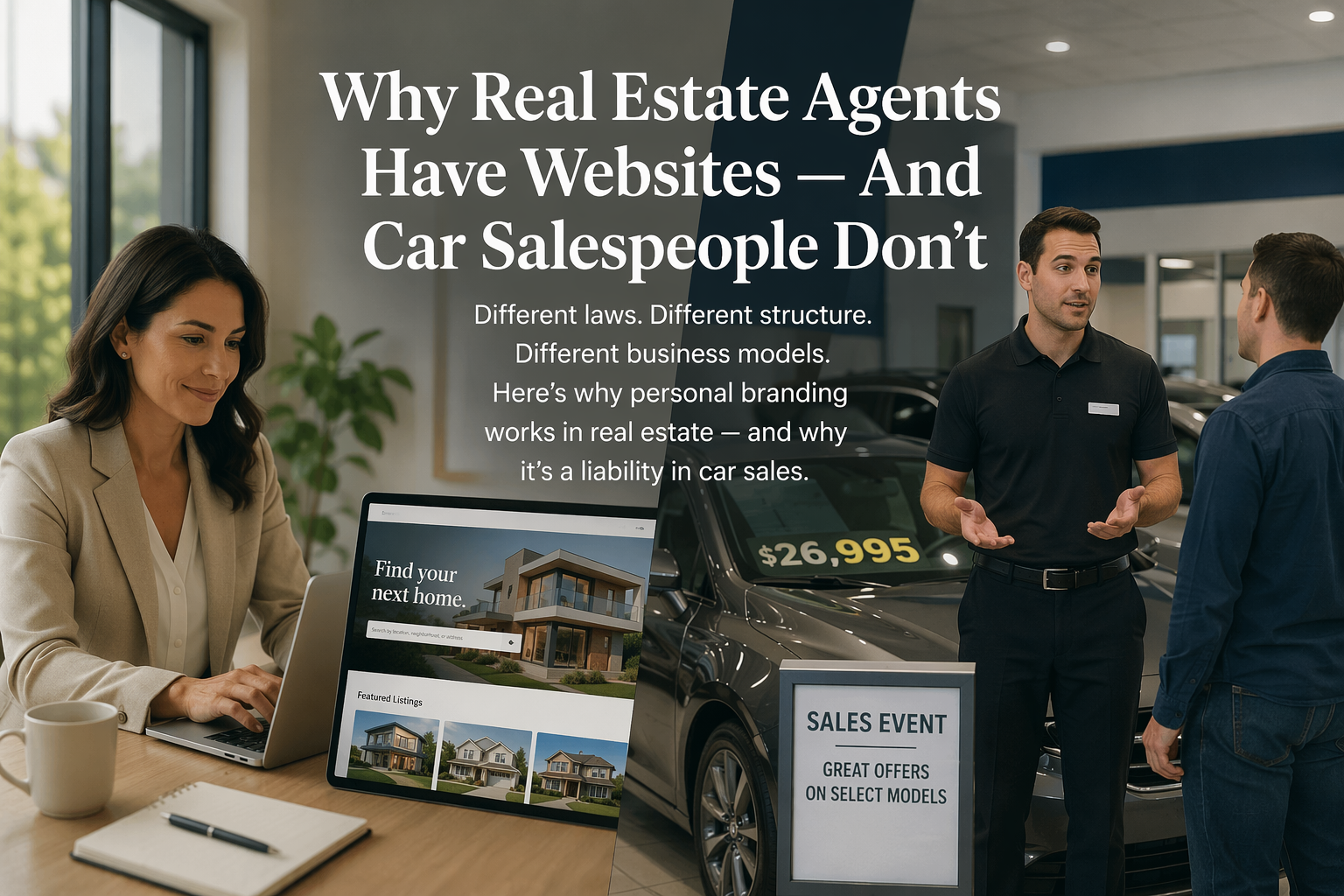
Walk through any neighborhood in the country and you'll find real estate agents with their own websites. Not their brokerage's website — their own. SarahSellsPhilly.com. TheBucksCountyRealtor.com. A personal domain, a personal logo, a personal bio, a featured listings page pulled in from the MLS, maybe a blog about school districts and closing costs, and a contact form that feeds directly into the agent's CRM. Their brokerage name is usually in the footer somewhere, required by state law, but the brand the agent is building is their own.
Now try to find a car salesperson's personal website. The one who sold your neighbor her SUV last year. The one whose business card is sitting in your glove compartment. The one who texted you about the new model year arrivals. You won't find it, because it almost certainly doesn't exist. That salesperson has a profile page on the dealership's website — if they're lucky — a LinkedIn account with a generic headline, and maybe a Facebook page where they post inventory photos that were already posted by the dealership. A full personal website, built to generate leads, capture contacts, and build a pipeline that belongs to them? Virtually never.
This isn't a coincidence. It isn't a matter of one industry being more tech-savvy than the other. It isn't that real estate agents are just more ambitious marketers than car salespeople. The difference runs much deeper. It comes down to how each industry is legally structured, who owns the relationship with the customer, and what the law actually permits an individual salesperson to do in their own name. The regulatory architecture of real estate is fundamentally built to let agents generate their own business. The regulatory architecture of automotive sales is fundamentally built to prevent it.
This post is about why that is — because for any business owner, marketer, or salesperson trying to understand where personal branding actually works as a business development strategy and where it doesn't, the comparison between these two industries is one of the cleanest case studies available. And it has real implications for how marketing budgets should be allocated, where personal brands should be built, and which industries can replicate the real estate model versus which ones are structurally stuck with the automotive one.
The Real Estate Model: A Federation of Independent Small Businesses
The first thing to understand about real estate is that the industry isn't really organized the way it looks from the outside. When you see a Keller Williams sign or a Coldwell Banker sign, it's easy to assume you're dealing with a company. You're not, at least not in the conventional sense. You're dealing with an independent contractor who happens to hang their license at that brokerage.
The IRS makes this explicit. Licensed real estate agents are one of only three categories of workers classified as "statutory nonemployees" — a designation that treats them as self-employed for all federal tax purposes. The IRS lays out the two conditions: substantially all of their payments must be related to output rather than hours worked, and their services must be performed under a written contract stating they will not be treated as employees. Put simply, real estate agents are small business owners who happen to need a broker's license hanging above them to legally operate. This framework has been in place since 1982, codified at 26 U.S.C. §3508, and the National Association of REALTORS® has aggressively defended it as a non-negotiable feature of the industry.
The brokerage's role, in this model, is largely regulatory and operational. The brokerage holds the license the agent operates under, provides supervision required by state law, splits commissions on closed transactions, and in many cases provides tools and back-office support. But the brokerage is not the agent's employer in the economic sense. The agent typically pays their own marketing costs, chooses their own business focus, sets their own hours, builds their own client base, and keeps their relationships when they change brokerages. Most agents receive a 1099-MISC or 1099-NEC at the end of the year rather than a W-2, and they file a Schedule C to report their business income and deduct their business expenses — including their advertising and marketing costs.
This structural reality drives everything else. When an agent invests in a personal website, they're investing in their own business asset. The leads that come in through that website belong to them. The client relationships the website generates compound into referrals and repeat business that follows them wherever they go. The SEO equity they build over years of blogging about their local market is theirs, not the brokerage's. A Keller Williams agent who moves to Compass takes their website, their client list, and their personal brand with them. The brokerage change is, from a marketing perspective, a change of regulatory umbrella, not a change of business.
Homebuyers reinforce this structure. Most buyers don't choose a brokerage first and then get assigned an agent — they choose an agent first, often through personal referral, and the brokerage affiliation is almost incidental to the decision. NAR's long-running data on how buyers find their agents consistently shows that personal referrals from friends, family, and past clients are by far the dominant channel, dwarfing any form of online advertising. Fewer than 1 in 10 homebuyers and sellers found their agents through a website in the data NAR has tracked over the past decade, while over 40 percent found their agent through human referrals. That means the agent's personal brand — their reputation, their visibility, their personal relationships — is the actual competitive asset in the business. Building a personal website to amplify that brand isn't a marketing indulgence. It's the core capital investment of an independent small business.
State regulation reinforces this further. Real estate advertising rules generally require agents to include their brokerage's name and license information in their marketing materials, but they don't prohibit agents from running their own websites or building their own brands. The brokerage supervises for compliance — making sure listings are accurate, making sure disclosures are made, making sure the agent's marketing doesn't run afoul of fair housing law or state-specific requirements — but the agent is free to build whatever marketing apparatus they want within those rules. The result is a regulatory environment that enables personal brand-building as long as certain disclosures are followed. NAR's own technology surveys confirm that social media, CRM systems, and personal websites are the primary lead-generating technologies REALTORS® use to build their businesses, with social media alone cited as the top lead source by roughly 4 in 10 agents.
The Automotive Model: An Employee of a Licensed Entity
Automotive sales is built on an almost inverted premise, and understanding the inversion is the key to understanding why a car salesperson's personal website is a practical impossibility.
Start with the legal framework for selling cars in the United States. All 50 states and the District of Columbia have laws that limit or prohibit manufacturers from selling vehicles directly to consumers — a regime Tesla has spent more than a decade challenging in court, with uneven results. These franchise laws date back to the 1930s, when independent dealers organized to protect themselves from manufacturer competition, and they've only grown more restrictive over time. Virtually every state requires auto manufacturers to sell new vehicles through local franchised dealers, protects those dealers from competition in defined "Relevant Market Areas," and limits the circumstances under which a franchise can be terminated. In 1979, fewer than half of all states regulated all three aspects; by 2014, all but one state regulated every single one.
This isn't a minor regulatory detail — it's the entire architecture of the industry. A car cannot legally be sold in most states except by a licensed dealer. Not by a manufacturer, not by an independent contractor, not by anyone without a dealer license. That license is expensive to obtain, requires a physical facility, requires bonding and insurance, and ties the license holder to the entire apparatus of dealer-specific compliance — the FTC's advertising rules, state advertising disclosure requirements, licensing board oversight, and so on.
Now consider where that leaves the individual salesperson. State laws do require salespeople themselves to be licensed — Maryland, Virginia, Wisconsin, Colorado, Pennsylvania, and most other states all issue individual motor vehicle salesperson licenses — but the license is explicitly tethered to the employing dealership. In Virginia, the salesperson's license is issued to and renewed through the dealership, and transferring to a new dealer requires a formal process and a fee. In Maryland, the salesperson's license is issued only upon the employing dealer's authorization and must be tied to a specific dealership at all times. Pennsylvania explicitly caps the tie at one dealership per salesperson. Wisconsin allows salespeople to sell across multiple dealerships only within a dealership group — not independently.
The legal definition of a salesperson in most states makes the subordinate structure even clearer. Virginia Code Section 46.2-1500 defines a motor vehicle salesperson as a person "hired as an employee by a motor vehicle dealer to sell or exchange motor vehicles." Not an independent contractor. Not a self-employed professional. An employee. The Wisconsin Department of Transportation's salesperson manual is explicit that no one is permitted to sell or lease a vehicle for a dealer without a salesperson license — and that license is an employment credential, not a business license. Compare this to the IRS's statutory nonemployee framework for real estate agents, and the structural difference is complete: real estate agents are federally recognized as self-employed; car salespeople are legally recognized as dealer employees.
This is the root of why car salespeople don't have personal websites. The car salesperson is not running their own business. They are an employed agent of a licensed entity, authorized to sell vehicles only on behalf of that entity, bound by that entity's compliance obligations, and tied to that entity by a license that doesn't travel with them when they leave.
Why Advertising Compliance Makes the Problem Worse
Even if state law permitted a car salesperson to market vehicles in their own name — which it generally doesn't — the federal and state advertising regime would make a personal website extraordinarily risky.
The Federal Trade Commission's Combating Auto Retail Scams Rule (the CARS Rule), finalized in December 2023, applies comprehensive disclosure and anti-misrepresentation requirements to "Covered Motor Vehicle Dealers" — defined as entities licensed by a state to engage in vehicle sales that take title to or hold ownership of covered motor vehicles. The rule is directed at the licensed dealer, not the individual salesperson, because the licensed dealer is the entity actually selling cars. Violations can result in civil penalties of more than $50,000 per violation. The rule also requires covered dealers to retain advertisements, marketing materials, sales scripts, training materials, and written consumer communications for two years from the date of creation — and recordkeeping obligations of this kind are a meaningful compliance lift for any dealer trying to manage marketing across channels.
Overlay this on state-level dealer advertising rules, which require dealers to clearly identify themselves in all marketing, prohibit bait-and-switch tactics, regulate how rebates and incentives are disclosed, and require specific language for financing and lease offers. These rules apply to every channel — newspaper, radio, television, direct mail, email, social media, and the dealer's own website. Industry compliance guidance consistently reinforces that the dealership bears primary legal responsibility for everything published in its name or on its behalf, regardless of whether the actual publication was done by an employee, a vendor, or an agency.
In this environment, a car salesperson who built a personal website to advertise vehicles, prices, or financing offers would be creating a major compliance problem for their employer. Every advertisement on that personal site would need to comply with federal and state dealer advertising rules. Every claim about pricing, rebates, financing, or inventory would need to be reviewed against CARS Rule requirements. Every post would need to be retained under the dealership's recordkeeping obligations. And every error — and there would be errors, because advertising compliance in this industry is genuinely difficult — would potentially expose the dealership to FTC enforcement, state regulator action, or consumer litigation.
This is why the legal and compliance structure of most dealerships treats salesperson-generated marketing content as a liability, not an asset. Dealers generally don't want their salespeople running independent advertising operations in their own names, because the dealership carries the risk and the salesperson has neither the expertise nor the infrastructure to manage compliance properly. Industry trade publications have covered this dynamic extensively, with compliance and advertising experts urging dealers to establish clear policies on employee social media and personal marketing to prevent individual posts from creating liability for the store.
Contrast this with real estate. Real estate has advertising rules too — NAR's Code of Ethics, state real estate commission rules, fair housing requirements, and MLS regulations all govern how agents can market themselves and their listings. But the compliance regime is calibrated to an industry where individual agents are expected to be doing their own marketing. Disclosure rules typically require the brokerage's name to appear, but they anticipate and accommodate agent-generated content. The system is built to let individuals operate. The automotive system is built to let licensed entities operate.
Who Owns the Customer Relationship
Behind the regulatory difference is an even more fundamental business question: who owns the customer relationship?
In real estate, the answer is unambiguous. The agent owns the relationship. Clients choose a specific agent, work with that agent across a transaction, and either refer friends and family to that same agent or return to them for their next transaction. When the agent moves brokerages, the clients move with them. When the agent retires, they can often sell their book of business to another agent. The agent's personal brand, personal reputation, and personal network are the assets that generate revenue, and those assets belong to the agent — not to the brokerage. This is why real estate agents invest in personal websites, personal CRMs, personal email lists, and personal social media presences. They're building capital in their own name because the capital itself is theirs.
In automotive sales, the answer is the opposite. The dealership owns the customer relationship. When a customer walks onto the lot, they're the dealership's customer, not the salesperson's. The dealership provides the inventory, the financing relationships, the service department, the warranties, and the physical infrastructure that the transaction depends on. The customer's contact information goes into the dealership's CRM, not the salesperson's. The customer's next purchase is pursued by whoever is working the floor at that dealership at that time, regardless of who sold them their previous vehicle. Individual salespeople build personal relationships with repeat customers, but those relationships are typically personal and social, not commercial — the customer is still buying from the dealership when they come back.
This ownership structure has a direct consequence for marketing investment. A real estate agent who spends $10,000 on a personal website is investing in an asset they own and will benefit from for the rest of their career. A car salesperson who spent $10,000 on a personal website would be investing in an asset that generates leads for whichever dealership they currently work at, subjects that dealership to compliance risk, and evaporates the moment they change employers — because their salesperson license doesn't travel, their access to inventory doesn't travel, and the customer relationships on that site belong to the dealership that employed them at the time. The economics don't work.
Even the industry's most sophisticated attempts to build salesperson-facing lead generation tools reflect this reality. The platforms that exist to help individual car salespeople generate leads — the CRMs, the personal-site-builders, the text-marketing tools designed for automotive salespeople — are small, niche products used by a minority of salespeople, and even those products emphasize their "portability" as a feature precisely because the underlying business structure makes portability difficult. Compare this to real estate, where personal branding platforms, IDX website tools, CRMs, and lead generation services are a massive industry built on the assumption that every individual agent is a business owner who needs their own infrastructure.
The Broader Lesson: Regulation Determines Where Personal Brands Can Be Built
The real estate versus automotive comparison is a useful case study precisely because it illustrates a principle that applies across many industries: the structure of personal brand-building is determined by the regulatory and ownership architecture of the industry, not by the ambition or sophistication of the individuals working in it.
Wherever an industry is structured so that the individual professional is economically self-employed, owns the client relationship, and is legally permitted to market in their own name with reasonable compliance obligations, personal brand-building flourishes. Lawyers in private practice. Financial advisors operating under independent broker-dealer or RIA structures. Insurance agents running their own agencies. Consultants, coaches, and professional services providers of all kinds. These industries all have their own regulatory regimes and compliance obligations — some of them substantial — but the individual practitioner is structurally positioned to build their own business, and so personal websites, personal content, and personal networks are standard infrastructure.
Wherever an industry is structured so that the individual professional is an employee of a licensed entity, the license is tied to that entity, the customer relationship belongs to the entity, and advertising compliance obligations fall on the entity rather than the individual, personal brand-building doesn't take root — regardless of how ambitious or marketing-savvy the individuals working in it might be. Automotive sales is the clearest example. Pharmaceutical sales representatives face similar constraints for different reasons. Bank tellers and mortgage originators at federally chartered institutions operate under regimes where individual marketing is tightly constrained. Retail financial services employees at large brokerages operate under supervisory regimes that severely limit what they can publish in their own names.
The lesson for anyone evaluating a personal branding or lead generation strategy is that the decision isn't really about whether personal branding is "effective" in the abstract. It's about whether the industry you're operating in is structured to let personal brands generate and own business. For a real estate agent, the answer is yes, overwhelmingly — and investing in a personal website, a personal content strategy, and a personal network is one of the highest-ROI business development moves available. For a car salesperson, the answer is largely no — and the energy that might go into personal brand-building is often better directed at building a strong personal referral network, leveraging the dealership's existing marketing infrastructure, and focusing on repeat and referral business within the dealership's CRM.
For business owners and marketers who sit somewhere in between — who operate in industries where the answer isn't obvious — the question to ask is this: do my sales professionals own their customer relationships, their licenses, and their ability to market in their own names? If yes, invest in personal brands. If no, invest in the company brand and in the systems that make that brand visible and accessible. The worst outcome is investing in personal brand-building in an industry structurally designed to prevent it from paying off.
What This Means for How You Should Actually Invest in Marketing
The practical upshot of all this is that the right marketing strategy for a business depends heavily on where your industry sits on this spectrum — and many businesses waste money by picking the wrong strategy for their structure.
For real-estate-style industries — where individual professionals own their relationships — the marketing investment should follow the individual. A personal website, a content strategy focused on the individual's expertise and market, SEO built around the individual's name and local market, a CRM the individual actually owns, and social media presence that builds the individual's personal brand. The brokerage or firm contributes a compliance framework and a supporting brand, but the primary marketing investment is at the individual level because that's where the business actually lives.
For automotive-style industries — where the licensed entity owns the relationships — the marketing investment should follow the entity. A strong company website, company-level SEO, company-level paid advertising, company-level social media, a company CRM that captures and nurtures every customer relationship, and employee engagement strategies that encourage individuals to amplify the company's brand rather than build competing personal ones. Individual salespeople contribute relationship-building and customer service; the company builds the marketing asset.
For the many industries that sit in between — where individual professionals have some ownership of client relationships but operate within significant compliance or brand constraints — the right answer is usually a hybrid. The company invests in the primary marketing infrastructure and brand, and individual professionals are supported in building selective personal presences that amplify the company's work without creating compliance risk or ownership confusion. Executive LinkedIn presences, subject-matter-expert content, and industry thought leadership all fit this model.
The mistake to avoid, in every case, is assuming that because personal branding works somewhere it works everywhere. It doesn't. Real estate agents build personal websites because the industry is federally and commercially structured to let them own the businesses they're building. Car salespeople don't build personal websites because the industry is federally and commercially structured to prevent them from owning anything. Understanding which side of that line your business is on is the single most important input into how you should be allocating your marketing budget.
Ritner Digital helps businesses identify where their marketing budget actually belongs — on individual professionals, on the company brand, or somewhere in between — and then builds the websites, SEO, content, paid advertising, and CRM infrastructure to execute against that strategy. Whether you're a brokerage thinking about how to support your agents, a dealership group thinking about how to consolidate and strengthen the company brand, or a business in between trying to figure out the right model for your industry, we'll help you invest where the returns actually are. Let's talk.
Sources: NAR Profile of Home Buyers and Sellers; NAR REALTOR Technology Survey; NAR Issue Brief on Real Estate Professionals Classification as Independent Contractors; IRS Statutory Nonemployees guidance (26 U.S.C. §3508); Inman / ECAR data on how buyers find agents; FTC Combating Auto Retail Scams (CARS) Rule, Federal Register; FTC CARS Rule Dealers Guide; Virginia Motor Vehicle Dealer Board (Va. Code §46.2-1500); Maryland MVA Salesman License Packet; Pennsylvania Department of State Vehicle Salesperson Licensure Snapshot; Wisconsin DOT Motor Vehicle Salesperson Manual; Colorado Auto Industry Division Salesperson Licensing; Mercatus Center, "State Franchise Law Carjacks Auto Buyers"; Fordham Law Review, "Letting the Electrics Slide"; Wikipedia, "Direct-to-consumer automobile selling in the United States"; Auto Remarketing industry commentary on dealer social media policies; Dealer.com and AutoRaptor compliance guides.
Frequently Asked Questions
Can a Car Salesperson Legally Have a Personal Website at All?
In most states, yes — they can have a personal website in the sense of an online profile, a LinkedIn-style presence, or a referral-focused landing page that directs potential customers to the dealership. What they generally cannot do is operate a site that advertises vehicles, prices, financing offers, or inventory in a way that functions as dealer advertising without routing everything through the dealership's compliance framework. The line isn't "no personal web presence." The line is "no independent advertising of vehicles or dealer services," because under state and federal law those are activities reserved for the licensed dealer. A salesperson can absolutely build a professional online presence — it just can't function as an independent pipeline the way a real estate agent's website does.
Why Can't a Car Salesperson Just Become an Independent Contractor Like a Real Estate Agent?
The answer is that federal and state law don't allow it. Real estate agents have an explicit carve-out in the Internal Revenue Code (26 U.S.C. §3508) that treats them as statutory nonemployees for federal tax purposes, and most state real estate laws are written to accommodate and reinforce that independent contractor status. Automotive sales has no equivalent framework. Most state motor vehicle codes define a salesperson specifically as an employee of a licensed dealer — Virginia's code is explicit that independent contractors are not motor vehicle salespersons for licensing purposes — and the dealer franchise system that governs how cars are sold in the United States is structured around licensed dealer entities, not independent agents. It's not a matter of preference or industry inertia. The legal architecture simply doesn't permit the real estate model in automotive retail.
Do Some Car Dealerships Actually Encourage Their Salespeople to Build Personal Brands?
A growing number do — but within tight boundaries. Some dealerships actively encourage salespeople to maintain professional social media presences, build relationships on platforms like LinkedIn and Facebook, and engage with their personal networks to drive referrals. What they don't do, and legally can't do, is let salespeople run independent advertising operations that sit outside the dealership's compliance oversight. The sophisticated approach is a structured program: dealership-approved personal branding templates, pre-cleared content, clear guidelines on what can and can't be published, and integration with the dealership's CRM so that the leads generated through those personal efforts are properly captured and managed within the licensed entity's systems. It's personal presence under company control, not independent personal business-building.
What About Luxury Car Salespeople or "Master Certified" Salespeople Who Seem to Have Big Personal Followings?
These are the exceptions that actually prove the rule. The luxury and high-end automotive segment is where personal selling skills matter most — a customer spending six figures on a vehicle often wants a specific salesperson they trust, and top performers at brands like Porsche, Ferrari, or high-end Mercedes dealers can develop significant personal followings on social media. But even in these cases, the underlying business structure is the same: the salesperson is still an employee of the licensed dealer, still bound by the dealer's advertising compliance obligations, and still operating with a license tied to a specific store. Their personal brand is a relationship-amplification tool, not an independent business. When a top luxury salesperson moves dealerships, they have to rebuild — they can't take the inventory, the brand relationship, or the license with them the way a real estate agent can.
How Do the New Tesla and Rivian Direct-Sales Models Change This Analysis?
They don't, at least not in the way most people assume. Tesla and Rivian have spent more than a decade fighting state-by-state legal battles for the right to sell directly to consumers, and even where they've won, those victories are narrow — most apply only to manufacturers with no pre-existing franchise agreements, and states like Louisiana, West Virginia, and others still prohibit direct sales entirely. Critically, the direct-sales model shifts the sales function from independent franchised dealers to the manufacturer itself, which becomes the licensed seller in states where it's permitted. That doesn't create independent salesperson businesses — it just replaces the dealer-employer with a manufacturer-employer. A Tesla sales advisor is still an employee of a licensed entity (Tesla), not an independent contractor running their own book of business. The direct-sales revolution is a dispute about who gets to be the licensed seller, not about whether individual salespeople can operate independently.
What Should a Sales Professional in an Automotive-Style Industry Actually Do for Personal Marketing?
The honest answer is: invest heavily in the relationship side of the business and lightly in the broadcasting side. Build a strong personal LinkedIn presence that emphasizes industry expertise and professional reputation without crossing into advertising. Cultivate your sphere of influence — past customers, referral partners, personal network — through consistent, high-quality personal contact. Use the dealership's CRM and marketing tools to stay top of mind with your existing customer base. Contribute to the dealership's content efforts (video walkarounds, customer testimonials, team features) to build visibility within the company brand. What you shouldn't do is pour money into a personal website that duplicates the dealership's marketing function, because the economics and compliance realities don't support the investment.
Does Any of This Apply to Commercial Real Estate? It Feels Different from Residential.
It does, and commercial is worth addressing specifically. Commercial real estate agents are still structurally independent contractors with the same IRS classification and the same business ownership model as residential agents. But the customer acquisition model is different — commercial deals are larger, less frequent, and driven much more by institutional relationships than by consumer-facing marketing. A commercial broker's personal website tends to function more as a credential page and deal sheet than as a lead generation engine, because commercial buyers and tenants don't typically find their brokers through Google searches. The underlying framework still allows for robust personal branding; the strategic application just emphasizes relationship-building, market reports, and thought leadership content over the SEO-driven lead capture model that works in residential. It's the same independent-contractor architecture, used differently.
Is There Any Industry Where Personal Brand-Building Is Changing Faster Than in Real Estate?
Financial advice is the most interesting one to watch. For decades, financial advisors at large wirehouses (Merrill Lynch, Morgan Stanley, and the like) operated under the automotive model — employees of licensed entities with minimal ability to build independent personal brands because of FINRA compliance constraints and firm policies. The rise of the independent RIA (registered investment advisor) channel has shifted a substantial portion of the industry toward the real estate model, with advisors leaving wirehouses to form their own firms, build their own brands, and own their client relationships directly. The shift has been massive — hundreds of billions of dollars in assets have moved from employee-advisor models to independent-advisor models over the past decade — and it's been accompanied by an explosion of personal branding, content marketing, and website-driven business development among advisors who now operate as small business owners. It's a real-time case study in how regulatory and structural changes open up or close down the space for personal brand-building.