The Best Day of the Week to Get B2B Clicks — And Why the Answer Is More Complicated Than You Think
You've invested in the website. The content is good. The SEO has been worked over. You've got something worth saying — but is anyone actually seeing it at the right moment?
Most B2B marketers know that timing matters in theory. But when you push past the surface-level advice and actually dig into the research, a picture emerges that's more nuanced, more interesting, and frankly more actionable than the standard "post on Tuesday" wisdom that gets recycled across every marketing blog on the internet.
So let's do this properly. Let's look at what the data actually says — about web traffic, email engagement, buyer behavior, search patterns, and seasonal rhythms — and build a real framework for when B2B audiences are most likely to click, engage, and convert.
The Midweek Window: Why Tuesday and Wednesday Still Dominate
Let's start with the foundation, because the conventional wisdom here is rooted in real data.
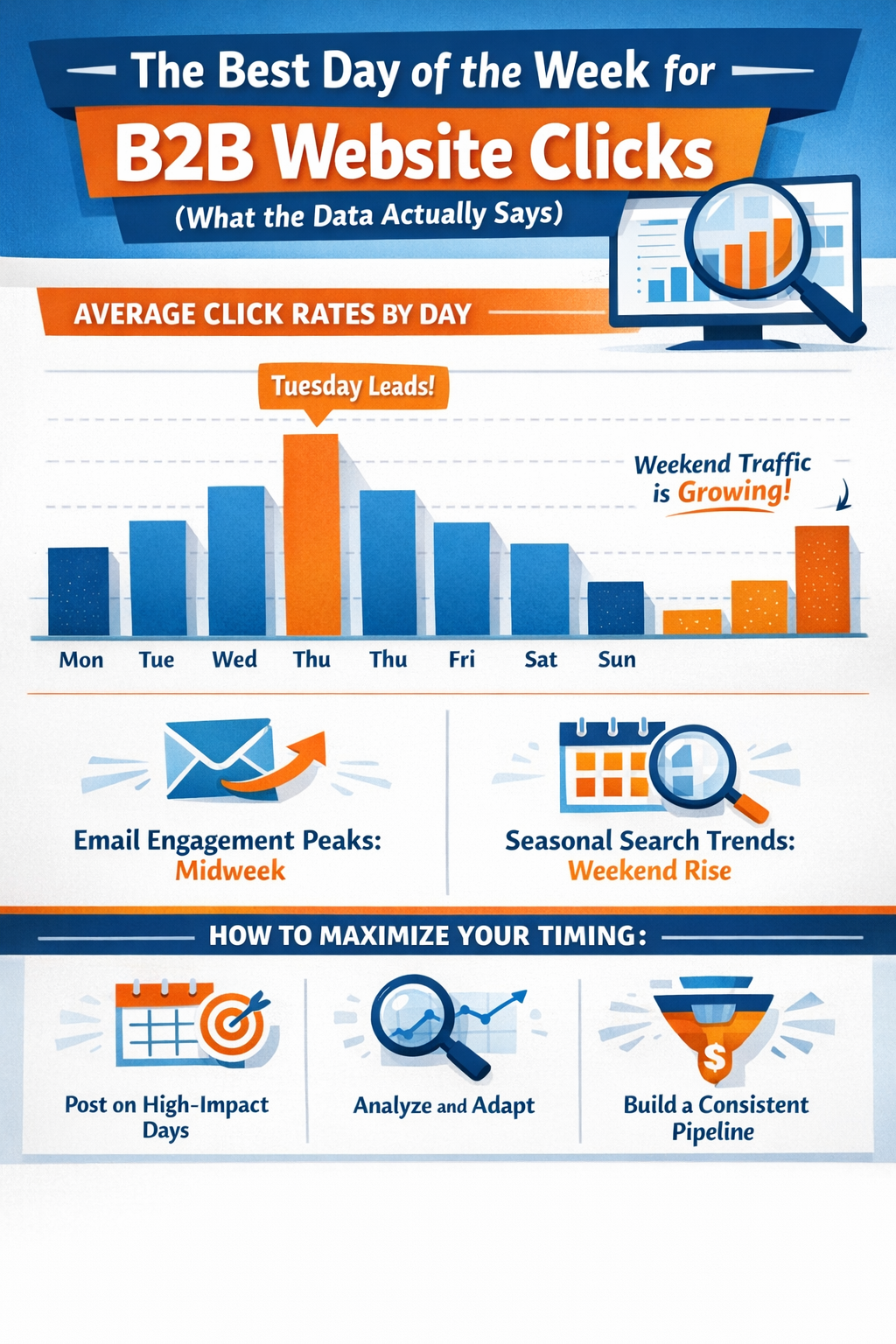
Tuesday and Wednesday consistently generate the biggest click-through and sharing rates for new B2B content, and they're the days when target decision-makers are most active online. Quora Wednesday and Thursday closely follow, creating what analysts describe as a sustained midweek peak. Monday starts high but often lags slightly below Tuesday, as professionals are still catching up on email and internal meetings. Friday afternoon is where B2B engagement falls off noticeably. Quora
The logic behind this pattern isn't complicated — it mirrors the professional workweek rhythm almost exactly. Monday is triage. By Tuesday, the inbox backlog has been cleared, the week's priorities are set, and decision-makers shift from reactive to proactive. They're researching, comparing, evaluating. That's when they're clicking on your content, your service pages, your case studies.
By Thursday, energy begins to dissipate toward week-end closeout. Friday afternoon, for most B2B audiences, is a write-off for anything other than internal wrap-ups and early departures.
Campaign Monitor's industry analysis confirms that Tuesday and Wednesday mornings show consistently higher engagement metrics for B2B communications across the board. Callin This holds not just for website traffic but for email open rates, content downloads, and form completions — the full chain of B2B engagement behavior.
From a pure traffic-volume standpoint, B2B and SaaS websites show strong weekday concentration with minimal weekend traffic, while many publishers report weekday page views running 10 to 30 percent higher than weekend averages. Quora
The practical implication: if you're publishing a blog post, launching a campaign, or sending a key piece of content out the door, Tuesday or Wednesday morning is your primary target. Not because it's a rule — but because that's when the audience you're trying to reach is in the right headspace to engage.
The Time-of-Day Layer: When Within the Day Actually Matters
Day of week is only half of the equation. The other half is what time you hit the inbox or the search results page — and the data here is surprisingly specific.
For B2B email, sending between 9 AM and 11 AM tends to yield higher open and click-through rates. Mondays are often busy with catching up on work, while Fridays are associated with wrapping up the week, making these days less optimal for B2B sends. Salesforce
But there's a counterintuitive wrinkle that more recent data is surfacing. Analysis of over two million email campaigns found that while open rates peak in the morning window of 8 AM to 11 AM — reflecting inbox-clearing behavior — the highest click rates actually fall much later, between 8 PM and 9 PM, suggesting audiences save action-oriented emails for after-hours engagement. MailerLite
What this means in practice: your email may get opened in the morning but acted upon in the evening. That's a critical distinction if you're trying to optimize for clicks specifically versus opens. A professional might scan your subject line at 9:47 AM, flag the email, and come back to click through at 8:30 that night when they're finally off the Zoom treadmill.
Tuesday at 10 AM is widely cited as the single strongest window for B2B email — the peak productivity window for most professionals, with HubSpot's data backing a 47.9% best-results rate for B2B marketers sending mid-morning on Tuesdays. OptinMonster
For web traffic more broadly, the morning window aligns with search behavior. People research solutions during work hours. The mid-morning slot — roughly 9 AM to 11 AM — is when professionals are most likely to be actively evaluating options, reading industry content, and clicking through from search results to vendor sites.
The Weekend Surprise: A Rising Traffic Pattern B2B Teams Are Ignoring
Here's where the data gets genuinely interesting — and where most B2B marketing teams are leaving opportunity on the table.
The traditional assumption is that B2B traffic belongs entirely to the workweek. Decision-makers are at their desks Monday through Friday, and the weekend is dead air. This was largely true. It's becoming less true every year.
A study analyzing 950,000 U.S.-based search queries across key B2B transactional pages found a significant and consistent rise in weekend traffic, particularly in Spring and Summer 2024. Weekend browsing sessions are longer and generating higher conversion rates, with visitors more likely to fill out forms, download resources, and explore deeper into content. Demand Gen Report
Read that again. Weekend sessions are not just more frequent — they're longer and converting at higher rates. The buyer who lands on your site on Saturday morning with a coffee is not skimming. They're evaluating. They have time. They're not context-switching between Slack messages and Zoom calls. They're doing the serious research they couldn't finish during the week.
A DesignRush study tracking B2B search behavior shows weekend visits are up 23%, with higher-intent traffic from Saturday through Sunday, particularly in spring and summer months in the U.S. DesignRush
This is consistent with a broader behavioral shift. The line between "work time" and "personal time" has blurred significantly in the post-pandemic era. Senior decision-makers — the people who actually approve vendor selections and sign off on purchases — are increasingly doing their homework on their own schedule. They're not waiting for Tuesday morning to research a CRM solution or a digital agency partner. They're doing it when they have uninterrupted focus, which increasingly means the weekend.
As the SEO Director at DesignRush put it: while many B2B marketing teams focus heavily on weekdays, the real opportunity lies in leveraging weekend engagement. With decision-makers becoming more active on Saturdays and Sundays, brands can no longer afford to ignore this time frame. Demand Gen Report
What this means practically is that your website experience needs to be optimized for weekend visitors just as much as weekday ones. Forms need to work. Content needs to be accessible. Pricing pages need to be clear. If someone lands on a Saturday afternoon and your site is hard to navigate, you've burned a high-intent visit.
The Buyer Behavior Context: Why Timing Is Only as Good as What You Show Them
Understanding when people click is important. Understanding why they click — and what they're looking for when they do — is what separates a timing strategy from an actual content strategy.
The modern B2B buyer has changed dramatically, and the data paints a striking picture. 74% of B2B buyers now complete at least 57% of their buying journey online before ever talking to a sales rep. Philomath Research Your website isn't a brochure that leads to a sales call — it is the sales process for the majority of the journey.
According to 6Sense's 2025 buyer experience report, in 95% of cases, the winning vendor is already on the buyer's shortlist by Day One of the buying process — and four out of five deals are won by the vendor the buyer was already leaning toward before they ever made contact. 6sense
This has a profound implication for timing strategy. The click that matters most isn't necessarily the one that comes right before a conversion. It's the early click — the one where a decision-maker first lands on your content, reads something genuinely useful, and adds your brand to their mental shortlist. That click might happen on a Tuesday at 10 AM. It might happen on a Saturday morning. What matters is that your content was there, was good, and was easy to find.
Buyers still mostly or fully define their purchase requirements 83% of the time before speaking with sales Corporate Visions — which reinforces that every piece of content you publish is doing selling work whether or not you think of it that way. A blog post. A case study. A service page. These are not supporting assets. They are the primary sales channel for most of the buying journey.
On the content format side: 51% of B2B buyers take action when content includes data and research to support its claims. Orengreenberg That's not a small number. If you want your content to drive clicks and engagement, the single highest-leverage thing you can do is make it data-backed and specific — which is exactly what this post is attempting to do.
The Seasonal Layer: Not Just What Day, But What Time of Year
Day of week and time of day are the tactical variables. But there's a strategic layer underneath them that most B2B marketing calendars don't account for well: the seasonal rhythm of B2B search intent.
An analysis of U.S. search volumes across 27 B2B service categories spanning January 2023 through mid-2025 found that Q1 is the clear decision-making epicenter for B2B search — this aligns with budget releases and fresh scopes at the start of the year. Teams that have campaigns, pricing updates, and outreach ready before January are the ones that capture early attention while competitors are still planning. DesignRush
Q1 is when budgets are freshly approved, annual plans have been set, and decision-makers are actively looking for the vendors and tools that will help them execute. If your content and campaigns aren't in market before January, you're playing catch-up while your competitors are closing deals.
But Q1 isn't the only wave. The data also identifies a second significant wave of B2B intent that builds from May through August — a late-spring and summer surge that many marketing teams miss entirely because they slow down content production after the Q1 push. DesignRush
Eight B2B categories consistently hit their peak search volume in December, showing that year-end activity is far from quiet. This is when many teams lock in budgets, approve vendors, and prepare migrations that go live in January — making it the right time to offer clear proposals, renewal incentives, and "approve now, launch in January" positioning. DesignRush
The takeaway: think in waves, not in uniform weeks. Your highest-priority content pushes should align with Q1 (January–March), the late-summer surge (June–August), and the year-end decision window (late November–December). Everything in between should be consistent maintenance publishing, not silence.
The Email Amplification Factor: Driving Traffic at the Right Moment
Organic search drives the majority of B2B web traffic — 76% of all traffic to B2B websites comes from search engines, with organic search accounting for the lion's share of that. SeoProfy But email is the amplification engine that determines when people actually arrive.
You can publish a blog post and wait for it to rank. Or you can publish it and send it to your list at the optimal time. The latter gets you faster engagement signals, faster sharing, and faster returns.
Cold emails sent at the right time can boost open rates by up to 30% compared to poorly timed sends, with Tuesday through Thursday between 9–11 AM or 1–3 PM proving the most effective windows for B2B outreach. Martal Group
For your own subscriber list, the window is similar but with an important nuance: for B2B specifically, emails sent on Mondays and Tuesdays generate the most opens, with engagement dropping sharply after Tuesday. The click-through pattern almost exactly traces the open-rate trend line. Brevo
There's also an emerging evening engagement pattern worth paying attention to. The peak click rate for the entire week, across all industries, belongs to Monday at 9 PM, followed closely by Tuesday at 9 PM and Sunday at 8 PM — suggesting that audiences reserve their highest-engagement behavior for the end of the day. MailerLite This doesn't necessarily mean you should send at 9 PM, but it does suggest that content that lands in the inbox Tuesday morning may get its most meaningful engagement that evening.
The practical play: send your best content emails on Tuesday or Wednesday morning, accept that the real engagement may happen several hours later, and make sure your emails are optimized for mobile reading since that after-hours engagement is almost certainly happening on a phone.
What to Actually Do With All of This
Here's what the data, taken together, points toward. Not rules — but clear directional guidance that any B2B company can start using immediately.
Publish and distribute your best content on Tuesday or Wednesday mornings. This is the consistent cross-channel signal. It's the moment when professionals are most focused, most likely to be in research mode, and most likely to click through from email or social to your website.
Don't ignore the weekend. Keep your website experience tight and your CTAs visible seven days a week. The visitors who arrive on Saturday are doing high-intent research. Weekend browsing sessions are longer and converting at higher rates than weekday sessions for B2B transactional pages Demand Gen Report — that's not a signal you can afford to wave off.
Build your content calendar around seasonal waves, not uniform weeks. Front-load your most important campaigns into Q1. Prepare a second surge for late spring and summer. And don't go quiet in December — that's when budgets get locked in.
Make your content data-driven and specific. Over half of B2B buyers take action when content is backed by research. The blog posts that generate clicks are the ones that treat the reader like an intelligent professional, not a consumer to be entertained.
Think about the full-day engagement arc. Morning sends get opens. Evening windows get clicks. Design your email content with both in mind — a compelling subject line that gets the morning open, and content rich enough to earn the late-night click-through.
Audit your own data. Every benchmark here is an industry average. Your specific audience may peak on Thursday. Your vertical may skew toward weekend research heavily. Industry analytics reports consistently recommend creating a day-of-week report in GA4 over a representative three-to-twelve month period to reveal the actionable patterns specific to your audience rather than relying on global averages. Quora These benchmarks give you a smart starting point. Your own analytics give you the actual answer.
The Bottom Line
The best day of the week for B2B clicks is Tuesday — with Wednesday and Thursday close behind. Morning hours, especially 9 AM to 11 AM, drive the most consistent engagement. But the most important shift the data is signaling right now is the rise of high-intent weekend traffic: buyers doing serious research on their own time, outside office hours, with longer sessions and higher conversion rates than most B2B teams expect.
The brands winning the traffic game aren't just publishing more. They're publishing smarter — at the right moments in the week, the right phases of the year, with the right content backing it up. They're showing up in the Tuesday morning inbox and on the Saturday morning search results page. They're present wherever their buyers are doing their homework.
Companies publishing more than nine blog posts per month increased Google traffic year-over-year by 35.8%, compared to just 16.5% for those publishing one to four times per month. SeoProfy Frequency matters. But frequency without timing strategy is just noise. The combination — consistent, data-backed, well-timed content — is what compounds into real pipeline.
Ready to stop guessing and start publishing with a strategy behind it?
Ritner Digital helps B2B companies build content and digital marketing plans grounded in actual data — not generic advice. We dig into your analytics, your audience behavior, and your competitive landscape to identify the windows where your brand needs to show up and what it needs to say when it gets there.
If you're tired of publishing into the void and want a clearer picture of when, what, and how to reach your buyers — let's talk.
Schedule a free strategy call with Ritner Digital →
Sources: DesignRush B2B Traffic Study (2024), 6Sense B2B Buyer Experience Report (2025), MailerLite Email Data Analysis (2025–2026), Campaign Monitor Industry Analysis, Salesforce Email Timing Guide, Philomath Research B2B Buyer Survey (2024), Demand Gen Report, BrightEdge Organic Search Data, HubSpot B2B Marketing Benchmarks.
Frequently Asked Questions
Is Tuesday really the best day for B2B website traffic, or is that just a myth that keeps getting repeated?
It's not a myth, but it's also not the whole story. Tuesday consistently shows up across multiple independent data sets — email open rates, web traffic analysis, cold outreach benchmarks, and content engagement studies — as the single strongest day for B2B engagement. The reason it keeps getting repeated is because the data keeps confirming it. That said, Wednesday and Thursday are close enough behind that the real answer is "Tuesday through Thursday is your window," with Tuesday being the sharpest peak. Where it becomes oversimplified is when people treat Tuesday as a magic button without accounting for time of day, industry, seasonality, or their own audience's specific behavior.
What time of day should we actually be publishing and sending content on those peak days?
For email, the morning window of 9 AM to 11 AM is your best bet for getting opened. However, the data on when people actually click is different — click-through rates tend to peak in the evening, between 8 PM and 9 PM, suggesting professionals open emails during the workday and come back to engage with the content after hours. The practical move is to send your email Tuesday or Wednesday morning so it gets seen early, but make sure the content itself is compelling enough to earn a return visit later that evening. For content publishing and social promotion, mid-morning aligns with when decision-makers are most actively in research mode.
We're a small B2B team. If we can only publish once a week, which day should we pick?
Tuesday. If you can only fire one shot per week, Tuesday morning is where you aim. Publish the post, send the email to your list, and share it across your channels all on the same day. The compounding effect of hitting email, social, and organic on the same high-engagement day outperforms spreading those actions across the week. As your publishing cadence grows, layer in Wednesday or Thursday as secondary distribution days for different content formats.
Should we bother making our website or content available on weekends if B2B traffic is mostly during the week?
Absolutely yes — and this is one of the most important things the recent data is telling us. Weekend B2B traffic is growing significantly. Research tracking nearly a million B2B search queries found that weekend visitors stay longer on site and convert at higher rates than weekday visitors. These are decision-makers doing serious, uninterrupted research when they're not stuck in meetings. Your website doesn't get to take Saturday off. What this means practically is that your forms need to work, your pages need to load fast, your CTAs need to be clear, and your content needs to be accessible on mobile — because weekend research is largely happening on phones and tablets away from a desk.
Does the best day change depending on our industry or what we're selling?
Yes, and this is where you should be spending real time in your own analytics. The benchmarks in the blog post are industry averages across broad B2B categories. Your specific audience may behave differently. A cybersecurity company targeting IT directors may see peak engagement on Monday mornings when those professionals are reviewing weekend alerts and setting the week's priorities. A professional services firm targeting CFOs may see stronger engagement mid-morning Thursday before the weekend planning begins. The Tuesday-Wednesday benchmark is your starting point — your GA4 data is your actual answer. Build a day-of-week report in Google Analytics, pull at least six months of data, segment by channel, and find your real peak.
What about LinkedIn? Does the best day for B2B social engagement match the website traffic data?
Largely yes. LinkedIn organic reach tends to peak Tuesday through Thursday, which aligns with the broader B2B workweek engagement pattern. Tuesday and Wednesday morning posts consistently outperform Friday or Monday posts in terms of impressions and engagement on the platform. The exception worth noting is that LinkedIn's algorithm rewards early engagement — meaning the first hour or two after posting matters a lot. A post published at 7:30 AM Tuesday that gets ten comments by 9 AM will dramatically outperform the same post published at 2 PM. So the answer isn't just Tuesday — it's early Tuesday.
We've heard Q1 is important for B2B. How should that affect our content timing strategy?
Q1 is the single most important content window in the B2B calendar. Budgets have just been approved. Annual plans have been set. Decision-makers are actively looking for the vendors, tools, and partners that will help them execute on their goals. Research across 27 B2B service categories consistently shows Q1 as the peak search intent period. What that means for your strategy is that your best content — your most authoritative pieces, your strongest case studies, your clearest service positioning — needs to be live and promoted before January. If you're planning to write that flagship piece in February, you're already behind. The brands that win Q1 traffic are the ones who published in November and December and are already ranking when buyers start searching in January.
Is there really a second traffic surge in the summer, and should we be adjusting our content calendar for it?
Yes, and most B2B marketing teams miss it entirely. The data shows a second meaningful wave of B2B search intent building from May through August. Content marketing, SEO services, cybersecurity, and IT categories all show significant search volume peaks in this summer window. The likely reason is mid-year budget reviews, half-year planning sessions, and companies that didn't finalize vendor decisions in Q1 coming back to the market. If your content calendar goes quiet after March, you're abandoning buyers who are actively searching in June and July. Maintain consistent publishing cadence through the summer and plan a secondary content push around May to catch this wave.
How many blog posts per month should we actually be publishing to see a real traffic impact?
The data on this is pretty clear and worth taking seriously. Companies publishing more than nine blog posts per month see Google traffic grow at more than double the rate of companies publishing just one to four posts per month — 35.8% year-over-year growth versus 16.5%. The step-change in results really kicks in around nine or more posts. That said, one excellent, data-backed, well-promoted post per week will outperform four thin, generic posts. Quality and frequency both matter, but frequency without quality just creates noise. Start by committing to one genuinely useful post per week, build the distribution habit around it, and scale from there.
What's the single most important thing we can do right now to improve our B2B click performance?
Pull your Google Analytics day-of-week report for the last six months, find your actual traffic peak, and align your publishing and email schedule to that day. Most B2B companies have never done this. They publish when the content is ready, send emails when someone remembers to, and wonder why engagement is inconsistent. The baseline fix — publishing on your audience's actual peak engagement day and sending email that same morning — costs nothing and usually produces an immediate, measurable lift. After that, audit your weekend experience: is your site optimized for the high-intent visitors arriving Saturday and Sunday? Those two changes alone put you ahead of most of your competitors.