The Credit Union CMO's Guide to AI Search Optimization in 2026
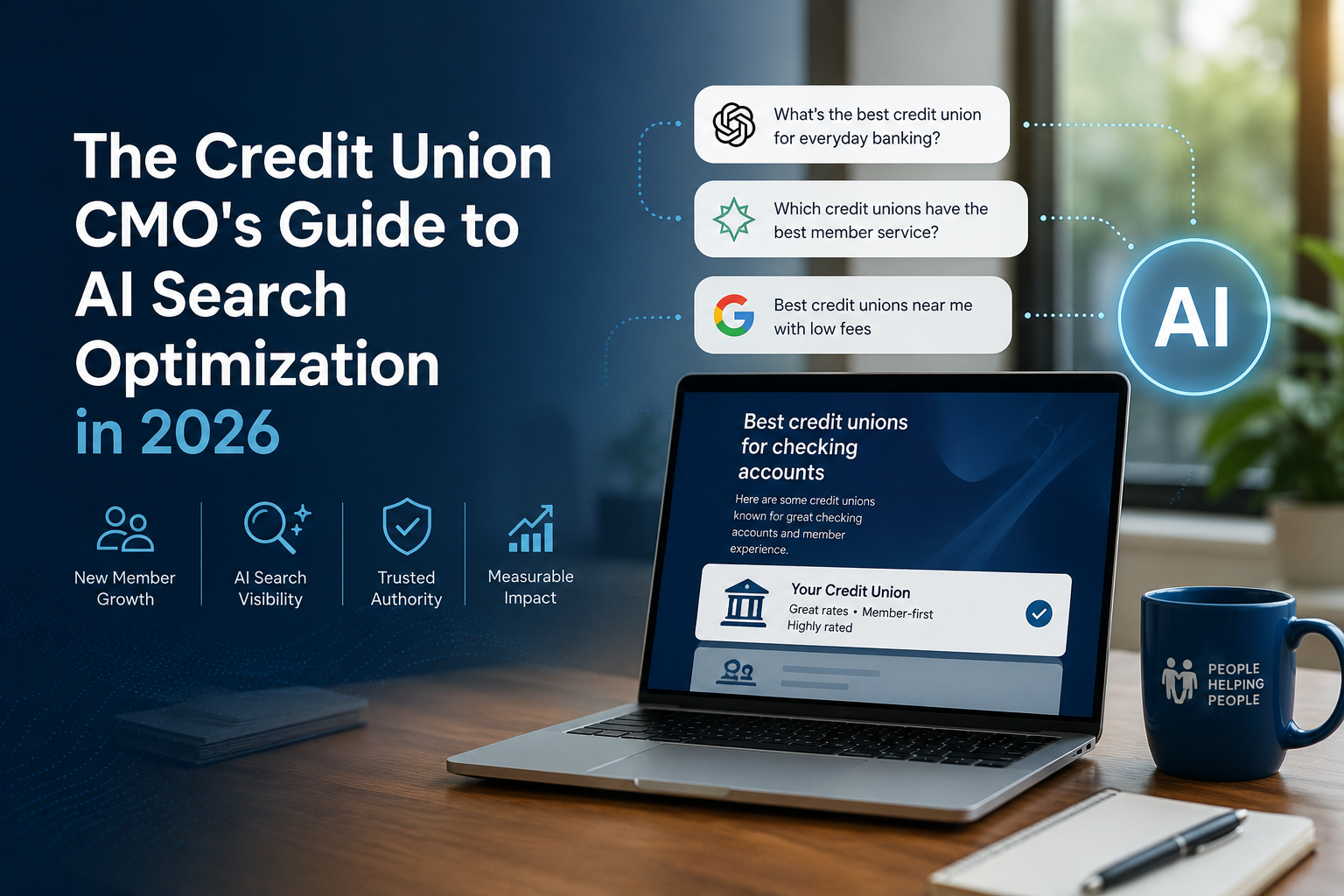
The Playbook Just Changed
You know the pressure. 62% of credit union executives ranked new member growth among their top three concerns in 2025, up from 41% in 2022 — a 51% increase over just three years. Boards are asking harder questions. Budgets are being scrutinized line by line. And the competitive landscape has shifted in ways that make the old playbook feel increasingly inadequate. The Financial Brand
Member growth expectations are climbing, marketing budgets face constant scrutiny, and the competitive set now includes not just the credit union across town but fintechs and megabanks spending billions on digital personalization. The old playbook of broad-reach campaigns, demographic targeting, and quarterly email blasts can't keep up. And most CMOs already sense that. RC Strategies
Here's what's different in 2026: the place where your next member first encounters your credit union has shifted. Not partially. Fundamentally. Prospective members are now asking ChatGPT, Google's AI Overview, Perplexity, and Gemini for financial guidance before they ever visit a website, call a branch, or click an ad. And the institutions showing up in those AI-generated answers — consistently, accurately, locally — are the ones capturing that first impression and the trust that comes with it.
We are moving from an era of multi-click "Discovery Engines" to an era of zero-click "Answer Engines," where Large Language Models and Google's AI Overviews provide immediate, synthesized responses. To win in this new era, credit union marketing teams must be intentional about Answer Engine Optimization, while also understanding how and why human-led strategies and human-generated content will give them the upper hand. Pixelspoke
This guide is written specifically for credit union CMOs navigating the AI search transition. Not as a technical deep-dive for developers, but as a strategic framework for marketing leaders who need to understand what has changed, what it means for their institution's growth, and how to build a credible AI search strategy with the team and budget they actually have.
Why AI Search Is a CMO-Level Priority, Not an SEO Footnote
The instinct at many credit unions is to treat AI search optimization as an extension of SEO — something to hand off to the web team or digital agency and check off as part of the quarterly content calendar. That instinct is understandable and wrong.
AI search isn't an SEO tactic. It's a member acquisition channel — and it's operating at the top of your funnel in ways that traditional SEO never did.
Nearly 60% of those polled by JD Power in late 2025 said they occasionally use AI for banking and financial services, and 13% said they do so every day. In a global study, Cognizant gave banking and financial products a score of 90 out of 100 measuring consumer willingness to use AI to learn more about them. The Financial Brand
Younger members are increasingly bypassing traditional search engines in favor of AI chatbots like ChatGPT and Claude. "I constantly throughout the day, if I have a question or there's something I want to know more about, especially finance products, I'll use ChatGPT to get a great broad overview," one financial services professional explained. "It helps you really get into the deeper nuances and answer specific questions in a carefree environment where you don't have to worry about looking uninformed." Yourmarketing
The demographic implications for credit unions are significant. The members you most need to attract — younger adults forming financial habits, first-time home buyers, young professionals opening their first investment accounts — are the heaviest AI search users. If your credit union isn't appearing in the AI answers they're getting, you're invisible at the exact moment they're most open to choosing a financial institution.
Enterprises are allocating an average of 12% of their digital budgets to AEO in 2025 and 2026. Visitors who come from LLMs convert at twice the rate in one-third the number of sessions compared to traditional channels, validating AI visibility as a critical new performance channel. If you aren't investing in AEO now, you're already behind, and the window for catching up is closing fast. Conductor
For a credit union CMO, the strategic framing is this: AI search is where your top-of-funnel is moving. Your marketing strategy needs to follow it.
The State of Credit Union AI Visibility Today — And Why It's Mostly a Gap
Before building a strategy, you need an honest baseline. And the honest baseline for most credit unions right now is: poor AI visibility, significant competitive gap, and a real but closing window to fix it.
What we're seeing at too many credit unions: websites built like digital brochures — product pages with no context, no FAQs, no member education content. These sites rank poorly in traditional search and are nearly invisible to AI assistants. If your website can't answer a prospect's question clearly, it won't be cited when AI does. Your Marketing Co
Profound's 2025 AI visibility data shows that Bank of America leads banking mentions with 32.2% visibility across AI platforms. But smaller financial brands have new opportunities to gain share of voice. Navy Federal Credit Union achieved disproportionate representation in LLM answers, achieving consumer consideration where they may have previously struggled to get the same share of voice through traditional marketing. Amsive
That Navy Federal data point is the strategic signal every community credit union CMO should internalize. Navy Federal isn't winning on budget — they're winning on content infrastructure. They have the structured, authoritative, locally and product-specific content that AI systems can parse and cite. Community credit unions that build that same infrastructure in their own markets can achieve the same disproportionate representation — at a fraction of the national scale.
Companies that delay AEO implementation face increasingly expensive catch-up requirements. Competitors are establishing authoritative positions in AI training data and real-time search results, making it harder and more costly for late adopters to gain meaningful visibility. Amsive
The window to establish AI citation authority before your regional competitors do is open in 2026. It will not stay open indefinitely. This is the first-mover advantage your board rarely gets to hear about in a marketing context — and it's real.
Understanding AEO: What Credit Union CMOs Actually Need to Know
You'll encounter several overlapping terms in conversations about AI search optimization — AEO, GEO, LLMO, AI SEO. For practical purposes as a CMO, they all describe the same strategic objective.
Answer engine optimization helps brands get cited by ChatGPT, Google AI, and Perplexity when there's only one answer. AEO is an expansion of SEO, not a replacement. Instead of trying to rank for specific keywords and drive clicks to a website, AEO focuses on writing clear, helpful answers that AI tools can easily find and synthesize into their responses. Amsive
In traditional SEO, the goal is to rank. In AEO, the goal is to be cited. Those are not the same thing. When someone types "mortgage rates" into Google, they receive a page of results. When someone asks ChatGPT "What's the best mortgage rate for a first-time buyer in my area?", they get a direct answer, often from a single source. The AI is doing the selection work that users previously did themselves. The Financial Brand
The reason this matters strategically for credit unions is that AI-generated answers create a very small citation set. Unlike Google, which shows ten results on page one, an AI answer typically cites two to four sources — or names one or two institutions directly. Either you're in that set, or you're not in the conversation at all.
Visibility does not always require a click, and in many ways, vanity metrics like traffic volume have never been as important as traffic quality. Instead of obsessing over session counts, look at brand mentions and citations: if an AI overview says "According to [Your Credit Union], the average credit score in your region is..." that is a massive win for brand trust and authority. A member who sees your helpful answer in an AI overview is more likely to search for your brand specifically when they are ready to apply for a loan. Pixelspoke
The Four Pillars of Credit Union AI Search Optimization
A credit union CMO doesn't need to understand the technical architecture of RAG retrieval systems. You do need to understand the four strategic levers your team controls that determine whether your institution gets cited.
Pillar 1: Content That AI Can Extract and Trust
The most important thing your content team can change is the structural format of your financial education content. AI systems don't read pages the way humans do — they extract self-contained answer units. Content that doesn't lead with its conclusion, that buries answers in paragraphs of context, or that is written primarily in promotional language doesn't get cited.
Financial literacy content is one of the most powerful AEO tools in your marketing toolkit. Members and prospects are searching for answers to questions like "How much house can I afford?", "Should I refinance my auto loan?", and "What's the difference between a credit union and a bank?" Create comprehensive, interlinked resource hubs around these topics. Structure content with clear headings, concise answer blocks at the top of each page — 40 to 60 words that directly answer the question — and supporting depth below. This format serves both traditional search engines and AI answer platforms, positioning your credit union as the go-to authority on financial topics in your market. Your Marketing Co
FAQs are one of the most natural vehicles for citable content chunks, but many institutions are not using them to their full advantage. The biggest AEO opportunities are found in product and service questions. It helps to think about how people interact with different tools. A traditional search query might be "best CD rates." An AI prompt might sound more conversational: "What CD rate should I expect from a credit union right now, and how does that compare to a big bank?" FAQs written to match real questions can meet the needs of both types of search query. The Financial Brand
For a CMO, the content investment priority is clear: financial education content structured as genuine answers to real member questions, organized into topic clusters around your key product categories, and maintained with current data on a regular refresh cadence.
Pillar 2: Technical Infrastructure That Enables AI Access
Your content team can produce excellent, well-structured educational content — and it can still be invisible to AI if the technical foundation isn't in place. The CMO doesn't need to implement this personally, but you do need to ensure it's being done.
The non-negotiables:
AI crawlers must be allowed access in your robots.txt file. PerplexityBot, GPTBot, ClaudeBot, and Google-Extended must be explicitly permitted. Many credit union websites using security WAF configurations inadvertently block these crawlers entirely, with no visibility into the problem.
Schema markup must be implemented systematically. FAQPage schema on every product and resource page with question-and-answer content. Article schema with accurate update dates on every educational piece. Organization and LocalBusiness schema establishing your institutional identity and branch network. HowTo schema on any page walking through a financial process.
Key product information must be in static HTML, not PDFs or JavaScript-rendered tables. If your loan rates, product terms, and eligibility criteria live in PDFs or dynamic tables, AI systems may never see them.
Structure content around the real questions your members ask — rates, eligibility, loan types, branch access. Add schema markup. Build resource hubs that establish genuine topical authority. The traffic you lose in volume you'll gain back in intent. Your Marketing Co
Pillar 3: Local Authority That Wins the Queries That Matter Most
For community credit unions, local AI search is where the competitive opportunity is most accessible and most underbuilt. When a prospective member in your community asks AI for the best credit union for an auto loan in your city, the answer is determined by local content relevance and local authority signals.
When members ask ChatGPT, Gemini, or Google's AI Overview for "the best credit unions near me," these engines don't just scan web pages — they extract verified entities, structured data, and localized context to form their answers. That's where GEO and AEO come in. Together, they ensure your credit union's website and local presence are machine-readable, entity-verified, and human-trusted — so your name shows up in both search results and AI-generated summaries. Matchboxdesigngroup
The local authority signals that matter for AI citation are: a fully optimized and actively managed Google Business Profile with current reviews; locally specific content that explicitly names your communities, counties, and service areas; branch-level LocalBusiness schema; and consistent name, address, and phone data across every directory listing. These are not exotic AI tactics — they are local digital marketing basics, applied with the specific understanding that AI systems read them as authority signals for local financial queries.
Instead of a general article on "How to Buy a Home," consider a guide specifically on "First-Time Homebuyer Programs in [Your County]." Highlight local business members, share economic updates relevant to your region, and align your marketing calendar with community events. When prospective members see that you understand their specific environment and challenges, you transition from being just another bank to being a local partner. Flexcutech
Pillar 4: Third-Party Authority That AI Systems Trust
Your website content, no matter how well structured, represents only a fraction of what AI systems use to decide whether to cite your institution. The off-site signals — what other credible sources say about you — are at least as important.
Answer engine optimization means structuring your website content with clear Q&A formats, implementing robust schema markup, building topical authority through comprehensive resource hubs, and keeping your business listings consistent across platforms. The credit unions that invest in AEO today will capture the audience that everyone else is losing. Your Marketing Co
For credit union CMOs, off-site authority building means actively managing your presence in the places AI trusts: member review generation on Google and Facebook; pursuit of local media mentions and community organization citations; financial comparison site representation where products can be accurately listed; and engagement with trade publications like The Financial Brand, CUInsight, and America's Credit Unions, which are among the sources AI systems reference when building financial service answers.
The Human Advantage: What No AI Can Replicate for Your Institution
Here's where credit union CMOs have an advantage that big banks and fintechs genuinely cannot buy: authentic local expertise and real community relationships.
What are your members and prospects actually searching for? Is there an answer you can provide that will be more relevant than the answers megabanks and other larger players are already offering? Talk to your frontline staff; understand the actual pain points. Focus first and foremost on questions that you're uniquely equipped to answer based on your local expertise and community roots. Pixelspoke
This is not just a strategic nicety — it's a genuine structural advantage in AI citation. AI systems favor content that provides locally specific, uniquely informative answers that cannot be found elsewhere. Your loan officers know the specific housing market challenges in your service area. Your branch managers understand the small business lending questions that come up repeatedly in your community. Your financial counselors hear the same member concerns week after week.
That institutional knowledge, translated into well-structured, specifically local content, is something no national brand can replicate for your market. A Wells Fargo product page cannot tell prospective first-time buyers about the specific down payment assistance programs available in your county. Your credit union can — and when you do, in a format AI can parse and cite, you become the locally authoritative source for those queries.
People helping people is still an important differentiator, perhaps even more important than in the pre-AI era. By structuring your site so machines can easily find your answers, you satisfy the technical requirements of AEO. But by ensuring those answers are addressing questions that humans are actually asking, are informed by community expertise, and are consistent with the brand voice that differentiates your credit union, you won't just survive the AI revolution — you can come out on top. Pixelspoke
Building the Internal Case: Talking to Your Board About AI Search
One of the most practically important challenges for credit union CMOs in 2026 is making the internal case for AI search investment. Boards and executive teams that grew up on direct mail ROI and website traffic reports don't naturally gravitate toward metrics like "AI citation rate" and "branded search volume."
Here's the framing that connects AI search investment to outcomes your leadership already cares about.
Member acquisition cost. AI-referred visitors convert at significantly higher rates than traditional organic search visitors — because they arrive already informed, already past the general awareness stage, and actively evaluating institutions rather than casually browsing. A smaller number of higher-quality visitors from AI citations produces better acquisition economics than the same budget spent on broad-reach campaigns generating lower-intent traffic.
Competitive positioning. Credit unions must transform their go-to-market strategy in 2026 by unifying teams, leveraging AI personalization, and expanding digital products to meet member expectations and drive sustainable growth. AI search isn't an experiment your competitors are watching — it's a channel that early movers are already building citation authority in, and that late movers will find expensive to close. RC Strategies
Branded search lift. The clearest measurable outcome of AI citation investment is growth in branded search volume — people searching your credit union's name directly. When AI cites your institution in a financial answer, prospects who weren't ready to act immediately remember your name. When they're ready to act, they search you specifically. Branded search volume growth is visible in Google Search Console and tells a clear story about whether your AI visibility is building real brand awareness.
Consolidation opportunity. The number of federally insured credit unions fell from 4,455 to 4,287 in 2025 — a loss of 168 institutions in a single year. When a competitor merges or closes branches in your field of membership, there's a brief window — typically 60 to 90 days — where displaced members are actively evaluating options. That window requires a playbook you need to build before the opportunity arises, not after. AI search visibility is part of that playbook — displaced members asking AI which credit union to join should be finding your institution. Your Marketing Co
The CMO's Priority Action List for 2026
Given budget realities and team capacity constraints, most credit union CMOs need a sequenced, prioritized action plan rather than a comprehensive ideal-state blueprint. Here is the sequence that delivers the most impact in the least time with the lowest disruption to existing workflows.
First 30 days — Audit and baseline. Run your ten most important member acquisition queries through ChatGPT, Perplexity, Google AI Mode, and Gemini. Document what appears, what's accurate, what's missing, and where competitors appear instead of you. Check your robots.txt for AI crawler access. Review whether your product pages have FAQPage schema. This audit takes two to four hours and gives you the baseline your entire strategy builds from.
Days 31 to 60 — Quick technical wins. Allow AI crawlers in robots.txt if blocked. Implement FAQPage schema on your five highest-traffic product pages. Add Article schema with accurate dateModified to your top blog posts. Ensure your Google Business Profile is fully completed with current reviews and services listed. These are technical changes that don't require new content and that pay immediate dividends in AI crawlability.
Days 61 to 90 — Content restructuring. Audit your top product and educational pages for answer-first formatting. Rewrite opening sentences of product pages to lead with specific, accurate product details rather than brand language. Add FAQ sections with five to eight questions per page, written in natural member language. Update any pages with rates or terms that have changed since last update.
Quarter 2 — Local content investment. Identify five to ten locally specific content gaps — queries about your market that your institution is uniquely positioned to answer but doesn't currently have content for. Commission those pieces with clear answer-first formatting requirements. First-time homebuyer programs in your county. Small business lending landscape in your service area. Local economic context for major financial decisions.
Quarter 3 and beyond — Measurement infrastructure and scaling. Build a regular AI citation monitoring cadence into your marketing reporting. Track branded search volume in Google Search Console as your primary leading indicator of AI visibility impact. Expand content production to cover more local and product-specific queries. Begin building systematic review generation processes if not already in place.
What Success Looks Like in 12 Months
Managing expectations is a legitimate CMO function. AI search optimization is not a campaign that produces a result in 30 days and gets measured in a single report. It is a compounding asset that builds over time — and the measurement framework needs to reflect that.
In the first 90 days, you should expect: improved technical crawlability, initial schema implementation, and a clearer picture of your AI visibility baseline compared to competitors.
At six months, you should expect: measurable improvement in AI citation rate for your targeted local queries, first signs of branded search volume growth, and higher-quality organic traffic from the remaining clicks that AI search generates.
At 12 months, you should expect: consistent citation authority for your key local financial queries, clear branded search lift attributable to AI visibility, and a content infrastructure that compounds in value as AI search continues to grow.
With AI referral traffic growing at 1% month-over-month, AI visitors converting at 4.4 times the rate of organic traffic, and nearly 55% of Google searches now featuring AI Overviews, the window to build an AEO advantage is open now. The 70/20 adoption gap means early movers capture disproportionate citation share. Frase
For a credit union CMO, the relevant framing for 2026 is this: the institutions that begin this work now are building a competitive position in AI search that will be increasingly difficult for competitors to displace. The ones waiting for clearer proof points or better budget conditions are watching that window close.
The Competitive Reality Is Simple
The competitive gap between credit unions running sophisticated digital marketing and those still sending batch-and-blast emails is wider than it's ever been. AI search is the next front in that gap. Your Marketing Co
Your prospective members are already asking AI for financial guidance. They're asking which credit union has the best auto loan rates in your city. They're asking what they need to qualify for a first mortgage. They're asking whether a credit union is better than a bank for a small business account. And the institutions whose content, authority signals, and local presence have been built for AI readability are the ones appearing in those answers — and being considered — while the others aren't.
The Profound data shows that brands like Navy Federal Credit Union can be disproportionately represented in LLM answers, achieving consumer consideration where they may have previously struggled to get the same share of voice through traditional marketing and advertising. Amsive
Your credit union has the community roots, the local expertise, and the member relationships that AI systems reward when they're made legible to machines. The question is whether your marketing strategy is going to make those strengths visible where your next members are looking for them.
Ready to Build Your Credit Union's AI Search Strategy?
At Ritner Digital, we work specifically with credit unions to build AI search visibility — from AEO audits and content strategy to schema implementation, local authority building, and AI citation monitoring. We understand the credit union marketing environment: the budget constraints, the compliance context, the board expectations, and the community mission that makes this work meaningful.
Let's start with an AI visibility audit for your institution — and build the strategy from what we actually find.
👉🏼 Talk to the Ritner Digital team today
Frequently Asked Questions
What is AI search optimization and why does it matter for credit union CMOs in 2026?
AI search optimization — also called Answer Engine Optimization (AEO) or Generative Engine Optimization (GEO) — is the practice of structuring your credit union's content and digital presence so that AI systems like ChatGPT, Perplexity, Google AI Overviews, and Gemini cite your institution when answering member questions about financial products. It matters for CMOs because it represents the top of your acquisition funnel shifting to a new platform. Prospective members — especially younger adults — are increasingly using AI assistants as their first step when evaluating financial institutions. If your credit union isn't appearing in those AI-generated answers, you're absent from the most influential moment in the discovery journey, before prospects ever reach your website or your ads.
How is AEO different from the SEO my team is already doing?
Traditional SEO optimizes your pages to rank in a list of search results and earn a click. AEO optimizes your content to be extracted and cited inside an AI-generated answer — a fundamentally different outcome. SEO works at the page level through keywords, backlinks, and technical signals. AEO works at the passage level through answer-first content formatting, schema markup, and cross-platform authority signals. The good news is that a strong SEO foundation helps significantly with AEO — they share common requirements like technical crawlability, content quality, and domain authority. But you can rank #1 on Google for a query and still be completely absent from AI's answer to the same query. Both strategies need to be running, and they need to be built to complement each other.
What's the most important first step a credit union CMO should take?
Run an honest AI visibility audit — manually test your institution's name and your top ten member acquisition queries across ChatGPT, Perplexity, Google AI Mode, and Gemini. Document what appears, what's accurate, what's wrong or outdated, and where competitors are appearing instead of you. This baseline takes a few hours and tells you exactly where your gaps are. Without it, you're investing in a strategy without knowing your starting position. Most credit unions that do this audit for the first time discover their institution isn't appearing in the majority of local financial queries — which is simultaneously sobering and validating of the urgency to act.
How do I justify AI search investment to my board?
Frame it in the member acquisition outcomes your board already understands. AI-referred traffic converts at significantly higher rates than traditional organic traffic because these visitors arrive informed and past the general awareness stage — lower cost-per-acquisition for higher-intent prospects. Connect AI visibility to branded search volume growth, which is the downstream effect of AI citations building brand recall in prospective members who aren't yet ready to act. And make the competitive argument: the first credit unions in your market to establish AI citation authority will be increasingly difficult for competitors to displace — this is a first-mover advantage that is available right now and won't be available indefinitely. Frame the cost of inaction as the relevant risk, not just the investment required to act.
How much content does my credit union need to produce for AI search?
You don't necessarily need more content — you likely need better-structured content. The most effective first move is restructuring your existing product pages and educational content for AI readability: answer-first openings, question-based headings, FAQ sections with FAQPage schema, and regular freshness updates. New locally specific content — guides tailored to your specific communities, markets, and member questions that no national brand can answer — is the highest-value new investment, but it doesn't require high volume. Five to ten well-structured, locally specific, thoroughly answer-formatted pieces can dramatically improve AI visibility for targeted local queries. Quality, specificity, and structure matter far more than volume.
How long does it take to see results from an AI search strategy?
Technical improvements — crawler access, schema markup, FAQ additions — can begin showing results within weeks as AI systems re-crawl and re-index your content. Content-driven improvements — restructuring existing pages, publishing new locally specific guides — typically produce measurable AI citation improvements within one to three months of publication. The more competitive the query (broad national financial terms), the longer the timeline. The more specific and local the query (your institution name, your specific city, your specific product categories), the faster results typically appear. The most reliable leading indicator to track is branded search volume in Google Search Console — growth there signals that AI visibility is building brand recall that eventually converts to direct intent.
What metrics should I use to track AI search performance?
Expand your measurement framework beyond sessions and click-through rates. Track AI citation rate by running your target queries through ChatGPT, Perplexity, and Google AI Mode monthly, documenting citation frequency and accuracy. Monitor branded search volume trends in Google Search Console as your primary leading indicator of AI-driven brand awareness. Track Perplexity referral traffic in your analytics platform as a direct measure of AI-generated visits. Monitor AI Overview impression share in Google Search Console. And watch direct traffic trends — growth in direct visits often reflects AI-mediated brand recall from people who encountered your institution in an AI answer and then returned to your site directly when ready to act.
Start with an AI visibility audit for your credit union — talk to Ritner Digital →
Sources: The Financial Brand, Your Marketing Co., evōk advertising, Finopotamus, PixelSpoke, Matchbox Design Group, Profound, Amsive, Frase, Conductor, CSI, Cornerstone Advisors, NCUA