How to Make Your Bank's Content AI-Readable and Citation-Worthy
The Gap Between Good Content and Cited Content
Most banks and credit unions that have been serious about digital marketing for the last decade have invested in content. Blog posts explaining financial products. FAQs answering common member questions. Educational guides on home buying, building credit, managing debt. That content took real effort to produce — and for years, it performed. It ranked on Google, drove organic traffic, and supported member acquisition.
Here's the uncomfortable reality of 2026: most of that content is not being cited by AI. Not because it isn't good. Because it isn't structured the way AI systems need it to be in order to extract and cite it reliably.
LLM Readability describes the state of content in terms of its processability by large language models. The higher the LLM Readability, the more likely it is that content will be extracted and cited by AI systems such as Google AI Mode, ChatGPT, or Perplexity. Even sources with lower overall document relevance can be cited if their chunks are better structured than those of the competition. | Kopp Consulting
That last sentence is the strategic opportunity hiding in this challenge. You don't have to be the biggest institution, have the most backlinks, or outspend the major banks on content production. You have to be the most parseable, the most structured, and the most specifically relevant to the queries your prospective members are actually asking.
This guide is the practical playbook for getting there. Every technique covered here has been validated against how AI retrieval systems actually work — and every one of them is executable by a bank or credit union marketing team without a complete website rebuild.
How AI Actually Reads Your Content: Understanding RAG
Before you can write for AI, you need to understand how AI reads.
When ChatGPT, Perplexity, or Google's AI Overviews generate a response to a financial query, they are not reading your entire website and forming a holistic impression of your institution. They use a process called Retrieval-Augmented Generation (RAG), which works in a specific, predictable sequence.
Stage one: The engine receives a user query. Stage two through four: It searches indexed content, retrieves top-ranked source documents, and ranks them by relevance. Stage five: The AI reads those source documents and synthesizes a coherent response — it does not copy text verbatim. Instead, it extracts key facts, statistics, and explanations, then rewrites them in natural language. Stage six: Citation. The engine attributes specific claims to their source documents. This is where content optimization pays off: content that provides clear, citable facts with supporting data is more likely to be cited than content that buries insights in long paragraphs. Frase
The critical insight for financial institution content teams is in that final stage. AI systems are not evaluating your content the way a human reader evaluates it — sequentially, contextually, holistically. They are scanning for extractable answer units: discrete, self-contained blocks of information that directly address a specific question. If your content doesn't contain those blocks, or if those blocks are buried behind introductory prose, the AI moves on to a competitor's content that gives it what it needs faster.
Answer engines don't read content the way people do. They don't skim for vibes or scroll for context. They look for clear, extractable answers tied to specific questions. If your structure makes that hard, your insight never gets cited — no matter how strong it is. AirOps
The Answer-First Principle: The Single Most Important Change You Can Make
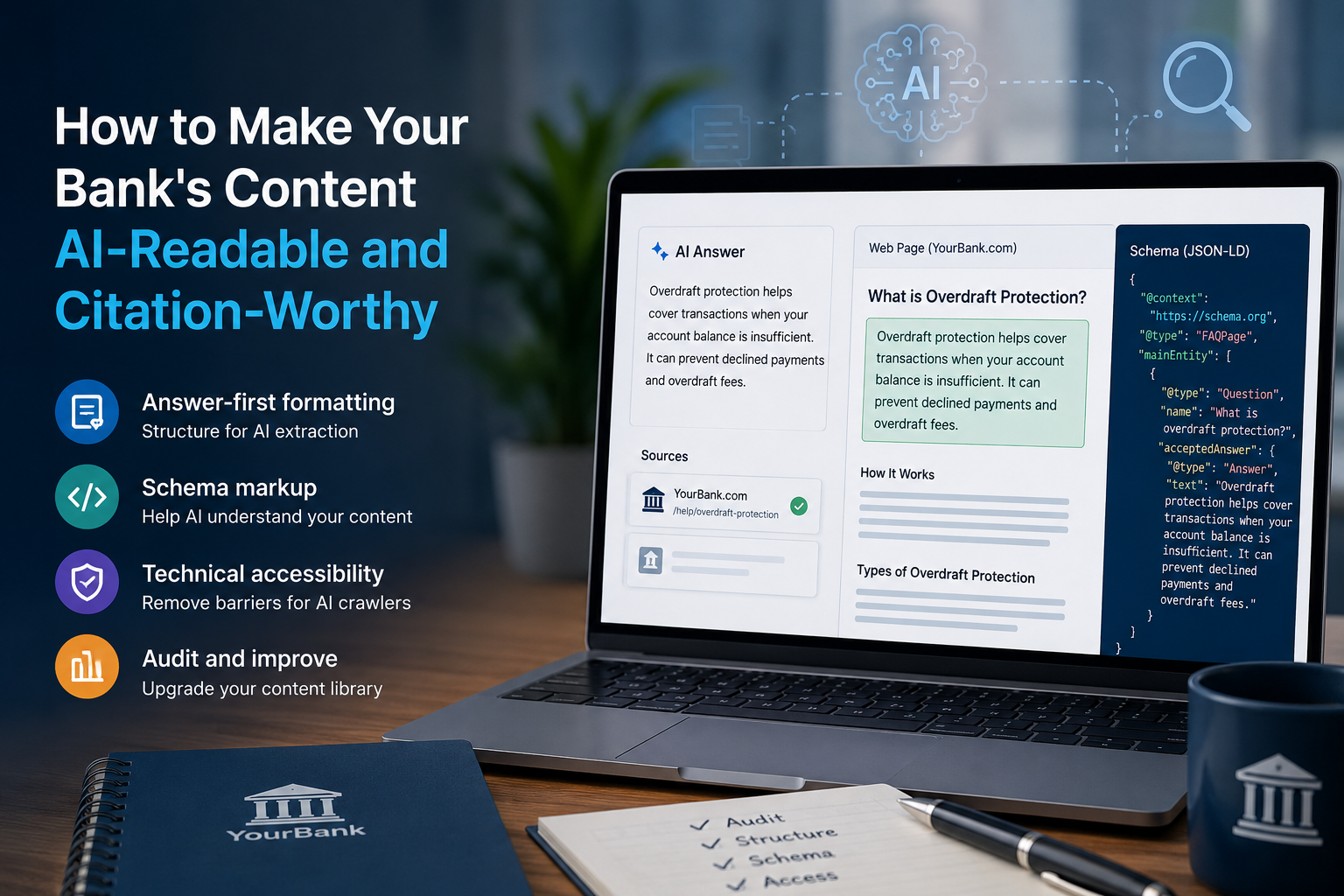
If there is one structural change that will do more for your AI citation rate than anything else, it is this: put the answer first. Always. On every page. In every section.
Every section of your content should lead with a direct answer. AI engines extract the first one to two sentences of a section to determine if it answers a query. If your opening is vague context-setting, the engine moves on to a competitor. Before: "In today's evolving digital landscape, many marketers are asking about AI citation strategies..." After: "Answer engine optimization is the practice of structuring content so AI platforms cite it when generating responses. Here is how to do it." Frase
For a bank or credit union, this means completely rethinking how product pages and educational content open. Compare these two approaches for a personal loan page:
Traditional opening: "Whether you're looking to consolidate debt, fund a home improvement project, or cover an unexpected expense, [Your Bank] offers personal loans designed with your needs in mind. Our experienced loan officers are here to help you find the right solution."
AI-readable opening: "A personal loan at [Your Bank] offers fixed rates from X% APR for amounts between $1,000 and $35,000, with terms from 12 to 60 months. Approval decisions are typically available within one business day, and no collateral is required."
The second version is citable. AI can extract it directly as an answer to "what personal loan rates does [your bank] offer" or "how long does personal loan approval take at a community bank." The first version gives AI nothing to work with — it's marketing language, and AI systems skip it.
AI engines parse content by sections, not by page. Each section must be a self-contained unit that can be understood and cited independently. Semantic chunking means organizing content so each section covers exactly one concept. Frase
The Anatomy of a Citable Financial Content Block
What does a properly structured, AI-citable content block look like for a financial institution? It has a consistent, predictable anatomy — and once you understand it, you can apply it across your entire content library.
The Question-Based Heading. Every major section should be introduced by a heading that mirrors the actual question a member would ask. "What is the minimum credit score for a mortgage at [Your Bank]?" performs better than "Mortgage Eligibility Requirements." The former directly maps to a query; the latter is structural navigation that AI has to interpret.
The Direct Answer Sentence. The first sentence after the heading must directly answer the heading's question. No preamble. No context-setting. The answer. "The minimum credit score for a conventional mortgage at [Your Bank] is 620, though borrowers with scores above 740 typically qualify for our best available rates."
The Supporting Detail. Two to four additional sentences that expand, qualify, or provide context for the direct answer. This is where you can add nuance, exceptions, and secondary information that makes the answer complete and accurate.
The Citable Data Point. Where possible, include a specific statistic, percentage, dollar amount, time frame, or other concrete figure. Evidence shows that adding statistics can increase AI visibility by 22%, while using quotations can boost it by 37%. Brand search volume — not backlinks — is the strongest predictor of AI citations. For financial content, your own product data is the most valuable source of citable specifics — rates, terms, minimums, approval timelines. The Digital Bloom
The formatting principle is simple: if an AI system extracts any single paragraph from your page, that paragraph should be a complete, accurate, useful answer on its own. Anything that requires reading the surrounding paragraphs to make sense is poorly formatted for citation. Isimplifyme
Applied to a HELOC page, this means every section — what a HELOC is, how rates are determined, who qualifies, how the draw period works, what the repayment terms look like — should be independently citable without requiring the reader to have seen the preceding sections.
Content Length, Paragraph Structure, and Information Density
The way you write individual paragraphs matters as much as how you structure sections. AI extraction happens at the passage level, and passages that are too long, too dense, or too unfocused are passed over in favor of cleaner alternatives.
AI engines process content faster when it is chunked into scannable sections with clear headings, short paragraphs of two to four sentences, and visual hierarchy. Dense walls of text reduce citation probability. Frase
Break content into focused blocks of four to six sentences, each addressing a single concept or point. This modular approach aligns with how AI systems chunk content for processing. When ChatGPT or Perplexity retrieves information to answer a question, they select relevant passages rather than entire articles. Content organized in clear, self-contained blocks increases the likelihood that the right passage gets selected. Hashmeta
For financial content, this has a specific application that many institutions get wrong. Long, comprehensive product pages — the kind built to satisfy Google's YMYL standards with deep explanations and thorough coverage — often fail AI extraction because the relevant answer is buried in the middle of a lengthy discussion. The solution is not to shorten these pages. It is to reorganize them so that each answer unit is self-contained, clearly headed, and leads with its conclusion.
Direct answer block length has a specific optimal range. Lead every section with a direct answer in 40 to 60 words. Add statistics with source citations every 150 to 200 words. That 40-60 word range for the direct answer is precise — it's long enough to be complete and useful, short enough to be extractable as a clean unit. Frase
Schema Markup: The Machine-Readable Layer You Can't Skip
Content quality and structure are necessary but not sufficient for consistent AI citation. The machine-readable layer — schema markup implemented via JSON-LD — is what allows AI systems to understand what your content represents without having to infer it from unstructured text.
A Data World study demonstrates that GPT-4 goes from 16% to 54% correct responses when content relies on structured data. Queries in AI are longer and conversational — 23 words on average versus 4 in Google. Structured data allows AI to quickly extract relevant response elements. Generative language models analyze billions of web pages to construct their responses. Structured data accelerates this process by providing a clear reading map of the content. Digidop
Content with proper schema markup has a 2.5x higher chance of appearing in AI-generated answers. Sites with complete Tier 1 schema see up to 40% more AI Overview appearances. Stackmatix
For financial institutions, the priority schema types in descending order of citation impact are:
FAQPage schema is the single highest-impact schema type for financial content. FAQPage directly maps to AI question-answer extraction pipelines. It is a must-have schema type that drives the highest AI citation rates across all major platforms. Every page with question-and-answer content — product pages, educational guides, member resource pages — should have FAQPage schema. Use JSON-LD format, implemented in the <head> of each page, with questions phrased exactly as members would ask them and answers that match what appears on the page. Stackmatix
HowTo schema tells AI systems that your content walks through a step-by-step process. HowTo provides step-by-step structure that AI engines can decompose and reassemble. It is a top-tier schema type for procedural content. For financial institutions, this applies to any page explaining a process: how to apply for a home loan, how to open a checking account, how to set up direct deposit, how to initiate a wire transfer. Stackmatix
Article schema with datePublished and dateModified is essential for every blog post, guide, and educational resource. This is how AI systems assess freshness — without it, they may not know when your content was last updated. If your Article schema says "Published: January 15, 2026" but your page shows a different date, that is a red flag. AI systems are smart enough to catch these inconsistencies. Always keep your schema current — forgetting to update dateModified when content is refreshed means AI keeps citing old information because the schema signals no update occurred. Medium
Person schema for author attribution is specifically important for financial content. AI platforms like Google AI Overviews and Perplexity weigh author expertise heavily when deciding which content to cite for YMYL topics. Person schema makes these signals machine-readable rather than requiring AI to infer them from context. Every piece of financial content that carries a byline should have Person schema connecting that author to their credentials, professional role, and licensing where applicable. Stackmatix
Organization schema on your homepage establishes your institution's foundational identity for AI systems — your legal name, geographic service area, contact information, and institutional description. This is the entity anchor that all your other content connects back to.
LocalBusiness schema for each branch location is critical for local query performance. AI platforms pull structured local data to answer queries such as "best [service] near me" and populate local knowledge panels. For multi-location businesses, implement a hierarchical schema structure: an Organization entity at the parent level with individual LocalBusiness entities for each location. Stackmatix
Comprehensive schema implementation across all layers yields a 4.2x higher AI citation rate versus basic markup alone. The gap between "some schema" and "comprehensive schema" is the gap between invisible and cited. Isimplifyme
The llms.txt File: The Emerging Standard Worth Implementing Now
There is a newer addition to the AI content accessibility toolkit that most financial institution websites don't yet have — and that provides a meaningful opportunity for early movers.
LLMS.txt is a plain-text file placed at the root of your website that communicates directly with large language model systems — ChatGPT, Claude, Perplexity, Google Gemini — about your content availability and preferred usage. While robots.txt has governed search engine crawling since 1994, it was never designed for AI systems that do not just crawl pages but synthesize, summarize, and cite content in AI-generated responses. LLMS.txt fills that gap. It is the new standard for AI-era content governance, and most websites do not have one yet. Seoscore
The llms.txt file is a plain-text file hosted in a website's root directory that provides a concise, Markdown-formatted map of a site's most important resources. It offers AI crawlers a standardized way to identify and process high-quality information, ensuring that content is accurately surfaced in AI-generated answers and search results as the web moves toward an AI-first discovery model. Bluehost
For a bank or credit union, an llms.txt file serves several practical functions: it tells AI systems what your institution is and who it serves; it maps your most important, citation-worthy content pages so AI crawlers prioritize them; and it can indicate which sections of your site should not be cited in AI responses — drafts, internal-facing pages, or content you want reserved for direct visitors.
The file uses standard Markdown. Four elements make up a valid implementation: an H1 heading with the brand or site name as the first element; a blockquote with one to three sentences describing what the site covers and who it serves; section headings grouping related pages by topic or purpose; and annotated links with a short description of each page, written for a reader who knows nothing about the site. DerivateX
It is worth noting that as of Q1 2026, no major AI company has publicly committed to reading or acting on llms.txt in their production systems — it is advisory, not enforcement. Think of it as a low-cost, no-downside signal that will become more valuable as adoption grows. The implementation cost is minimal; the potential benefit is meaningful; and in an era when most bank websites still don't have this file, creating one is a genuine first-mover advantage. DerivateX
Technical Barriers That Silently Kill AI Citation
Beyond content structure and schema, a set of technical issues prevent AI systems from reading your content at all — and they're more common on financial institution websites than most marketing teams realize.
JavaScript-rendered content. Many modern bank websites use JavaScript frameworks that render content dynamically in the browser. Keep critical content in raw HTML, avoiding reliance on JavaScript-rendered blocks which slow or prevent indexing. If your loan rates, product features, or key member information are only visible after JavaScript executes — rather than present in the initial HTML response — AI crawlers that don't fully render JavaScript may never see them. The test is simple: view the page source (Ctrl+U in most browsers) and look for your key content. If it's absent from the source HTML, it's potentially invisible to AI crawlers. Hashmeta
PDF product information. Many financial institutions publish rate sheets, product summaries, disclosure documents, and application instructions as PDF files. To an AI agent, a PDF is a black box. What an AI agent will read more efficiently is data stored in structured metadata and clean HTML. Any key product information currently locked in PDFs should be mirrored in crawlable HTML pages — not instead of the PDF for compliance purposes, but in addition to it, in a format AI can read. FinTech Weekly
Blocked AI crawlers. This remains the most common and most consequential technical issue. If your robots.txt file blocks AI crawlers — explicitly or through a wildcard Disallow: / rule for unknown bots — none of your content optimization matters. Verify your robots.txt explicitly allows PerplexityBot, GPTBot (ChatGPT), ClaudeBot, and Google-Extended. Also audit your Web Application Firewall settings, as many WAF configurations treat these crawlers as unknown threats and block them by default.
Inconsistent NAP data. Your institution's name, address, and phone number need to be identical across your website, Google Business Profile, FDIC listing, and every directory and third-party platform that references you. AI systems cross-reference this data when establishing entity confidence. Inconsistencies — different address formats, old phone numbers, name variations — reduce the AI's confidence in attributing information to your institution and suppress citation rates.
Missing or outdated publication dates. AI systems weight content freshness as a citation signal. Pages without visible publication dates, or with dates from 2022 and 2023 on content that hasn't been updated since, are deprioritized. Every piece of content that can carry a visible "last updated" date should have one — and that date needs to reflect genuine content refreshes, not cosmetic updates.
Building Financial Content That Specifically Earns Citations
Beyond structure and schema, the content itself has to earn citation through quality signals that AI systems have learned to recognize and prioritize.
Original data and proprietary information. If you publish a report with original charts and statistics, AI models will use your data to answer user queries, citing your brand as the primary source — creating a virtuous cycle where your research becomes the canonical reference. For financial institutions, this means publishing original research: your community's local housing market data, member financial wellness survey results, small business lending trends in your market, or comparative product analysis using your own pricing data. Information that only exists in your published content cannot be found anywhere else — making you the definitive citable source. Anuragology
Verifiable institutional claims. AI systems favor financial content that makes specific, verifiable claims over content that makes vague, promotional assertions. "Our auto loan rates start at X% APR for 60-month terms as of [current quarter]" is citable. "We offer competitive auto loan rates" is not. Every rate, term, limit, threshold, and process detail on your site should be expressed with the specific precision that makes it verifiable and citable.
Named, credentialed authors. For YMYL content, every piece must have a named, credentialed author with a detailed bio. Anonymous content signals that the publisher is not confident enough in their credentials to attach a name to the work. Your mortgage content should carry your licensed loan officers' names. Your business lending content should be attributed to your commercial lending team members with their credentials visible. These aren't just trust signals for human readers — they're the Person schema anchors that AI systems use to evaluate the YMYL credibility of financial content. Outpace
Citation of authoritative sources. When your content references external data — Federal Reserve research, FDIC statistics, CFPB guidelines, local economic data — cite those sources explicitly. Citing reputable sources strengthens credibility while increasing the likelihood of citation. When an AI system surfaces a response that includes data within your structured answer, your institution may still be credited as the source even when the underlying data comes from an external authority. Stackmatix
Comparison and contrast content. AI systems consistently favor structured comparison content because it directly serves the comparative queries users ask most often. Users often search by comparing two products, services, or ideas. AI platforms surface these because the format is binary and easy to summarize. "HELOC vs. home equity loan," "savings account vs. money market account," "fixed vs. adjustable rate mortgage" — these comparison pages, built with clear side-by-side structure and specific factual distinctions, are among the highest-citation content types available to financial institutions. Ryan Tronier
Freshness as a Continuous Obligation
One of the most important — and most consistently underestimated — requirements for AI citation is content freshness. This is not a one-time optimization. It is a continuous obligation.
Ahrefs' study of 17 million citations found that AI-surfaced URLs average 1,064 days old compared to 1,432 days for traditional search results — a 25.7% freshness advantage. Update your high-value content quarterly with new data, examples, and statistics. Automated content decay detection can flag pages that need refreshing before they lose citation share. Frase
For financial institutions, freshness has specific operational requirements that differ from most other industries. Rates change. Product terms change. Regulatory requirements change. Branch hours change. Any content that references specific rates, terms, or regulatory details without a clear update cadence is actively accumulating staleness that degrades AI citation performance.
Add temporal context to claims. Instead of "LLMs are growing rapidly," write "As of Q1 2026, ChatGPT processes over 2.5 billion prompts per day." Specificity signals currency. Revise, don't just republish — updating a paragraph with new data or a clearer explanation carries more weight than changing a date and reposting. Add "What's Next" or "What's Changing" sections. Even when the core advice hasn't changed, a forward-looking section signals that the author is actively tracking the space. HubSpot
For banking content specifically, this means implementing a quarterly content audit calendar that reviews:
Every product page for rate and term accuracy — rates are the highest-staleness-risk content on any financial institution website. Every regulatory reference for current compliance accuracy. Every statistical claim for recency — a 2023 housing market statistic cited in a 2026 mortgage guide is a citation liability. Every FAQ for continued relevance as products and procedures evolve. Every author bio for currency — credential changes, role changes, and added certifications should be reflected.
The Content Audit Approach: Upgrading What You Already Have
The good news for financial institutions with existing content libraries is that most of the work involved in AI readability is restructuring, not replacement. Well-researched content that has been performing in traditional search often contains the right information — it just needs to be reorganized for AI extraction.
Start with content that already performs well. A 2022 article about debt consolidation, for example, can be made more AEO-friendly by adding a callout — a citable chunk — that highlights a clearly framed question, a direct answer, and a supporting statistic. Ask yourself: do you know how your website content is organized and when it was last reviewed or updated? The Financial Brand
The audit process for AI readability works in tiers by content priority:
Tier 1 — Product pages. These are your highest-value, highest-intent pages. Every product page should be audited for: answer-first opening sentence, rate and term specificity, FAQ section with FAQPage schema, question-based H2 headings, named author attribution, visible update date, and LocalBusiness/Service schema where applicable.
Tier 2 — Educational guides and blog posts. Audit for answer-first section openings, question-based headings, paragraph length (two to four sentences per paragraph maximum), presence of Article schema with accurate dateModified, and at least one original or specifically cited data point per major section.
Tier 3 — FAQs and help content. These pages are often already close to AI-ready because they're naturally structured as question-and-answer. The audit here focuses on ensuring FAQPage schema is implemented, answers are 40-60 words in the direct answer portion, and the questions mirror actual member language rather than institutional terminology.
Tier 4 — About pages and branch information. Audit for complete Organization and LocalBusiness schema, consistent NAP data, service area specification, and current staff attribution on relevant content.
Pages with clean heading hierarchy and aligned schema earn 2.8 times higher AI citation rates than poorly structured pages, showing that structure is a retrieval signal in its own right. AirOps
What AI-Readable Financial Content Looks Like in Practice
To make all of this concrete, here is what a properly structured checking account page looks like for AI readability, compared to the traditional approach most bank websites still use:
Traditional approach (not AI-readable): The page opens with brand language about your commitment to member financial wellness. It has a photograph of smiling people at an ATM. A paragraph explains that checking accounts are fundamental to everyday financial management. Eventually, after several paragraphs, product features are listed. Rates, if any, are referenced vaguely as "competitive." There is no FAQ section. There is no schema markup. The author is listed as "staff." The last update date is not visible.
AI-readable approach: The page opens with: "[Your Bank]'s Free Checking account offers no monthly maintenance fees, no minimum balance requirement, access to [X] ATMs with no surcharge, and a free debit card with real-time fraud alerts." Each feature section begins with a direct answer to its heading question. A FAQ section addresses the top eight questions members ask about checking accounts, implemented with FAQPage schema. The page carries Article schema with a current dateModified reflecting the last rate or feature update. The author is a named product specialist with Person schema linking their credentials. LocalBusiness schema connects the page to your branch network.
The second page is citable. The first is not. The gap between them is not content quality — it's content architecture.
Ready to Make Your Financial Content AI-Ready?
At Ritner Digital, we help banks and credit unions audit, restructure, and optimize their content libraries for AI citation — from technical schema implementation and content restructuring to freshness audits and llms.txt setup. We understand the specific requirements of YMYL financial content and the compliance context in which financial institution marketing operates.
Find out how AI-readable your current content is — and what it will take to close the gap.
👉🏼 Talk to the Ritner Digital team today
Frequently Asked Questions
What makes financial content AI-readable versus just well-written?
Well-written content is structured for human readers — it builds context, develops arguments, and guides readers through a narrative. AI-readable content is structured for machine extraction — it leads every section with a direct answer, organizes information into self-contained blocks, uses question-based headings that mirror real queries, and includes specific, verifiable data points that AI can extract and cite independently. The fundamental test is whether any single paragraph from your page is a complete, accurate, useful answer on its own — without requiring surrounding context to make sense. If it is, it's AI-readable. If it requires the reader to have absorbed the previous three paragraphs to understand it, it isn't.
Which schema markup types matter most for a bank or credit union?
In priority order: FAQPage schema on any page with question-and-answer content — this directly maps to how AI systems extract financial answers; HowTo schema on any page that walks through a process; Article schema with accurate datePublished and dateModified on all blog and educational content; Person schema for named authors on financial content to establish YMYL credibility; Organization schema on your homepage as your institutional identity anchor; and LocalBusiness schema for each branch. Comprehensive implementation across these types yields a 4.2x higher AI citation rate versus basic markup alone. All schema should be implemented in JSON-LD format — the standard all major AI engines reliably parse.
How often should a bank update its content for AI citation purposes?
Product pages should be reviewed every time rates, terms, or product features change — staleness in financial product details is both a citation liability and a compliance risk. Educational guides and blog posts should be reviewed quarterly and updated with current data, current examples, and any relevant regulatory changes. FAQ content should be reviewed semi-annually to ensure questions reflect current member language and answers reflect current policies. Any page that has not been substantively updated in twelve months should be flagged for review — AI systems weight content freshness heavily, and financial content from 2022 or 2023 that references specific rates or market conditions is likely both stale and inaccurate.
What is an llms.txt file and should my bank have one?
An llms.txt file is a Markdown-formatted text file placed at your website's root directory that tells AI systems what your institution is, who it serves, and which pages contain your most important, citation-worthy content. Think of it as a curated map for AI crawlers — similar in spirit to an XML sitemap but designed for large language models rather than search engine crawlers. It's an emerging standard proposed in 2024 and gaining adoption in 2026. Major AI companies haven't publicly committed to acting on it in production systems yet, but it's a low-cost, no-downside signal that costs little to implement and provides a framework for communicating your content structure to AI systems as the standard matures.
Why is content buried in PDFs a problem for AI visibility?
AI crawlers cannot reliably extract text from PDF files the way they can from HTML pages. When your rate sheets, product summaries, disclosure documents, and application instructions exist only as PDFs, the specific financial details they contain — rates, terms, eligibility criteria, process steps — are effectively invisible to AI. The fix is not to remove PDFs, which may be required for compliance and regulatory purposes, but to mirror the key information they contain in clean, crawlable HTML pages. Any product or service information currently locked in a PDF that a prospective member would need to make a financial decision should have a corresponding HTML page that makes that information machine-readable.
How do I know if AI is correctly reading and representing my institution?
Manual testing is the most direct approach: search for your institution's name and key products across ChatGPT, Perplexity, Google AI Mode, and Gemini. Note what AI says about you — is the information accurate? Is it current? Are rates and product details correct? Are there factual errors you need to address at the source on your website? Also look for how your institution appears in response to local acquisition queries — "best mortgage lender in [your city]," "community bank for small business loans in [your area]." If your institution isn't appearing, or is appearing with inaccurate information, that signals either a content structure gap, a technical accessibility issue, or an authority signal deficit — all of which Ritner Digital can diagnose through a full AI visibility audit.
Can small community banks compete with large banks for AI citations?
Yes — and in local and specific queries, they often have structural advantages. AI citation is not purely a function of institutional size or marketing budget. It is a function of content structure, specificity, freshness, schema completeness, and local relevance. A community bank that publishes a well-structured, locally specific guide to small business lending in its market — with named authors, current data, FAQ schema, and clear answer-first formatting — can earn more citations for local small business loan queries than a national bank's generic product page. The competitive advantage available to community institutions is local specificity: content that explicitly names your communities, addresses local market conditions, and answers the precise questions your prospective members are asking is citation-worthy in ways that no national bank's one-size-fits-all content can replicate.
Get your bank's AI content readability audit from Ritner Digital →
Sources: AirOps, Frase, Hashmeta, iSimplifyMe, Stackmatix, Semrush, Digital Bloom, The Financial Brand, Kopp Online Marketing, Digidop, Bluehost, SEO Score Tools, Derivatex Agency, Page Traffic