Zero-Click Financial Searches: How Banks and Credit Unions Can Win Anyway
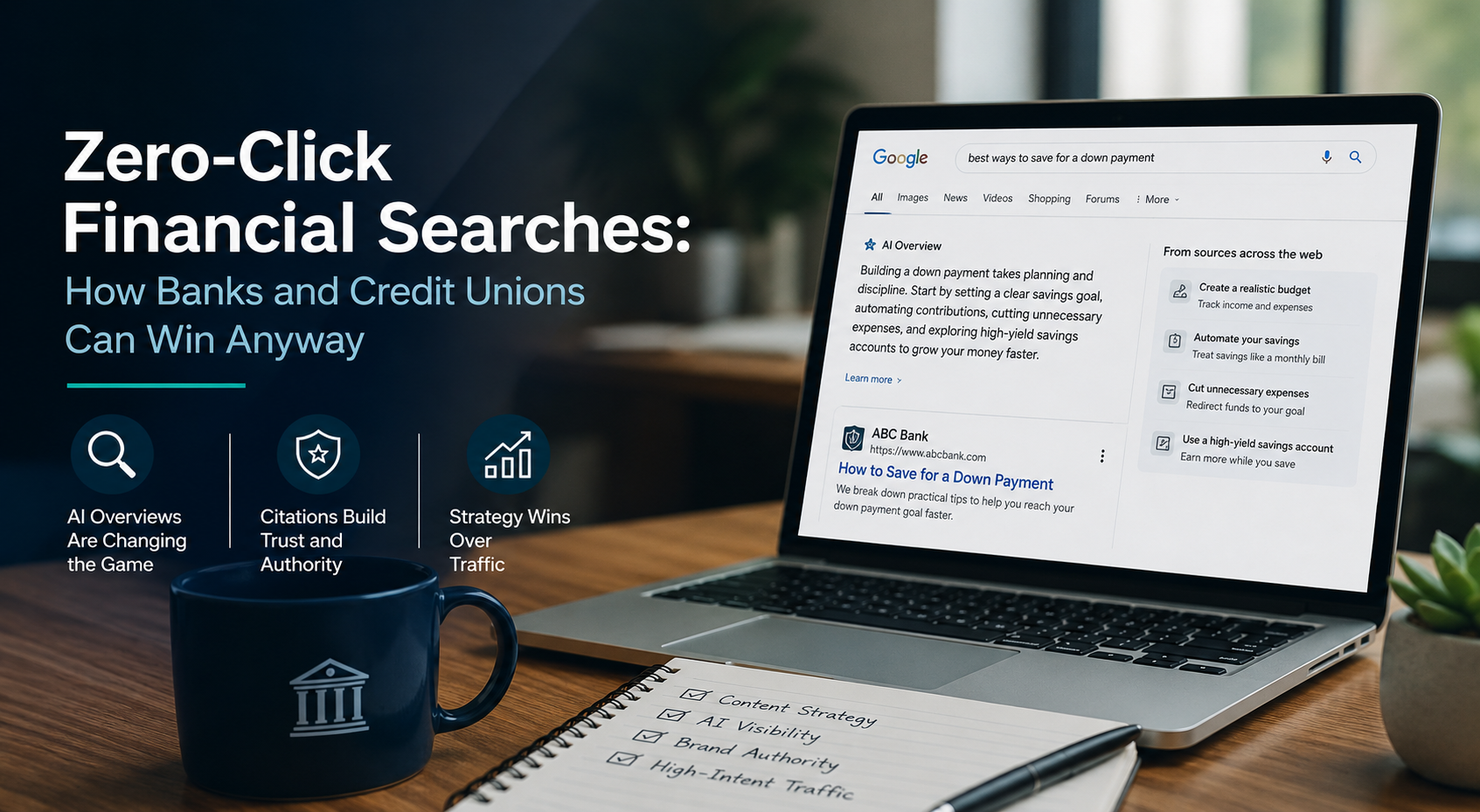
The Click That No Longer Comes
For over two decades, the digital marketing playbook for banks and credit unions was built on a single premise: get ranked, get clicked, get a visitor on your website. That premise is breaking down — not gradually, but at a pace that is rewriting the economics of financial institution marketing faster than most teams have adapted.
64.82% of Google searches now end without the user clicking on any result. The zero-click rate has climbed steadily from 50% in 2019 to nearly 65% in 2026 — this is not a temporary blip caused by AI Overviews. The trend predates generative AI and has been accelerating since featured snippets and knowledge panels matured. Digital Applied Team
When AI Overviews are present, the numbers are starker still. Searches triggering AI Overviews now show an average zero-click rate of 83%. In other words, 8 out of 10 users now get their answer directly inside the search interface. And in Google's newer AI Mode, Semrush puts the zero-click rate at 93%. CLICKVISION DigitalGoodFirms
Do the math for a financial institution: for every 1,000 Google searches in the US, only around 360 result in a visit to a website that is not owned by Google or paid for through Google Ads. Digital Applied
This isn't a crisis — if you understand what it actually means. It is, however, a complete reframing of what "winning" in search looks like for banks and credit unions. And the institutions that grasp this reframing first are building a durable competitive advantage that the ones still chasing click-through rates are going to find increasingly difficult to close.
What Zero-Click Actually Means for Financial Marketing
Before getting into strategy, it's worth being precise about what zero-click search is and isn't doing to financial institution marketing.
Zero-click does not mean zero influence. A brand can dominate the conversation even without earning the click. When your content appears in an AI-generated summary, your expertise is being read, referenced, and trusted within the search interface itself. That presence builds authority in ways that traffic data alone cannot capture. CLICKVISION Digital
What zero-click does mean is that the metrics your leadership team has used to evaluate digital marketing performance — organic sessions, click-through rates, paid search clicks — are now measuring a shrinking fraction of the total value your digital presence is generating. Buyers may encounter your brand inside an AI-generated summary, form a preference, and convert later through a different channel. If your attribution model only credits the final click, it systematically excludes that earlier influence from revenue calculations. That accounting gap creates structural undervaluation. Revvim
For financial institutions specifically, the zero-click era also creates an important distinction between two types of queries — and getting this distinction wrong is where most bank and credit union marketing strategies are currently going off track.
Informational queries — "how does a HELOC work," "what is the difference between a CD and a money market account," "what credit score do I need for a personal loan" — are being answered almost entirely on the search results page or inside AI responses. These queries will rarely drive clicks to your website. But they represent the research phase of a financial decision — the moment when a future member or customer is forming their understanding of their options and, critically, which institutions they should consider.
Transactional and navigational queries — "apply for auto loan [your institution name]," "open checking account online," "[your credit union] hours" — still drive clicks at high rates. These are bottom-of-funnel queries from people who have already made their shortlist and are ready to act.
For commercial and transactional searches — where a user wants to compare providers, request a quote, or make a purchase — the #1 organic position still drives significant click-through. For informational queries, AI Overviews now answer the question before users reach organic results. GoodFirms
The strategic conclusion: you need two different approaches running simultaneously, optimized for two different jobs. And most financial institution websites are currently doing neither well.
The Invisible Influence Machine
Here's the counterintuitive insight that changes how you think about zero-click: the searches that generate no click to your website may be doing more for your acquisition funnel than the searches that do.
Zero-click does not mean zero influence. The industry is shifting from click-based marketing to influence-based marketing. Every time you win an AI citation in your authority layer, you are earning a "branded search." Even if the user does not click immediately, they are more likely to search for your company by name once they move from the research phase to the buying phase. Entrepreneur
This is the downstream effect that most financial institutions aren't measuring — and therefore aren't optimizing for. When a prospective member sees your credit union cited as a trusted source in a Perplexity answer about HELOC rates in your city, they don't necessarily click. But your institution's name is now associated in their mind with HELOC expertise in their area. When they're ready to apply, they may search your name directly. That branded search converts at dramatically higher rates than any informational click — and its origin is the zero-click citation that left no trail in your analytics.
Branded search volume is one of the clearest indicators of sustained awareness. When users search for your company name, product names, or branded variations, they are signaling active awareness and intent. Unlike broad informational queries, branded searches reflect demand that has already been shaped — whether by advertising, word of mouth, AI summaries, or prior research. If informational sessions decline but branded search volume remains stable or grows, it suggests demand generation is intact. Revvim
AI Overviews reduce organic CTR by an average of 18%, but the clicks that survive convert 23% better. When AI Overviews appear, fewer users click through to websites — but the users who do click have already read a summary and are seeking deeper information, making them higher-intent visitors. Digital Applied Team
The math here is important for financial institutions to internalize. Fewer clicks, but better qualified visitors who convert at higher rates, plus a sustained uplift in branded search volume from awareness built through zero-click citations — this is actually a better acquisition dynamic than the pre-AI model of driving high traffic volumes of low-intent visitors.
The Split Architecture Strategy for Financial Institutions
The most effective framework for banks and credit unions navigating zero-click is what some practitioners call a "split architecture" — two distinct content layers serving two distinct purposes, each optimized differently.
Entrepreneurs and founders must decouple their "authority layer" from their "conversion core." The authority layer — the teacher — is your AI-bait. This content must be purely educational, structured for machine readability using JSON-LD and clear H2 headers, and devoid of heavy sales pressure. Its job is to win the AI citation and build invisible influence. The conversion core — the seller — consists of your product pages, pricing tables, and lead forms. These should remain lean, fast, and aggressively optimized for human psychology. Every time you win an AI citation in the authority layer, you are earning a branded search. Entrepreneur
For a community bank or credit union, this architecture looks like this in practice:
The Authority Layer is your financial education content — blog posts, guides, FAQs, local market analyses, product explainers. These pages are not designed to convert visitors directly. They are designed to be cited by AI systems, to appear in featured snippets, to populate People Also Ask boxes, and to build the association between your institution and financial expertise in your community. They need to be comprehensive, locally specific, written by identified credentialed authors, regularly updated, and structured with clear question-based headings, schema markup, and direct answer formatting.
The Conversion Core is your product and service pages — checking accounts, savings accounts, auto loans, mortgages, personal loans, HELOCs, credit cards, CDs. These pages serve people who already know they want a product and are evaluating you as a provider. They need complete, accurate product information, clear eligibility criteria, rates that are current, easy-to-find application entry points, and trust signals like member reviews and security certifications. They should still be optimized for traditional SEO because transactional queries still drive clicks — but they serve a different funnel stage than the authority layer.
The failure mode most financial institutions fall into is building hybrid pages that try to do both jobs — educational enough to rank for informational queries, promotional enough to convert visitors — and end up doing neither job well. AI systems struggle to extract citable educational answers from pages with heavy CTAs and promotional language. Visitors arriving with transactional intent bounce when they hit content that starts with a history of home equity rather than product details and an application button.
What Financial Queries Trigger Zero-Click vs. Drive Clicks in 2026
Not all financial searches behave the same way, and understanding the distribution is essential for allocating your content investment intelligently.
High zero-click, high AI coverage (optimize for citation, not traffic):
"How does a HELOC work"
"What is a money market account"
"HELOC vs. home equity loan"
"How to build credit from scratch"
"What credit score do I need for a car loan"
"How do CDs work"
"Difference between checking and savings account"
"How do I qualify for a small business loan"
These are the queries where AI systems answer fully on the results page. Your content should be structured to be the source AI cites — even though few users will click through. The value is the association, the authority signal, and the branded search it eventually generates.
Moderate zero-click, mixed AI coverage (optimize for both citation and clicks):
"Best credit union in [your city]"
"Credit union auto loan rates [your city]"
"Best HELOC rates [your city]"
"Community bank for small business [your area]"
"First-time home buyer programs [your state]"
Local queries with product specificity are where community institutions have their greatest AI visibility opportunity. Citation is visibility, not traffic: being cited builds brand awareness even when it won't drive significant click volume. Primary position matters enormously — the first-cited source captures the lion's share of limited clicks. For these local financial queries, being cited first is both a branding win and a click opportunity. Ekamoira
Low zero-click, strong click intent (optimize for traditional conversion):
"[Your institution name] auto loan application"
"Open checking account [your institution]"
"[Your institution] mortgage rates"
"[Your institution] near me hours"
"Log into [your institution] online banking"
Navigational and branded queries still drive clicks at very high rates. These pages should be technically sound, fast-loading, and conversion-optimized. They are the bottom of the funnel, and they still work the way they always have.
The opportunity lies in understanding what triggers AI Overviews versus other SERP features. Complex informational queries that benefit from nuanced explanations generate AI responses. Simple factual questions may still trigger featured snippets or knowledge panels. Commercial queries often skip both and show shopping results. Search Engine Land
The Content Formats That Resist Zero-Click Summarization
One of the most important tactical insights for financial institutions in the zero-click era is that not all content types are equally susceptible to AI summarization. Some content formats cannot be fully answered on a results page — they require a visit, an interaction, or personalization that AI cannot replicate.
Content requiring interactivity, fresh data, or nuanced context retains more traffic than content that can be fully summarized by AI. Specific formats that naturally resist zero-click summarization include interactive tools and calculators, personalized assessments and diagnostic tools, and real-time data dashboards. Ekamoira
For banks and credit unions, this points directly to a high-value content category that most institutions are dramatically underinvesting in:
Loan and mortgage calculators. A user asking "what would my mortgage payment be on a $350,000 home" is not going to get a fully personalized answer from an AI Overview — because that answer requires their specific down payment, credit profile, loan term preference, and your current rates. A well-built, fast-loading mortgage calculator on your website is exactly the kind of interactive tool that drives clicks from zero-click-adjacent queries and creates high-intent engagement.
Rate comparison tools. AI can give approximate rate ranges. It cannot give your current, live rates with the exact product parameters your institution offers. A page that allows visitors to see live rates and compare product options by term, amount, and rate type is a tool — and tools drive visits in ways that informational content increasingly doesn't.
Eligibility assessments. "Do I qualify for a HELOC?" is a question AI can answer in general terms. But a short eligibility check that gives a personalized preliminary assessment — based on the visitor's input — delivers something AI fundamentally cannot. These tools generate leads and collect intent signals simultaneously.
Member financial health tools. Budget calculators, savings goal planners, debt payoff calculators — these serve your mission of financial wellness and create interactive touchpoints that keep visitors engaged with your digital properties in ways that informational articles cannot.
Smart content creators are adapting by layering their content strategy — providing the clear, authoritative information that AI systems crave, while embedding unique data, tools, or resources that compel users to click through for the full experience. Search Engine Land
The authority layer earns the citation and builds the brand association. The interactive tools give people a reason to come to your website even when AI has answered their initial question. Together, they create a funnel that works in the zero-click era rather than against it.
Local Search: Where Zero-Click Hasn't Won Yet
For community banks and credit unions, there is one search category where zero-click dynamics are significantly more favorable than in broad informational search — and where your institution has structural advantages over any national competitor.
Local intent queries — especially map-based and "near me" searches — resolve differently from informational queries. Local intent triggers the Local Pack. Transactional queries may still drive clicks as users need to complete purchases. The Google Local Pack — the map and business listing results that appear for location-based searches — generates clicks at meaningfully higher rates than organic results for the same queries, and it is not meaningfully disrupted by AI Overviews. Ekamoira
Your Google Business Profile is one of the most underutilized digital assets most financial institutions have. A fully optimized GBP — with complete service listings, current hours and holiday exceptions, accurate contact information, regularly posted content, and a consistent stream of current member reviews — performs in local search and local AI queries in ways your website alone cannot replicate.
Appearing within a Knowledge Panel now generates more brand impressions than traditional top-10 rankings. Content structured around schema, Wikidata alignment, and E-E-A-T signals is more likely to surface in these instant panels. CLICKVISION Digital
The specific local search optimizations worth prioritizing for financial institutions:
Google Business Profile completeness. Every field completed. Services listed with specific product categories. Business description optimized with your key community and product differentiators. Attributes set for things like wheelchair accessibility, drive-through availability, and appointment availability.
Review velocity and recency. AI systems evaluate review recency as a freshness signal. An institution with fifty reviews, all from two years ago, ranks below one with thirty reviews, ten of which are from the last ninety days. Build a consistent, ethical review generation process — asking satisfied members at moments of high satisfaction, like after a successful loan closing or a resolved service issue.
Local content publishing. Posts on your GBP, blog content tied to local events and community initiatives, and any pages on your website that reference specific neighborhoods, cities, or regional market conditions all strengthen local entity signals that AI uses when answering local financial queries.
Measuring Success in the Zero-Click Era
If your current digital marketing reporting shows only web sessions, click-through rates, and paid search metrics, you are measuring less than half of your actual search presence in 2026. Only 14% of marketers are currently tracking AI citation visibility, and only 11% monitor branded search or share of voice. The measurement gap is not a data availability problem — it is a measurement scope problem. The tools to close it exist; most practitioners have not yet added them to their reporting stack. GoodFirms
A complete measurement framework for financial institutions in the zero-click era includes:
Traditional metrics (still essential for transactional queries): organic sessions by query intent, click-through rates for product and navigational pages, paid search performance for bottom-funnel terms, and conversion rates from organic and paid traffic.
Zero-click visibility metrics: AI Overview impression share in Google Search Console, featured snippet ownership for target informational queries, People Also Ask coverage for financial education topics, and Local Pack performance metrics including calls, direction requests, and website clicks from GBP.
AI citation metrics: Regular manual testing across ChatGPT, Perplexity, Google AI Mode, and Gemini for your top acquisition queries. Track citation frequency, citation accuracy, and which competitors appear alongside or instead of you. AI visibility monitoring platforms can automate this for your most important query sets.
Downstream brand health metrics: A sharp CTR drop for informational searches often means featured snippets or AI Overviews are answering users before they click. In contrast, stable or growing CTR for branded queries suggests that your SERP presence is strengthening brand awareness and recall. Branded search volume trend in Google Search Console is one of the clearest leading indicators of whether your zero-click presence is building the brand associations that eventually drive conversions. Verz Design
Direct traffic trends. Direct visits reflect remembered preference. When informational sessions decline but direct traffic remains stable or grows, it indicates that AI-mediated exposure is generating brand recall that converts to direct intent. Revvim
Presenting this expanded measurement framework to leadership requires changing the narrative around what SEO and digital presence success looks like. But institutions that make this shift — from measuring only the clicks that happened to measuring the influence that built before the click — will make far better content investment decisions.
The Five Priorities for Financial Institutions Right Now
If you're a bank or credit union marketing director reading this and trying to decide where to focus, here is the prioritized action list:
Priority one: Build and maintain your authority layer. Invest in comprehensive, locally specific financial education content structured for AI citation — answer-first formatting, question-based headings, FAQPage schema, named credentialed authors, and regular freshness updates. This content earns zero-click citations that build brand authority and eventually generate branded searches.
Priority two: Build or improve interactive financial tools. Loan calculators, mortgage payment estimators, rate comparison tools, and eligibility assessments are the content formats that resist zero-click summarization and drive high-intent visits. They are underbuilt at most community financial institutions.
Priority three: Protect and optimize your transactional pages. Your product pages are still driving clicks from high-intent queries. Keep them technically fast, structurally clean, rate-current, and conversion-optimized. Don't let zero-click anxiety cause you to neglect the pages where you're still winning clicks.
Priority four: Maximize local search presence. Fully optimize your Google Business Profile. Build a systematic review generation process. Create locally specific content on your website that ties your institution to specific communities and geographies.
Priority five: Expand your measurement framework. Add AI citation monitoring, branded search tracking, and AI Overview impression share to your regular reporting. Stop measuring only the bottom of the funnel. Start measuring the full influence chain.
Zero-Click Isn't the End of the Story
It would be easy to read the zero-click data and conclude that the traffic-based digital marketing model is simply dying — that financial institutions are going to face inevitable declines no matter what they do. That reading is wrong.
Brands optimizing for AI citation, structured visibility, and authority signals will outperform traffic-focused competitors by up to 30% in search-driven revenue impact. Zero-click search represents not the end of digital discovery, but the beginning of a more sophisticated way to build authority. Indexly
The 23x higher conversion rate for AI search visitors is the most important data point for reframing how businesses should think about zero-click search. When AI Overviews answer simple queries on the results page, the users who still click through are those with deeper intent — they want to verify the AI's answer, explore in more detail, or complete a transaction. Casual curiosity traffic filters out before reaching your site. The visitors who arrive are already past the awareness stage and closer to a decision. Digital Applied Team
For financial institutions, this is genuinely good news. You are not in the business of entertaining casual browsers. You are in the business of building relationships with people making meaningful financial decisions. The zero-click era is filtering out the tire-kickers and delivering higher-intent audiences for the traffic that does convert. The catch is that your institution has to be visible in the zero-click environment in order to be considered when that high-intent moment arrives.
We are no longer optimizing just for clicks — we are optimizing for citations. If you are not referenced by large language models and AI search engines, your brand practically does not exist in the modern buyer's journey. Anuragology
The institutions that understand this — and build their digital presence accordingly — are the ones that will be on the shortlist when a prospective member is ready to act. The ones still optimizing for last-click attribution are going to find increasingly difficult to explain to leadership why their conversion numbers are declining even as their product quality and pricing remain competitive.
Ready to Build a Zero-Click Strategy for Your Institution?
At Ritner Digital, we help banks and credit unions build the content architecture, technical infrastructure, and measurement frameworks needed to win in a zero-click world — from authority layer content and interactive tool strategy to AI citation tracking and local search optimization.
Let's talk about what your institution's zero-click presence looks like today — and what it needs to look like tomorrow.
👉🏼 Talk to the Ritner Digital team today
Frequently Asked Questions
What is zero-click search and why does it matter for banks and credit unions?
Zero-click search happens when a user's query is answered directly on the search results page — through an AI Overview, featured snippet, knowledge panel, or other SERP feature — without the user clicking through to any website. Nearly 65% of all Google searches now end this way, and the rate climbs to over 80% for queries that trigger AI Overviews. For financial institutions, it matters because the research phase of a financial product decision — where potential members form their institution shortlists — is happening almost entirely in this zero-click environment. If your institution isn't being cited as a trusted source in those AI-generated answers and SERP features, you're absent from the most influential moment in the customer acquisition journey.
Does zero-click search mean our content strategy is pointless if it doesn't drive traffic?
No — and this is the most important reframe for financial institution marketing teams. Zero-click visibility still builds brand authority, creates associations between your institution and financial expertise, and generates downstream branded searches from people who encountered your institution in an AI summary and later searched your name directly when ready to act. The measurement model that only counts clicks and sessions is missing the majority of the value your digital presence is generating. The institutions winning in the zero-click era are the ones that have expanded their measurement to include AI citation rate, branded search volume, and direct traffic trends — not just organic sessions.
What financial content types are most affected by zero-click search?
Informational content — anything that explains how a financial product works, defines terms, or answers general financial questions — is most affected. Queries like "how does a HELOC work," "what is a money market account," and "how to build credit" are now answered almost entirely on the results page without a click. Transactional and navigational content — product pages, application pages, and branded searches — are far less affected and still drive clicks at meaningful rates. The strategic response is not to abandon informational content but to restructure it for AI citation rather than click-through, while ensuring transactional pages remain optimized for the high-intent visitors who still click.
What content formats resist zero-click summarization and still drive website visits?
Interactive tools and personalized experiences are the most click-resistant content formats available to financial institutions. Loan calculators, mortgage payment estimators, rate comparison tools, and eligibility assessments give users something they cannot get from an AI summary — a personalized answer based on their specific inputs. These tools drive visits from zero-click-adjacent queries and generate high-quality engagement. Real-time rate pages with current product details also resist summarization because AI cannot reliably deliver your live rates. Investing in these interactive tools is one of the highest-leverage strategic moves a financial institution can make for the zero-click era.
How should a financial institution measure success in a zero-click environment?
Expand your measurement framework beyond web sessions and click-through rates. Add AI Overview impression share from Google Search Console, which shows how often your content appears in AI-generated summaries even without a click. Track branded search volume trends — growth in people searching your institution's name directly is a leading indicator that your zero-click visibility is building brand awareness that converts. Monitor AI citation rate across ChatGPT, Perplexity, and Google AI Mode for your key acquisition queries. Track People Also Ask coverage, featured snippet ownership, and Local Pack performance. And compare your transactional page CTR against your informational page CTR to confirm you're protecting click performance where clicks still happen.
Is local search affected by zero-click the same way as general informational search?
Local search is meaningfully more favorable for community financial institutions than general informational search in the zero-click era. The Google Local Pack — map-based results for location queries — still drives clicks at high rates because users want to take specific local actions. Your Google Business Profile, branch-level local pages, and locally specific content all perform well in local search and local AI queries. This is where community banks and credit unions have structural advantages over national competitors. Fully optimizing your GBP, building a consistent review generation process, and creating content that explicitly ties your institution to specific communities and geographies is among the highest-return digital investments available to local financial institutions right now.
How do I explain zero-click strategy to leadership who only track web traffic?
The best bridge is branded search volume. Show leadership that when informational sessions decline due to zero-click search, branded search — people searching your institution's name directly — tends to stabilize or grow if your zero-click visibility is working. Branded searches convert at dramatically higher rates than any informational traffic, making them a better leading indicator of revenue impact than session counts. Supplement this with the conversion rate data: visitors arriving from AI search citations convert at significantly higher rates than traditional organic search visitors because the casual browsers have already been satisfied on the results page. The goal isn't to replace sessions as a metric — it's to add the upstream visibility metrics that show the full picture of how your digital presence is driving growth.
Build your zero-click strategy with Ritner Digital →
Sources: Digital Applied, Click-Vision, Ekamoira, Indexly, Goodfirms, Entrepreneur, Revvim, Digital Applied, Search Engine Land, NameSilo, Similarweb, SparkToro, Seer Interactive