The Customer Who Asked AI Where to Buy Their Next Work Truck — And Why It Wasn't You
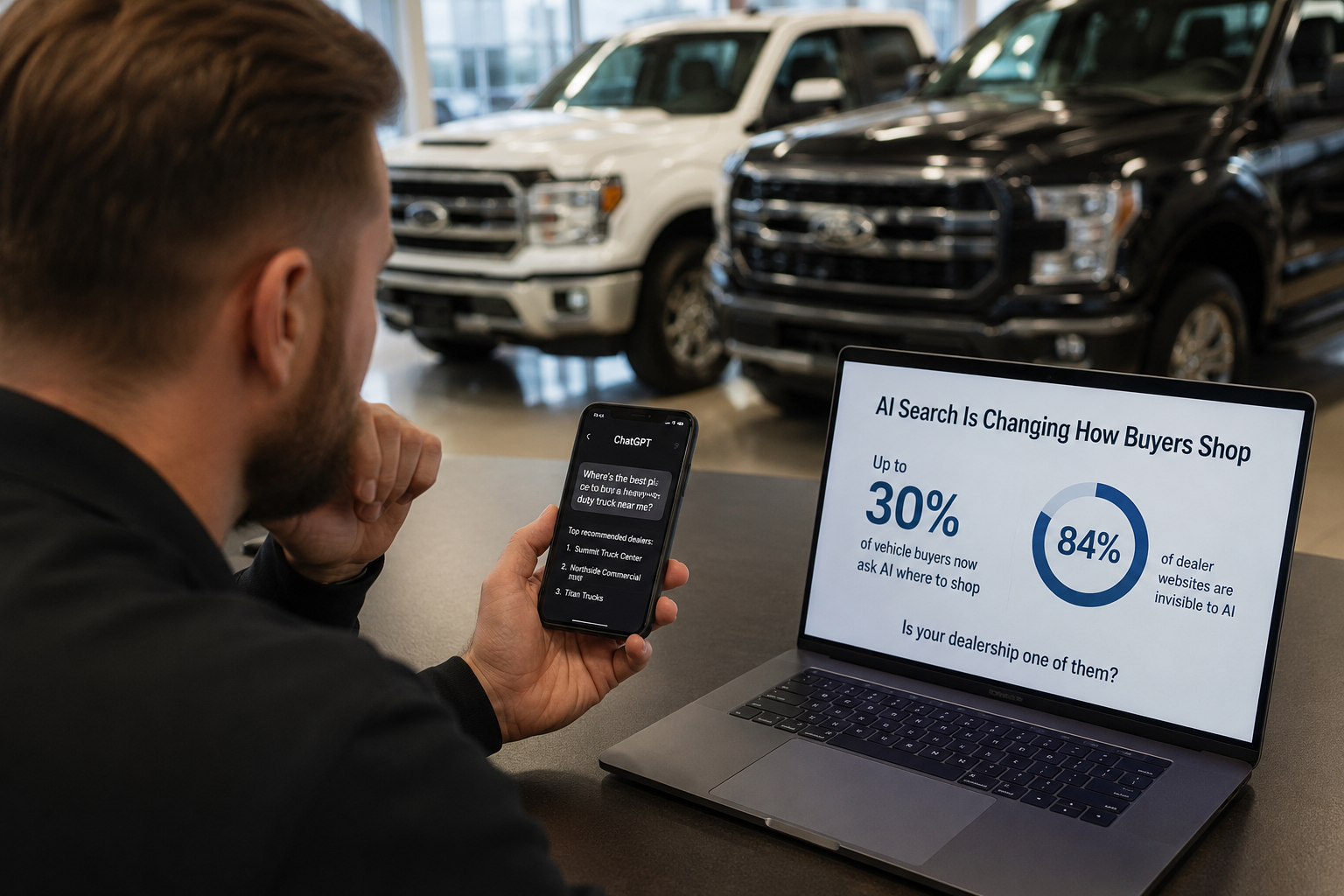
There's a contractor in your market right now who needs a truck. Maybe a service body for a plumbing crew, maybe a flatbed for hauling equipment, maybe a Super Duty to replace the one that finally gave out. Five years ago, that person opened Google, typed in "commercial trucks for sale near me," and started clicking through a page of blue links. Your dealership had a shot at being one of those links.
Today, that same buyer opens ChatGPT and types: "I run a landscaping business and need a reliable used flatbed truck under $60K, who sells those?" And in about four seconds, the AI hands them a shortlist of dealers — named, described, and recommended — before they've visited a single website.
The uncomfortable question for any independent dealer is simple: were you on that list?
For most dealerships, the honest answer is no. And the reasons why have almost nothing to do with your inventory, your prices, or your reputation — and almost everything to do with whether the machines doing the recommending can actually see you.
This Isn't a Prediction. It's Already the Buyer Behavior.
It would be easy to file "AI search" under things to worry about later. The data says later already arrived.
According to Cox Automotive's 2026 Car Buyer Journey Study — which surveyed 2,300 people who actually bought a vehicle in the prior 12 months — 19% of all buyers and 25% of new-vehicle buyers used either AI websites like ChatGPT and Copilot or AI-generated overviews like Google's during their shopping process. Ekho's 2026 AI Vehicle Research Study puts the number even higher, finding that 30% of shoppers used an AI search engine tool during their buying journey. CarEdge's survey of U.S. buyers landed in the same range, and crucially found that among people who hadn't yet purchased, that number jumped to 40% planning to use AI tools like ChatGPT during the shopping or buying process. Cox Automotive + 2
So somewhere between one in five and one in three of the buyers on your lot this month formed opinions about where to shop based on what an AI told them — and the pipeline of future buyers leaning on AI is even larger.
Two more findings make this impossible to dismiss as a novelty:
First, on satisfaction. Of the buyers who used AI, 88% said the tools were helpful for navigating the car buying process, and Cox found that 59 percent of buyers who used AI tools said they were highly satisfied with the experience — reporting greater trust in dealers and a faster, easier process. These aren't tire-kickers playing with a chatbot. They're serious, high-intent buyers who found a research method they like and trust. BlueJar AIYahoo!
Second, on which tool. When buyers reach for AI, they overwhelmingly reach for one. Among AI users in Ekho's study, 68.4% relied on ChatGPT — more than all other AI tools combined. ChatGPT is the new front door. Ekho
Why Your Dealership Is Probably Invisible to It
Here's the part that should genuinely concern you. Being a great dealer with a strong local reputation does not automatically translate into AI visibility. They're different games with different rules.
A SOCi analysis found only 45% overlap between the brands that lead in traditional local search and those that lead in AI recommendations. In other words, more than half the businesses winning on Google are losing in AI answers — and they have no dashboard telling them so. BlueJar AI
For dealerships specifically, the invisibility is often structural. The same industry analysis identified the core problem plainly: most dealership websites render inventory through JavaScript-heavy, image-heavy dynamic pages, and the AI crawlers that feed ChatGPT, Google AI Overviews, and Perplexity cannot parse this content reliably. The blunt conclusion: your vehicles might as well not exist as far as the AI is concerned, because these crawlers need clean, text-based, server-rendered HTML to ingest content, and when your inventory page requires JavaScript to display vehicle data, most AI systems simply skip it. BlueJar AIBlueJar AI
This is a technical landmine that hits independent dealers hardest, because most run on templated platforms where the inventory loads dynamically and was never built with AI crawlers in mind. The trucks are there. The prices are there. The AI just can't read any of it.
The scale of the problem was quantified at the start of 2026 by a Savvy Dealer study, which found that 84 out of 100 dealership websites were effectively invisible to AI search. As that report put it: even websites that allow AI access often lack the structured data that helps AI understand a dealer's inventory, location, hours, and services — dealers are paying for websites that make them invisible to the future of search, and most don't even know it. Dealership Guy
Read that again. Most don't even know it. You can't fix a leak you can't see, and AI invisibility doesn't show up in your monthly traffic report. The leads just quietly go somewhere else.
The Missing Piece: Structured Data Is the Language AI Speaks
If JavaScript rendering is what keeps AI from reaching your inventory, structured data is what lets AI understand it once it gets there.
Structured data — specifically a format called JSON-LD — is code that labels your content for machines. It's the difference between an AI seeing a wall of text and guessing what it means, versus seeing: "This is a commercial truck dealership in [your city]. Here are their hours. Here are 47 vehicles with these years, prices, and mileages. Here are their financing FAQs." One industry guide described schema as what tells AI crawlers "this is a 2023 RAV4 Hybrid, priced at $34,500, with 12,000 miles, located in Denver" — and without it, the AI has to guess, and it usually doesn't bother. Phyron
How much does it matter? A controlled experiment is the clearest evidence available. A Search Engine Land test ran three nearly identical pages with the same content and keyword difficulty, where the only meaningful variable was schema markup — and only the page with well-implemented JSON-LD appeared in a Google AI Overview and hit the highest organic ranking, while the page with no schema never even got indexed. Industry analysis backs the pattern: content with proper schema markup has a 2.5x higher chance of appearing in AI-generated answers, and sites with complete foundational schema see up to 40% more AI Overview appearances. GWContentStackmatix
But — and this is the honest part most vendors skip — schema is not a magic switch. Google has been clear that structured data is not a direct ranking factor, and that's technically still true. Adding code to a weak, unauthoritative site won't vault you to the top. What's changed is what structured data unlocks: AI Overview citations, Knowledge Graph entity recognition, and the entity verification signals that Gemini, ChatGPT, Perplexity, and Claude rely on when generating AI answers. GWContentGWContent
There's also a technical trap worth flagging, because it catches even sophisticated sites: many websites correctly implement JSON-LD but still miss out on AI visibility because their structured data relies on JavaScript — and AI crawlers like GPTBot, ClaudeBot, and PerplexityBot don't execute scripts the way Googlebot does. The fix is to embed schema directly in the server-rendered HTML response rather than injecting it after the page loads. It's the kind of detail that separates a site that's technically "done" from one that actually shows up. homerhomer
Authority Is What Decides Whether AI Picks You
Getting crawled and getting understood are table stakes. They get you into the conversation. They don't win it.
Here's a finding that reframes the whole game. Ahrefs' February 2026 study of 863,000 keyword SERPs and four million AI Overview URLs found only 38% of cited pages rank in the top 10 of search results — down from 76% in mid-2025. The takeaway is genuinely good news for an independent dealer competing against bigger players: pages without traditional authority can win citations if they're structured cleanly enough for AI extraction. You no longer have to outrank the national chains to get named alongside them. But you do have to give the AI a reason to trust and cite you. GWContentGWContent
That reason is authority — and for dealers, it's built on a few concrete things:
Reviews get you in the door. SOCi's research found locations recommended by ChatGPT averaged 4.3 stars, suggesting a floor around 4.0 below which AI is unlikely to recommend you. The good news: the automotive industry averages around 4.2 stars on Google, so most dealerships clear that threshold — which means reviews get you into the conversation, and everything else determines whether AI picks you over the dealer down the street. BlueJar AIBlueJar AI
Unique, specific content is the differentiator. AI models actively penalize sameness. As one analysis explained, when thousands of dealers publish the same manufacturer description, none of them stand out, because AI models deduplicate aggressively and cite whoever has the unique angle. The dealer who writes "we carry the largest selection of low-mileage Super Duty service trucks in the region, with nationwide shipping" gives the AI something citable. The dealer running stock OEM copy gives it nothing. Phyron
The most practical content strategy anyone offered was this: take your top 20 sales conversations from the last month and extract the questions customers asked before visiting — those are the same questions being typed into ChatGPT — then build content that answers each one with specific, localized information only your dealership can provide. BlueJar AI
Visibility Means Nothing If the Site Doesn't Convert
There's a final link in this chain that's easy to overlook. Getting recommended by AI, getting the click, getting the high-intent buyer to your site — none of it matters if the site itself leaks the lead.
And these AI-influenced buyers are exactly the leads you don't want to lose. They arrive better-informed, more confident, and further down the funnel. Buyers now expect the same quality of experience they get from e-commerce platforms — clear, visual, trustworthy content that loads fast and works on every device. A buyer who just got a personalized recommendation from ChatGPT and lands on a slow, confusing, hard-to-navigate inventory page feels the friction immediately — and bounces to the dealer whose site respects their time. Phyron
This is why AI visibility and conversion optimization aren't two separate projects. They're one system. The fast, clean, server-rendered site that AI crawlers can read is the same fast, clean site that converts human buyers. The structured data that helps ChatGPT understand your inventory is the same clarity that helps a contractor find the right flatbed in thirty seconds instead of giving up. You don't get to pick one. The work that wins the machine wins the human too.
The Window Is Open Now — and Closing
Here's the strategic reality. The dealers who fix this in 2026 are claiming shortlist positions while the field is still wide open and 84% of competitors are invisible. Every month of waiting hands that position to someone else. As the automotive analysis put it: every month you wait, a competitor with better-structured, richer, more citable listings earns the shortlist spot your inventory should have occupied. What was a nice-to-have in 2024 is table stakes in 2026 — and this kind of authority compounds. The dealer who starts now owns the AI recommendations for years. The one who waits spends those same years clawing back ground. Phyron
This is winnable. The trucks are real, the prices are competitive, the reviews are strong, the financing relationships are there. The only thing missing is making sure the machines that now recommend dealers can find you, read you, trust you, and cite you — and that the buyer who clicks through actually converts.
Find out where you stand — before your competitor does.
We'll run a free AI search audit on your dealership: whether ChatGPT, Perplexity, and Google's AI Overviews can actually see your inventory, where your structured data is leaking visibility, how you stack up against the dealer down the road, and what it would take to own the shortlist in your market. No pitch, no obligation — just a clear read and a clear next step within one business day.
Book your free AI search audit →
Frequently Asked Questions
Are car and truck buyers really using AI to decide where to shop?
Yes, and the data is consistent across multiple independent studies. Cox Automotive's 2026 Car Buyer Journey Study found that 19% of all buyers and 25% of new-vehicle buyers used either AI websites like ChatGPT and Copilot or AI-generated overviews during their shopping process. Ekho's 2026 study put the figure at 30% of shoppers using an AI search engine tool during their buying journey. And among buyers who hadn't yet purchased, CarEdge found that 40% planned to use AI tools like ChatGPT during shopping or buying. This isn't a future trend — it's current buyer behavior, and the share of future buyers leaning on AI is even larger. Cox Automotive + 2
Which AI tool do most vehicle shoppers actually use?
ChatGPT, by a wide margin. Among AI users in Ekho's research, 68.4% relied on ChatGPT — more than all other AI tools combined. Google's AI Overviews, Perplexity, and Gemini matter too, but if you're optimizing for one environment first, ChatGPT is where the buyers are. Ekho
My dealership ranks well on Google. Doesn't that mean I'm fine in AI search?
Not necessarily. They're separate games. A SOCi analysis found only 45% overlap between the brands that lead in traditional local search and those that lead in AI recommendations. More than half the businesses winning on Google are losing in AI answers — and there's no dashboard telling them so. Strong Google rankings help, but they don't guarantee you'll be the name an AI recommends. BlueJar AI
Why would my inventory be invisible to AI in the first place?
Usually it's structural. Most dealership websites render inventory through JavaScript-heavy, image-heavy dynamic pages, and the AI crawlers that feed ChatGPT, Google AI Overviews, and Perplexity cannot parse this content reliably — these crawlers need clean, text-based, server-rendered HTML, so when your inventory page requires JavaScript to display vehicle data, most AI systems simply skip it. The trucks, prices, and mileage are all there — the AI just can't read them. A 2026 Savvy Dealer study found 84 out of 100 dealership websites were effectively invisible to AI search, and most owners didn't even know it. BlueJar AIDealership Guy
What is structured data, and why does it matter for a dealership?
Structured data (specifically JSON-LD) is code that labels your content so machines understand it. It's the difference between an AI seeing a wall of text and guessing, versus knowing "this is a commercial truck dealer in this city, here are their hours, here are 47 vehicles with these years, prices, and mileages." As one guide put it, schema is what tells AI crawlers "this is a 2023 RAV4 Hybrid, priced at $34,500, with 12,000 miles, located in Denver" — and without it, the AI has to guess, and it usually doesn't bother. Phyron
How much of a difference does structured data actually make?
A controlled Search Engine Land experiment ran three nearly identical pages where the only meaningful variable was schema markup — and only the page with well-implemented JSON-LD appeared in a Google AI Overview and hit the highest organic ranking, while the page with no schema never even got indexed. More broadly, content with proper schema has a 2.5x higher chance of appearing in AI-generated answers, and sites with complete foundational schema see up to 40% more AI Overview appearances. GWContentStackmatix
Is schema markup a magic switch that fixes everything?
No, and anyone who promises that is overselling it. Google has been clear that structured data is not a direct ranking factor. Adding code to a weak site won't vault you to the top. What schema unlocks is different: AI Overview citations, Knowledge Graph entity recognition, and the entity verification signals that Gemini, ChatGPT, Perplexity, and Claude rely on when generating answers. There's also a common trap — many sites correctly implement JSON-LD but still miss out because their schema relies on JavaScript, and AI crawlers like GPTBot and PerplexityBot don't execute scripts. The fix is serving schema in server-rendered HTML. GWContent + 2
I'm an independent dealer. Can I really compete with the big national chains in AI search?
Yes — and this is the encouraging part. Ahrefs' February 2026 study of 863,000 SERPs and four million AI Overview URLs found only 38% of cited pages rank in the top 10 of search results, down from 76% in mid-2025, meaning pages without traditional authority can win citations if they're structured cleanly enough for AI extraction. You don't have to outrank the national chains to get named alongside them. GWContent
Do online reviews affect whether AI recommends my dealership?
They're the entry ticket. SOCi found locations recommended by ChatGPT averaged 4.3 stars, suggesting a floor around 4.0 below which AI is unlikely to recommend you. The good news: the automotive industry averages around 4.2 stars on Google, so most dealerships clear that threshold — reviews get you into the conversation, and everything else determines whether AI picks you over the dealer down the street. BlueJar AIBlueJar AI
What kind of content actually helps me get cited by AI?
Unique, specific, locally-grounded content. AI penalizes sameness — when thousands of dealers publish the same manufacturer description, none stand out, because AI models deduplicate aggressively and cite whoever has the unique angle. The most practical approach: take your top 20 sales conversations from the last month, extract the questions customers asked before visiting — those are the same questions being typed into ChatGPT — and build content answering each one with specific information only your dealership can provide. PhyronBlueJar AI
If AI sends buyers to my site, isn't my job done?
No — that's where conversion comes in. AI-influenced buyers arrive better-informed and further down the funnel, and they expect the same quality of experience they get from e-commerce platforms: clear, visual, trustworthy content that loads fast and works on every device. A buyer who lands on a slow, confusing inventory page bounces to the next dealer. The good news is that AI visibility and conversion are the same project: the fast, clean, server-rendered site AI crawlers can read is the same one that converts human buyers. Phyron
How urgent is this, really?
Urgent, because the advantage compounds. Every month you wait, a competitor with better-structured, richer, more citable listings earns the shortlist spot your inventory should have occupied. With 84% of dealer sites currently invisible to AI, the field is wide open right now — but the dealers who claim those shortlist positions in 2026 will own them for years, while late movers spend that time clawing back ground. Phyron
Find out where you stand — before your competitor does.
We'll run a free AI search audit on your dealership: whether ChatGPT, Perplexity, and Google's AI Overviews can actually see your inventory, where your structured data is leaking visibility, how you stack up against the dealer down the road, and what it would take to own the shortlist in your market. No pitch, no obligation — just a clear read and a clear next step within one business day.