The Funeral Home Growth Playbook: More Pre-Planning Leads, More At-Need Calls, More Google Reviews
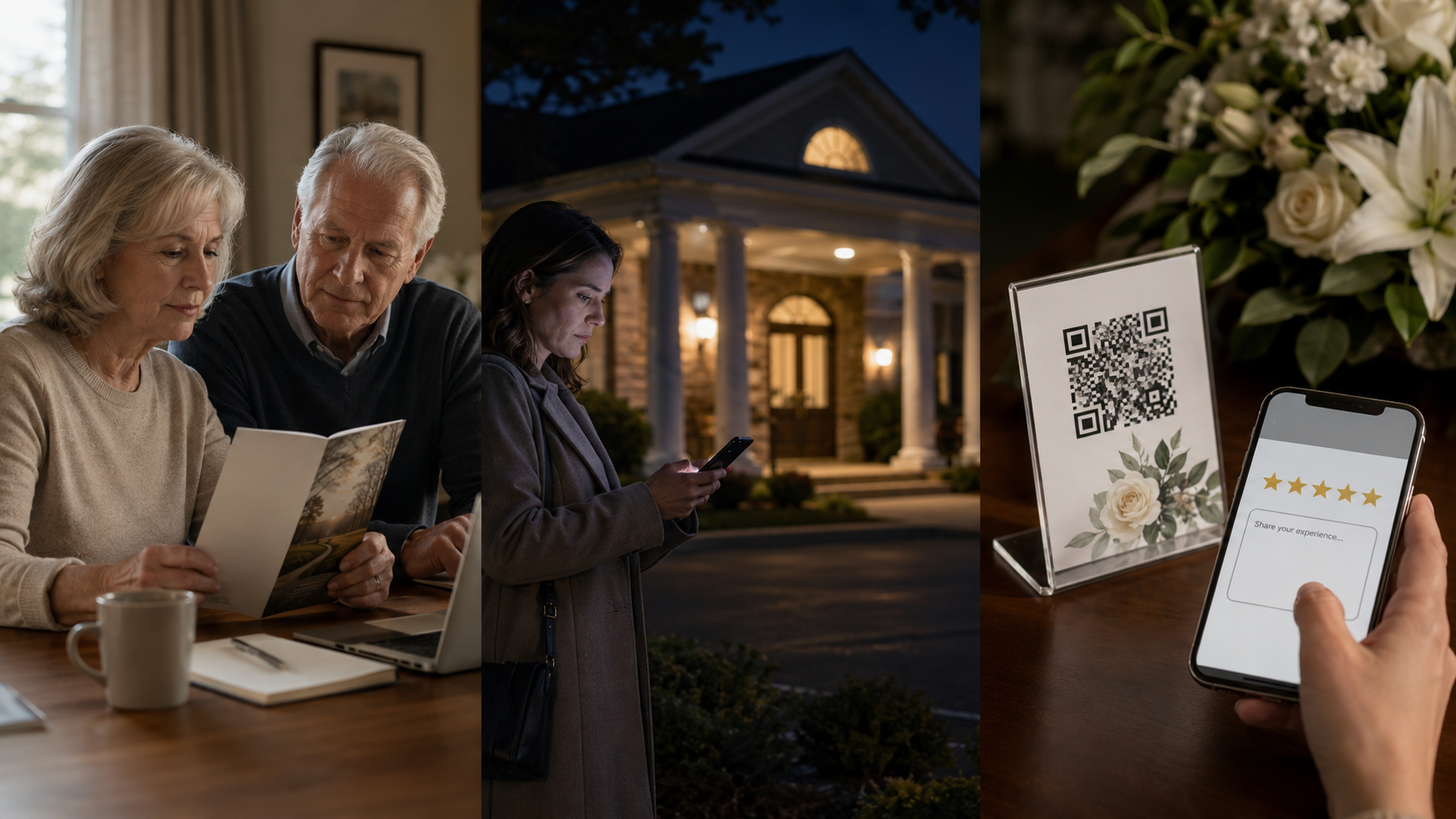
Every funeral home's growth comes down to three moments.
The first happens years in advance, at a kitchen table, when someone decides to spare their children the hardest decisions. The second happens at 2 a.m., in the worst week of a family's life, when they need someone now. The third happens quietly, weeks after a service, when a grateful family would gladly tell the world what you did for them — if anyone made it easy.
Pre-planning leads. At-need calls. Reviews. Win all three consistently and a funeral home compounds; the preneed book stabilizes revenue against the cremation shift, the at-need visibility fills the calendar, and the reviews feed both. Miss them, and you're relying on a reputation pipeline that the data says is drying up: according to analysis of the NFDA's Consumer Awareness & Preferences Study, the share of consumers choosing a funeral home because of a prior relationship fell from 27% in 2012 to just 16% in 2025 — while price rose from 10% to 18% as the leading selection factor.
Translation: the generational loyalty that built most family firms is eroding, and the decision is moving to screens. That's not a reason for despair. It's a reason for a system. Here's the one we build at Ritner Digital — moment by moment.
Moment One: Pre-Planning Leads (The Most Undervalued Pipeline in Funeral Service)
Preneed is the strategic answer to almost every pressure on the profession. It locks in future cases against discount competitors, smooths revenue against the direct cremation squeeze we've written about before, and serves families genuinely — nobody who has watched a grieving family argue about "what Mom would have wanted" doubts the value of a plan.
And the market is wide open. Per the NFDA's 2025 Consumer Awareness and Preferences Study, only 19.4% of Americans over 40 have preplanned and prepaid their arrangements. Meanwhile, 44.4% say they would feel not very or not at all confident planning a funeral without a funeral director's help — up 7.1 points in two years. Sit with that combination: four in five haven't planned, and confidence in doing it alone is falling. The demand for guidance exists. What's missing, in most markets, is a funeral home visibly offering it where people actually look.
How the preneed content engine works
Pre-planning is a research-heavy, slow-burn decision — which makes it a nearly perfect match for SEO and content systems. The engine has three gears:
Gear 1 — Own the questions. People considering preplanning search for months before contacting anyone: How does prepaying for a funeral work. Is a prepaid funeral plan safe. Funeral trust vs. funeral insurance. Can you preplan without prepaying. How to preplan a cremation. And one that deserves special attention: the NFDA data shows more than one in four people who preplanned and prepaid did so specifically for Medicaid spend-down purposes — meaning "irrevocable funeral trust Medicaid" content reaches families with urgent financial motivation and almost no local competition for the answer. Each question becomes a genuinely authoritative page, written in plain language, honest about trade-offs (including when prepaying isn't the right move — that honesty is what earns the trust that converts).
Gear 2 — Convert research into conversations. Informational traffic needs a bridge to a lead. We build it with downloadable planning guides and checklists ("The 27 Decisions Your Family Will Face — and How to Make Them Now"), preplanning seminar and webinar registration pages, and low-pressure calls to action — "request a preplanning guide" converts far better than "schedule an appointment" for someone six months from ready. Every conversion point feeds a follow-up sequence, because preneed timelines are long and the firm that stays helpfully present wins the eventual meeting.
Gear 3 — Get cited by the AI doing the family's research. This is the new gear most funeral marketing ignores. BrightLocal's 2026 Local Consumer Review Survey found AI tools like ChatGPT surged from 6% to 45% usage for local business recommendations in a single year. Adult children researching options for aging parents are asking AI engines "should my mom prepay her funeral" and "best way to preplan a funeral in New Jersey" — and the engines answer from whoever published the most credible, best-structured material. Our AI search optimization work makes your firm that source, so the answer doesn't just inform the family — it names you.
Moment Two: At-Need Visibility (Being Findable at 2 A.M.)
At-need is a different search entirely. There's no six-month research arc — there's a family in crisis, a phone, and a decision that gets made within hours. Three facts define the battlefield:
First, it's local and it's fast: 76% of people who search for something nearby take action within 24 hours, and 46% of all Google searches carry local intent. Second, it's increasingly digital end-to-end: the NFDA found nearly 30% of families completed all funeral arrangements online, and 40% used a funeral home they found on Facebook — nearly double the 21% from 2023. Third — and this is the encouraging one — 93.4% of Americans say they would contact a funeral director for help. Families want you. The entire question is whether you appear in the ninety seconds they spend looking.
The at-need visibility stack
Google Business Profile as your real front door. For "funeral home near me" and "cremation services [town]," most families never reach a website — they decide from the map pack: your rating, your review count, your photos, your hours, your response to that one negative review from 2023. GBP actions (calls, directions, website taps) grew 41% year-over-year, and our local SEO work treats the profile accordingly: complete services, current photos, Q&A seeded with the questions families actually have ("Do you answer overnight?" — yes, and say so), and posts that keep the profile visibly alive.
Pages built for a person in crisis. At-need pages have one job: reduce panic. Immediate-need phone number at the top, a calm "what happens when you call us" walkthrough, transparent starting prices, obituaries that are easy to find (obituary pages are, for most funeral homes, the highest-traffic pages on the site and a massively underused trust asset). Fast, mobile-first, and human — which is web design in service of compassion, not decoration.
The "what to do right now" content. The single highest-value at-need asset is a definitive local guide: What to do when someone dies in [county] — the first 24 hours. Hospital vs. home vs. hospice scenarios, who to call, what not to rush. It ranks, it gets cited by AI engines answering panicked midnight questions, and it introduces your firm as the calm authority before a single dollar is discussed. When ChatGPT is asked "my father just died at home in [your county], what do I do," the engine assembles its answer from published content. It should be assembled from yours.
Moment Three: Reviews — the QR Code and the SMS System
Now the third moment, and the one where a small operational change produces outsized returns.
Reviews are no longer a vanity metric; they're the connective tissue between the first two moments. 87% of consumers read reviews for local businesses, and 47% won't use a business with fewer reviews than they expect. Recency matters as much as volume: 73% of consumers only trust reviews written in the last month, which means 200 reviews from three years ago lose to 60 reviews arriving weekly. And reviews feed the machines too — review volume, velocity, and content are core local ranking signals, and AI engines lean on review sentiment when recommending local businesses.
Here's the stat that should change your operations: 78% of consumers were asked to leave a review last year — and 83% of those who were asked did. Asking works. The reason most funeral homes have a fraction of the reviews their service deserves isn't the quality of their care. It's that nobody built the ask into the workflow — usually out of a well-meaning fear that asking is inappropriate in a grief context. That fear is solvable with timing and tone. Here's the system.
The QR code layer
A QR code linking directly to your Google review form (your GBP short link) placed where gratitude naturally peaks:
The aftercare packet. Every family receives follow-up materials — death certificate copies, estate checklists, grief resources. A small, dignified card belongs inside: "If our care meant something to your family, sharing a few words helps other families find us in their hardest moment." Note the framing — it positions the review as an act of service to other grieving families, which is exactly what it is, and exactly how families think of it.
The thank-you note. Many directors already send a handwritten note two to four weeks post-service. The card rides along.
The arrangement office and lobby — for preneed families and service attendees, who are also legitimate reviewers of their experience.
QR codes work because they remove every step between gratitude and expression: no searching for your business, no login hunting — direct links, QR codes, and one-click prompts are exactly what BrightLocal recommends for making responding simple. A family member sitting with your thank-you note and a full heart is one camera-tap from the review.
The SMS layer — operationalized, and respectful
SMS is the highest-performing request channel that exists: 98% of texts are opened, versus roughly 20% of emails. But in funeral service, the workflow must be built with more care than a plumber's. This is the system we operationalize:
Consent first. During arrangements, the family's primary contact opts into text updates — which they want anyway, for service logistics, death certificate arrival, and aftercare. Review requests ride on that consented channel; nothing is cold.
Timing that honors grief. No requests in the first two weeks. The sequence: a service-logistics text during the arrangement window (pure utility, builds the channel), a check-in text at two to three weeks ("Thinking of your family. Your certified copies are ready for pickup — and if there's anything you need, John's cell is below." — no ask), then the single review request at four to six weeks, once acute logistics are done and gratitude has had room to settle: "It was an honor to care for your mother. If you're willing, a few words about your experience helps other families in their hardest moments find the right care: [link]. No reply needed — we're here if you need anything at all."
One ask, ever. No reminder barrage. One respectful request, then silence. In this industry, restraint is the brand — and it converts fine, because the underlying experience was genuinely review-worthy.
Route feedback before it becomes a public problem. The check-in text gives an unhappy family a private channel to raise concerns before the review ask — service recovery in the medium they'll actually use.
Respond to every review. 88% of consumers trust a business more when it responds to all reviews, versus 47% when it responds to none. For a funeral home, responses double as public demonstrations of your voice: brief, warm, never disclosing service details, always honoring the person by name only if the reviewer did first.
The compounding effect is the point: reviews lift map-pack rankings, which lifts at-need calls; review language ("they handled everything," "answered at 3 a.m.") becomes third-party proof of the exact value propositions your preneed content makes; and AI engines recommending local funeral homes weigh precisely this sentiment. One operational workflow, feeding all three moments.
One System, Measured Like a Business
These three moments aren't three projects — they're one engine with shared infrastructure: the content and copywritingthat earn rankings and AI citations, the local and technical foundation, the review flywheel, and measurement that speaks in cases and preneed contracts rather than impressions. We build a 12-month forecast for every engagement and publish our own Search Console data monthly so you can judge our work the way we ask you to judge your own: openly, against real numbers.
Frequently Asked Questions
How do funeral homes generate pre-planning leads online?
By matching content to how preneed decisions actually happen: months of quiet research before any contact. The system is authoritative pages answering preplanning questions (costs, trusts vs. insurance, Medicaid spend-down, planning without prepaying), soft conversion offers like downloadable planning guides and seminar registrations, and follow-up sequences that stay present until the family is ready. With only 19.4% of Americans 40+ having preplanned and prepaid, the addressable market in most service areas is enormous and largely uncontested.
How can a funeral home show up first for at-need families?
Three assets decide it: a fully optimized Google Business Profile (rating, review volume, photos, complete services — most at-need decisions happen in the map pack without a website visit), crisis-ready pages with immediate-need numbers and transparent guidance, and definitive local "what to do when someone dies" content that ranks in Google and gets cited by AI engines. With 76% of nearby searchers acting within 24 hours, at-need visibility is won or lost before the first phone call.
Is it appropriate for funeral homes to ask families for Google reviews?
Yes — when the timing and framing respect grief. Wait four to six weeks past the service, ask once, frame the review as helping other families find care in their hardest moment, and provide a private feedback channel first. Families who received exceptional care generally want to express gratitude; the data shows 83% of consumers who are asked for a review leave one. The inappropriate version is the automated same-day blast — which is exactly why the workflow, not just the tool, matters.
Do QR codes actually work for getting Google reviews?
Yes, because they collapse the effort between gratitude and action: one camera tap opens your review form directly, with no searching or logins. Placement determines results — aftercare packets, mailed thank-you notes, and the arrangement office reach families at natural gratitude peaks. BrightLocal's consumer research specifically recommends QR codes and direct links on printed materials as core review-generation tactics.
What should a funeral home's SMS follow-up sequence look like?
Consent-based and restrained: opt-in during arrangements for logistics updates families genuinely want; a utility text during the service window; a no-ask check-in at two to three weeks that doubles as private service recovery; a single review request at four to six weeks; then done. SMS earns its place with a 98% open rate, but in funeral service the restraint is the strategy — one respectful ask outperforms any drip campaign and protects the relationship that produces referrals for decades.
How do Google reviews affect AI search recommendations?
Heavily, and increasingly. Consumer use of AI tools like ChatGPT for local recommendations jumped from 6% to 45% in a year, and those engines draw on review volume, recency, and sentiment when deciding which local businesses to name. A steady flow of recent, detailed reviews — full of phrases like "handled everything" and "answered at 2 a.m." — becomes machine-readable evidence of exactly the value a funeral home most needs families to understand.
Three Moments. One Engine. Let's Build Yours.
Somewhere in your community right now, a couple is finally ready to talk about preplanning, a family is searching for help they need tonight, and a widow is holding your thank-you note wishing she knew how to tell people what you did for her family. The firms that grow over the next decade will be the ones with a system standing ready in all three moments.
We'll show you exactly what that system looks like for your firm — where you stand today in Google and AI answers, what your review profile is costing or earning you, and a 12-month forecast tied to cases, not clicks.
Book a free 30-minute strategy call → No pitch, no obligation — a real read on your visibility and a clear next step within one business day.
Sources
Legacy of Love — What the 2025 NFDA Consumer Study Reveals About Funeral Planning (NFDA 2025 Consumer Awareness and Preferences Study data)
Connecting Directors — NFDA 2025 Consumer Awareness & Preferences Study Release
Johnson Consulting Group — Inside the NFDA Consumer Awareness and Preferences Survey
CCC — Local Consumer Review Survey 2026 Insights (AI recommendation usage growth)
BizIQ — Online Reviews Statistics 2026 (review recency, ask-and-receive rates)