The Funnel and the Flywheel Aren't Competing Models — They're Two Halves of the Same Strategy
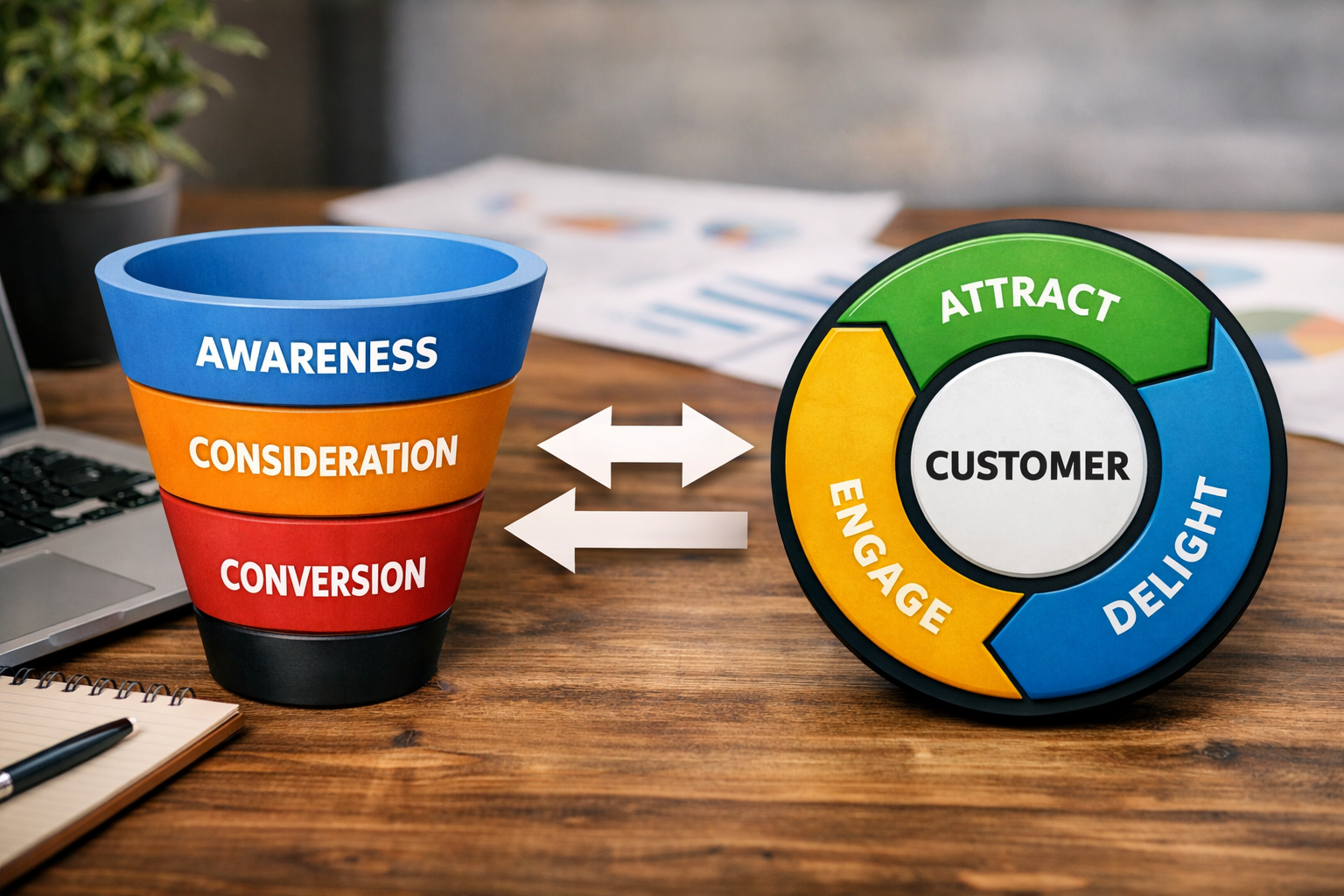
If you've spent any time reading about marketing frameworks, you've probably encountered the argument that the funnel is dead. The flywheel killed it. Customer experience is the new acquisition. Delight is the new close.
It's a compelling narrative. It's also incomplete.
The funnel isn't dead. It's just not the whole picture — and it never was. The mistake most businesses make isn't choosing the wrong model. It's treating one model as sufficient when the two are actually designed to work together. Understand both, connect them correctly, and you have a growth system that acquires customers and compounds on itself simultaneously. Use only one and you have either a pipeline with no retention engine or a retention engine with no reliable way to fill it.
This post explains what each model actually describes, where each one falls short on its own, and how to connect them into a single integrated strategy.
The Funnel: What It Is and What It Was Built to Solve
The marketing funnel is one of the oldest frameworks in the discipline. Its origins trace back to the late 19th century — the AIDA model (Awareness, Interest, Desire, Action) — and the core logic has remained largely intact ever since. People move through predictable stages on the way to a purchase decision, and marketing's job is to move them efficiently from one stage to the next.
The modern version typically looks like this:
Top of Funnel (TOFU) — Awareness The prospect becomes aware that a problem exists or that a solution like yours is available. They're not evaluating you yet. They're not even necessarily looking for you. They're encountering your brand through search, social, paid ads, content, or word of mouth for the first time.
Middle of Funnel (MOFU) — Consideration The prospect is actively researching. They know what they need and they're evaluating their options. They're reading comparison content, visiting your service pages, consuming case studies, watching demos. They haven't committed but they're engaged.
Bottom of Funnel (BOFU) — Decision The prospect is ready to act. They're requesting a quote, booking a call, filling out a contact form. The decision is imminent. This is where sales closes the loop.
What the Funnel Does Well
The funnel is an excellent model for managing acquisition. It gives you a clear framework for understanding where prospects are in their decision process and what they need at each stage. It creates natural checkpoints for measuring conversion rates — what percentage of awareness-stage visitors become consideration-stage leads, and what percentage of consideration-stage leads become customers. It makes it easy to identify where the process is leaking.
For any business that needs a structured, repeatable process for turning strangers into customers, the funnel is the right mental model. It maps cleanly to content strategy, paid media, SEO, and sales workflows. It has stages, it has metrics, and it has a clear endpoint.
Where the Funnel Falls Short
The funnel ends at the sale. That's not a design flaw — it's a design choice. The funnel was built to model acquisition, and it does that well. But it treats the customer as the finish line rather than the starting point for the next phase of growth.
In a pure funnel model, every growth cycle starts over from scratch. You need new awareness, new leads, new pipeline constantly — because the customers you already have aren't systematically contributing to the next wave of growth. There's no mechanism for that. The funnel pours leads in at the top and produces customers at the bottom, but it doesn't capture what happens after the bottom.
For businesses where referrals, retention, and repeat purchases are significant growth drivers — which is most businesses — this is a meaningful gap.
The Flywheel: What It Is and What It Was Built to Solve
The flywheel model was popularized in the marketing context by HubSpot, though the underlying concept comes from Jim Collins' work on what makes great companies sustain long-term growth. The core insight is that satisfied customers don't just generate revenue — they generate momentum. They refer. They return. They leave reviews. They become advocates who do acquisition work without being paid to do it.
In the flywheel model, the business is a wheel with three segments:
Attract Drawing the right people to your brand through content, SEO, social media, and paid channels. This is functionally similar to the top of the funnel — getting people into your orbit.
Engage Converting those people into customers through compelling offers, strong sales processes, and frictionless buying experiences. Similar to the middle and bottom of the funnel.
Delight Delivering enough value post-sale that customers become active promoters — leaving reviews, referring others, sharing content, coming back for more. This is the segment the funnel doesn't have.
The flywheel's defining characteristic is that the Delight segment feeds back into the Attract segment. Happy customers generate word of mouth, referrals, and reviews that bring new people into the wheel. The more customers you delight, the faster the wheel spins. The faster the wheel spins, the lower your cost of acquisition becomes over time. Growth compounds rather than requiring constant reinvestment.
What the Flywheel Does Well
The flywheel captures something the funnel ignores entirely: the compounding economic value of a good customer experience. It reframes the customer not as a destination but as a growth asset. It creates a structural reason to invest in retention, service quality, and post-sale experience — not just because it's the right thing to do but because it directly feeds the acquisition engine.
For businesses where reputation is a significant driver of new business — professional services, healthcare, home services, hospitality, local businesses of almost any kind — the flywheel is a more accurate description of how growth actually works than the funnel is. Most of their best new customers came from someone who was already a customer. The flywheel models that. The funnel doesn't.
Where the Flywheel Falls Short
The flywheel assumes you have customers to delight. It assumes the wheel is already spinning. But if you're a newer business, a business entering a new market, or a business whose current customer base isn't large enough to generate meaningful referral volume, the flywheel alone doesn't tell you how to fill the top of the engine.
The flywheel also doesn't give you a clean framework for managing the acquisition journey itself — the specific stages a prospect moves through, the content and messaging appropriate at each stage, the conversion checkpoints to measure. It's great at describing the system-level outcome of good marketing. It's less useful as an operational tool for building and managing an acquisition pipeline.
A flywheel without a funnel is a retention strategy without a reliable way to acquire the customers you need to retain.
Why They're Two Halves of the Same System
The funnel and the flywheel aren't competing answers to the same question. They're answers to different questions that happen to connect at a critical junction — the moment a prospect becomes a customer.
The funnel answers: How do we reliably move the right people from awareness to decision?
The flywheel answers: How do we turn the customers we've won into a source of ongoing momentum?
Put them together and you have a complete growth system: a structured acquisition engine that feeds a compounding advocacy engine, which in turn feeds the top of the acquisition engine with lower-cost, higher-quality leads.
Here's what that connection looks like in practice.
The Funnel Fills the Flywheel
Every customer who makes it through your funnel is a new input into your flywheel. The quality of your acquisition process — how well you target the right prospects, how clearly you set expectations, how smoothly the sales experience unfolds — directly affects how easy it is to delight that customer after the sale.
A business that fills its funnel with poorly-qualified leads, over-promises during the sales process, or creates friction at the close is feeding damaged inputs into its flywheel. The wheel spins slowly or not at all. Churn is high. Referrals are rare. The business has to work harder and harder to replace customers it's losing, which means the funnel has to work harder, which means costs go up.
A business that targets well, sets accurate expectations, and delivers a smooth purchase experience is feeding high-quality inputs into its flywheel. Those customers are predisposed to be satisfied. They're more likely to stay, refer, and review. The wheel spins faster with less friction.
The Flywheel Supercharges the Top of the Funnel
When the flywheel is working — when customers are actively referring, reviewing, and advocating — it doesn't replace the funnel's top-of-funnel work. It supplements it with a higher-quality, lower-cost source of new prospects.
A referral from a satisfied customer arrives at the top of your funnel with a fundamentally different posture than a cold prospect from a paid ad. They've already had a trust-building conversation with someone they trust. They arrive with context, credibility, and a disposition toward working with you. They move through the funnel faster and convert at higher rates.
This is the compounding effect the flywheel describes — and it only happens if the funnel is being fed and the customer experience is being actively managed. Neither model creates this on its own.
The Content Layer Connects Both
One of the most practical ways to connect the funnel and flywheel is through a content strategy that serves both simultaneously.
Top-of-funnel content — blog posts, SEO articles, social content, educational resources — attracts new prospects into the acquisition pipeline. This is classic funnel work. But that same content, when it's genuinely useful and authoritative, also gets shared by existing customers, cited in referral conversations, and used by advocates to explain why they recommend you. It functions as both an acquisition tool and a flywheel amplifier.
Bottom-of-funnel content — case studies, testimonials, detailed service pages — closes the deal for prospects in the decision stage. But those same case studies, when distributed post-sale, reinforce customers' confidence in their decision, reduce buyer's remorse, and give them a tangible story to share when referring you to someone else.
A content strategy built with both models in mind produces assets that do double duty — moving prospects through the funnel while simultaneously giving existing customers the tools to amplify the flywheel.
What This Looks Like in Practice
For a Business Just Getting Started
The funnel takes priority. You need a reliable acquisition engine before the flywheel has enough momentum to contribute meaningfully. Focus on building top-of-funnel visibility through SEO and content, a middle-of-funnel nurturing process that educates and builds trust, and a bottom-of-funnel conversion experience that closes efficiently and sets accurate expectations.
At the same time, don't ignore the flywheel entirely. Even with a small customer base, the habits you build around post-sale experience — follow-up, review requests, check-ins, referral asks — set the foundation for compounding returns as the base grows.
For a Business With an Established Customer Base
The flywheel deserves more investment than it's probably getting. Most businesses with satisfied customers significantly underinvest in activating those customers as advocates. A structured referral program, a proactive review generation process, a post-sale email sequence that deepens the relationship, and a customer success touchpoint at 30 and 90 days can meaningfully increase the referral velocity of the flywheel without requiring additional ad spend.
At the same time, don't defund the funnel. Even with a strong referral engine, referrals alone rarely produce the volume and diversity of new business that a growing company needs. The funnel gives you control — the ability to target specific segments, enter new markets, and scale acquisition intentionally. The flywheel gives you efficiency. Both matter.
For a Business With High Churn
If customers are leaving at a high rate, neither model is working correctly — and the root cause is almost always in the space between them. Either the funnel is attracting the wrong customers, expectations are being set inaccurately during the sales process, or the post-sale experience isn't delivering on what was promised. The flywheel can't spin if it's constantly losing inputs. Fix the leak before investing more in either acquisition or advocacy.
The Metric That Connects Both Models
If you want a single number that tells you how well your funnel and flywheel are working together, it's Customer Lifetime Value to Customer Acquisition Cost ratio — LTV:CAC.
CAC measures how efficiently your funnel converts spend into customers. LTV measures how much value each customer generates over the full relationship — which is a direct reflection of how well your flywheel retains and expands them. A healthy LTV:CAC ratio means you're acquiring customers efficiently and keeping them long enough to generate strong returns. A deteriorating ratio usually means either acquisition costs are rising (funnel problem), retention is weakening (flywheel problem), or both.
Track it over time. If CAC is rising while LTV holds steady, invest more in the flywheel — better customers who stay longer and refer more will eventually lower your acquisition costs. If LTV is declining while CAC holds steady, the post-sale experience has a problem worth diagnosing before you spend more on acquisition.
The Bottom Line
The funnel and the flywheel aren't rivals. They're a sequence. The funnel is how you fill the engine. The flywheel is how the engine compounds. Used together, they describe a complete growth system — one that acquires customers deliberately, delivers experiences worth talking about, and turns satisfied customers into the most efficient acquisition channel you have.
The businesses that grow most consistently aren't choosing between the two models. They're running both, measuring where they connect, and investing in each based on where the system is strongest and where it's leaking.
That's not a complicated idea. But it's one that takes real strategy — and real execution — to get right.
Ritner Digital builds marketing systems that work at both ends — acquisition and retention, funnel and flywheel. If you want to know where your current strategy has gaps, let's start with a conversation.
Frequently Asked Questions
Do I need to choose between a funnel model and a flywheel model?
No — and that's the core point. The funnel and the flywheel describe different parts of the same growth system. The funnel models how you acquire customers. The flywheel models how those customers generate momentum for future growth. A business that only thinks in funnels keeps starting over from scratch with every new growth cycle. A business that only thinks in flywheels has a retention and advocacy strategy but no reliable engine for filling it. You need both, connected intentionally at the point where a prospect becomes a customer.
Our business runs almost entirely on referrals. Do we still need a funnel?
Yes, for two reasons. First, referral volume is hard to control and harder to scale. A purely referral-driven business is dependent on the pace and volume at which existing customers happen to recommend you — which may be strong in good periods and unreliable in slow ones. A funnel gives you a lever you can pull intentionally when you need to accelerate growth. Second, even referral-driven businesses benefit from the funnel's structure for managing the journey from first contact to close. Referrals still need to be nurtured, educated, and converted — the funnel gives you a framework for doing that consistently.
What's the most common mistake businesses make with the flywheel?
Assuming it operates passively. The flywheel doesn't spin on its own just because you have satisfied customers. It requires active investment — a structured process for asking for reviews, a referral program that makes it easy for customers to recommend you, post-sale communication that reinforces the relationship, and customer success touchpoints that surface problems before they become churn. Most businesses have the raw material for a strong flywheel — happy customers who would refer if asked — but no systematic process for activating it. The wheel has potential energy that never gets converted.
How does content marketing fit into this framework?
Content sits at the intersection of both models, which is what makes it such a high-leverage investment. At the top of the funnel, content attracts new prospects through organic search, social, and distribution. In the middle and bottom of the funnel, case studies, testimonials, and detailed service content move prospects toward a decision. Post-sale, that same content gives existing customers something concrete to share when recommending you — and it reinforces their confidence in the decision they already made. A strong content strategy produces assets that do work at every stage of both models simultaneously.
What does a healthy LTV:CAC ratio actually look like?
It depends on the industry and business model, but a commonly cited benchmark for healthy unit economics is a 3:1 ratio — meaning you generate three dollars of lifetime customer value for every dollar spent acquiring that customer. SaaS businesses often target higher ratios. Service businesses with long client relationships and strong referral rates can sustain lower CAC because the flywheel is subsidizing acquisition. The specific number matters less than the direction of travel — a ratio that's improving over time means your acquisition is getting more efficient and your retention is holding. A declining ratio is a warning sign worth investigating before it becomes a crisis.
We have high churn. Should we fix that before investing in marketing?
Partially. You shouldn't pour more budget into top-of-funnel acquisition if the fundamental problem is that customers are leaving quickly — that's filling a leaky bucket. But diagnosing why churn is high often requires marketing input, because churn frequently has its roots in the acquisition process itself. If you're attracting the wrong customers, setting inaccurate expectations during the sales process, or converting people who were never a good fit, churn is the symptom of a funnel problem as much as a service problem. Fix the targeting and expectation-setting first, then reinvest in acquisition once the retention metrics stabilize.
How does this framework apply to e-commerce versus service businesses?
The core logic is the same but the mechanics look different. In e-commerce, the funnel is often shorter and more transactional — awareness to purchase can happen in a single session. The flywheel is driven by repeat purchase rate, loyalty programs, user-generated content, and product reviews. In service businesses, the funnel is longer — there's more nurturing, more trust-building, more consideration before a decision. The flywheel is driven by referrals, testimonials, and long-term client relationships. The framework applies to both. The channels, content, and metrics you use to execute it are industry-specific.
Can a small business with a limited budget realistically run both models?
Yes — and in some ways a small business is better positioned to do this than a large one. The flywheel doesn't require a big budget. It requires intentionality. Sending a follow-up email after a project closes, asking a satisfied client for a Google review, checking in at 60 days, making a referral ask at the right moment — these are low-cost, high-return activities that most small businesses simply don't do systematically. On the funnel side, a focused content and SEO strategy compounds over time without requiring ongoing ad spend. The combination of organic acquisition and an activated referral engine is one of the most capital-efficient growth models available to a small business.
Want to know where your funnel and flywheel have gaps? Ritner Digital can show you exactly where the system is leaking — and how to fix it.